

My father barred me from entering my own medical school graduation ceremony because my stepmother insisted her daughter should take my ticket instead.
“You’re just a nurse’s assistant anyway, let your sister have her moment,” my father sneered, physically pushing me toward the exit.
I stood outside in the pouring rain, watching them pose for photos inside. But none of them knew I wasn’t simply graduating—I was the keynote speaker and the recipient of the university’s highest research honor. And when the Dean stepped up to introduce the guest of honor, my family’s smiles would collapse in an instant…
After a brutal 22-hour shift at the hospital, I returned home exhausted. My stepmother’s sharp voice cut through the air the moment I stepped inside: “Clara, clean up those greasy plates. Haley has a photoshoot tomorrow; don’t ruin the aesthetic.”
My father, Thomas, didn’t even look up from his tablet. He waved me off like I was invisible. I swallowed my exhaustion and reached into my bag, pulling out a single gold-embossed envelope.
“Dad,” I whispered, my throat tight. “My graduation is this Friday. I only received one VIP ticket, and I really hoped you would come…” Before I could finish, he snatched it from my hand and immediately passed it to my stepsister.
“Don’t be selfish, Clara,” Thomas said coldly. “You’re just a nurse’s assistant; you’ll be sitting in the back anyway. Haley needs this VIP access to network with wealthy doctors for her brand. Let your sister have her moment.”
I froze. For four years, I had carried a truth I never revealed to them.
The sky on graduation day was heavy and gray, pouring relentless rain over the university grounds. I stood near the entrance of the grand hall, soaked and trembling, my hair clinging to my face. A black taxi pulled up to the VIP curb. My family stepped out.
My stepsister, Haley, spun around in her designer coat, proudly waving the VIP ticket my father had taken from me the night before.
“This VIP access is going to make my photos go viral!” she laughed.
I took a steady breath and stepped forward toward the entrance, ready to explain I didn’t need a ticket because I was part of the graduating class. But before I could speak, my father’s grip locked onto my arm. He yanked me back into the rain.
“What the hell are you doing?” Thomas snapped, his voice low and furious. “You’re going to ruin Haley’s photos! You’re just a low-level assistant! Do not embarrass us in front of those wealthy doctors. Go wait in the car!”
My stepmother walked past without hesitation, her expression twisted in disgust. “Listen to your father, Clara. Let your sister have her moment. Go hide somewhere.”
With a final shove, they left me standing in the storm as they entered through the grand bronze doors. For years, they believed I was nothing more than a disposable assistant—someone beneath their attention, someone whose life could be controlled and dismissed.
I wiped the rain from my face and turned to leave.
Then the rain stopped falling on me.
A large black umbrella appeared above my head.
I looked up, startled, and saw Dean Jonathan Bradley, head of the university’s medical board, standing there in full academic regalia. His expression shifted instantly from confusion to shock.
“Dr. Hensley?!” his voice boomed through the storm. “Why are you standing out here in the freezing rain? The entire Board of Trustees has been searching for you backstage for over thirty minutes to prepare you for the Valedictorian address!”
For a moment, the world went silent.
Inside the grand hall, the ceremony was already beginning. My family had no idea that the person they had just pushed into the rain was about to stand on that stage.
The Dean guided me quickly through a private entrance. As we walked through the backstage corridor, staff members straightened in alarm.
“She’s here!” someone called. “We found her!”
A stylist rushed forward to dry my hair. Another adjusted my academic robe, carefully placing the gold honor cord over my shoulders. I caught my reflection in a mirror—no longer a soaked, dismissed daughter standing outside, but a physician-researcher whose work had already been published internationally.
Dean Bradley lowered his voice. “We’ve delayed your introduction as long as possible, but we can’t hold it much longer. Are you ready?”
I nodded slowly.
“I’ve been ready for four years,” I said.
He gave a small, approving smile. “Then let’s remind them who you are.”
Inside the hall, my family sat comfortably in the VIP section.
Haley was still posing for photos, holding the stolen ticket like a trophy.
Thomas leaned back, satisfied, watching the stage as though nothing in the world could disturb his certainty that he had everything under control.
The announcer’s voice echoed through the auditorium.
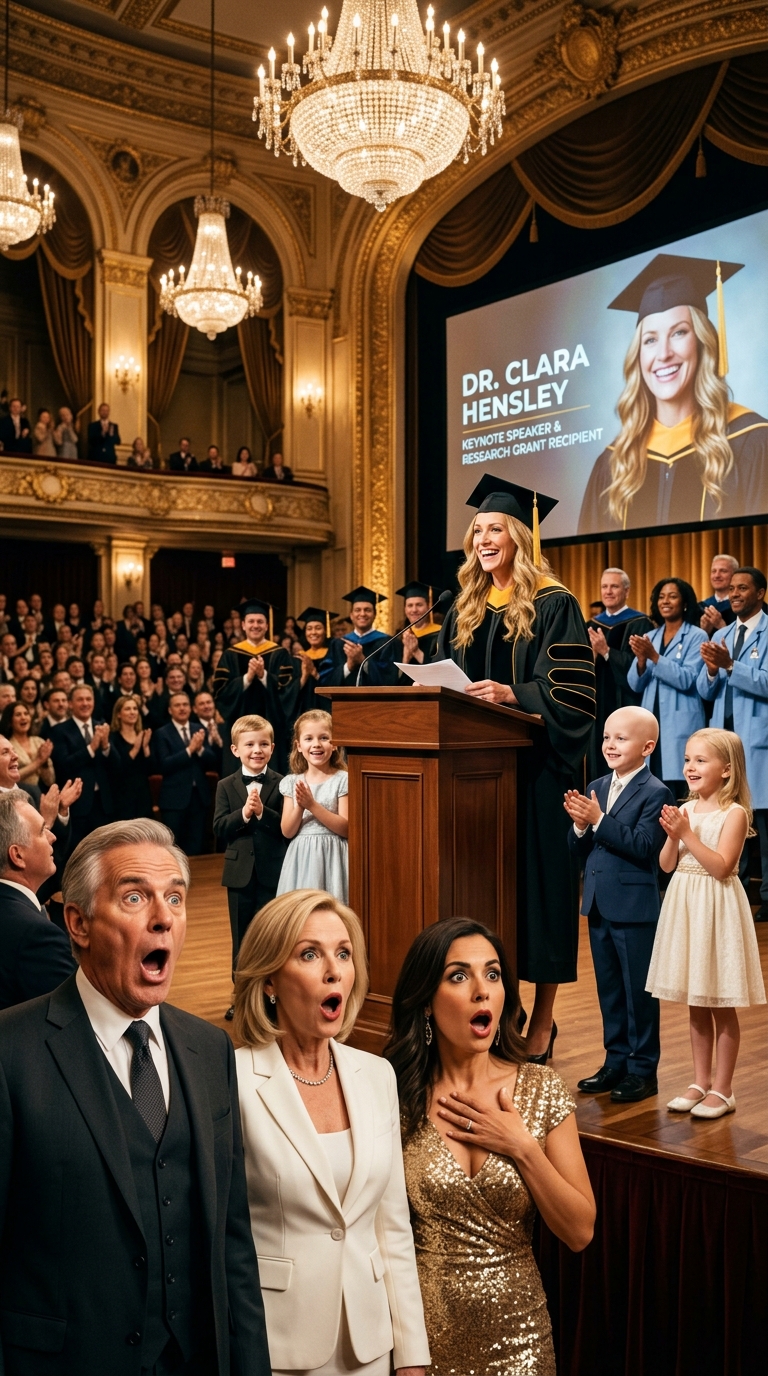
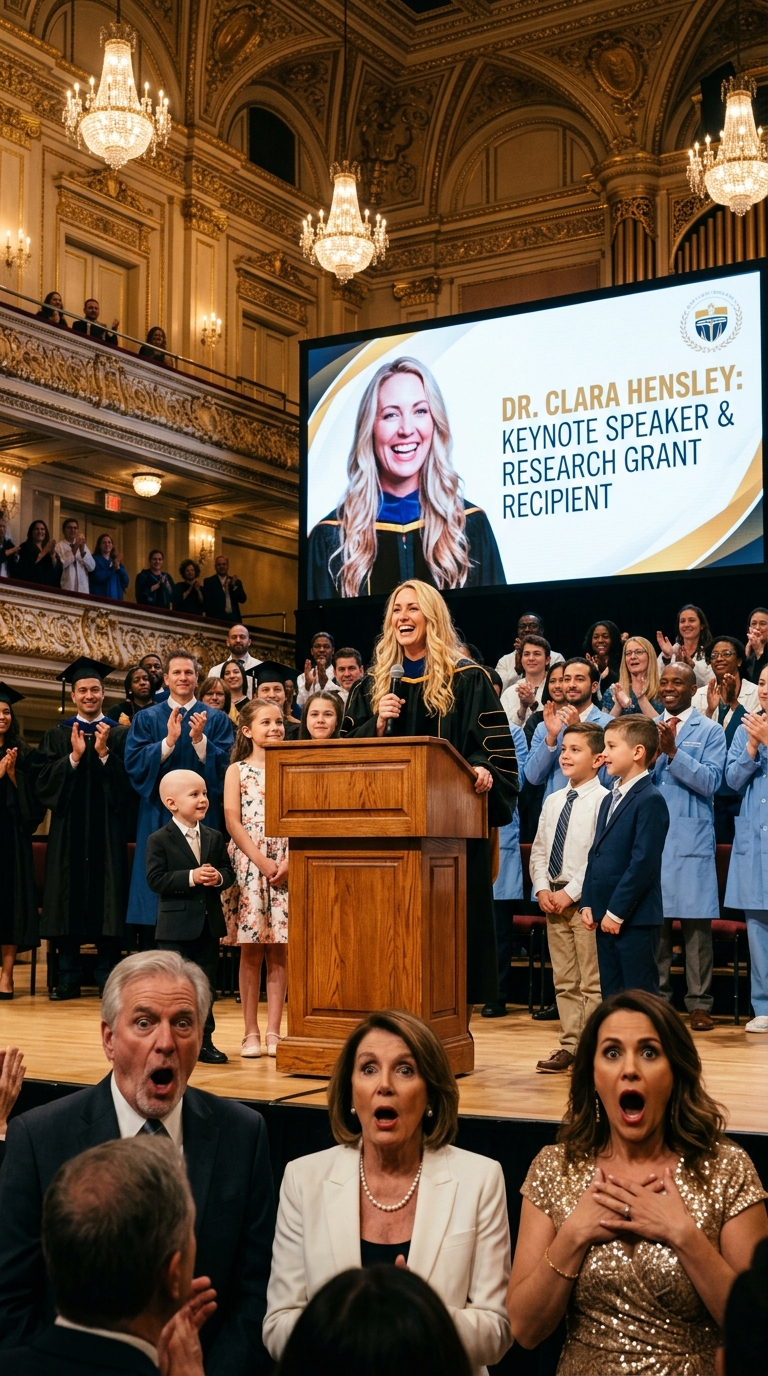
“And now… please welcome our keynote speaker and recipient of the University’s Highest Medical Research Award… Dr. Clara Hensley.”
A polite applause began.
Then stopped.
Because my father’s expression froze mid-smile.
My stepmother’s hand stopped moving.
Haley lowered her phone slowly.
On stage, I stepped into the light.
For a few seconds, no one spoke.
Then the applause returned—louder, rising, filling the hall like a wave.
I approached the podium, my voice steady despite the storm I had just walked through.
“My journey in medicine did not begin with recognition,” I said. “It began with being invisible.”
In the audience, I saw my father stiffen.
I did not look away.
“I want to thank the people who believed in me when I had nothing—because they are not sitting in this front row.”
A quiet murmur spread through the crowd.
I continued, carefully, deliberately, without anger—only truth.
“Medicine teaches us that assumptions can cost lives. Today, I was reminded that assumptions can also cost dignity.”
Silence deepened.
Then I added, softer but sharper than anything I had said before:
“But truth has a way of arriving… even when it is left standing in the rain.”
The hall erupted in applause.
My father stood up halfway, then hesitated. For the first time, he looked uncertain.
Haley whispered something to my stepmother, panic creeping into her voice.
But I was already done speaking to them.
After the ceremony, I was surrounded by professors, researchers, and medical leaders congratulating me. My research grant would fund a new trauma-response program across multiple hospitals—work that would directly impact emergency care systems nationwide.
Then, slowly, I turned and saw them approaching.
Thomas looked older than he had just hours earlier.
Haley no longer held her phone up.
My stepmother avoided my eyes completely.
“Alice—” Thomas began, then corrected himself. “Clara… we didn’t know—”
“You didn’t want to know,” I replied calmly.
Silence.
For the first time, there was nothing they could take from me.
No ticket. No seat. No title.
Everything I had built was already mine.
Haley stepped forward, her voice smaller now. “I thought you were just—”
“A nurse’s assistant?” I finished for her, gently. “Yes. That’s what you chose to believe.”
She flinched.
My father finally spoke again, quieter than I had ever heard him.
“Why didn’t you tell us?”
I looked at him for a long moment.
“Would it have changed anything?” I asked.
He didn’t answer.
Because we both already knew it wouldn’t have.
That night, I stood alone on the quiet steps outside the medical building. The rain had stopped completely.
Dean Bradley approached and handed me a folder.
“You did well,” he said.
I smiled faintly. “I didn’t do anything special. I just stopped explaining myself.”
He nodded. “That’s usually when people finally start listening.”
I looked out at the empty campus.
For years, I had tried to earn a place in a home that never made space for me.
Now, I realized I had built something better than acceptance.
I had built distance from disrespect.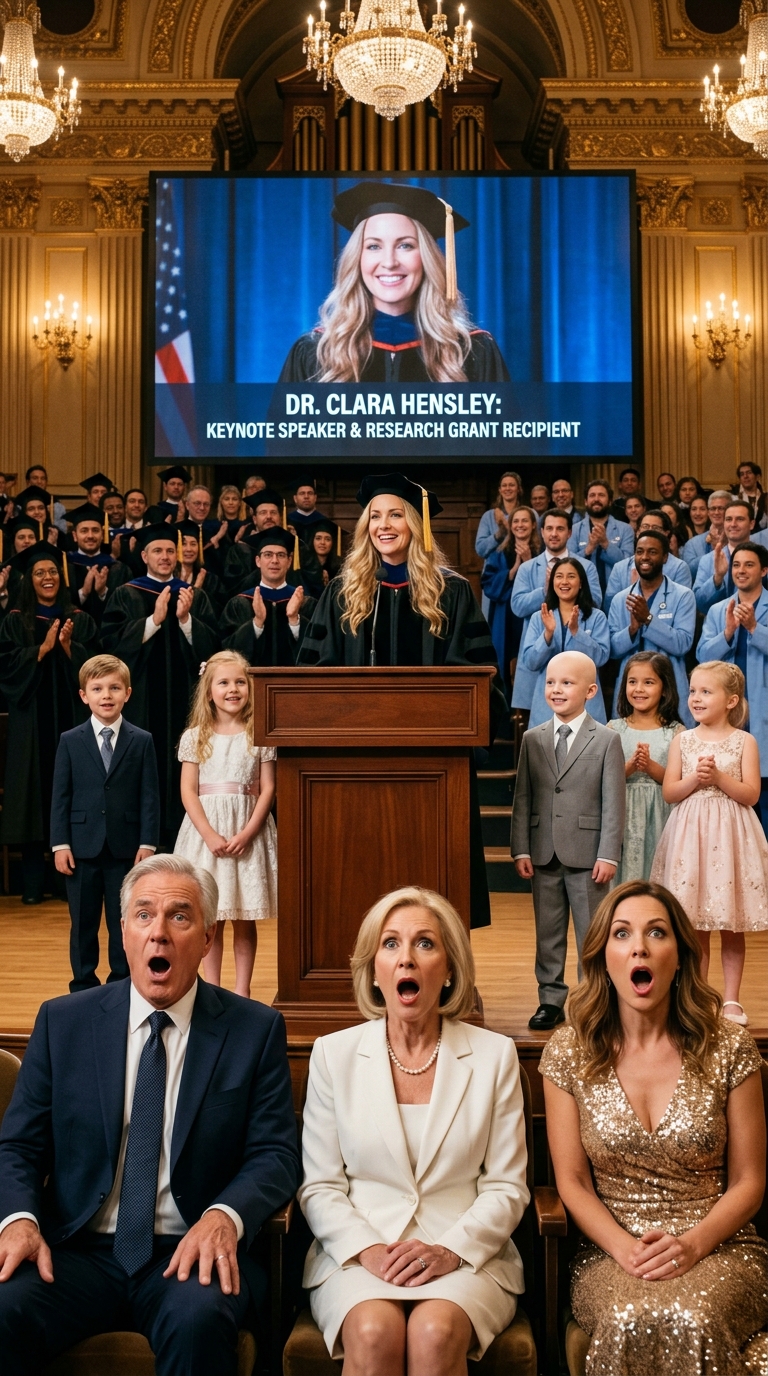
My phone buzzed once. A message from an unknown number—my father.
“We need to talk.”
I stared at it for a moment.
Then I turned off the screen.
For the first time in my life, I chose silence not as surrender—but as peace.
And as I walked away under the open sky, I finally understood something simple, and long overdue:
Being seen by the wrong people is never as valuable as being built by the right ones.
