

PART 1
Alejandro Mendoza had signed million-dollar contracts, bought entire buildings in Santa Fe, and appeared in magazines that called him “the businessman who never stops.”
But that morning, in Parque México, the only thing he was trying to do was walk slowly.
His mother, Doña Teresa, was holding his arm with a rare delicacy. Since they had detected her high blood pressure, the doctor had recommended quiet walks, less stress, and more family time.
Alejandro agreed to accompany her more out of guilt than habit.
He wasn’t wearing a driver. He wasn’t wearing bodyguards. He wasn’t wearing his assistant whispering in his ear about meetings, investments, or urgent calls.
There was only the morning humidity in the Condesa neighborhood, the smell of café de olla coming from a cart near the lake, and the jacarandas dropping purple flowers along the path.
“Son, you always walk as if someone were chasing you,” said Doña Teresa, squeezing his arm. “One day you’ll turn around and life will have passed you by.”
Alejandro smiled without much enthusiasm.
He was about to respond with something elegant, one of those speeches he gave in front of investors, when he suddenly froze.
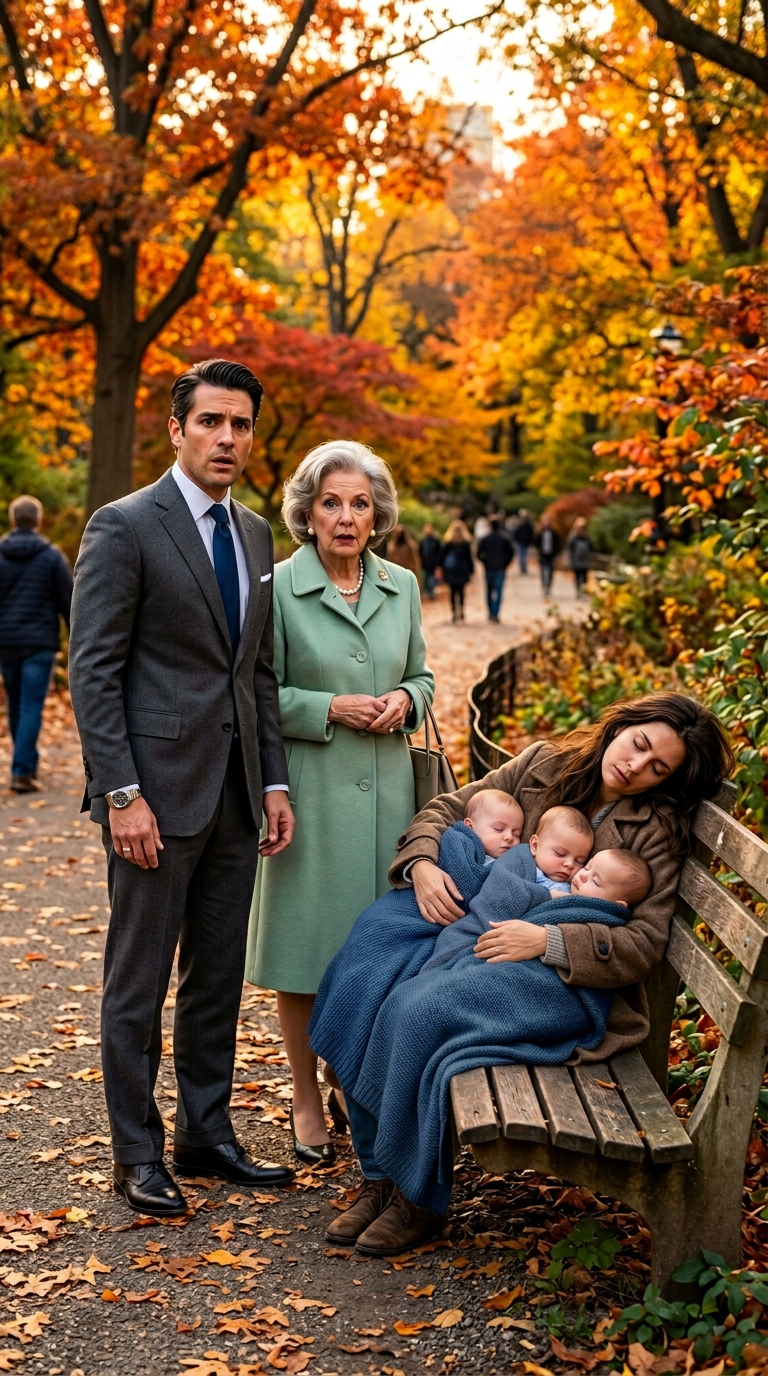
A few meters away, under the shade of a huge ash tree, a woman was sleeping on a bench.
At first he thought she was a stranger. Just some woman overcome by exhaustion.
But then he saw her profile. The curve of her nose. The dark hair stuck to her cheek. The way she pressed her lips even in sleep, as if the pain could stay awake inside her body.
Alejandro felt his chest tighten.
It was Valeria Torres.
The same Valeria who five years earlier had begged him not to leave her alone.
The same woman he had loved when he still wasn’t the owner of half a corporate empire, when he rented a small apartment in Narvarte and dreamed of conquering the world.
Now she was there. With an old coat over her shoulders. With worn-out shoes. With a torn diaper bag at her feet. And with three babies wrapped in thin blankets, pressed against her body like chicks seeking warmth.
One had a little hand sticking out of the blanket. Another slept with his mouth slightly open. The third moved restlessly, letting out soft whimpers of hunger.
Alejandro couldn’t move forward.
Doña Teresa followed his gaze and, as soon as she saw the woman, the color drained from her face.
It wasn’t surprise. It was fear. A fear so clear that Alejandro noticed it immediately.
“Mom…” he said, without taking his eyes off the bench. “Do you know something?”
Doña Teresa didn’t answer.

Her fingers began to tremble over the rosary she carried in the pocket of her sweater.
Alejandro took a step toward the bench.
Every detail hit him harder.
The almost empty bottle lying next to a wooden leg. An open can of formula inside the diaper bag. A crumpled receipt from a popular pharmacy. The sleeve of Valeria’s coat patched with white thread.
She wasn’t sleeping like someone who was resting. She was sleeping like someone who simply couldn’t go on.
One of the babies moved again and Alejandro saw his hand more clearly.
The long fingers. The small fold over the knuckle. The same one he had had since he was a child. The same one Doña Teresa showed in family photos every Christmas, saying it was a Mendoza trait.
Alejandro felt cold. An absurd cold, because the sun was already starting to warm the park.
He looked at the three babies. Then at Valeria. And then at his mother.
“Tell me the truth,” he murmured.
Doña Teresa closed her eyes.
“Alejandro, please…”
“Don’t say ‘please.’ Tell me what’s going on.”
His voice came out low, but loaded with something dangerous.
Valeria stirred slightly, exhausted, without waking up.
The babies remained pressed against her, protected by that thin arm that seemed to have no strength, but even in sleep continued to defend her children from the world.
Alejandro swallowed.
“Are those children mine?”
Doña Teresa brought a hand to her mouth.
Her tears came before her words.
And then Alejandro understood that his entire life had just split in two.
“Mom… answer me.”
She lowered her gaze to the ground.
The noise of the city continued around them. A dog barked. A vendor shouted “cafecito, pan dulce.” A bicycle passed nearby.
But for Alejandro everything fell silent when Doña Teresa whispered:
“Yes, son… those three babies are yours.”
Alejandro stepped back as if he had been struck.
But the worst was not that.
The worst was the next sentence.
Doña Teresa, crying like a defeated woman, added:
“And Valeria did try to find you… but I never let her reach you.”
PART 2
Alejandro felt the ground of Parque México open beneath his expensive shoes.
He couldn’t shout. He couldn’t cry. He couldn’t even approach the babies.
He stood staring at his mother as if the woman who had raised him had suddenly become a complete stranger.
“What did you say?” he asked in a hoarse voice.
Doña Teresa clutched the rosary between her fingers.
“I thought it was for the best for you.”
“For the best for me?”
Alejandro let out a dry, broken laugh without joy.
“Hiding my children from me was for the best for me?”
Valeria opened her eyes at that moment.
First she blinked, confused. Then she hugged the babies tightly. And when she saw Alejandro standing in front of her, the blood drained from her face.
“No…” she whispered.
She tried to get up quickly, but exhaustion overcame her. One of the babies started crying and she pulled him desperately to her chest.
“Valeria,” said Alejandro, taking a step.
“Don’t come near me.”
Her voice was low but firm. It wasn’t explosive anger. It was something worse. It was exhaustion accumulated over years.
“Valeria, I just found out.”
She looked at Doña Teresa. She saw her tears. She saw the guilt on her face. And she understood.
A part of Valeria broke right there, on that bench, in front of people who walked by without knowing they were witnessing the collapse of a family.
“Did you tell him?” Valeria asked.
Doña Teresa lowered her head.
“Forgive me.”
Valeria let out a bitter laugh.
“Forgive you? After five years?”
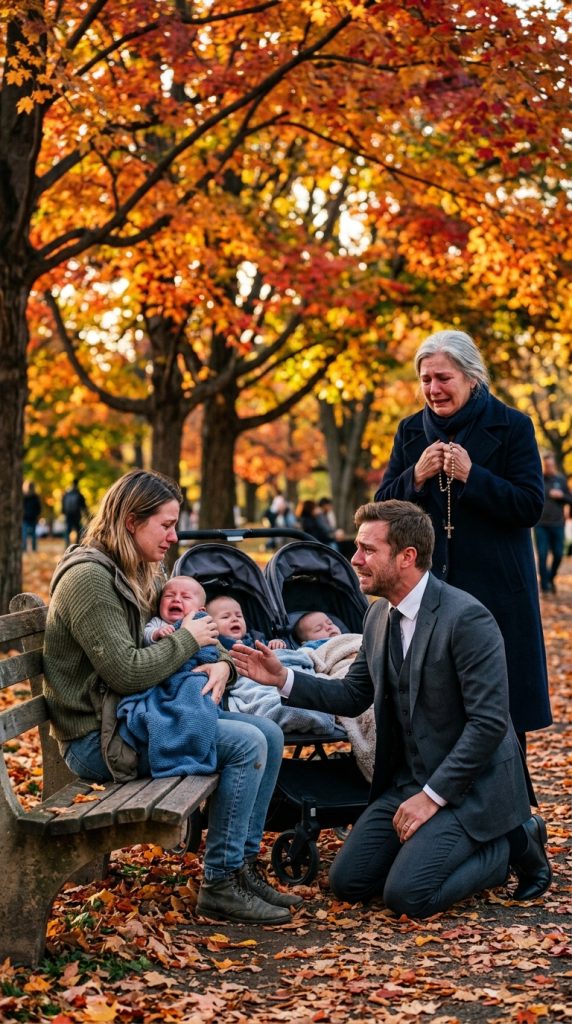
Alejandro knelt in front of the bench.
The man who never knelt before anyone, the businessman who made boardrooms tremble, was now on his knees on the damp earth.
“I didn’t know,” he said with tears in his eyes. “I swear I didn’t know.”
Valeria looked at him with pain.
“I looked for you at your office.”
“They never told me.”
“I sent you letters.”
“I never received them.”
“I went to the building in Polanco seven months pregnant and the guards threw me out.”
Alejandro closed his eyes as if each word were tearing off his skin.
“Who gave the order?”
Valeria didn’t answer. She only looked at Doña Teresa.
Alejandro slowly turned toward his mother.
“You?”
Doña Teresa covered her face.
“I was scared. Your company was just taking off. There were partners, banks, people waiting for you to fail. I thought that if Valeria showed up pregnant, everyone would say she wanted your money.”
“And you decided that for me?”
“I wanted to protect you.”
“No, Mom. You didn’t protect me. You stole from me.”
The words fell heavily.
Doña Teresa cried harder, but Alejandro could no longer comfort her.
Valeria tried to stand up, carrying two babies and pushing the diaper bag with her foot.
“I’m leaving.”
“No,” said Alejandro desperately. “Please, don’t leave again.”
“I never left, Alejandro. They threw me out.”
That phrase destroyed him.
A park guard approached upon seeing the scene, but Alejandro raised a hand.
“I need medical help. And a car. Now.”
Valeria shook her head.
“I don’t want to owe you anything.”
“You don’t owe me anything. I owe you everything.”
They took her to a private hospital in Roma, where the doctors confirmed the obvious: Valeria had mild malnutrition, severe exhaustion, and the babies needed urgent check-ups.
The three boys—Mateo, Emiliano, and Santiago—were 8 months old.
Triplets.
Alejandro heard those names with a knot in his throat.
Valeria had named them alone. She had cared for them alone. She had survived selling desserts, cleaning houses in Coyoacán, and sleeping some nights in shelters when she could no longer afford the room where she lived.
Meanwhile, he was inaugurating towers, giving interviews, and talking about discipline.
Honestly, nothing had hurt him as much as realizing that his success had grown on top of a manufactured silence.
That afternoon, in the hospital, Alejandro asked to speak with Valeria.
She was sitting next to the transparent cribs of the babies.
Her hair was pulled back, her face pale, and her eyes swollen.
“I don’t want you to think I came to take the children from you,” he said.
Valeria looked at him with distrust.
“You have money. Lawyers. A name. I have nothing.”
“You have the only thing that matters. You have been their mother when no one else was there.”
She lowered her gaze.
“You don’t know what it was like to hear them cry from hunger.”
Alejandro broke down.
He cried without covering his face. Without pride. Without pretense.
“Forgive me for not doubting. Forgive me for believing you had simply left. Forgive me for not looking for you more.”
Valeria also cried, but she didn’t hug him. Not yet. Because there are wounds that cannot be healed with a pretty apology.
Days later, Alejandro took her and the babies to his house in Las Lomas.
Not as a hidden guest. Not as a shame. He received her in front of all the staff and said:
“Valeria is the mother of my children. And my children are the owners of this house before anyone else.”
Doña Teresa, sitting in the living room, listened in silence.
From that day on, she stopped giving orders. For the first time in her life, she had to face the consequences of her fear.
But the biggest twist came two weeks later.
A lawyer named Salcedo arrived at the house with a blue folder.
“Mr. Mendoza, you need to see this.”
Alejandro thought they were custody documents.
But no. They were copies of letters. Printed emails. Courier receipts. And audios saved on a flash drive.
Valeria hadn’t just looked for him. She had sent prenatal DNA tests, medical appointments, ultrasound photos, and even a letter where she didn’t ask for money. She asked that Alejandro be present at the birth.

But every envelope had been received by someone in his company. The signature was always the same. Teresa Mendoza.
Alejandro felt nauseous.
That night he confronted his mother in the library.
He placed all the letters on the table.
“Read them.”
Doña Teresa shook her head.
“I can’t.”
“Read them.”
With trembling hands, she opened the first one.
Valeria’s handwriting said she was afraid, that she didn’t want to destroy anyone’s life, that she only wanted her children to one day know that their father had not rejected them.
Doña Teresa fell apart.
“I thought you would thank me later.”
Alejandro looked at her with icy sadness.
“Thank you? You made me miss eight months of pregnancy, the birth of my children, and five years of love. What part of that did you think was a favor?”
The old woman fell to her knees.
“Forgive me, son.”
Alejandro did not lift her up.
“It’s not up to me to decide whether to forgive you.”
The next day, Doña Teresa asked to speak with Valeria.
She sat in front of her without jewelry, without makeup, without that elegant arrogance she had always used as armor.
“I destroyed your life out of fear of losing my son,” she said. “And in doing so, I lost him anyway.”
Valeria had Mateo sleeping in her arms.
She said nothing.
Doña Teresa continued crying.
“I’m not asking you to love me. I’m not asking you to let me be their grandmother. I only came to tell you that I will declare everything before a notary. Every letter. Every lie. Every order I gave.”
Valeria looked at her for the first time without anger.
“That doesn’t give me back the nights on the street.”
“I know.”
“It doesn’t give me back the fear.”
“I know.”
“It doesn’t give me back the first time my children said ‘mommy’ while I cried because I had nothing for milk.”
Doña Teresa lowered her head.
“I know.”
And then something no one expected happened.
Valeria did not forgive her. But she did not humiliate her either. She simply said:
“Then do something useful with your guilt.”
Months later, Alejandro and Valeria inaugurated a foundation for single mothers living on the streets in Mexico City.
It was not a showy event. There were nurseries, legal advice, a dining hall, clean dormitories, and psychological support.
At the entrance they placed a simple plaque: “For the women who were not heard in time.”
Doña Teresa donated part of her assets and publicly signed a statement accepting what she had done.
The press went wild. Some said Alejandro was an example of responsibility. Others criticized him for having lived so many years without asking more questions. Social media exploded. “What a shock—a mother can also be the villain.” “Valeria didn’t have to forgive anyone.” “That man was lucky to find her alive.”
Alejandro read the comments in silence. Because, for the first time, he didn’t care about defending his image. He cared about bathing his children. Preparing bottles. Falling asleep in an armchair with one baby on his chest and the other two breathing nearby.
One night, while the triplets slept, Alejandro found Valeria in the garden.
“You don’t have to stay with me for the children,” he told her.
She looked at him for a long time.
“I’m not going to stay out of guilt.”
“I know.”
“And not because you’re good now.”
Alejandro nodded.
“I know.”
Valeria took a deep breath.
“I will stay only if every day you prove that you understood something.”
“What?”
She looked toward the window where the three babies were sleeping.
“That a family is not built with money. It is built by showing up when they need you most.”
Alejandro did not respond. He simply took her hand.
This time, Valeria did not let go.
One year later, at the first birthday they could celebrate together, the triplets ran clumsily through the garden in Las Lomas.
Mateo fell onto the grass. Emiliano stole cake with his hand. Santiago shouted “Dad!” before throwing himself against Alejandro’s legs.
The businessman crouched down and hugged all three, crying in front of everyone without shame.
Valeria watched him from the table with a tired but real smile.
Doña Teresa observed from a distance. She did not approach without permission. She had learned that love does not give anyone the right to control another person’s life.
At the end of the afternoon, a reporter asked Alejandro what his best investment had been.
He looked at Valeria. He looked at his children. Then he answered:
“Stopping.”
The reporter frowned.
“Stopping?”
Alejandro smiled with tears in his eyes.
“Yes. Because I spent years running after an empire… and the day I finally stopped, I found my family sleeping on a bench.”
And while three small voices shouted “Dad!” from the garden, Alejandro understood that he was not rich because of his companies.
He was rich because, after almost losing everything without knowing it, life had still given him a chance to come home.
