

You stop breathing.
Not because you choose to.
Because your body simply forgets how.
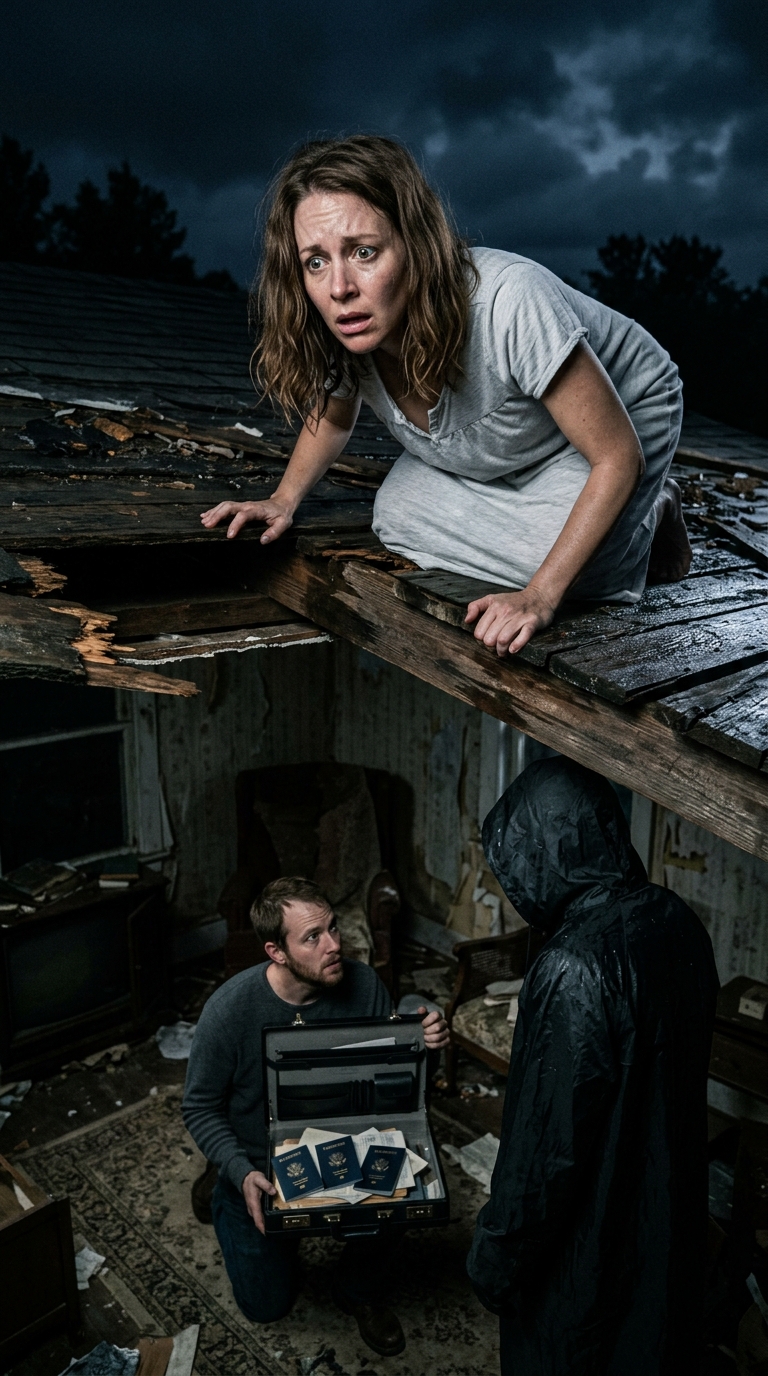
Downstairs, your husband is standing in the hallway holding three passports that should not exist. One shows his face. One shows Noah’s. One shows yours. Yet the names printed on them belong to other people entirely.
Caleb Morrison is not Caleb Morrison.
Or something far worse.
Caleb Morrison is only one of the identities he has worn.
The man in the dark raincoat looks into the shadowed living room.
“Where is she?”
Caleb shuts the passport case. His expression stays steady. Too steady. The same kind of calm that once made you trust him, and now feels like a warning. You remember it when Noah had a fever and Caleb told you not to panic. You remember it when your car broke down and he handled everything with the mechanic. You remember it when your mother died and he arranged the funeral because you could barely function.
Now it clicks into place.
That calm was not always care.
Sometimes calm is training.
“She was in bed,” Caleb says.
The man’s jaw tightens. “Was?”
Caleb glances toward the stairs.
“She got a call.”
Your nails press into the dusty wood of the attic floor.
The man lowers his voice. “From the sister?”
Caleb says nothing.
That silence confirms everything.
Your sister Mara didn’t sound paranoid. She sounded terrified. You want to call her back, but your phone is off because she told you to shut everything down. Your thumb hovers near the power button anyway.
Then Caleb speaks again.
“If Mara warned her, we don’t have much time.”
The man steps closer. “Then bring her. We still have the boy.”
Noah.
The attic seems to tilt beneath you.
Your son is not just staying with Caleb’s parents for the weekend.
He is leverage.
You press your hand over your mouth to hold back the sound trying to escape. Noah is four. He sleeps with a blue dinosaur tucked under his arm and still says “aminal” instead of animal. He believes his grandparents took him there to bake cookies and watch cartoons.
But Caleb’s parents are not truly his parents.
Are they?
Your thoughts fracture as memory after memory replays.
The first time you met them at their quiet Richmond home. His mother’s polite smile. His father’s minimal words. How they never asked about your past, your family, or your museum job. How intensely they adored Noah, as if they were trying to memorize every detail of him.
Below, the man pulls out his phone.
“Team is five minutes away.”
Caleb turns sharply. “No. No team. Not in my house.”
“My house?” the man replies coldly. “You lost that right when your FBI sister-in-law started digging.” You almost make a sound. Mara was digging?
Into Caleb?
The stranger says, “Find your wife. Bring her down quietly. If she runs, we take her sister first.”
Caleb’s expression shifts.
Barely.
But you see it through the floorboards.
Fear.
Not for you.
Not for Noah.
For himself.
The stranger turns toward the kitchen. “You’ve got two minutes.”
Caleb stands alone in the hallway.
For a second, he looks up.
Straight at the attic.
You press yourself flat against the floor, your heart pounding so violently you’re certain it must echo through the ceiling.
“Elise?” he calls softly.
Your name in his voice almost breaks you.
It’s the same voice that read Noah bedtime stories. The same voice that whispered vows beneath a white tent in your aunt’s backyard. The same voice that said, “I found you,” the night he proposed.
Now it sounds different.
Maybe he really did find you.
Maybe it was never love.
Maybe it was placement.
“Elise,” he says again, louder. “Come down. We need to talk.”
You don’t move.
The attic is freezing. Dust clings to your knees. Rain taps faintly against the roof. Your eyes scan for anything useful—Christmas boxes, old frames, a broken lamp, Noah’s baby swing, a plastic bin labeled TAXES.
Your phone is still dark in your hand.
Then it buzzes once.
Impossible.
You nearly drop it.
The screen lights up weakly—not a call, but a message from Mara.
DO NOT ANSWER HIM. BACK WALL. VENT PANEL. GO NOW.
You turn slowly.
The far wall is stacked with storage bins. Behind them, half hidden by insulation, is a small square vent panel you’ve never noticed before. You crawl toward it, sliding boxes aside as quietly as you can.
Below, the attic stairs creak.
Caleb is coming up.
“Elise,” he calls, closer now. “I know you’re scared.”
You reach the vent and pull.
It doesn’t move.
The attic latch rattles.
Caleb tries the door.
Locked.
“Open the door,” he says.
You pull harder.
A screw bites into the bottom edge.
Caleb’s voice tightens. “Elise, open it right now.”
There he is.
Not the husband.
The man underneath him.
You grab a metal ornament hook from a Christmas box and wedge it under the screw. Your hands shake so badly it slips twice. The door rattles again—harder.
“Elise!”
The screw gives.
The vent opens.
It isn’t a vent.
It’s a narrow crawlspace.
Your breath catches.
Mara knew.
Your sister knew your house better than you did.
You slide inside just as the attic door slams again.
Wood groans.
You pull the panel back into place behind you.
Darkness swallows everything.
The crawlspace is barely wide enough to move. You drag yourself forward on your elbows, biting your lip to stay silent. Fiberglass tears at your arms. A nail catches your sleeve and rips it open.
Behind you, the attic door bursts open.
Caleb’s footsteps enter.
For a moment, only his breathing fills the space.
Then boxes shift.
“Elise?”
Not angry anymore.
Worse.
Begging.
“You don’t understand what’s happening.”
You keep crawling.
The space slopes downward. A faint line of light appears ahead. Another panel. Garage, maybe. Outside, maybe. Or nothing.
Your phone buzzes again.
KEEP MOVING. FEDERAL TEAM 3 MIN OUT. GET OUT OF HOUSE.
Relief hits so hard it almost hurts.
Then—
A new voice below.
“She’s not up there, is she?”
The stranger.
Caleb doesn’t answer.
The stranger swears. “She’s in the walls.”
You freeze.
A panel behind you bursts open.
Light floods the crawlspace.
They’ve found it.
You crawl like something stripped of everything human.
No silence. No dignity. No thought except Noah.
Your shoulder hits the second panel.
It swings open.
You fall out into the mud beneath the back deck.
Rain slams into your face.
Cold air fills your lungs.
You scramble across the wet grass, barefoot, bleeding, phone clenched in your hand.
Behind you—
shouts.
And you run. Your backyard backs onto a narrow strip of woods that separates your subdivision from an abandoned service road. In daylight, it’s a pleasant line of trees. In a storm at midnight, it becomes a dark, swallowing mouth. You run into it anyway.
Branches slash at your face.
Mud drags at your feet.
Your lungs burn.
Then floodlights detonate behind you.
“Elise!” Caleb shouts.
You don’t look back.
A siren erupts from the street.
Then another.
Red and blue light fractures through the trees.
A voice blasts through a loudspeaker.
“Federal agents! Drop your weapon!”
Gunfire cracks.
You drop to the ground, covering your head.
Shouting. Heavy boots. A man screaming. “Clear left!” “Suspect down!”
You crawl behind a tree, shaking so violently you can barely grip your phone.
Then a hand clamps your shoulder.
You scream.
“It’s me!”
Mara.
Your sister drops into the mud in front of you, dark tactical jacket soaked, hair stuck to her face, eyes sharp with urgency.
You throw yourself into her arms.
For three seconds, you are not a wife, not a mother, not a woman escaping a betrayal.
You are just a little sister.
Then you pull back fast.
“Noah,” you gasp. “They have Noah.”
Mara’s expression tightens.
“We know.”
The world collapses into silence.
“You know?”
“We tracked the transfer. He’s not with Caleb’s parents.”
Your stomach drops.
“Where is he?”
Mara grips your shoulders.
“Elise, listen. Noah is alive. A team is already moving.”
“Where?”
“Morrison’s parents’ house was empty. They moved him two hours ago to a property outside Fredericksburg.”
You try to stand.
Your legs fail.
Mara catches you.
“I’m going.”
“No, you’re not.”
“That’s my son!”
“I know,” she says, voice cracking. “And I need you alive when we bring him back.”
Behind her, agents flood your yard. Caleb is dragged from the house in handcuffs, rain running down his face—or sweat, or something that isn’t quite tears. When he sees you, he stops fighting.
“Elise!”
You turn before Mara can stop you.
For one heartbeat, he still looks like your husband.
Then the passports return to your mind.
The false names.
Noah’s empty nursery.
“What is my son’s name on those passports?” you shout.
Caleb flinches.
An agent pushes him toward a black SUV.
“Elise, I can explain!”
“Then explain where Noah is!”
His face tightens.
Not with regret.
With calculation.
“You’ll never get him back without me.”
Mara goes completely still.
Every agent nearby hears it.
Caleb realizes too late.
Mara walks toward him slowly.
“Thank you,” she says.
“For what?” he snaps.
“For confirming custodial abduction, conspiracy, and leverage intent on federal recording.”
His expression drains.
The SUV door closes between you.
You don’t remember the ride.
You remember a blanket around your shoulders. A medic cleaning your cuts. Mara in the back seat, one hand gripping yours, the other speaking into a radio with a voice so controlled it scares you.
You remember your phone at 3% battery.
You remember thinking you should’ve charged it.
You remember laughing once, broken and hysterical, because your child is missing and your brain is worrying about battery life.
At the FBI field office, they place you in a room with gray walls, bolted furniture, and coffee that tastes like nothing. Mara sits across from you—not your sister anymore, but Special Agent Mara Bennett, someone built for rooms like this.
You stare at her.
“How long?”
She doesn’t pretend.
“How long have we been investigating Caleb?”
You nod.
“Six months.”
It hits like another betrayal.
“Six months? And you didn’t tell me?”
“Elise—”
“No. Don’t use that tone. You came to my baby shower. You ate at my table. You watched him hold Noah.”
Pain flickers across her face.
“I didn’t know he was involved at first. I was working a passport fraud ring tied to identity laundering and disappearances. Caleb’s alias showed up in travel data three months ago. I pushed to tell you, but we didn’t have enough to act without tipping him.”
“You used me.”
“No.”
“You let me live with him.”
“I watched you so he wouldn’t disappear you and Noah before we could stop him.”
Silence burns between you.
“And tonight?”
Mara swallows.
“Tonight I found a sealed travel package. New identities for all three of you. Flight window tomorrow morning. I called it in immediately.”
Your husband was going to erase you.
Not leave you.
Erase you.
You whisper, “What is he?”
Mara exhales.
“His name isn’t Caleb Morrison. It’s Caleb Voss. Raised by a private intelligence contractor, Victor Hale. Foster placements, false adoptions, identity shells. Caleb builds people new lives.”
Your stomach turns.
“For criminals?”
“For anyone paying,” she says. “Witnesses. fugitives. politicians. corporate assets. He doesn’t discriminate.”
“And me?”
Mara looks away.
“Say it.”
She meets your eyes.
“We think you were a cover.”
The words don’t feel real.
“A cover?”
“A normal life stabilizes an alias. Wife. Child. House. Records. Photos. It makes everything harder to trace.”
Your breathing turns thin. “So he married me for paperwork.”
Mara’s eyes fill with tears.
“At first, maybe.”
“Don’t soften it.”
“I don’t know, Elise.”
And that is worse.
Because neither of you do.
A knock cuts through the room.
An older agent steps in holding a tablet. “We have movement at the Fredericksburg property.”
You’re on your feet so fast the chair tips backward.
On the screen is black-and-white drone footage. A farmhouse. Two vehicles. Heat signatures inside. One small figure upstairs.
Noah.
Your hand flies to your mouth.
Mara steps in beside you.
The agent continues, “Tactical team is in position. We have visual confirmation of a child matching Noah’s size. Two adult males. One adult female. We are awaiting command authorization.”
“Waiting?” you choke.
Mara turns sharply. “Why?”
“Possible explosive trigger at the rear entrance. They may have rigged the property if breached.”
The room tilts.
Noah is four.
He’s afraid of hand dryers and thunder.
He is inside a house wired to kill.
Mara’s jaw tightens. “Who are the adults?”
The agent swipes the screen.
A grainy image appears.
The woman at the window is Caleb’s mother.
Or the woman you were told was his mother.
Mara says, “That’s Evelyn Voss.”
Your stomach drops.
“Voss.”
“Caleb’s biological mother. Not adoptive. Not deceased, despite official records.”
You stare at the screen.
That woman held your son. Baked cookies with him. Once told you motherhood meant learning to live with your heart outside your body.
She said it while helping plan his disappearance.
A phone rings.
The agent answers, listens, then looks at you.
“Caleb is requesting to speak to his wife.”
Mara immediately says, “No.”
You say, “Yes.”
“Elise—”
“If he knows anything about that house, I need to hear it.”
Mara studies you for a long moment.
Then nods.
Caleb is brought into the interrogation room in handcuffs, hair still damp, face marked from the arrest. You stand behind the glass first, watching him before he knows you’re there.
He looks smaller.
Not physically.
Less real.
Like the version of him you married has been stripped away, leaving something hollow wearing his face.
You enter with Mara and two other agents.
Caleb stands.
“Elise.”
You don’t sit.
“Where is Noah?”
He glances at the agents.
“I want a deal.”
Mara lets out a short laugh.
Wrong answer.
You move before anyone can stop you. You cross the room and slap him so hard your hand burns.
Agents step forward—Mara stops them with a single gesture.
Caleb turns back slowly, cheek red.
You step in close.
“You don’t get to negotiate my son.”
His expression shifts.
For the first time, he looks ashamed.
Real shame.
“The back entrance is wired,” he says quietly. “Front too. Not to level the house—flash charges. Enough to blind and disorient. Evelyn prefers escape routes. There’s a storm cellar under the kitchen with a tunnel to an old well.”
Mara steps forward. “How many inside?”
“Evelyn. Jonah. Pierce. Maybe one more outside.”
“Armed?”
“Yes.”
“Noah?”
His voice breaks.
“They won’t hurt him unless they panic.”
A bitter laugh escapes you.
“You think that helps?”
Caleb looks at you.
“I never wanted him harmed.”
“You planned passports.”
“I planned to get you both out before Evelyn did.”
The room tightens.
Mara’s eyes sharpen. “Explain.”
Caleb’s hands flex in the cuffs.
“Evelyn ordered me to separate the boy from Elise weeks ago. Said the investigation was too close. Family bonds were a liability. I delayed. I moved money. Built exits. I was going to run with you both.”
“With no warning?”
“You would have gone to Mara.”
“Because she’s FBI!”
“Because she would have stopped me.”
“She should have!”
He shuts his eyes.
“I know.”
The silence that follows is heavier than sound.
You step back before emotion can crack you open.
“Tell them how to get my son.”
And he does.
Everything.
The cellar door. The tunnel. The false pantry wall. The trigger system for the charges. The upstairs window that sticks. Noah’s likely location in an interior room.
Mara records every word.
Then she leaves to transmit it.
You stay.
Caleb looks at you like a man staring at what he destroyed.
“I did love you,” he says.
Your voice goes cold.
“Don’t.”
“I know it doesn’t matter.”
“You’re right.”
“But there was a moment when it stopped being just a cover.”
Your grip tightens on the chair.
“Before or after you forged a passport for our child?”
He flinches.
“I deserve that.”
“You deserve worse.”
“Yes.”
You turn toward the door.
“Elise.”
You stop—but don’t look back. “His blue dinosaur is in the left pocket of his backpack,” Caleb says. “He’ll ask for it when he’s scared.”
You close your eyes.
Not because you choose to.
Because your body forgets how to keep them open.
Because he knows.
Because he was there.
Because monsters remember bedtime rituals.
That is the cruelest part of all.
The rescue begins at 3:42 a.m.
You watch from the command room, wrapped in a blanket that smells faintly of antiseptic and someone else’s detergent. Mara stands beside you, her hand hovering near yours but never quite touching. She knows you might forgive her one day. She also knows tonight is not that night.
Drone footage shows agents advancing through the dark fields behind the farmhouse.
Not the front.
Not the back.
The old well.
Because Caleb told them.
A camera probe snakes through the tunnel first. Then two agents. Then a third. Inside the command room, no one breathes loudly.
A voice crackles over the radio.
“Cellar clear.”
Another follows.
“Moving to kitchen.”
Then everything explodes into motion.
Gunfire.
Your knees give out.
Mara catches you before you hit the floor.
On the screen, heat signatures scatter.
“Second floor team advancing.”
A flash detonates at the front entrance.
The charges.
But the agents were already elsewhere.
Caleb told the truth.
Mara whispers, “Come on.”
The radio crackles again.
“Child located. Child located. He’s alive.”
Your body forgets how to function.
You collapse fully to the floor.
Mara drops with you, crying now.
Then the radio adds, “Child is conscious. Requesting mother.”
You make a sound that doesn’t belong to language.
Twenty-seven minutes later, Noah is carried into the field office wrapped in an FBI jacket far too large for him. His cheeks are streaked with tears. His hair sticks up on one side. He clutches his blue dinosaur with both hands like it is the only solid thing in the world.
“Mommy!”
You run.
You drop to your knees before he reaches you and pull him into your arms so tightly he lets out a small squeak.
You immediately loosen your grip, terrified you’ve hurt him.
He smells like dust, apple juice, and fear.
“Mommy, Grandma Evie said we were playing hide-and-seek but I didn’t like it.”
“I know, baby. I know. You’re safe now.”
He pulls back, lower lip trembling.
“Where’s Daddy?”
The question tears straight through the room.
You look at Mara.
Then back at your son.
Your voice shakes.
“Daddy did something very wrong.”
Noah frowns.
“Is he in trouble?”
“Yes.”
“Can I see him?”
You close your eyes for a second.
Every version of the truth is too heavy for him.
“Not tonight.”
Noah starts crying again, and you hold him while your own heart breaks in two directions at once.
The trial lasts fourteen months.
Not one.
Several.
Evelyn Voss and her network are charged with identity trafficking, custodial abduction, passport fraud, conspiracy, and obstruction. The farmhouse yields decades of evidence. Hidden drives. Blank passports. Birth certificates. Photographs of people who stopped existing on paper.
Caleb cooperates.
That is the word everyone uses.
Cooperates.
Clean. Simple. Incomplete.
It does not describe the eighty-six hours he spends giving federal agents names, routes, accounts, false identities, corrupt officials, safe houses, and procedures. It does not describe the reunions. It does not describe the bodies. It does not describe the nights you wake up shaking because every truth he gives comes from the same mind that lied beside you for years.
He pleads guilty.
He receives a reduced sentence because his testimony dismantles the entire network.
Reduced does not mean small.
It means he will miss Noah’s first lost tooth, first school play, first bike ride without training wheels, and a thousand ordinary mornings he will never get back.
You file for divorce.
You request sole custody.
You change everything—locks, accounts, contacts, pickup lists, passwords, your phone number, even the way your life is indexed.
You sell the house outside Arlington.
Not immediately.
First, you walk through it room by room with Mara and a forensic team. They find three hidden compartments. One behind the laundry cabinet. One beneath Caleb’s office floor. One in the attic wall near the crawlspace where you escaped.
Inside are cash, IDs, hard drives, and a small velvet box containing your original engagement ring receipt under a false identity.
You stand in the attic after everyone leaves.
The floorboards are repaired now.
The vent panel is open.
You look at the place where your marriage ended and your life was saved.
Mara stands behind you.
“I should have told you sooner,” she says.
“Yes.”
“I was trying to protect the case.”
“I know.”
“That doesn’t make it right.”
“No.”
She nods, accepting the truth without asking it to soften.
“I’m sorry.”
You look at your sister.
The woman who withheld the truth.
The woman who saved your life.
Both are real.
“I’m not ready to forgive you,” you say.
Her eyes fill.
“I know.”
“But I’m glad you called.”
That breaks her.
It breaks you too.
Noah heals in the uneven, unpredictable way children do.
He asks about Caleb less over time.
Then in bursts.
Therapy helps more than explanations ever could.
So does time.
A year after the rescue, you move to a smaller house in Alexandria.
It has no attic.
That decision is final.
Noah chooses a bedroom with blue walls and asks, very seriously, if monsters can find new houses. You sit on his bedroom floor beside a half-built train set.
“Some monsters can,” you say carefully. “But this house has a lot of people protecting it.”
“Aunt Mara?”
“Yes.”
“Police?”
“Yes.”
“Mommy?”
You touch his cheek.
“Especially Mommy.”
He considers that for a moment.
“Can I protect it too?”
“You can help by telling me when something feels wrong.”
He nods seriously.
“Even if a grown-up says don’t tell?”
Your throat tightens.
“Especially then.”
That becomes the rule of your home.
No secret that makes you scared.
No adult gets to own the truth alone.
When Caleb writes from prison, you leave the first letter unopened for three weeks. It stays in a drawer like it’s alive. Eventually, your therapist asks what you fear it will say.
You answer, “Something kind.”
She understands.
When you finally open it, the letter is four pages long.
No justifications.
No begging.
No “I did it for you.”
He writes that love without truth is only another disguise. He writes that Noah should hate him if he needs to. He writes that he will accept any custody limits you set. He writes that the only useful thing he can still do as Noah’s father is stop asking for access he hasn’t earned.
At the bottom, he adds:
His dinosaur’s name is Blue because when he was two, he said the real name was too long. I don’t know if you remember that. I do. I’m sorry memory doesn’t make me safe.
You fold the letter.
You cry.
Then you put it in a box labeled CALEB — FOR LATER, MAYBE.
Not forgiveness.
Not erasure.
Just a place where complicated truth can exist without poisoning everything else.
Years pass.
Evelyn Voss dies in federal prison before her appeals conclude. Mara receives a commendation and does not attend the ceremony. Instead, she shows up at Noah’s soccer game and cheers too loudly every time he touches the ball, even when he kicks it wrong.
You and Mara rebuild slowly.
Through Sunday dinners.
Through silence.
Through one disastrous Thanksgiving where you both drink too much wine and finally scream about the six months she knew.
Then you wash the dishes together.
Then she sleeps on your couch.
Then Noah wakes her at 6:00 a.m. with a waffle on a plate and says, “Mom says family tells the truth now.”
Mara cries into the waffle.
By the time Noah turns ten, he knows a careful version of everything.
He knows his father broke the law.
He knows people tried to take him.
He knows Aunt Mara helped bring him home.
He knows you hid in the attic and escaped through the wall, which he finds terrifying and cool at the same time.
One day he asks, “Was Dad always bad?”
You stop chopping carrots.
There are simple answers.
You don’t choose one.
“I don’t know,” you say. “I know he did bad things. I know he lied. I know he also loved parts of us in ways that felt real. People can be more than one thing, but that doesn’t mean we let unsafe people close.”
Noah leans against the counter.
“Do I have to hate him?”
“No.”
“Do I have to love him?”
“No.”
“What do I have to do?”
You set the knife down and look at your son.
“Tell the truth about how you feel. Even when it changes.”
He nods.
“Today I’m mad.”
You pull him into your arms.
“Mad is allowed.”
At fifteen, Noah asks to read Caleb’s letters.
You knew this day would come.
It still takes the air from your lungs.
You give him the box.
You sit outside his bedroom door for an hour, not listening, just staying close enough to be found.
When he comes out, his eyes are red.
“He sounds sorry,” Noah says.
“Yes.”
“Is that enough?”
“No.”
He nods.
“Can I write him?”
Your heart tightens.
“Yes.”
The first letter Noah sends is three sentences.
I remember the farmhouse. I remember you read dinosaur books. I don’t know what I want from you.
Caleb writes back.
That is okay. You don’t owe me knowing.
You hate him a little less for that.
Not enough to change anything.
Enough to breathe.
When Caleb is released years later under strict supervision, Noah is eighteen. He agrees to meet him in a federal reentry office with you, Mara, a therapist, and an exhausted parole officer present.
Caleb looks older.
Of course he does.
His hair is grayer at the temples. His face is thinner. The calm is still there, but it no longer looks polished. It looks like something worn down by consequence. He does not hug Noah.
He does not ask.
He simply stands and says, “Hi, Noah.”
Noah studies him for a moment.
Then he says, “Hi, Caleb.”
The name lands in the room.
Caleb lets it sit there.
Good.
They talk for twenty minutes.
Books.
College.
Dinosaurs, oddly enough—because some things survive everything.
At the end, Caleb says, “Thank you for meeting me.”
Noah nods.
“I’m still angry.”
“I know.”
“I might always be.”
“That’s fair.”
“I don’t want you near Mom.”
Caleb looks at you once.
Then back at Noah.
“I understand.”
Noah stands.
The meeting is over.
Outside, your son draws in a cold breath like he’s just stepped out of a burning building.
“You okay?” you ask.
“No.”
You nod.
He looks at you.
“But I’m glad I saw him.”
That is enough.
Years later, when people ask why you don’t like attics, you usually laugh and say old houses make too much noise.
You don’t tell them about the floorboards.
The passports.
Your husband’s calm voice in the hallway.
Your sister shouting through a phone call.
The crawlspace.
The mud.
The farmhouse on a drone feed.
Your son wrapped in an FBI jacket too big for him.
Some stories don’t belong in casual conversation.
But on nights when rain taps against your windows, you still check every lock twice. You still sleep with your phone charged. You keep a flashlight in your nightstand, your car, your kitchen, your office.
Not because you live in fear.
Because preparation is what fear becomes when it learns discipline.
Noah grows tall.
Mara turns gray.
Life moves forward.
Not smoothly.
Not perfectly.
But honestly.
On the twentieth anniversary of that night, Noah comes over for dinner with his fiancée, a sharp, warm young woman named Claire who asks direct questions and laughs easily. After dessert, rain starts tapping softly against the windows.
Noah looks at you.
You look at him.
For a moment, everything returns.
Then he reaches across the table and squeezes your hand.
“I’m here,” he says quietly.
Your throat tightens.
“I know.”
Mara, sitting beside you, lifts her glass.
“To charged phones,” she says.
Noah laughs.
You laugh too.
The sound fills the kitchen—warm, ordinary, almost unbelievable.
That is the ending most people don’t understand.
They expect revenge to be loud.
A confession. A trial. A final confrontation in the rain.
You had some of that.
But the real ending is quieter.
It is your son growing up under his own name.
It is your sister finding her way back to the table.
It is sleeping in a house without an attic and knowing the lights can stay on if you want them to.
It is understanding that love without truth isn’t love at all.
It is a cage with flowers painted on it.
And it is remembering that the night your sister called at 12:08 a.m., she didn’t save you by explaining everything.
She saved you by giving you the only instruction that mattered.
Hide first.
Ask later.
Because sometimes survival begins before understanding.
Sometimes the person beside you is the danger.
And sometimes the only thing standing between your child and a stolen life is a dead phone, a locked attic, and a sister brave enough to sound like she’s lying when she isn’t.
