

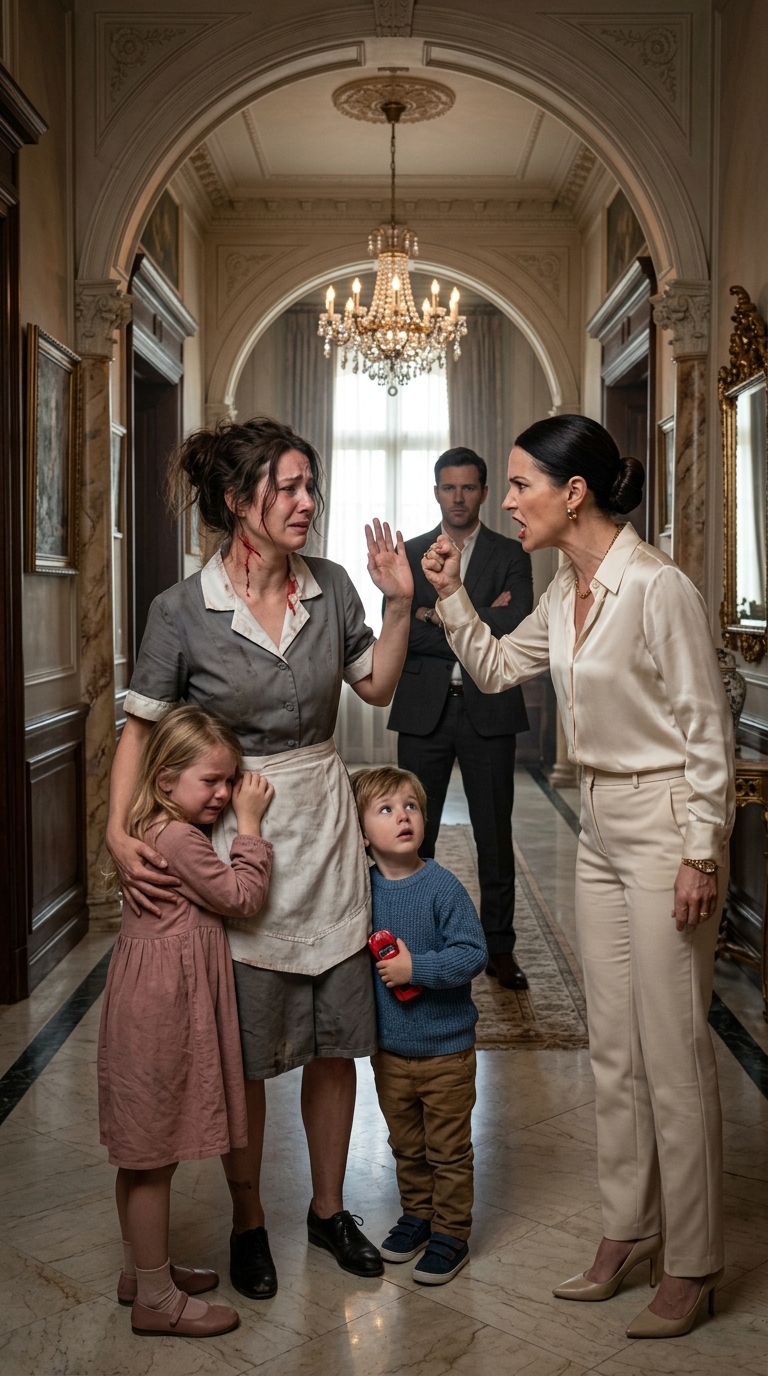
Mariana Torres was never meant to matter in the Arriaga mansion. She was supposed to move silently through the corridors, polish glass tables until they mirrored the chandeliers, fold children’s clothes worth more than her old monthly rent, and vanish the moment the family entered a room. In that estate outside Greenwich, Connecticut—where iron gates guarded a sweeping driveway and security cameras watched every angle—people like Mariana were expected to have hands, not voices. But the night she stepped between Patricia Arriaga and seven-year-old Sofia, everything inside the house shifted.
Alejandro Arriaga had built a fortune that made bankers take his calls after midnight. He owned construction empires, luxury restaurants, private security firms, and half a dozen Manhattan properties carrying other people’s names on paper. Men twice his age lowered their voices around him, and women like Patricia wore his surname like jewelry. Yet for all his influence, Alejandro had failed to notice the fear growing inside his own home. He mistook silence for peace, obedience for manners, and his children’s rigid smiles for healing.
That night, after reviewing recovered security footage in a safe house three streets away, Alejandro did not shout. He did not throw anything. He did not call Patricia demanding explanations. He simply sat in a leather chair, elbows on his knees, watching hours of video that dismantled every lie he had been living inside. There was Sofia forced to stand in the hallway for forty minutes for mentioning her dead mother. There was Diego crying quietly over a broken toy while Patricia told him boys who cried became weak men. And there was Mariana, over and over again, absorbing blame that was never hers.
The final clip destroyed him. Diego had spilled milk on the rug. Sofia stepped in front of her younger brother. Patricia’s hand rose fast, sharp, practiced. Then Mariana appeared like a shield, taking the strike across her shoulder and neck, her face tightening in pain while her arms stayed spread in front of the children. Alejandro replayed it three times, slower each time, until the truth settled in completely. A woman he paid $3,800 a month to clean his house had shown more courage in a single second than he had shown in two years as a father.
Across from him, Victor Hale, head of security, stood with his arms folded. Victor had been with Alejandro for nearly fifteen years. He had watched him close deals that destroyed powerful men, face threats without blinking, and leave rooms so silent no one dared breathe. But he had never seen him like this. Not angry. Not cold. Broken.
“Do the children know?” Alejandro asked quietly.
Victor shook his head. “No. Miss Torres doesn’t know either. Patricia believed the second-floor cameras were offline after renovations. She was wrong.”
Alejandro stared at the paused frame. Mariana knelt in front of Sofia and Diego, wiping Diego’s tears with the edge of her apron. Her shoulder was still red where Patricia had struck her, yet she smiled gently, as though pain was something she had learned to hide too well. Alejandro’s jaw tightened. “Find everything about Mariana Torres.”
Victor hesitated. “Already did.”
Alejandro turned slowly.
“She grew up in foster care in Pennsylvania after losing both parents in a house fire. She aged out at eighteen. Diner work, laundries, nursing homes, private homes. No criminal record. No family. No emergency contact except the agency that placed her here.” Victor paused. “She’s been sending part of her salary to a youth shelter in Philadelphia every month. Not much. Two hundred dollars sometimes. One hundred when she can’t.”
Alejandro looked back at the screen. Something heavy shifted behind his eyes. “And Patricia?”
Victor’s expression hardened. “She’s been moving money.”
That finally pulled Alejandro’s full attention.
Victor set a folder on the table. “Small amounts at first. Then larger. Jewelry purchases disguised as charitable donations. Wire transfers to an account tied to her brother. A trust attorney in Miami. She’s also been in contact with a boarding school in Switzerland.” Alejandro’s voice dropped. “For my children?” “Yes.”
The room fell completely still.
Victor continued with measured caution. “There’s more. She has been telling staff that you plan to send Sofia and Diego away after the holidays because they’re becoming emotionally unstable. She’s been constructing a narrative.”
Alejandro rose.
No one in the room moved. Not Victor. Not the guards by the door. Not even the city lights beyond the glass seemed to shift. Alejandro picked up the folder, closed it slowly, and said, “Tomorrow morning, everyone in that house will understand what happens when someone touches my children.”
Back at the mansion, Mariana barely slept. Her room was small but clean, tucked beside the laundry wing on the east side of the house, far from the family suites and the grand staircase. She lay on her side, unable to rest as her shoulder throbbed with every breath. She had wrapped it in a towel and applied cheap ointment from her suitcase, the kind bought with coupons at a pharmacy. But the pain wasn’t what kept her awake.
It was Sofia’s question.
“Are you going to leave?”
Mariana had promised she wouldn’t abandon them, but promises were fragile things for people without power. Patricia could dismiss her with a single call. The agency would believe the wealthy wife before the maid. By morning, Mariana could be outside the gates with a suitcase, no reference, no savings, nowhere safe to go. She had survived worse. But Sofia and Diego had not.
At 6:10 a.m., Mariana heard footsteps in the hallway. Not Patricia’s sharp heels. Not the light steps of morning staff. These were heavier—controlled, deliberate. She sat up quickly, pulling her cardigan over her bruised shoulder just as a knock came once.
“Mariana Torres?” a man’s voice asked.
Her heart nearly stopped. “Yes?”
“It’s Victor Hale. Mr. Arriaga asked me to escort you to breakfast.”
Breakfast.
No one had ever escorted Mariana anywhere in that house except out of rooms she wasn’t meant to enter. She opened the door slowly. Victor stood there in a dark suit, tall, composed, not unkind. Behind him was another staff member holding a garment bag and flat black shoes.
Mariana frowned slightly. “Did I do something wrong?”
Victor’s expression softened a fraction. “No, ma’am. Not wrong.”
The word “ma’am” almost made her step back. In houses like this, ma’am belonged to women with diamonds, not women with cleaning gloves. Victor gestured down the hall. “Mr. Arriaga would like you dressed comfortably. A doctor will examine your shoulder after breakfast.”
Mariana’s throat went dry. “My shoulder is fine.”
“No,” Victor said quietly. “It isn’t.”
Downstairs, the mansion looked different in morning light. Marble floors gleamed, tall windows framed the pale Connecticut sky, and the dining table was set for a breakfast worthy of a magazine spread. Silver coffee pots. Fresh fruit. Warm pastries. White roses in a crystal vase. But the atmosphere was wrong. Staff stood along the walls, tense and silent. Patricia sat at the head of the table in cream silk, one hand around her coffee cup, her diamond ring flashing as if untouchable.
Sofia and Diego sat side by side, unnaturally still. Sofia’s hair was neatly brushed, but her eyes were swollen. Diego clutched his napkin with both hands, glancing toward the doorway as though searching for an exit. When Mariana entered, both children straightened. Diego almost smiled before stopping himself under Patricia’s gaze.
Patricia’s lips curved. “What is this?”
Victor did not respond.
A moment later, Alejandro entered the dining room.
No tie. Sleeves rolled at the wrists. Calm in a way that made everyone more uneasy. Patricia stood at once, shifting into her polished public voice. “Alejandro, darling, I was just telling the children how happy we are that you’re home.”
Alejandro looked at his children first. “Sofia. Diego.”
Sofia whispered, “Good morning, Daddy.”
Diego tried to respond, but his voice caught.
Alejandro’s expression flickered—pain, quickly buried. Then he looked at Mariana. “Please sit.”
The room froze.
Patricia let out a short laugh. “Sit? Alejandro, she’s staff.”
“She is injured,” Alejandro said.
Patricia’s smile tightened. “She bumped herself yesterday. She’s careless. I was actually planning to speak to you about her performance.”
Alejandro pulled out a chair himself.
Not near the wall. Not at the edge. At the family table—between Sofia and Diego.
Mariana felt every gaze on her. Her hands trembled. “Mr. Arriaga, I shouldn’t—”
“Sit,” he said. Not harsh, but final.
Mariana sat.
Sofia immediately slipped her hand into hers beneath the table. Mariana squeezed it once, carefully. Alejandro noticed. He noticed everything now.
Patricia set her cup down. “This is humiliating.”
Alejandro looked at her. “For whom?”
The question struck like a blade.
Patricia blinked. “Excuse me?”
“For whom is it humiliating, Patricia?” he asked. “For the woman who protected my daughter? Or for the woman who tried to strike her?”
Color drained from Patricia’s face.
No one spoke.
Sofia’s fingers tightened around Mariana’s. Diego stared at his father, eyes wide. Patricia recovered quickly, but not quickly enough. “That’s absurd. Children exaggerate. Staff lie. You know how stories are invented when people want sympathy.”
Alejandro nodded once. “I expected you to say that.”
Victor stepped forward and placed a tablet on the table, turning it on.
The footage began.
Patricia in the second-floor sitting room. Diego spilling milk. Sofia stepping in front of him. Patricia’s hand rising. Mariana taking the blow. The sound played through the speakers—small, sharp, undeniable.
Diego jerked so hard his fork hit the floor.
Alejandro reached instinctively for him, but Diego pulled back before he could. That small movement hit harder than anything else. His child had learned to fear his own table.
Patricia stood. “You recorded me?”
Alejandro didn’t look away. “I recorded my house.”
“This is illegal.”
“No,” Alejandro said. “What you did to my children is.”
Patricia’s voice sharpened. “Your children? I raised them while you built your empire. I handled the crying, the tantrums, the grief they used to manipulate everyone.”
Sofia began to cry.
Mariana turned instinctively toward her, but Alejandro lifted a hand—stopping the room without stopping Mariana. “Let her comfort my daughter,” he said.
Patricia’s face twisted. “So the maid becomes the mother now.”
Alejandro stepped closer. “Choose your next words very carefully.” For the first time since Mariana had entered that house, Patricia looked afraid. But pride was a stubborn disease. She lifted her chin. “You think this little orphan saint cares about them? She cares about your money. They all do. Give her a bonus and watch how quickly she forgets these children.”
Mariana felt the insult land exactly where it was aimed, but she kept her eyes on Sofia. She had been called worse. She had survived labels thrown by people who believed wealth made them pure. But Sofia looked up at her, frightened that the words might be true, and Mariana could not let that stand.
She turned to Alejandro. “Sir, I don’t want money from your family.”
Patricia scoffed.
Mariana continued, voice low but steady. “I just want Sofia and Diego safe. That’s all.”
Alejandro held her gaze for a long moment. Then he nodded. “They will be.”
Patricia laughed again, but it cracked this time. “You can’t just throw me out.”
“No,” Alejandro said. “I can do far more than that.”
Victor opened the dining room doors.
Two attorneys entered, followed by a woman in a navy suit with a government badge clipped to her jacket. Patricia’s composure collapsed instantly. The woman introduced herself as Karen Whitmore from Connecticut’s Department of Children and Families. Patricia turned on Alejandro with pure fury.
“You called child services on your own wife?”
“I called them on the woman abusing my children.”
The words struck the room like thunder.
The next hour moved like a storm breaking loose. Sofia and Diego were taken gently into the library with Mariana and a child advocate. A doctor examined Mariana’s shoulder and documented the bruising. Staff were interviewed one by one. At first, fear kept them quiet. The cook, Mrs. Alvarez, twisted her apron and insisted she hadn’t seen enough. The gardener kept his eyes on the floor. One housekeeper broke down crying before she could even begin.
But once the first truth came out, the rest followed.
They spoke of nights Patricia locked the children out of the playroom. Of meals taken away as punishment. Of the rule forbidding Lucía’s name. Of threats, shouting, and Sofia sleeping with shoes beside her bed in case she needed to run. Of Mariana bringing food to the children, cleaning bruises, standing between them and Patricia’s rage.
By noon, Patricia was no longer wearing Alejandro’s ring.
She had thrown it at him when the attorneys explained the emergency separation order. It hit the marble once and rolled beneath the table. No one reached for it.
“You’ll regret this,” Patricia hissed.
Alejandro looked drained, older, but steady. “I already regret everything. Just not this.”
Patricia was escorted out through the front doors she once treated like an entrance to power. She didn’t look at Sofia or Diego. She didn’t apologize. She only looked back at the house, at the staff, at Mariana, and finally at Alejandro with something like a vow of revenge in her eyes.
That should have been the end.
But people like Patricia didn’t fall quietly, and she had never been forced to accept consequences.
Three days later, the story hit the tabloids.
“Billionaire’s Wife Claims Maid Manipulated Children for Money.”
By morning, phones in the house wouldn’t stop ringing. By afternoon, a black SUV from a major network sat outside the gate. By evening, Mariana’s face had been lifted from her employee file and spread across gossip sites alongside words like opportunist, homewrecker, and gold digger. Someone leaked her foster care history. Someone found the shelter she supported. Someone twisted her kindness into ambition.
Mariana stood in the pantry, staring at her name on a staff phone until the words blurred.
She had expected Patricia to target Alejandro.
She had not expected Patricia to target her.
Alejandro found her there. “Mariana.”
She quickly wiped her face. “I’m sorry. I shouldn’t have looked.”
“You have nothing to apologize for.”
She gave a small, bitter smile. “People like me always do, Mr. Arriaga. Even when we tell the truth.”
He looked away, because she was right.
That night, Alejandro held his first family meeting without Patricia. Not a business call, not a legal emergency, but something real—in the playroom, sitting on the carpet with Sofia on one side and Diego on the other. Mariana stood near the door, unsure where she belonged.
Sofia noticed immediately. “Can Mariana sit with us?”
Alejandro looked at Mariana. “Only if she wants to.”
There was no command in it. No assumption. Just choice. Mariana sat slowly on the edge of the carpet, and Diego immediately moved closer until he was beside her. Alejandro watched his son lean against her with a trust he had withheld from his own father for months. Something in him tightened with shame.
“I need to tell you something,” Alejandro said. “What happened in this house was not your fault.”
Sofia looked down.
He continued, voice steady but heavy. “Not when you cried. Not when you missed your mother. Not when you were scared. Adults are supposed to protect children. I failed to see what was happening, and I am sorry.”
Diego whispered, “Are we bad?”
Alejandro closed his eyes for a second. When he opened them, they were wet. “No, buddy. You are not bad. You are my son.”
Sofia’s lip trembled. “Patricia said Mommy died because we made everyone tired.”
Alejandro looked like something inside him broke. “No. Your mother loved you more than anything. She didn’t leave because of you. She got sick. That was not your fault. Loving her is not wrong. Saying her name is not wrong.”
Sofia began to cry—real, shaking, childlike sobs that finally broke through everything she had been holding in. Alejandro reached for her slowly, letting her decide. She didn’t hesitate. She fell into him, Diego following, and for the first time in years, Alejandro held both children without fear in their bodies.
Mariana turned away.
She didn’t want to intrude on something so fragile.
But Sofia reached back without looking and took her hand.
So Mariana stayed.
The court battle began two weeks later.
Patricia arrived in a white designer coat with sunglasses and a team of attorneys who looked like they billed by the minute of breathing. She claimed the footage was edited. She claimed Mariana had manipulated the children. She claimed Alejandro was using them to avoid a divorce settlement. She claimed Sofia and Diego were confused, grieving, easily influenced by a domestic worker who had formed an “inappropriate emotional attachment.”
Mariana sat outside the hearing room, hands cold in her lap, wearing a navy dress chosen by Alejandro’s legal team. It cost $180, and even that felt like too much. She thought about her old shoes back in her room, the ones held together with glue. She could face anger. She could face lies. But being evaluated in a courthouse as if her love for two children was suspicious made her feel like she was nine again, sitting in a foster office while adults decided where she would be sent next.
A woman sat beside her.
Mariana looked over and froze.
It was Elena Whitaker, Lucía’s sister. Sofia and Diego’s aunt.
Elena had flown in after Alejandro called her. She had Lucía’s eyes—soft but steady, carrying the same quiet grief Sofia now had. For years, Patricia had kept her away with stories of instability and danger. Alejandro, buried in work and grief, had allowed distance to become normal. Now Elena sat with a folder of old photographs, anger and sorrow held tightly in her expression.
“You’re Mariana,” Elena said softly.
Mariana nodded.
Elena’s eyes dropped to the fading bruise near Mariana’s shoulder. “My niece told me you stood in front of her.”
Mariana hesitated. “She was scared.”
Elena’s voice cracked slightly. “Thank you.”
Two words.
No one had ever given Mariana those words like they carried weight.
Before she could answer, Elena opened the folder and pulled out a photo. Lucía sat in a hospital bed holding baby Diego, Sofia curled against her side. Alejandro stood behind them, younger, softer, smiling in a way Mariana had never seen. On the back, in blue ink, Lucía had written: My whole world.
Mariana touched the edge gently. “They miss her.”
“I know,” Elena said. “And I should have fought harder to stay in their lives.”
Mariana shook her head. “Patricia made everyone afraid.”
Elena looked toward the courtroom doors. “Not anymore.”
Inside, Patricia’s mask finally cracked.
It happened when Sofia’s recorded interview was played privately for the judge. The public never heard it, but those inside did. Sofia’s small voice described Patricia telling her that crying made Daddy leave. That Diego was forced to sleep on towels after a nightmare. That Mariana sat outside their door at night humming so they knew they weren’t alone.
Patricia’s lawyer objected.
The judge allowed it to continue.
Then came Diego’s therapy notes. Medical records. Staff statements. Financial trails showing boarding school inquiries while Alejandro was told the children needed “discipline abroad.” Bank transfers. Messages to her brother about “clearing the house before new trust arrangements.”
By the end of it, Patricia no longer looked like someone defending herself.
She looked like someone realizing there was nowhere left to stand.
Temporary custody remained fully with Alejandro. Contact was prohibited. A criminal investigation opened. The divorce shifted from ugly to catastrophic. But the moment everyone remembered came after the hearing, when reporters gathered outside the courthouse shouting questions into the air. “Mr. Arriaga, did your maid break up your marriage?”
Alejandro stopped walking.
His attorneys tried to guide him forward, but he turned. Cameras flashed. Microphones pushed closer. Mariana stood behind him, pale and humiliated, wishing the floor would open and take her.
Alejandro looked directly into the cameras.
“Mariana Torres did not break my marriage,” he said. “She protected my children when I failed to. If anyone wants to question character, start there.”
The clip went viral before sunset.
By morning, the headlines shifted.
“The Maid Who Saved the Arriaga Children.”
“Housekeeper Takes Slap Meant for Little Girl.”
“Billionaire Father Credits Woman Who Protected His Kids.”
But public sympathy didn’t repair private damage. Sofia still flinched at raised voices. Diego still hid food in his drawers. Alejandro still woke at 3 a.m. walking the hallway outside their rooms like a guard who had arrived too late. Mariana still moved carefully, afraid that safety offered by powerful people could vanish as quickly as it came.
One evening, about a month after Patricia left, Alejandro found Mariana in the kitchen making grilled cheese sandwiches. It was after nine. The house was quiet. Snow tapped lightly against the glass.
“For the children?” he asked.
She turned quickly. “Diego had a nightmare. Sofia said your wife—” She stopped herself. “Patricia used to say food after bedtime was for spoiled children. I thought maybe tonight they needed something warm.”
Alejandro leaned against the doorway. “You don’t have to justify feeding hungry children.”
Mariana looked down at the pan. “Old habit.”
He studied her for a moment. “I owe you more than I can repay.”
Her shoulders tightened. “Please don’t say that.”
“Why?”
“Because men like you say things like that, and women like me don’t know what it costs.”
That made him pause. Not because it was disrespectful, but because it was honest. Most people wrapped their words around Alejandro like silk. Mariana handed him truth without padding.
He nodded slowly. “Fair.”
She flipped the sandwich. “I don’t want rewards. I don’t want interviews. I don’t want to be called a hero. I just want them safe.”
“And you?”
Mariana blinked. “What about me?”
“Do you want to be safe?”
No one had ever asked her that.
The question lingered between them, too large for the kitchen. Mariana turned off the stove and set the sandwich on a plate. “I don’t know what that feels like.”
Alejandro looked at her like he understood something painful. “Then maybe it’s time you do.”
Two weeks later, he offered her something different.
Not maid. Not nanny. Not someone tucked away in the background.
He created a position with a contract, benefits, health insurance, paid leave, and a salary that made Mariana freeze when she saw it: $72,000 a year as a live-in child care coordinator while the children recovered, with legal protection from media harassment and access to therapy if she chose it.
Mariana pushed the contract back. “This is too much.”
Alejandro didn’t touch it. “No. What you had before was too little.”
“I’m not qualified for this.”
“You know my children’s fears, routines, safe foods, nightmares, their mother’s name, and the difference between silence and peace. That is more qualification than anyone else here had.”
Her eyes burned. “People will talk.”
“They already do.”
“They’ll say I planned this.”
“Let them,” Alejandro said. “Truth doesn’t weaken because people lie louder.”
She signed three days later.
Not for the money—though it finally let her breathe—but because Sofia asked if she would still be there for Christmas, and Diego asked if she would come to his school play. And Mariana understood that sometimes staying wasn’t dependence. Sometimes it was the first free choice after a life of being moved from place to place.
Christmas arrived quietly.
No grand event. No society guests. No Patricia beneath a towering tree pretending love was decoration. Just Alejandro, the children, Elena, Mariana, Mrs. Alvarez, Victor, and a few staff who had chosen honesty when it mattered. The house felt less perfect, more alive. Toys covered the rug. A mug stayed on a table. Diego’s drawings filled the walls. Sofia placed Lucía’s photo on the mantel herself.
No one moved it.
After dinner, Alejandro gave his children one gift first. A small wooden box. Inside were letters Lucía had written before she died—one for every birthday she feared she might miss. Alejandro had kept them locked away because opening them had been unbearable. Patricia had used that grief to erase Lucía from the house. Now, with shaking hands, he returned them.
Sofia held the box carefully. “Mommy wrote to us?”
Alejandro nodded. “Yes. And I should have given them to you sooner.”
Diego touched an envelope. “Can Mariana hear too?”
Alejandro looked at Mariana. “That’s up to you and Sofia.”
Sofia nodded immediately. “She’s family.”
The word hit Mariana so deeply she had to turn toward the window. Outside, snow covered the estate in quiet white. For years, family had been something other people had—something in warm houses, holiday films, school forms, emergency contacts. Now a child had offered it to her like it was simple.
But Patricia wasn’t finished.
In January, police arrested her brother in Miami for fraud tied to the hidden transfers. Patricia attempted to flee to France but was stopped before boarding a private flight. The arrest made national news because people loved watching cruelty fall under bright lights. In court, her lawyers argued stress, grief, emotional pressure—anything but responsibility. But the videos remained. The bank records remained. The children’s statements remained. And Mariana remained.
Patricia accepted a plea deal.
No one in the house celebrated.
When Alejandro told Sofia and Diego she wouldn’t be returning, Diego only asked if his toy cars could stay in the hallway now. Sofia asked if she could put more photos of her mother in her room. Those were the victories they understood—not prison sentences, not headlines, just the right to exist without fear in their own home.
Spring softened the estate.
The gardens bloomed. Windows stayed open. Sofia entered art therapy and painted houses with open doors. Diego stopped hiding food and started asking Alejandro to sit on the floor for train tracks. Alejandro worked less—imperfectly, but intentionally. He moved meetings. He canceled trips. He learned the bedtime stories Mariana had been reading and tried the voices until Diego laughed so hard he forgot to be cautious.
One afternoon, Mariana found him in the west hallway staring at an empty wall.
“What are you doing?” she asked.
“Choosing a place for Lucía’s portrait.”
Mariana looked at the space. “Here?”
“She loved the afternoon light.”
Mariana smiled faintly. “Then this is right.”
Alejandro glanced at her. “Sofia said you helped her remember her mother when no one else did.”
“She remembered on her own,” Mariana said. “I just didn’t tell her to stop.”
“That matters.”
Mariana looked toward the stairs where the children were laughing. “Yes. It does.” By summer, the mansion no longer felt like a museum guarded by fear. It felt like a place relearning how to breathe. The staff spoke without hesitation. Mrs. Alvarez sang softly in the kitchen. Victor pretended not to notice Diego’s constant questions about security cameras. Elena came often, bringing stories of Lucía that slowly filled the spaces Patricia had tried to erase.
Mariana was different too.
She went to therapy. She opened a savings account with more than fifty dollars in it. She bought a coat because it was warm, not because it was cheap. She visited the Philadelphia shelter and donated enough to fix the girls’ dormitory heater before winter arrived. When the director asked what name should go on the donor plaque, Mariana hesitated and said, “Put: For every child who needed someone to stand in front of them.”
The following fall, the Arriaga Foundation announced a new program for foster youth and abused children. Alejandro funded it with $25 million. Elena helped design it. Child advocates ran it. Mariana was invited to join the advisory board.
At first, she refused.
“I clean up spilled milk,” she told Alejandro. “I don’t sit on boards.”
He gave a faint smile. “You stood between a violent woman and my daughter. I think you can handle a conference table.”
The first time Mariana spoke publicly, her hands shook so badly she had to grip the podium. Reporters watched. Donors in expensive suits studied her. Alejandro sat in the front row with Sofia and Diego, both children sitting taller than they once did.
Mariana took a breath.
“When I was a child,” she began, “I learned that some people look away from fear because it makes them uncomfortable. But children notice when adults look away. They feel it. They remember it. And sometimes the difference between a child breaking and a child surviving is one person who says, ‘Not this time.’”
Her voice steadied.
“I am not special. I was not powerful. I was not rich. I was just there. But being there matters. Seeing matters. Speaking matters. Protecting a child should never require permission from someone with more money.”
The room went still.
Then Sofia stood and clapped.
Diego stood too.
Then Alejandro.
Then everyone.
Mariana cried on stage, not from weakness, but because for the first time in her life, she was not being asked to disappear.
Years later, people would still get the story wrong.
Some said Mariana saved the Arriaga children. Some said Alejandro rescued Mariana from poverty. Some said Patricia’s cruelty destroyed a powerful family. None of those versions were fully true.
The truth was quieter.
A little girl closed her eyes expecting pain. A woman who knew what it meant to be unprotected stepped forward. A father saw, too late, what his absence had allowed. And a house built on money, silence, and fear finally cracked open enough for love to enter.
Mariana never became the version gossip blogs imagined. She did not marry Alejandro for wealth. She did not take over the mansion. She did not replace Lucía in some simple fairy-tale ending. Instead, she became something steadier.
She became safe.
Sofia grew into a strong teenager who kept her mother’s letters in a blue box and told the truth even when her voice shook. Diego became a boy who laughed freely, spilled things without panic, and once proudly told his class, “Mariana is the reason monsters don’t win.” Alejandro became a father who understood that providing a roof was not the same as being present beneath it. And Mariana became the woman she once needed when she was a child.
On the anniversary of the night everything changed, Sofia found Mariana in the garden near the tall windows where Alejandro once stood watching from the dark. The girl was older now, nearly twelve, with Lucía’s eyes and a courage entirely her own.
“Do you ever wish you hadn’t done it?” Sofia asked.
Mariana looked at her. “Stepped in front of you?”
Sofia nodded.
Mariana smiled gently. “Never.”
“But you got hurt.”
“Yes,” Mariana said. “But you didn’t.”
Sofia hugged her then, tightly, without hesitation, without fear, without asking permission. From the doorway, Alejandro watched them in the golden evening light—no longer hidden in darkness, no longer blind, no longer too late.
For the first time in that mansion’s history, no one had to shrink themselves to survive.
And the woman nobody used to notice became the reason two children finally learned that home is not a place where you stay silent.
Home is the place where someone stands between you and the hurt—and stays.
