

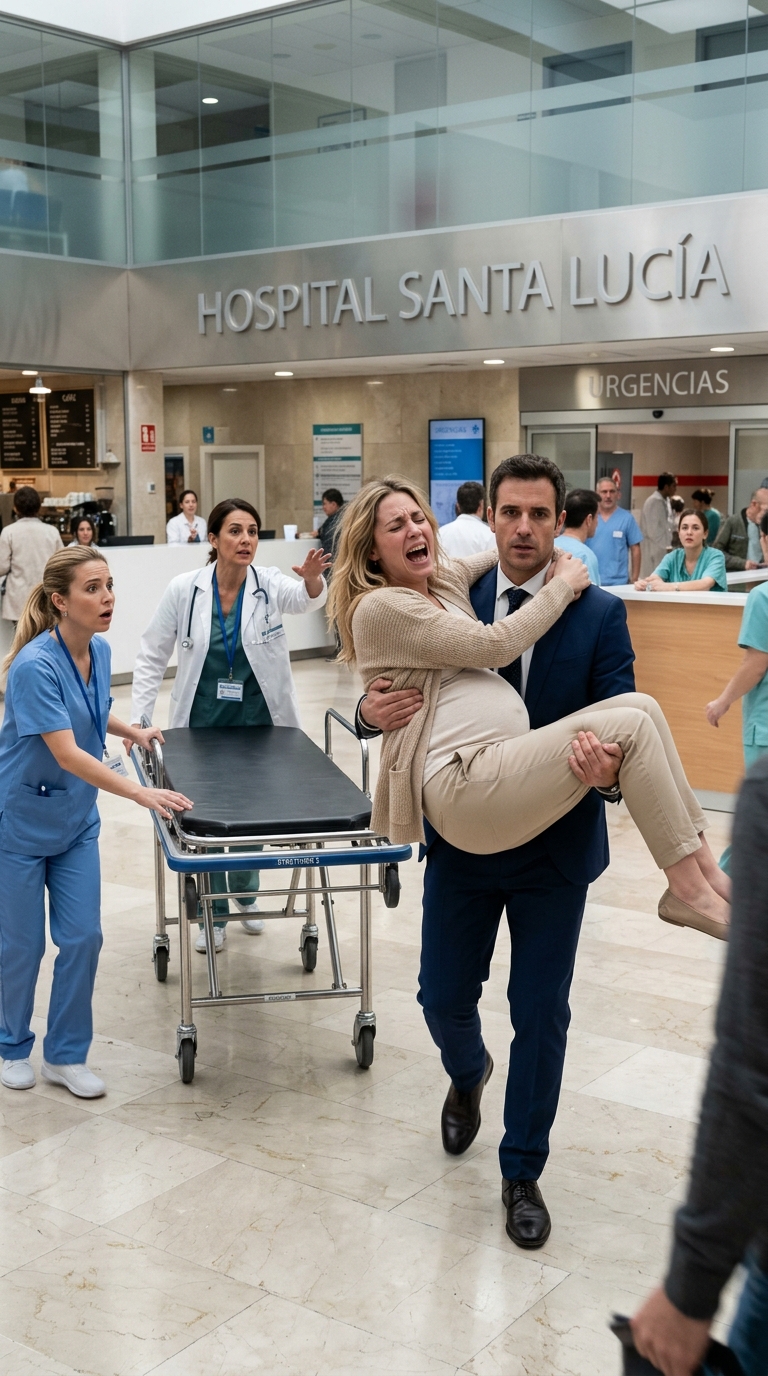
Camila Whitaker stood motionless in the corridor of St. Mercy Medical Center in Chicago, her phone still recording inside the pocket of her white coat. Through the slightly open hospital door, Daniela Rivers lay on the bed with one hand resting on her pregnant belly while a young man named Ivan held her other hand as if he truly belonged there. For eight years, Camila had protected Rodrigo’s pride, endured his mother’s humiliation, and allowed the world to believe she was the reason their marriage had no children.
Now, in less than a day, everything had fractured in front of her.
Rodrigo was infertile.
Daniela was pregnant.
The baby was not Rodrigo’s.
And Rodrigo, the brilliant attorney who believed he had outplayed everyone, was being manipulated like a fool by the woman he introduced as his wife in public.
Camila stepped back from the door before Ivan could notice her silhouette. Her heart raced, but her hands stayed steady. That steadiness surprised her until she recalled something her medical mentor once told her during residency: panic is loud, but precision is quiet.
She entered the supply room, locked the door, and sent the recording to her attorney, Maurice Keller.
Then she typed a single line.
He is not the father. And I have proof.
Maurice called within seconds.
“Camila,” he said carefully, “tell me exactly where you are.”
“At the hospital.”
“Are you safe?”
“Yes.”
“Good. Do not confront anyone. Do not tell Rodrigo what you know. Do not mention the fertility records to the mistress, the boyfriend, the mother-in-law, or anyone in that hospital.”
Camila closed her eyes.
“He brought her here and called her his wife.”
“I know.”
“He told his mother he was bringing his wife and daughter.”
“I know.”
“He planned to pressure me into signing the divorce and giving him the house.”
Maurice’s tone sharpened.
“Then we let him continue planning. People like Rodrigo talk too much when they think they’ve already won.”
Camila leaned against the metal shelf. Eight years of accumulated humiliation surfaced in fragments. Rodrigo’s mother, Evelyn Salazar, staring at her during Thanksgiving and saying, “Some women are just beautifully useless.” Rodrigo resting his hand on Camila’s knee under the table, not to defend her, but to silence her reaction. Rodrigo later whispering, “Just let Mom talk. You know how she is.”
Yes.
Camila knew exactly who Evelyn was.
And she finally understood who she had become by staying silent.
A shield for a man who used her.
Maurice pulled her back to the present.
“I’ll file the initial draft today. But we need one more thing.”
“What?”
“Proof Rodrigo intended to defraud you in the divorce. If he pressures you into a settlement built on deception, coercion, or concealment, it strengthens our case. If he threatens you or admits intent, even better.”
Camila looked toward the hallway.
“He’ll come to me.”
“Yes,” Maurice said. “And when he does, don’t act like a betrayed wife. Act like the woman he still believes he can control.”
That sentence settled inside her like something bitter and necessary.
Be the woman he thinks he can control.
She knew that version of herself well.
She had lived as her for years.
Camila returned to Daniela’s room half an hour later with a nurse beside her and a composed expression. Daniela’s boyfriend was gone. Daniela was scrolling on her phone, smiling faintly until she noticed Camila enter.
Her expression shifted.
Sweet. Controlled. Sharp.
“Doctor,” Daniela said, “is my baby okay?”
Camila checked the monitor.
“For now, yes. You experienced a fluid leak scare, but the fetal heartbeat is stable. We’ll continue monitoring closely.”
Daniela placed a hand on her belly.
“Rodrigo will be so relieved. He’s waited so long to become a father.”
Camila glanced at the chart.
“Is Rodrigo your husband?”
Daniela hesitated briefly.
“Almost.”
Camila lifted her gaze.
“Almost?”
Daniela gave a soft laugh.
“His divorce is complicated. His ex refuses to let go.”
The word ex landed cleanly.
Camila wrote a note on the chart.
“She sounds difficult,” she said.
Daniela relaxed, mistaking neutrality for agreement.
“You have no idea. Rodrigo says she made him miserable for years. Always emotional. Always bitter. Always blaming him for not giving her children.”
Camila placed the stethoscope carefully on Daniela’s abdomen.
“That must have been hard for him.”
Daniela exhaled.
“He deserves happiness. He deserves a real family.”
A real family.
Camila’s expression barely changed.
“Then I hope everyone is being honest with him.”
Daniela’s eyes flickered.
Just once.
Enough.
Camila completed the exam and left before her anger became visible.
By late afternoon, Rodrigo intercepted her near the nurses’ station.
For the first time since arriving with Daniela, he truly looked at her. Recognition spread across his face in stages. Confusion. Shock. Fear. Then calculation.
“Camila?” he said quietly.
She turned as if surprised.
“Rodrigo.”
He scanned her coat, badge, and chart.
“You work here?”
“My first week.”
His mouth opened, then shut.
He glanced toward Daniela’s room.
“How long have you been here?”
“All day.”
That answer did exactly what she intended. It made him uncertain about what she had overheard while revealing nothing.
He stepped closer, lowering his voice.
“I can explain.”
“I’m working.”
“Camila, please.”
She looked at him with the gentle fatigue he had always expected from her.
That expression almost disgusted her now, but she wore it flawlessly.
“Not here,” she said.
Relief softened his face.
“Tonight. I’ll come to the apartment.”
“Our apartment,” she corrected lightly.
He paused.
“Right. Our apartment.”
She nodded once and walked away.
Behind her, Rodrigo exhaled like a man convinced control had not yet slipped away.
That night, Camila placed her phone on a bookshelf in the living room, camera angled toward the couch. Maurice had advised her that Illinois recording laws were complex, so she created a safer structure: he would remain on speaker as her attorney if the conversation became legal, and Rodrigo would be told the call was active. First, she needed him to speak freely.
No candles.
No tea.
No softened edges.
For eight years, she had smoothed every sharp moment so he could remain comfortable while hurting her.
Not anymore.
Rodrigo arrived at 9:12 p.m. holding flowers from a grocery store and wearing the expression of a man rehearsing remorse.
“Cam,” he said softly as she opened the door. “You look exhausted.”
She stepped aside.
He entered cautiously, scanning for anger. There was none. Camila sat in the armchair instead of the couch.
He held out the flowers.
She didn’t take them.
He placed them on the table.
“I never wanted you to find out like that,” he began.
Camila folded her hands.
“You called her your wife.”
He closed his eyes.
“I know.”
“You asked us to save your baby.”
His jaw tightened.
“I panicked.”
“Is she your wife?”
“Not legally.”
Camila studied him.
Rodrigo leaned forward.
“Cam, our marriage has been over emotionally for a long time. You know that.”
“No,” she said softly. “I know you stopped coming home. That’s different.”
Frustration flickered.
“I didn’t plan to hurt you.”
“But you planned to leave me.”
He exhaled sharply.
“I planned it respectfully.”
Camila almost smiled.
Respectfully.
He had brought his pregnant mistress into her hospital and spoken of a “new family.”
He had allowed his mother to label her infertile for years.
He had planned to take the house and leave her with nothing but humiliation.
Respectfully.
He picked up the flowers again, then set them down.
“Daniela is pregnant. I have responsibilities.”
Camila tilted her head.
“To her?”
“To my child.”
The lie hung between them.
She waited.
He misread the silence.
“I know this isn’t fair. I know you wanted children. But maybe this is better. You can start over.”
“With what?”
He frowned.
“What do you mean?”
“What does a respectful divorce look like?”
He relaxed immediately.
Negotiation.
His domain.
“I think we avoid court. No drama. No public mess. I file, you sign. We say infertility and emotional distance.”
Camila’s fingers tightened briefly.
“We say my infertility.”
He looked away.
“It’s what people already believe.”
“The story your mother built.”
“The story you accepted.”
Not gratitude.
Not regret.
Just blame.
Camila nodded slowly.
“And the apartment?”
“I think I should keep it.”
She blinked.
“My parents gave the down payment.”
“It was for us as a couple.”
“They also gave you money to start your practice.”
“And I covered expenses for years.”
Camila let out a quiet laugh.
“With money I earned during residency?”
He stiffened.
“This isn’t productive.”
“Continue. I’m listening.”
He softened his tone.
“You’re a doctor now. You’ll be fine. Daniela can’t work right now. The baby needs stability.”
Camila looked at him.
“Her baby.”
“Yes.”
She tapped her phone.
“Maurice, are you there?”
Rodrigo froze.
A voice came through the speaker.
“I’m here, Camila.”
“What is this?” Rodrigo snapped.
Camila remained calm.
“My attorney is present because you began discussing divorce terms.”
Rodrigo’s face reddened.
“You set me up?”
Maurice responded evenly.
“Mr. Salazar, you may leave at any time. However, since you are proposing settlement terms involving infertility claims, property division, and support for another child, I recommend you proceed carefully.”
Rodrigo stared at the phone.
Then at Camila. His voice dropped.
“You really want to do this?”
Camila stood as well.
“No. I wanted a husband who defended me when his mother called me defective.”
His expression flickered.
“Camila—”
“I wanted honesty. I wanted respect. I wanted the truth to matter before it became evidence.”
Rodrigo’s face changed again.
Evidence.
He heard the word the way lawyers hear thunder.
“What evidence?”
Camila walked to the bookshelf and took out a folder.
She placed it on the coffee table.
Rodrigo looked down.
His old fertility reports stared back at him.
The same ones he had cried over in the clinic parking lot eight years earlier. The same ones Camila had held while he trembled and whispered, “My mother can never know.” The ones she had kept hidden because she had chosen his dignity over her own truth.
Color drained from his face.
“You kept those?”
Camila’s tone stayed calm.
“You asked me to protect you. I did.”
Rodrigo reached for the folder, but she slid it slightly away.
Maurice’s voice came through the phone.
“Do not touch those documents.”
Rodrigo’s eyes sharpened.
“Those are private medical records.”
“Yes,” Maurice said. “And they establish that your wife was never the infertile party your family treated her as for eight years.”
Rodrigo turned sharply to Camila.
“You would actually use this against me?”
Camila felt something inside her finally give way.
“You used me every Sunday at your mother’s table.”
He stepped back.
“That’s different.”
“No. It was just quieter.”
Rodrigo’s breathing grew uneven.
“Daniela doesn’t know.”
Camila tilted her head.
“She knows enough.”
“What does that mean?”
Camila did not answer.
Rodrigo’s voice rose.
“Camila, what does that mean?”
She looked at him steadily.
“It means before you ask me to sacrifice anything else for your new family, you should confirm it is actually yours.”
Rodrigo stared at her.
For once, the courtroom strategist had no argument left.
He left five minutes later without the flowers.
Camila slept poorly, but she slept.
By morning, Rodrigo had called seven times. Evelyn had called twelve. Daniela had called once from the hospital bed, then sent a message that read: You’re bitter because he chose me. Don’t punish my baby.
Camila stared at the message over her coffee.
Her first instinct was to delete it.
Her second was to preserve it.
She chose the second.
At the hospital, Daniela’s condition had worsened overnight. The fluid leak was stable, but her blood pressure was rising, and the fetus required close monitoring. Camila requested another attending physician take over primary oversight to avoid conflict of interest, but remained on the team due to staffing shortages and Daniela’s prior admission under her care.
That morning, Evelyn Salazar arrived like a storm wrapped in pearls.
She marched through the maternity wing with Rodrigo trailing behind her, wearing a cream designer coat and carrying a handbag that signaled wealth more loudly than words. She stopped at the nurses’ station.
“I need to see my daughter-in-law.”
The nurse asked for the patient’s name.
“Daniela Salazar,” Evelyn said.
Camila, standing nearby, turned.
Rodrigo saw her and froze.
Evelyn did not.
“She is under Dr. Whitaker’s care,” the nurse said.
Camila stepped forward.
“I’m Dr. Whitaker.”
Evelyn’s eyes landed on her badge.
Then her expression tightened.
“You.”
Camila offered a professional smile.
“Good morning, Evelyn.”
Evelyn scanned her coat, her ID, her face.
“So this is your new game? Playing doctor while my son’s real family falls apart?”
A few staff members went still.
Rodrigo muttered, “Mom, not here.”
But Evelyn had never been interested in location when she had something to say.
“She couldn’t give my son children,” Evelyn said loudly, “and now she’s hovering around the woman who can. How convenient.”
The hallway went quiet.
Camila met her gaze evenly.
“This is a hospital. If you continue harassing staff, security will escort you out.”
Evelyn let out a sharp laugh.
“Staff? You are still technically my son’s wife because you refuse to let him move on.”
Camila’s voice stayed level.
“Your son came to my apartment last night with divorce terms. My attorney was present.”
Rodrigo stiffened.
Evelyn snapped toward him.
“You spoke to her without me?”
Camila almost smiled.
Control always surfaced in moments like this.
Before Rodrigo could respond, Daniela’s door opened.
Daniela stood there in a hospital gown, one hand gripping the IV pole, the other supporting her abdomen.
“Rodrigo,” she said weakly. “I need you.”
Evelyn’s entire demeanor shifted.
The hostility disappeared.
Warmth replaced it instantly.
“Oh, sweetheart,” she cooed, rushing forward. “You should not be standing.”
Camila watched Evelyn’s hands soften around Daniela’s shoulders—the same softness she had never once extended to her.
Rodrigo moved toward them too, torn between instinct and doubt.
Daniela looked past Evelyn at Camila.
And smiled.
Small.
Certain.
Claiming.
Camila simply checked the chart.
“Back to bed, Ms. Rivers. Your blood pressure is elevated.”
Evelyn stiffened.
“Ms. Rivers?”
Camila looked up.
“That is her legal name.”
Rodrigo closed his eyes.
Daniela’s smile vanished.
The day unraveled from there.
By midday, Rodrigo stopped referring to Daniela as his wife in front of staff. By afternoon, he asked Camila for a private conversation.
She refused.
“All communication goes through legal counsel or medical necessity.”
He looked exhausted.
“Camila… did you hear something yesterday?”
“I hear many things in a hospital.”
“About Daniela.”
Camila finally met his eyes.
“Ask her.”
Fear crossed his face.
For a moment, she almost felt pity.
Almost.
At 5:20 p.m., Ivan returned.
He entered through the maternity wing wearing a cap and carrying a backpack. He tried to slip into Daniela’s room, but Rodrigo was already there. Camila was at the end of the hall when the voices rose.
“Who are you?” Rodrigo demanded.
Daniela snapped, “Ivan, leave.”
Ivan stepped inside anyway.
“No. I’m not disappearing anymore.”
Camila signaled the charge nurse.
“Call security. Wait outside unless escalation is necessary.”
Then she moved closer.
Rodrigo’s voice dropped.
“You again?”
Ivan laughed bitterly.
“Ask her.”
Daniela immediately began crying.
“You’re insane. He’s obsessed with me.”
Ivan opened his backpack.
Photographs.
Printouts.
Messages.
“I’m obsessed?” he said. “I lived with her until four months ago. She told me you were a rich fool who would pay for silence if I stayed quiet.”
Rodrigo froze.
Daniela screamed, “Shut up!”
Evelyn rose slowly from the chair.
“What is he talking about?”
Ivan looked at her directly.
“That baby is mine.”
Silence dropped hard.
Rodrigo went pale.
Camila stood at the doorway, close enough to hear everything, far enough not to be seen.
Daniela clutched her abdomen.
“He’s lying.”
Ivan’s voice cracked.
“Then explain why you told me Rodrigo couldn’t be the father.”
Rodrigo staggered back.
Evelyn turned to him.
“What does that mean?”
Rodrigo looked at Daniela.
Daniela looked at Camila.
And in that moment, the room finally ran out of places to hide.
Camila stepped inside.
“Security is on the way. The patient needs stability.”
Rodrigo stared at her.
“You knew.”
Camila met his gaze.
“I knew before she ever entered this hospital.”
Evelyn gasped.
Rodrigo’s humiliation turned sharp.
“You told her?”
Camila’s tone stayed clinical.
“No. Biology did.”
Ivan looked stunned.
Evelyn looked between them all.
“What is going on here?”
Camila said nothing.
This was no longer hers to carry.
Rodrigo looked at his mother.
For the first time in years, he had no script left.
“I can’t have children,” he said.
Evelyn’s mouth opened.
Then closed.
“No.”
Rodrigo lowered his gaze.
“Camila was never the problem.”
The words hit harder than any accusation she had ever made.
For years, Evelyn had built her identity around Camila’s supposed failure. Now that foundation collapsed in a single sentence.
She turned toward Camila.
Not with apology.
With disbelief.
“You knew?”
Camila nodded once.
“And you let me believe—”
“I let your son decide when the truth was told.”
Evelyn’s face hardened again.
“You should have told me.”
Camila let out a quiet breath.
“After you called me defective at Christmas?”
Evelyn looked away.
Rodrigo sank into a chair.
Daniela reached for him.
“Rodrigo, please—”
He pulled back.
Ivan stepped forward.
“I don’t care about money. I just want my daughter.”
Daniela snapped, “You want leverage.”
“From you?” Ivan laughed. “You can’t even support yourself.”
Evelyn gripped the bed rail.
“My son paid for your apartment?”
Daniela said nothing.
Rodrigo slowly looked up. “Did you lie to me from the beginning?”
Daniela’s expression shifted again. The fragile patient disappeared. In her place stood the survivor, the opportunist, the woman backed into a corner.
“You lied too,” she snapped. “You told me your wife trapped you in a dead marriage. You told me you were leaving her. You told me everything you had was basically yours.”
Camila took that in quietly.
Everything you had was basically yours.
So Rodrigo had been rehearsing theft long before he brought Daniela to the ER.
Security arrived and escorted Ivan out after he agreed to wait downstairs. Daniela was reexamined. Her blood pressure spiked under stress, and the medical team decided to keep her under close observation. The baby remained stable, stubbornly surviving inside the chaos the adults had created around her.
By evening, Rodrigo was alone in the hospital chapel.
Camila found him there by chance while passing through the corridor between wards.
He looked smaller than she had ever seen him.
For a moment, she saw the man from the fertility clinic years ago—the man who cried in his car, who whispered that his mother could never know, the man she had once protected because she loved him.
Then he looked up.
And that old softness in her chest turned into grief for someone who had never truly existed.
“Cam,” he said.
She stopped at the doorway.
“I won’t stay.”
“I know.”
He rubbed his hands together.
“I ruined everything.”
“Yes.”
He flinched.
Maybe he had expected comfort.
Camila had none left to give.
“I was ashamed,” he said.
“I know.”
“I thought if Daniela was pregnant, maybe the doctors were wrong. Maybe it was a miracle.”
Camila looked at him.
“You’re a lawyer, Rodrigo. You understand evidence.”
He let out a bitter laugh.
“I understand wanting to believe a lie when it makes you feel like a man.”
That sentence might have once reached her.
Now it only explained the damage.
“You let your mother humiliate me for eight years.”
His eyes filled.
“I’m sorry.”
Camila studied him.
“Are you sorry because you hurt me, or because Daniela lied to you?”
Rodrigo closed his eyes.
He didn’t answer.
That was answer enough.
Camila turned to leave.
He stood quickly.
“Wait. The divorce. We can talk.”
“We will. Through attorneys.”
“I won’t fight you on the apartment.”
She glanced back.
“You won’t win if you do.”
His mouth tightened.
There it was again—the calculating edge beneath the remorse.
“Your parents gave us money,” he said. “But my name is on certain things too.”
Camila smiled faintly.
“And there he is.”
“What?”
“The real Rodrigo. Still negotiating over a life he set on fire.”
He looked hurt.
“I said I wouldn’t fight.”
“No. You said it because you realized I have more evidence than you expected.”
He went silent.
Camila walked away.
The divorce petition was filed the next morning.
Maurice moved quickly. The filing included emotional cruelty, financial misconduct, attempted coercion, and documentation that Rodrigo had allowed false claims about Camila’s infertility to shape divorce negotiations. The $65,000 from her parents and the $120,000 condo contribution were fully recorded.
Rodrigo’s first response came through his attorney.
He wanted privacy.
He wanted discretion.
He wanted “a fair and compassionate separation.”
Camila read the phrase three times.
Fair and compassionate.
Where had fairness been when his mother mocked her?
Where had compassion been when he called another woman his wife?
Where had discretion been when he planned to trade her pain for convenience?
Maurice asked what she wanted.
Camila answered without hesitation.
“The condo. Repayment of my parents’ money. My retirement untouched. No spousal support. And a written admission that infertility was never mine.”
Maurice lifted an eyebrow.
“The admission will be the hardest part.”
“Then make it expensive not to give it.”
He smiled.
“Now you sound like a surgeon.”
“I’m an OB-GYN.”
“Same thing. Clean cuts.”
While the divorce escalated, Daniela delivered early.
A baby girl was born by emergency C-section after fetal distress two weeks later. Camila was not in the operating room—she had stepped away from Daniela’s care by then—but she heard the cry afterward, strong and real, and felt a brief, unexpected relief.
The child had done nothing wrong.
She had simply arrived inside consequences she didn’t create.
A paternity test followed quietly.
Ivan was the father.
Rodrigo was not.
The result no longer surprised anyone, but it still shattered Rodrigo publicly because Evelyn had already told her circle he would become a father. Daniela disappeared from his plans, his apartment fantasies, and eventually his life. Ivan sought custody rights. Daniela, facing medical bills and no financial support, tried twice to reach Rodrigo.
He never responded.
Camila learned this indirectly through Maurice, when the legal noise spilled beyond containment.
One afternoon, Daniela appeared outside the hospital.
She was thinner now, pale, holding a baby carrier in one hand and a diaper bag in the other. Camila saw her near the staff lot and stopped a few steps away.
“Dr. Whitaker,” Daniela said.
Camila glanced around.
“You shouldn’t be here.”
“I needed to talk to you.”
“There’s nothing to discuss.”
Daniela’s eyes filled, but Camila no longer trusted tears as truth.
“I know you hate me.”
“I don’t.”
That startled her.
Camila continued.
“Hating you would take more space than you’re worth.”
Daniela swallowed.
“I didn’t know everything.”
“You knew enough.”
Daniela looked down at the carrier.
“She’s beautiful,” Camila said quietly.
Daniela’s mouth trembled.
“She is.”
“Then stop using her as a way into someone else’s life.”
Daniela flinched.
For a moment, the mask broke. What remained wasn’t a villain—just a frightened woman who had made damaging choices and expected them to be reversible.
“Rodrigo lied to me too,” Daniela whispered.
“Yes,” Camila said. “And you lied right back.”
Daniela nodded slowly.
“I’m sorry.”
Camila looked at the sleeping baby.
The apology was late, incomplete, and mostly useful to Daniela.
But Camila accepted one truth inside it: Daniela wasn’t the root. She was the reflection of Rodrigo’s choices.
“Raise her better than you behaved,” Camila said.
Then she walked away.
The confrontation with Evelyn came three months later.
Not at the hospital.
Not at a dinner table.
In a mediation room during divorce proceedings.
Evelyn arrived uninvited, dressed in black like a performance of grief. Rodrigo’s lawyer looked uneasy. Maurice looked amused. Rodrigo looked exhausted.
Camila sat across from them with a folder in front of her.
Evelyn ignored everyone and fixed her gaze on Camila.
“You destroyed my son.”
Camila didn’t blink.
“No. I stopped protecting him.”
Evelyn’s face tightened.
“You humiliated him.”
“You humiliated me for eight years.”
“I didn’t know.”
Camila opened the folder and placed a printed photo on the table. A holiday dinner. Camila standing beside Rodrigo. Evelyn mid-toast, smiling.
“You said, ‘To women who can fill a home with children, not excuses.’ Everyone laughed.”
Rodrigo looked down.
Evelyn’s jaw tightened.
Camila placed another photo.
“Mother’s Day. You gave me an empty frame and said maybe I could use it for a dog.”
Maurice’s expression hardened.
Another photo.
“Rodrigo’s birthday. You told guests your son could have built a dynasty if he had married correctly.”
Evelyn’s voice dropped. “Enough.”
“No,” Camila said. “You don’t get silence anymore.”
The room went still.
Camila turned slightly toward Rodrigo.
“And you sat through all of it.”
His eyes filled.
“I know.”
Evelyn shook her head.
“I was defending my son.”
“You were feeding his cowardice.”
Evelyn slammed the table.
“Don’t speak to me like that.”
Camila leaned in slightly.
“You mistook my patience for permission. That ended the day he brought another pregnant woman into my ER and called her his wife.”
Evelyn looked away first.
Not victory. But shift.
The settlement finalized six weeks later.
Rodrigo signed the written admission.
It was only two paragraphs, but Camila read them until her hands steadied.
During the marriage, I allowed others to believe Dr. Camila Whitaker was responsible for our infertility. That was false. Medical records confirmed my infertility years earlier. I failed to correct that narrative and failed to protect her from harm caused by it.
It wasn’t enough.
Nothing would be.
But it was real.
The condo went to Camila.
Her parents were repaid over time. Rodrigo kept his practice, though his reputation suffered. Evelyn’s social standing quietly collapsed under the weight of gossip she could no longer control.
Camila didn’t celebrate.
She changed the locks.
Then she repainted the bedroom.
Gray became deep green. White curtains replaced heavy drapes. The shared bed was replaced entirely. Wedding photos disappeared, except one from her medical school graduation—her parents beside her, proud and tired.
Rodrigo wasn’t in it.
He had missed the ceremony.
As she now remembered, he hadn’t even called until the next day.
Six months later, her mother visited with soup.
“You look thinner,” her mother said.
“I’m fine.”
“No, mija. You’re functioning. That’s different.”
Camila closed her eyes.
When she finally told her parents the truth, her father had once broken a mug in the kitchen without meaning to, hands shaking as he said, “I should have known.”
She had told him no.
But parents often carry guilt even when they did nothing wrong.
Over soup, her mother asked, “Do you still want children?”
Camila stared into the bowl.
“I don’t know,” she said honestly.
Her mother nodded.
“That is allowed.”
And for the first time, not knowing felt like air instead of failure.
She buried herself in work, but not as escape. She worked with focus and then went home. She ate. She slept. She joined a pottery class and made uneven bowls her coworker insisted were “emotionally significant.”
She also changed how she practiced medicine.
When women apologized for crying, she told them not to. When husbands interrupted, she redirected the conversation back to the patient. When mothers-in-law dominated rooms, she had security remove them without hesitation.
Pain hadn’t erased her kindness. It had refined it.
One rainy night, almost a year later, Rodrigo returned.
Not with Evelyn.
Not with Daniela.
Alone.
He sat in the waiting area with a bruised cheek and blood on his sleeve when Camila passed after a delivery.
She stopped despite herself.
He looked up.
“Cam.” Her body reacted before her mind could catch up. A quick pulse. A tightening in her throat. A memory of flowers on a coffee table and medical records laid between them.
“What happened?” she asked.
“Car accident. Minor. They already checked me.”
She nodded.
“Good.”
She turned to leave.
“Wait.”
Camila stopped and looked back.
Rodrigo rose slowly.
“I heard you got promoted.”
She blinked.
“Yes.”
“Chief resident said you’re one of the best attendings they have.”
Camila almost corrected him on the title, then decided he didn’t need any more access to her.
“Thank you.”
He looked older.
Not dramatically—just worn at the edges, like something slowly eroding.
“I’m in therapy,” he said.
She didn’t respond.
“I should have started years ago.”
“Yes.”
He gave a small, strained smile.
“You don’t make anything easy.”
“I made everything easy for eight years.”
That silenced him.
He nodded once.
“You did.”
For once, he didn’t argue.
It felt stranger than anger.
“I came here because the ambulance brought me,” he said. “Not because I wanted to see you.”
“Okay.”
“But since I saw you… I need to say something. I know the admission in the settlement was legal language. I know it wasn’t enough.”
Camila folded her arms.
“No, it wasn’t.”
“I was cruel because I was ashamed. That doesn’t excuse it. It just means the person I punished for my shame was the person who protected me from it.”
His eyes welled, but he didn’t lean on it.
“I’m sorry, Camila. Not because Daniela lied. Not because my mother knows. Not because I lost the condo. I’m sorry because you loved me better than I deserved, and I made you pay for my weakness.”
Camila studied him for a long moment.
Something in the apology reached her.
Not the part that wanted him back—that part was gone.
It reached the part that once questioned whether the harm had been real.
“I hope therapy helps you become someone safer,” she said.
He nodded.
“Me too.”
She turned to leave.
“Camila?”
She stopped again.
“Do you forgive me?”
The question landed heavy—not as accountability, but as a request for relief.
Camila stayed quiet.
Then she said, “I release you from being part of my life. That is what I can give you.”
His face fell, but he didn’t protest.
He accepted it.
And that was all.
She walked away without looking back.
Two years later, Camila stood in an auditorium at Northwestern’s medical school, speaking at a conference on reproductive ethics and patient dignity. Her talk was meant to be clinical—fertility stigma, confidentiality, gendered blame, family pressure in medicine.
But midway through, she paused.
The room was full of residents, physicians, nurses, counselors.
So she told the shape of something true.
Not names. Not private details.
Just the outline.
“A woman can be harmed by a diagnosis she does not have,” Camila said. “Sometimes the body being blamed is not the body with the condition. Sometimes silence is requested in the name of love, but silence becomes the place where cruelty grows.”
The room went still.
“Protecting someone’s dignity should never require the erasure of your own. If love asks you to become a shield for someone else’s lies, it is not love. It is extraction.”
Afterward, a young resident approached her, eyes red.
“My husband’s family thinks I’m the reason we can’t have children,” she whispered. “I’m not.”
Camila felt a familiar tightening in her chest.
“Does your husband defend you?”
The woman looked down.
“No.”
Camila placed a steady hand on her arm.
“Then start there. Not with the test results. With that.”
Years ago, she would have softened it.
Now she told the truth cleanly.
The resident hugged her quickly before leaving.
Camila stood still for a moment afterward, feeling the strange balance of it—pain that had not become beautiful, only useful.
And useful was enough.
That spring, she bought a small house outside Evanston with a blue front door and a garden that refused to behave. Her father planted tomatoes badly. Her mother brought too many dish towels. Friends filled the rooms with noise and laughter and arguments about furniture placement.
No one asked where Rodrigo would sit.
No one asked when she would have children.
No one treated her absence as something to fix.
One Sunday morning, Camila sat on the back steps with coffee, watching light fall across the unfinished garden. Her phone buzzed with a message from Maurice.
Final payment completed. Rodrigo has fulfilled all obligations. Case closed.
Camila stared at the words.
Case closed.
Too neat for something that had taken years.
She looked around—the crooked stakes, the chipped mug, the quiet house behind her.
No courtroom applause. No dramatic closure. No one begging for forgiveness on their knees.
Just silence.
And peace that didn’t ask permission.
Months later, she ran into Evelyn at a women’s health charity event. Evelyn looked smaller somehow, less certain, still elegant but no longer commanding the room.
She approached near the exit, hands tight around her purse.
“Dr. Whitaker,” Evelyn said.
Camila turned.
“Evelyn.”
A pause.
“I heard your talk was excellent.”
“Thank you.”
Evelyn hesitated, as if searching for a version of herself that could survive this moment intact.
Then she said, “I was wrong.”
Camila didn’t respond immediately.
Evelyn’s eyes watered.
“I was cruel because I thought protecting my son meant choosing someone to blame. I liked being right more than I cared about being fair.”
It wasn’t full redemption.
But it was truth, finally spoken without an audience.
“I know,” Camila said.
Evelyn flinched slightly at how calm it was.
“I don’t expect forgiveness.”
“Good.”
Not sharp. Just final.
Evelyn nodded, accepting what she could not shape.
Camila walked past her into the sunlight.
She didn’t feel victorious.
She felt unburdened.
That evening, she visited her parents for dinner. Her father overcooked the meat. Her mother packed leftovers before anyone finished eating. They argued gently about her workload, and she let herself be cared for without turning it into obligation.
After dinner, her father sat beside her on the porch.
“I used to think strength meant you didn’t need anyone,” he said.
Camila looked at him.
“I used to think that too.”
He lowered his gaze.
“I’m sorry.”
She leaned lightly against him.
“You showed up when I told the truth. That’s what matters.”
They sat in the fading light.
Camila thought of who she had been that day in the ER—standing still while her life split open in real time.
That version of her had wanted to break.
Instead, she had documented. Protected. Chosen precision over collapse.
Not because she was unfeeling.
Because she was done surviving by erasing herself.
Years later, people would ask why she became known for advocating so strongly for women in reproductive medicine.
They expected a polished answer.
She usually gave them one.
“I learned that silence can be mistaken for consent,” she would say.
It was enough.
She never told them about Rodrigo’s voice in the ER, or Daniela’s messages, or Evelyn’s frame for a child that never existed, or the box of medical records that had once defined her worth in someone else’s hands.
Those belonged to survival.
Not to identity.
On the third anniversary of her divorce, she hosted dinner in her blue-door house. Her parents came. Maurice brought wine. A colleague from the hospital brought dessert. The resident from the conference—now no longer under anyone’s control—came too.
They ate in the garden under soft lights.
Someone made a toast to new beginnings.
Camila lifted her glass but didn’t repeat the phrase.
New beginnings sounded too clean.
Nothing about her life had been clean.
It had been rebuilt—slowly, deliberately, unevenly.
A signature. A boundary. A truth spoken aloud. A debt erased. A lock changed.
Piece by piece.
Later, after everyone left, she washed dishes in a quiet kitchen. Outside, the garden moved in the wind. Her phone stayed still on the counter. No demands. No manipulations. No crises that required her to disappear into someone else’s story.
She dried her hands and stood in the hallway.
For years, she had mistaken endurance for love.
Now she understood the difference.
Love did not require self-erasure.
Love did not turn private pain into public punishment.
Love did not bring another life into your emergency room and call it yours while you stood there erased.
And dignity, once reclaimed, did not bend again.
Camila walked into her bedroom—the deep green room she had chosen herself—and hung her white coat over the chair.
Tomorrow she would deliver babies.
Hold trembling hands.
Speak truth gently.
Remove people from rooms when control disguised itself as care.
And never again confuse silence with safety.
Because Rodrigo had been wrong about one thing.
Camila was never lacking.
Not in the way that mattered.
Her life, once no longer contained by someone else’s story, grew everywhere.
