


At 9:47 on a rainy Tuesday night in Chicago, Evelyn Whitlock died for the first time.
The monitors screamed so loudly that Dr. Mara Ellison could still hear them over the shouting nurses, the metallic crash of instruments, and the wet slap of blood hitting the delivery-room floor. Evelyn was only twenty-seven, her dark hair pasted to her temples, her lips almost white, her body opened beneath the lights so two premature babies could be pulled from the disaster her husband had helped create.
“Pressure is crashing,” a nurse called.
“Get the second unit in here now,” Dr. Ellison snapped. “And page neonatal. We are not losing all three of them.”
Evelyn’s eyes opened for one thin, impossible moment. They were gray-green, fever-bright, and full of a terror that did not belong to the surgery. It belonged to whatever waited outside the operating room.
Dr. Ellison leaned close. “Evelyn, stay with me.”
“My babies,” Evelyn breathed.
“We’re getting them out. I promise.”
Evelyn’s fingers twitched against the sheet. “Don’t… give them… to Grant.”
Dr. Ellison froze for half a second. In medicine, half a second was dangerous, but the words landed hard enough to break her rhythm.
“Your husband?”
Evelyn tried to answer, but her body arched once, violently, and the monitor flattened into a single, merciless tone.
“Start compressions,” Dr. Ellison shouted. “Now.”
Across the room, the neonatal team lifted out the first baby, a girl, tiny and furious, her cry sharp enough to cut through the panic. The second baby, a boy, came out blue and silent for three terrible seconds before he coughed, whimpered, and then screamed as if protesting the world that had nearly taken him before he could see it.
Two babies lived.
Their mother did not.
At least, that was what everyone believed.
Outside the delivery room, Grant Whitlock stood near the vending machines with his phone in his hand. He was handsome in the polished way men became handsome when money had spent years sanding away every rough edge. His navy suit jacket was folded over one arm. His tie was loosened, but not enough to look careless. His face had the patient irritation of a man waiting for a delayed flight, not the fear of a husband whose wife was bleeding to death twenty feet away.
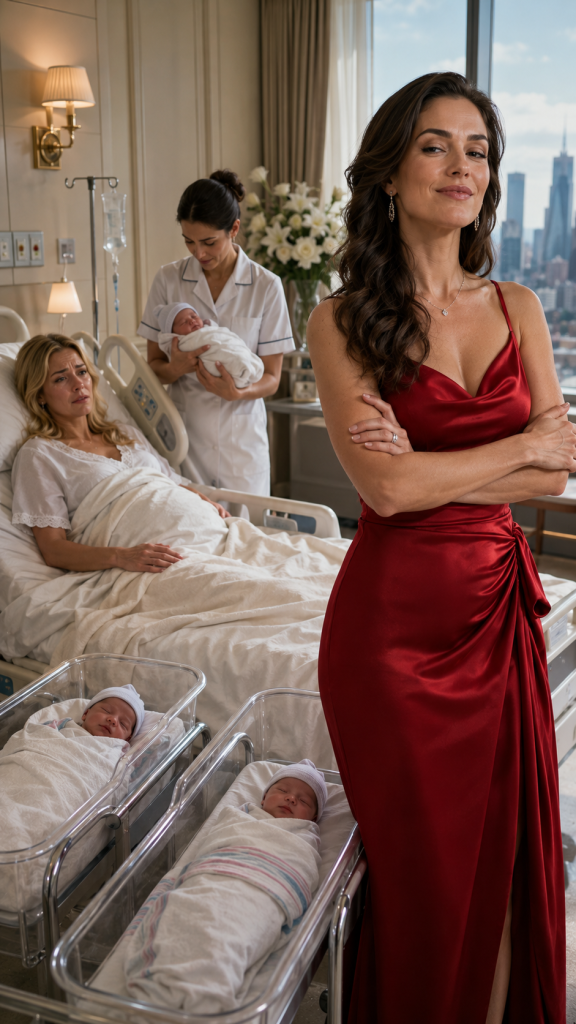
When Dr. Ellison came out, she still had blood on the cuff of her surgical gown.
“Mr. Whitlock,” she said quietly.
Grant looked up. “Are the babies alive?”
Dr. Ellison stared at him.
She had delivered babies for almost twenty-three years. She had seen men collapse. She had seen men curse God. She had seen men deny reality until their voices broke. She had never seen a husband ask first about the infants and not the woman who had carried them.
“The babies are alive,” she said. “A boy and a girl. They’re premature, but they’re breathing.”
Grant exhaled, almost like relief.
Then Dr. Ellison said, “Your wife didn’t make it. I’m sorry. We did everything we could.”
Grant blinked once.
Not twice.
Once.
Then he looked down at his phone, turned away, and said, “I need to make a call.”
Dr. Ellison watched him walk to the darker end of the hall. Something moved through her that was colder than medical grief. It was recognition. Not proof, not yet, but the shape of proof before it had words.
Grant pressed the phone to his ear.
A woman answered on the second ring. “Is it done?”
Grant’s voice dropped. “She’s gone.”
There was silence, then a breathy laugh that tried to become a sob and failed.
“Oh my God,” Sloane Mercer whispered. “Finally.”
“Don’t come tonight,” Grant said. “We wait a few days. We do it clean.”
“What about the babies?”
“They’re alive.”
“Both?”
“Yes.”
Sloane was quiet for a beat. “Then we still win.”
Grant smiled faintly in the dim hallway. “Yes. We still win.”
Four days later, Sloane Mercer changed the sheets on Evelyn Whitlock’s bed.
She came into the Lakeview townhouse with two rolling suitcases, a cashmere coat, and the confidence of a woman who had spent two years rehearsing this entrance in her mind. She ordered the housekeeper to throw away Evelyn’s robe, Evelyn’s slippers, Evelyn’s half-used bottle of lavender lotion beside the sink.
“She wouldn’t want us living in a shrine,” Sloane said, standing in the bedroom doorway while Grant held one of the newborns awkwardly, not because he wanted to, but because his mother had told him appearances mattered.
The baby girl, Lily, cried against his shoulder.
The baby boy, Noah, slept through everything.
Sloane reached into a drawer and pulled out a pair of soft yellow baby shoes Evelyn had bought during her seventh month. The tag was still attached. Evelyn had saved them, waiting for the day the twins could wear them home from the hospital.
Sloane photographed them on the freshly made bed.
An hour later, she posted the picture online with the caption:
Sometimes life gives you a second chance at family.
By midnight, three hundred people had liked it.
By morning, half of Grant’s social circle had commented with hearts, prayers, and phrases like Evelyn would want you to be happy.
But Evelyn had wanted no such thing.
Evelyn had prepared.
Weeks before her delivery, while Grant slept drunk in the guest room and Sloane sent him pictures from hotel bathrooms, Evelyn had sat on the floor of the nursery and sewn a sealed envelope into the lining of her old gray coat. Inside the envelope were three things: a handwritten letter, a small USB drive, and a typed page titled:
Instructions If I Do Not Survive.
The first line of the letter read:
If anyone is reading this now, please believe me.
The woman everyone underestimated had written her last battle plan before she ever reached the operating table.
And the first person to find it was not Grant.
It was Ruth Navarro, a fifty-nine-year-old night nurse with silver-streaked hair, steady hands, and the kind of eyes that had seen too many families lie beside hospital beds. Ruth had worked at Northwestern Memorial for thirty-one years. She had learned that grief had many faces, but greed had only one. Grant Whitlock wore it cleanly.
Three hours after Evelyn was pronounced dead, Ruth went downstairs to help prepare the body for release.
She told herself she had volunteered because the younger nurses were shaken. That was true, but it was not the whole truth. She had seen Evelyn before. Three months earlier, Evelyn had come in with a “fall down the stairs.” Ruth had noticed the bruises around both wrists, the split lip carefully hidden under makeup, the way Evelyn flinched when Grant entered the room.
Now Evelyn lay on the steel table beneath a white sheet.
“Sweet girl,” Ruth whispered. “I’m sorry.”
By routine, she checked the wristband. Evelyn Harper Whitlock. Female. Twenty-seven. Time of death: 9:47 p.m.
Then, because thirty-one years in a hospital made habit stronger than sorrow, Ruth placed two fingers lightly against Evelyn’s neck.
Nothing.
She started to pull away.
Then she felt it.
So faint it was almost imagination.
A pulse.
Ruth stopped breathing.
She pressed again, harder, waiting through one second, two, five, ten.
There.
A weak beat.
Then another.
Ruth stumbled back. “No.”
Evelyn’s chest did not visibly rise. Her skin was cold. Her pulse came so slowly that a rushed doctor in a collapsing emergency could miss it. But she was not dead.
Ruth ran for Dr. Ellison.
Within minutes, the basement room was filled again with people who understood that a miracle could become a murder if the wrong man learned about it too soon.
Dr. Ellison checked Evelyn herself. Her face went pale.
“She’s alive,” Ruth said.
“I know.” Dr. Ellison swallowed. “Profound shock. Minimal cardiac activity. It happens rarely, but—God. We called it too early.”
“Her last words were about not giving the babies to him,” Ruth said.
Dr. Ellison looked at her.
Ruth lowered her voice. “I saw the bruises months ago. You saw him tonight.”
The doctor did not answer immediately. Medicine had protocols. Hospitals had policies. Husbands had rights. But Evelyn had rights too, and Evelyn could not speak.
Then Ruth remembered the coat.
It was in the belongings bag on the lower shelf, folded beside Evelyn’s scuffed flats, wallet, and ultrasound photo. Ruth had inventoried thousands of bags like it, but the seam near the lining caught her eye because it was uneven, stitched by hand.
She cut it open with medical scissors.
The envelope slid out.
Dr. Ellison read the letter first.
By the second page, her hands were shaking.
By the third, she had called hospital legal, a domestic violence advocate, and one number Ruth never expected to hear spoken inside a hospital.
The name was Dante Caruso.
In Chicago, people said that name carefully.
Dante Caruso owned import companies, restaurants, security firms, parking garages, warehouses near the river, and half a dozen charities that photographed well at Christmas. He also owned things nobody put on paper. Men who crossed him left town, lost businesses, or vanished into silence. The police suspected. The newspapers hinted. No one proved.
But Ruth knew something most people did not.
Eight months before Evelyn’s delivery, Dante Caruso had carried Evelyn into the emergency entrance at three in the morning.
Ruth had been on shift.
She had seen the blood on Evelyn’s mouth. She had seen Dante’s hands, bruised at the knuckles, and the way he stood beside the bed like a wall between Evelyn and the world. He had not given his name at first. Evelyn had been too frightened to give Grant’s.
That night, while Grant was at home passed out drunk after beating his wife in a hospital parking lot, Evelyn had spoken to Dante in the quiet dark of an emergency room.
She had told him too much because pain had made her honest.
He had told her one thing in return.
“My mother died because every man in the room pretended not to see my father’s hands,” Dante said. “I don’t pretend.”
Evelyn had looked at him through swollen eyes. “Are you a good man?”
Dante had been silent for a long time.
“No,” he said. “But I know what evil looks like.”
That night should have ended there.
It did not.
One broken woman, one dangerous man, one night of comfort neither of them named.
By morning, Dante was gone.
Evelyn thought she had dreamed him.
Then, weeks later, she learned she was pregnant.
Grant smiled when the doctor confirmed twins. He celebrated with champagne. He called his mother. He let everyone believe they were his.
Evelyn did not correct him because survival taught her that truth, used too early, could become a weapon against you. But she counted dates. She knew. She also knew Grant would never allow her to leave with babies he considered his property.
So she collected evidence.
She hid cameras. She copied messages. She downloaded bank files from Grant’s unlocked laptop. She wrote dates, times, bruises, threats. She built a case in silence because no one had ever saved her long enough to teach her another way.
Now, lying in a hospital basement with a pulse too faint for the world to notice, Evelyn became the center of a war.
Dante arrived through a service entrance twenty-two minutes after Ruth’s call.
He wore a black overcoat, rain on his shoulders, his dark hair slicked back from a face cut sharp by old violence. A thin scar ran from his left temple to his jaw. His eyes were a cold gray that made even hospital security guards look away.
Dr. Ellison stood between him and Evelyn’s body.
“She needs a protected medical transfer,” the doctor said. “Not a kidnapping. Not one of your disappearing acts. If you want to help her, it happens clean. Legal. Documented. Sealed under domestic violence protection until she can speak for herself.”
Dante looked at Evelyn on the table.
For the first time, Ruth saw something fracture in his expression.
“Do it,” he said.
Hospital legal moved faster than anyone expected because the letter was detailed, the videos were undeniable, and Evelyn’s last words had been witnessed by a doctor. By sunrise, Evelyn had been transferred under a sealed protective order to a private critical-care facility north of the city. Grant was told only that an administrative review had delayed the release of remains.
But Grant did not wait.
He pushed papers. He pressured. He lied. He claimed Evelyn had wanted immediate cremation. A funeral home connected to his mother’s lawyer produced a sealed urn for a closed memorial three days later.
No one in that room knew the urn contained ashes from a hospital-contracted crematory with no name attached.
Grant did not ask.
He placed the urn on the mantel for exactly six hours, accepted condolences, and moved it to a closet before dinner.
Two weeks later, he filed the life-insurance claim.
Three weeks later, he filed for full custody.
Six weeks later, Evelyn opened her eyes.
The first thing she saw was sunlight on Lake Michigan.
For a moment she believed she was dead and heaven was colder than advertised.
Then she heard a heart monitor.
A woman’s voice said, “Evelyn?”
Evelyn turned her head. Ruth Navarro sat beside the bed, a book fallen open in her lap, tears standing in her eyes.
“My babies,” Evelyn rasped.
Ruth took her hand. “They’re alive. Lily and Noah. They’re healthy.”
Evelyn’s face crumpled with relief so pure it was almost pain.
Then Ruth said, “They’re with Grant.”
The relief disappeared.
Evelyn tried to sit up. Her arms buckled. The room tilted.
“No.” Her voice came out broken. “No, he can’t have them. Ruth, he’ll use them. He’ll—”
“I know,” Ruth said. “We all know now.”
Evelyn’s eyes sharpened. “Who is ‘we’?”
The door opened before Ruth could answer.
Dante Caruso stepped inside.
Evelyn stopped breathing.
Eight months had not softened the memory of him. She remembered his hand around Grant’s throat in the parking lot. She remembered his coat around her shoulders. She remembered waking in the ER with him in the chair beside her, silent, dangerous, and somehow safer than anyone she had known.
“You,” she whispered.
Dante stopped at the foot of her bed. “You woke up.”
“You were real.”
His face did not change. “Yes.”
Evelyn stared at him, and slowly, painfully, the pieces arranged themselves. The private room. Ruth. The secrecy. The way Dante stood like a man who had purchased the right to command the air around him.
“You know,” she said.
Dante’s jaw tightened once. “I read the letter.”
“My children?”
His eyes flicked toward her stomach, now flat beneath the blanket. “Our children.”
The words should have startled her. They did not. They only made the truth heavier.
Evelyn looked away toward the lake.
For months she had carried that truth alone, afraid of it, protected by it, haunted by it. Now it stood in the room wearing a black overcoat and a scar.
“Grant thinks they’re his,” she said.
“Not for long.”
Evelyn turned back. “Don’t kill him.”
For the first time, Dante looked almost surprised.
She pushed herself higher against the pillows. Her voice was weak, but her eyes were not. “I mean it. Don’t kill him. Death would make him a victim in someone’s story. I want him alive. I want him exposed. I want every person who smiled at him, every person who believed him, every person who called me fragile or unstable or dramatic, to hear exactly what he did.”
Dante studied her.
Evelyn continued, each word clearer than the last. “I want my babies back legally. I want his money frozen. I want the insurance company to know I’m breathing. I want the police to see the videos. I want his mistress to explain why she posted my children’s shoes on my bed four days after I ‘died.’ I want his mother to watch her perfect son get handcuffed in a courtroom.”
Something like approval moved through Dante’s eyes.
“You came back from the dead angry,” he said.
Evelyn gave a faint, humorless smile. “No. I came back a mother.”
That became the plan.
Not revenge in the dark.
Revenge under fluorescent lights, before a judge, with transcripts and evidence and reporters waiting outside.
Dante’s attorneys were not the kind of lawyers whose names appeared on bus benches. They worked from private offices with no signage and spoke in calm voices that made threats unnecessary. They filed first as representatives of the children’s interests, requesting a temporary review of Grant Whitlock’s custody petition. The reason was simple: credible evidence suggested Grant might not be the biological father.
Grant received the motion on a Thursday morning.
Sloane found him in the kitchen, the paper shaking in his hand.
“What is it?” she asked.
He shoved it at her.
She read three lines and went pale. “Can they do that?”
“They can request whatever they want,” Grant snapped. “It doesn’t mean anything.”
“But what if—”
His head turned slowly. “What if what?”
Sloane swallowed. “Nothing.”
Grant stepped closer. “Say it.”
“I’m just asking if there’s any chance Evelyn—”
Grant slapped the coffee mug off the counter. It shattered against the floor, spraying black coffee across the white cabinets Sloane had chosen to replace Evelyn’s warm yellow paint.
“Evelyn was weak,” he said. “She was afraid of her own shadow. She wouldn’t dare.”
But that night, he did not sleep.
He remembered the morning eight months earlier when Evelyn had come home with hospital discharge papers folded in her purse and eyes that refused to meet his. He had asked where she had been. She had said nothing. He had hit her until she fell against the bedroom dresser.
He remembered her silence.
At the time, he thought silence meant defeat.
Now he wondered if it had meant protection.
The first hearing was held in Cook County Family Court, courtroom 7, on a gray morning that smelled like wet wool and old coffee.
Grant arrived with Sloane on his arm and his mother, Beatrice Whitlock, walking behind them like royalty inspecting a disappointing village. Beatrice was sixty-three, silver-haired, and made of social discipline. She wore pearls to funerals and courtrooms because she believed both required the same expression.
Grant’s attorney, Prescott Hale, opened confidently.
“My client is the surviving parent of two minor children,” Hale said. “Their mother, Evelyn Whitlock, tragically passed during childbirth. Mr. Whitlock has provided a stable home and seeks only to formalize what is already natural and lawful.”
At the other table sat a man Grant did not recognize. He was older, composed, with gold-rimmed glasses and a charcoal suit. He rose when the judge called on him.
“Your Honor, my name is Nathaniel Rhodes, appearing on behalf of the children’s protected interests. Before permanent custody is granted, we request court-ordered DNA testing.”
Grant laughed once. Too loudly.
The judge looked over her glasses. “Mr. Whitlock, is something amusing?”
“No, Your Honor.” Grant stood anyway. “But this is insulting. Those children are mine.”
Nathaniel Rhodes turned to him with a mild smile. “Then the test will be favorable to you.”
Prescott Hale placed a hand on Grant’s sleeve. Sit down, the gesture said. Do not look guilty.
Grant sat.
The judge granted the test.
Two weeks later, the results returned.
Grant opened the envelope alone in his study.
He read the page.
Then he read it again.
Then he screamed so loudly that both babies woke upstairs and began crying together.
Sloane ran in wearing one of Evelyn’s silk robes.
“What happened?”
Grant handed her the paper.
She read:
Probability of paternity: 0.00%.
Sloane’s mouth went slack.
Grant’s voice became very soft. “Did you know?”
“What? No.”
“Did you know she was sleeping with someone?”
Sloane backed away. “Grant, don’t look at me like that.”
“You told me she was too pathetic to leave.”
“She was.”
“Apparently not.”
The next hearing was crowded.
Someone had leaked the existence of the DNA dispute. Reporters gathered outside the courthouse, hungry for the kind of scandal Chicago devoured whole: dead young wife, wealthy husband, mistress in the marital home, twins who might not belong to him.
Grant walked in with his jaw tight and his eyes bloodshot. Sloane followed, heavily made up, wearing black as though auditioning for widowhood. Beatrice entered last, chin lifted, her expression unreadable.
The judge called the case.
Prescott Hale immediately stood. “Your Honor, my client disputes the laboratory findings and requests—”
The judge interrupted. “The court ordered testing through three independent facilities. I have the reports here.”
The room went silent.
The judge read clearly.
“Laboratory One excludes Grant Whitlock as the biological father. Laboratory Two excludes Grant Whitlock as the biological father. Laboratory Three excludes Grant Whitlock as the biological father. Probability of biological relationship: zero percent.”
The room erupted.
Grant stood. “No. That’s impossible.”
“Mr. Whitlock,” the judge warned.
“No.” His voice cracked. “She was my wife. She was mine.”
The word hung there.
Mine.
Not beloved.
Not trusted.
Mine.
Nathaniel Rhodes rose. “Your Honor, the children’s biological father has also submitted independent DNA results.”
Grant spun toward him. “Who?”
Before Nathaniel could answer, the courtroom doors opened.
Evelyn walked in wearing a cream-colored dress.
Not white. White would have made her look like a ghost. Cream made her look alive.
Her dark hair was pinned back. Her face was thinner than before, but not fragile. Her gray-green eyes moved once across the room and stopped on Grant.
The sound died.
A pen fell somewhere.
Sloane made a small choking noise.
Grant stumbled backward into his chair. “No.”
Evelyn kept walking.
“You’re dead,” he whispered.
She stopped three feet from him. “You keep saying that like you’re disappointed it didn’t last.”
His mouth opened, but nothing came out.
The judge stared. “Ma’am, identify yourself.”
Evelyn turned. “Evelyn Harper Whitlock, Your Honor. Legal mother of Lily and Noah Whitlock.”
“You were declared deceased.”
“Yes, Your Honor. I was mistakenly pronounced dead following catastrophic hemorrhagic shock. I was later found alive and placed under protected medical care pursuant to a sealed domestic violence order while I recovered enough to testify.”
Nathaniel Rhodes handed a thick file to the bailiff. “Medical records, judicial seal, protective order, physician statements, and identity confirmation, Your Honor.”
Grant found his voice. “This is fraud. This is insane. She faked her death.”
Evelyn looked at him. “No, Grant. You celebrated it.”
Sloane began crying silently in the second row.
Beatrice did not move, but color drained from her face as she calculated the distance between herself and her son’s ruin.
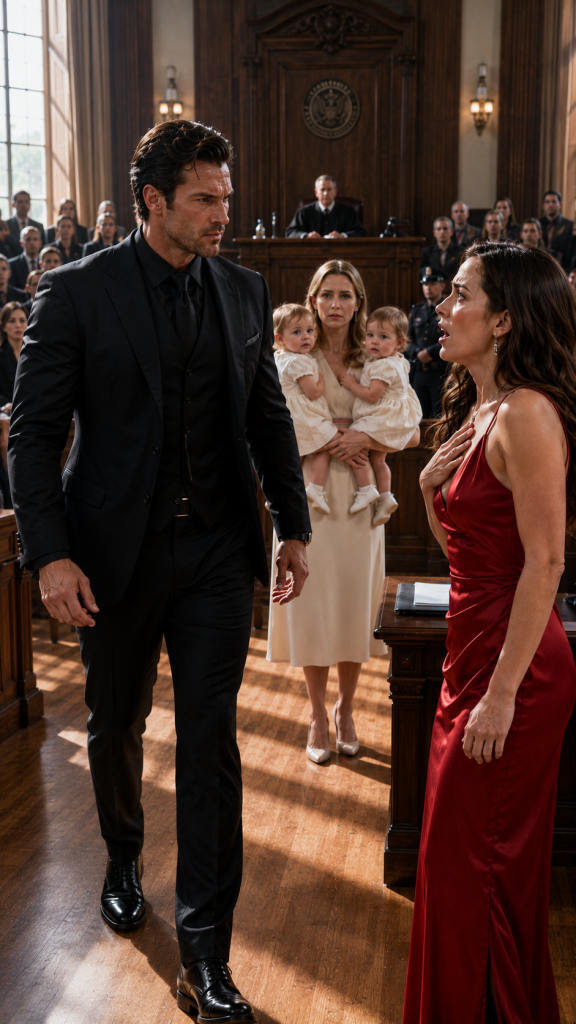
Temporary custody was granted to Evelyn under protective supervision, with Dante recognized as biological father pending further family proceedings. Because Evelyn was still recovering and because threats were credible, the children were transferred that afternoon to a secure residence north of the city.
Evelyn saw them at 4:36 p.m.
She remembered the exact minute because the clock above the nursery door clicked as Ruth placed Lily in her arms.
Lily was smaller than Evelyn had imagined and heavier than any hope she had ever carried. She smelled of milk, clean cotton, and life. Her tiny fist opened against Evelyn’s collarbone.
Evelyn made one sound, a broken breath.
Then Noah was placed beside her, tucked into the other arm, blinking up with solemn gray eyes that looked painfully like Dante’s.
Evelyn lowered her face between them and wept.
Not quietly.
Not gracefully.
She wept like a woman whose body had crossed death and returned to find the world still holding what she loved.
Dante stood near the doorway, motionless.
Ruth touched his arm. “Go to them.”
“I don’t know how,” he said.
Ruth’s face softened. “No one does at first.”
Dante walked over slowly.
Evelyn looked up at him through tears. For a moment, neither spoke. Their alliance had been built on necessity, evidence, strategy, and survival. But the babies between them changed the shape of the silence.
“Do you want to hold your son?” Evelyn asked.
Dante’s face tightened.
“I might hurt him.”
“You won’t.”
“You don’t know that.”
“Yes,” she said, looking at him with a certainty that startled them both. “I do.”
She lifted Noah carefully into his arms.
Dante held the baby like a man holding a bomb.
Noah yawned.
His tiny hand caught Dante’s shirt.
Something inside Dante’s face broke open and closed again quickly, but Evelyn saw it.
He had spent his life becoming untouchable because touch had once meant pain. Now a newborn’s fist held him in place more completely than any threat ever could.
Months passed.
Grant’s trial became a public spectacle, but Evelyn refused to let the spectacle become her life. She testified once, clearly and without embellishment. The videos did what tears could not. The messages did what rumors could not. The bank records did what polite society could not ignore.
Grant pleaded guilty when his own attorney told him a jury would hate him before opening statements ended.
Sloane accepted a deal and left Chicago after sentencing, though no city would ever be far enough from the shame she carried.
Beatrice sold the Lakeview townhouse.
Evelyn did not want it.
“Burn it, sell it, turn it into condos,” she told the attorney. “I won’t raise my children in a house where I learned to be silent.”
Dante expected her to stay at the Lake Forest estate because it was safe.
Evelyn stayed because it became something else.
At first, she kept a guest room and locked the door every night. Dante never questioned it. He never entered without permission. He never raised his voice at her. When they disagreed, he went still and cold, but he did not punish silence, and that mattered.
Slowly, the locks became unnecessary.
Slowly, Evelyn learned that a room could be quiet without danger hiding in it.
Dante changed too, though not in ways that looked dramatic from the outside. He still had men who feared him. He still conducted business behind closed doors. He still carried darkness like a tailored coat.
But when Lily cried at two in the morning, he woke before Evelyn did.
When Noah had a fever, Dante sat on the nursery floor all night, one hand on the crib rail, watching every breath.
When Evelyn woke from nightmares, he did not grab her. He did not demand explanations. He sat on the floor beside the bed where she could see him and said, “You’re here. He’s gone. The babies are safe.”
One year after the courtroom hearing, Evelyn stood on the back lawn overlooking Lake Michigan while Lily and Noah wobbled across a blanket in the grass.
Lily moved first, reckless and bright-eyed, falling twice and laughing both times.
Noah watched her, considered the mechanics, then crawled to the safest corner of the blanket and pulled himself up using Dante’s pant leg.
“Smart boy,” Dante murmured.
Evelyn smiled. “Careful boy.”
“He gets that from you.”
“No,” she said. “From you. I was never careful. I was trapped.”
Dante looked at her.
She no longer looked like the woman he had carried through hospital doors. Her cheeks had color. Her shoulders had strength. Her eyes still held shadows, but the shadows no longer owned the room.
He reached into his jacket pocket and took out a small velvet box.
Evelyn stared at it. “Dante.”
“I’m not good at speeches,” he said.
“I know.”
“I won’t promise to be harmless. I’m not.”
“I know that too.”
He opened the box. The ring inside was simple, a diamond set in white gold, elegant without shouting.
“I can promise you this,” he said. “No locked doors between us. No fear in the house. No one touches you or the children and keeps the hand. You leave if you want to leave. You stay if you want to stay. But if you stay, I will spend the rest of my life making sure you never confuse love with a cage again.”
Evelyn looked down at Lily, who had fallen asleep against Ruth’s knee, and Noah, who was chewing Dante’s cuff button with deep concentration.
Then she looked back at Dante.
“Ask me properly,” she said softly.
For the first time since she had known him, Dante looked uncertain.
“Evelyn Harper,” he said, voice low, “will you stay with me?”
She laughed once, because it was not quite a proposal and somehow exactly the right one.
“Yes,” she said. “But not because you saved me.”
His eyes held hers.
“I’m staying because I saved myself,” she said. “And when I did, you were still standing there.”
Dante slid the ring onto her finger with hands steadier than his expression.
Far away, in a federal prison outside Chicago, Grant Whitlock received a photograph in the mail two weeks later.
There was no return address.
The photograph showed Evelyn on the grass by the lake, laughing as Lily grabbed her hair. Noah sat in Dante’s lap, one hand pressed against his father’s jaw. Dante was not smiling exactly, but he was looking at Evelyn like a man who had found a country after years at sea.
On the back, Evelyn had written one sentence:
You thought my story ended in that delivery room. It began there.
Grant tore the photograph apart.
But he had already seen it.
He would see it every morning when the cell doors opened. He would see it every night when the lights went out. He would see the family he never owned, the woman he failed to bury, the children who would never learn to fear his footsteps.
That was Evelyn’s revenge.
Not blood.
Not death.
A life rebuilt so completely that the man who tried to erase her became nothing more than the shadow behind her beginning.
Years later, when Lily and Noah were old enough to ask why their mother sometimes touched the scar near her wrist when she thought nobody was watching, Evelyn told them the truth carefully.
She did not make herself a saint.
She did not make Dante a hero.
She told them that people are complicated, that love without respect is not love, that fear is not a family value, and that silence can protect you for a while but truth is what sets you free.
Lily asked, “Were you scared?”
Evelyn kissed her daughter’s forehead. “Very.”
Noah asked, “Then how did you fight?”
Evelyn looked across the room at Dante, who stood in the doorway as always, no longer a ghost, no longer only darkness, but a father with one child’s drawing folded in his pocket and another stuck to his shoe.
Then she looked back at her children.
“I fought because I loved you,” she said. “And love does not mean you are never afraid. It means something matters more than your fear.”
Outside, Lake Michigan moved under the evening light, endless and silver.
Inside, the house was warm.
And Evelyn, who had once died beneath hospital lights while her husband called his mistress, sat between her children and understood the truth no court could write into record.
She had not returned from death to become someone else’s miracle.
She had returned to become her own.
THE END
