

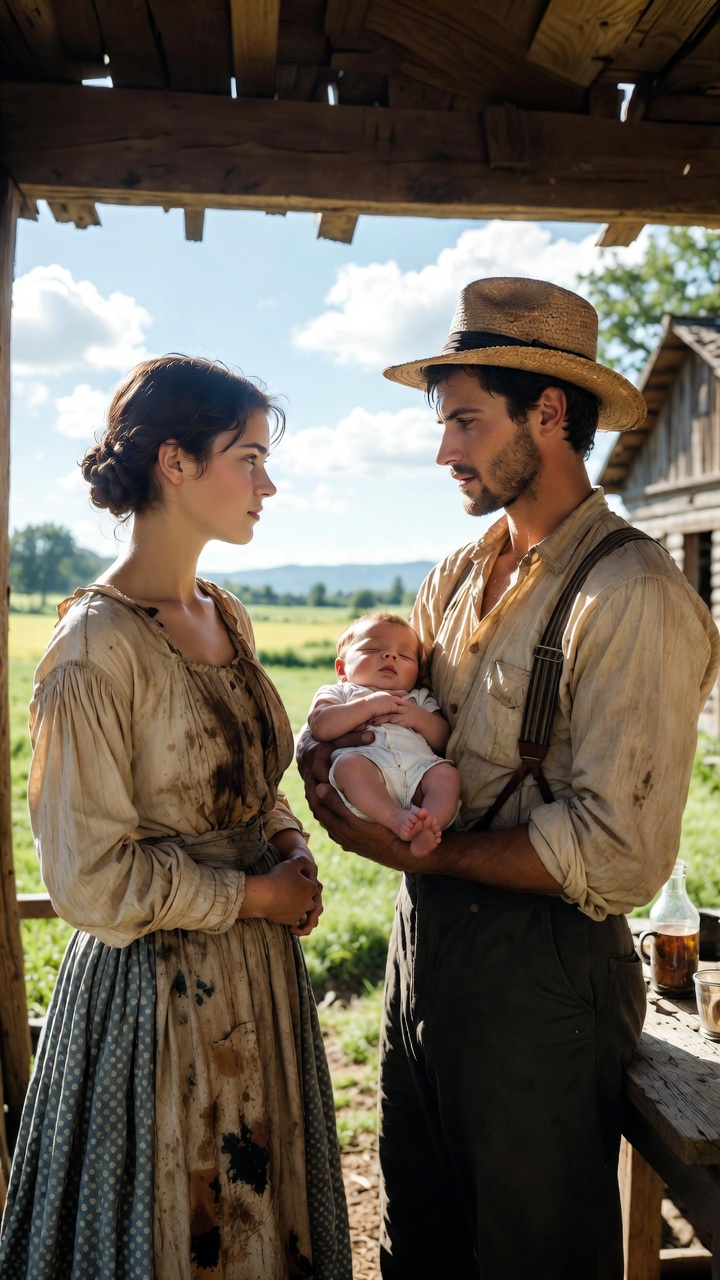
The dirt road ended right there, in the middle of nowhere, and Rosario could no longer feel her feet inside her broken boots. She had been walking for four days among hills, mesquite trees, and thin streams, carrying a change of clothes in a shawl, a copper medallion that had belonged to her mother, and exhaustion deep in her bones. She wasn’t asking for much. At that moment, she only wanted a glass of water.
When she reached the gate of that remote hacienda lost in the fields of Jalisco and saw a man come out wearing a palm-leaf hat, a wrinkled shirt, and holding a baby soaked in milk who was crying in his arms, she understood that she had arrived at a place where sorrow lived alongside silence.
The man looked at her for barely a second. He had deep dark circles under his eyes, a grown beard, and the expression of someone who could no longer tell if he was tired or defeated. The child was crying with such desperation that it seemed to hurt his soul. Rosario raised her hand toward the gate.
“I just wanted a little water, sir.”
He nodded, as if even speaking required effort.
“There’s water. Come in if you want. The jug is in the kitchen… I can’t let go of the child.”
Rosario opened the gate and walked to the corridor. Up close, she saw the baby better: he couldn’t have been more than five months old. His face was red from crying so much, and his little fists were clenched, trembling with anger and hunger. Without thinking, Rosario stretched out her arms. She didn’t ask permission with words; she asked with her eyes.
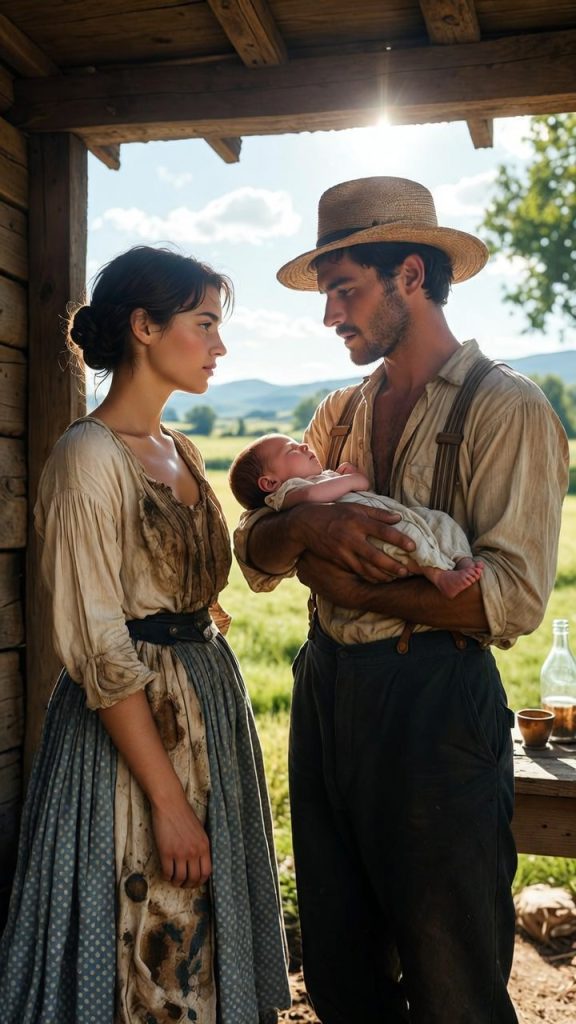
The man hesitated for just a moment, then handed the baby over like someone handing off a weight too heavy to carry alone any longer.
Rosario cradled the child against her chest, held his little head in the hollow of her neck, and began to rock him with a gentle, ancient rhythm she had learned from her mother when she herself was a child. She hummed softly, without words, just a smooth vibration. The crying gradually stopped — first in gasps, then in whimpers — and after two minutes, the baby had fallen silent.
The man stood watching her as if he had just witnessed a miracle.
“How did you do that?” he asked.
“Children can sense the fear of the person holding them,” Rosario replied, still rocking the little one. “And this little angel is truly hungry, not just sleepy.”
In the kitchen she found the jug, a cold stove, dirty dishes, and the sad disorder of a house without hands to care for it. She warmed some milk, diluted it with boiled water, and fed the child with a clean cloth. He drank with a desperation that broke her heart. When he finally fell asleep, Rosario carefully laid him down in a wooden drawer lined with blankets.
Only then did she pour herself some water.
The man remained at the door, watching. He had the broad shoulders of someone who had worked all his life, but also a weariness so deep it seemed to live beneath his skin.
“My name is Mateo,” he said at last. “The boy is called Tomás.”
“I’m Rosario.”
Mateo looked down at the floor, then back at her.
“Would you like to stay tonight? The path is dangerous when it gets dark.”
Rosario gripped the glass tightly in her hands. She knew how to recognize both a favor and a plea disguised as courtesy. That man wasn’t offering her just a roof; he was asking for help in the only way his pride allowed.
“Yes,” she said. “I’ll stay.”
What was supposed to be just one night became a week. And the week, without either of them knowing exactly when, began to feel like a lifetime.
Mateo was a widower. His wife, Lucía, had died of fever three months after giving birth to Tomás. Since then, the house had slowly fallen apart: the stove stayed cold, clothes piled up, and the patio was overtaken by grass. He did what he could, but one man alone, with a baby in his arms and sadness like a stone in his chest, could not sustain both a hacienda and a cradle at the same time.
Rosario didn’t ask questions at first. She rose before dawn, took care of Tomás, lit the stove, prepared café de olla, swept, cooked, washed clothes at the stone washbasin, and by midday had already restored some order to that wounded house. The child, who had lived among tears, began to sleep better, eat better, and look at the world with curiosity.
Mateo began to breathe again.
There was a serene way Rosario moved, as if she did everything with exact measure: not one extra word, not a single complaint, not a clumsy gesture. Mateo watched her walk through the house with the child in her arms and felt something he didn’t want to name. At first he thought it was gratitude. Later he understood that gratitude doesn’t keep a man awake thinking about a smile.
Rosario also carried her own shadow. She was twenty-two years old, but her eyes held a weariness that didn’t belong to her age. She always wore long sleeves, even in the dry heat of that land, and avoided talking about the hacienda she had come from. She only said that she had left there at night and never intended to return.
The truth came out in pieces.
One afternoon, when they went to town to buy salt, kerosene, and cloth for diapers, stares pierced them as soon as they got off the cart. In small towns, people always know two things: what happened and what hasn’t happened yet, even if neither is entirely true.
Doña Amalia, the blacksmith’s wife, was the first to approach with her knife-like smile.
“And who is this young lady, Mateo?” she asked, looking Rosario up and down.
“This is Rosario. She’s helping me with the child.”
“Does she live at the hacienda?” the woman insisted, stretching out the question like a hook.
Rosario held Tomás firmly and answered before Mateo could:
“I work, I take care of things, and I don’t owe anything to anyone. If the town doesn’t like that, the problem isn’t mine.”
The woman fell silent. Mateo turned his face to hide a half-smile, but on the way back he noticed that Rosario was too quiet, hugging the child as if afraid someone would snatch him away.
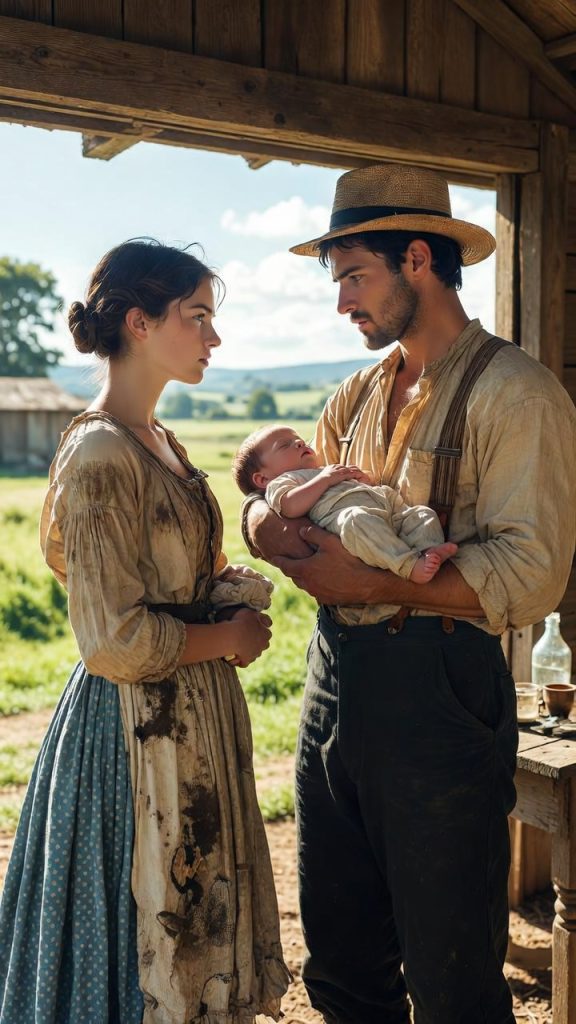
Three days later, the threat appeared.
An old laborer who helped Mateo, don Laureano, brought the news: in the town cantina, a man on a fine horse was asking about a young, dark-skinned girl with tired eyes who had fled from a large hacienda in Tepatitlán. He didn’t say her name, but he spoke like the men who serve the powerful.
Rosario turned so pale that Mateo felt rage before he even knew against whom.
That night, sitting on the gallery while Tomás slept, she finally spoke. She told him she had lived at don Eusebio Treviño’s hacienda since she was sixteen, after her parents died. At first it was work: cooking, washing, serving. Then the owner began with gifts, compliments, special orders. When she rejected his advances, he changed. He didn’t shout. He didn’t hit. He did something worse: he controlled. He decided when she ate, who she spoke to, when she slept. One night he locked her in with a key. Another time, she tried to escape through a barred window and tore her left wrist on the iron.
Then, for the first time, she rolled up her sleeve.
The thin white scar circled her wrist like a bracelet of pain.
Mateo looked at it and felt a fury so deep he had to clench his teeth. It wasn’t pity he felt. It was something wilder. The brutal need to protect.
“No one will ever touch you again,” he said quietly. “As long as I breathe, no one.”
Rosario looked at him as if no one had ever said anything like that to her in her life. Not with desire. Not with pity. With respect.
The next morning, the men arrived.
There were two of them. One with a trimmed mustache and expensive boots. The other, broad-shouldered, with a whip coiled in his hand. They stopped in front of the gate as if they already owned the place.
“We’ve come for a woman named Rosario,” said the one with the mustache. “She belongs to don Eusebio’s hacienda. She fled, taking valuable things with her.”
Mateo stood firmly in front of the gate, motionless.
“No one belongs to anyone here,” he replied. “And no one is taking anyone away.”
“You’d better not get involved,” warned the other, touching the whip. “Don Eusebio has friends everywhere.”
Mateo took a step forward. He didn’t raise his voice. He didn’t grab the rifle. And precisely because of that, the men understood he wasn’t playing.
“Set foot on this land without permission,” he said, “and you’ll leave here worse than you came.”
A heavy silence fell. The one with the mustache calculated. He knew how to read men. And he knew that this quiet widower was not the type to back down once he had chosen a side.
“We’ll deliver the message to the boss,” he said finally.
“Deliver it well,” Mateo replied.
The men left, but fear lingered in the air like dust after a stampede.
Rosario wanted to leave that same afternoon.
“I can’t bring this misfortune upon you,” she said, with Tomás sleeping in her arms. “You have a life, land, a son. I’m not worth that risk.”
Mateo closed the distance between them and held her arm firmly — not with violence, but with determination.
“Don’t ever say you’re not worth it again,” he said. “This house no longer breathes without you. Tomás needs you… and so do I.”
Rosario’s tears came then, heavy and ancient. She wasn’t crying only out of fear, but because someone had finally chosen her. Not to use her. Not to hide her. To defend her.
That night, under a sky full of stars, they sat on the gallery and finally opened the doors to their pains.
Mateo told her about Lucía, about the guilt of not being there when the fever started, of arriving too late, of feeling he had let her die alone. Rosario took his hands and told him, with a serenity born from her own ruins, that love cannot always defeat death, and that guilt is a creature that devours even the innocent.
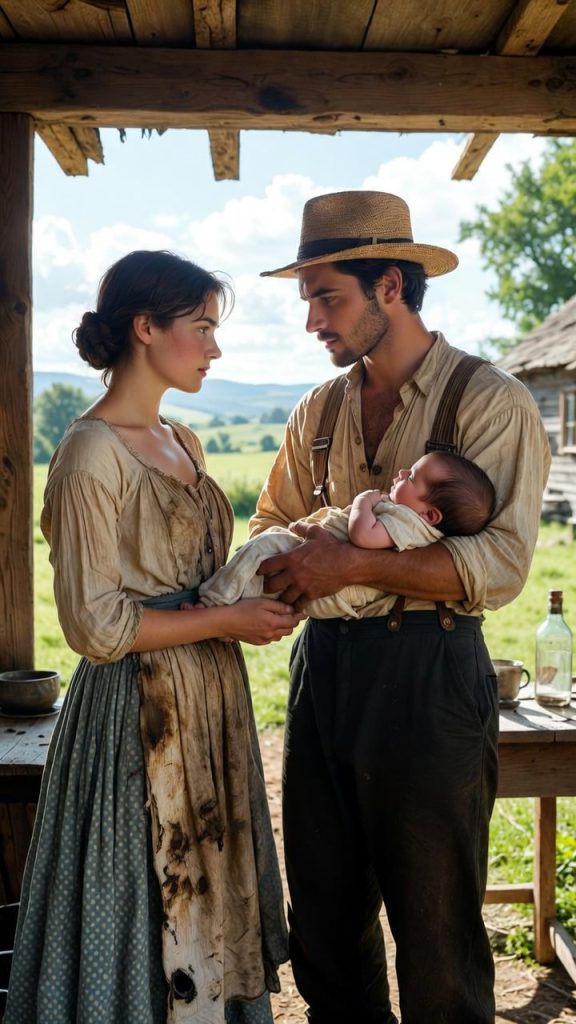
When he raised his hand and caressed her face, Rosario did not pull away.
The first kiss came just like that — without music, without rehearsed promises, with fear still alive in the world and yet with a new certainty between them.
The next day, Mateo went to see Father Julián.
He didn’t go to ask permission to love. He went to ask how to do it right.
“I want to marry her,” he said, sitting under a bougainvillea in the atrium. “Not out of convenience. Not out of pity. I want her to have my last name, my house, and my protection before God and before men.”
The priest looked at him for a long moment and then nodded.
“Then don’t waste time.”
They were married ten days later in the small village church. Rosario wore a light blue dress that she had sewn herself with fabric Mateo had secretly bought. She entered with Tomás in her arms, because she insisted that if she was going to be his mother, she wanted to begin by being so before God.
Mateo waited for her at the altar, emotion overflowing even into his hands.
When Father Julián declared them husband and wife, Tomás let out a laugh so clear and happy that even the most gossipy women in the village burst out laughing. It was the first time Rosario felt that the world could stop being a battlefield and start to feel like a home.
And the home became real.
Don Eusebio never insisted again. In those years, a married woman with a landowner husband was no longer easy prey. The owner swallowed his rage and looked for a weaker victim. Rosario finally began to sleep without startling awake.
The months turned into seasons. The house came back to life. The garden bloomed again. Tomás took his first steps in Rosario’s hands and said “mama” before any other word. She cried when she heard it. Mateo pretended to look at the horizon so no one would notice that he was crying too.
In time, a girl was born, whom they named Esperanza, because that was exactly what that tired woman had brought the day she stopped to ask for water. Then another son came. And then the years, shared work, harvests, good days and difficult ones, small arguments and great forgivenesses that sustain true marriages.
Many years later, on a golden afternoon, sitting on the same gallery where they had once confessed their wounds, Rosario rested her head on Mateo’s shoulder and asked if he regretted anything.
“Regret what?” he asked.
“Opening the gate for me. Telling me to stay that night.”
Mateo let out a low laugh and kissed her forehead.
“I only regret one thing,” he said. “Saying ‘tonight’ instead of ‘forever’.”
Rosario laughed, and that sound remained, even after so many years, the most beautiful music on that land.
Before them, the hacienda breathed with life. Tomás was already working with his father. Esperanza taught the village children to read. The orange trees bore fruit, the chickens pecked in the patio, and the white house — once sad and silent — was full of voices.
Rosario looked at the dirt road in the distance, where it had all begun, and thought of the exhausted girl who had arrived with nothing, asking only for a glass of water.
She hadn’t known then that God sometimes hides an entire life behind an open door.
And Mateo, squeezing her hand, looked at the woman who had saved his son, his house, and himself, and understood that some loves don’t arrive like lightning. They arrive like rain on dry earth: slowly, deeply, and exactly when they are most needed.
That’s why they last. Because they are not born of whim. They are born of choice.
And they, on that day and every day after, kept choosing each other.
