

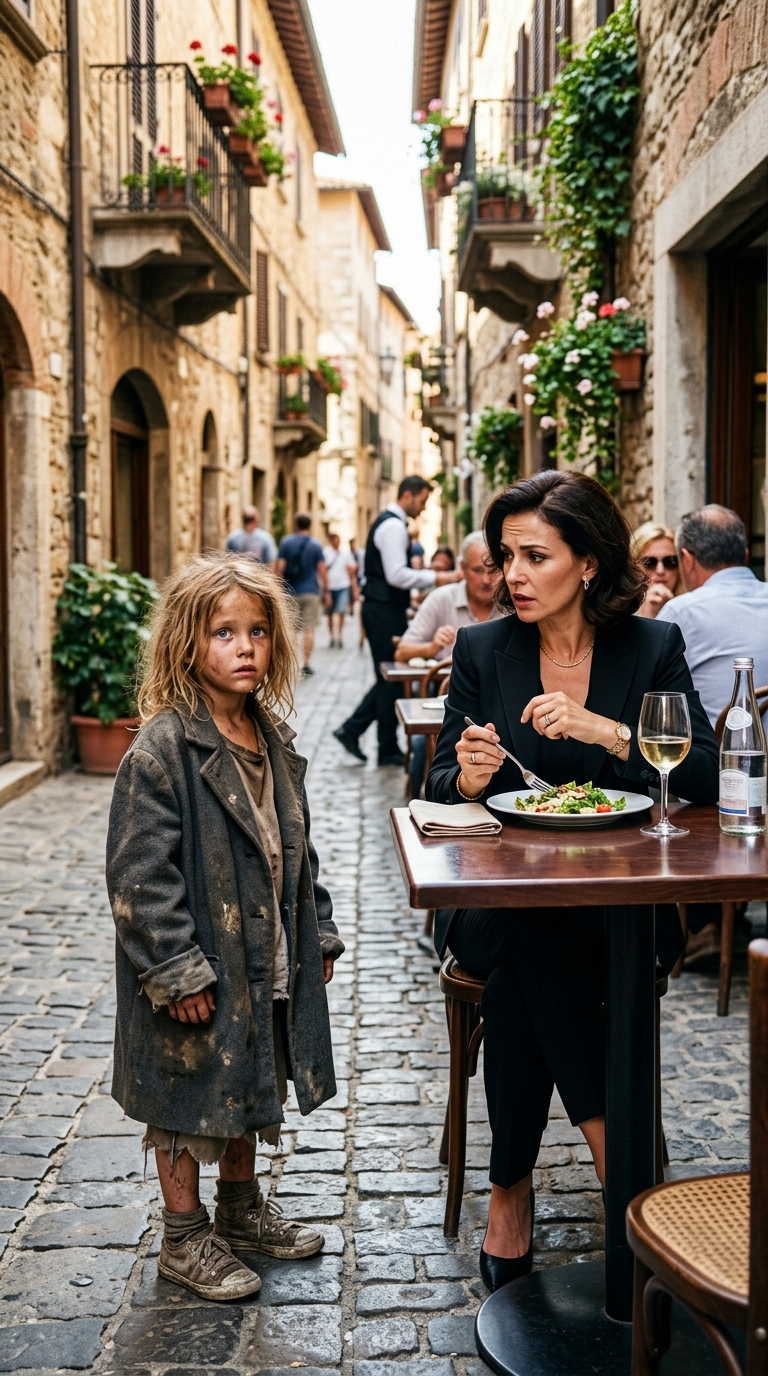
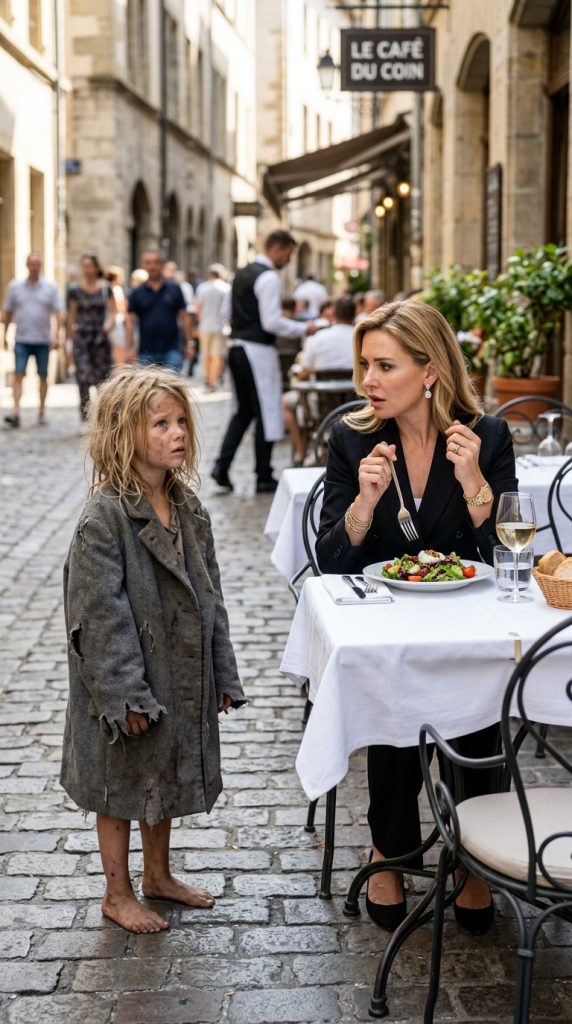
In the middle of an elegant lunch at one of the city’s most exclusive restaurants, a barefoot, dirt-streaked little girl suddenly appeared beside a table set with crystal and silver.
She lifted her chin, met a wealthy woman’s eyes without flinching, and asked in a trembling but steady voice, “Could I please have your leftovers?”
The entire room seemed to stop breathing.
No one could have predicted what would happen next — or how that single question would change both of their lives forever.
Victoria Harrington entered the restaurant the way she entered every room: composed, self-assured, untouchable. Sunlight poured through the tall glass windows, catching the subtle shimmer of her silk blouse.
Her heels clicked rhythmically against polished marble. She greeted the maître d’ by name, requested the quietest table in the corner, and scanned the menu with the calm authority of someone who never needed to check a price.
In front of her, grilled sea bass rested on porcelain, a flute of champagne sparkling beside it. Everything about the scene whispered wealth and control.
Across town, ten-year-old Maya Alvarez walked barefoot along scorching pavement. Her feet were cracked and sore. Dust clung to her skin, her dark curls tangled from nights spent sleeping wherever she could find shelter.
She couldn’t remember the last time she’d eaten something warm. For months, she had survived by learning the city’s hidden corners — which alleys were safe, which markets tossed scraps at closing time, how to curl up against the cold.
Her stomach twisted constantly with hunger.
The restaurant had become a boundary in her mind — a glittering world separated from hers by invisible rules. Crossing that doorway meant daring to step into a place where she didn’t belong.
But hunger doesn’t wait for dignity.
When the glass doors opened and a rush of cool air brushed her face, she hesitated. The air-conditioning made her shiver. Conversations hummed softly inside. She spotted Victoria sitting alone — elegant, poised, distant — and something inside her pushed her forward.
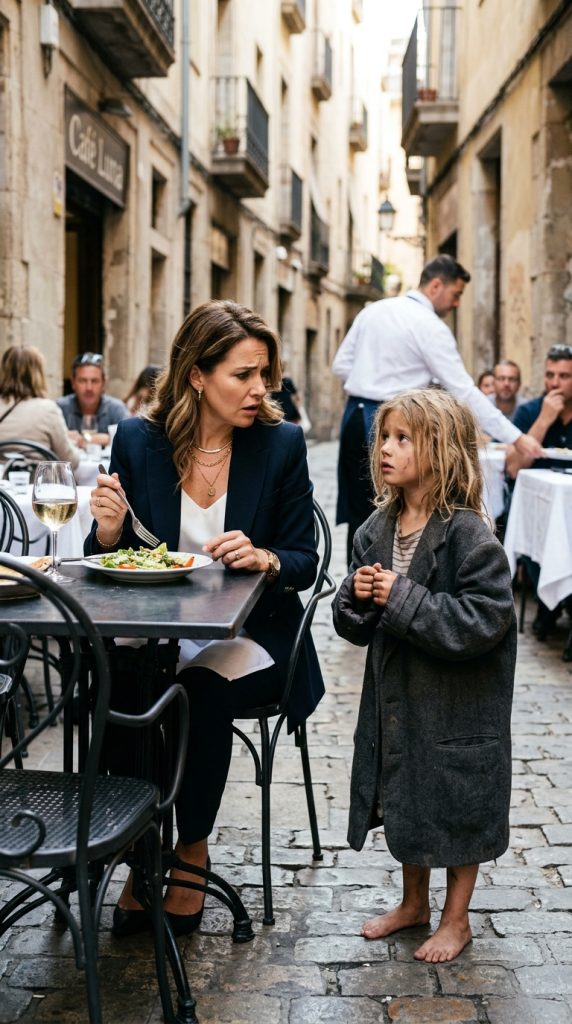
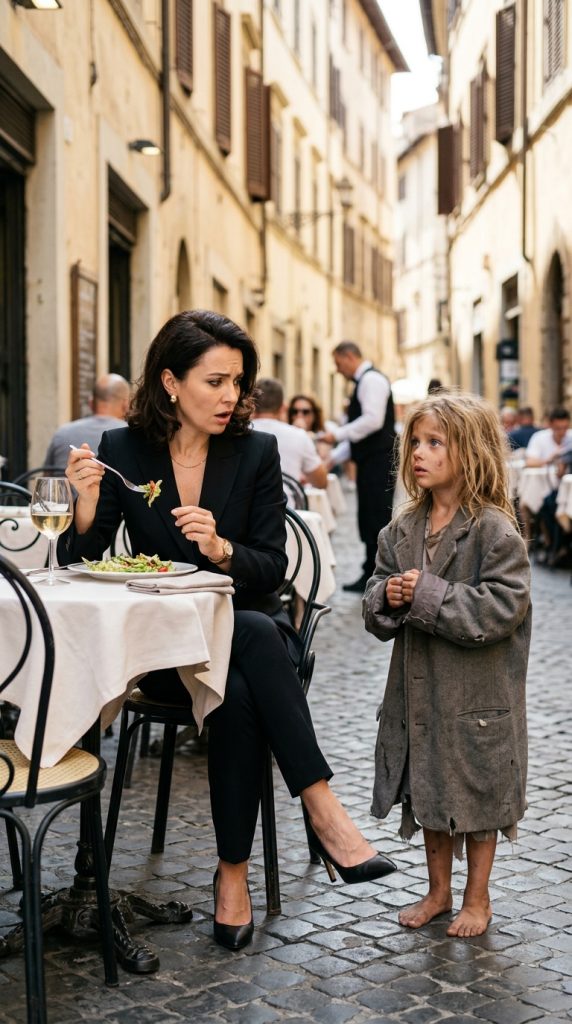
She walked between tables, painfully aware of the stares. Some guests frowned. Others looked away. A few whispered. She stopped at Victoria’s table, clasped her dirty hands together, lowered her eyes, and asked quietly,
“Could I eat what you don’t finish?”
The words echoed louder than any shout.
She hadn’t asked to come inside. She hadn’t apologized for existing. She had simply told the truth.
She braced herself for rejection — for security guards, for humiliation.
Victoria looked up.
For a heartbeat, annoyance flashed across her face. Her fingers tightened slightly around her glass. She could call security. She could complain. This interruption was unacceptable.
Then she really saw the child.
The oversized, frightened eyes. The trembling shoulders. The silent pride that had forced her to ask.
And something deep inside Victoria — something she had buried for decades — stirred.
Once, long ago, she had also been a hungry child.
She slowly set her glass down and stood.
“Sit,” she said gently.
The softness in her voice surprised even herself.
Maya blinked, unsure she had heard correctly.
“Sit,” Victoria repeated, pulling out the chair across from her.
The girl took hesitant steps and sat, shaking. Relief flooded her — mixed with shame for interrupting something so beautiful.
Victoria signaled the waiter. “Please bring another plate. Something simple.”
Murmurs rippled across the dining room. Disapproval. Curiosity. A few approving nods.
Maya ate carefully, slowly, as if afraid the food might disappear. She didn’t leave a crumb.
Victoria watched closely. There was no greed in her movements. Only hunger — deep, aching hunger.
Under the table, Victoria sent a message to her assistant: Claire, bring clean clothes. For a child.
When Maya finally looked up, she found no judgment in Victoria’s gaze. Only a quiet warmth. Something in her chest loosened.
When they finished, Victoria stood and extended her hand.
“Come with me,” she said softly. “I want to help you.”
The maître d’ stood speechless. A few guests began clapping hesitantly as Victoria guided Maya out of the restaurant.
What had started as an ordinary lunch became a turning point neither of them had planned.
The chauffeur opened the car door. Maya sat stiffly beside Victoria, staring at her hands.
“Where are we going?” she whispered.
“To my home,” Victoria replied. “But you don’t have to stay if you don’t want to.”
Home. The word felt foreign on Maya’s tongue.
They arrived at iron gates that opened to reveal manicured gardens and a towering mansion. Maya’s breath caught.
Claire was waiting at the entrance, immaculate and unsmiling.
“This is the girl?” she asked coolly.
“Yes,” Victoria answered calmly. “She needs a shower, warm clothes, and dinner.”
An hour later, warm water washed months of dust from Maya’s skin. Clean pajamas. Soft towels. The scent of shampoo. She felt like she was stepping into someone else’s life.
Meanwhile, Victoria sat alone in her study, a glass of whiskey untouched in her hand. Memories rose uninvited — selling candy at bus stops, being sent home for unpaid tuition, nights when hunger burned so sharply she couldn’t sleep. And one woman, years ago, who had once bought her a meal without asking for anything in return.
A small kindness she had never forgotten.
Claire entered without knocking. “You’re really bringing a street child into this house? What if she steals?”
“She won’t,” Victoria said quietly. “And even if she did, I wouldn’t care. I didn’t bring her here for things. I brought her here because I recognized something.”
That night, Maya ate two full plates in the kitchen.
“Tomorrow,” Victoria told her gently, “we’re seeing a doctor. And if you’d like, we’ll enroll you in school.”
“What if I’m not good at school?” Maya asked cautiously.
“Then we’ll figure it out together,” Victoria said. “But the street is no longer your only option.”
For the first time in months, Maya smiled.
Weeks passed. School was difficult. Letters blurred. Numbers confused her. But she tried. A classmate named Lily befriended her. A tutor stayed late to help her read.
Victoria rearranged meetings, canceled trips. Claire grew colder, resentful of the attention Maya received.
One afternoon, Claire accused Maya of stealing an expensive bracelet she had secretly hidden in the girl’s drawer. For a split second — just one — doubt flickered across Victoria’s face.
That moment shattered something fragile inside Maya.
But that night, Victoria reviewed the security footage.
It showed Claire planting the bracelet.
The next morning, Victoria fired her.
Claire didn’t leave quietly. Soon, Victoria’s company faced investigations. Accounts were frozen. Board members questioned her leadership. Claire had been building influence for years.
To protect Maya, Victoria temporarily placed her in foster care. But the girl ran back.
“I don’t want safety without you,” Maya cried.
Victoria realized she couldn’t protect her from behind mansion walls. So she made a choice.
She walked away from the mansion, the luxury, the boardroom.
They moved into a modest apartment downtown. Two bedrooms. No fountains. Just peace.
Maya enrolled in public school and began helping at a neighborhood bakery owned by a gentle man named Daniel. She learned to knead dough, to laugh again.
Financial pressure mounted. Headlines questioned Victoria’s stability. Rumors spread.
Finally, Maya wrote a simple post online — telling the truth about the day she had asked for leftovers and been given a second chance.
It went viral.
Public support surged. Evidence of Claire’s manipulation surfaced. Claire eventually confessed publicly, admitting to sabotage driven by jealousy.
Victoria was reinstated.
But she chose not to return to her old life unchanged. Instead, she and Maya founded a nonprofit called Second Chance House — a place for girls with nowhere else to go.
Laughter began filling their new home.
Then one day, an old letter from Victoria’s late father surfaced. It revealed a secret: her estranged brother had once had a daughter named Maya, abandoned years ago.
DNA tests confirmed it.
Maya wasn’t just a child from the street.
She was family.
A lawyer later informed them that Victoria’s father had left part of his personal inheritance to an unrecognized granddaughter — if she were ever found.
Maya listened quietly.
“What should I do with it?” she asked.
“Use it wisely,” Victoria replied. “So no one can ever push you down again.”
Maya showed her a drawing — a large building filled with light. Across the top she had written: Second Chance Home.
“I want this,” she said. “Not a mansion. I want other girls to feel what I felt that day.”
Victoria embraced her — not as a benefactor, not as a savior, but as an aunt.
The real miracle wasn’t the inheritance.
It was that a brave, hungry question — “Could I have your leftovers?” — had uncovered family, healed old wounds, and rewritten two broken lives.
And from that day forward, neither of them would ever be alone again.
