

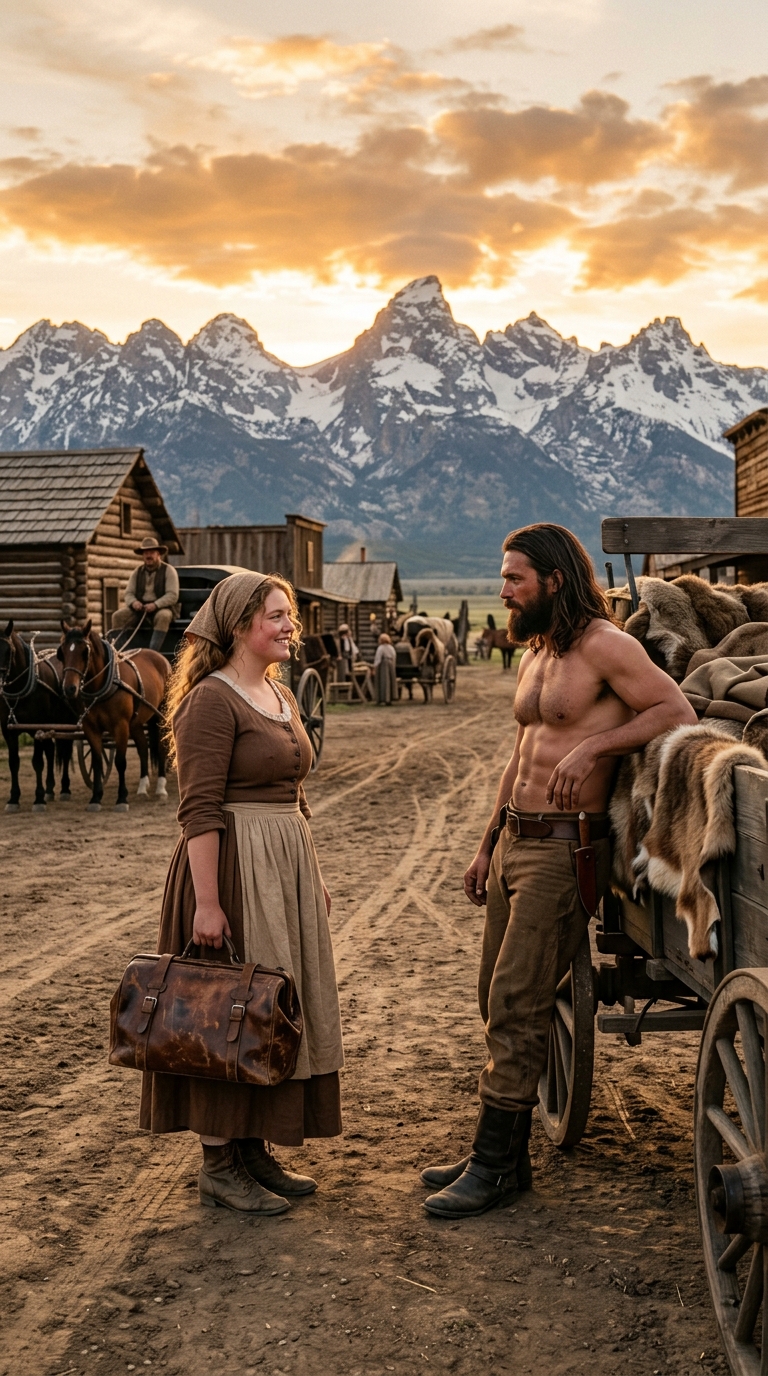
The Woman Who Did Not Leave
Five women came to his mountain. Five women left before the week was over. The sixth stepped down from the stagecoach, looked at the cabin, looked at him, and said:
“Well, we both have a lot of work to do.”
And she never left again.
In the north of Mexico, in the year 1872, the sierra separated people the same way a river separates stones. The smooth ones slid down easily, carried by the current toward towns, life in company, and the comforts of places where everyone is somewhat alike. The rough ones, the rare ones, the too big or too stubborn, stayed stuck between earth and rock, where the water could not move them.
Julián Briseño was one of those stones.
He was forty-three years old and built as if the sierra had assembled him with whatever was at hand, without asking permission and without thinking about proportions. He was so tall that most doors required him to bend down; so broad-shouldered that any chair seemed offended when he approached. His hands were enormous, weathered, crossed with scars on the knuckles — memories of axes, fences, horses, snowstorms, and everything that frontier life usually demands. His face did not help. A scar split his left eyebrow. A horse that did not want to be saddled had dislocated his nose years earlier. His thick, rebellious beard did little to soften his expression.
But his eyes betrayed him.
They were brown, deep, warm, the color of wet earth after rain. Absurdly noble eyes in a face that made children hide behind their mothers and women, seeing him for the first time, look away with caution.
He was not cruel. He only seemed too much.
He lived on a hill above the Bavispe Valley in Sonora, in a three-room cabin he had built himself over sixteen years. It had a stone chimney, a porch facing west, and a sunset view so beautiful it hurt his chest every time the sky began to burn. Because beauty, when looked at alone, can feel like another form of sadness.
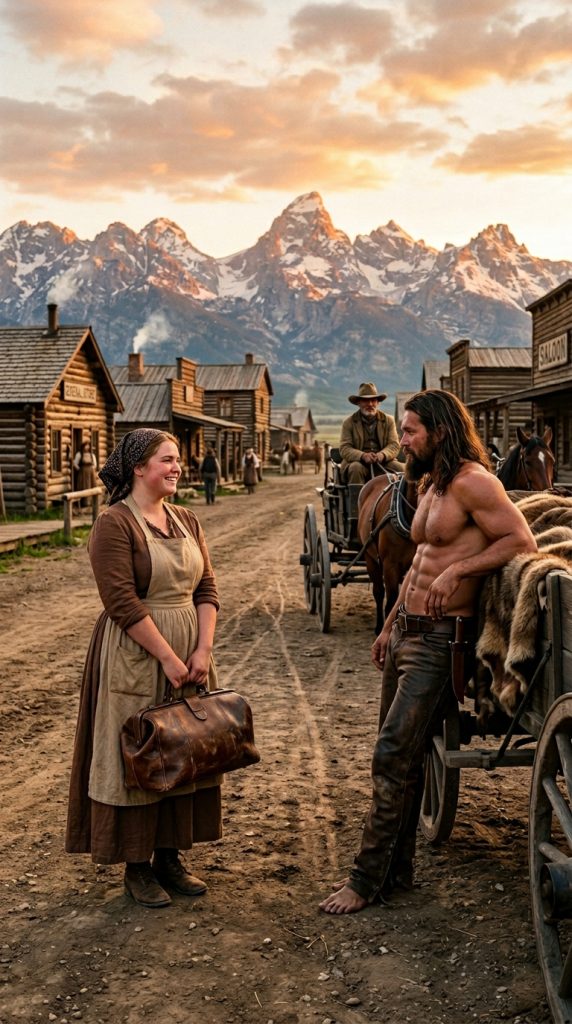
Julián wanted a wife.
Not for comfort. Not because he needed someone to cook or wash his clothes. He wanted companionship. He wanted a woman who would sit beside him when the day dissolved into red and copper over the hills. He wanted a voice that answered something more complex than a horse’s whinny. He wanted a life that did not sound hollow when he closed the door at night.
So he placed an advertisement with a mail-order marriage service. It was practical: there were practically no single women within a day’s ride by horse, and those who had seen him up close and shown interest numbered exactly zero.
The first arrived in April. Her name was Leonor and she came from Puebla. She lasted four days. She said the mountain was too high, the cabin too lonely, and he too quiet.
The second arrived in June. Amalia, from Querétaro. She lasted three days. She cried every night because the silence made her feel the world had ended and she was the only person left alive.
The third, Matilde, lasted six days. It was a record. The distance and the work did not bother her. What she could not stand was Julián: the way he ate, the way he walked, the way he filled an entire room simply by existing.
“I feel like I’m living inside a bear,” she said before climbing back into the stagecoach.
The fourth barely unpacked a suitcase. The fifth did not even want to see the cabin. She stepped down from the stagecoach, looked at him once, and said with brutal honesty:
“I can’t do this.”
Then she climbed back up and disappeared down the dusty road.
Five women. Five rejections. Five confirmations of what Julián had suspected since childhood: he was too big, too rough, too far from everything the world called normal.
He stopped writing letters. He put away the advertisement. He returned to his routine of horses, firewood, winter snow, and sunsets seen alone.
Until March 1873.
That month, an unexpected letter arrived at the store in the valley. It came from a woman named Rosa Valdés, thirty-seven years old, born in Durango and raised on a farm in Iowa after her parents emigrated when she was a child. The letter was not adorned. It did not try to impress. In that, it was so different from the others that Julián read it three times.
Rosa wrote that she was not pretty. That she was big, not tall: big. That she had spent her whole life being the woman no one asked to dance, the one who heard mothers sigh with resignation when they saw her approaching forty without a husband. She said she cooked like angels would if angels had learned to work with lard, firewood, and hunger. She said she could make a banquet out of almost nothing, preserve fruit, salt meat, bake bread, and run a kitchen like a general runs a campaign. She said she was strong, that she could carry water, split firewood, and walk for hours without fainting because her size was not a defect, but a reserve.
And at the end she wrote a sentence that forced Julián to sit down again before finishing the letter.
I understand that you have difficulty keeping wives. I have had difficulty being desired. Perhaps our difficulties are compatible.
Julián replied that same day. His letter was the shortest he had ever written in his life.
Come.
She arrived on a Tuesday in April.
The stagecoach stopped in front of the valley store, and Julián saw her step down with a single suitcase and a presence that did not apologize. Rosa Valdés was exactly as she had described herself. Big, yes, wide-hipped, robust, solid, with a round face tanned by the wind and eyes between green and gold that saw too much. She wore a simple brown dress that did not pretend to make her look thinner, and her hair was tied back with the efficiency of someone who considered hair a task, not an ornament.
They looked at each other for a long moment.
“You are bigger than I imagined,” Rosa said.
“So are you,” Julián replied without thinking.
Horror rose to his neck. He wanted to shove the words back into his mouth.
But Rosa let out a laugh. Not a polite, restrained laugh, but a real one — wide, free, resonant, as if her whole body knew how to echo.
“Well,” she said, still laughing, “then there won’t be a problem if we have to go through a door at the same time.”
He took her up the mountain in a cart. During the ride, she observed the landscape in silence: the pines, the immensity of the sky, the blue ravines, the air that smelled of dry earth and resin.
“It’s beautiful,” she said at last.
“It’s far from everything,” Julián answered. “The nearest town is two hours away. In winter the road closes with snow. You’ll only hear wind, animals, and me. And I don’t talk much.”
Rosa shrugged.
“I’ve spent my whole life surrounded by people who look at me like I’m a piece of furniture in the wrong place. Silence sounds better.”
When they reached the cabin, Julián prepared himself for the familiar expression: disappointment, fear, regret. Rosa got down, stood in front of the house, and examined it with a practical eye.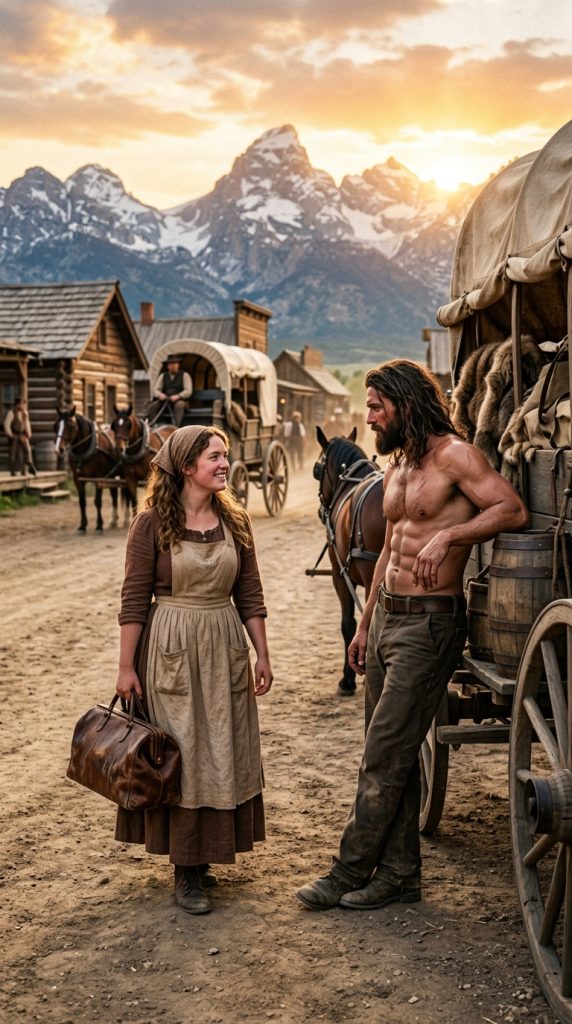
“Does the chimney draw well?”
“Yes.”
“Is the pantry dry?”
“Most of the time.”
“Does the iron stove work?”
“It works.”
She nodded, picked up her suitcase, and walked in without waiting for an invitation.
Julián followed. He found her in the kitchen, running her hand over the surface of the stove with the respect a musician would have for a fine instrument.
“This is going to work,” she declared. “But the kitchen needs order. The pantry needs a system. And you need a decent meal. How long has it been since you ate something that wasn’t raw or burned?”
Julián blinked.
“I don’t know.”
“Sit down.”
He sat. In his own kitchen. At his own table. Obeying a woman who had been in his house for six minutes.
Rosa opened boxes, found spices, discovered potatoes, beans, onions, and some wild herbs he had seen growing for sixteen years without knowing they were good for anything. Half an hour later, the cabin smelled of meat stew with dried chili and garlic. Even the horses looked in through the corral window.
She placed the plate in front of him.
Julián took the first spoonful and stopped chewing. Not because it tasted bad. Quite the opposite. Because it was the best food he had tasted in years, and his body needed a second to understand that such a thing could also exist in his home.
Rosa raised an eyebrow.
“Is it acceptable?”
“Yes,” he managed to say. “It’s… acceptable.”
She smiled sideways. She knew perfectly well what she had done.
She did not leave that week. Nor the next. Nor ever.
The days began to take shape around her like water around a stone.
Rosa organized the kitchen with military precision. She hung herbs from the ceiling, rearranged the pantry, ordered the cellar, sewed simple curtains, and achieved the feat of making the house smell of freshly baked bread instead of leather, smoke, and loneliness. Julián observed these changes with the reverent bewilderment of a man who sees dawn in a place where he always believed there was only night.
He tried to help.
She redirected him with the confidence of a woman who knew her craft.
“Outside, you’re in charge. Here, I’m in charge.”
He did not argue much, partly because she was right, and partly because arguing with Rosa was like arguing with a storm: possible, but useless.
She was also strong. Truly strong. She carried water, split firewood, walked steep paths without complaining, and did not crumble under hard work. Her size, the same thing that had condemned her to rejection elsewhere, served her here. She was not made to decorate. She was made to endure.
One afternoon she sat with him on the porch as the sun melted over the hills.
“You look at the sunset like it owes you money,” she commented.
“I like the sunset.”
“No. You like to suffer it alone. That’s different.”
Julián turned to look at her. She was not contemplating the landscape, but him.
“The other women left,” he said.
“I know. They told me at the store. They said you were the worst matrimonial investment in the entire sierra.”
He let out a snort.
“It’s true.”
Rosa looked toward the horizon, where the sky turned copper and violet.
“They left because they were looking for something you are not,” she said calmly. “They wanted a life closer to town, smaller, more understandable. But I have never fit into anything small.”
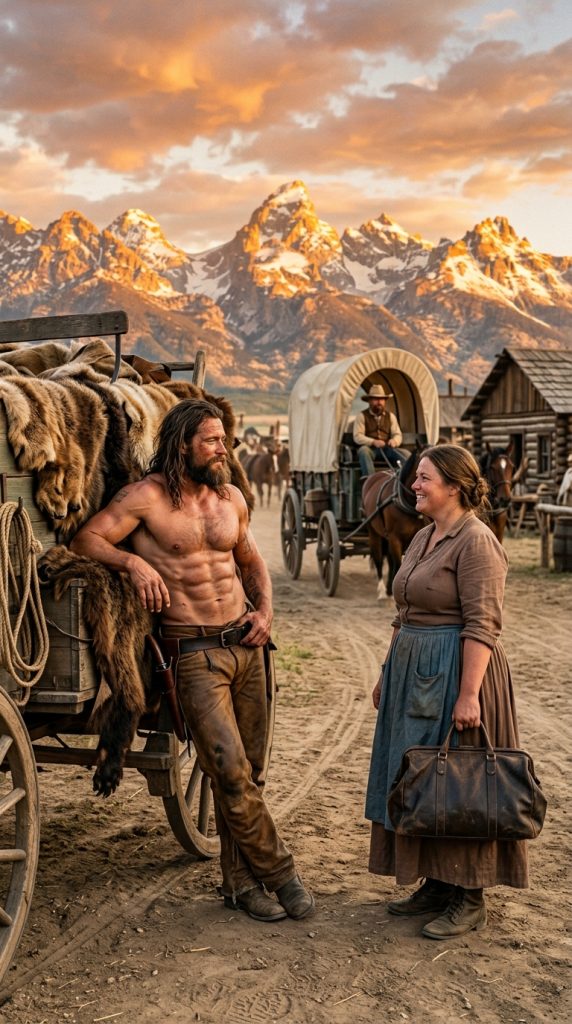
She was silent for a moment and then added:
“All my life I have been too much. Too big, too visible, too present for a world that prefers women who barely take up space. But here…” she turned toward the mountain, toward the house, toward him, “here there is enough room.”
Julián felt something strange in his chest. Something like relief and fear at the same time.
“You’re not going to leave,” he said, not as a question, but as a discovery.
“I’m not going to leave,” she confirmed. “Your cabin needs too much work. Leaving now would be irresponsible.”
He burst out laughing.
A genuine, deep laugh, so rare in him that it surprised him more than anyone. It felt as if he had found a secret room inside himself.
They were married in May, on the porch, with the valley storekeeper as witness and a priest who climbed the rocky path grumbling. Rosa wore the same brown dress she had arrived in, because she saw no reason to pretend to be another woman on the day she promised to be herself forever. Julián placed on her finger a copper ring he had made and polished with his own hands. It was not elegant, but it fit perfectly.
“It fits,” Rosa said.
“Yes,” he replied.
And both knew they were talking about much more than the ring.
The following years were not easy, but they were good.
The cabin grew because Rosa had very serious ideas about the right size of a pantry and the necessary number of shelves. Julián built what she designed. She cooked what he brought from the mountain. He taught her to read the clouds, track deer, and recognize when the wind announced a storm. She taught him to make edible bread, to salt meat properly, and not to ruin a stew through impatience.
They argued frequently. Loudly. Both had plenty of voice, body, and opinions. But never with cruelty. They were arguments between people who respected each other enough not to pretend they always agreed. Afterward they ate dinner as if nothing had happened, because the stew was too good to waste over a fight about fences or chickens.
In the second year, a big, healthy, noisy girl was born.
They named her Esperanza.
Because that was what she was. The physical proof that two people the world had considered excessive could build something beautiful precisely with what had been held against them all their lives.
Over time, in the valley they began to talk about the man from the mountain and his wife. About the couple too big for other people’s small world, but perfect for that sierra. They said that in that house it always smelled of bread, that the arguments could be heard all the way to the corral, and that at sunset two enormous figures could be seen sitting side by side on the porch, looking at the sky as if beauty had finally been given the audience it deserved.
The five women who left were never remembered with resentment. They had not been bad. They were simply wrong for that mountain. They were smooth stones looking for a gentle current. Rosa was something else. Another shape. The right one.
Because some love stories are not about finding the perfect person.
They are about finding the person who does not ask you to make yourself smaller.
The person who looks at everything you are — the rough, the big, the rare, the intense, the too much — and instead of stepping back says, with a calm that changes everything:
Here there is enough room.
And sometimes that is enough to turn a cabin into a home, a mountain into a refuge, and two enormous solitudes into one well-accompanied life.
