

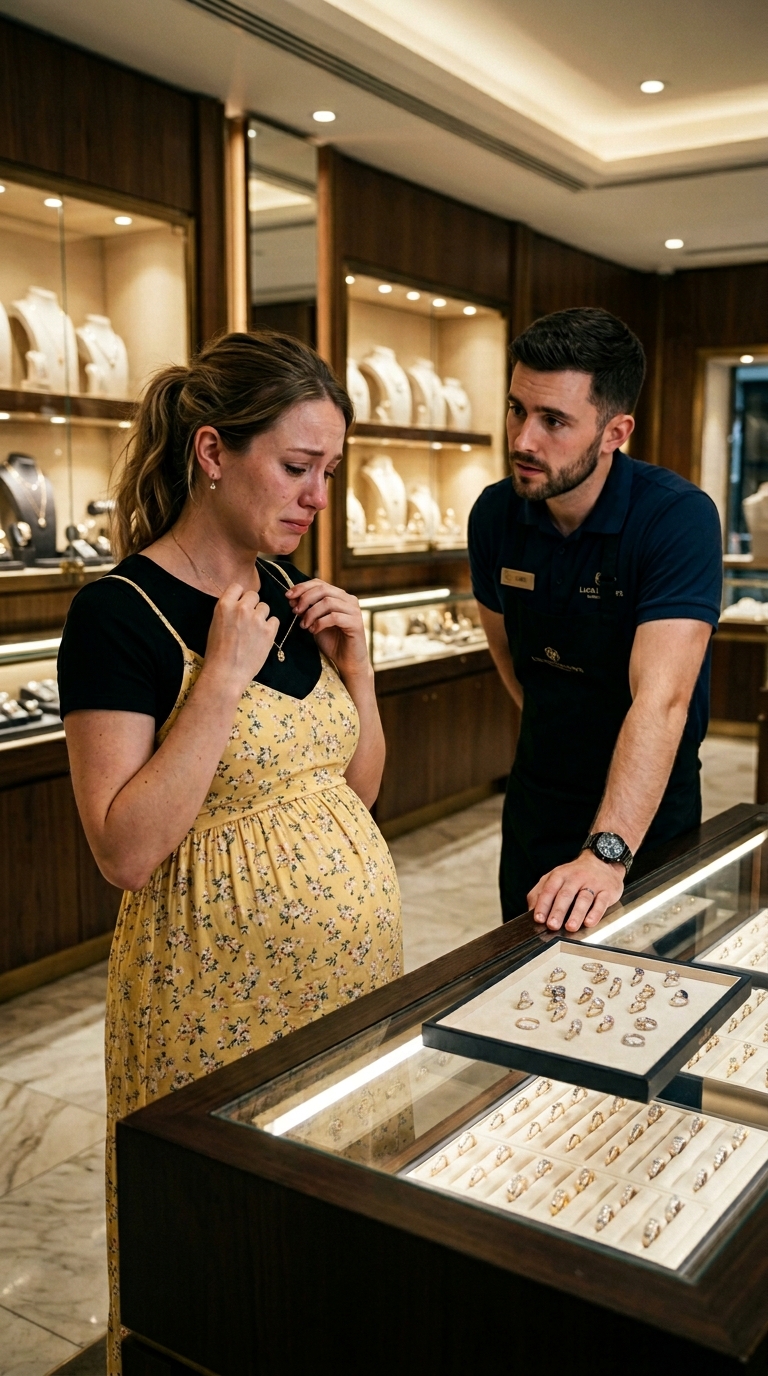
That day, a pregnant woman entered an expensive jewelry store, and many people immediately looked at her with surprise. She wore an old worn-out dress, her hair was hastily tied back, and exhaustion was written all over her face. But what stood out most was the grief in her eyes — so deep that even the coldest person would have understood she had not come there because life had treated her kindly.
The woman slowly approached the glass counter where a young salesman stood and spoke quietly, almost with embarrassment:
— Excuse me, sir, may I sell you my necklace?
The salesman looked at her carefully before answering in a reserved voice:
— I’m sorry, but I doubt I can help you.
The woman sighed heavily, as though she had expected that response from the beginning. Then she gently touched the chain around her neck and spoke more firmly:
— I understand how I look, and I understand the impression I make. But this is not cheap jewelry. It was a gift from my husband. It is the only valuable thing I have left. I really need money. My baby will be born soon, and I’ve been left completely alone and without a roof over my head. Please, just take a look at it.
The salesman frowned slightly and asked:
— Are you sure your husband wouldn’t mind you selling this? I wouldn’t want any trouble later.
The woman lowered her eyes and, after a brief silence, answered softly:
— He is gone. Six months ago, he died during a special operation. He was a police officer.
Something shook in her voice after those words, but she still carefully removed the necklace from around her neck and placed it on the glass display.
At that moment, the store grew unusually quiet.
The young salesman picked up the necklace, examined it closely, and after several seconds said:
— I can give you five hundred dollars for it.
The woman immediately nodded because it seemed she no longer had the energy left to negotiate.
— All right. I agree.
She extended her hand, but just before the salesman could take the necklace, she suddenly pressed it tightly against her chest and whispered almost inaudibly:
— Forgive me, my love. For our baby, money matters more right now.
After that, she finally handed over the chain, accepted the money with trembling hands, and slowly headed toward the exit, trying not to burst into tears in the middle of the store.
And then something happened that nobody expected. When the woman was almost at the door, the salesman suddenly called after her loudly:
— Wait! Please, wait!
She turned around immediately, clutching the money tightly in fear.
— What happened? I really need this money, — she said quietly.
The young salesman hurried over to her, held out the necklace, and said firmly:
— Take it back. I can’t accept it.
The woman stared first at the necklace and then at him, completely bewildered.
— But why? You said it yourself…
He slowly shook his head and answered in a completely different tone:
— Yes, you need money, and I can see that. But this isn’t simply an expensive piece of jewelry. It’s a memory of your husband. I can’t take away the last thing you still have from the person you loved. Keep the money too. You can return it someday later, when you have a home, a job, and your life becomes stable again.
The woman looked at him as though she could not believe what she was hearing. Then her lips trembled, and she suddenly burst into tears.
The entire store fell silent.
The same people who only minutes earlier had looked at her with suspicion now stood quietly, unable to even lift their eyes.
And the young salesman simply remained beside her, waiting patiently for her to take back the necklace.
The woman pressed the jewelry tightly against her chest and whispered softly:
— Thank you. I will never forget this.
A year later, that same salesman stepped outside his apartment one morning and noticed a thick envelope lying near his door.
Inside was money along with a short note written in careful feminine handwriting:
“Thank you for your kindness. You helped me when I had no one. I have repaid the debt. And I will never forget that you preserved for me the memory of my husband.”
