

THE BOY ON THE PARK BENCH
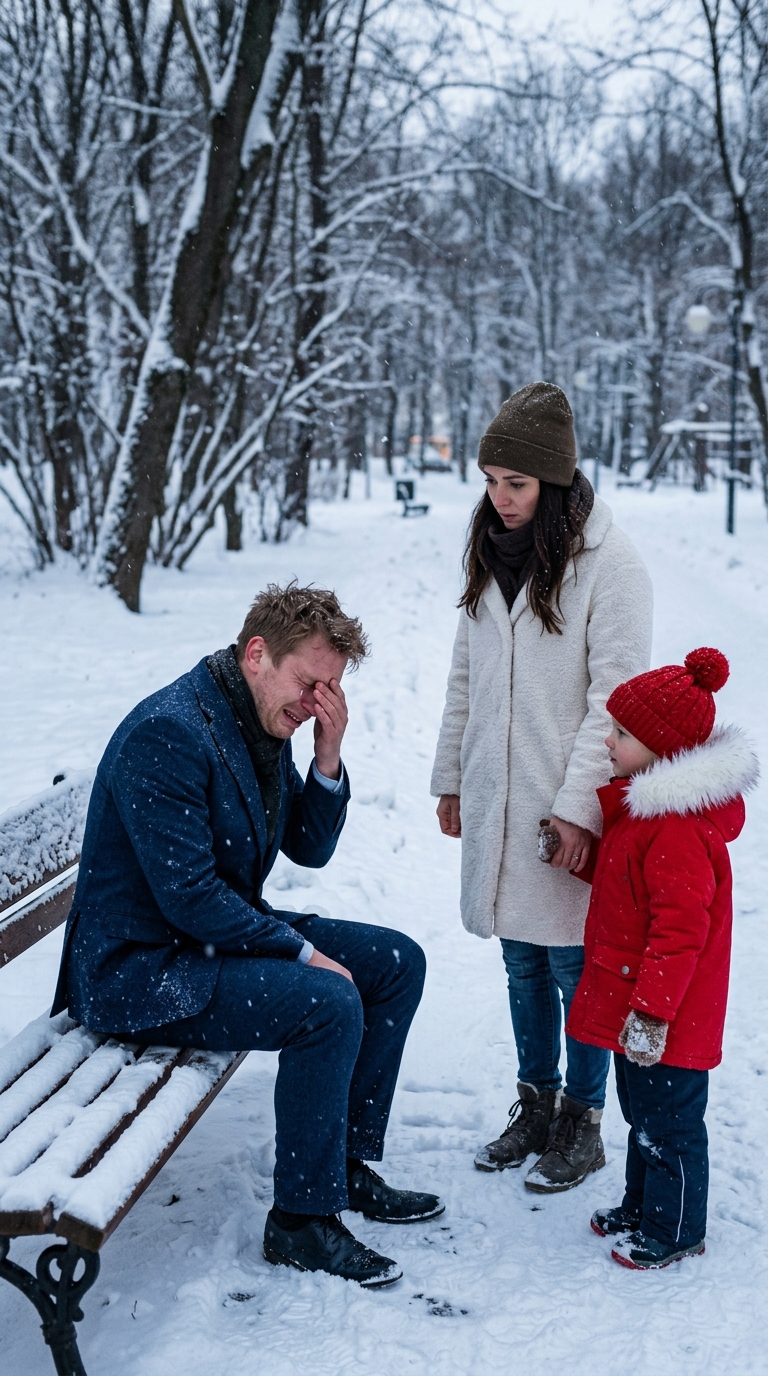
I wasn’t meant to cry that night. At least, that’s what I told myself while sitting on the old park bench facing the frozen lake — the same bench I once sat on as a boy, the same place where I waited for a mother who never came back.
Winter has a way of sharpening memory into something even harsher than grief.
And grief, once sharpened, becomes a habit you carry.
I thought I was alone — until a small voice broke through.
“Don’t cry, Mister.”
I turned.
A little boy stood a few steps away, cheeks flushed from the cold, mismatched gloves on his hands, eyes far too honest for his age.
He pointed at me with complete seriousness.
“You can borrow my mom.”
Behind him, a woman stopped mid-step — his mother. Warm brown eyes, quiet strength wrapped in a worn coat, and a gentle smile that seemed meant to excuse her son’s words.
“I’m sorry,” she murmured. “He… sees things.”
She reached into her bag and offered a cookie wrapped in waxed paper.
“Merry Christmas.”
Her fingers brushed mine — a small, electric kindness. I whispered, “Thank you,” because it was all I could manage.
The boy nodded like it made perfect sense.
“Eat the whole thing. It helps.”
They walked away.
I stayed there, staring at the crumpled napkin in my glove, unable to break free from the orbit of that unexpected kindness.
So I didn’t.
I followed the faint glow that seemed to linger around them.
And that was how I stepped into a light I didn’t know I had been searching for.
THE CAFÉ WITH GOLDEN WINDOWS
The café looked like a lantern resting in the snow — warm yellow light spilling into the grey winter night.
Inside, cinnamon hung in the air. Jaime — that was the boy’s name — talked about candy canes and paper stars while his mother poured cocoa from a thermos into small cups.
She slid one toward me.
“Jaime is terrible at ignoring sad people. He gets that from me.”
Her voice was soft, grounded, and completely unforced.
“You look nicer when you smile,” Jaime added.
So I smiled.
And something tight inside me cracked — not breaking, but healing.
We spoke about small things:
Paper stars.
Snow-covered sidewalks.
Quiet joys people overlook.
She never asked what I did or why my eyes were red.
She only asked if I liked cinnamon.
It was the first time in years someone had noticed me beyond appearance.
THE FOLDER FROM 1999
A few days later, Elise — that was her name, Elise Grant — arrived at our café with a worn manila folder.
“I found something,” she said. “I think you should see this.”
Inside:
A school photo dated December 1, 1999.
A boy with eyes too old for his face.
Me.
She touched a drawing tucked inside — a shaky reindeer drawn in a child’s uncertain handwriting.
“I made this for a boy in my class once,” she whispered. “He looked like he needed a Christmas.”
“I kept it,” I said, my voice breaking. “I folded it until it tore.”
Our pasts brushed together gently, like two small boats meeting in the dark.
I didn’t remember her face then, but I remembered the feeling.
The warmth of being seen.
A kindness I had carried without knowing where it came from.
Now I saw its source — sitting in front of me with cocoa in her hands.
THE RUMOR THAT ALMOST DESTROYED HER
The children’s theatre Elise ran came under sudden attack.
An anonymous blog accused her of plagiarism.
Sponsors withdrew.
Parents fell silent.
The theatre — her life’s work — began to collapse.
Jaime told me at dinner, crumbs on his cheek:
“Some kids say my mom stole her play.”
He thought it was nonsense.
I did not.
I called my legal team.
Within hours, a formal statement was released:
Timestamped drafts. Emails. Collaborators’ notes.
The truth — organized, precise, undeniable.
The rumor collapsed under its own weight.
When Elise called that night, her voice trembled.
“I’m not used to being protected,” she admitted.
“Neither am I,” I said quietly. “But no one should have to get used to being alone.”
She cried softly — not from weakness, but from finally being seen.
THE NIGHT JAIME RAN AWAY
One afternoon, Jaime came home shaken — kids at school had mocked him for “not having a father.” That night, he disappeared.
Elise’s panic cracked something open in me.
I searched instinctively — the park, the bench, the familiar paths.
There he was.
Curled on the cold bench, his small body shaking.
He looked up as soon as he sensed me.
“You came,” he whispered.
I sat beside him and wrapped my coat around his shoulders.
“I’m here,” I said — a promise, simple and absolute.
When Elise found us, tears carved down her face as Jaime ran into her arms.
Callum — me — stood at the doorway of their small home holding a crooked Christmas tree I had found along the way.
“Reinforcements,” Jaime declared.
Elise laughed — like a window opening after years of stale air.
“Maybe,” Jaime said softly, “you don’t borrow anymore. Maybe you just stay.”
I didn’t answer.
Some truths grow in silence.
Some promises are lived before they’re spoken.
THE PLAY ABOUT BORROWED LIGHT
The theatre reopened.
Their new play — The Boy and the Borrowed Light — echoed everything that had brought them back together.
Onstage, Jaime delivered the line that sank straight into me:
“When you’re lost in the dark, you can borrow someone’s light until yours shines again.”
The audience erupted in applause.
Backstage, under humming lights and tangled costumes, Elise placed her hand over mine.
“You stayed,” she whispered.
“I’m not borrowing anymore,” I replied.
Her forehead rested against my shoulder — a quiet, trembling yes.
THE NEW LIFE BUILT FROM SMALL THINGS
We didn’t rush toward anything like a perfect ending.
We learned each other through small routines:
Night cookies.
School runs.
Rehearsals where I held the camera wrong.
Dinners made of mistakes and laughter.
Elise learned to accept help.
I learned to offer it without hesitation.
Jaime learned family is chosen, not inherited.
The rumor faded.
The theatre thrived.
The city came to know the woman who built worlds from paper and glue — and the man who stayed quietly beside her.
THE BENCH WHERE IT ALL BEGAN (THE END)
A year later, on Christmas Eve, we returned to the park.
Lights glowed softly. Snow drifted through the air.
Jaime held my hand like it had always belonged there.
“You kept your promise,” he said.
I looked at Elise beside me, her smile steady in the cold.
“If I’m honest,” I said, “I borrowed more than a mother that night. I borrowed a family.”
Elise brushed snow from my sleeve.
“We borrowed you back,” she said.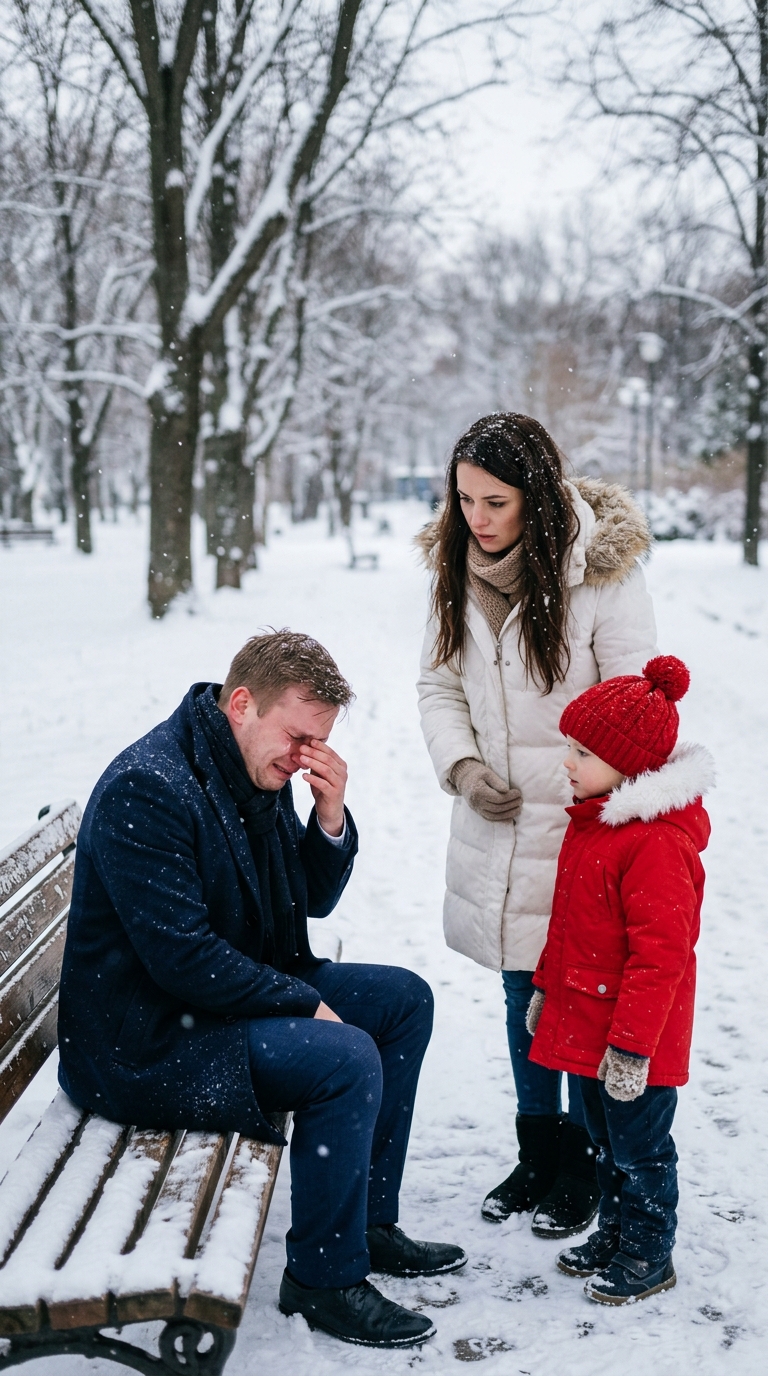
Jaime lifted the cocoa thermos proudly.
“Family meeting!” he announced.
We laughed — the kind that settles in the chest and stays there.
And on that old bench, under falling snow, something finally settled inside me.
I was no longer waiting to be found.
I had already come home.
