

PART 1
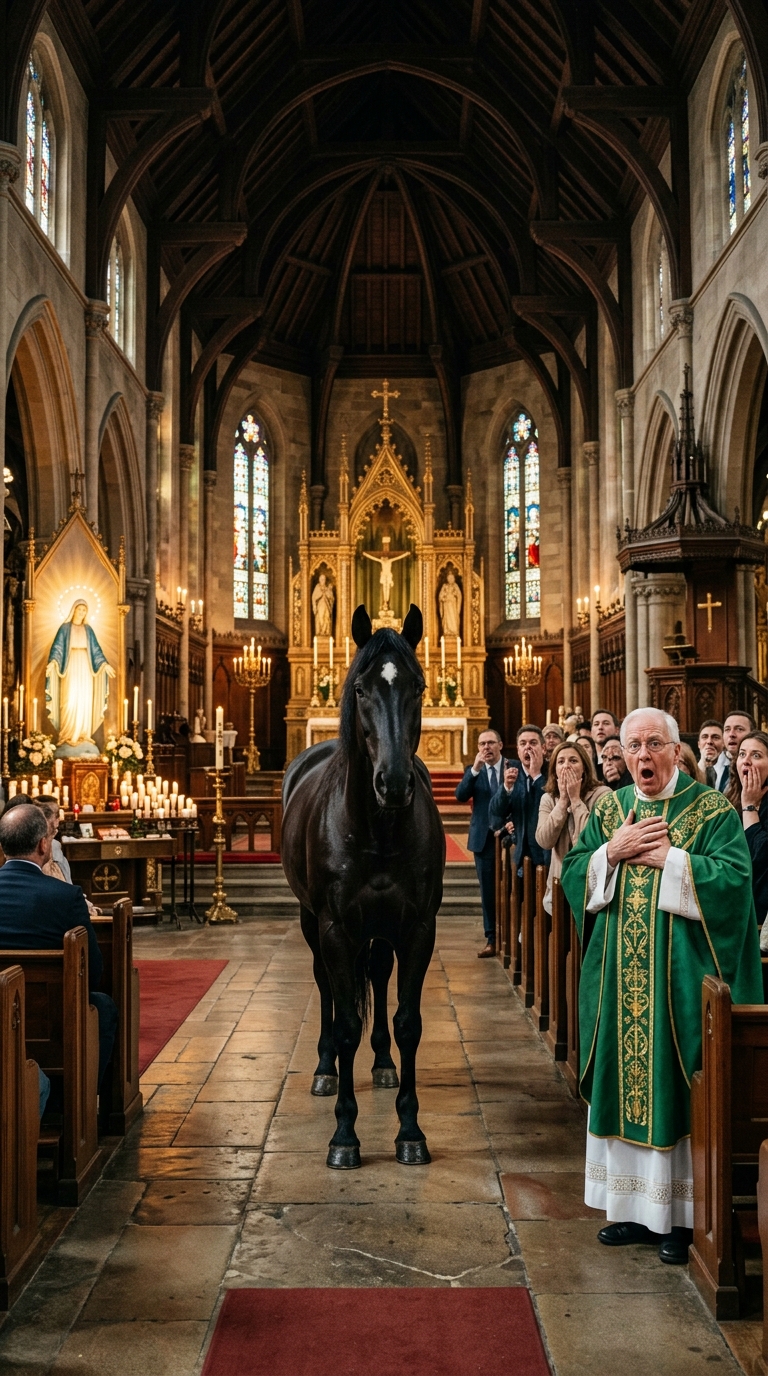
It was past 9 o’clock at night, and over the small town of San Lorenzo, in the heart of Jalisco, a storm fell that seemed determined to erase the dirt streets. The sky cracked with lightning that lit up the darkness, as if the weather itself was warning that something terrible was about to happen. Inside the town parish, the atmosphere was heavy, filled with the smell of melted wax, copal incense, and damp clothes from more than 150 parishioners who had taken shelter there for the Sunday mass.
In row number 3, sitting next to his mother, was Mateo. At 22 years old, Mateo was a young man consumed by resentment. While Doña Margarita clutched her rosary in her hands, murmuring prayers with her eyes closed, Mateo stared at the clock on the wall. Less than two hours remained until the 11 p.m. bus to the border left. In his right pocket, Mateo kept touching a one-way ticket. He had made the decision to leave the town — and more painfully, to leave his mother — that very night, without saying goodbye.
The tension between them was an open wound. Exactly five years earlier, Mateo’s father had died after working 14 hours a day under the scorching sun on Don Arturo’s lands — the richest and most ruthless landowner in the region. When tragedy struck his family, Don Arturo didn’t give them a single peso in compensation, leaving them in absolute ruin. From that day on, Mateo hated his mother’s submission. He hated that she responded to injustice by kneeling to pray instead of demanding justice. For Mateo, the church was a symbol of defeat, and that night he was only there because of Doña Margarita’s insistence — one last favor before disappearing forever.
Father Miguel had begun his sermon, raising his voice to compete with the roar of the rain hammering the tin roof. Suddenly, a different sound cut through the air. It wasn’t thunder or wind. It was a rhythmic, heavy, violent pounding. The noise came from the street and approached at a terrifying speed. The heavy oak wooden doors at the main entrance began to shake.
There were three seconds of confusion before absolute terror broke loose.
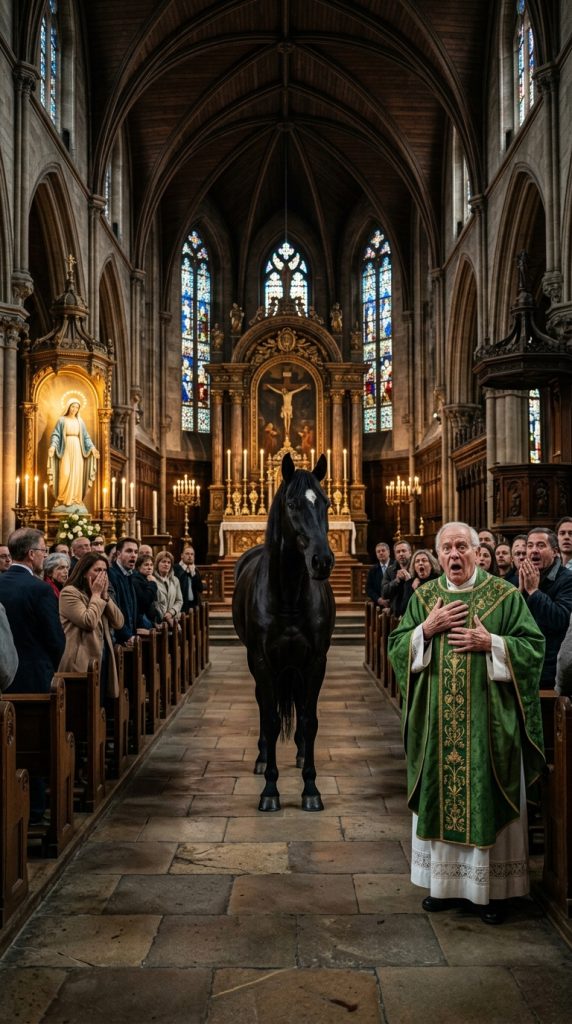
The doors burst open, slamming against the walls with a deafening crash. The icy wind swept down the central aisle, extinguishing 20 candles at once. And there, framed in the entrance and illuminated by a lightning flash, rose the figure of a gigantic beast.
It was a huge black horse, soaked by the storm and completely out of control. But this was no ordinary animal. Mateo felt his blood freeze in his veins the instant he recognized it. It was “Huracán,” the legendary and feared stallion of Don Arturo. Everyone in town knew the story of this animal. It was a wild, fury-filled creature that had already sent four experienced charros to the hospital, one of them with broken ribs and a punctured lung. No one could get near it without risking their life.
And now, this machine of muscle and panic was inside the church.
The people exploded in screams of terror. Mothers hugged their children, men tried to back away, but the space was small and panic created a deadly trap. Huracán let out a neigh that froze everyone’s soul, and with bloodshot eyes, it began to gallop down the central aisle, slipping on the tiled floor and smashing the wooden pews in its path. It was heading straight for the altar, but right in its way was row number 3.
Doña Margarita, paralyzed by fear, fell to her knees in the aisle, unable to move. Mateo tried to shout, tried to reach her, but his legs wouldn’t respond. The gigantic beast, weighing more than 600 kilos, reached the woman, rising violently onto its hind legs. Huracán’s front hooves cut through the air, casting a demonic shadow over the terrified face of Mateo’s mother.
No one in the church could breathe. Terror paralyzed every heart. Seeing the shadow of the furious beast rise above them, it seemed completely impossible to believe the tragedy that was about to happen…
PART 2
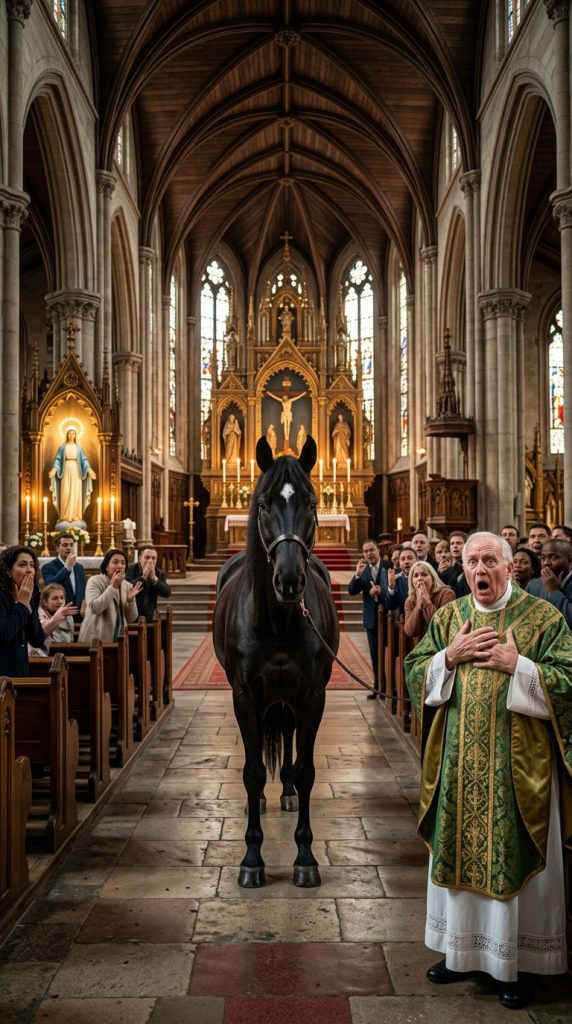
But the fatal blow never came. Against all logic, the beast did not crush Doña Margarita. Huracán dropped its front hooves just two centimeters from her, striking the stone floor with a dull impact that made the ground vibrate. The horse took a clumsy step to the left, avoiding the woman, and staggered forward until it reached the foot of the main altar, directly in front of the enormous image of the Virgin of Guadalupe.
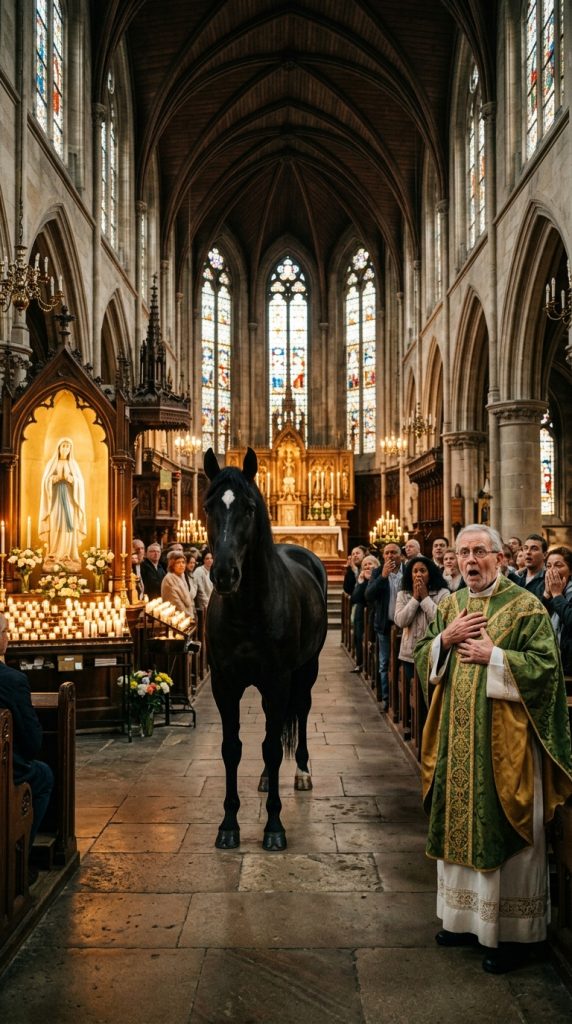
There, the chaos seemed to evaporate. The animal, which ten seconds earlier had seemed like an untamable demon, stopped completely. Its sides heaved frantically, exhaling clouds of steam from its nostrils, but there was no longer any aggression in its movements. In the graveyard silence of the church, before the astonished gaze of 150 people, Huracán lowered its heavy head, almost touching the ground, as if the invisible weight of its own fury had exhausted it — as if it had finally found a safe refuge that no one else had wanted to give it.
Before anyone could process what their eyes were seeing, a new commotion erupted at the entrance.
“Get out of the way! Move aside!” roared a thick, imposing voice.
It was Don Arturo. The powerful landowner strode in, drenched, his face red with rage, holding a hunting rifle in his hands. Behind him, two of his foremen escorted him, gripping thick ropes. The man’s presence in the sacred space with a firearm caused instant outrage, but fear of his power kept everyone silent.
“That devil of an animal just destroyed my stables and nearly killed two of my workers!” Don Arturo shouted, walking decisively down the central aisle without taking his eyes off the horse. “Enough! This beast has already cost me too much money. I’m going to put a bullet in it right here before it really kills someone.”
Father Miguel tried to step in, raising his hands. “Arturo, for the love of God, you are in the Lord’s house! You cannot spill blood here!”
“Step aside, Father, or the devil will take you by the collar!” the landowner threatened, chambering a round. The metallic sound of the rifle echoed horribly inside the church. Don Arturo raised the weapon, aiming directly at Huracán’s head.
It was in that precise millisecond that something broke inside Mateo. All his life he had felt rage — rage for his father’s death, rage for his mother’s poverty, rage for the absolute power that men like Don Arturo exercised over the weak. Looking at Huracán, he didn’t see a murderous beast. He saw a mistreated, cornered being, judged for defending itself from the blows it had surely received for years to be “tamed.” He saw himself.
Without thinking about the bus ticket, without thinking about the danger, Mateo let go of his mother’s hand.
“Mateo, no!” Doña Margarita sobbed, trying to grab his shirt, but the young man had already taken the first step.
He walked slowly down the aisle. Fifteen meters remained to the altar. The eyes of the entire town were fixed on him. Don Arturo’s foremen looked at him mockingly, expecting the horse to tear him apart or for the boss to teach him a lesson. But Mateo didn’t stop. Ten meters left. Five meters.
“Get out of there, you stupid kid!” Don Arturo warned, without lowering the rifle. “It’ll rip your head off!”
Mateo ignored the threat. He positioned himself exactly between the rifle barrel and the imposing horse. Behind him, he felt the heat radiating from Huracán’s body. The horse lifted its head slightly, its ears flicking back nervously at the landowner’s shouts. Mateo slowly extended one hand backward, without looking at the animal. The entire church held its breath, waiting for the attack.
But Huracán did not bite. It did not kick. In an act that defied all the logic of the charros and ranchers present, the huge black stallion took a step forward and pressed its wet, warm forehead against Mateo’s open palm.
Mateo felt an electric current run down his spine. He looked directly into Don Arturo’s eyes with a fire he had never felt in his 22 years of life.
“If you want to shoot someone tonight, Don Arturo, you’re going to have to start with me,” Mateo said, and his voice did not tremble. “You’ve already taken enough from us. Five years ago my father died on your lands and you left us in the street with a debt that wasn’t ours. You break people and you break animals because you think money gives you the right to own their souls. But you’re not going to kill this animal. He only came looking for peace — the same peace you stole from this town.”
The silence that followed those words was so thick you could hear the raindrops falling from the coats. Don Arturo’s face went from rage to astonishment. No peon, no inhabitant of San Lorenzo had ever dared speak to him like that. He clenched his teeth and shouldered the rifle, ready to assert his authority.
But then the real miracle happened.
Doña Margarita, the woman Mateo had always thought weak and submissive, stood up. She wiped her tears, lifted her chin, and walked to stand beside her son, directly in front of the gun barrel.
Moments later, the old town pharmacist stood up and joined them. Then two more women approached. After that, five men — peons who worked for Don Arturo himself — left their seats and formed a human wall around the horse, Mateo, and Margarita. In less than a minute, more than 50 people were standing, silently defying the most feared man in the region.
Don Arturo slowly lowered the weapon. He looked at the crowd, at the imposing horse now resting its huge head gently on young Mateo’s shoulder, and for the first time in his life, he felt the weight of his own defeat. Without saying a single word, he turned around and walked out of the church, followed by his two foremen, disappearing into the darkness of the storm.
The sound of the rain seemed to have lessened. Mateo turned toward Huracán. He stroked its wet neck, running his fingers through the dark mane. He had no experience breaking horses, no technique, but he didn’t need it. The connection had already been made. With one agile movement, Mateo pulled himself up and mounted the horse bareback, without saddle or reins.
The people slowly parted, opening the aisle. Mateo gave a light squeeze with his knees and Huracán began to walk. Its steps were now soft, firm, and respectful. The animal walked down the same aisle it had destroyed minutes earlier and exited through the main doors into the night cleansed by the rain.
That night, Mateo did not take the 11 p.m. bus.
As he walked beside Huracán back to their humble house under a sky where stars were beginning to appear, Mateo reached into his pocket, pulled out the bus ticket, and tore it into ten small pieces, letting the wind carry them away. He looked at his mother walking beside him, and for the first time in five years, he took her hand firmly. She gave him a smile full of tears and peace.
Huracán’s destiny changed forever. Don Arturo, perhaps out of public shame or fear, never claimed the animal. Mateo began working with horses, discovering a natural talent for healing animals that others considered useless. But the biggest change did not happen in the horse. It happened in Mateo. That night, in front of that altar, he understood that his mother’s faith was not weakness, but a silent strength that held the world together when everything else was falling apart.
Today, when someone asks Mateo what really happened that night — whether it was just a coincidence that the most violent horse in town surrendered in the most sacred place — he simply smiles, looks at Huracán grazing peacefully in the field, and answers: “There are things that cannot be explained with the head. They are understood when your heart is broken and something divine comes to pick up the pieces.”
And you, what do you think? Do you believe animals have the ability to sense the sacred and seek divine refuge, or do you think it was just a coincidence? Leave your answer in the comments, because I’m sure many of us have felt that protection in the darkest moments. If this story touched your soul, share it on your wall and don’t forget to leave your blessing. May the Virgin protect your path and the path of your entire family! Amen.
