

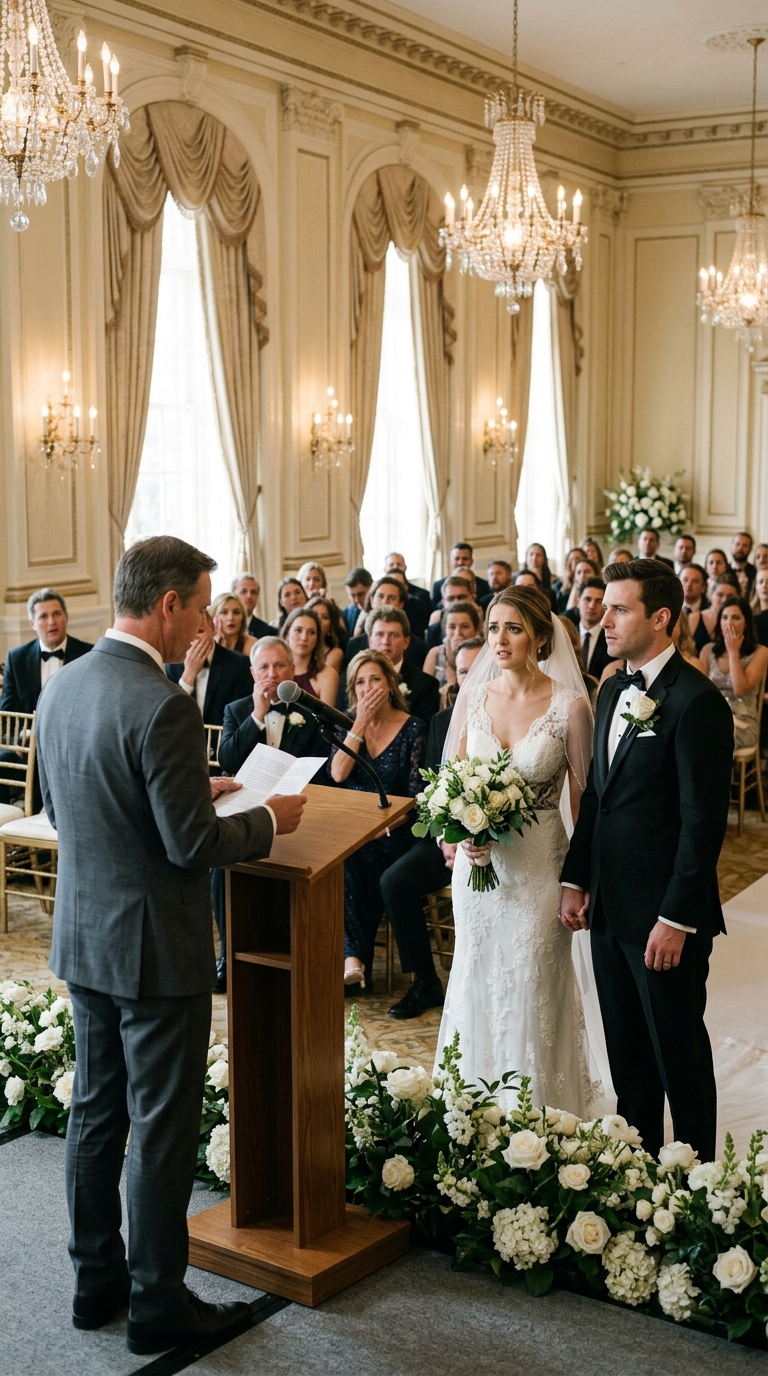
The first impression of Azure Heights Estate was that it was never meant for people who breathed like they belonged there.
The ballroom stretched across two towering levels of polished stone and glass, with chandeliers hanging like frozen light beneath an ivory ceiling that screamed inherited wealth. Everything looked designed by someone who had never once paused to consider cost or consequence.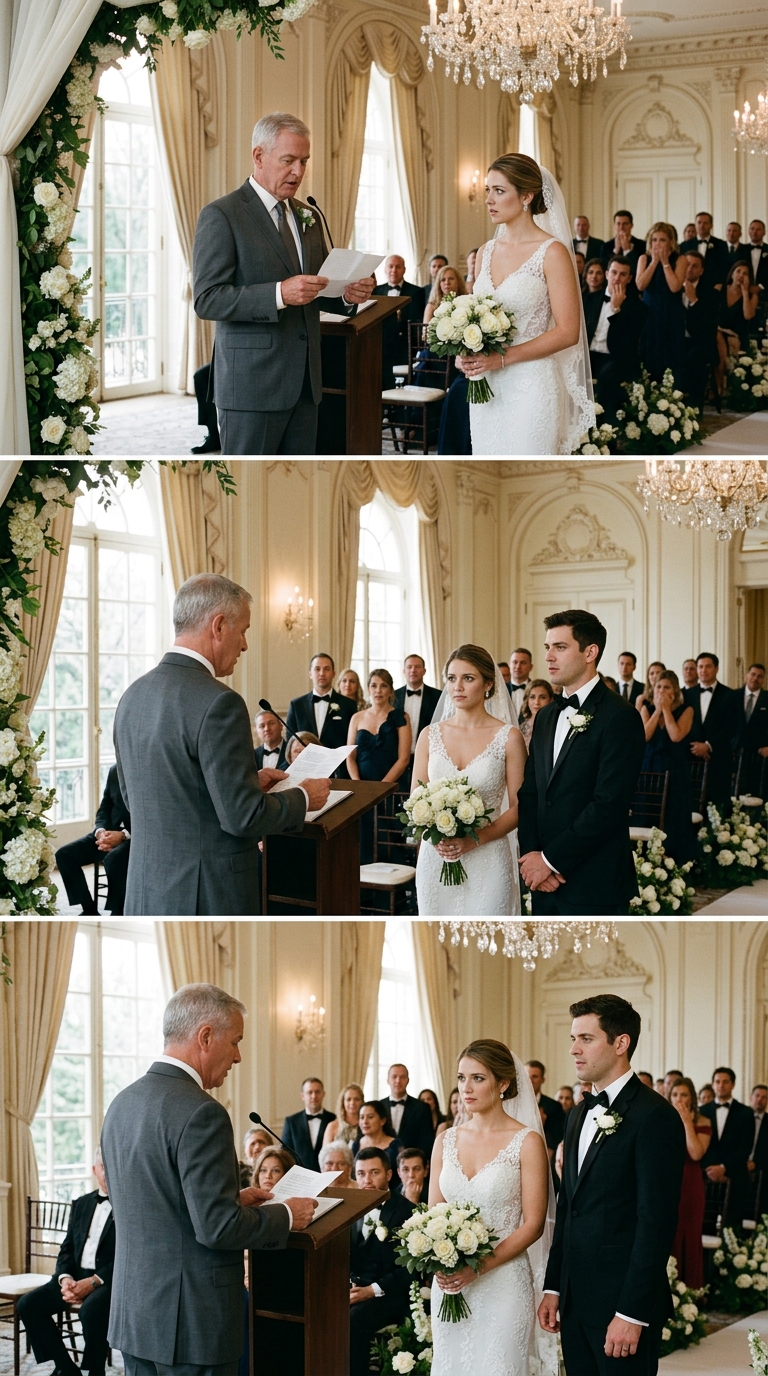
Golden late afternoon light spilled through the vast windows, washing over white rose arrangements and turning candle flames into trembling sparks. Staff in dark uniforms moved silently between guests, balancing champagne trays that shimmered like liquid glass.
The reflective floor doubled every figure crossing it, making the entire room feel like a mirrored illusion where everyone appeared larger, richer, and more important than reality allowed. Anyone unfamiliar with this world might have mistaken it for perfection.
I remember believing that for a brief moment before noticing my father’s suit.
It was not flawed in any real sense—just a simple dark suit, clean and respectable. But I knew every detail of its wear, the faint shine at the elbows from years of use, and the slightly uneven sleeve from a rushed alteration done years ago.
It had waited all week in a plastic dry-cleaning cover like something being called back into service for duty.
My father, Robert Preston, owned only one formal suit, reserved for weddings and occasions where my mother insisted he abandon his brown jacket. Today he wore it with a white shirt and the navy tie I had given him years earlier for Father’s Day.
He looked like every father who has lived a life written in responsibility and exhaustion. But in a room full of perfectly tailored tuxedos, he looked like he had arrived in the wrong story.
My mother noticed it too.
I watched her smooth her dress repeatedly, her fingers restless against navy fabric. She had spent the entire morning perfecting her appearance, carefully curling her hair and pinning a silver clip before asking me if she looked out of place.
“You look beautiful, Mom,” I had told her, and she had smiled like she wanted it to be true.
Now, surrounded by floral arrangements and elegant seating cards, that same uncertainty crept back into her posture.
My mother, Susan Preston, had once worked nights in hospital billing while raising Logan and me. She knew how to stretch meals, remove stains, and turn scarcity into something that still felt like care.
She could turn simple pancakes into celebration and hardship into routine kindness. But none of that mattered here, where worth was measured in polish, accent, and inherited ease.
We were seated near the back—my parents and me. I was Maya Preston, twenty-eight, sitting stiffly in heels that already hurt under chandeliers worth more than my student debt.
At the front stood my brother Logan in a perfectly fitted black tuxedo, looking both proud and nervous in a way that made me soften toward the entire room.
He had earned this moment. Everyone knew it.
He had worked multiple jobs through college, stocking shelves overnight while building every opportunity from nothing. I remembered his tired hands, his sleepless eyes, and my mother preparing meals for him to take back to school.
Nothing about his success had been handed to him.
Now he stood ready to marry Isabella Fontaine.
She looked like she belonged in photographs—effortless, composed, and deliberately unforgettable. Her dress shimmered with delicate beadwork, and her movements made people instinctively watch.
Her family, the Fontaines, carried old Boston wealth like a second language. They belonged everywhere without needing to be welcomed.
Her parents moved through the room with practiced grace, acknowledging guests as if attendance itself was an honor.
When they passed our table, their eyes briefly assessed us.
The judgment was subtle but immediate.
I had seen it all day in small fragments: polite smiles that never fully warmed, compliments that felt rehearsed, and a constant sense that we were being measured against a standard we were never told about.
Still, Logan loved her.
And that meant I stayed quiet.
When he asked us to arrive early, his voice had carried something unusual.
“I just need you close, okay?” he said.
We came because that is what our family did—we showed up, always, even when it was uncomfortable.
Cocktail hour blurred with music and champagne as guests drifted through conversations. My parents stayed composed, though I could see the tension in their posture.
Then Isabella approached.
“Maya!” she called brightly, her bridesmaids trailing behind her.
At first, I felt relief—until I saw the sharpness behind her smile.
She leaned in slightly, her voice carrying further than intended.
She said she didn’t realize Logan’s family would be sitting here.
My mother’s expression faltered.
Then Isabella added, without hesitation:
“A poor family here lowers our wedding’s prestige.”
Silence followed—not immediate outrage, but the kind that arrives when people are unsure whether they heard correctly.
My mother froze mid-motion. My father looked at Isabella for a long moment, expression unreadable.
Heat rose in my chest, but no words came.
Isabella’s words hung in the air like something irreversible.
Then my father laughed.
It was sudden and real, cutting through the tension so sharply that heads turned across the room.
Isabella’s smile disappeared instantly as she demanded to know what was funny.
My father stood slowly, adjusting his jacket with calm precision, as if gathering his thoughts.
When he finally spoke, his tone was steady.
“Then,” he said evenly, “we’re leaving.”
Isabella blinked and nodded as if this resolved everything.
My father reached into his jacket and pulled out a sealed envelope stamped with the estate’s crest.
He walked toward the front without urgency.
Conversation faded as he reached the microphone stand.
The wedding coordinator stiffened as she received the envelope, her expression shifting the moment she read it.
My father took the microphone.
Logan turned, confused, asking what was happening.
Dad raised a hand slightly, asking for silence.
“My name is Robert Preston and some of you may know me as the CEO of Preston Global Freight,” he announced.
A ripple moved through the room.
Recognition spread slowly, unevenly.
I saw people react differently—some surprised, some uncertain, and some suddenly attentive in a new way.
Isabella’s confidence fractured.
My father continued, explaining calmly that he had arranged and funded the venue.
Murmurs grew louder.
He then addressed the earlier comment directly.
“A moment ago, you told my wife and daughter that a poor family lowers your wedding’s prestige,” he said.
The words landed heavily across the ballroom.
Then he spoke about my mother’s nights working, about Logan’s sacrifices, and about our family’s history that had been mistaken for weakness.
“That history is not an embarrassment to us,” he said firmly.
Logan’s expression changed as realization settled in.
Isabella tried to recover, insisting it was a misunderstanding.
But my father’s tone remained unchanged.
“We are discussing it publicly because the insult was public,” he said.
He then stated that he would not remain where his family was disrespected.
The room held its breath.
Logan finally spoke, asking Isabella if she had meant it.
She dismissed it as exaggeration.
But her response only revealed more than she intended.
Logan’s voice tightened.
“You already ruined it,” he said.
Silence followed again—heavier this time.
My father told him quietly that he did not need to decide immediately, only to see clearly.
Logan closed his eyes for a moment.
Then he took the microphone.
“There won’t be a wedding today,” he said.
The reaction was immediate—shock, whispers, confusion.
Logan explained nothing further, only thanked the guests.
We left the ballroom together.
Outside, the air felt cooler, realer, stripped of everything artificial.
The internet reacted before we even arrived home.
Clips circulated, opinions formed instantly, judgments assigned.
Some praised my father. Others criticized Logan.
At home, silence settled into something heavier.
Logan returned to our parents’ house days later.
We packed together in quiet stretches of conversation and longer pauses of thought.
Eventually, grief replaced anger.
My parents stayed close to him.
Time passed unevenly.
Eventually, life adjusted.
Logan rebuilt slowly, learning how to exist outside what he thought his future would be.
He met someone new later, someone who valued presence over appearance.
Their life together grew without spectacle, without pressure, without performance.
Their wedding was small and quiet, held somewhere simple and real.
My father gave a toast.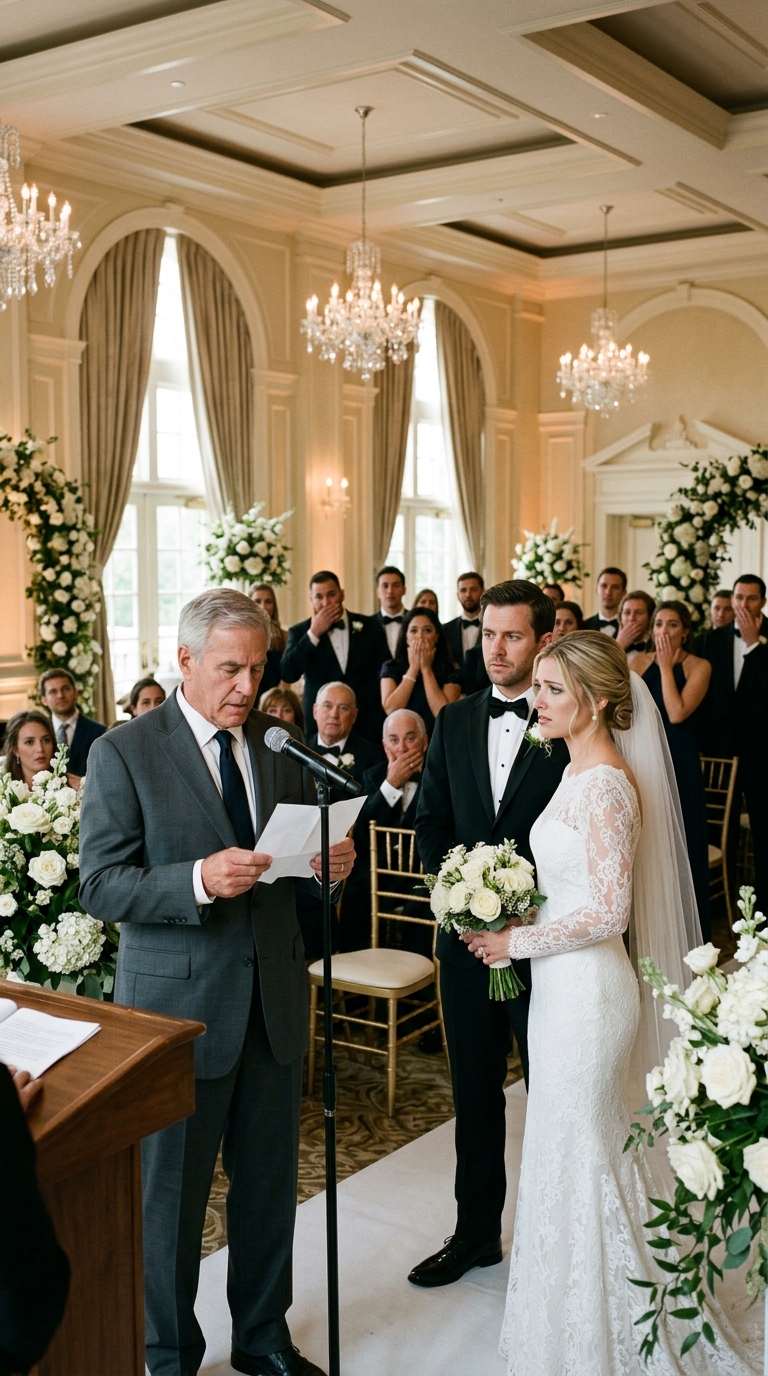
“Always know who you are when no one important is watching,” he said.
And for the first time, that room felt like enough.
I still think about that day sometimes—not as a collapse, but as a correction.
Because what ended there was never just a wedding.
It was the illusion that respect can survive without truth.
THE END.
