

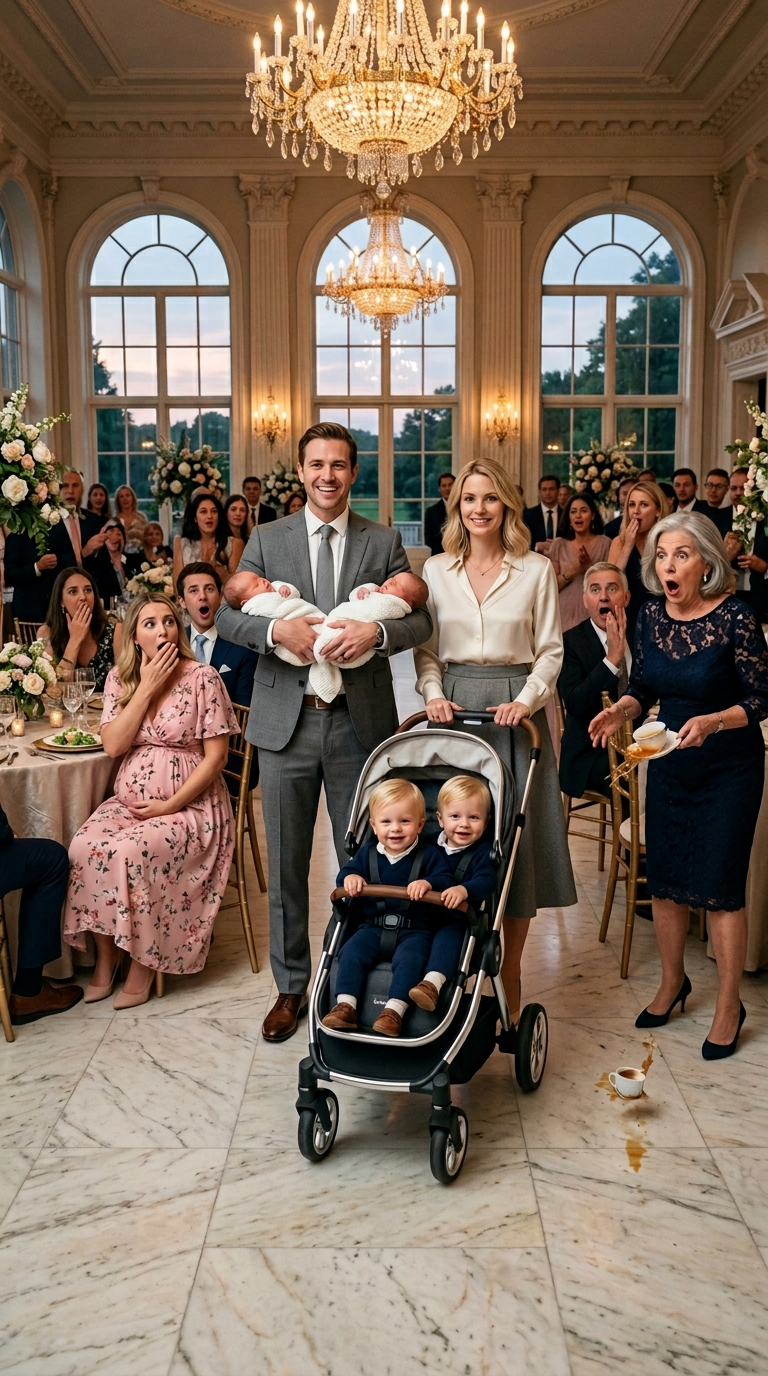
The air inside the Huntington Conservatory carried the scent of expensive lilies, vanilla buttercream, champagne, and a sharp undertone of judgment dressed up as tradition. I hadn’t been inside that stifling atmosphere in three years, yet the moment I crossed the marble threshold, it clung to my throat like smoke.
That conservatory had always been my mother’s stage, where she performed authority under glass and steel. Attached to the eastern wing of my parents’ sprawling Barrington estate in Rhode Island, it stood like a cathedral filled with orchids, palms, and controlled beauty.
In winter, condensation softened the edges of the glass and turned the room into something dreamlike. In summer, the brightness felt overmanaged, as if even sunlight had to behave properly here.
That day, everything had been dressed in pink and cream for a celebration of motherhood. Roses wrapped around doorframes, silk ribbons draped across gilded chairs, and every surface looked curated to perfection.
Near the windows, a towering cake stood with sugar flowers and tiny fondant shoes. A gold plaque on top declared Welcome to the New Huntington Heir in elegant script.
Crystal glasses chimed gently as laughter rose in delicate bursts beneath the vaulted ceiling. I stood just inside the entrance, my fingers unconsciously adjusting the silk cuff of my navy blouse.
It was an old habit I thought I had outgrown when I left this place behind. But the house seemed to remember who I used to be, returning that version of me the moment I stepped inside.
At the center of the room sat my younger sister, Penelope, placed like a centerpiece on a velvet chair. Her hands rested over her pregnant belly as she smiled at the circle of women surrounding her.
She wore pale pink silk, as if she always embodied whatever role she was given. Her blonde hair fell softly over her shoulder, her cheeks warm with the heat and attention of the room.
Even from a distance, I could see the tension behind her blue eyes. She was glowing, as everyone insisted, but she was also performing.
No one performed better than Madeline Huntington. My mother stood beside her like a shadow that owned the light.
Madeline was sixty-three, though no one would dare say it aloud. Her icy blonde hair never changed, her skin remained carefully preserved, and she carried herself like aging was something that happened to other people.
She wore a cream suit and pearls, her expression suggesting the world should pause in her presence. For a moment, she didn’t notice me at all, and I almost turned away.
That was the truth of it. I had spent three years convincing myself I was free of her and these polite gatherings where cruelty was disguised as elegance.
I had built a life in Philadelphia without her approval, married a man she never met, and survived pain that reshaped my entire body and identity.
Yet standing there, I was twenty-seven again, crying in a bedroom while being told I was nothing more than something decorative.
I forced myself to breathe and remember I was thirty-two now. I wasn’t there for permission or forgiveness.
I was there because my father had begged me, and because I wanted to face the place where I had once been reduced to nothing.
My heels clicked against the stone floor as I stepped forward. My mother’s voice cut through the room immediately.
“Lydia?”
Conversation dulled as heads turned. I felt eyes land on me from every direction.
Madeline approached slowly, never in a hurry unless she wanted to be. She stopped just close enough to make her presence invasive.
“Mother,” I said evenly. “The decorations for the party are quite lovely.”
Her eyes swept over me in a practiced inspection, searching for flaws as if I were an object rather than a person.
“I am honestly surprised you decided to come today,” she said with a pitying smile.
“I told your father it would be much too painful for you to be around all of this life,” she continued, gesturing toward the celebration. “We all know about your difficult situation and the struggles you have faced.”
“I am doing just fine, Mother,” I said, gently pulling my arm free.
“I always worried that without a husband to take care of your needs, you would just fade away into nothing,” she whispered.
I opened my mouth to respond, but held back. Marcus was parking outside. The children were on their way inside. Timing mattered.
“I am just here to wish Penelope well,” I said instead.
Madeline dismissed me with a small smile and told me to take champagne I didn’t need. I stepped away, accepted sparkling water instead, and moved into a quieter corner.
From there, I could see everything—Penelope surrounded by gifts, Madeline orchestrating attention, my father standing near the buffet with a drink he hadn’t touched.
He saw me and looked briefly relieved, then guilty. He always wanted peace, even when peace meant submission.
Time ticked forward in my mind. I had minutes left before everything changed.
As Penelope opened gifts, the room reacted softly to every ribbon and layer of paper. She smiled, but her expression remained tight.
I thought about who she had become: compliant, careful, shaped by expectation. Not unlike me once.
A server passed with food, but I refused it. My appetite had nothing to do with hunger anymore.
Five years earlier, I had been engaged to Chandler, a man chosen for his name and lineage. I hadn’t loved him enough to survive him.
Then illness came, followed by surgeries and doctors speaking in quiet, devastating terms about fertility and loss.
Chandler stayed briefly, then withdrew. His words turned cautious, distant.
Madeline eventually sat beside my hospital bed and explained my value as if it were measurable.
“A woman who cannot produce an heir for a family like ours is like a beautiful vase that cannot hold any water,” she said.
Two weeks later, the engagement ended through a letter.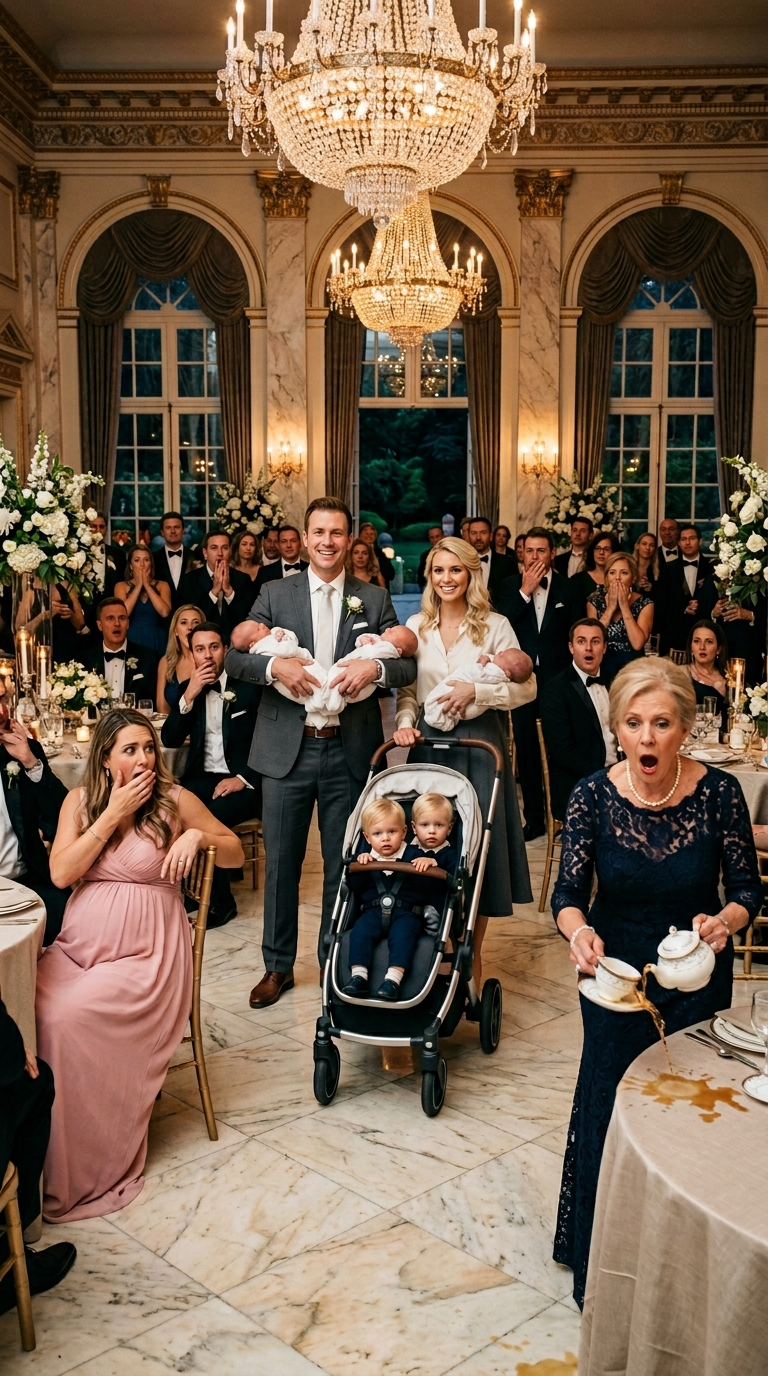
I left with two suitcases and a hidden trust fund from my grandmother. Philadelphia became my escape and my rebuilding.
I studied, worked, and eventually inherited a gallery that became my entire world. My mother believed I worked somewhere insignificant, and I let her believe it.
Then I met Marcus at a charity auction. He looked at a sculpture like it had offended him.
“You clearly hate that piece,” I said.
His smile was immediate, warm, unguarded.
On our third date, I told him everything about my medical history. I didn’t want secrets between us.
I expected distance. Instead, he held my hand.
“Lydia, I am falling in love with you, and I am not falling in love with your reproductive system,” he said firmly.
We married quietly in a garden, without my family present.
After years of treatments and hope, our triplets arrived first—Leo, Sam, and Maya—followed later by twins, Jonah and Sarah.
Five children under four. A life built from persistence, science, and love.
And yet here, I was still “broken” in their eyes.
Penelope called me over. I walked toward her, steadying myself.
“I am so glad you came today, Lydia,” she said softly.
“I am not jealous of anyone, Penelope, because I have a very full and happy life,” I said to her.
Madeline appeared instantly, as if summoned by dissent.
“We should all be extra kind to Lydia today,” my mother announced loudly.
Silence spread through the room.
“She told the room that it takes a lot of strength to celebrate a sister’s joy when you know you will never have it yourself.”
And then she said it clearly, deliberately:
“some women are built for legacy while others are just damaged goods.”
The room froze.
I felt something sharp and clean rise inside me, but I didn’t break.
“Is that really what you think, Mother?” I asked calmly.
I told her to define worth by more than reproduction, and she insisted she was stating facts.
“Well, let us talk about reality then,” I said, turning toward the entrance.
The doors opened.
Rosa walked in first, pushing a wide stroller built for three.
Inside were Leo, Sam, and Maya.
The room gasped.
Rosa apologized about a pacifier lost in the fountain.
“Thank you, Rosa,” I said, as Sam looked up and clearly said Mama.
My mother’s face collapsed slightly.
Before she could speak, the doors opened again.
Marcus entered holding Jonah and Sarah.
He walked straight to me and kissed my forehead.
“Sorry I am late, love, but the hospital board meeting ran much longer than I expected,” he said loudly.
Whispers spread. Recognition followed.
Marcus looked at my mother and spoke with quiet clarity.
Madeline dropped her teacup. It shattered across her suit.
“Triplets and twins, Mother,” I said.
Penelope moved closer, stunned. Marcus confirmed the children were ours.
“I did not lie to you, Mother, but I simply stopped giving you access to information that you would only use as a weapon,” I said.
She tried to claim rights. I corrected her.
The guests shifted uncomfortably, some whispering, some staring openly.
Marcus stated who he was and what I had built.
My mother looked unsteady, unraveling.
“My children are not trophies for your vanity or props for your social media pages,” I said.
She reached out, but Marcus blocked her.
“You do not get to hold them, and you do not get to be a grandmother in public after being an executioner in private,” I said.
We turned to leave.
My father called my name. I saw tears in his eyes.
“They are beautiful, Lydia, and you did a good job,” he said softly.
We walked out into sunlight that felt lighter than anything inside that house.
The SUV was loaded. The children were counted twice.
In the mirror, my mother stood frozen on the steps.
No one spoke for several minutes except the children.
That night, we sat on the kitchen floor surrounded by toys, laughing despite everything.
My father later admitted he was finally seeing the damage he had ignored.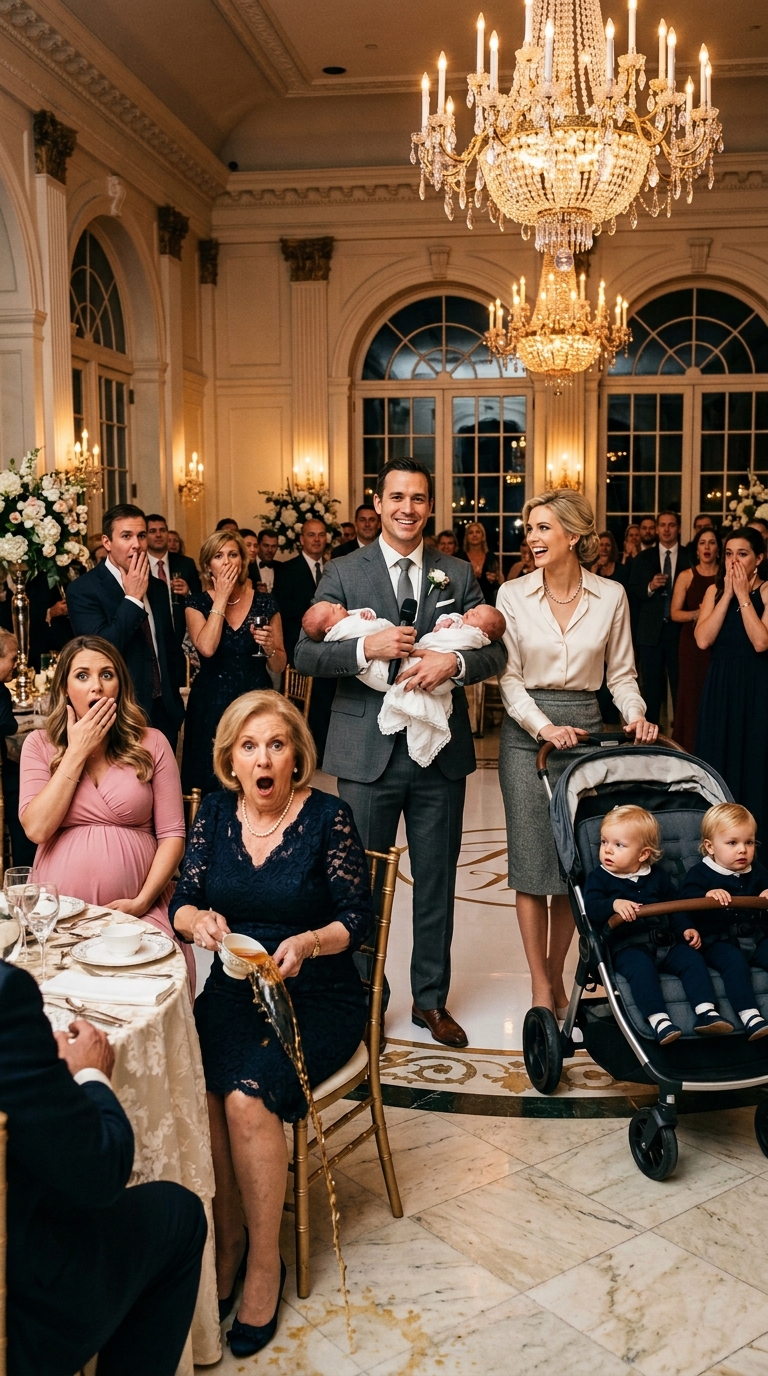
Penelope visited weeks later and asked for help finding her voice.
My mother eventually wrote an apology after a long silence and therapy.
I allowed limited contact, but only under strict boundaries.
My children grew up loved, safe, and unmeasured by legacy.
And I finally understood that I had never been broken.
I had simply built a life no one there could control.
