


Part 1
Alejandro Valdés arrived at his home in Lomas de Chapultepec at 7:18 in the evening, his jacket folded over his arm, his phone filled with missed calls, and an old guilt tightening in his chest.
From the outside, the residence looked perfect: light stone walls, an immaculate garden, enormous windows, and a fountain running even though no one ever stepped outside to admire it.
But inside, that house had spent the last 14 months feeling like a museum where someone had removed the most important piece.
His wife, Lucía, had died in an accident on her way to the San Juan market. She had gone to buy ingredients for Sunday dinner, the dinner the three of them treated almost like a sacred ritual: Lucía, Alejandro, and their son Emiliano.
From that day on, the boy stopped eating.
Not suddenly, not like in a movie, but little by little, in a quiet way that slowly wore his father down.
Emiliano was 5 years old, with big eyes and a seriousness far beyond his age. He would sit in front of his plate, push the rice around, nudge the chicken aside, swirl the spoon in his soup, and after a few minutes, always say the same thing:
—I’m done.
Alejandro had consulted pediatricians, psychologists, nutritionists, expensive specialists who all used gentle words to say the same thing: the boy’s body associated food with the absence of his mother.
Eating meant remembering that Lucía was no longer sitting beside him.
Alejandro understood the explanation, but understanding did nothing for him when he watched his son grow thinner inside his clothes, when the school called because the boy had gotten dizzy during recess, when the nights ended with him sitting at the table, staring at an almost untouched plate and feeling like the worst father in the world.
Eight months after Lucía’s death, Renata Salcedo appeared.
She was elegant, intelligent, confident — the kind of woman who walks into a room and seems to rearrange the air around her. She worked designing interiors for luxury hotels and spoke with a measured, flawless sweetness.
At first, Alejandro believed Renata was a blessing.
She said she wanted to help him, that Emiliano needed a mother figure, that a house could not remain dressed in mourning forever.
After 4 months, she was already living there. After 6, Alejandro gave her a ring.
To everyone else, Renata was patient and charming with the boy. In school photos, she smiled with one hand resting on Emiliano’s shoulder. At gatherings, she would say:
—I love him as if he were my own.
But when Alejandro wasn’t around, her patience turned to ice.
She never yelled, never left marks, never did anything that could easily be pointed out. She simply sighed whenever Emiliano refused to eat. She would snatch the plate away roughly and whisper:
—Your father has already suffered enough for you to keep acting dramatic.
The boy didn’t know how to explain that feeling. He only learned to make himself smaller whenever Renata walked into the kitchen.
Then Mercedes Iturbide arrived.
She was 44 years old, from Puebla, carrying an old suitcase and the hands of a woman who had worked her entire life. Alejandro hired her to clean, do laundry, cook simple meals, and keep the house in order. Nothing more.
He welcomed her in the kitchen with a short list of instructions and a weariness he no longer tried to hide.
—My son has problems with food, he told her. Don’t take it personally if he doesn’t eat. Just serve the plate and leave it there.
Mercedes didn’t make a face of pity. She didn’t ask uncomfortable questions. She simply nodded.
—Understood, sir.
During the first week, Mercedes observed.
Not like a specialist, but like someone who knew food was never just food. She watched Emiliano push beans around with his fork, glance at the empty chair where his mother used to sit, tense his shoulders whenever Renata approached.
On the eighth day, she changed just one thing.
Instead of leaving the plate and walking away, she stayed in the kitchen chopping vegetables. She didn’t look directly at the boy. She simply let the sound of the knife against the cutting board fill the silence.
Emiliano looked up.
He watched Mercedes slicing carrots into perfect little rounds. Without stopping, she said:
—My grandmother used to say food speaks softly. If you listen to it, you’ll know what it wants to become.
Emiliano didn’t answer. But he didn’t say “I’m done” either. He stayed sitting there for 40 minutes.
The following night, Mercedes peeked into the living room.
—I need an assistant. These zucchinis aren’t going to chop themselves.
Emiliano looked at her suspiciously. Then he set his crayons on the floor and followed her.
Mercedes handed him a small butter knife and a soft piece of zucchini.
—Make slices. If they come out crooked, even better. That gives them personality.
The first cut was a disaster. The second one too. The third looked almost like a little wheel.
Mercedes lifted it up as if it were a jewel.
—This one goes right on top of the soup. The best slice in the kitchen.
Something small moved at the corner of Emiliano’s mouth. It wasn’t quite a full smile, but almost.
They cooked together for 45 minutes. He washed tomatoes, tore cilantro leaves apart, stirred the broth with a wooden spoon.
When the soup was ready, Mercedes served two bowls, sat beside him, and began eating without watching him.
Emiliano saw his little zucchini slice floating on top, picked up the spoon, and ate.
One spoonful. Then another. Then six.
At the end, he didn’t say, “I’m done.” He said:
—Can I help again tomorrow?
Part 2
Mercedes didn’t tell Alejandro right away.
Not because she wanted to hide it, but because she understood that fragile things break when too many people look at them. If she turned it into news, Alejandro would call the pediatrician, measure portions, ask questions, and Emiliano would feel like the kitchen had become a test again.
So she kept the miracle quiet and continued cooking.
Within 3 weeks, Emiliano was already waiting on his little stool before dinner, holding his small knife with brighter eyes. He asked why onions made people cry, whether rice could hear when it boiled, why lemon changed the taste of everything.
Mercedes answered seriously, as if every question deserved respect.
One morning, Alejandro came downstairs early and saw something that left him speechless: Emiliano was sitting at the table eating eggs with tortillas, toast, and orange juice.
He was eating willingly, with real hunger, while Mercedes prepared more because he had asked for seconds.
Alejandro stood frozen in the doorway. He wanted to speak, but if he did, he knew he would cry.
Later, after the boy left for school, he found Mercedes washing dishes.
—How long has he been eating like this? he asked.
—A few weeks.
—And why didn’t you tell me?
Mercedes turned off the faucet and looked at him calmly.
—Because he wasn’t eating for you, sir. He was learning to eat for himself. If I had told you, you would’ve looked at it like an achievement, and he would’ve felt like he had to perform.

Alejandro opened his mouth, but he didn’t argue. She was right.
—He doesn’t need an audience, Mercedes added. He needs a kitchen where it doesn’t hurt to breathe.
That night, for the first time in a long while, Alejandro had dinner with his son without fear.
Emiliano talked about school, about a frog he saw in a book, and about how cilantro “looked like grass but tasted like Sundays.”
Alejandro laughed with a knot in his throat.
Renata watched everything from the other end of the table. She smiled, congratulated Emiliano, said she was proud of him.
But her eyes weren’t smiling.
For months, she had been building a perfect plan. She had quietly spoken with a family consultant about therapeutic boarding schools for children with eating disorders. She had kept brochures hidden in a folder labeled “Terrace Ideas.”
She had planted comments within Alejandro’s family: that Emiliano needed structure, that the house wasn’t enough, that perhaps a residential program would be the most loving option.
She didn’t want the boy to heal. She wanted him gone from the house without seeming cruel.
Emiliano was Alejandro’s last living connection to Lucía. And as long as he remained there, Renata would never fully own that life.
Without realizing it, Mercedes was destroying her entire argument one dinner at a time.
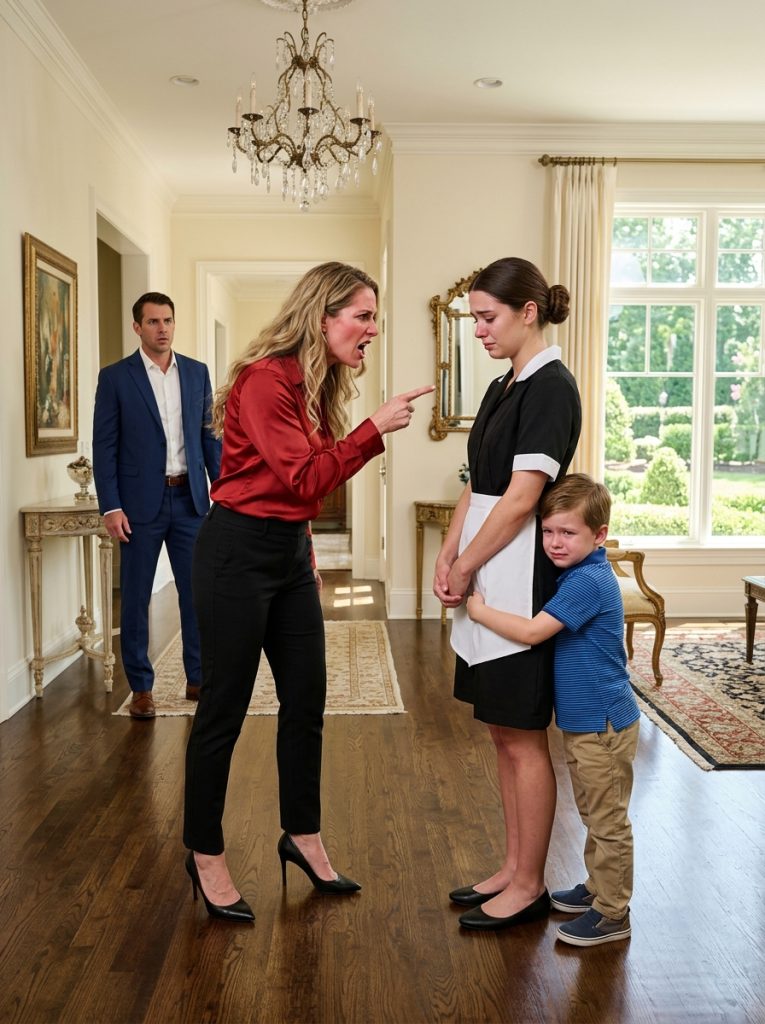
The following Monday, Renata waited until Alejandro left for a meeting in Santa Fe and Emiliano had gone to school.
She walked into the kitchen in sharp heels, expensive perfume, and a smile that never reached her eyes.
—Mercedes, we need to talk.
Mercedes set the dishcloth down on the counter.
—Yes, ma’am.
—Alejandro and I have decided your services are no longer necessary. You can finish today and come back tomorrow for your belongings.
Mercedes looked at her for a few seconds.
—Did Mr. Alejandro tell you to say that?
—This is my house, Renata replied, avoiding the question. And I’m making a decision for the good of my family.
Mercedes understood. She had seen that kind of look before: it wasn’t an employer speaking to an employee, it was someone defending territory.
—I’ll wait until Mr. Alejandro comes home, she said. If he asks me to leave, I’ll go.
Renata clenched her jaw.
—You don’t make the decisions here.
—No, ma’am. But I’m not going to abandon a child who only just started eating again because my presence here makes you uncomfortable.
Renata’s mask cracked.
—Don’t get confused, Mercedes. You cook. You clean. You do laundry. You are not family.
At that moment, neither of them knew that Emiliano was home.
The school had called because he had a slight fever, and the driver had dropped him off 20 minutes earlier. Mercedes had tucked him upstairs with a cool cloth on his forehead.
But when he heard the harsh voices, he slowly came downstairs in wrinkled pajamas, his feverish eyes shining.
He appeared at the kitchen entrance just as Renata was saying:
—I want your things out by tomorrow.
Emiliano looked at Renata. Then at Mercedes. Then he took a small step forward and stood between them.
His voice came out quiet, firm, far too serious for a 5-year-old boy.
—Don’t make her leave.
Renata froze.
—Emiliano, go back to your room. You’re sick.
The boy didn’t move. He repeated it, now with tears in his eyes:
—Don’t make her leave.
Those three words filled the kitchen like thunder.
Mercedes immediately knelt down.
—I’m here, my boy. I’m not leaving right now. You need to rest.
Emiliano grabbed the edge of her apron.
—She wants you to go away.
—Your father and I are going to talk, Mercedes said, gently stroking his hair. But you need soup and bed rest.
Renata tried to regain control.
—Don’t be dramatic, Emiliano. Nobody is taking anything away from you.
Then the boy looked at her with a clarity no adult expected.
—You do. You take away everything that makes me feel good.
The color drained from Renata’s face.
Mercedes picked the boy up and carried him upstairs.
When she came back down, Renata was no longer in the kitchen.
Part 3
Alejandro arrived at 4:30, two hours earlier than usual. Mercedes had called him with one simple sentence:
“Your son is fine, but you need to know what happened.”
He found Emiliano asleep on the couch with half a cup of soup beside him. He touched his forehead, kissed him carefully, and went into the kitchen.
Mercedes told him everything: Renata’s lie, the order to leave, the boy coming downstairs with a fever, the three words he had repeated as if he were defending his home.
Alejandro listened without interrupting. When she finished, he asked quietly:
—Did she say I agreed with this?
—She implied it.
—I knew nothing about it.
That night, while Renata was showering, Alejandro opened his laptop. He found the folder labeled “Terrace Ideas.”
Inside were brochures for boarding schools, completed application forms, emails with an admissions coordinator, and a note written by Renata:
“Present it as a necessary intervention. Speak with the pediatrician. Make Alejandro understand that it’s for the good of the child.”
He read every line feeling something inside him break apart and settle into place at the same time. He had been so desperate to rebuild a family that he had allowed a stranger to walk across the cracks in his son’s heart.
The next morning, he waited for Renata in the dining room.
On the table, he placed the brochures, the ring, and a photo of Lucía and Emiliano baking cookies together.
Renata came downstairs looking flawless, as always. The moment she saw the papers, she stopped.
—Alejandro, I can explain.
—No, he said. You’ve already explained enough in those emails.
She tried to cry. She tried to say she was doing it out of love, that Emiliano needed professional help, that Mercedes was manipulating the child.
Alejandro barely listened for more than a few minutes. Then he raised his hand.
—My son does not need to be hidden away in a boarding school so you can feel like the owner of this house. He needs security. He needs patience. He needs people who don’t look at him like he’s a burden.
Renata’s tone changed.
—You’re choosing a maid over your future wife?
Alejandro glanced toward the staircase, where Emiliano was still asleep.
—I’m choosing my son.
Renata left that very afternoon. She placed the ring on the table and walked out with her expensive suitcases, furious because for the first time, she had not won.

Alejandro didn’t yell. He didn’t humiliate her. He simply closed the door and felt the house breathe again.
That night, Mercedes made noodle soup with vegetables.
Alejandro wanted to apologize a thousand times, but he didn’t know how. He sat beside Emiliano and said:
—Son, I’m sorry I didn’t see what was happening.
Emiliano stirred the soup with his spoon.
—Mom would’ve seen it.
Alejandro felt his heart tighten.
—Seen what?
—When someone is truly good.
Mercedes pretended to stay busy at the stove, but she wiped away a tear with the back of her hand.
The following months weren’t magical, but they were good.
Emiliano continued going to therapy. Alejandro began coming home early three times a week. He learned how to chop onions, even though he cried more than anyone else.
Mercedes continued working in the house, but no one ever treated her like she was invisible again.
One afternoon, Alejandro formally offered her a permanent position as head of the kitchen and Emiliano’s companion, with better pay, insurance, and a proper room in the house.
Mercedes accepted on one condition:
—The kitchen will not become a hospital or an office. This is a place for living.
Alejandro smiled.
—Deal.
Three months later, Emiliano set the table every night: three plates, three glasses, three napkins.
In the center, he placed a flower from the garden. Sometimes a rose, sometimes a bougainvillea, sometimes a half-wilted flower he defended by saying, “It still wants to live.”
One evening, Alejandro asked:
—Why do you always put a flower there?
Emiliano arranged the silverware without looking up.
—Because my mom used to put flowers on Sundays. Now I want there to be one every day.
Alejandro looked at the empty chair where Lucía used to sit. For the first time, it didn’t hurt like an open wound. It hurt like a living memory.
Mercedes arrived with the stew, Emiliano clapped because he had helped season it, and Alejandro understood something no specialist had ever been able to teach him: sometimes saving a child doesn’t begin with grand speeches, but with a spoon, a warm kitchen, and someone who stays when everyone else wants to leave.
That night, Emiliano finished everything on his plate.
Then he looked at Mercedes and asked:
—Can we make cookies tomorrow like my mom used to?
Mercedes smiled.
—Tomorrow we’ll make cookies. But you’re going to tell me the secret.
Emiliano thought for a second. Then he answered:
—The secret is not rushing.
Alejandro closed his eyes for a moment, listening to his son’s laughter filling the house.
And for the first time since Lucía’s death, the table no longer felt like a place of absence.
It felt like a beginning.
