

The Delay That Changed Everything
Graham Whitaker knew airports well. He understood their rhythm: rolling suitcases, hurried steps, boarding announcements, and business travelers glancing at watches they rarely had time to respect. At forty-six, he moved through terminals the way other men moved through their own homes. Quickly. Sharply. Untouchable.
He owned boutique hotels across Colorado, Arizona, and California. His name appeared on glass towers, charity listings, and private agreements few ever noticed. People described him as disciplined. Sometimes cold. Always successful.
That morning, he strode through Denver International Airport with a leather briefcase in one hand and his phone in the other. His flight to New York had already been delayed once, and he had no patience for further issues.
Then he noticed her.
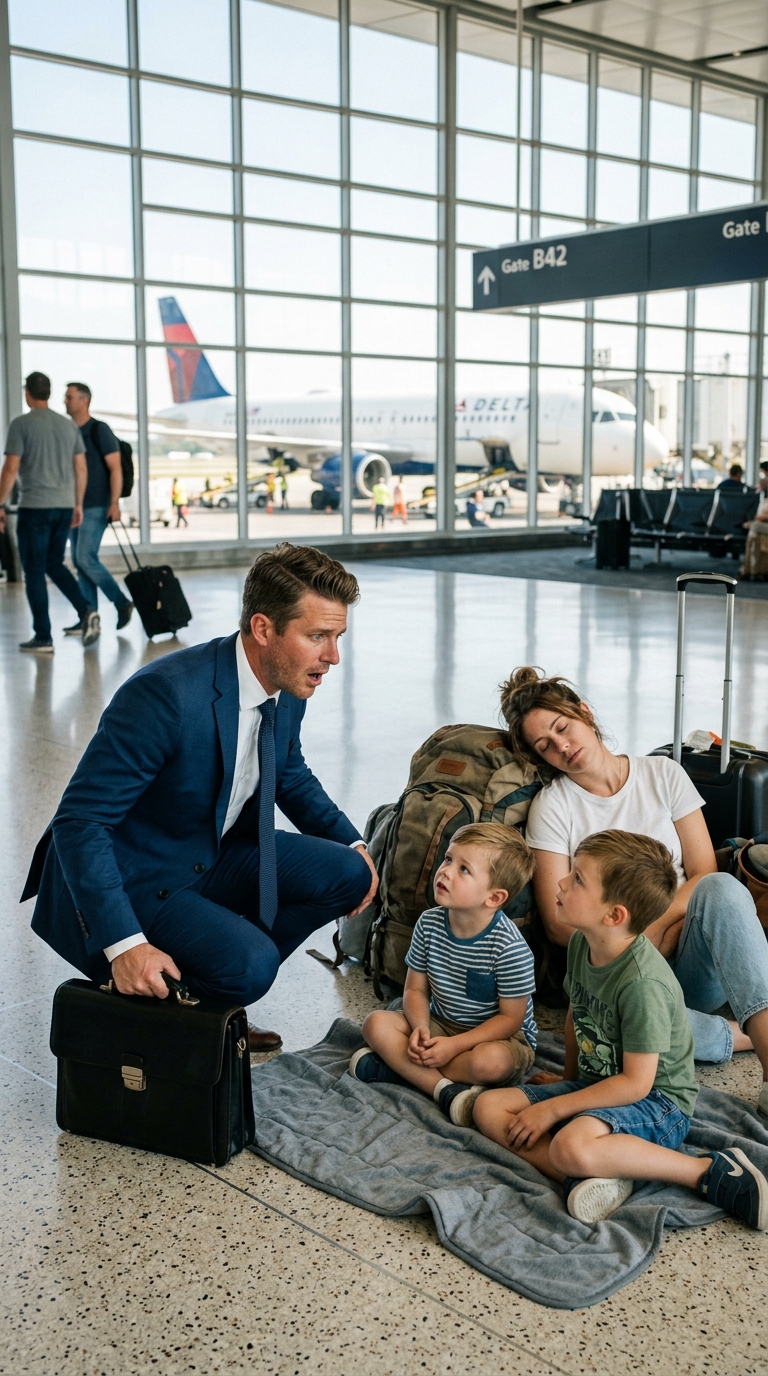
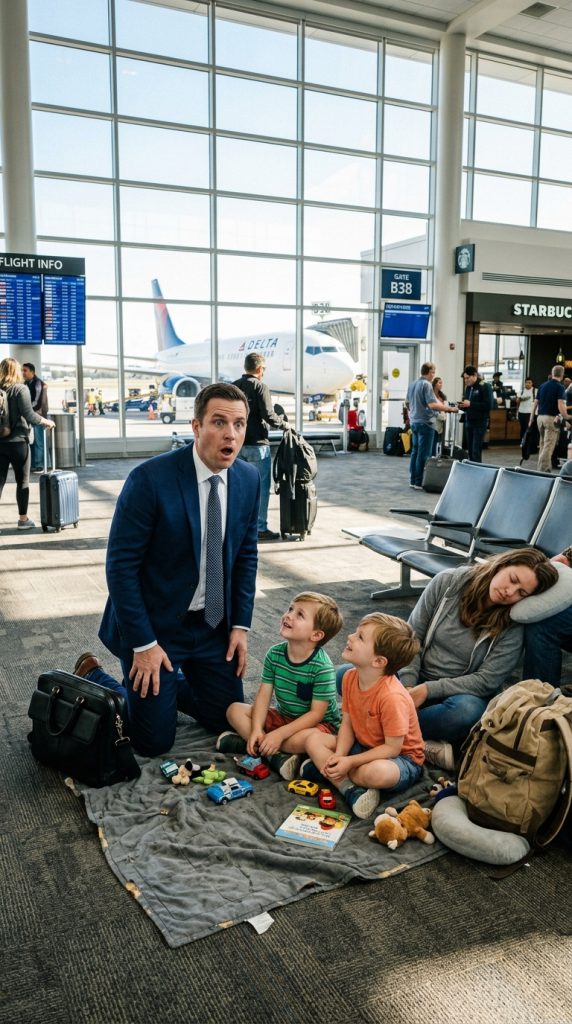
At first she was just a shape by the wall, partly hidden behind seats near Gate B38. A woman sat on the floor, leaning against her suitcase, head tilted as sleep had overtaken her without warning.
Two small boys nestled against her, one on each side. A thin blanket covered their legs. An open diaper bag rested nearby. A crumpled paper cup lay beside her shoe.
Graham slowed.
Something about the turn of her face caught him. The brown hair across one cheek. The faint scar near her eyebrow. The protective hand still resting over the children even in sleep.
His chest tightened before his mind caught up with what his eyes already knew.
Maren Ellis.
The young woman who had once worked in his family home. The woman he had loved. The woman who had vanished from his life six years earlier without a final goodbye.
The Woman He Never Forgot
Graham stood motionless in the middle of the terminal as travelers flowed past.
Maren appeared thinner than he remembered. Tired in a way no one should be while guarding two young children in a public airport. Her sweater was clean but frayed at the cuffs. Her shoes were worn. Her face still held the softness he recalled, yet time had etched quiet lines around her eyes.
For years he had convinced himself she left because she wanted something different.
That was what his mother had claimed. “She was never right for you.” “She only worked here.” “She embarrassed this family.” And finally: “She took something that didn’t belong to her.”
Graham had resisted believing it. But he had been young, furious, and still under his mother’s influence more than he liked to admit now.
Maren was already gone when he returned from a business trip. Her room stood empty. Her number had changed. Every letter he sent came back unopened.
Eventually, pride felt simpler than sorrow. So he buried her name.
Until now.
A soft sound came from one of the boys. He stirred beneath the blanket and opened his eyes.
Graham stopped breathing.
The boy had Graham’s eyes. Not merely blue. The same pale blue circled with gray. The same slight crease near the left lid. The same expression Graham had seen in his own childhood photographs.
Then the second boy woke. And Graham saw those same eyes again.
Two little boys, about five years old, gazing up at him with the face of his past.
The Question He Was Afraid to Ask
Maren stirred when one child touched her arm. Her eyes opened slowly. For a moment she looked disoriented.
Then she saw Graham. All color drained from her face.
She sat up quickly, drawing the boys closer by instinct.
“Graham?”
His name sounded different in her voice. Softer. Older. Like a word she had not permitted herself to speak in years.
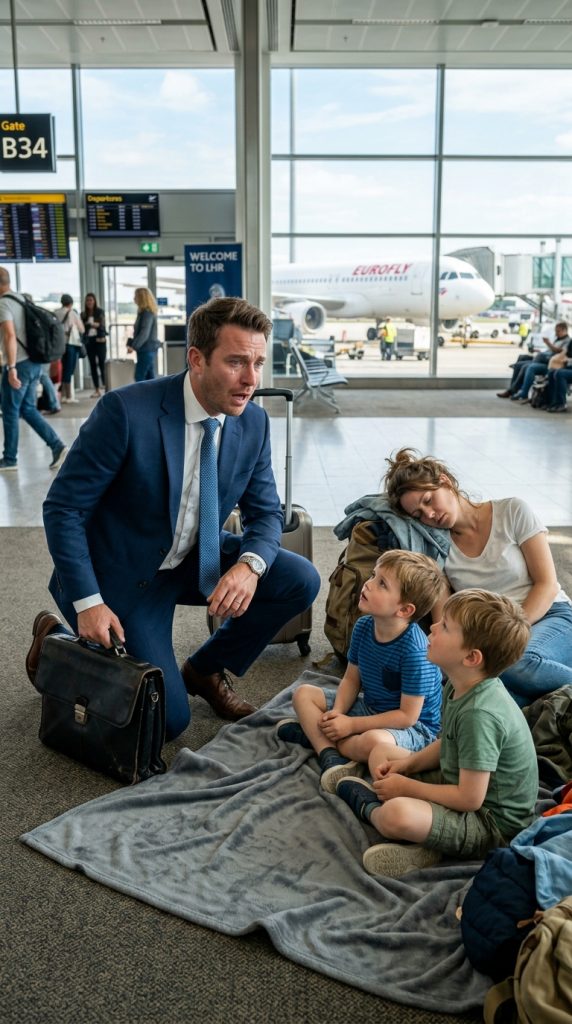
Graham knelt before her, ignoring the onlookers.
“Maren,” he said quietly. “What happened to you?”
She looked away. That hurt more than he expected.
One of the boys leaned against her shoulder and whispered, “Mom, who is he?”
Mom. The word fell between them like an opening door.
Graham glanced from the child to Maren and back. His voice nearly failed.
“Maren… are they mine?”
Her eyes filled at once. She did not answer. She did not have to.
Graham lowered himself onto one knee, briefcase forgotten beside him.
“Please,” he said. “I need to hear the truth.”
Maren pressed her lips together, trying to stay calm for the boys. Then she nodded once. A small, broken movement.
“Yes,” she whispered. “They’re yours.”
For the first time in many years, Graham Whitaker had no words.
The airport noise receded. Announcements blurred. The crowd vanished. All he could see were two little boys on the cold terminal floor, looking at him with his own eyes.
The Lie That Took Years Away
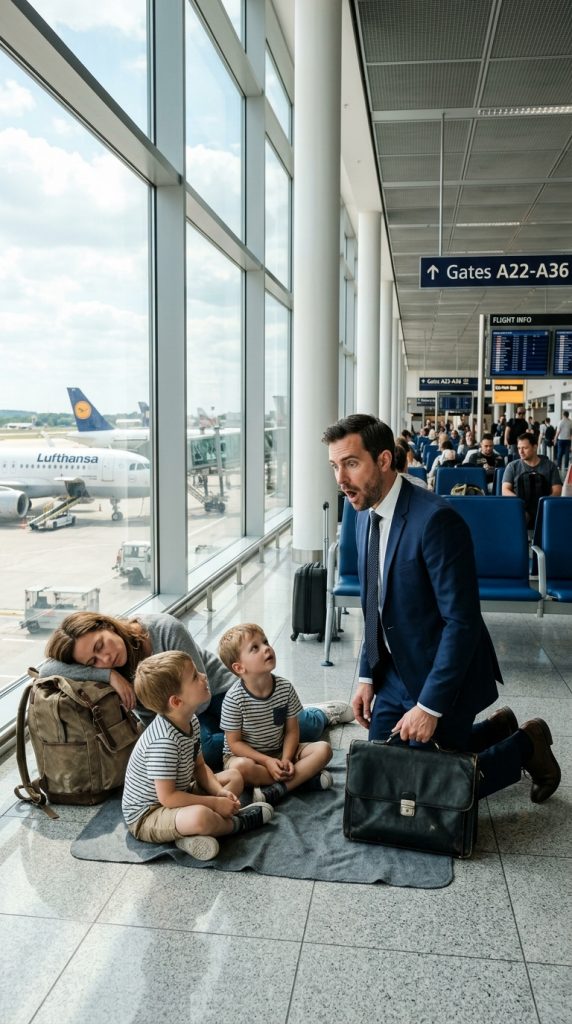
Graham looked at Maren as the questions flooded in.
“Why didn’t you tell me?”
Maren’s face tightened, not with anger but with exhaustion.
“I tried.”
“You tried?”
She reached into the side pocket of her bag and pulled out a folded envelope. It was old, worn at the edges, handled many times.
She handed it to him.
Graham opened it carefully. Inside were copies of letters. His name appeared on each one. Graham Whitaker. His old address in Cherry Creek. Every envelope had been returned. Wrong address. Undeliverable. No forwarding information.
His hand began to shake.
“I never saw these,” he said.
Maren nodded as if she had expected that answer, but it still pained her to hear it.
“Your mother made sure you didn’t.”
Graham closed his eyes.
Evelyn Whitaker. His mother had always believed love served only to safeguard the family name. She had disliked Maren from the start—because Maren worked in their home, because she came from an ordinary family, because she cared nothing for polished rooms or costly manners.
“She told me you left,” Graham said. “She told me you wanted money. She told me there was an issue with jewelry from the house.”
Maren gave a sad little laugh, but there was no humor in it.
“I knew that part would stay with you.”
“I didn’t want to believe it.”
“But you did enough to let me disappear.”
The words were quiet. That made them worse.
Graham looked down. For years he had blamed her silence. Now he realized silence had been deliberately built around them like a sealed room.
The Boys With His Father’s Eyes
One of the boys edged closer to Graham. He seemed braver than his brother, or simply more curious.
“Are you our dad?”
Maren closed her eyes.
Graham looked at the child. He wanted to say something perfect. Something strong. Something worthy of five lost years.
But all he could manage was the truth.
“I think I should have been there from the beginning.”
The boy studied him carefully.
“My name is Owen,” he said.
His brother lifted his head from Maren’s shoulder.
“I’m Caleb.”
Graham smiled, though his eyes burned.
“Owen and Caleb,” he repeated. “Those are strong names.”
Owen touched the sleeve of Graham’s suit jacket.
“Are you rich?”
Maren looked embarrassed.
“Owen.”
But Graham shook his head gently.
“It’s okay.”
He looked at the boy and answered honestly.
“I have a lot of things. But I don’t think I understood what mattered until today.”
Caleb leaned closer to his mother.
“Mom says people don’t always come back.”
Graham felt that sentence pierce him like a quiet wound.
He looked at Maren.
“I came too late,” he said. “But I’m here now.”
Maren did not soften immediately. She had carried too much alone for one sentence to mend.
“Being here for one moment isn’t the same as staying.”
Graham nodded.
“Then let me stay long enough to prove it.”
The Flight He No Longer Wanted
An announcement echoed through the airport.
“Final boarding call for Flight 284 to New York.”
Graham turned toward the gate. His assistant had booked that flight weeks earlier. There was a meeting in Manhattan, a room full of investors, and a deal big enough to make headlines.
For years that kind of thing had defined him. Now it felt strangely small.
Maren noticed his hesitation and looked down.
“You should go,” she said. “You have a life.”
Graham looked at the boys again. Owen held his mother’s sleeve. Caleb watched Graham as if already expecting disappointment.
Graham stood, walked to the trash bin near the gate, and tore the boarding pass in half.
Maren stared at him.
“What are you doing?”
He returned and lowered himself beside them on the floor.
“Choosing the life I should have fought for.”
Her eyes filled again, but this time she did not turn away.
“Graham, you can’t fix everything in one morning.”
“I know.”
“You don’t even know them.”
He looked at the boys.
“Then I’ll start with their names, their favorite cereal, what scares them, what makes them laugh, and everything I missed because I believed the wrong person.”
Maren covered her mouth. For six years she had practiced being strong. But strength had its limits. Sometimes the kindest thing in the world was finally being allowed to stop pretending nothing hurt.
The Truth Behind the Separation
Graham helped Maren to her feet. He picked up the diaper bag, then the suitcase, then the small blue backpack one of the boys had used as a pillow.
The simple act nearly broke him. His sons had been sleeping on an airport floor while he owned hotel suites with empty rooms.
“Where were you going?” he asked.
Maren hesitated.
“Portland. My cousin said we could stay with her for a while.”
“For a while?”
She gave him a tired look.
“That’s what people say when they don’t know how long they’re allowed to need help.”
Graham swallowed hard.
“You should have had help from me.”
“I didn’t know how to reach the man who had been taught not to hear me.”
That sentence stayed with him.
They moved to a quieter corner near a coffee shop. Graham bought warm food for the boys, hot tea for Maren, and water for everyone. Owen ate like he was trying to be polite but could not hide his hunger. Caleb took smaller bites and kept glancing at Graham.
Graham did not rush them.
When Maren finally spoke again, her voice was low.
“After I left your mother’s house, I found out I was pregnant. I went back once. Your mother met me at the gate before I could even ring the bell.”
Graham’s jaw tightened.
“What did she say?”
Maren looked at the boys, then chose her words carefully.
“She said you had moved on. She said if I cared about you, I would let you live the life you were meant to have.”
Graham stared at the table.
“And you believed her?”
“No,” Maren said. “But I was twenty-six, alone, scared, and carrying two babies. She had money, lawyers, and a way of making people feel very small.”
Graham had never hated his family name until that moment.
A Call That Could Not Be Ignored
Graham stepped away for one phone call.
His assistant answered on the first ring.
“Mr. Whitaker, are you boarding?”
“No.”
There was a pause.
“Should I rebook?”
Graham looked through the glass wall at Maren helping Caleb wipe crumbs from his sleeve. Owen was telling her something with both hands moving excitedly.
“Cancel New York.”
“Cancel the meeting?”
“Yes.”
“Sir, the investors are already—”
“Then they can invest in someone else.”
Another pause.
“Is everything okay?”
Graham’s voice changed. It became quieter, but stronger.
“For the first time in years, I think it might be.”
He ended the call and made another. This one was to his attorney.
He did not raise his voice. He did not make threats. He simply asked for the truth to be gathered properly: returned letters, employment records, old household documents, anything that showed how Maren had been pushed out and cut off.
When he returned to the table, Maren looked worried.
“What are you doing?”
“Making sure no one gets to rewrite your life again.”
“I don’t want a fight.”
“Neither do I,” Graham said. “I want peace. But peace needs the truth.”
The First Ride Home
Graham did not take them to a luxury hotel first. He asked Maren what she wanted.
She looked surprised, as if being asked was unfamiliar.
“A quiet place,” she said. “Somewhere the boys can sleep.”
So he drove them to a small family hotel he owned outside Boulder—one with warm rooms, mountain views, and a manager who knew better than to ask questions.
Owen fell asleep in the car within ten minutes. Caleb fought sleep longer, watching Graham from the back seat.
“Are you going to leave before morning?” Caleb asked softly.
Graham looked at him in the rearview mirror.
“No.”
“Promise?”
Graham’s throat tightened.
“I promise.”
Maren looked out the window. A tear slipped down her cheek, but she wiped it quickly before the boys could see.
Graham saw anyway.
At the hotel, he carried Owen inside while Maren carried Caleb. The room had two beds, clean sheets, soft lamps, and a small table by the window.
To Graham, it looked ordinary. To the boys, it looked like a palace.
Owen woke just enough to whisper, “We get beds?”
Graham almost had to sit down.
“Yes,” he said gently. “You get beds.”
The Morning After the Truth
The next morning, Graham woke in a chair by the window. He had not planned to sleep there. He had only planned to stay until Maren felt safe enough to rest.
But Caleb found him there at sunrise. The boy stood barefoot on the carpet, holding a blanket around his shoulders.
“You stayed.”
Graham opened his eyes.
“I told you I would.”
Caleb nodded, as if filing that away.
A few minutes later, Owen woke and asked if pancakes were allowed.
Graham smiled.
“Pancakes are absolutely allowed.”
At breakfast, Maren watched him with cautious eyes. She was not cold. She was careful. There is a difference. Coldness pushes people away. Carefulness asks whether someone has earned the right to come closer.
Graham understood that now.
He did not ask her to forgive him. He did not ask the boys to call him Dad. He did not pretend money could cover the years he missed.
Instead, he listened. He learned Owen liked drawing trucks. Caleb liked dinosaurs but only the ones that were “not too scary.” Maren had worked two jobs. She had moved three times. She had kept every returned letter because some part of her still needed proof that she had tried.
When Graham reached across the table, he did not take her hand. He only placed his hand near hers.
“I can’t give you those years back,” he said. “But I can spend the rest of my life not wasting another one.”
Maren looked at his hand for a long moment. Then, slowly, she placed her fingers over his.
The Family He Almost Lost Forever
Weeks later, the truth emerged quietly, not dramatically. There was no public scene. No shouting in a grand hallway. No performance for strangers.
Just documents. Returned letters. Old messages. A former staff member who admitted she had been told to keep Graham away from Maren’s calls.
And Evelyn Whitaker, suddenly facing the consequences of decisions she had once called “protecting the family.”
Graham did not enjoy it. That surprised him. He had imagined anger would feel powerful. Instead, it felt heavy.
When his mother asked to see him, he went alone. She sat in her elegant living room, surrounded by expensive things that no longer impressed him.
“I did what I thought was best,” she said.
Graham looked at her for a long time.
“No,” he answered. “You did what kept you in control.”
She looked away.
“That girl would have changed your life.”
Graham’s voice stayed calm.
“She did. And so did the sons you kept from me.”
His mother had no answer for that.
Graham left without slamming the door. Some doors do not need to be slammed. They only need to be closed.
What Staying Really Meant
Months passed. Graham learned that being a father was not a single emotional moment in an airport. It was breakfast spilled on shirts. It was bedtime questions. It was standing in school hallways with name tags stuck to his jacket. It was learning which twin needed quiet when overwhelmed and which one needed to talk until the fear went away.
It was showing up again and again until showing up stopped being surprising.
Maren did not rush back into love with him. And Graham did not ask her to.
They rebuilt slowly. Coffee after school drop-off. Walks in the park. Honest talks after the boys fell asleep.
Sometimes they laughed about memories from years ago. Sometimes they cried about the years between them. Sometimes they sat in silence because healing does not always need perfect words.
One evening, Owen brought Graham a drawing. It showed four people standing in front of a house. Maren. Owen. Caleb. And Graham.
Above them, in uneven letters, Owen had written: FAMILY DAY.
Graham held the paper carefully.
“Is this us?”
Owen nodded.
“It’s when you came back.”
Graham looked at Maren. She smiled through tears.
“No,” Caleb corrected from the couch. “It’s when he stayed.”
Graham could not speak for a moment. Because the boy was right.
Coming back was only the beginning. Staying was the promise.
Sometimes life does not give people a second chance in a perfect place; sometimes it gives that chance on a cold airport floor, surrounded by strangers, when a person finally sees what they should have protected long ago.
A family is not built only by blood, money, or beautiful promises; it is built by the quiet decision to keep showing up after the emotional moment has passed and real life begins.
The truth may be delayed by pride, fear, or the people who believe they have the right to control others, but truth has a way of waiting patiently until the right eyes are finally ready to see it.
Love that is separated by misunderstanding does not always return the same way it left, because time changes people, pain teaches caution, and forgiveness must be earned with patience rather than demanded with tears.
A child does not need perfect words from an adult; a child needs steady actions, honest eyes, and the comfort of knowing that promises will still be true the next morning.
Money can buy rooms, flights, buildings, and comfort, but it cannot buy back missed birthdays, bedtime stories, first steps, or the years a parent should have been present.
When someone has survived alone for too long, kindness must come gently, because even a good heart can feel frightening to a person who has already been let down.
The strongest apology is not the one spoken loudly in a dramatic moment, but the one lived quietly through changed behavior, patience, and respect for the person who was hurt.
Some people call control protection because it sounds kinder, but real protection never requires hiding the truth, breaking trust, or separating people who deserved the chance to choose for themselves.
In the end, Graham did not become a better man because he found his sons; he became a better man because he understood that finding them meant nothing unless he was willing to stay, learn, listen, and love them every single day.
