

PART 1: THE KNOCK THAT CHANGED EVERYTHING
The rain didn’t fall that night — it attacked.
It came down in violent, slanted sheets that turned the world outside into something broken and unrecognizable, as if the storm had decided to wipe away everything that came before it.
The cracked asphalt in front of the Black Vultures Motorcycle Club shimmered beneath the flickering glow of neon signs, reflecting streaks of red and blue light like a wounded mirror.
Headlights bled into puddles.
Thunder rolled low, not sharp but constant, like something restless moving just out of sight.
Inside the clubhouse, time moved differently.
Twelve men sat around a heavy oak table that had witnessed more history than most courtrooms — its surface marked by knives, fists, spilled whiskey, and decisions that never reached any official record.
The air carried the scent of leather, oil, and something older — something like memory.
Conversations were low, measured, and deliberate.
These were not men who spoke merely to fill silence.
They spoke only when something needed to be said.
And for long stretches, nothing did.
It was just past midnight — the hour when even chaos seemed to pause and breathe.
Engines were quiet.
The world beyond the walls softened at the edges.
Inside, the only sounds were the soft hum of a generator, the steady drumming of rain against metal siding, and the occasional scrape of a chair as someone shifted.
Then came the knock.
It wasn’t loud.
It wasn’t urgent.
It was… wrong.
Too soft for danger. Too hesitant for confidence.
It sounded like someone who already expected to be turned away, as if the knock itself was asking permission to exist.
Every head turned.
Silence snapped tight across the room.
Ronan “Grave” Hale was the first to move.
He stood slowly, his chair legs dragging across the concrete with a low, grinding protest.
His hand didn’t reach for a weapon — not exactly — but it hovered near his belt out of pure instinct.
Ronan didn’t react because he expected trouble.
He reacted because he had survived long enough to know that trouble rarely announced itself properly.
He crossed the room, each step deliberate, and slid the internal latch free with a metallic click that seemed louder than it should have been.
The door opened.
And the storm poured in.
For a second, that was all there was — wind, rain, and cold air rushing past him.
Then his eyes adjusted.
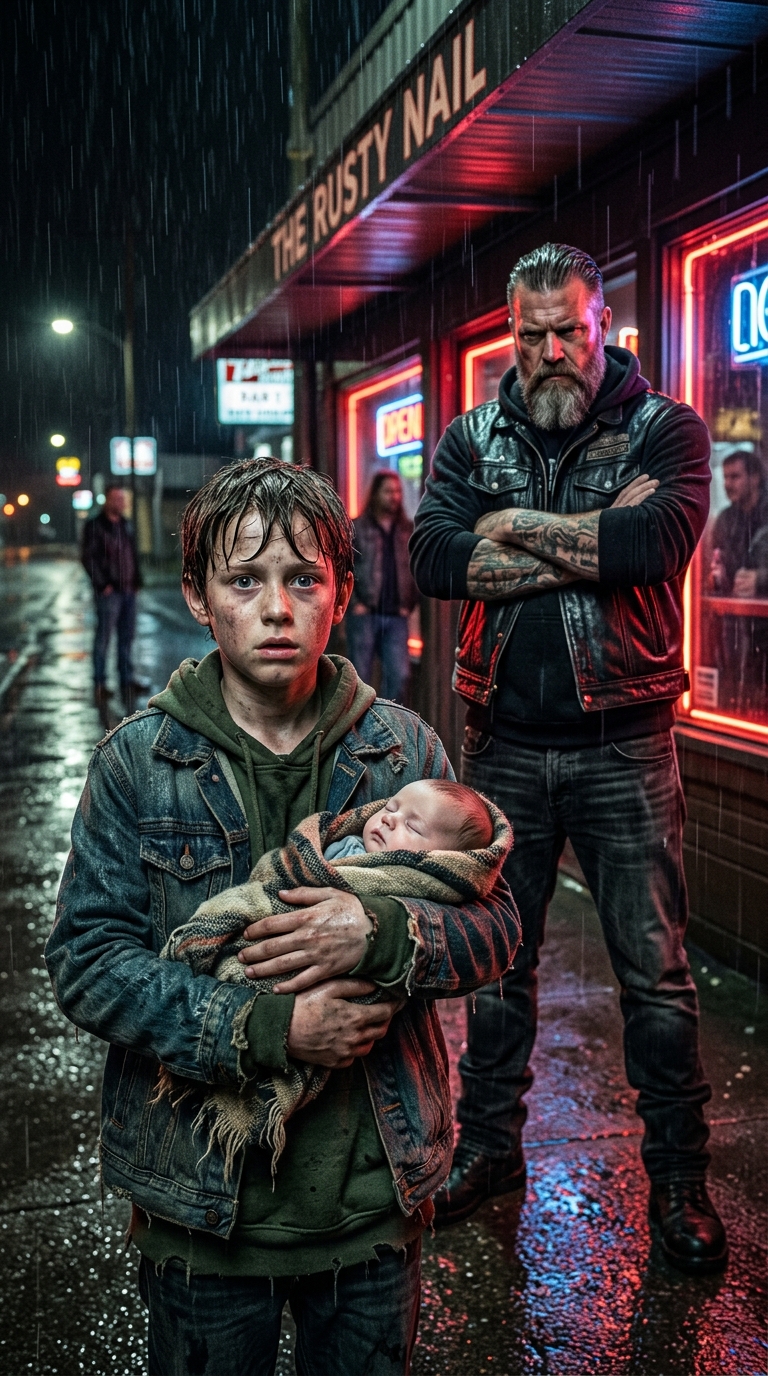
A boy stood there.
He couldn’t have been more than nine.
He was completely soaked, his thin frame trembling so violently it looked like he might collapse at any moment.
Dark hair clung to his forehead in wet strands.
His sweatshirt hung off one shoulder where the fabric had torn, exposing bruised skin beneath — purple and blue spreading into something worse.
Dirt streaked across his face, mixing with rainwater and something darker that might have been blood.
But that wasn’t what made Ronan stop breathing for a second.
The boy was holding a baby.
Wrapped in a blanket that had long since given up against the cold, the infant was small — too small — her face flushed and tight with exhausted discomfort.
One tiny fist was tangled in the boy’s shirt, gripping it as if instinct alone understood that this was the last place safety might exist.
The boy swallowed. Hard.
It was visible — the effort it took to force words out of a body that had nothing left to give.
“Please…”
His voice barely carried over the rain.
His eyes flicked past Ronan, into the dim room behind him, where silhouettes of men in leather vests and heavy boots watched in absolute stillness.
“Can you hide my sister… just until morning?”
Something in Ronan’s chest tightened before his mind could catch up.
The boy’s lips trembled.
“He’s coming,” he added quickly, panic breaking through the cracks.
“He said he’d kiII her. I didn’t know where else to go.”
Behind Ronan, boots sounded against concrete.
Slow. Heavy. Intentional.
The room shifted without anyone speaking.
Then the club president stepped forward.
Darius “Ironclad” Voss didn’t raise his voice, didn’t need to.
His presence alone changed the air — steady, controlled, the kind of quiet authority that made even dangerous men straighten without realizing it.
He moved into the doorway, his broad frame blocking part of the storm, his eyes settling first on the boy… then the baby… then the bruise.
Something unreadable flickered behind them.
“Inside,” Darius said.
The boy hesitated.
It was brief — but it was there.
Like stepping across that threshold meant something irreversible.
Like once he crossed, there was no going back to whatever life he’d come from.
Then he stepped forward.
Once.
Twice.
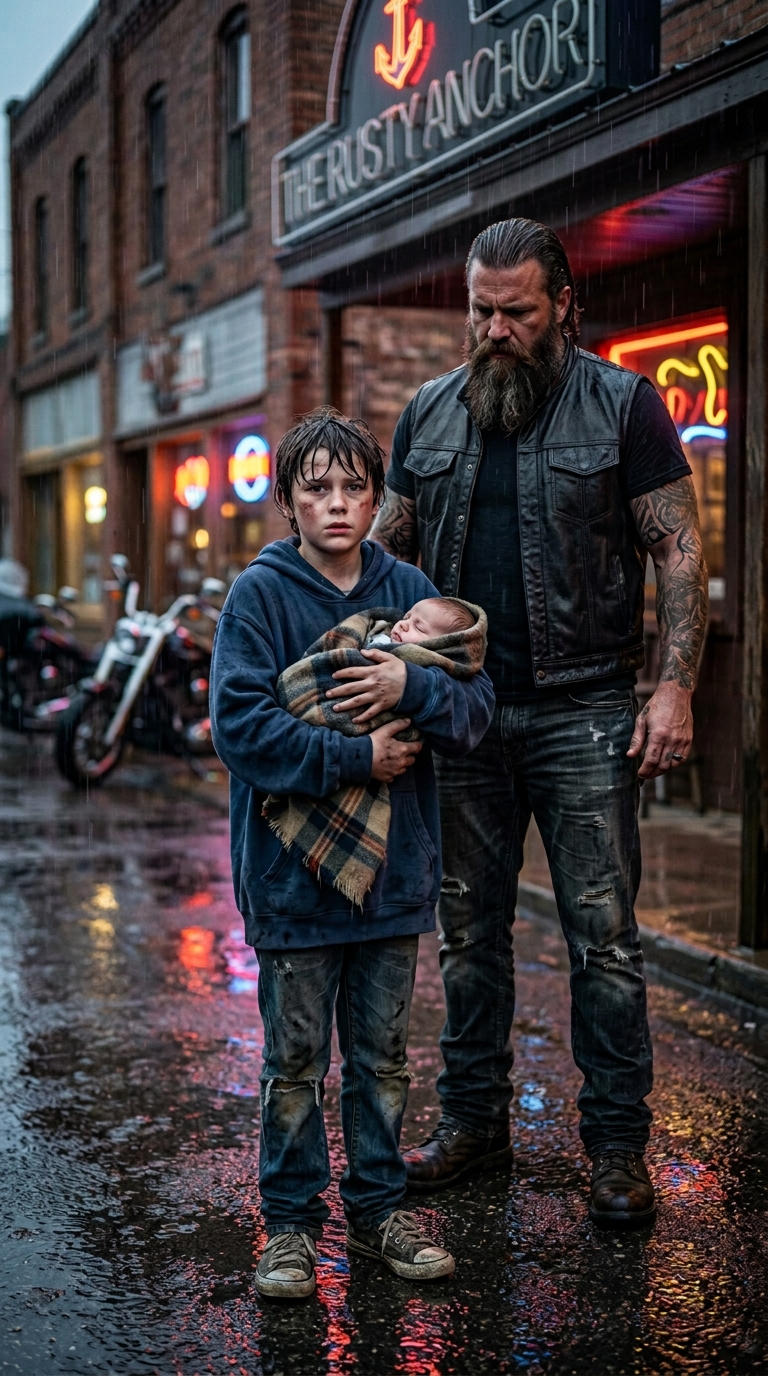
Water dripped from his shoes onto the concrete floor as Ronan pulled the door shut behind him, sealing out the storm.
The silence that followed was complete.
The baby whimpered softly.
“Get towels,” Darius said, calm and precise.
“Turn the heaters up.”
No one argued.
No one hesitated.
Men who had spent their lives breaking things moved instantly and efficiently — one grabbing blankets, another adjusting the thermostat, someone else already heading toward the kitchen.
Ronan crouched slightly, wrapping a thick towel around the boy’s shoulders, his movements careful in a way that didn’t match the hard lines of his face.
Another man, Elias “Switch” Navarro, appeared with a bottle of warm milk like it had always been part of the plan.
The boy stared at it for half a second.
Then he adjusted his grip on the baby with practiced precision and lifted the bottle to her lips first.
Only when she drank did he allow himself to breathe.
Darius noticed that.
He noticed everything.
He lowered himself slowly until he was at eye level with the child — not towering, not threatening.
Intentional.
“What’s your name?” he asked.
The boy swallowed again.
“Noah,” he said. “Noah Keane.”
His voice was steadier now — but only just.
He shifted the baby slightly.
“This is Lila. She’s one.”
Darius nodded once.
“I’m Darius.”
A pause. Not long. Just enough.
“You’re safe here for now, Noah. But I need to understand what’s happening. Who’s after you?”
For a moment, the boy held together.
Then something broke.
Not loudly. Not dramatically.
Just… quietly.
“My stepdad,” Noah whispered. “Victor Keane.”
The name landed like weight in the room.
“I heard him,” Noah continued, wiping his nose with his sleeve.
“On the phone. He got out of jail today. He came to the foster house and said we were leaving. And when the lady stepped outside…”
His voice cracked.
“He grabbed me. And he said he was going to finish what he started with Lila.”
Darius didn’t move.
“What did he start?”
Noah’s hands shook harder now.
“Two years ago… he threw her into a wall,” he whispered.
“She was just a baby. That’s why he went to prison. But the judge gave him custody again. Because our mom’s dead.”
Around the room, something shifted.
Not movement — something deeper.
Jaws tightened. Hands curled into fists.
A few men looked away — not because they didn’t care, but because they cared too much.
Ronan returned with another towel, draping it around Noah’s shoulders and gently patting Lila’s blanket dry.
Elias crouched nearby, opening a small container of food like feeding a starving child at midnight was the most normal thing in the world.
“When did you last eat?” Darius asked.
Noah blinked, thinking.
“Yesterday morning.”
“And you’ve been running since?”
A nod.
“I walked,” Noah said. “For hours. I didn’t want him to hear us.”
Darius glanced at the men around him. It wasn’t a question. It was a signal.
Noah hesitated again, then added in a quieter voice,
“He has a friend… a cop. And the foster people — they always send us back. They don’t listen.”
That changed things.
Not visibly.
But it did.
Darius leaned back slightly, absorbing it. Filing it away.
Then he asked the question that mattered.
“Why us?”
Noah’s eyes flickered. Uncertain. Then firm.
“Last year… you did a food drive,” he said.
“You gave me a jacket. It was winter. I didn’t have one.”
He looked down at Lila.
“And I heard people say… the Black Vultures protect their own.”
A pause.
“I thought… maybe you’d protect us too.”
The room changed.
Not loudly.
But completely.
Something invisible shifted into place — like a line had just been crossed and no one intended to step back.
Darius exhaled slowly.
“Noah,” he said, his voice steady but different now,
“we’re not just hiding you until morning.”
Noah looked up, startled.
“You’re not?”
Darius shook his head.
“No.”
A beat.
“We’re going to make sure you and your sister are safe.”
Another pause.
“However long that takes.”
And for the first time since he had stepped through that door, Noah Keane allowed himself to cry.
Not loudly.
Not uncontrollably.
Just silent tears slipping down his face as he held onto the only thing he had left in the world.
But outside, the storm didn’t stop.
And somewhere in the dark, something far worse than rain was already closing in.
PART 2: THE LIES THAT WEAR BADGES
By dawn, the storm had spent itself, leaving the world washed clean in a way that felt dishonest, as if it were pretending nothing had happened.
The streets glistened under pale gray light, and the town began to wake in slow, ordinary rhythms — coffee brewing, engines turning over, doors opening without hesitation.
Inside the Black Vultures clubhouse, however, nothing felt ordinary.
Noah and Lila slept in a back room that had been cleared out overnight, wrapped in blankets that still smelled faintly of leather and smoke, while the men who had taken them in moved with a quiet urgency that replaced sleep entirely.
Darius stood near the window, watching the empty road with a stillness that suggested calculation rather than rest.
Across the room, Ronan leaned over a cluttered table covered in phones, a battered laptop, and scribbled notes, while Elias paced slowly, his jaw tight.
It was Ronan who broke the silence first, his voice low but sharp enough to cut through the air.
“He filed a report,” he said.
“Just before sunrise. Missing child. Claims Noah abducted his sister.”
The words hung there, heavy and deliberate, and Darius didn’t react immediately, but when he did, it was a slow exhale that carried more understanding than surprise.
“Of course he did,” he murmured.
“Control the story before the truth has time to breathe.”
Elias stopped pacing.
“It’s already on local news,” he added, holding up his phone.
“They’re painting him as a grieving father. Kid’s face is everywhere.”
For a moment, no one spoke.
The law had entered the game — and it wasn’t neutral.
By midmorning, the first knock came again, but this one was nothing like the last.
It was firm. Official. Demanding in a way that assumed authority would be answered.
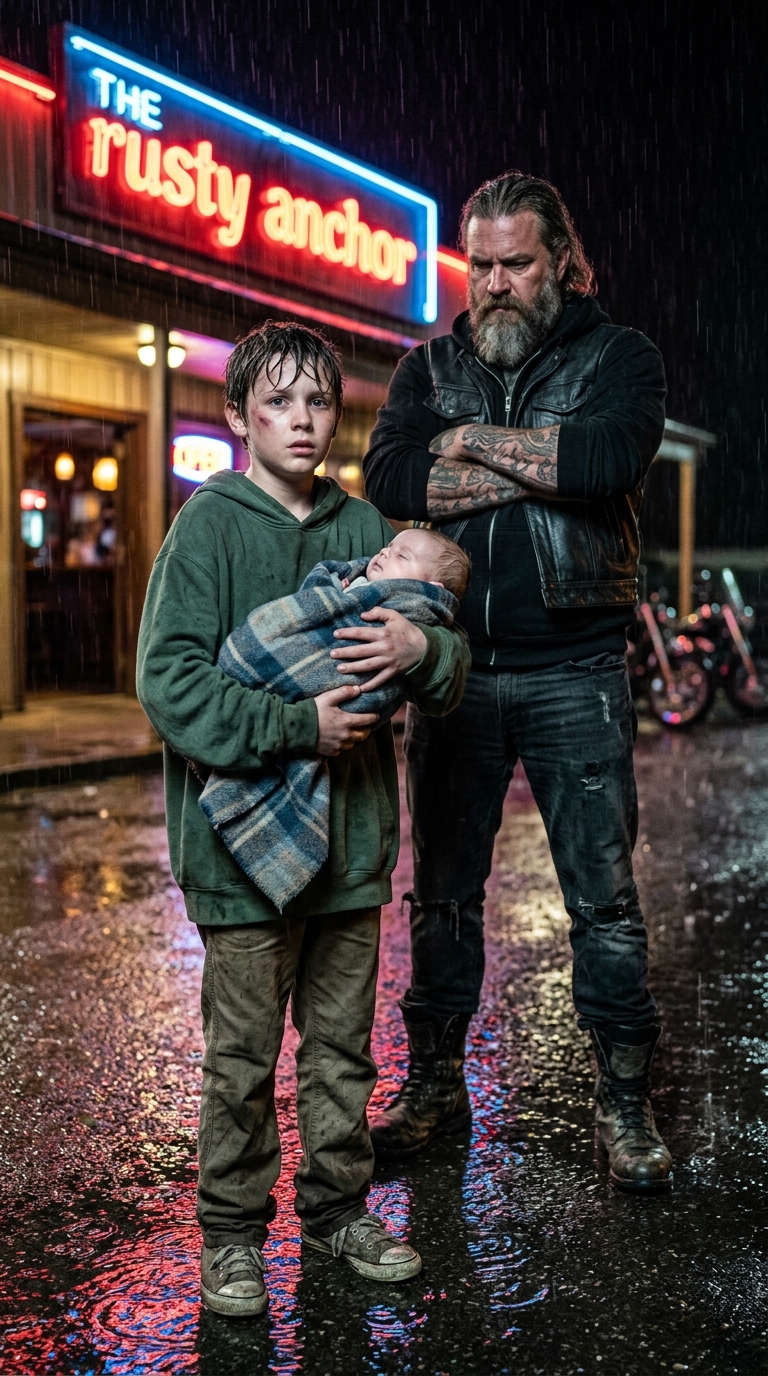
Ronan opened the door this time without hesitation, revealing two uniformed officers standing under the washed-out sky, their expressions polite but rigid, like men who had already decided what they were here for.
Behind them, a black sedan idled at the curb, its windows too dark to read.
“We’re looking for a boy,” one officer said, glancing past Ronan into the clubhouse as if expecting resistance.
“Noah Keane. Nine years old. We have reason to believe he may be here.”
Ronan didn’t move aside.
“You got a warrant?” he asked calmly.
The second officer shifted slightly, irritation flickering across his face.
“We’re conducting a welfare check.”
“Then you can check the welfare from outside,” Ronan replied, his tone unchanged.
The air thickened.
For a second, it looked like the situation might escalate, but then the first officer exhaled, adjusting his stance.
“If you’re harboring that child, you’re interfering with a legal custody case,” he said.
“That won’t end well.”
Behind Ronan, Darius stepped into view, his presence shifting the balance without a word.
He didn’t raise his voice. He didn’t need to.
“Then you should come back with paperwork that says we’re doing something illegal,” Darius said evenly.
“Until then, you’re done here.”
The officers held their ground for a moment longer, then retreated with the kind of forced calm that promised this wasn’t over.
As the sedan pulled away, Darius’s eyes followed it, narrowing slightly.
“They’re already leaning his way,” Elias muttered.
Darius nodded once.
“Because someone’s making sure they do.”
That someone revealed himself faster than expected.
By early afternoon, Victor Keane didn’t hide behind reports or proxies anymore — he came in person.
He arrived in a polished SUV that didn’t belong in a town like this, stepping out in pressed clothes that tried too hard to look respectable.
His smile was controlled, measured, the kind of expression built for cameras rather than truth.
Two men stood behind him — not uniformed, but carrying themselves with the quiet arrogance of authority borrowed or bought.
Ronan met him at the door, blocking the entrance before Victor could take another step.
“You’re trespassing,” Ronan said flatly.
Victor chuckled softly, like this was all an inconvenience.
“I’m here for my children,” he replied, voice smooth.
“I think we both know you’re in possession of them.”
Darius appeared behind Ronan again, his gaze locking onto Victor with a calm that bordered on dangerous.
“Funny,” Darius said, “because from what we’ve heard, they ran from you.”
Victor’s smile didn’t falter, but something colder slipped underneath it.
“Children get confused,” he said.
“They misunderstand discipline.”
Elias scoffed quietly behind them.
“Throwing a baby into a wall isn’t discipline.”
That did it — just for a second, Victor’s expression cracked, irritation flashing through the carefully maintained calm.
But it was gone almost instantly.
“You don’t know the full story,” he replied, his tone tightening.
Darius stepped forward just enough to make the distance between them feel deliberate.
“Then maybe you should tell it somewhere that matters,” he said.
“Because it’s not happening here.”
Victor’s eyes darkened, his patience thinning.
“You’re making a mistake,” he said softly.
“The law is on my side.”
Darius didn’t blink.
“The law’s only as clean as the hands holding it.”
What Victor didn’t expect was that the Vultures wouldn’t play his game at face value.
That night, while Noah and Lila remained hidden in a place no map would reveal, the clubhouse transformed into something else entirely — a war room without weapons, a strategy built on truth instead of intimidation.
It was Elias who reached out first, pulling old contacts from a past life he rarely spoke about, while Ronan dug into records that weren’t meant to be easily accessed.
But it was the quietest man in the room, Adrian “Cipher” Vale, who found the thread that unraveled everything.
A former analyst who had walked away from systems that buried more than they exposed, Adrian worked in near silence, his fingers moving across the keyboard with methodical precision.
Hours passed before he spoke.
“Victor Keane isn’t just an abuser,” he said, not looking up.
The room stilled instantly.
“He’s a courier.”
Darius stepped closer.
“For what?”
Adrian turned the screen toward them.
Transactions. Names. Movements that didn’t belong to a man trying to rebuild a life.
“Money, weapons, identities,” Adrian said.
“He moves things for people who don’t exist on paper.”
Elias frowned.
“And the kids?”
Adrian’s jaw tightened slightly.
“Leverage. Witnesses if they talk. Liabilities if they don’t stay quiet.”
The realization hit hard — harder than anything before it.
This wasn’t about custody.
This wasn’t even about control.
Victor wasn’t trying to get his family back.
He was trying to erase a problem.
The weight of that truth settled heavily over the room as Darius leaned back against the table, his mind already moving ahead of the moment.
“Then we don’t just protect them,” he said quietly.
“We expose him.”
Ronan crossed his arms.
“That means going against more than just him.”
“I know,” Darius replied.
His gaze shifted toward the hallway where Noah and Lila slept, unaware of how close the danger still was.
“But we don’t hand kids back to a man like that. Not for paperwork. Not for threats. Not for anything.”
Elias nodded slowly, the tension in his shoulders turning into something sharper, more focused.
Adrian closed the laptop with a soft click.
“Then we’ll need proof,” he said.
“Real proof. Enough to break through whatever protection he has.”
Darius pushed off the table, standing fully now, his decision already made long before the words left his mouth.
“Then we find it,” he said.
“Piece by piece if we have to.”
Outside, the sky had cleared, but the air still carried the weight of the storm that had passed — and the one that was still coming.
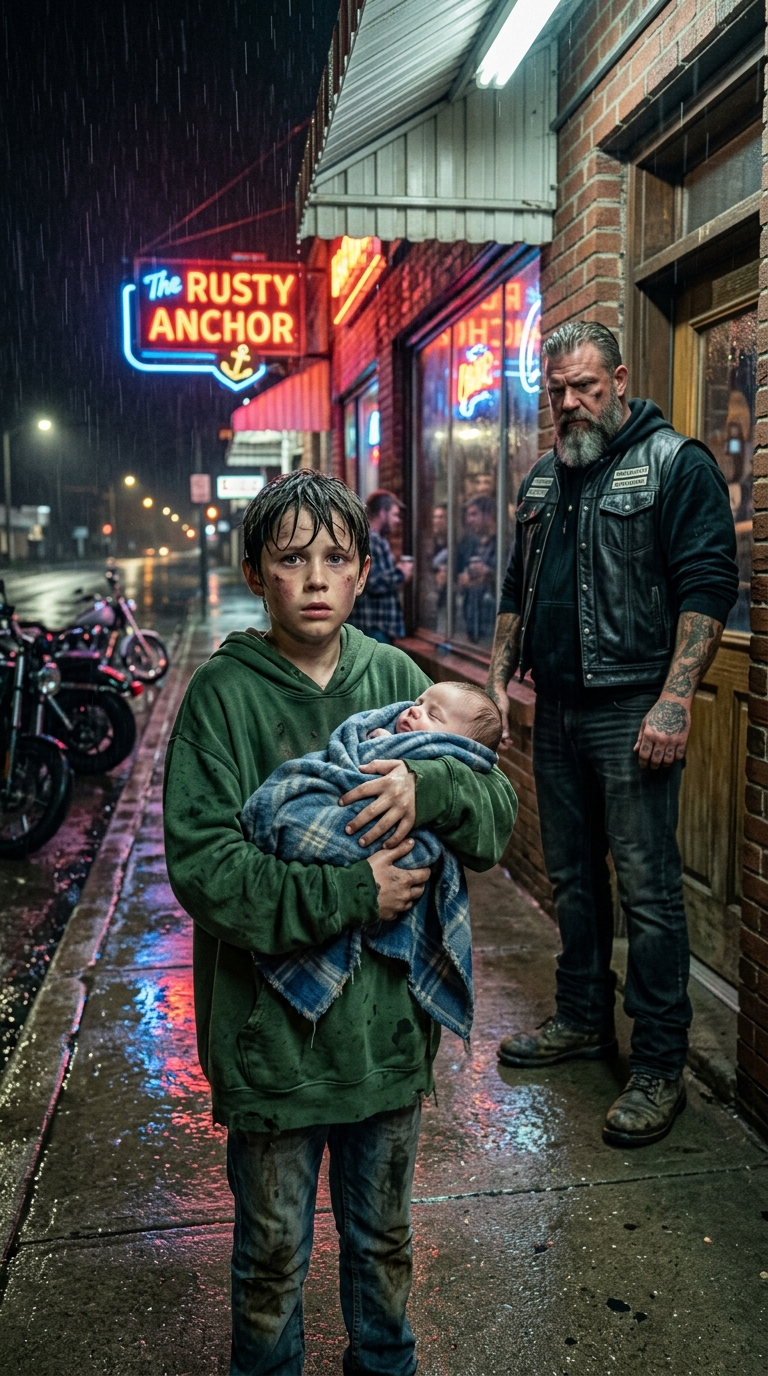
PART 3: THE TRUTH THAT DOESN’T BEND
The case didn’t explode all at once — it tightened, slowly and relentlessly, like a vice closing around something that had nowhere left to escape.
Within days, the story that had once painted Victor Keane as a grieving father began to fracture under the weight of contradictions too sharp to ignore.
Anonymous tips surfaced, records were quietly submitted, and a pattern emerged that could no longer be dismissed as coincidence.
The turning point came when Adrian “Cipher” Vale uncovered a chain of financial transfers linked to shell accounts — money that moved too cleanly, too precisely, and always in the shadows of Victor’s known movements.
Paired with witness statements Elias had secured from former contacts — people who spoke reluctantly but truthfully about shipments, coded exchanges, and a man who always delivered without asking questions — the narrative shifted.
The authorities, once dismissive, were forced to look again.
A federal task force stepped in quietly at first, then with growing urgency, and the custody hearing that Victor had tried to weaponize against Noah became something else entirely — a doorway into a larger investigation that reached far beyond a single family.
The courtroom on the day of the hearing was packed, not just with legal representatives but with reporters, observers, and people who sensed something bigger unfolding beneath the surface.
Victor arrived dressed in composure, his expression carefully constructed, but the edges of it were beginning to crack.
Behind him stood the same quiet figures who had once projected borrowed authority, though now they seemed less certain, their confidence eroded by scrutiny they couldn’t control.
Across the room, Darius “Ironclad” Voss sat with Ronan and Elias, their presence drawing attention not because they demanded it, but because they refused to hide from it.
Noah sat between them, small in the chair, Lila resting in his arms, her breathing soft and steady, oblivious to the weight of the moment.
When the judge entered, the room stilled into something absolute, and as proceedings began, it became clear that this would not be a simple matter of custody — it would be a confrontation between two versions of truth, one built on manipulation and the other on everything that had finally come to light.
Victor spoke first, his voice measured, controlled, appealing to sympathy with the precision of someone who had rehearsed every word.
He painted himself as a father wronged by circumstance, a man trying to reclaim what was his, twisting absence into devotion and violence into discipline softened by regret.
For a moment, it almost worked — the room listening, absorbing, weighing.
But then the evidence began to speak.
Documents were presented.
Timelines unraveled.
Financial records surfaced.
And with each piece, Victor’s narrative began to collapse, not dramatically, but decisively, like a structure that had been hollow from the beginning.
When Adrian’s findings were introduced, linking Victor to illicit networks and transactions that had nothing to do with fatherhood, the shift became undeniable.
The courtroom leaned forward, attention sharpening, and even Victor’s legal counsel seemed to hesitate, recalculating a defense that no longer held.
Yet it wasn’t the data that changed everything — it was Noah.
When Noah Keane was called to the stand, the room seemed to hold its breath.
He walked carefully, each step deliberate, Lila carried in by a court officer who gently settled her nearby.
Noah’s hands trembled as he took his seat, but when he spoke, his voice, though small, carried with a clarity that cut through everything else.
He didn’t dramatize.
He didn’t embellish.
He simply told the truth — the kind that doesn’t need decoration to be devastating.
He spoke about nights filled with fear, about hiding, about learning too early how to stay quiet so someone else wouldn’t get hurt.
He spoke about Lila, about holding her when she cried, about running through the rain because he knew what would happen if they didn’t.
And when he described the moment he stood at the door of the Black Vultures clubhouse, asking strangers for help because he had nowhere else to go, something in the room shifted irreversibly.
It wasn’t pity — it was recognition.
Even the judge’s expression softened, not out of weakness, but out of understanding.
When Noah finished, silence followed — not empty, but full of something that couldn’t be undone.
The ruling came hours later, after deliberation that felt both endless and immediate.
Custody was stripped from Victor Keane permanently, his claims dismantled under the weight of evidence that now extended into a full federal investigation.
Charges followed swiftly — not just for past abuse, but for the network he had operated within, the crimes that had once remained hidden now brought into light.
He was taken into custody before he could leave the building, his composure finally cracking as the illusion of control dissolved completely.
The officers who had once stood at the clubhouse door with quiet authority were nowhere to be seen, their absence as telling as their earlier presence.
As for Noah and Lila, the court granted protective status, placing them under the care of a system that, for once, seemed determined to do its job properly — though not without oversight from those who had refused to let them fall through the cracks again.
Darius and his men didn’t celebrate.
They didn’t need to.
The outcome spoke for itself, and when Noah looked back at them, there was no fear left in his expression — only something steadier, something that resembled trust.
Years passed in ways that felt both slow and sudden, as life reshaped itself around a moment that had once seemed like the end of everything.
Noah grew, not untouched by what he had endured, but strengthened by it, carrying forward a quiet resilience that defined him more than the fear ever had.
Lila thrived, her earliest memories replaced by safer ones, her laughter no longer interrupted by shadows she couldn’t understand.
They were placed with a family that chose them not out of obligation, but out of genuine care, and though the Black Vultures Motorcycle Club was never written into official records as part of their story, their presence remained — steady, unseen, but always there when it mattered.
Adrian returned to a life of quiet distance, though his work that night became a line he never crossed again, choosing instead to use what he knew to prevent rather than uncover.
Elias found a kind of purpose he hadn’t expected, working with organizations that protected children from the very systems that had once failed Noah.
Ronan remained exactly who he had always been on the surface, but those who knew him understood that something had shifted — his silence now carrying a different kind of weight.
And Darius… Darius continued to lead, unchanged in the ways that mattered, but marked by a decision that had redefined everything.
Because in the end, the story was never about outlaws or lawmen, not really.
It was about a door in the middle of a storm, and the choice to open it when it would have been easier not to.
Noah would grow up remembering that night not as the moment everything almost ended, but as the moment something better began, and the Black Vultures would carry it with them like a quiet truth: that redemption isn’t found in what the world calls you, but in what you choose to do when someone needs you most.
