

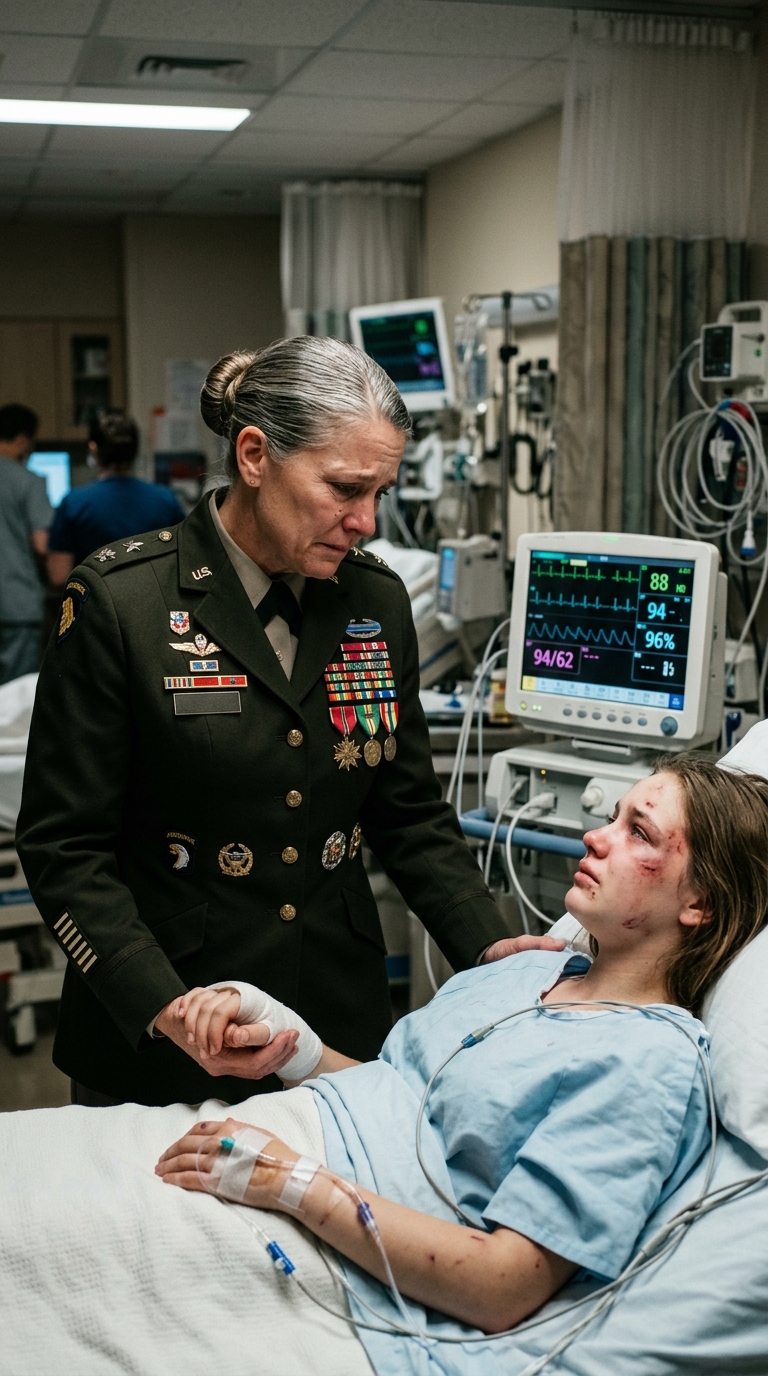
The hospital room carried the kind of sterile chill that made every sound feel sharper, every shadow deeper. Fluorescent lights buzzed overhead like distant insects, casting a harsh, unforgiving glow across the white walls and linoleum floor. The heart monitor beeped in a steady, mechanical rhythm—proof that life still clung to the fragile figure lying in the bed. White sheets framed sixteen-year-old Emily Hayes, but the girl they held looked almost unrecognizable. Her left eye was swollen shut, ringed with deep purple bruising that spread across her cheekbone like spilled ink. A bandage stretched over her broken nose, and her right arm rested stiffly in a fresh plaster cast. Purple fingerprints marked her neck where someone had grabbed her, and every shallow breath she took seemed to cost her.
At the bedside stood Colonel Rebecca Hayes, United States Army, her dark navy uniform immaculate despite the late hour. Rows of medals and service ribbons gleamed under the lights—silent witnesses to twenty-two years of deployments, leadership under fire, and decisions made in chaos. At forty-four, Rebecca was known throughout her command as a woman of unbreakable composure. She had led troops through ambushes in the Hindu Kush, coordinated joint operations in volatile regions, and buried good soldiers without shedding a tear in public. But this was different. This was her only child.
She did not cry. She did not scream. She simply stood there, one hand resting on the cold metal bed rail, staring at the damage done to Emily’s face. Her jaw tightened until the muscle stood out like corded steel. For a long moment, the only sounds were the monitor and the faint hum of the air conditioning.
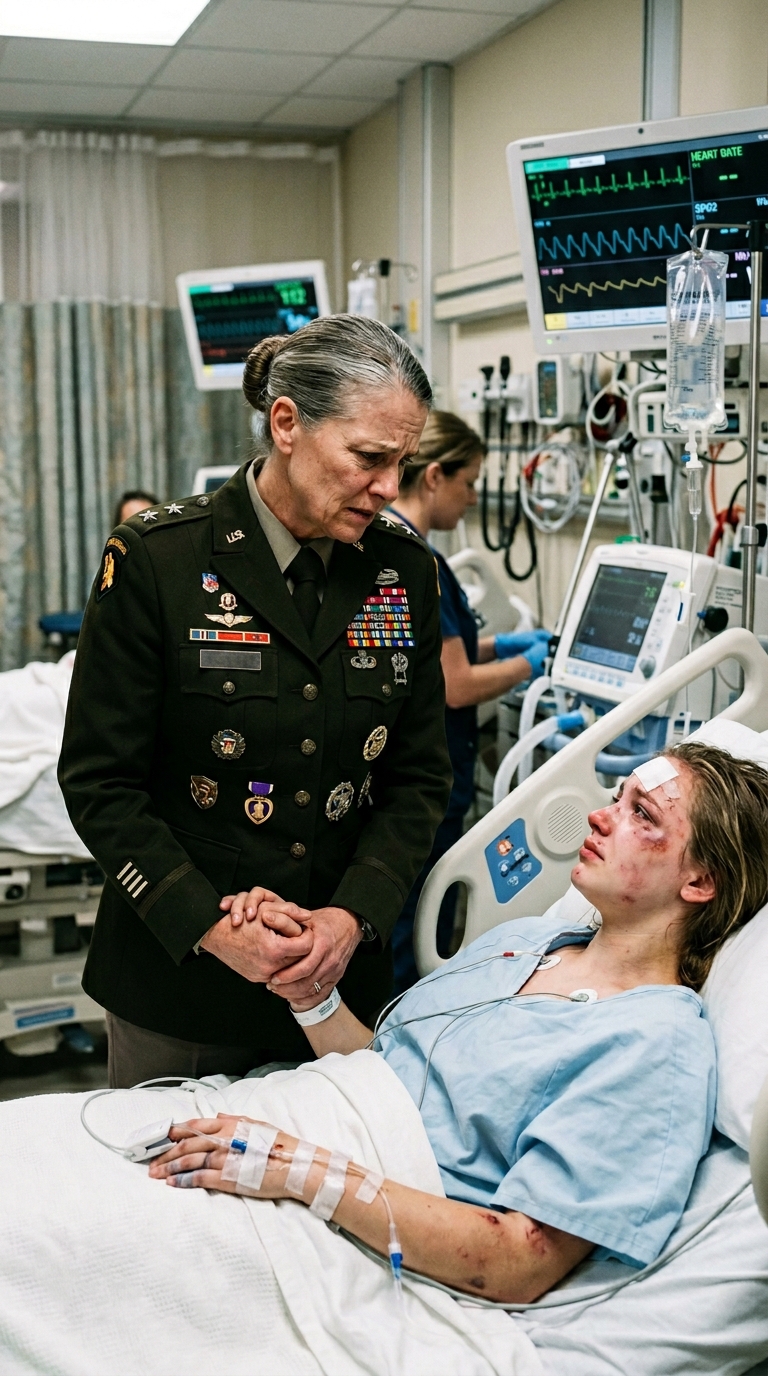
Finally, Rebecca leaned down, her voice low and steady.
“Who did this?”
Emily’s lips trembled. A tear slipped from the corner of her good eye and traced a slow path toward the pillow. She tried to speak, winced at the pain in her jaw, and closed her eyes for several seconds as if gathering courage.
“Mom…” she whispered, her voice hoarse and small.
Rebecca waited, motionless.
“Tyler,” the girl breathed at last.
The name landed in the room like a grenade pin. Rebecca’s fingers tightened around the rail until her knuckles blanched white. She repeated the name slowly, tasting it.
“Tyler?”
Emily gave the faintest nod, fear flickering across her battered face. “He wasn’t alone. Three of his friends… they held me down. They laughed the whole time.”
Something shifted in the air between them. Not an explosion of rage, but a colder, more deliberate change. Rebecca straightened to her full height, her posture snapping into parade-ground precision. The medals on her chest caught the light like armor locking into place. Her expression emptied of any trace of softness. What remained was something far more dangerous than fury—a calm, calculated resolve forged in combat zones and hardened by loss.
She looked directly into her daughter’s eyes.
“Look at me, Emily.”
The girl obeyed, tears still spilling.
“No more fear,” Rebecca said quietly. “No more tears for them. Do you understand?”
Emily’s breath hitched, but she nodded.
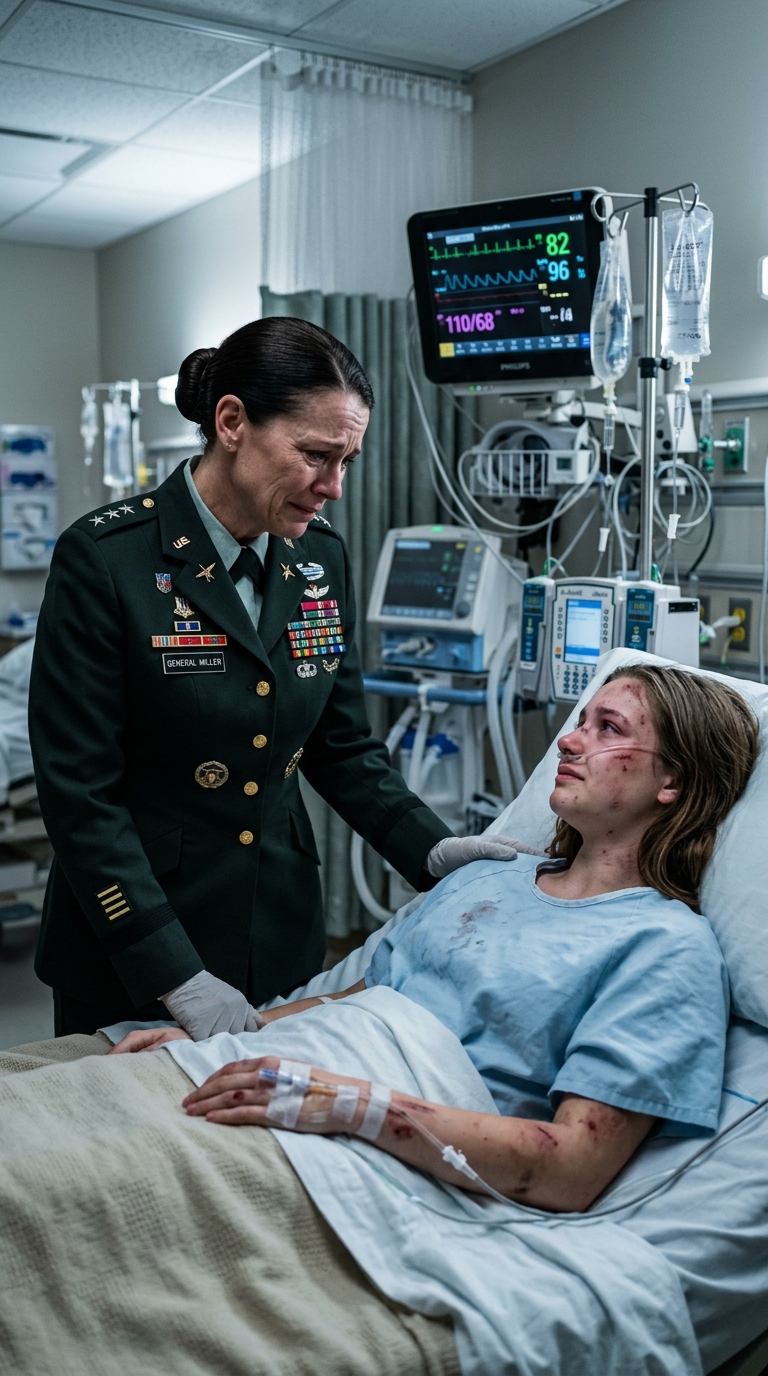
Rebecca reached into the inner pocket of her uniform coat and pulled out her phone. Her movements were precise, unhurried. She pressed a single contact and lifted the device to her ear. When the line connected, she spoke only four words, her voice flat and authoritative.
“It’s me. Find Tyler. Now.”
She ended the call without waiting for a reply. Years of military intelligence contacts, former subordinates now in law enforcement, and trusted friends in high places meant that order would be acted upon immediately and thoroughly.
But before she could straighten again, Emily’s uninjured hand shot out and caught her sleeve. The girl’s fingers trembled against the fabric.
“Mom… wait.”
Rebecca froze, turning back to the bed.
“He took something,” Emily whispered.
Rebecca’s eyes narrowed. “What did he take?”
Emily looked ashamed, as if the loss hurt worse than the broken bones. Fresh tears slid into her hair.
“My necklace,” she said, her voice cracking. “The gold one. Dad’s necklace.”
The words struck Rebecca like a rifle shot at close range.
Three years earlier, on the morning of his final deployment, Major James Hayes had knelt in front of their daughter in the driveway. With steady hands, he had fastened the simple gold chain around Emily’s neck. It was nothing extravagant—just a small, elegant pendant engraved with coordinates of the place where he and Rebecca had first met. “So you always know where home is,” he had told her. Two months later, James was killed in a helicopter crash during a training exercise. That necklace was the last physical thing he had given his daughter. It was not jewelry. It was memory made tangible. It was the final echo of his laugh, his voice, his scent.
Rebecca stood perfectly still, absorbing the new information. The room seemed to grow even colder.
Emily continued, her words tumbling out between sobs. “He ripped it off my neck. He said nobody would miss it… that it was just cheap crap. Then they all laughed again while they… while they kept hitting me.”
Rebecca closed her eyes for one brief second. When she opened them, the transformation was complete. The mother who had been fighting to hold herself together was gone. In her place stood Colonel Rebecca Hayes at full operational capacity.
She leaned down and brushed a strand of hair from Emily’s forehead with a gentleness that contrasted sharply with the steel in her eyes.
“He should have left the room,” she murmured. “He should have left the city. Hell, he should have left the state.”
Emily stared up at her mother, fresh terror mixing with something like awe.
“I didn’t want you to know,” the girl whispered. “I was scared you’d get in trouble… or that something would happen to you too.”
A sad, fleeting smile touched Rebecca’s lips before it vanished.
“Scared for me?” she asked softly.
Emily nodded.
Rebecca shook her head once. “No, sweetheart. You should be scared for him.”
Her phone buzzed in her hand. She glanced at the screen. A message had already arrived—efficient, as expected. Tyler had been located. The necklace was with him. Rebecca’s expression barely changed, but her eyes darkened with purpose.
“Mom…” Emily breathed, reading the shift in her mother’s face. “What are you going to do?”
Rebecca slipped the phone back into her coat and sat on the edge of the bed, careful not to jostle her daughter’s injuries. She took Emily’s good hand in both of hers, the way James used to do when nightmares woke their little girl.
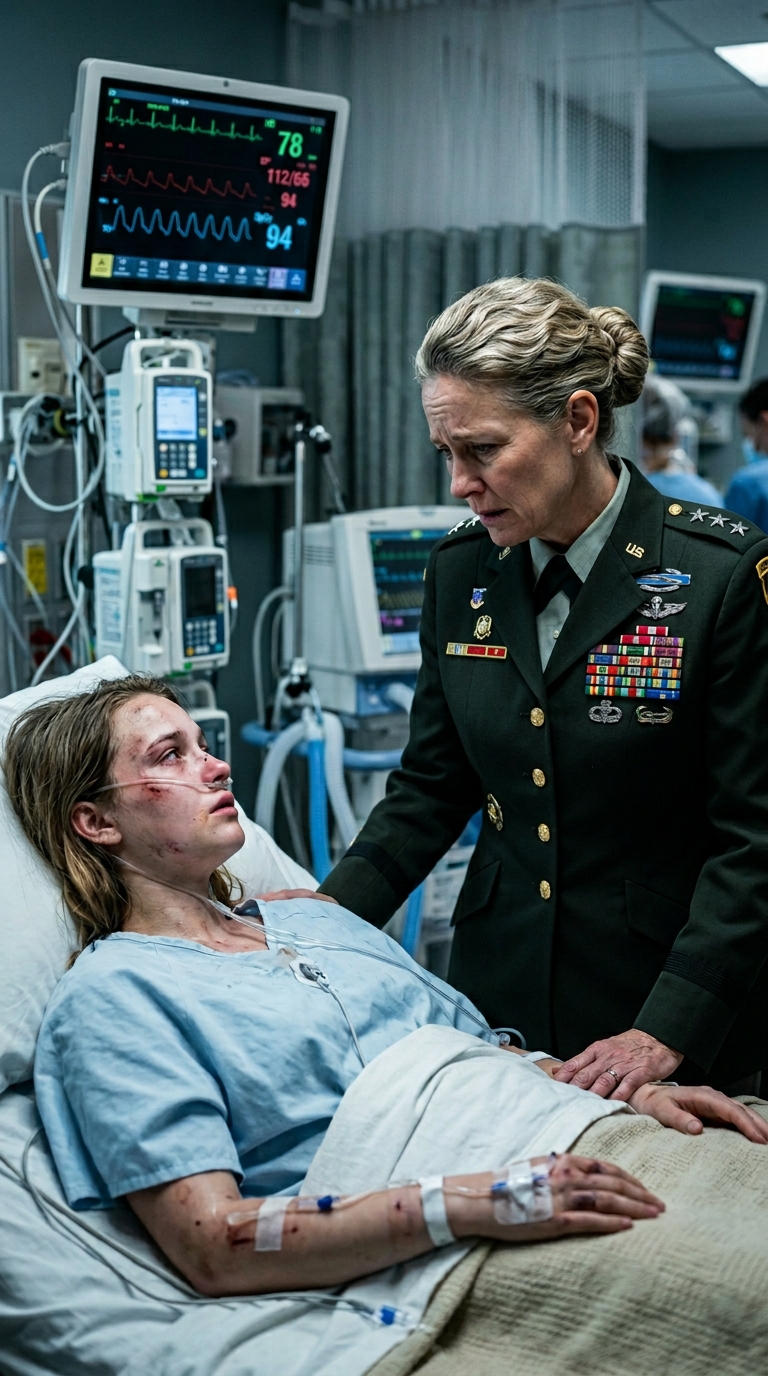
“First,” she said, her voice low and certain, “I’m bringing your father’s necklace home. Where it belongs.”
She leaned closer, so only Emily could hear the rest.
“And then Tyler is going to learn what happens when someone mistakes kindness for weakness. When they forget that some families don’t just survive—they fight back.”
The monitor continued its steady beeping. Outside the room, nurses moved through the hallway, unaware of the storm building in silence. Rebecca stayed with her daughter through the long hours of the night, telling quiet stories about James—how he used to sing off-key in the car, how he once carried Emily on his shoulders through the mountains so she could see the sunrise. She spoke of the man whose love still protected them, even from beyond the grave.
By morning, Rebecca had made several more calls. Not out of anger, but out of strategy. Tyler’s father was a local businessman with connections, but those connections meant nothing against a colonel with decades of operational experience and a network that reached far beyond civilian courts. Evidence was already being gathered—security footage from the parking lot where the attack occurred, witness statements collected by people who owed Rebecca favors, medical records that painted a picture no defense attorney could easily dismiss.
Later that afternoon, while Emily slept under pain medication, Rebecca stepped into the hallway. A trusted contact met her there—a former sergeant now working private security. He handed her a small evidence bag. Inside lay the gold necklace, the chain broken but the pendant intact.
Rebecca held it for a long moment, running her thumb over the engraved coordinates. The metal was still warm from being clutched in someone’s pocket. She closed her fist around it, then slipped it into her own pocket.
Tyler would be picked up quietly. Charges would be pressed—aggravated assault, robbery, and anything else the investigators could substantiate. His friends would turn on each other once pressure was applied. Rebecca would ensure the case moved swiftly and publicly enough that no one in their quiet Colorado town would ever forget what happened when you touched a soldier’s daughter.
But more than justice, Rebecca wanted Emily to see something important: strength was not the absence of pain. It was the decision to keep moving forward anyway. The same way she had after losing James. The same way she had on every deployment when fear tried to paralyze her.
That evening, as golden light filtered through the hospital blinds, Rebecca fastened the repaired necklace around her daughter’s neck. Emily’s fingers rose to touch it, fresh tears in her eyes—but this time they were different. Not just pain, but relief. Recognition.
“I thought it was gone forever,” she whispered.
Rebecca kissed her forehead. “Nothing that matters is ever truly gone. Not your father’s love. Not this necklace. And not the fight we still have left in us.”
Outside, the mountains stood tall and silent against the fading sky. Inside the cold hospital room, something had shifted. The bruises would heal. The bones would mend. But the lesson delivered that night would echo far longer.
Colonel Rebecca Hayes had stayed silent at first, absorbing every detail of her daughter’s suffering. She had not exploded. She had not broken.
But when the whisper about her dead husband’s necklace reached her ears, everything changed. And Tyler—and anyone foolish enough to stand with him—would soon discover exactly how much.
The fluorescent lights continued to hum. The monitor kept its steady rhythm. And in that sterile room, a mother’s love, sharpened by grief and tempered by duty, had become something unbreakable.
