

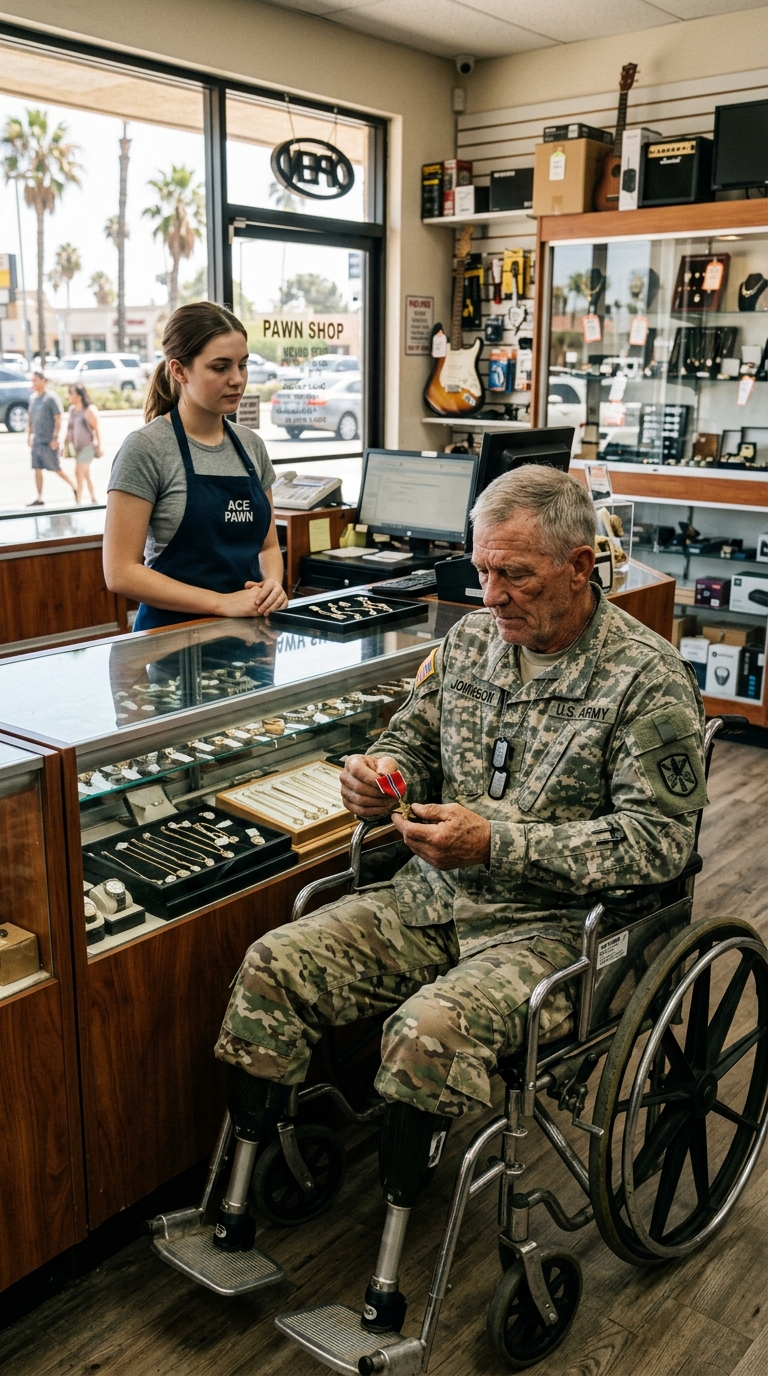
The disabled veteran spent a long time trying to avoid this moment.
For weeks, he convinced himself that somehow things would improve. Maybe another pension payment would arrive sooner than expected. Maybe an old acquaintance would call. Maybe he would find temporary work he could still manage despite his condition.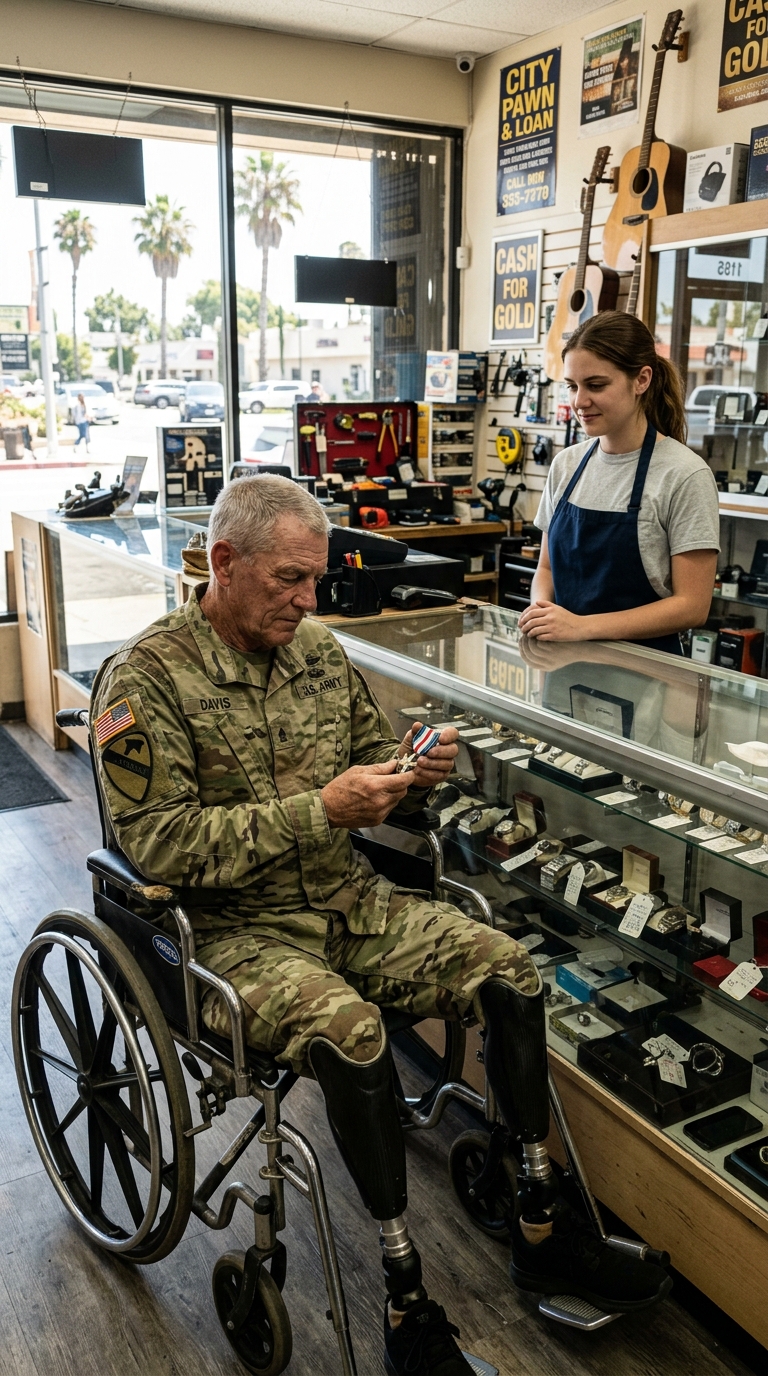
But none of that happened.
The refrigerator in his small apartment had been nearly empty for days. There was only an old bottle of water, half a loaf of dry bread, and expired medicine sitting on the top shelf. The electricity bill remained unpaid on the kitchen table beside several unopened letters he no longer had the strength to read.
And worst of all, the loneliness had become unbearable.
Still, asking for help felt impossible to him.
All his life, he had survived by relying only on himself.
Captain Viktor Sokolov had once been the kind of man others followed without hesitation. Strong, disciplined, fearless under pressure — the sort of commander soldiers trusted with their lives. During military operations, he always entered dangerous zones first and left last, making sure every member of his unit returned alive whenever possible.
His men respected him deeply.
Some even considered him invincible.
But war destroys even the strongest people eventually.
That morning, Viktor sat silently beside the window in his apartment while weak sunlight filtered through faded curtains. His old wheelchair stood nearby, worn and scratched from years of use. One wheel squeaked every time it turned, but replacing it cost money he didn’t have.
In his trembling hands rested the only valuable thing left from his former life.
A gold medal.
The medal had been awarded to him for bravery during a classified rescue operation years earlier — an operation that changed his life forever.
For several long minutes, he simply stared at it.
The metal still shined faintly despite its age. His fingers slowly brushed across the engraved surface as old memories flooded back into his mind.
Gunfire.
Smoke.
Shouting.
The smell of burning metal.
He remembered every detail.
His unit had been trapped during a nighttime mission in hostile territory. An explosion destroyed part of their convoy, leaving several soldiers wounded under heavy enemy fire. Viktor could have retreated to safety like others ordered him to.
Instead, he went back.
Again and again.
He carried injured soldiers out one by one while bullets struck the ground around him. He ignored his own injuries and kept moving until everyone possible was evacuated.
Then came the final explosion.
A hidden device buried beneath the road detonated beside him.
After that, there was only darkness.
When he woke in the hospital weeks later, the first thing he saw was white ceiling lights and the exhausted face of a military doctor standing beside his bed.
The doctor hesitated before speaking.
Then quietly said:
— “You’ll never walk again.”
At first, Viktor thought the man was mistaken.
But eventually reality became impossible to deny.
Both of his legs were permanently damaged beyond repair.
His military career ended immediately afterward.
There were ceremonies.
Handshakes.
Speeches about honor and sacrifice.
They pinned the gold medal onto his uniform and called him a hero.
Then they sent him home.
For everyone else, the story ended there.
For Viktor, the hardest part had only begun.
He lost his position, his purpose, and slowly even his connection to the outside world. Friends from the military visited at first, but over time the visits became less frequent. People moved on with their lives while he remained trapped inside the same tiny apartment with silence and memories.
He tried finding work.
Again and again.
But every interview ended the same way.
Employers looked at the wheelchair before politely rejecting him.
Eventually, he stopped trying.
Months turned into years.
The medal became the only thing reminding him that once, long ago, he had mattered.
That once, he had been more than a lonely disabled man forgotten by society.
Which was why deciding to sell it felt almost unbearable.
But hunger is stronger than pride.
That afternoon, Viktor finally slipped the medal carefully into his coat pocket.
Then he transferred himself slowly into his wheelchair and left the apartment.
Outside, cold wind swept through the streets. The city moved around him without noticing him at all. People hurried past carrying coffee cups, talking on phones, laughing with friends. Nobody looked twice at the aging veteran struggling to push his wheelchair over cracked sidewalks.
Each movement required effort.
His shoulders ached constantly.
By the time he reached the jewelry store several blocks away, sweat covered his forehead despite the cold weather.
For a moment, he hesitated outside the entrance.
The elegant glass windows reflected a man he barely recognized anymore.
Gray hair.
Exhausted eyes.
Worn clothes.
A hero reduced to selling his medal just to survive another week.
Finally, he forced himself inside.
The store was bright, warm, and painfully quiet compared to the noisy streets outside. Glass displays filled with gold chains, watches, rings, and expensive jewelry stretched across the room beneath soft lighting.
Everything there felt foreign to him.
A young sales assistant standing behind the counter noticed him immediately.
Her name tag read “Anna.”
She looked to be around twenty-five years old, dressed neatly in the store uniform with dark hair tied back professionally. At first, she simply observed him quietly as he approached the counter.
Viktor avoided eye contact.
Slowly, he reached into his pocket and placed the gold medal onto the glass surface.
His hands trembled slightly.
— “I… would like to sell this,” he said quietly.
Anna carefully picked up the medal.
The moment she saw it clearly, her expression changed.
This wasn’t ordinary jewelry.
It was a military award.
She examined the engraved details while occasionally glancing back at Viktor. She noticed the way his fingers tightened against the wheelchair handles. The way he kept staring downward as though ashamed to even be there.
— “Is this your medal?” she asked softly.
Viktor nodded once.
— “For military service.”
The store suddenly felt completely silent.
Even the faint music playing overhead seemed distant.
Anna looked at the medal again, then at the man sitting before her. There was something heartbreaking about him — not only exhaustion, but dignity too. A quiet pride buried beneath years of struggle.
She understood immediately that this was not greed.
This was desperation.
Still, she remained professional.
She pretended to inspect the medal carefully while secretly trying to steady her emotions.
Finally, she quietly named a price.
— “I can offer you this amount.”
Viktor nodded immediately.
The number barely mattered anymore. He only needed enough money for groceries, medication, maybe electricity.
But before agreeing, he slowly took the medal back into his hands one final time.
His fingers traced its surface gently.
Almost like saying goodbye.
His lips trembled slightly as memories overwhelmed him again — his soldiers, the operation, the men he carried to safety, the life he lost afterward.
Tears formed in his eyes.
He quickly turned his head away so nobody would notice.
Anna saw anyway.
Without another word, she completed the transaction and handed him the money.
Viktor folded the bills carefully and placed them into his pocket with shaking hands.
Then he turned his wheelchair toward the exit.
He didn’t look back.
He simply gripped the wheels harder and slowly headed for the door as though every movement weighed heavily on him.
The bell above the entrance rang softly when he exited the store.
Several seconds passed.
Then something unexpected happened.
Anna suddenly rushed out from behind the counter.
— “Wait!” she shouted.
Customers inside turned in surprise as she hurried outside after him.
Viktor stopped and slowly turned around, confused.
Anna ran up to him, slightly out of breath.
In her hands was the gold medal.
She held it toward him firmly.
— “Take it back,” she said.
Viktor stared at her in disbelief.
— “What?”
— “Take it,” she repeated gently. “Things like this shouldn’t be sold. They belong to the people who earned them.”
He looked completely stunned.
— “But… the money…”
Anna shook her head.
— “The money stays with you,” she said softly. “This isn’t a purchase. It’s just help.”
For several seconds, Viktor couldn’t speak at all.
His hands trembled as he slowly accepted the medal again.
He stared at it silently, overwhelmed.
— “I can’t accept this…” he whispered.
— “You can,” Anna interrupted kindly. “And honestly… you should.”
The veteran lowered his head.
No one had shown him compassion like this in years.
Not pity.
Not charity.
Real human kindness.
Anna hesitated briefly before speaking again.
— “I have a brother,” she said. “He owns a small repair business outside the city. Some of his employees have disabilities. He always says people just need someone willing to give them a chance.”
Viktor listened quietly.
— “If you want,” she continued carefully, “I can introduce you to him. He’s been looking for someone experienced to help with inventory and training younger workers. It’s honest work.”
Viktor stared at her silently for a long moment.
Inside the jewelry store, several customers had gathered near the windows watching the scene unfold quietly.
Some looked emotional.
Others looked ashamed.
Because they realized something painful:
A man who once risked his life for others had nearly been forced to sell his honor just to eat.
Viktor finally looked down at the medal resting in his hands again.
This time, it no longer felt like a painful reminder of what he had lost.
It felt like proof that his life still mattered.
Tears appeared in his eyes once more, but now they were different.
Not tears of humiliation.
Tears of relief.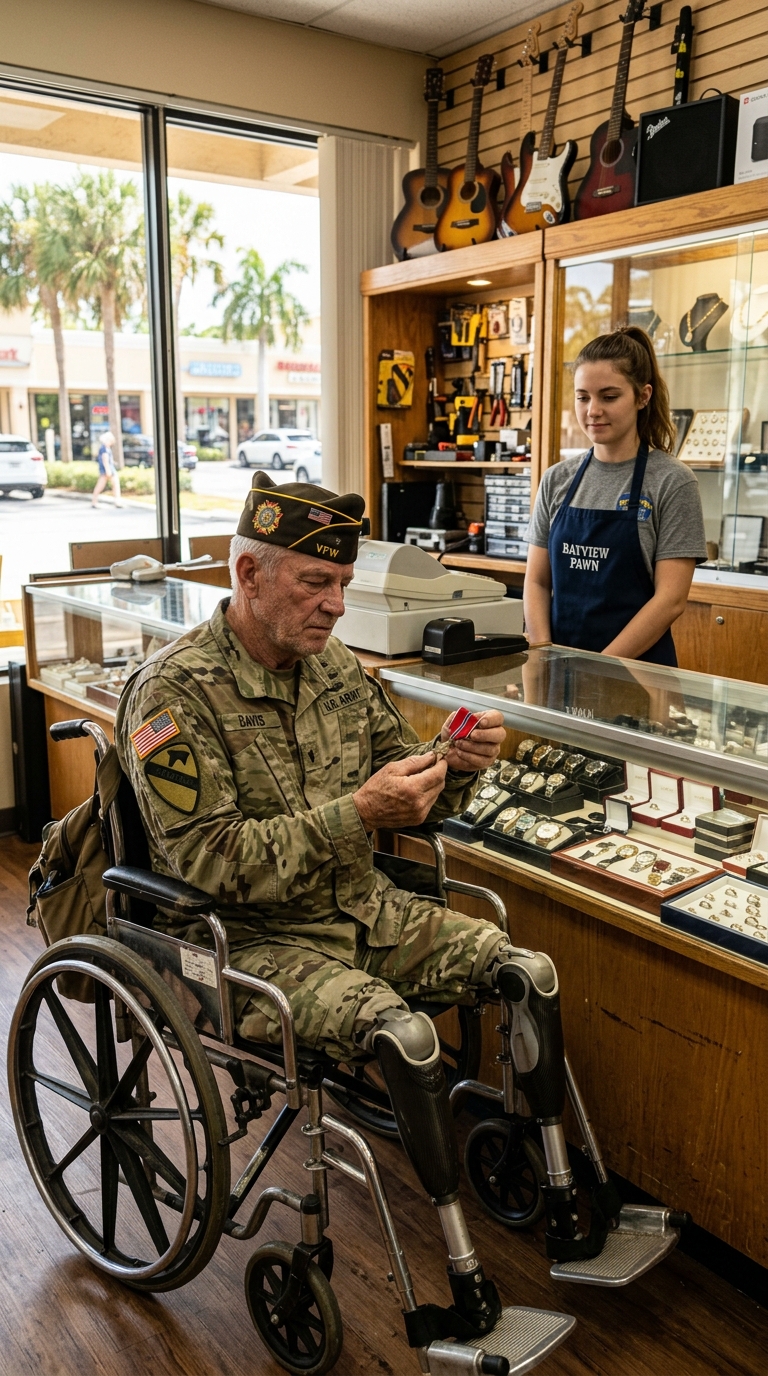
— “Thank you…” he whispered hoarsely while gripping the medal tightly against his chest.
Anna smiled softly.
— “You don’t need to thank me.”
But Viktor knew she was wrong.
Because at that moment, standing on the cold sidewalk outside the jewelry store, he realized something he had forgotten years ago.
The day he lost his legs was not the day his life ended.
Sometimes hope returns in the smallest, most unexpected moments.
And sometimes one act of kindness is enough to save a person long after the war is over.
