

Part 1
The call came while I was stripping old varnish from a walnut nightstand, the kind of patient, solitary work that convinces a retired man he has finally outrun chaos. Dust floated in the shaft of afternoon light beside my workshop window, and for a moment the world was simple: wood grain, sandpaper, silence, breath.
Then my phone began to vibrate across the bench.
I glanced over, expecting something forgettable—a missed pharmacy delivery, a neighbor asking for help moving a chair, maybe a telemarketer who thought old age meant extra free time. Instead, I saw the name Marisol Vega. She had been cleaning houses for the better part of a decade after leaving child welfare, and she only called me directly when something mattered.
I answered on the second ring. “Marisol?”
“Mr. Hale,” she said, and the fear in her voice straightened my spine before I even stood up. “I need you to come here. Right now.”
The room around me seemed to pull tight.
“What happened?” I asked, already reaching for my keys.
There was a pause on her end, broken only by thin, uneven breathing. Then she said, in a whisper so strained it hardly sounded human, “At first I thought it was a television. Or maybe one of those smart speakers somebody left running upstairs. But I checked every room. I turned everything off. And it’s still happening.”
My hand stopped on the doorknob.
“Marisol,” I said carefully, “what is still happening?”
Another pause. Then, lower, as if saying it aloud made it more real: “There’s a child crying behind the walls. Or above them. I think… I think it’s coming from the crawlspace.”
For one suspended second, my mind rejected the sentence completely. Men my age are supposed to get aches in their knees, not moments like this. We are supposed to settle into manageable problems: weather, blood pressure, wood stain, utility bills. Not hidden children. Not terror wrapped in drywall and silence.
But training does not disappear just because the state hands you a retirement plaque.
“Stay downstairs,” I said, my voice suddenly sharp, clipped, familiar even to me. “Do not go looking for it again. Do not call out. Do not touch anything else. Stay near the front door and wait for me.”
“Okay,” she breathed. “Please hurry.”
“I’m on my way.”
I barely remembered leaving my apartment. I remember jamming my feet into shoes without socks. I remember the half-sanded nightstand sitting under the work light like a life abandoned mid-sentence. I remember locking the door and then checking it twice because my hands were shaking too badly to trust themselves.
The drive to Ridgeview Lane normally took twenty minutes from my place if traffic cooperated. That afternoon I made it in twelve, breaking every promise I had ever made to myself about calm, restraint, and civilized conduct behind the wheel. Fear strips a man down. It burns away caution and leaves only motion.
As I drove, the city blurred past in fragments—crosswalks, brake lights, storefront glass, the bright indifferent faces of strangers who still believed normal was a guarantee. I did not.
I had spent thirty-six years as a social worker. Thirty-six years learning that cruelty almost never announces itself properly. It does not wear fangs. It does not drip menace from the front porch.
It wears good shoes.
It hangs tasteful curtains.
It smiles for Christmas cards.
It posts filtered photos and calls itself a family.
By the time I turned onto Ridgeview Lane, my jaw hurt from clenching it. The neighborhood looked exactly as it should have: trimmed hedges, white fences, expensive SUVs in neat driveways, an American flag stirring lazily from a porch column two houses down. A little boy in a bike helmet coasted past me without a care in the world.
Normal. Clean. Safe-looking.
The kind of street people trusted too easily.
Marisol was standing on the front steps when I pulled in, arms wrapped around herself, phone clenched in one hand. She was pale enough to look ill. Her eyes fixed on the house the way people watch a hospital room before a doctor comes out.
“It stopped,” she said as I hurried toward her. “Then it started again. Softer this time.”
“You did the right thing calling me.”
She gave a small, strained laugh that collapsed into nothing. “I used to tell frightened mothers that.”
I looked at the house and felt something bitter move through me.
The property had been mine once. Twelve years of mortgage payments, backyard repairs, school drop-offs, Christmas lights, broken gutters, and ordinary family life. Then my son had married the wrong woman at exactly the right time, and I had convinced myself that generosity would keep us close. I transferred the title to him after the wedding. A gift, I called it. A head start. A father’s pride disguised as paperwork.
That was three years ago.
Now the place belonged to Adrian Hale and his wife, Vanessa Vale—the lifestyle entrepreneur with a million followers, a smile built for sponsorships, and a house curated so aggressively it no longer felt lived in. I had only been invited back twice since giving it to them. Adrian always had a reason. They were traveling. They were redoing the floors. Vanessa was filming content. Another time, maybe.
Another time had arrived in the ugliest way possible.
“They wanted the place detailed before some magazine photographer comes tomorrow,” Marisol said quietly as I unlocked the front door with the emergency key I had never admitted I kept. “I was dusting the hallway when I heard it.”
The door swung inward.
The house looked like an expensive lie.
Cream walls. Sculptural lamps. Pale linen sofa untouched by actual human softness. Coffee-table books no one had read. The air smelled of cedar candles and lemon polish. Nothing was out of place. Nothing suggested a child. No toys. No little shoes. No drawings crookedly taped to a refrigerator. No crumbs, no life, no evidence of mess or need or noise.
Then I heard it.
A muffled sound, faint enough to deny if you wanted to stay blind. A small broken catch of breath. Then another. Then the unmistakable soft, exhausted sob of a child who has learned not to cry too loudly.
I went still.
Marisol grabbed my sleeve. “That. That’s what I heard.”
The sound came from the upstairs hall. More specifically, from above it.
My mouth went dry. I looked up at the ceiling and remembered the old access hatch near the linen closet, the narrow pull cord, the storage crawlspace stretched above the second floor. When Adrian was ten, he used to drag Halloween decorations up there and complain about spiders.
I moved toward the stairs.
“Call the police now?” Marisol whispered.
“Not yet,” I said automatically, though every instinct in me was already preparing for that next step. “Let me see first.”
Her expression said she hated that answer but understood it. Once you have done this work, your mind gets wired for evidence, containment, sequence.
Upstairs, the house was quieter, the polished stillness somehow worse. The crying came again—stifled, quickly suppressed, as if someone had learned that sound invited punishment.
I stopped beneath the access hatch and pulled the cord.
The folding ladder snapped down with a rattling metallic groan.
The crying stopped instantly.
Cold flooded my chest.
Because silence like that is not accidental. Silence like that is trained.
I looked down at Marisol, who stood three steps behind me with tears already in her eyes.
“Stay here,” I said. “If I say call, you call.”
She nodded once.
I climbed.
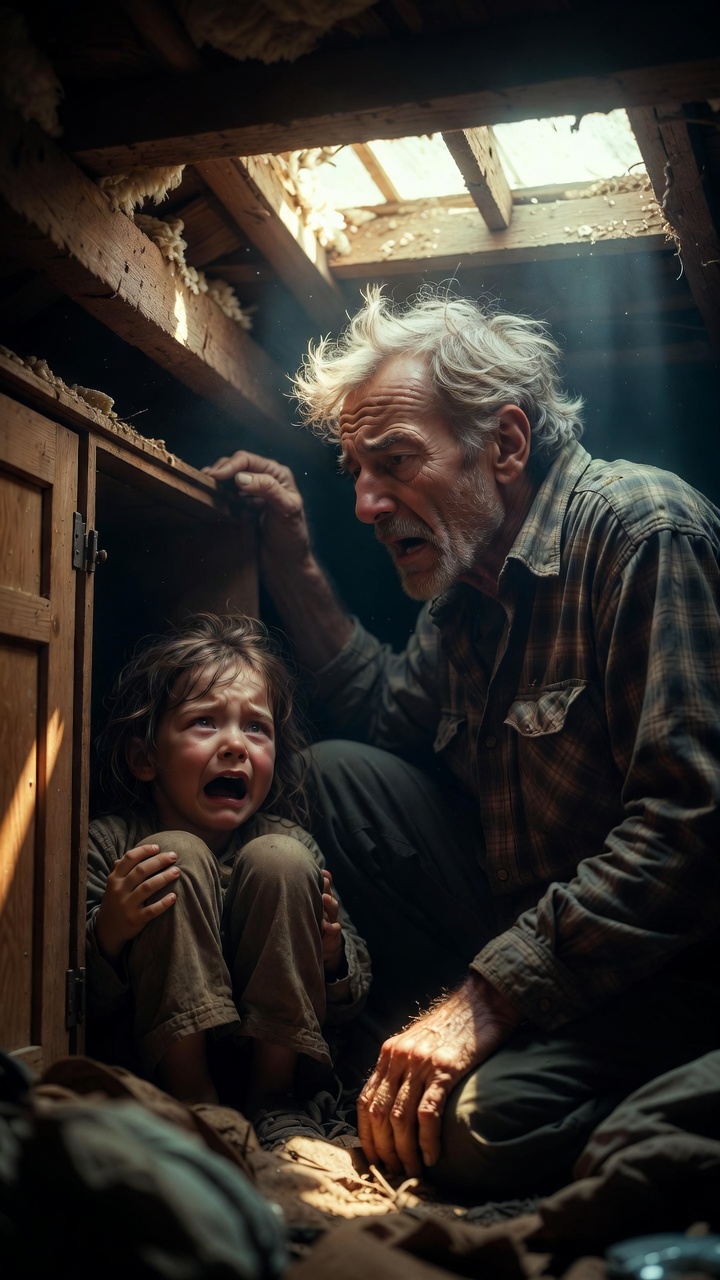
Heat met me first, then dust. The crawlspace was long, shallow, lined with insulation and storage bins. My eyes adjusted slowly to the dimness filtered through a vent at the far end. Plastic tubs labeled WINTER DECOR, CAMP GEAR, VANESSA ARCHIVE were stacked along the beams. Garment bags hung from a metal rack. Everything looked staged, organized, domesticated.
And then I heard breathing.
Not mine.
A tiny, panicked attempt to make as little sound as possible.
I turned toward the far wall and saw a built-in cabinet recessed between the rafters—something Adrian had installed last year, according to Vanessa’s online renovation posts. “Smart hidden storage,” she had called it in one caption, smiling in front of whitewashed paneling and brass pulls.
One of the cabinet doors was shut.
From behind it came the smallest sniffle I had ever heard.
My knees nearly failed me.
I crossed the crawlspace slowly, hands open and visible, every movement deliberate. The closer I got, the more I could smell it: stale air, sweat, damp fabric, trapped fear.
And then, from inside the cabinet, a little voice whispered, so quietly I almost missed it, “Please don’t tell her I made noise.”
The words hit me harder than a blow.
I crouched in front of the cabinet and had to force my own voice low and steady. “I’m not here to hurt you,” I said. “My name is Walter. I’m going to open the door now, all right?”
No answer. Just a sharp, trembling inhale.
I opened it.
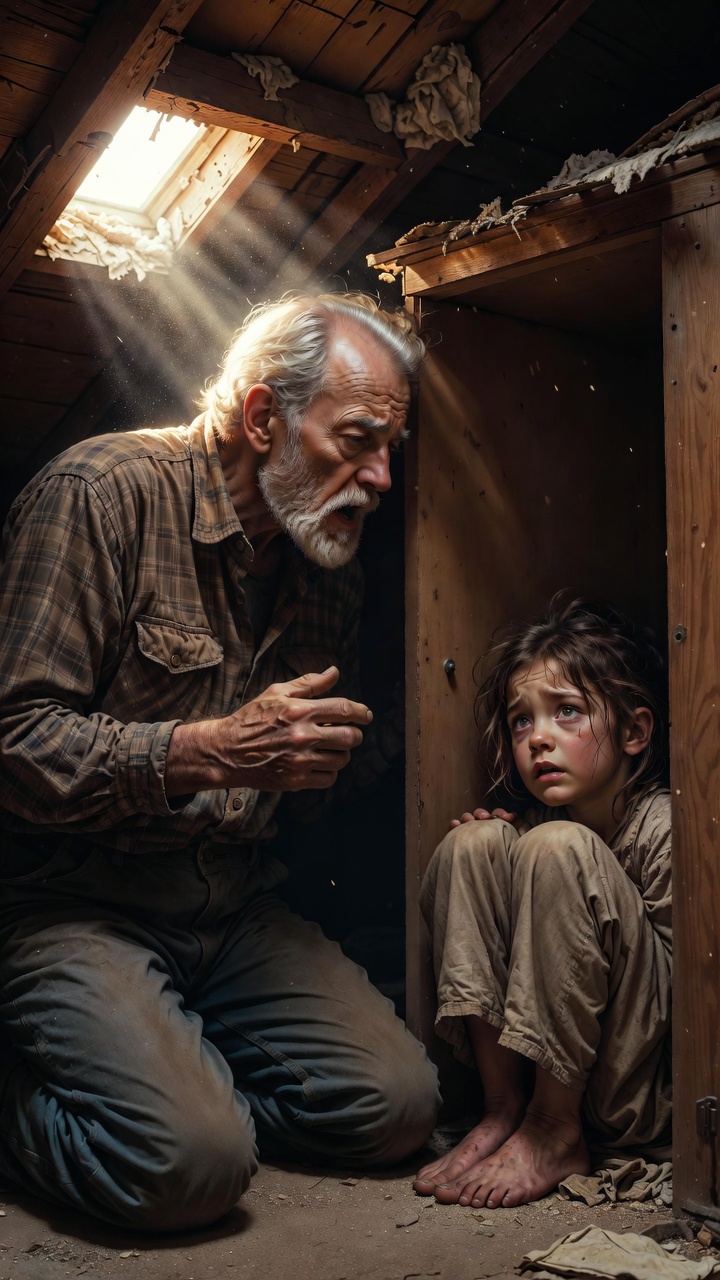
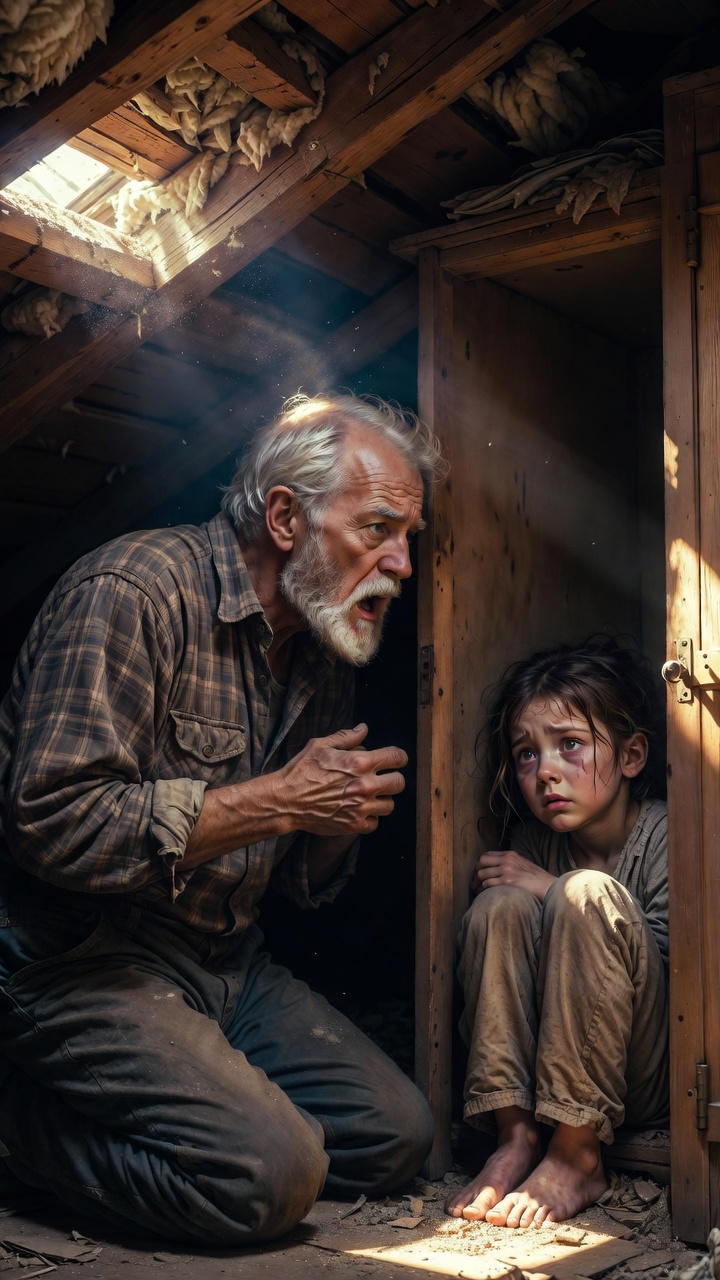
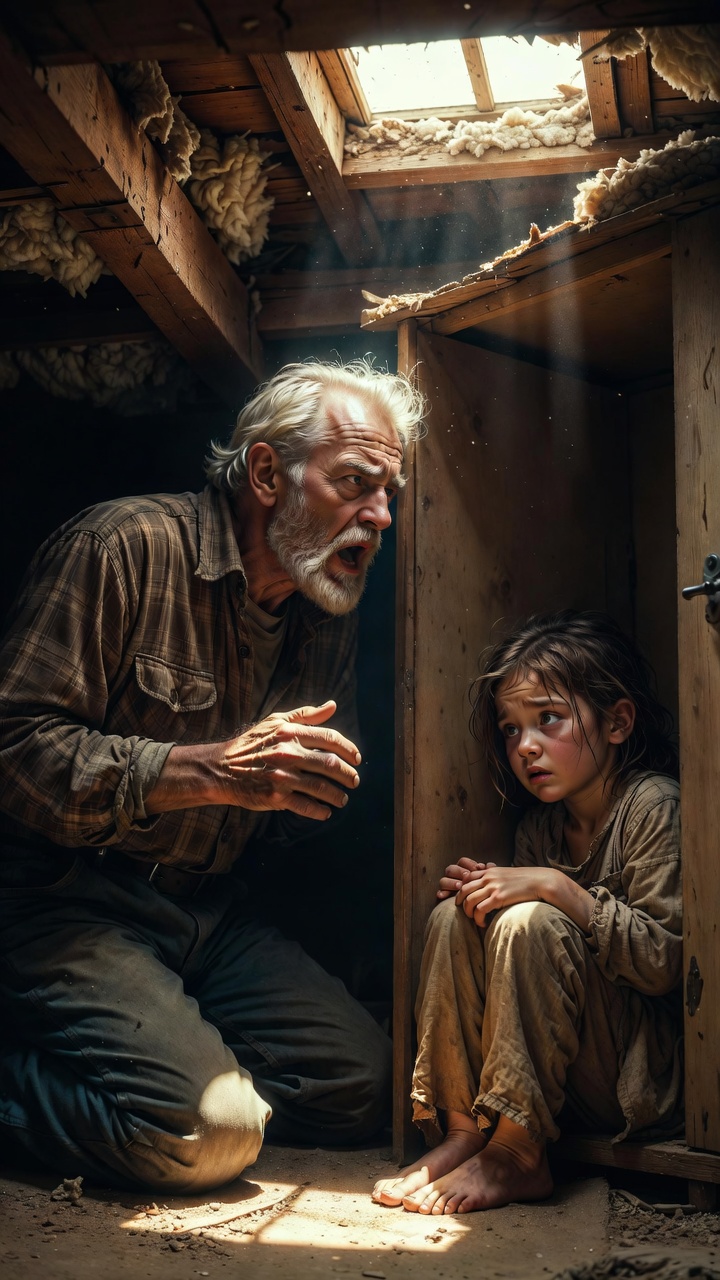
Inside, curled into the back corner on a thin foam pad, was a little girl.
Five, maybe six. Dark curls matted against her temples. Huge frightened eyes in a face too pale beneath the grime. Her T-shirt was wrinkled and stained. Her leggings were too short, riding up skinny shins marked with pressure dents from sitting curled too long. Beside her sat a plastic cup, an empty applesauce pouch, and a battery-operated lantern turned off to save power.
The space was not storage.
It was a cage disguised as furniture.
My entire body went numb with fury.
She recoiled when light hit her, raising one hand instinctively as if expecting to be struck.
I lowered myself fully to the floor so I would not tower over her. “Hey,” I said gently. “You’re okay. You’re safe with me.”
Her lower lip shook. “I tried to be good.”
The sentence broke something inside me.
“You do not have to try to be good for me,” I said. “What’s your name, sweetheart?”
She hesitated for so long I thought she might refuse. Then: “Ivy.”
“Ivy,” I repeated, because names matter, because children deserve to hear themselves spoken gently. “That’s a beautiful name.”
Her eyes flicked past me toward the hatch. Toward escape, danger, the possibility of witnesses.
“Are you with the cleaning lady?” she whispered.
“Yes. She heard you crying.”
Fresh tears slid down her cheeks. “I wasn’t supposed to. Vanessa said quiet girls get to stay.”
I closed my eyes for one second, only one, because rage is a luxury when a child is still trapped.
“And who told you to stay in here, Ivy?” I asked, though something deep in me already knew the answer would be unbearable.
She bent her head. “My dad.”
My voice nearly failed me. “What’s your dad’s name?”
“Adrian.”
The space around me tilted.
“Adrian Hale?”
A small nod.
I swallowed and tasted metal. Adrian Hale was my son.
I looked at her again—really looked—and suddenly I could see traces of him around the mouth, around the eyes. Not enough to soften anything. Only enough to make it worse.
“How old are you, Ivy?”
“Five.”
“How long have you been staying here?”
She shrugged, the helpless movement of a child with no calendar and no safe way to measure suffering. “A lot.”
I felt the old professional part of myself taking notes automatically: malnourished, socially conditioned to silence, fear response tied to sound, likely prolonged confinement, possible hidden paternity, probable emotional abuse by father and stepmother. But over all of it rose something far more primitive and personal.
This was my granddaughter.
And my son had hidden her in a wall.
“Ivy,” I said softly, “I need to tell you something. Adrian is my son.”
Her eyes widened in alarm.
“That means I’m your grandfather.”
She stared at me as if the concept was too large to fit into the space with us.
“My grandpa?”
“Yes,” I said, and my throat tightened so sharply I had to fight to keep my voice even. “And I am getting you out of here right now.”
She looked at me for a long, trembling moment. “Will he be mad?”
I held her gaze. “That is not your problem anymore.”
Very carefully, I held out my hand. “Can I help you?”
She moved slowly, like someone expecting the world to change its mind. When she tried to uncurl her legs, they trembled badly enough that I saw at once she had not been allowed enough room or freedom to move properly. I slid one arm beneath her knees and the other around her back and lifted her.
She weighed almost nothing.
As I stood, she clutched my shirt in both fists and pressed her face against my shoulder with the desperate trust of a child who has run out of options.
Marisol was already crying openly when she saw us at the hatch.
“Oh my God,” she whispered.
“Call now,” I said, and this time there was no hesitation in me at all. “Police. Child services. Ambulance. Tell them we found a little girl hidden in a crawlspace.”
Marisol was already reaching for her phone.
I carried Ivy down the ladder one careful rung at a time, and every step felt like descending with evidence, with grief, with the shattered remains of the life I thought I understood.
By the time my feet touched the upstairs floor, I knew one thing with absolute certainty:
Whatever came next would not be the retirement I had imagined.
And whatever happened to my son after this, he had earned it.
Part 2
By the time the paramedics and police finished filling the upstairs hallway with radios, footsteps, and clipped professional voices, Ivy had stopped trembling hard enough to make her teeth chatter, but she still refused to let go of my hand. I sat beside her on the ivory sofa Vanessa had probably once described online as timeless and family-friendly, and watched my granddaughter hold a bottle of water with both hands as if someone might snatch it away. She drank too quickly at first, then looked up in panic, asking in a whisper whether she was allowed to have more. That question alone nearly brought me to my knees. Officer Lena Brooks photographed the crawlspace. Another officer took Marisol’s statement. A medic with kind eyes knelt in front of Ivy and asked permission before checking her pulse, her pupils, the thin bruised shadows beneath her knees. Every answer Ivy gave came with a pause first, as if she had to sort through landmines before choosing words. When a caseworker from Child Protective Services arrived—a sharp, controlled woman named Naomi Price—she looked at me, then at Ivy, then at the open hatch upstairs, and I saw the exact instant this stopped being a disturbing callout and became a criminal case. “You said this is your son’s house?” she asked. “Yes,” I answered, and those words tasted like rust. “And the child says Adrian Hale is her father.” Naomi’s eyes shifted back to Ivy. “Sweetheart, do you know where your daddy is right now?” Ivy nodded faintly. “In Italy. Vanessa said we had to stay hidden until they got back because I make everything complicated.” I closed my eyes for one heartbeat and felt something inside me go from heartbreak to cold, permanent fury.
At St. Vincent’s Medical Center, reality sharpened into paperwork and fluorescent light. They weighed Ivy, drew blood, photographed old rashes and pressure marks, tested hydration levels, and documented every sign of neglect with the merciless precision I had once relied on for other people’s children. I sat in a rigid plastic chair outside the exam room while Naomi made calls and a police detective asked me the same timeline three different ways. I answered every question cleanly: Marisol’s call, the drive, the ladder, the cabinet, the child. No embellishment. No confusion. Just facts, because facts were what would bury Adrian later. After an hour, Naomi returned with a file pulled from emergency records and sat beside me with the expression of someone delivering bad news she already knows will detonate. “Ivy Hale,” she said quietly, tapping the page, “mother deceased eighteen months ago. Eleanor Mercer. Ovarian cancer. Adrian Hale was listed as surviving parent and granted sole custody.” I stared at her so hard the words seemed to lose meaning. Sole custody. Eighteen months. Eighteen months of my son having a daughter no one in the family had been told about. Eighteen months in which he had apparently chosen secrecy over school enrollment, privacy over pediatric care, image over childhood. “There’s almost nothing else,” Naomi said. “No active school registration. Minimal medical history. A private account with monthly deposits in the child’s name. We’re subpoenaing access now.” I let out a bitter laugh with no humor in it. “Check the withdrawals,” I said. “If Adrian set it up, he’s been siphoning from it.” Naomi’s head turned toward me, surprised. “You sound very certain.” I looked at the floor, at my old hands, at the tremor I could not fully control. “Because I’ve met fathers like him before,” I said. Then, after a beat: “I just never thought I raised one.”
The doctor came out near midnight and delivered the verdict in the clipped, exhausted voice of a man who has long since stopped being shocked by human failure. Ivy was underweight. Mildly dehydrated. Deficient in iron and vitamin D. No fractures, no acute physical assault injuries, but clear signs of prolonged confinement, chronic emotional stress, and neglect severe enough to warrant immediate protective custody. Clinical language has always irritated me when it tries to summarize suffering with neat phrases, but I understood why it existed. Courts liked language they could file. Children paid the price for how long adults took to believe it. They let me sit with Ivy once the IV was in and the monitors quieted. She looked impossibly small in the hospital bed, washed clean now, curls combed loosely by a nurse, swallowed by white blankets and caution. When she saw me, her eyes filled instantly—not from fear this time, but from the terrible uncertainty of wanting comfort without trusting it would remain. “Grandpa?” she whispered, trying the word like it belonged to someone else’s life. “I’m here,” I told her, sitting carefully beside the bed. “I’m not going anywhere tonight.” Her fingers found mine under the blanket and held on. “Are they gonna put me back?” she asked. There it was. The question beneath every frightened child’s silence. Not What happened? Not Why me? Only the practical horror: Do I have to return to the place where I learned pain? I bent close so she could see I meant every syllable. “No,” I said. “Nobody is putting you back in that crawlspace. Ever.” Her face crumpled with relief so raw I had to look away for a second to keep my own composure from breaking. She fell asleep still holding my hand, and I sat there listening to the machines breathe around her while the full shape of my life rearranged itself.
The next morning I began moving before sunrise, powered by black coffee, fury, and old instincts that had spent too many months pretending retirement was peace. First, I called Naomi and told her I wanted emergency kinship placement. She did not argue long; she knew my work history, knew my housing record, knew I understood both the privilege and burden of asking the state to trust me with a child pulled from abuse. By nine, the forms were in my inbox. By ten-thirty, they were completed, scanned, and returned with every supporting document I could assemble: pension statements, lease, background check authorization, medical clearance, references. At noon I called a family attorney downtown named Celeste Rowan, expensive enough to hurt and ruthless enough to matter. She listened in total silence while I told her everything from Marisol’s call to the hospital report, and when I finished she said, “Mr. Hale, this is not just a custody matter. This is a neglect prosecution waiting to happen. If the evidence is as strong as you say, we don’t aim for visitation limits. We aim for guardianship, no-contact orders, and termination if the state is willing.” The retainer she quoted would have made me wince a week earlier. Now I gave her my card number without hesitation. By late afternoon Naomi called back: preliminary approval granted, Ivy could be released to me pending formal review. I drove to the hospital with a child’s toothbrush, soft pajamas, two stuffed animals, and an ache in my chest so deep it felt geological. Ivy came out carrying everything she owned in a paper discharge bag. Hospital socks. A coloring sheet. A cheap plastic bracelet. That was it. I helped her into the passenger seat, buckled her in, and started the engine. After a few blocks, she asked in a tiny voice, “Is this your car forever?” I almost smiled. “It can be ours for as long as you need,” I said. She thought about that, then pressed her forehead to the window and watched the city pass like she was crossing into another country.
My apartment had never been meant for a child. It was a quiet one-bedroom over a hardware store, with a narrow kitchen, a workbench by the living room window, and exactly one rhythm: mine. By evening it had already begun changing shape around Ivy. I gave her my bedroom and moved my blankets to the couch without discussion. I ordered soup, bread, and grilled chicken because I did not yet know what she liked or what her stomach could handle. She ate slowly at first, eyes lifting to me between bites for permission, then faster when she realized no one was going to take the plate away. After dinner, she wandered the apartment in silence, fingertips trailing lightly across bookshelves, lamp bases, the edge of my workbench where the unfinished walnut nightstand still sat under the lamp. “You fix things?” she asked. “Sometimes,” I said. She looked at the wood for a long moment, then nodded as if that answer meant more than I understood. That night, after a bath and fresh pajamas, I tucked her into my bed and left the door open because she could not bear it shut. “Grandpa?” she asked into the dim light. “Yes?” She twisted the blanket in her hands. “If Daddy calls, do I have to talk?” I sat on the edge of the bed and kept my voice calm, even though every muscle in my body tightened at the word Daddy. “No,” I said. “You do not have to do anything that scares you.” She nodded, but her eyes stayed troubled. “Vanessa says people leave if I’m difficult.” I leaned down until she had no choice but to look at me. “Listen carefully, Ivy. You are not difficult. You are not a secret. You are not the reason adults failed you. They were wrong, not you.” Her face softened in a way that made her look painfully young. A minute later, she was asleep, one hand still curled in the blanket, as if even in sleep she expected something to be taken. I sat alone at the kitchen table long after midnight with Celeste’s legal pad open in front of me, making a list the way I used to do for other families: police report, medical records, crawlspace photos, financial subpoenas, neighbor statements, custody file, school absence trail. Adrian had hidden his daughter in the bones of a house I once called home. He had made the mistake of believing darkness was enough. He had forgotten that I knew exactly how to pull a case like his into the light.
Part 3
The call from Adrian came just after sunrise two days later, his name flashing across my screen like a challenge I had been waiting for without admitting it. I stepped into the kitchen so Ivy wouldn’t hear, though part of me knew she would sense the tension anyway. “Dad,” he said, voice tight, already defensive, already angry. “What the hell did you do? Police called us in Rome. They said Ivy was found in the house—what are you playing at?” Behind him I could hear Vanessa’s voice, sharp and frantic, something about lawyers, about reputation, about how this would look. For a moment, I saw him as a boy again—ten years old, muddy shoes, running in from the yard with a grin—but the image shattered as quickly as it came. “I found a child locked inside a wall,” I said evenly. “What did you expect me to do?” There was a pause, then he snapped, “She’s my daughter. You had no right.” My grip tightened on the phone. “The moment you chose to hide her instead of raise her, you forfeited your rights in anything that matters.” His breathing turned ragged. “We’re flying back. You’re giving her to me when we land.” I let the silence stretch just long enough to settle the weight of what came next. “No,” I said. “The state placed her with me. Everything is documented. You should focus on the conversation you’re about to have with Child Services—and the police.” He hung up without another word. I stood there, staring at the blank screen, feeling the line between past and present seal shut for good.
The first hearing moved faster than I expected, as if the system recognized urgency for once instead of delay. Celeste stood beside me in court, precise and controlled, while Adrian and Vanessa arrived dressed in neutral tones that screamed strategy. They had hired a defense attorney who spoke smoothly about misunderstandings, temporary arrangements, renovations—every polished excuse designed to soften reality into something digestible. Then Celeste presented the evidence. Photographs of the crawlspace cabinet. Medical reports documenting malnutrition and stress. Marisol’s testimony. Neighbors confirming no child had been seen entering or leaving the house for months. Finally, the financial records—monthly deposits into an account under Ivy’s name, followed by withdrawals funding travel, luxury purchases, dinners that cost more than a week of groceries. When the judge asked Adrian directly whether he had used those funds, he hesitated just long enough to condemn himself. “I was going to replace it,” he muttered. The courtroom fell silent. The judge’s expression hardened into something cold and final. Temporary guardianship remained with me. Adrian and Vanessa were barred from contact pending further investigation. The case was formally referred for criminal review. When the gavel struck, it echoed like a door closing on everything I thought I knew about my own son.
The weeks that followed unfolded with a clarity that felt almost merciless. The district attorney filed charges: child neglect, endangerment, financial exploitation of a minor. Adrian was arrested first, then Vanessa, their curated lives unraveling in headlines and public scrutiny. He lost his position within days. Her sponsorships evaporated overnight. Every carefully filtered image they had built dissolved under the weight of truth. Meanwhile, Ivy’s world expanded in small, fragile steps. She started kindergarten, clinging to my hand the first morning, then walking into the classroom on her own by the end of the week. She learned to ask for food without apologizing. She stopped hiding crumbs in her pockets. She began to sleep through the night without waking in panic. Therapy sessions gave her language for fear, and with each passing day, she filled the apartment with a little more sound—laughter, questions, the soft hum of a child learning she was allowed to exist. I built routines around her the way I once built case files—carefully, deliberately, making sure nothing essential was missing. And in the quiet hours after she slept, I worked with Celeste, preparing for the final stage, knowing that justice was not just about punishment, but permanence.
The sentencing hearing arrived under a sky the color of steel. I stood at the podium and delivered my statement not as a retired social worker, but as a grandfather who had seen too much and refused to look away. I spoke of Ivy’s fear of darkness, her instinct to apologize for breathing too loudly, the way she had asked if she deserved to be hidden. I did not raise my voice. I did not need to. Truth does not require volume. Adrian stared at the floor. Vanessa cried, but there was no performance left in it, only consequence. The judge spoke with deliberate clarity. What they had done was not a mistake, not negligence born of confusion, but a sustained, conscious pattern of harm. She sentenced both of them to prison terms, ordered restitution, and, with a finality that seemed to settle into my bones, terminated Adrian’s parental rights. No custody. No visitation. No contact. When Adrian looked at me as he was led away, something desperate flickered in his eyes. “Dad, please—” he began. I held his gaze and felt no anger, only a distant, irreversible certainty. “You made your choices,” I said quietly. “Now you live with them.” It was the last conversation we ever had.
The final guardianship order was signed six weeks later. Permanent custody of Ivy Hale was granted to me in full. Outside the courthouse, she squeezed my hand and asked if it meant she could stay forever. “Forever,” I told her, and for the first time, the word felt real. I sold the Ridgeview house soon after, closing that chapter completely, and placed the proceeds into a protected trust in Ivy’s name—one that no one could ever touch except for her future. Our life settled into something steady and whole: school mornings, homework at the kitchen table, evenings at the park, ice cream on cold nights because she had learned she deserved sweetness without conditions. The apartment changed, filled with drawings taped to walls, books stacked in uneven towers, the quiet evidence of a childhood being rebuilt piece by piece. Sometimes, late at night, I would sit alone and think about the man my son had become, about the years I had missed, about the fracture that would never mend. But those thoughts no longer defined me. What defined me was the sound of Ivy laughing in the next room, the certainty in her voice when she said my name, the way she no longer asked if she was allowed to stay. Justice, I learned, was not only the fall of those who caused harm—it was the rise of the one who survived it. And in the end, that was enough.
