

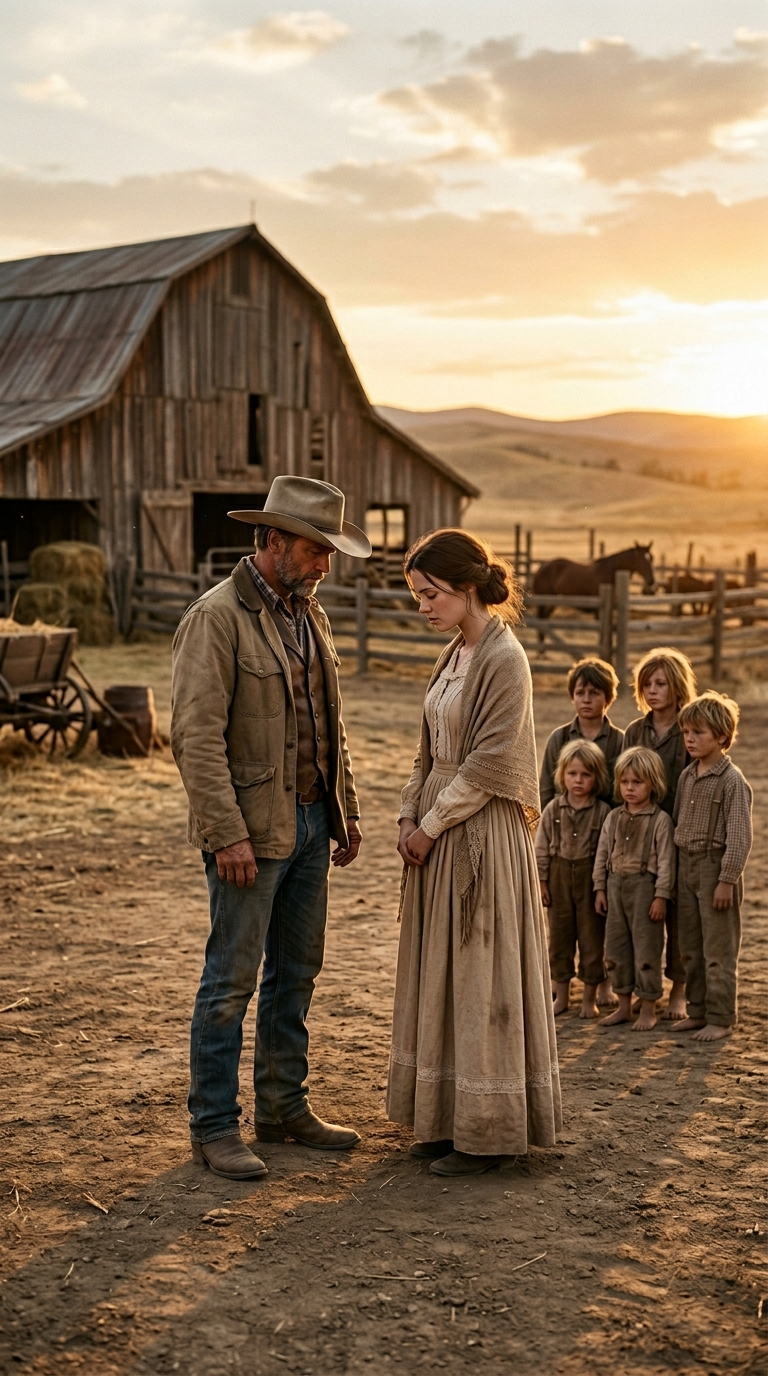
A woman battling infertility responds to a widower’s ad asking for help to raise six children. What happens next will break your heart.
The letter arrived on a Tuesday, coated in road dust and folded so many times the creases looked like worn fabric. Sara Méndez held it between her fingers as if it might fall apart in the sunlight. She stood at the entrance of the shop where she had worked for three years, watching the ink tremble slightly in the afternoon heat. Behind her, Doña Paula arranged cans of peaches on a shelf, humming an uneven tune. Sara knew she only had a few minutes before the questions would begin.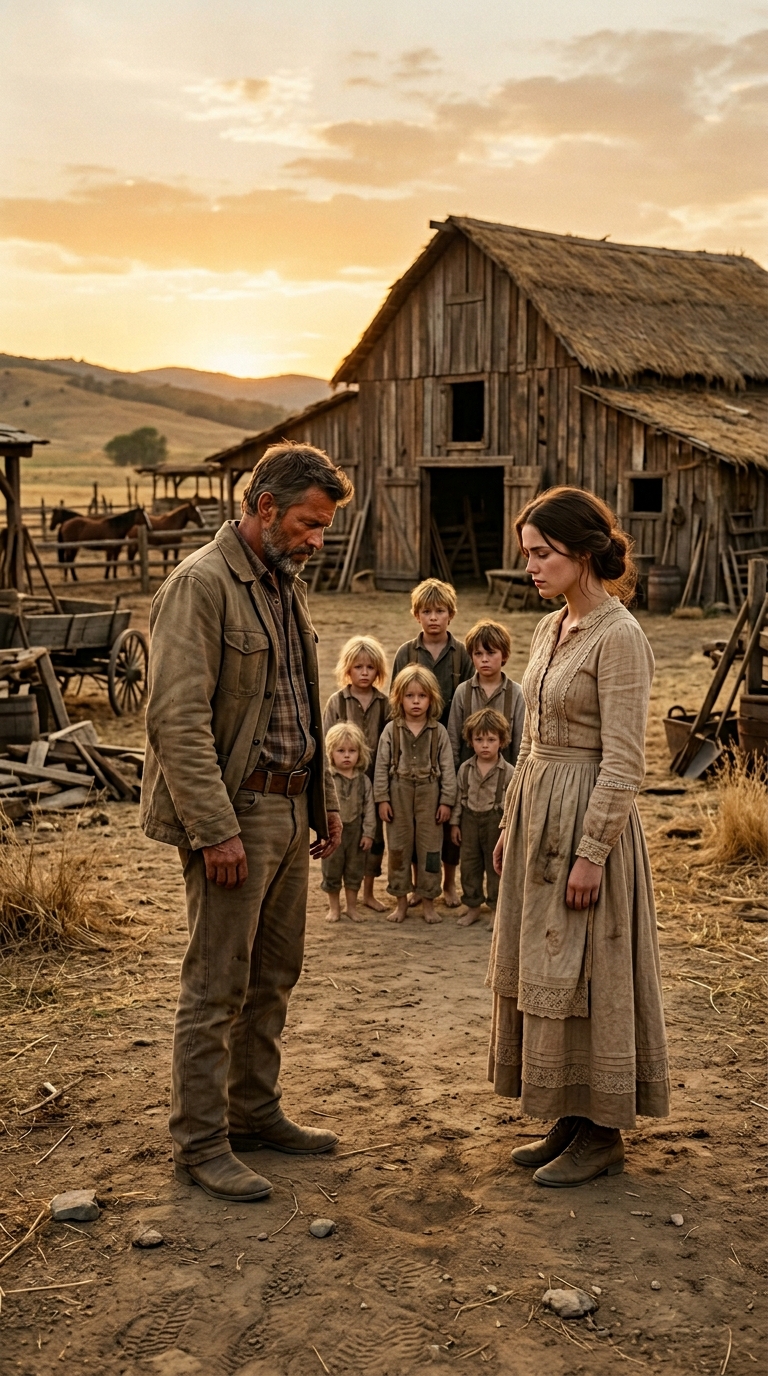
She stepped out onto the main street of Santa Aurelia. The sun beat down harshly on the dry ground, and every passing horse stirred up clouds of dust that hovered briefly before fading away. She took shelter beneath the wooden awning and read the letter again, though she already knew every word by heart.
Widower, six children, ranch two days north, near San Jerónimo. Seeking a woman of good character, strong spirit, to help at home and with the children. No romance offered, only honest work, respect, and a fair arrangement.
The letter was signed Gabriel Ortega, the handwriting firm, almost carved rather than written.
Sara had replied to the ad four weeks earlier, one night when loneliness weighed heavier than usual. She had written it by candlelight in the narrow room she rented at the Hernández house. She hadn’t expected a reply. Women like her rarely received one. She was thirty-one, with an ordinary face, overly straight shoulders, hardworking hands, and a sadness she had learned to hide.
And she carried a secret.
Six months earlier, a doctor in Real del Monte had written with cruel precision: the fever had left irreversible damage. She would never be able to have children.
She had cried for weeks. Then she stopped—not because the pain was gone, but because it had changed shape. It was no longer an open wound, but a stone inside her chest. It weighed on her whenever she saw a woman rocking a baby, heard a lullaby drifting from a window, or listened to neighbors speak of pregnancy as if life were handed out fairly.
“And?” Doña Paula called from the doorway.
Sara quickly folded the letter and slipped it into the pocket of her skirt.
“Nothing important. It’s from a cousin.”
Doña Paula narrowed her eyes, suspicious, but didn’t press. Not yet. She would later.
The stagecoach to San Jerónimo left at dawn on Friday. Sara had three days to decide between staying where no one truly waited for her, or stepping into an uncertain life with a man she didn’t know and children who would never be hers.
On Friday, she boarded with a single suitcase, two dresses, an old Bible, and a fear that wouldn’t fit in her luggage.
Gabriel Ortega smelled of smoke, leather, and exhaustion when he came to meet her. He wasn’t old, perhaps thirty-five, but his eyes carried the weight of someone who had lived too much in too little time. Broad-shouldered, sun-browned, with dark hair falling across his forehead and hard lines at the corners of his mouth.
“Miss Méndez?”
“Yes.”
He took her suitcase without questions and led her to a wagon pulled by two strong horses. He helped her up with a rough but steady hand, not unkind.
“The children don’t know you’re coming,” he said once they were on the road.
Sara glanced at him.
“Is that to make things easier for me—or for you?”
For the first time, something like a smile touched Gabriel’s face.
“Good question.”
The land opened into golden hills, cacti, long fences, and scattered cattle in the distance. They rode in silence for a while until he spoke again, not looking at her.
“My wife died two years ago. Influenza. She was a good woman. Very good. The children haven’t forgotten her.”
“I’m sorry.”
“I tried managing alone,” he continued. “But the ranch, the house, the children… I can’t keep up. They need someone who stays.”
The word stays hung between them.
Sara took a breath. She could lie, invent a more acceptable reason for being there. But something in his exhaustion demanded honesty.
“I can’t have children,” she said quietly. “I found out last year. I thought no man would choose me for marriage knowing that. But maybe someone could choose me to help care for his.”
Gabriel tightened his jaw, taking a moment before replying.
“Not many people speak that plainly.”
“Only when it matters.”
He nodded slowly.
“It matters.”
Then he told her the children’s names: Emilia, thirteen; Diego, ten; Lucía, eight; Tomás, seven; Graciela, six; and Samuel, the youngest, four.
“They’re good kids,” he added. “A bit wild. But good.”
The ranch was larger than Sara had imagined. A wide wooden house, weathered with age, a front porch and a stone chimney. Chickens pecked near the well. Behind the house came laughter, shouting, the sound of children arguing.
They appeared around the corner and stopped short when they saw her. Emilia stood in front, thin, dark braids, serious eyes—a younger version of her father. The others gathered behind her like a shield.
“This is Miss Méndez,” Gabriel said. “She’s going to stay with us and help around the house.”
“For how long?” Emilia asked without greeting.
“If it works out, permanently.”
The girl’s face hardened instantly.
Sara felt like she was stepping into icy water, but kept her voice calm.
“I’m not here to replace anyone. Just to help.”
“We were fine,” Emilia said.
“You were surviving,” Gabriel corrected.
That night, Sara discovered the kitchen was chaos—dirty dishes, spilled flour, burnt pots, knives out of place, damp cloths on the table. She said nothing. She rolled up her sleeves and got to work. Potatoes, onions, beans, a piece of salted bacon, enough corn for thick tortillas.
As she peeled potatoes, Emilia appeared in the doorway.
“You don’t have to do that,” she said flatly.
“I know.”
“I usually cook.”
Sara set the knife down and looked at her.
“Then you’ve been carrying too much.”
Emilia’s jaw tightened.
“Someone had to.”
“You’re thirteen.”
“My mother did it too.”
The silence sharpened.
“I’m sure your mother did many things well,” Sara said carefully. “I didn’t come to be your mother, Emilia. I came so you don’t have to do everything alone.”
The girl said nothing and walked away.
The first week passed in work, silence, and wary glances. Sara cooked, mended clothes, cleaned, organized, baked bread, tended the garden. The children circled her like cautious animals—close enough to watch, too far to trust.
Gabriel barely spoke. He came in at dusk, exhausted, ate quietly, and withdrew. Sara reminded herself that everything needed time.
But on the eighth day, she found Emilia crying in the barn, hidden behind hay bales.
She almost walked away. It wasn’t her place. But the sound of that crying brought back her own longest night—the diagnosis, when she realized some pains had no rescue.
She sat at a distance and waited.
When Emilia calmed slightly, she wiped her face and glared.
“What do you want?”
“Nothing. Just making sure you’re okay.”
“I’m fine.”
“You don’t sound fine.”
The girl broke again.
“I hate this. I hate that my mom is gone. I hate that you’re here. I hate that everything changed and will never be the same.”
Sara’s chest tightened.
“You’re right. It won’t ever be the same.”
Emilia looked up, surprised.
“Then why did you come?”
“Because your father needed help. And you do too, even if you won’t admit it.”
“We could manage.”
“No. You were sinking.”
The girl stared at her, tears mixing with dust.
“I don’t know how to stop taking care of everything.”
Sara softened her voice.
“Then let me help you learn.”
It wasn’t forgiveness. It wasn’t trust. But it was a crack in the wall.
From then on, things shifted slowly. Diego asked for help with numbers. Lucía brought her wildflowers. Graciela stopped running when Sara smiled. Tomás showed her his “important” rock collection. One day, Samuel let her fix his hair while Emilia was distracted.
And Gabriel began lingering at the table after dinner.
One night, when the children were asleep, Sara found him on the porch, staring into the dark fields.
“You don’t have to hide every night,” he said without turning.
She sat beside him, keeping a respectful distance.
“I didn’t want to be in the way.”
“You’re not anymore.”
The night air smelled of cold earth.
“The children are better,” he added. “Emilia too. You were right.”
Sara hesitated before asking:
“Is that enough?”
He stayed silent.
“I don’t know yet. But it’s more than I had before.”
That “yet” stayed with her for days.
The turning point came in October.
The first frost coated the grass white, and Samuel started coughing. At first it seemed minor. By the third day, fever burned through him. Emilia turned pale, remembering too well the illness that took her mother.
Gabriel rode out immediately to fetch the doctor. The town was far, and dark clouds gathered overhead. Sara stayed with the boy, cooling his forehead with damp cloths and singing old lullabies her own mother once sang.
The other five stood at the doorway, frozen with fear.
“He’ll be okay,” she told them, though fear clawed at her throat too.
But night fell. Then another. No doctor came.
A violent storm struck the valley. Wind battered the windows and tore at the barn roof. At midnight, Lucía burst in, soaked and breathless.
“There’s fire in the barn!”
Lightning had ignited part of the roof.
Everything happened at once. Diego and Tomás shouted. Chickens scattered wildly. Emilia tried to run out, but Sara stopped her.
“You stay with Samuel and the girls.”
“But Dad isn’t here!”
“Exactly.”
Sara ran into the rain toward the barn. Flames licked the dry wood. She grabbed buckets, pulled a blanket, fought the fire with desperate force. Her arms burned. Smoke stung her eyes.
Then she heard a panicked whinny.
A young horse was trapped inside.
Without thinking, she ran in. Heat slammed into her face. The animal was tangled in a rope, kicking wildly. Sara coughed, moved closer, managed to cut the rope with a kitchen knife still tied to her apron. The horse bolted out, nearly knocking her over. She followed, stumbling, just as a burning beam crashed where she had stood seconds before.
She collapsed to her knees in the mud.
A voice shouted her name.
Gabriel had arrived with the doctor. He jumped down and ran to her, his face twisted with fear.
“Sara!”
He gripped her shoulders as if afraid she might vanish.
“I’m fine,” she murmured, coughing. “Samuel…”
The doctor rushed inside. Gabriel wrapped a blanket around her and, for the first time, didn’t hide how much she mattered.
“What were you thinking?” he asked, voice breaking.
Sara looked at him, exhausted, rain mixing with tears.
“That I wasn’t going to let this house lose anything else.”
The doctor diagnosed pneumonia. For six nights, Gabriel and Sara took turns by Samuel’s bed. Emilia barely slept. The others prayed softly. Outside, the barn smoldered like a black wound.
On the fourth night, Gabriel covered his face.
“I can’t lose another one,” he said, finally breaking.
Sara reached out and took his hand.
“We won’t lose him.”
He held her hand tightly.
The fever broke on the sixth morning. Samuel opened his eyes slowly, breathing easier, searching for the woman beside him.
“Sara…” he whispered.
He didn’t say mom. He didn’t need to. In that one word was trust, comfort, love.
Something opened inside Sara. Not the old pain—something else. Dangerous and beautiful: hope.
By winter, the ranch felt like home. Laughter in the kitchen, boots by the door, warm bread, shared work, fewer shadows on faces. Emilia no longer saw her as an intruder. One afternoon, she even asked Sara to teach her sewing. Graciela fell asleep against her shoulder. Diego shared horse secrets. Samuel reached for her hand when he walked.
And Gabriel smiled more.
One January night, while everyone slept, Sara was kneading bread in the kitchen. Gabriel entered quietly, carrying the cold with him.
“You should be resting,” he said.
“So should you.”
He stepped closer, lamplight warming his face.
“I’ve spent months trying to name this,” he said. “At first I thought it was gratitude. Then habit. Then I realized it was something more dangerous.”
Sara didn’t move.
“Dangerous?”
“Yes. Because if I say it out loud, there’s no going back.”
He looked at her with an intensity that shook her.
“I choose you, Sara. Not because I need help. Not because my children love you. Not because this house works better with you—though all of that is true. I choose you because when I almost lost Samuel, I realized I was afraid of losing you too. And because this life, without you, no longer feels like enough.”
Sara looked away briefly, flour on her hands, years of doubt in her heart.
“Gabriel… I can’t give you children.”
He stepped closer.
“Look at me.”
She did.
“You already gave me a family,” he said. “To me. To them. To yourself. That’s worth more than blood.”
Then he kissed her. Not rushed, not desperate—but the kind of kiss shared by two people who reached the same place after walking through ruins.
When they pulled apart, they saw six small figures in the doorway.
Emilia stood in front, arms crossed, hiding a smile.
“Took you long enough,” she said.
Diego laughed. Tomás clapped. Graciela hugged Sara’s skirt. Samuel, half asleep, asked:
“So… are you staying forever now?”
Sara felt tears fill her eyes.
She looked at Gabriel. Then at the children. Then at the warm kitchen, the bread on the table, the life she never imagined—but more beautiful than any dream she had ever known.
“Yes,” she said softly. “If you want me, I’ll stay forever.”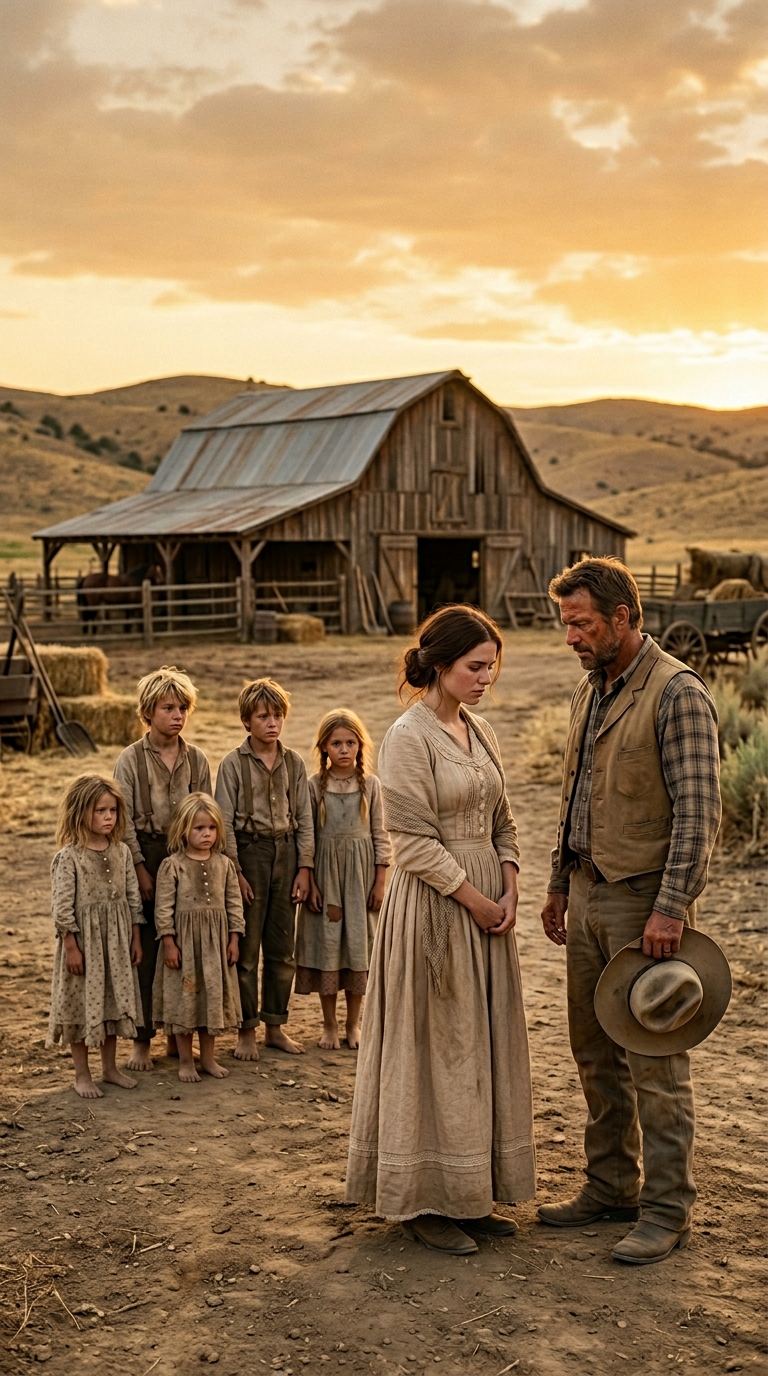
Samuel was the first to hug her. The others followed. Emilia came last—but when she did, she held tight.
And for the first time in many years, Sara Méndez understood that love does not always arrive in the form we expect. Sometimes it doesn’t come as a cradle, or an easy promise, or a perfect destiny. Sometimes it arrives tired, covered in dust, with scars, frightened children, a house on the brink of collapse, and a letter folded too many times.
But it arrives.
And when it truly does, it can turn loss into home, fear into hope, and a woman who believed she was incomplete into the steady heart of an entire family.
