

PART 1
The Whitmore estate had an unusual relationship with silence. It wasn’t the lack of sound that made people uneasy—it was the knowledge that every sound carried weight. The walls didn’t simply contain noise; they seemed to absorb it, retain it, and remember it. Conversations lingered longer than expected. Footsteps felt heavier. Even breathing, if too loud, could feel like an error.
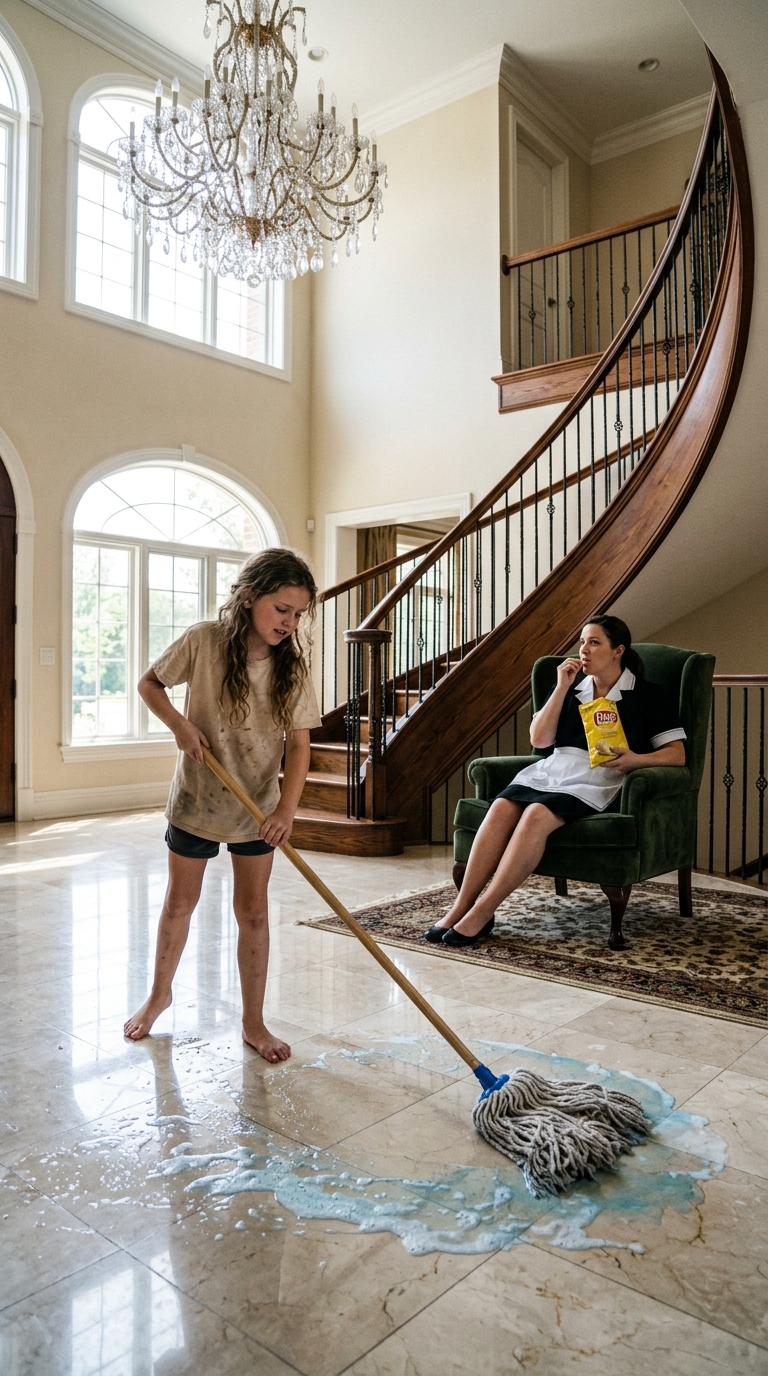
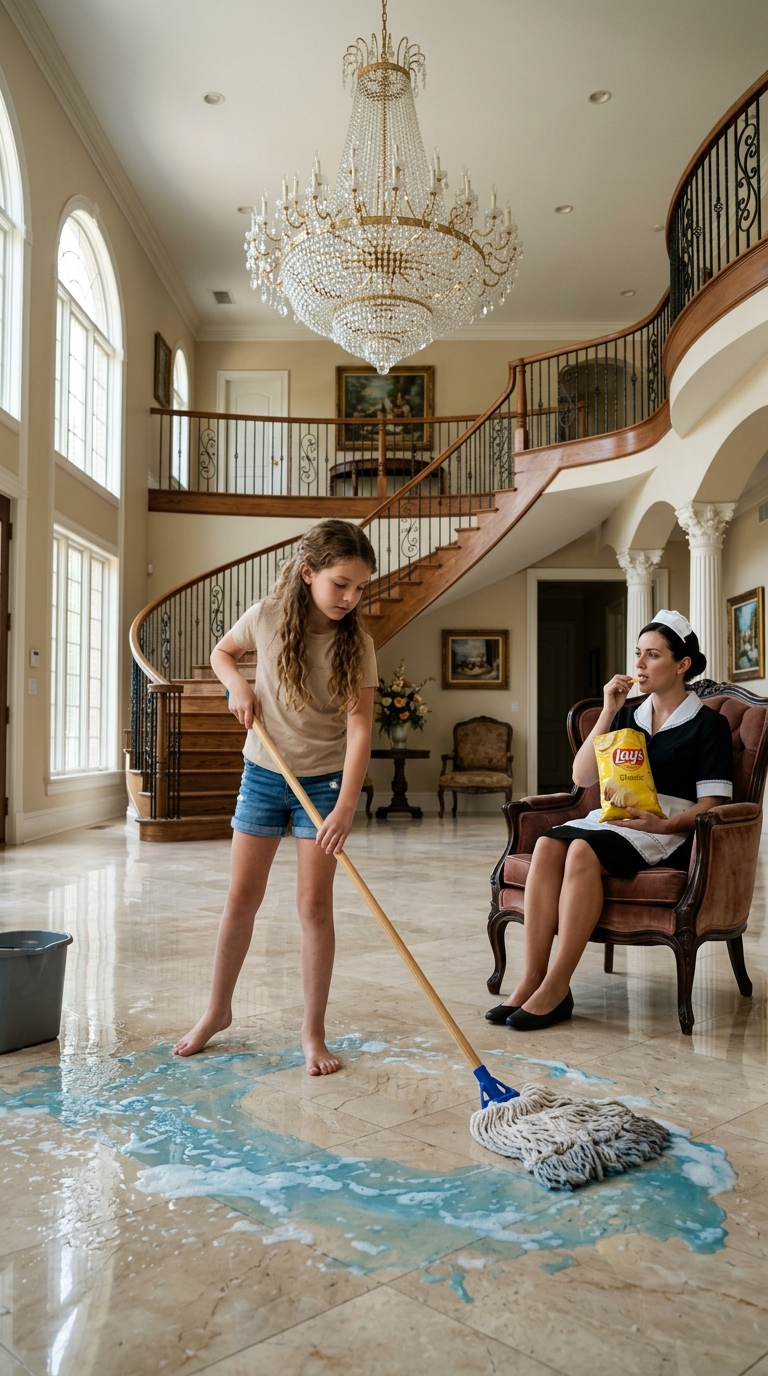
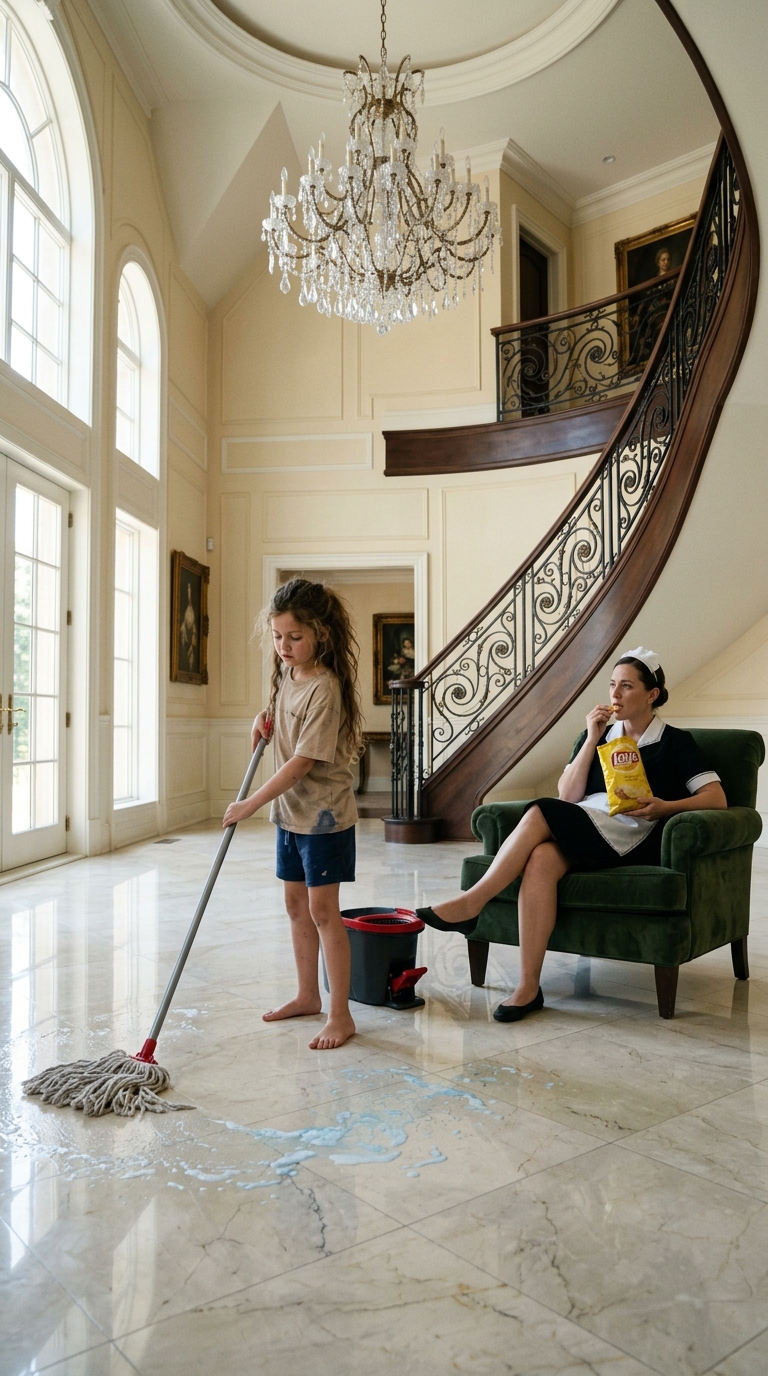
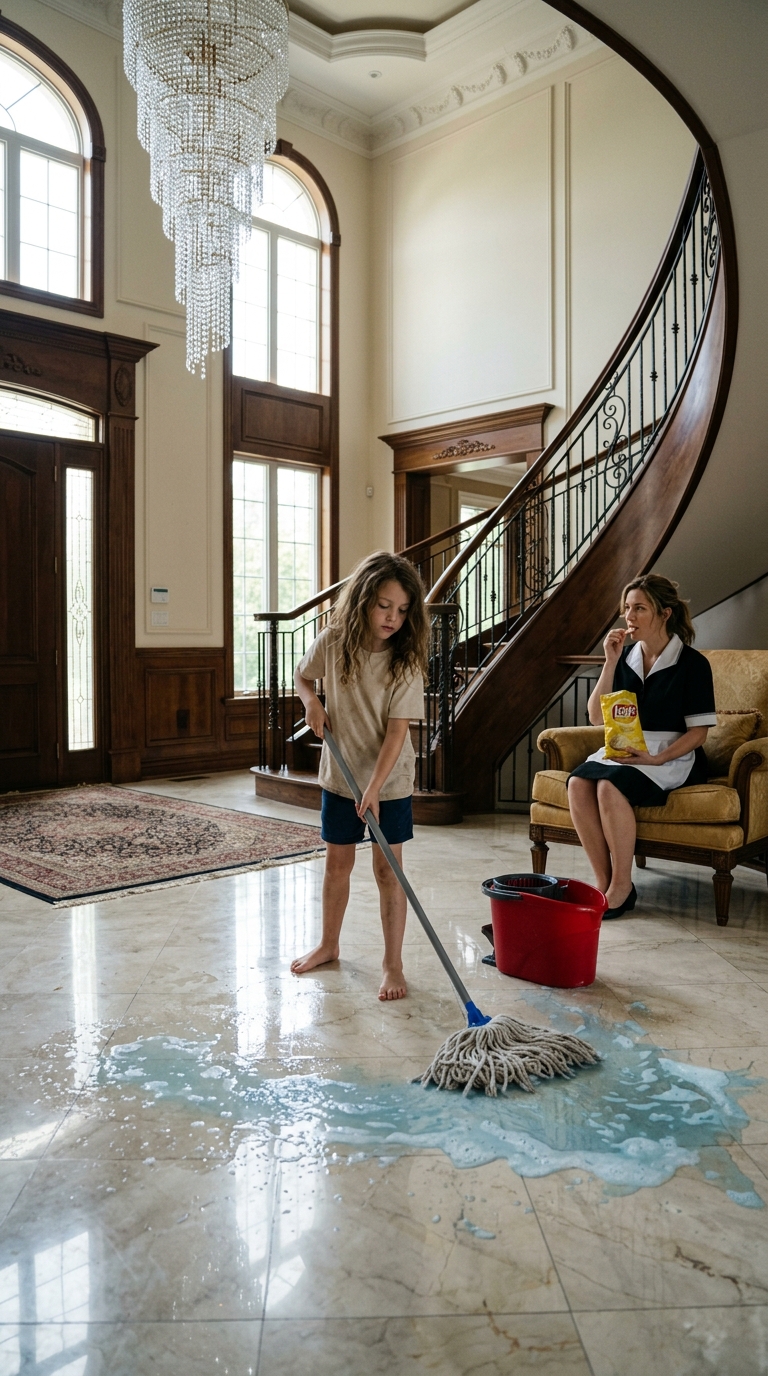
At the center of the mansion stood the grand foyer—a vast, echoing space designed more to impress than to comfort. Pale marble covered the floor, polished so perfectly it reflected light like a motionless body of water. A sweeping staircase curved upward with dramatic elegance, its banister carved with fine detail. Above, a chandelier hung like a frozen cascade of glass, glowing softly even in daylight, as if the house itself refused to grow dim.
Tall arched windows lined the walls, letting warm golden light flood inside and bathe everything in a deceptive calm. A glass table stood near the center, adorned with pristine white lilies arranged so perfectly they appeared untouched by human hands.
It was the kind of place where laughter should have lived. Where a child should have run freely, leaving echoes of joy behind her. Instead, eight-year-old Eliza knelt on the cold marble floor, gripping a mop that felt too large for her small hands, trying desperately not to cry.
Each movement of the mop left a faint streak of water that caught the light, only to vanish seconds later as the surface dried again, spotless as before. It felt pointless. Endless. Like trying to erase something that refused to stay gone.
Behind her, the crinkling sound of a snack bag broke the stillness. Sharp. Casual. Out of place.
On a nearby armchair, Mrs. Dalton reclined comfortably in her uniform, one leg crossed over the other, lazily eating chips as if she were watching entertainment rather than supervising a child.
“Don’t stop until I can see my reflection,” she said, her voice dull with disinterest as she chewed.
Eliza swallowed hard, the burn in her throat thick with unshed tears. She tightened her grip on the mop and continued scrubbing.
She had learned quickly—far more quickly than any child should have to—that grief did not soften everyone. Some people grew gentler in the presence of loss. Others sharpened. Mrs. Dalton had sharpened.
The change had begun subtly, almost imperceptibly, shortly after Mr. Whitmore resumed his business trips. At first, it was small things—meals served cold, doors that were suddenly locked, instructions to stay upstairs when guests arrived. Then came the shift. The tone changed. The rules multiplied. And gradually, without any formal announcement, Eliza stopped being treated like the daughter of the house. She became… something else. An inconvenience. A responsibility. A problem to manage.
Each time Eliza tried to mention it—to say something, anything—Mrs. Dalton would smile, soft and reassuring on the surface, but with something colder beneath.
“He’s busy,” she would say. “Don’t give him a reason to stop coming home.” The message was clear. So Eliza stopped talking. Not because she had nothing to say. But because hope had become something fragile—and dangerous to hold onto.
That morning, she had made a mistake. A small one. She had been carrying a vase filled with fresh water, trying carefully not to spill it as she walked across the foyer. Her hands had been tired. Her grip had slipped. The vase tilted, and water spilled across the marble floor. The glass itself hadn’t even cracked. But that didn’t matter.
Mrs. Dalton had appeared almost instantly, her footsteps sharp, her expression tight with irritation. Without a word, she shoved the mop into Eliza’s hands and struck its handle against the floor so hard the sound rang upward through the staircase.
“Clean it.”
Eliza had lowered her head. Said nothing. And obeyed.
Because that was what she always did.
But as she moved the mop across the floor now, something shifted. Not outside. Inside. Her gaze lifted slowly. Upward. Toward the ceiling.
There, fixed neatly in the corner, was a small white security camera. Its red indicator light blinked steadily—quiet, constant, watching.
Her father had installed them after her mother passed away. He used to joke about them, his voice lighter back then. “When I’m away, these help me feel like I’m still home.” Sometimes, late at night, he would call her. “I saw you spinning in the hallway again,” he’d say, amused. That hadn’t happened in a long time. Months. According to Mrs. Dalton, he had “more important things to think about now.”
Eliza stared at the blinking red light. For a moment, she said nothing. Then, very softly— “My dad watches the cameras when he misses me.”
PART 2
At first, her words seemed too quiet to matter, as though they might dissolve into the air before anyone truly registered them. Yet they lingered, settling into the room in a way that could not be ignored, no matter how much one might want to dismiss them.
Mrs. Dalton’s chewing slowed noticeably, though she did not stop entirely. The casual rhythm she had maintained all morning faltered just enough to reveal a subtle crack in her composure, a small but significant shift that changed the atmosphere of the foyer.
“What did you just say?” she asked, her voice sharper now, stripped of its earlier laziness and edged with something closer to irritation.
Eliza did not respond immediately. Instead, she continued moving the mop across the marble floor, watching as the thin layer of water caught the golden light from the windows before fading once more into the flawless surface. Her hands trembled slightly, but her movements remained controlled, as though she had already committed herself to something she could not take back.
After a moment, she rose slowly to her feet, still holding the mop upright. Her posture straightened in a quiet, almost fragile way, not defiant, but no longer entirely submissive either. A tear slipped down her cheek, tracing a path she did not bother to wipe away.
“He always checks the foyer first,” she said, her voice steady in a way that did not match the tension building inside her.
The words seemed to draw an invisible line through the room.
Mrs. Dalton turned sharply toward the ceiling, her gaze snapping to the small security camera mounted high in the corner. The red indicator light continued its steady rhythm—blinking on and off with mechanical indifference, as it had all morning.
For a brief second, nothing appeared to change. Then, without warning, the blinking stopped. The red light remained on. Solid. Unmoving. Almost watching.
A faint mechanical sound followed, echoing distantly from somewhere deeper within the house. It was subtle, easily missed by someone unfamiliar with it, yet unmistakable to anyone who had heard it before.
Eliza’s heart began to race instantly, the sound thudding in her chest as recognition settled in. She had heard that exact noise countless times in the past, usually late at night or early in the morning, when her father returned home earlier than expected from his travels.
It was the sound of the front security system disengaging.
Mrs. Dalton lowered the chip bag slowly, the crinkling plastic suddenly too loud in the otherwise tightening silence.
“That doesn’t mean anything,” she said quickly, her voice losing its earlier confidence as it strained to regain control of the situation.
But Eliza was no longer looking at her. Her attention had already shifted toward the far end of the foyer, where the massive front doors stood in silent anticipation. They had always seemed imposing, almost distant, like a boundary separating two completely different worlds. For months, they had represented absence—the place where her father disappeared through, leaving behind a house that felt less like a home each day.
Now, for the first time in a long while, they felt like something else entirely. Expectation.
Mrs. Dalton pushed herself up from the armchair, the sudden movement breaking the stillness with a faint scrape against the marble floor.
“Go upstairs,” she ordered, her tone sharp and urgent now, the calm authority she once carried replaced by something far less stable. “Right now.”
Eliza did not move. Her fingers tightened slightly around the mop handle, but her feet remained firmly planted against the cold marble beneath her. For a moment, the two of them stood there in silence, the tension between them stretching thin, as though both understood that whatever was about to happen could not be undone.
Then the door handle moved. The sound was small—almost insignificant under normal circumstances—but in that moment, it cut through the air with startling clarity.
Mrs. Dalton froze completely.
The doors opened slowly, allowing a wave of cooler air to slip into the foyer, carrying with it the faint, unfamiliar scent of the outside world. It felt out of place against the carefully controlled environment of the mansion, like something real entering a space designed to avoid it.
Footsteps followed, steady and unhurried, each one echoing softly across the marble floor as they moved inward.
And then came the voice.
“Why is my daughter holding a mop?”
It was not raised, nor was it filled with immediate anger, yet the calmness within it carried a weight far greater than shouting ever could. The question settled into the room with quiet authority, leaving no space for misinterpretation.
Mrs. Dalton’s breath caught.
Eliza turned slowly toward the entrance.
Standing just beyond the doorway was her father, Adrian Whitmore, still dressed in his dark travel coat, the lines of his journey visible in the fabric. A phone rested in his hand, but his attention was fixed entirely on the scene before him, his gaze moving carefully, deliberately, as though taking in every detail at once.
His eyes traced the room methodically, noting the overturned vase, the scattered chips near the armchair, the damp streaks across the marble floor. Then his gaze settled on Eliza—on her trembling hands, her tear-streaked face, the way she still clung to the mop as though unsure she was allowed to let it go.
Finally, his eyes dropped to her wrist. The mark there was fresh. Faintly red. But impossible to miss.
Something in his expression shifted. Not dramatically, but enough to change the entire atmosphere of the room.
Eliza felt it immediately, even before she fully understood what it meant. It was a change she had been waiting for without realizing she still could.
Her voice, when it came, was smaller now, fragile in a way that betrayed everything she had been holding back for months.
“Dad…”
PART 3
The word lingered between them, fragile and unfinished, as if it carried far more weight than a single syllable should have been able to hold.
Adrian did not respond immediately. Instead, he took a few slow steps forward, his gaze never leaving Eliza. There was no rush in his movement, no outward display of anger, yet the control in the way he walked made the space feel smaller, tighter, as though the room itself was adjusting around him.
From where she stood, Mrs. Dalton seemed to shrink without physically moving. The confidence that had once defined her posture had already begun to unravel, replaced by something brittle and uncertain. She glanced briefly toward the door, then back at Adrian, as if calculating whether there was still time to reshape what he had seen into something harmless.
“Sir, I can explain,” she began, her voice quick, almost rehearsed, as though she had prepared for this moment in theory but never truly believed it would arrive.
Adrian did not look at her. He had reached Eliza now, close enough to see the details he had missed through a screen—the uneven stitching of her worn dress, the faint discoloration of fabric that had been washed too many times without care, the way her hands trembled not just from effort, but from something deeper, something learned.
For a brief second, his attention lingered on the mop still clutched in her fingers, as if the object itself were something he needed to understand before anything else.
Then, without a word, he reached out and gently took it from her.
The movement was slow, deliberate, careful in a way that made it clear he was not simply removing an object, but giving her permission to let go.
The mop handle slipped from her grip almost immediately, as though she had been holding onto it only because she believed she had no choice.
Adrian set it aside.
Only then did he kneel.
The shift in height was small in distance, but immense in meaning. It placed him at her level, not above her, not distant, but present in a way that had been missing for far too long.
Eliza’s breath caught. It had been months since anyone had lowered themselves to look at her like that—not as a problem, not as a responsibility, but as someone worth seeing.
His eyes moved over her face slowly, tracing every detail with a focus that felt almost unbearable in its gentleness. The tear tracks had not yet dried. The exhaustion in her expression was not something a child should have carried.
And then he saw it clearly. The mark on her wrist. Up close, it was worse than it had seemed from a distance. The faint red had deepened into the distinct shape of fingers pressed too hard, too long—a bruise that told its own story without needing explanation.
His jaw tightened.
“Did she do this to you?” he asked softly.
The question was simple, but it carried a gravity that made the room feel as though it were holding its breath.
Eliza tried to speak. For a moment, no sound came out. Everything she had been holding inside—the fear, the confusion, the long, quiet ache of not being believed—rose all at once, pressing against her voice until it broke apart before it could form.
Instead, she nodded. Just once. It was enough.
Adrian closed his eyes briefly, as though absorbing the answer required more than a single moment could hold. When he opened them again, something had changed—not explosively, not visibly to an untrained eye, but in a way that shifted the entire atmosphere around him.
He removed his coat and draped it gently over her shoulders.
The fabric was warm. Familiar.
Eliza clutched it instinctively, her small hands gripping the edges as though it were something solid she could anchor herself to. It still carried the faint scent of him—travel, winter air, and something steady that she had been missing even while living under the same roof.
Behind them, Mrs. Dalton took a step forward, her composure slipping further with each passing second.
“Sir, you’re misunderstanding the situation,” she said, her words coming faster now, layered with urgency. “She’s been difficult lately. She refuses to listen, she breaks things, she—”
“Stop.”
Adrian did not raise his voice. He did not need to. The word cut cleanly through everything she was trying to build, leaving nothing behind.
Mrs. Dalton froze mid-sentence, the rest of her explanation dissolving before it could reach the air.
For a moment, the silence that followed was heavier than anything that had come before.
Adrian rose slowly to his feet, one hand resting lightly but protectively on Eliza’s shoulder, grounding her without needing to hold her in place. When he finally turned to face Mrs. Dalton, his expression had settled into something far colder than anger.
“I watched it,” he said.
The words were quiet. Controlled. But absolute.
Mrs. Dalton’s face drained of color.
“What… what do you mean?” she asked, though the answer had already begun to take shape in her mind.
Adrian lifted his phone slightly, just enough for her to see it.
“I saw you force the mop into her hands,” he continued, his voice steady, each word placed with deliberate clarity. “I saw you knock the flowers aside. I saw you sit down and eat while she cleaned the floor.”
He paused. Not for effect. But because there was more.
“And that was only the last few minutes.”
The weight of the sentence settled heavily between them.
Mrs. Dalton shook her head quickly, panic now visible in every movement. “Sir, I was trying to discipline her. She’s spoiled, she doesn’t understand boundaries, and since—”
Adrian took a single step forward. Not aggressive. Not rushed. But final.
“I also watched yesterday,” he said, his gaze unwavering. “And the day before that.”
The room seemed to tighten around the words.
Behind him, Eliza looked up, her expression shifting from fear to something closer to disbelief. The idea that he had been watching—that he had seen, that he had known—collided with everything she had been told to believe.
Mrs. Dalton’s composure collapsed entirely. For the first time, she looked afraid. Real fear. The kind that comes when explanation is no longer enough. And when silence begins to carry consequences.
PART 4
The weight of his words did not explode into the room. It settled. Slowly. Heavily. Like something that had already passed judgment before anyone could argue against it.
Mrs. Dalton’s lips parted as though she intended to respond, but whatever explanation she had been preparing no longer seemed to fit the moment. Her eyes moved quickly between Adrian’s face and the phone in his hand, searching for a version of reality that still allowed her to speak her way out of what had already been seen.
“Sir, I was only trying to manage her behavior,” she said finally, her voice uneven now, stripped of the composure she had relied on for months. “She’s been… difficult since everything happened. She refuses instructions, she becomes emotional, and I had no choice but to be firm—”
Adrian did not interrupt immediately. He let her speak just long enough for the emptiness of her explanation to reveal itself.
Then he stepped closer. Not abruptly, not aggressively, but with a certainty that made retreat impossible.
“My wife died,” he said, his voice low and controlled, yet carrying a depth that made the statement feel larger than the words themselves. “Which means my daughter needed patience, not punishment.”
He held her gaze, not raising his voice, not breaking his composure, but making it clear that every word he spoke was final.
“You chose humiliation.”
The sentence did not need emphasis. It landed exactly as it was.
Mrs. Dalton’s expression faltered, the last fragments of confidence dissolving into something far less stable. Her shoulders tightened, her posture shrinking as though she were attempting to make herself smaller within a space that no longer allowed it.
Behind Adrian, Eliza shifted slightly, her fingers still gripping the edge of his coat. The warmth of it had not faded, but something else was building beneath it now—something fragile, uncertain, and difficult to hold.
“She told me you didn’t want to see me.”
The words came quietly. So quietly that, for a moment, it felt as though they had slipped out without her permission.
Adrian turned back to her immediately.
Eliza’s eyes were no longer holding back. The tears that had been gathering since morning now fell freely, tracing uneven paths down her face, carrying with them everything she had been forced to keep silent.
“She said you were tired of me,” Eliza continued, her voice trembling but refusing to disappear. “She said if I kept crying when you left, you’d send me away to school… and you wouldn’t come back.”
Each sentence seemed to take something from him. Not visibly, not dramatically, but in a way that made his stillness feel heavier, as though it required effort to remain upright.
For a moment, he said nothing. Then he lowered himself again, kneeling in front of her, bringing himself back to her level as though distance itself had become unacceptable.
“Eliza,” he said, and this time his voice broke—not loudly, but enough to reveal the strain beneath it. “I never said that. Not once.”
She looked at him, searching. Not for comfort. For truth.
Her expression carried something far older than her years—the careful hesitation of someone who had learned that believing too quickly could hurt more than doubting.
“I kept asking why you stopped answering my calls,” Adrian continued, his voice quieter now, as though speaking too loudly might shatter the moment. “Every time I asked, I was told you were asleep, or studying, or spending time with friends. And when I noticed you looked… different on the cameras, I was told you just needed space.”
He paused, swallowing the weight of his own words before finishing. “That you wanted to be alone.”
Eliza shook her head almost immediately. The movement was small, but certain.
“I didn’t want to be alone.”
The simplicity of the sentence broke something far deeper than any accusation could have.
Adrian closed his eyes for a brief second, but this time it wasn’t to steady himself—it was to contain something that threatened to surface too quickly, too forcefully.
When he opened them again, there was no uncertainty left. Only clarity.
Behind them, Mrs. Dalton made one final attempt, her voice rising slightly as desperation replaced calculation.
“She’s misunderstanding everything,” she said quickly. “Children exaggerate, they misinterpret, and she’s been emotionally unstable since—”
“No,” Adrian said.
He stood as he spoke, the movement smooth but decisive, placing himself fully between Eliza and the woman who had controlled her world for months.
“I misunderstood,” he continued, his tone unchanged, but heavier now with the weight of recognition.
The distinction was small. But absolute.
He lifted his phone again, his thumb moving across the screen with practiced precision.
Within seconds, footsteps approached from the hallway beyond the foyer. Not hurried. Not uncertain. Professional.
Two security men appeared at the doorway, their presence immediate and unmistakable.
Mrs. Dalton’s expression shifted again—this time not into defense, but into fear. Real fear.
“Mr. Whitmore, please,” she said, her voice breaking now as she took an involuntary step backward. “There’s no need to escalate this. I can explain, we can resolve this privately—”
Adrian did not look at her.
“Escort her out,” he said, his voice calm in a way that made it far more final than anger ever could. “And contact the authorities.”
The word hung in the air. Authorities.
Mrs. Dalton froze.
“Police?” she whispered, disbelief and panic colliding in her expression.
Now, finally, Adrian looked at her.
“Three months of recorded footage,” he said evenly. “Neglect, intimidation, and physical harm toward a child in my home.”
His gaze did not shift.
“Pray the recordings are kinder than my memory will be.”
The guards moved forward without hesitation.
Mrs. Dalton resisted at first—not violently, but desperately, her hands pulling back as though she could physically undo what was happening.
“This isn’t necessary,” she insisted, her voice rising, unraveling completely. “She’s just a child, she doesn’t understand—”
But the words no longer mattered.
The guards took her by the arms, guiding her toward the exit as her protests dissolved into pleading, then into something less coherent, less controlled.
For a brief moment, she turned back, her eyes searching for something—sympathy, perhaps, or leverage—but Eliza had already stepped closer to Adrian.
That movement said everything. It was small. Instinctive. But unmistakable.
And it hurt him more than anything else. Because it meant she had already learned which adult was safe. And which one was not.
The doors closed behind Mrs. Dalton. The sound echoed softly through the foyer.
And for the first time that day, the silence that followed did not feel oppressive. It felt… clean.

PART 5
The foyer remained still long after the doors had closed. Yet the silence now felt entirely different from before. It no longer carried the suffocating weight of fear or restraint, but something quieter and cleaner, as though a presence that had been pressing against the walls for months had finally been removed.
Adrian did not move immediately. For a moment, he simply stood there, allowing the reality of what had just unfolded to settle into place. The marble floor, the scattered chips, the faint streaks of water—all of it remained exactly as it had been, yet none of it felt the same.
Then he turned. Fully. Toward Eliza.
She looked smaller than he remembered. Not physically—though the oversized coat draped around her shoulders emphasized how slight she was—but in the way exhaustion had settled into her posture, in the way she held herself as though expecting something to go wrong even now.
He lowered himself once more, slowly, carefully, as though approaching something fragile that might break if handled too quickly.
This time, he did not reach for her immediately. Instead, he opened his arms. Not as a command. Not as an assumption. But as an offer. An invitation. One that gave her the choice he had not realized she had been missing.
Eliza stood still for a long second. Her eyes searched his face, not just looking, but measuring—testing the space between what she had been told and what she was seeing now. The hesitation in her expression was not doubt alone; it was the careful instinct of a child who had learned that trust, once misplaced, carried consequences.
Then something shifted. Not dramatically. But enough.
She stepped forward. And then she ran into him.
There was nothing controlled about the movement. It was not graceful, not restrained, not cautious. It was the release of something that had been held too tightly for too long, collapsing all at once into the only place that felt safe enough to hold it.
Adrian caught her immediately, wrapping his arms around her with a force that surprised even himself. He held her close, his hand pressing gently against the back of her head as though to anchor her there, as though letting go would risk losing her again.
Her small frame shook against him. The sound of her crying, once held back and quiet, broke free completely now, filling the foyer in a way no laughter ever had.
“I’m sorry,” he whispered, his voice unsteady for the first time since he had walked through the door. “I’m so sorry I wasn’t here. I’m sorry I didn’t see it sooner.”
The words came without hesitation, without defense, stripped of anything that might soften responsibility.
Eliza clung to him tighter.
“I thought you stopped loving me,” she said, her voice muffled against his coat, each word carrying the weight of months spent believing it.
That broke him. Not outwardly, not in a way that demanded attention, but in a quiet, irreversible way that settled into his expression as he pulled back just enough to look at her.
“Eliza,” he said, his voice lower now, steadier despite the emotion behind it, “I never stopped loving you. Not for a second. Not when I was away, not when I called, not even when I thought you didn’t want to talk to me anymore.”
She searched his face again, but this time there was less hesitation in her gaze. Less distance.
“I should have come home sooner,” he continued, his words measured but deeply felt. “I should have asked more questions, listened more carefully, and trusted what I saw instead of what I was told.”
He paused, then added quietly, “But I am here now.”
The simplicity of the statement carried more weight than anything else he could have said.
Eliza took a small breath, steadying herself, though her fingers still gripped his coat as if she were afraid he might disappear again if she let go.
“Will you stay?” she asked.
The question was soft. But it held everything.
Adrian did not hesitate.
“Yes.”
The answer came immediately, without qualification, without condition, leaving no space for doubt.
He stood, lifting her into his arms as though she belonged there, as though that had always been the place she was meant to be. He carried her away from the center of the foyer, away from the damp marble floor she had been forced to clean, past the abandoned mop, past the scattered remains of a moment that no longer defined her.
As they moved, the golden light from the windows followed them, stretching across the floor in long, quiet patterns. Above, the red indicator light of the security camera continued to glow steadily, capturing everything as it had always done.
But this time, what it recorded was different. Not neglect. Not silence. Not something hidden.
It recorded a father who had returned in time to see the truth. And a daughter who no longer had to stand alone inside it.
And for the first time in months, the house did not feel like a place that listened for mistakes. It felt like a place where something broken had finally begun to be repaired.
