

At the edge of the downtown plaza, where the concrete was worn down by decades of footsteps and early sunlight slipped through unfinished buildings, a boy sat on the steps of a closed courthouse and wondered whether memory could endure hunger, grief, and time all at once.

His name was Miles Benton, and although he was only nine years old, his body carried the stiffness of someone who had spent too many nights on unforgiving ground and learned too early that the world did not pause for sorrow.
Nearly two years had passed since his mother died quietly in a public ward after an illness no one ever explained to him in words he could understand, and after a brief service attended by relatives who disappeared almost immediately, the city kept moving while Miles remained still within it.
Every morning before sunrise, he washed his face at a public fountain, enduring the sting of cold water because it reminded him he was awake and still alive, then folded his thin jacket carefully as if it were something valuable instead of something worn down by time.
He spent his mornings near the small grocery bakery on Franklin Avenue, not because he expected food, but because the scent of bread helped him imagine fullness even as his stomach twisted with hunger.
By midmorning, Estelle Parker, an elderly woman who sold handmade bouquets from a wooden cart, would arrive and greet him with a tired smile that still held warmth.
“You look thinner every day, sweetheart,” she would say while placing a wrapped roll into his hands as if it were routine rather than kindness.
Later, Bernard Klein, who ran a cluttered magazine stand nearby, allowed Miles to sweep the sidewalk and arrange papers in exchange for a sandwich and a few coins, and although nothing was ever formally agreed upon, it became a rhythm that kept the boy alive.
Pedestrians passed without noticing him, or worse, saw him only as a problem, yet within the quiet routines of the square, something like a family slowly formed among those who had little to give except their presence.
Across the city, beyond iron gates and manicured hedges, another morning unfolded in complete contrast.
Franklin Sawyer, once a respected executive whose name carried weight in boardrooms and charity events, sat motionless by the window of a vast home that felt more like a museum than a place meant for living.
An accident three years earlier had taken his wife and left his lower body unresponsive, but what truly hollowed him out was not the paralysis itself, but the sudden loss of everything he believed defined him as a man.
Since that night, ambition had turned brittle, affection had faded into distance, and conversation had become something he avoided whenever possible.
His teenage daughter Tessa Sawyer moved quietly through the house, speaking less with each passing year, while Dolores Finch, who had worked in the household longer than anyone else, absorbed his bitterness with a patience that carried sadness.
Even the company he had built no longer felt like his own, though he sensed something wrong in the numbers and contracts crossing his desk, a quiet decline hidden behind polite smiles.
Despite his suspicions, Franklin lacked the will to care, because grief had already convinced him that effort no longer mattered.
Two lives moved separately through the same city, one shaped by hardship, the other by emptiness, neither aware that a single afternoon would change everything in ways neither believed they deserved.
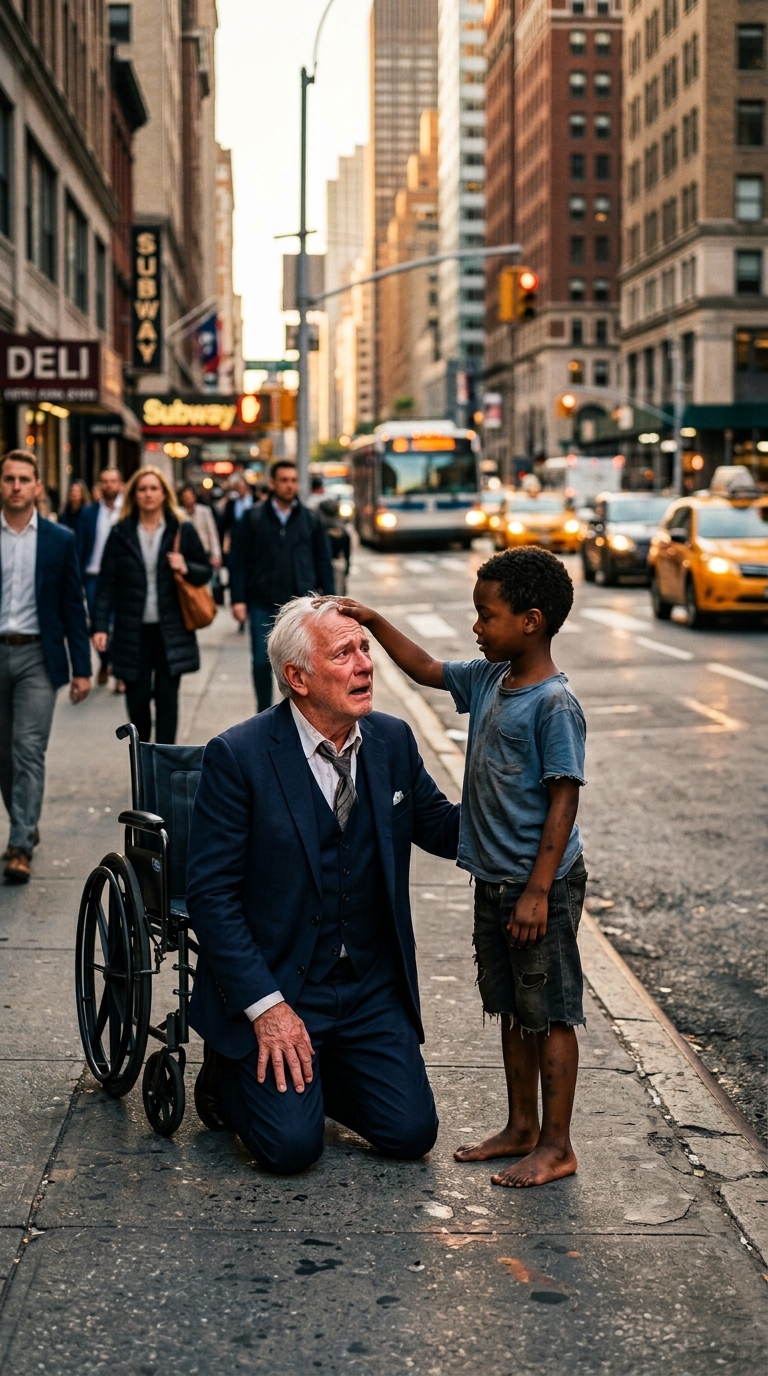
The moment came without warning. On a crowded street near the plaza, Franklin’s wheelchair struck a broken edge of pavement and tipped forward violently, sending his body crashing onto the ground as the metal frame clattered behind him. Pain surged as his head hit the concrete, and warm blood ran along his temple while the noise of traffic swallowed his attempt to call for help.
People stopped, stared, hesitated, then stepped around him, unsure or unwilling to act, until fear tightened his chest more than the injury itself. Miles noticed the commotion while helping an older woman gather spilled groceries, and without hesitation, he ran toward the fallen man and knelt beside him.
“Sir, can you hear me,” the boy asked, his voice shaking but steady.
“Do not touch me,” Franklin snapped instinctively, though the words lacked strength.
Miles ignored the command, removing his jacket and pressing it firmly against the wound with careful hands that carried unexpected warmth. “You are bleeding badly,” he said softly. “Stay still. I am here.”
The pressure slowed the bleeding, but something else happened too, something neither could explain, as Franklin felt a calm spread through him that had nothing to do with physical pain. When paramedics arrived, the wound had already closed enough to leave them puzzled, and Franklin was taken home shaken but alive, unable to forget the boy’s eyes or the strange peace that followed his touch.
That night, lying awake in his silent bedroom, Franklin examined the place where blood had flowed earlier and found only smooth skin, but what unsettled him more was the memory of compassion he had not felt in years.
Tessa knocked softly at his door later, concern clear in her expression.
“Dad, they said you fell. Are you really all right,” she asked.
“I am,” he replied after a pause. “I just do not know why.”
Her words lingered after she left, stirring something he believed grief had buried. The next morning, Franklin insisted on returning to the plaza, offering no explanation, only urgency.
When he arrived, he saw Miles immediately, lifting water containers for Estelle with a smile that seemed untouched by hardship.
Franklin asked the boy to come closer and offered him money in gratitude, but Miles calmly shook his head.
“If I take that,” the boy said, “then helping becomes something else, and I do not want that.”
The refusal unsettled Franklin more than any criticism ever could, because it revealed a sincerity he had forgotten existed. In the days that followed, Franklin quietly learned about Miles through community contacts, discovering the truth of the boy’s life, his loss, his nights under awnings, his quiet determination.
The knowledge weighed heavily on him until one evening when he saw Miles give away his only earnings to an elderly vendor who had lost his goods in an accident.
Something inside Franklin broke open completely. He ordered the car to stop, lowered himself painfully to the pavement, and crawled forward, ignoring the stares, until Miles reached him in alarm.
“I need you,” Franklin said, his voice breaking. “Not your hands. Not your help. I need what you have inside you because I am empty.”
Miles gently placed his hands over Franklin’s chest.
“I do not know how to fix that,” the boy whispered. “But I can stay.”
When Franklin returned home, he spoke honestly to his daughter for the first time in years, admitting his failures and asking for forgiveness, and she responded by holding him as if afraid to let go.
In the weeks that followed, Franklin faced the truth about his company with clarity instead of anger, removing corruption without cruelty and choosing not to add more harm to a world already burdened by it.
But his most important decision came quietly. He founded a center called The Sawyer Haven, not as charity, but as a promise, a place where children without safety could find it without conditions.
When Franklin invited Miles to be the first resident, the boy asked only one question.
“What about the others,” he said.
“They are coming too,” Franklin answered.
The Haven grew into something alive, filled with laughter, learning, and healing, shaped not by miracles of the body but by daily choices to care.
Miles thrived, becoming a guide for others, while Tessa found her own purpose working beside him, and Franklin learned that life does not end when movement does.
Years later, watching children run beneath open skies, Franklin finally understood that kindness is not weakness, and miracles are not sudden, but built slowly through courage, humility, and love chosen again and again.
