

My father was dying, and the only thing standing between him and survival was a number I couldn’t comprehend. The surgery would cost more than I had earned in my entire life, more than my mother’s modest insurance payout after her death, more than the value of our small apartment if I sold it tomorrow. I spent weeks begging—banks, charities, distant relatives who suddenly remembered they had never liked my family much. Each door slammed shut with the same polite finality.
I was twenty-six, working two jobs, and watching the strongest man I had ever known shrink into someone fragile under hospital sheets. The doctors spoke in hushed tones about time running out. Every night I sat beside his bed, holding his hand, promising him I would find a way. I lied because the truth was unbearable.
Then Mr. Elias Hawthorne appeared.
He had been a name in my father’s old stories—a quiet business associate from decades ago, the kind of man who lingered at the edges of conversations rather than dominating them. I remembered my father mentioning him once or twice: “Elias sees more than he says.” Now that man stood in the hospital corridor wearing an immaculate charcoal suit, his silver hair neatly combed, his posture straight despite his age. He must have been in his late sixties, yet something about him felt ageless and unnervingly composed.
He listened as I poured out the story in the sterile waiting room. I didn’t cry; I was beyond tears. I simply laid out the facts—the diagnosis, the cost, the refusal letters. He didn’t interrupt. He didn’t offer sympathy or empty words of encouragement. When I finished, silence stretched between us like a living thing.
“I will cover everything,” he said at last. His voice was low, measured, almost gentle. “The surgery, the hospital bills, rehabilitation—whatever is required. Your father will receive the best care available.”
Hope flared so sharply it hurt. But I had learned that hope always came with conditions.
“And in return?” I asked.
He looked at me directly for the first time. His eyes were a pale, piercing gray.
“You will marry me. You will live in my house. And you will never question what occurs within its walls.”
The proposal was clinical, devoid of romance or even basic affection. No mention of love, companionship, or shared future. Just a transaction. My stomach twisted, but my father’s shallow breathing echoed in my mind. Love, dignity, freedom—they all became meaningless when the alternative was watching someone you love slip away forever.
I said yes before the fear could catch up with me.
There was no ceremony. No white dress, no friends, no photographs. Only two signatures on legal documents in a lawyer’s office and a quiet car ride to a sprawling estate on the outskirts of the city. The house rose against the evening sky like something out of a gothic novel—stone walls covered in ivy, tall windows that reflected the world but revealed nothing inside. When the heavy front door closed behind me, it sounded final.
The first few days passed in a strange, suspended rhythm. Mr. Hawthorne—Elias, as he insisted I call him—was courteous in a distant way. He made sure I had everything I needed: clothes, books, even a small studio room where I could paint if I wished. He asked about my father’s progress each morning over breakfast, nodding with satisfaction at the reports. The surgery had gone well. My father was stable, already showing signs of recovery. For that alone, I felt a crushing gratitude.
But the nights were different.
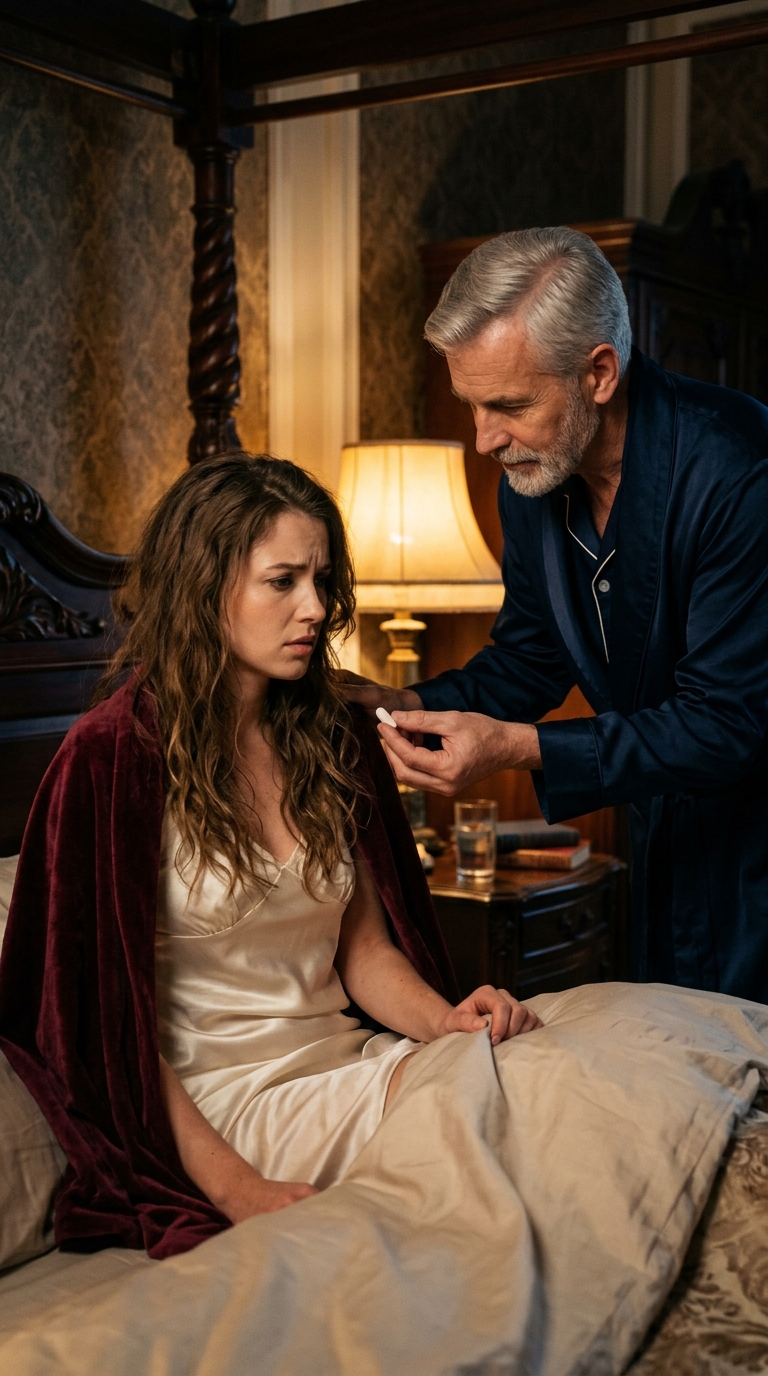
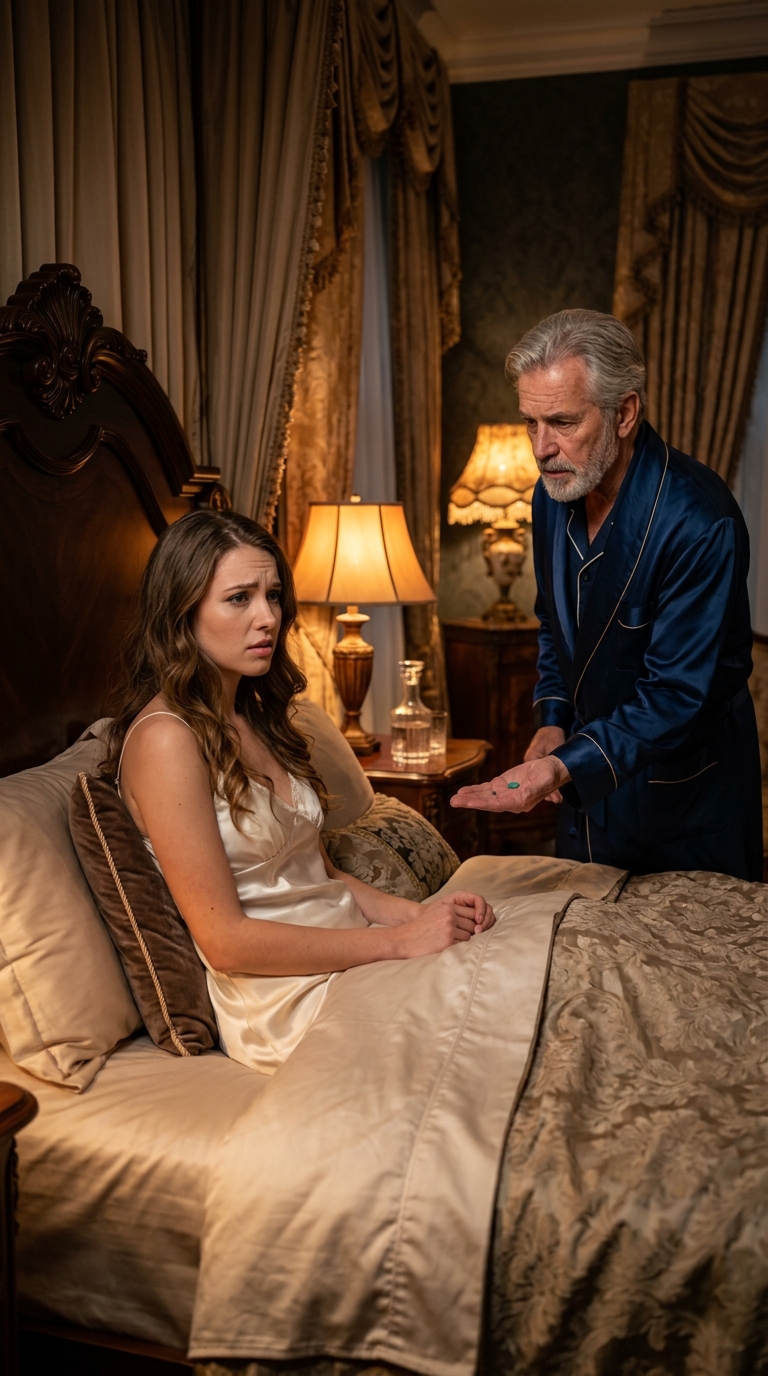
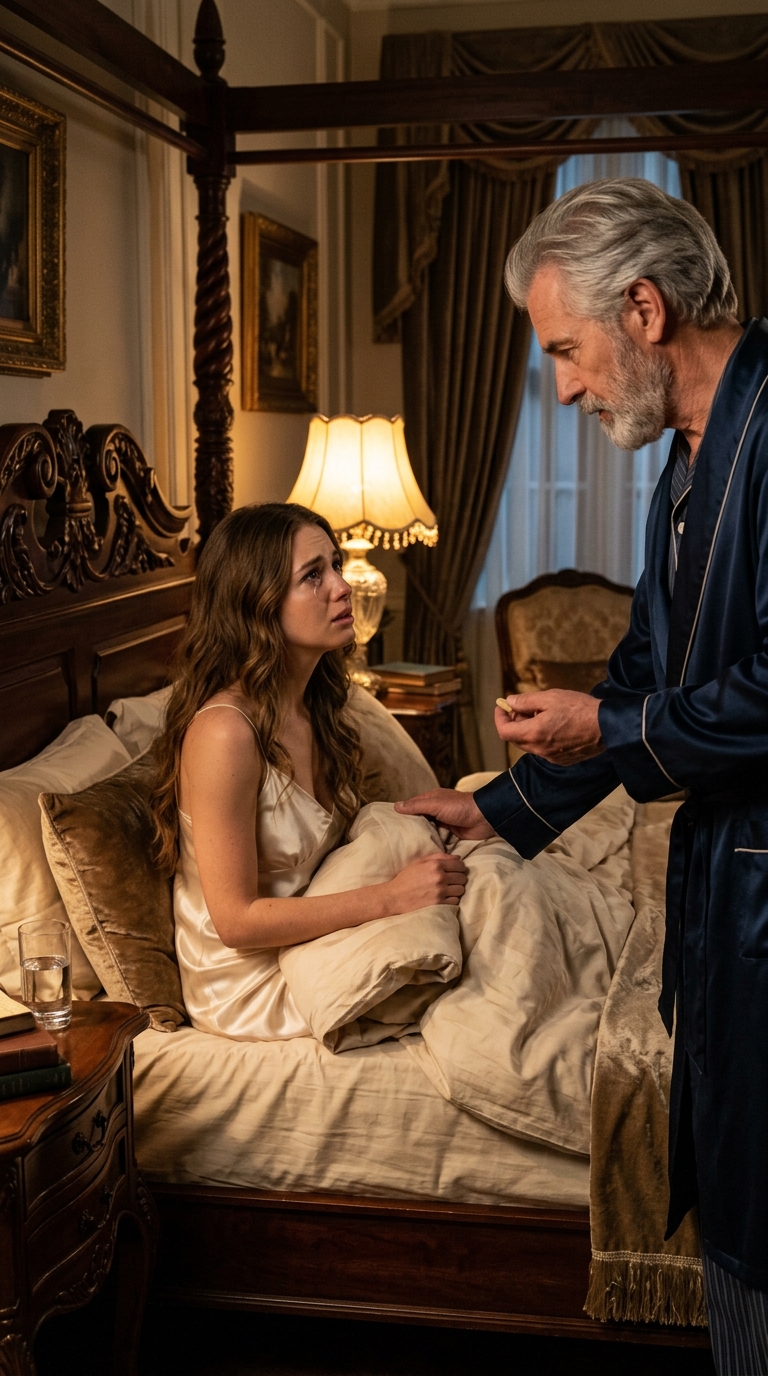
On our first night as husband and wife, I waited in the large bedroom assigned to me, nerves taut. Elias entered well after midnight. He carried a small silver tray with a single white pill and a glass of water. No knock, no preamble.
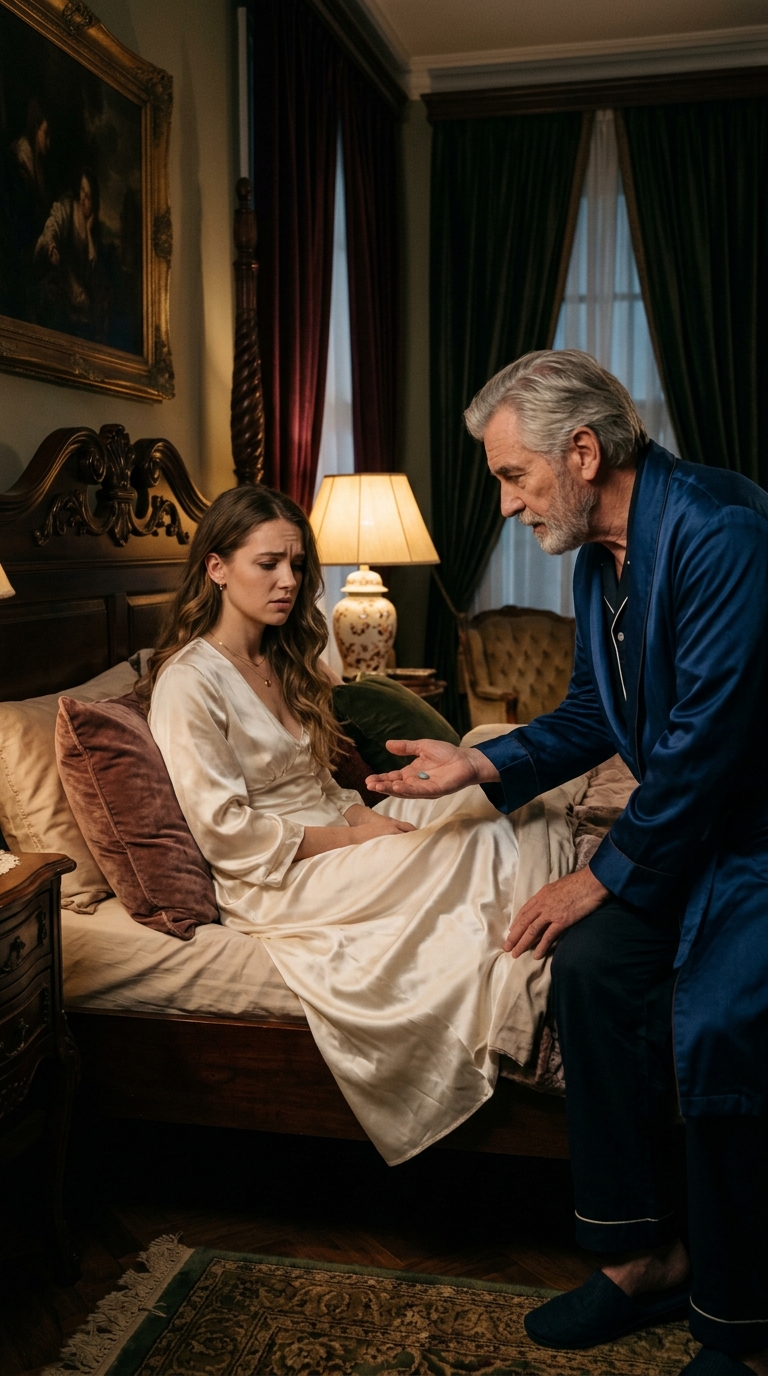
“You need to take this,” he said calmly.
I stared at the pill. “What is it?”
“Your father’s continued treatment depends on your compliance,” he replied. The words were soft, but the implication was steel. “You don’t need to understand. You only need to trust the agreement.”
His voice carried no threat, which somehow made it worse. It was simply inevitable. I took the pill. Within minutes, a heavy, unnatural drowsiness pulled me under. It wasn’t sleep—it was oblivion, like falling through layers of black velvet into nothing. When I woke the next morning, sunlight streamed through the curtains, and I felt strangely hollow, as though pieces of myself had been quietly removed while I wasn’t looking.
The pattern repeated every single night. Elias would appear like a ghost in the doorway, hand me the pill, watch me swallow it, and leave without another word. Mornings brought no memory, only a growing fatigue that no amount of rest could erase. I began noticing small things: faint bruises on my arms that I couldn’t explain, a soreness in my muscles, and worst of all, gaps in time. Entire evenings felt stolen. I would sit down to read at nine o’clock and suddenly it would be morning, with no recollection of closing the book.
My father continued to improve. I visited him twice a week, smiling brightly as he thanked me for whatever miracle I had performed. I never told him the truth. How could I? He was alive. That was supposed to be enough.
But something inside me was fracturing. The unease grew into a constant, whispering dread. I started keeping a secret journal, noting every odd sensation, every lost hour. I tried gentle questions with Elias during the day—about his work, his past, even the house itself. He would answer politely but reveal nothing of substance. His gray eyes always held that same watchful quality, as though he were studying an experiment rather than a wife.
One rainy afternoon, while Elias was away at a meeting, I made my decision. I couldn’t live like this anymore. Not knowing was killing me slowly. With trembling hands, I drove to a small electronics shop in the city and purchased a compact hidden camera. I installed it carefully in the corner of the bedroom, disguised among decorative books on a high shelf. My heart pounded so violently I thought I might faint. If he discovered it, I had no idea what the consequences would be. But ignorance had become a cage tighter than any marriage contract.
That night followed the familiar ritual. Elias brought the pill. I swallowed it under his gaze. The world dissolved.
The next morning, after confirming his car had left the estate, I locked myself in the bathroom, laptop balanced on my knees, and opened the footage. My hands shook so badly I almost dropped the device.
At first, the video showed nothing alarming. I lay still under the covers, breathing deeply. The room was dark and quiet. Minutes ticked by in fast-forward. Then, at 1:47 a.m., the door opened.
Elias entered slowly, deliberately. He wore a dark robe. He didn’t approach immediately. Instead, he stood at the foot of the bed for a long time, simply watching me. The camera captured his face in the dim glow of the nightlight. There was no lust, no violence in his expression—only intense, clinical focus mixed with something softer I couldn’t name.
He moved to the side of the bed and sat down. For nearly twenty minutes, he remained there, motionless, observing every rise and fall of my chest. Then he reached out with surprising gentleness and brushed a strand of hair away from my face. His fingers lingered for a moment on my cheek. The touch wasn’t cruel. If anything, it was tender. Yet it chilled me to the bone because it felt possessive in the most disturbing way—like I was an object he had acquired and was now responsible for maintaining.
He leaned closer, studying my features. His lips moved slightly, as though whispering something I couldn’t hear. He adjusted the blanket around my shoulders with care, then sat back and continued his vigil. The minutes stretched. He checked his watch once, twice. Whatever he was waiting for never visibly happened. Eventually, he stood, gave me one last long look, and left the room as quietly as he had entered.
I watched the footage three times, each viewing deepening the horror. This wasn’t a marriage. It was never about companionship or even simple physical desire. I had agreed to something I didn’t understand, and now I was trapped inside it. The pill wasn’t medicine for my benefit—it was a tool. For what purpose, I still didn’t know, but the not-knowing had become unbearable.
I couldn’t stay another night.
With frantic but silent efficiency, I packed a small bag—only essentials, clothes, my journal, some cash I had secretly saved. I moved through the house like a shadow, every creak of the floorboards sounding like an alarm. The grand rooms that had once impressed me now felt like a luxurious prison. Portraits of ancestors I didn’t know watched me with indifferent eyes. I paused briefly in the library where Elias sometimes read, wondering what secrets those books held, but I didn’t dare linger.
Outside, the afternoon light was gray and heavy. I slipped through the side garden gate, heart hammering, and ran down the long private road until I reached the main street. Only then did I allow myself to breathe. I hailed a taxi and didn’t look back.
In the days that followed, I stayed with an old friend who asked no questions. My father was discharged from the hospital and continued his recovery at a rehabilitation center, unaware of the cost I had paid. I changed my phone number. I avoided anywhere Elias might look. The fear lingered like a shadow, but so did a fierce relief.
I still don’t know exactly what those pills were doing to me. I may never know. Perhaps they were part of some deeper experiment, some obsession of a wealthy, lonely man who collected lives the way others collect art. What I do know is that survival sometimes demands terrible bargains, and courage sometimes means breaking them.
Sometimes the most dangerous thing isn’t the monster you can see. It’s the one you invite into your life because desperation blinds you to the fine print. I escaped with my life, but I left pieces of myself behind in that silent house—pieces I’m still trying to reclaim, one careful day at a time.
And every night when I close my eyes, I wonder if the oblivion will return uninvited, or if I have finally earned the right to dream my own dreams again.
