

Morning light stretched softly across a quiet street in South San Antonio, casting a gentle glow over rows of aging houses standing shoulder to shoulder like silent witnesses to years of perseverance.
The modest homes showed peeling paint, patched fences, and small yards where plastic chairs and stubborn plants reflected lives built on patience rather than luxury.
The air carried the comforting scent of freshly brewed coffee drifting from unseen kitchens, blending with the warmth rising from the pavement.
Near a leaning utility pole, a sandy-colored stray dog named Rusty dozed lazily, its chest rising and falling in calm rhythm, untouched by human worries.
A distant radio hummed faintly from a nearby window, its melody dissolving into the quiet soundtrack of the morning.
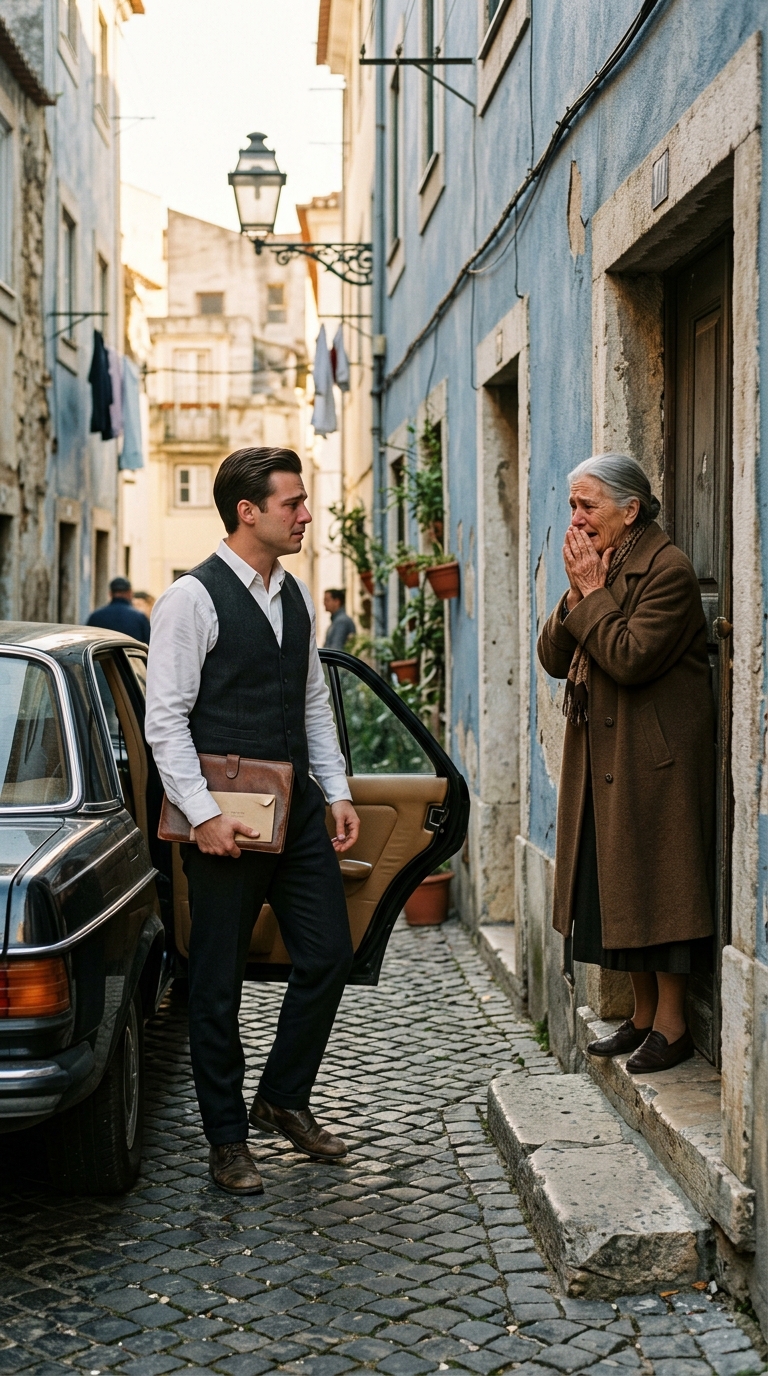
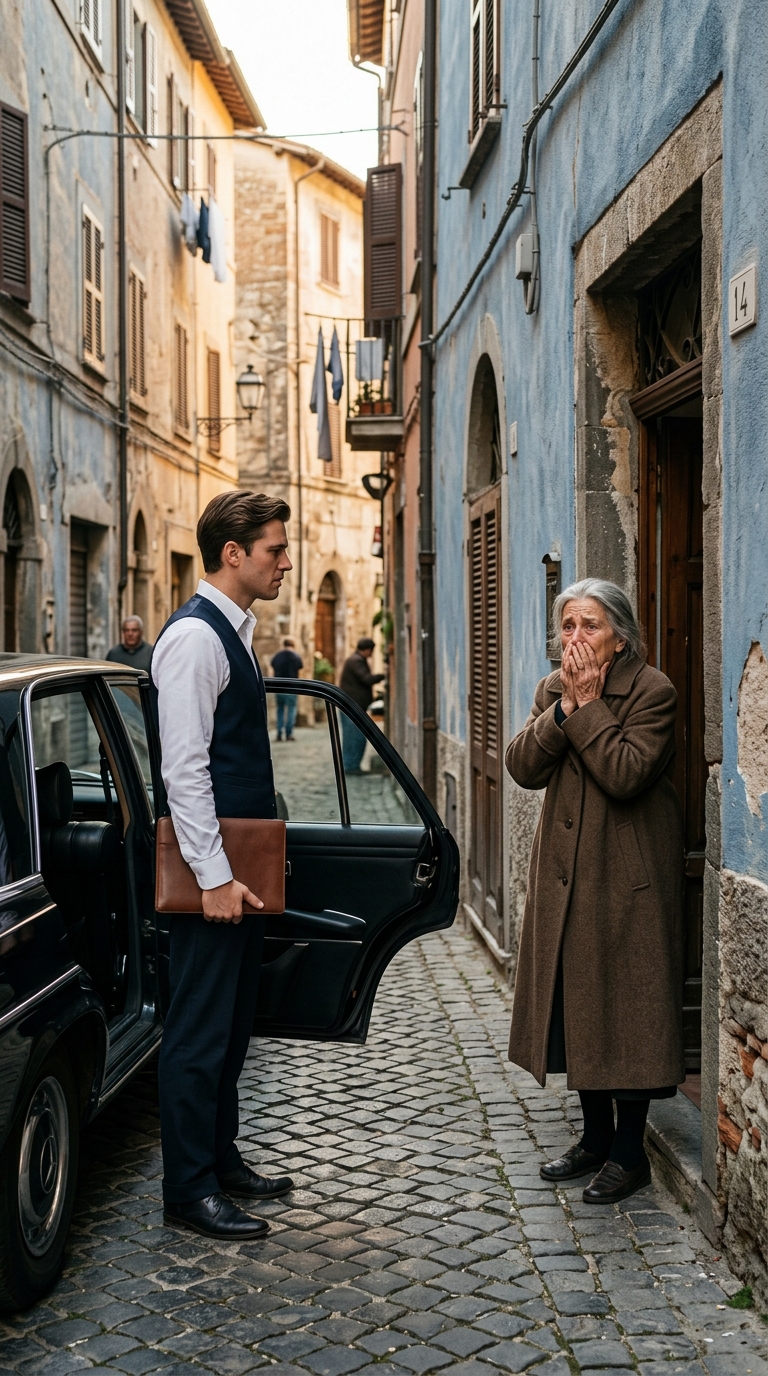
Then a polished black Mercedes-Benz sedan appeared, gliding forward with effortless precision before stopping directly in front of a small stucco house with a weathered screen door and a cracked walkway worn by time.
The car’s flawless surface reflected the sunlight with sharp brilliance, so out of place that several neighbors instinctively paused to watch.
From the vehicle stepped a young man named Benjamin Carter, his movements revealing both discipline and hesitation.
At twenty-six, Benjamin wore a fitted charcoal suit more suited to corporate halls than worn sidewalks. His shoes remained spotless, untouched by the broken street, while his composed posture barely hid the storm of emotion beneath.
In his left hand, Benjamin held a leather portfolio.
In his right, a thick sealed envelope.
He stood still for several seconds, eyes fixed on the modest house before him. His expression carried anticipation, uncertainty, and something deeper that resembled reverence. The street seemed to hold its breath with him, curiosity passing silently from porch to porch.
Finally, Benjamin drew in a slow breath, steadying himself against the weight of memory.
He walked to the door.
His knuckles tapped firmly against the frame.
Inside, slow footsteps approached, each one measured with the fatigue of someone long used to physical labor. The door opened with a soft creak, revealing a woman whose presence radiated quiet strength rather than surprise.
Margaret Doyle stood there, fifty-five, her silver-streaked hair loosely gathered behind her head. Her face carried the marks of time, sun, and countless early mornings spent working demanding shifts. She wore a faded diner uniform stitched with her name, its fabric lightly stained with coffee and grease. Her rough hands rested cautiously against the doorframe.
“Yes?” Margaret asked gently, her voice careful but polite.
Benjamin swallowed.
“Are you Margaret Doyle?” Benjamin asked, steady but fragile.
Margaret nodded slowly, confusion flickering across her tired features as she studied the unfamiliar man. Nothing about him matched her daily reality—not the suit, not the luxury car, not the unmistakable tension of someone carrying unfinished history.
“I believe there may be some misunderstanding,” Margaret said softly.
Benjamin shook his head at once.
“There is no misunderstanding,” Benjamin replied quietly. “I came to settle a debt I have carried for eighteen years.”
Margaret’s brow tightened.
“I think you may have the wrong person,” she said cautiously.
“I do not,” Benjamin answered.
He extended the envelope toward her.
Margaret stepped back instinctively, uncertainty sharpening her expression.
“Sir, I do not know anyone who arrives here in a car like that,” Margaret said politely.
Benjamin’s composure faltered.
“You saved my life when I was eight years old,” Benjamin whispered.
Margaret froze. Memory stirred behind her eyes, searching through years of blurred faces and forgotten moments. Her life had been shaped by survival rather than reflection, by necessity rather than nostalgia.
“May we speak inside?” Benjamin asked quietly, glancing toward neighbors openly watching.
Margaret hesitated, then opened the door. The living room reflected modest care rather than poverty, its simplicity maintained with quiet discipline.
A worn sofa sat neatly beside a small wooden table covered with a floral vinyl cloth. Framed photographs captured birthdays, graduations, and ordinary joys preserved against time. The scent of fresh coffee filled the space, warm and welcoming.
“Please sit,” Margaret said softly.
Benjamin sat carefully, emotion tightening his posture.
“Eighteen years ago,” Benjamin began slowly, “you worked at Riverside Diner near the downtown bus terminal. It was February, and freezing rain had turned the streets into sheets of ice.”
Margaret’s eyes widened slightly.
“Two boys stood outside your window,” Benjamin continued. “We were soaked, shivering, and starving. I was the older one. My younger brother was burning with fever.”
Margaret’s hand trembled faintly.
“The supervisor wanted us gone,” Benjamin said. “He believed we would disturb customers. But you stepped outside without hesitation. You looked at us differently.”
Tears gathered in Margaret’s eyes.
“You did not see inconvenience,” Benjamin whispered. “You saw children.”
Margaret’s breath caught.
“You brought us inside,” Benjamin continued. “You paid for hot soup and sandwiches with your own tips. When you noticed my brother’s condition, you called a taxi despite the storm. You rode with us to St. Matthew’s General Hospital.”
Margaret whispered faintly, “The older boy kept telling him not to fall asleep.”
Benjamin nodded through tears.
“My brother, Samuel Carter, passed away three days later,” Benjamin said quietly. “But I survived. I survived because you refused to turn away.”
Silence filled the room.
“I entered foster care afterward,” Benjamin continued. “I studied relentlessly, driven by a promise formed that night. If I ever achieved stability, I would return.”
Margaret shook her head gently.
“I did nothing extraordinary,” Margaret said softly.
“You did everything,” Benjamin replied.
He opened his portfolio with trembling hands.
“This house is now fully paid,” Benjamin said quietly. “Every remaining balance has been cleared.”
Margaret stared in silence.
“And there is also a trust account established under your name,” Benjamin continued carefully. “Not charity. Gratitude preserved across eighteen years.”
Margaret’s gaze fell on the envelope.
Time seemed to pause.
After a long silence, she accepted it, her hands trembling slightly as she felt its unfamiliar weight. She studied it quietly, absorbing both its material value and the deeper meaning behind it.
Then, with calm dignity, Margaret closed it.
And gently pushed it back.
“I do not want money, Benjamin,” Margaret said softly.
Benjamin stared, stunned.
Margaret continued, her voice steady with lived wisdom.
“Money resolves difficulties,” Margaret said gently. “But it does not ease loneliness.”
Emotion shifted across Benjamin’s face.
“If you truly wish to give something meaningful,” Margaret continued, “give your time. Sit with me. Share coffee. Tell me about your life.”
Emotion overwhelmed Benjamin.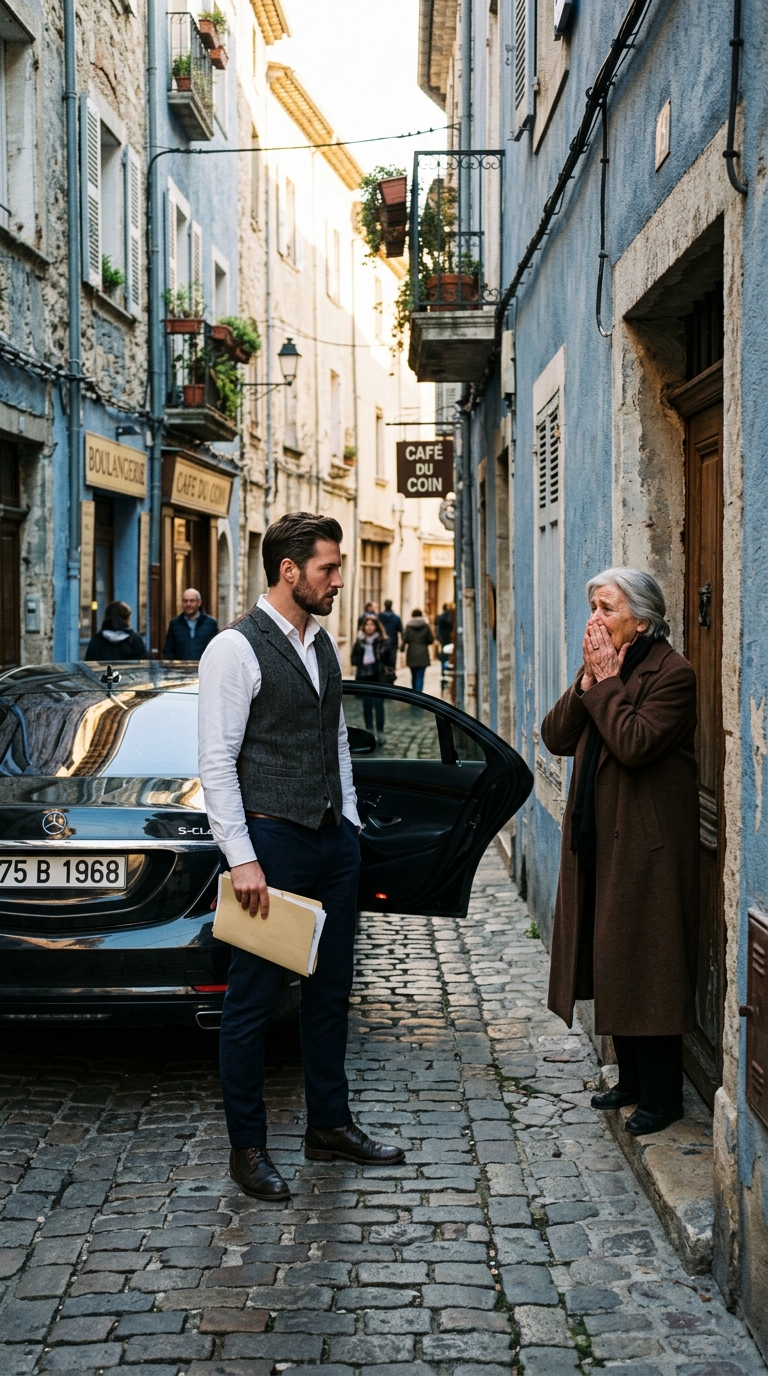
“That is worth more than any financial gift,” Margaret said.
Benjamin smiled through tears.
“I promise, Margaret,” he whispered.
Margaret embraced him quietly.
Outside, the Mercedes-Benz gleamed beneath the Texas sun. Inside, something far more valuable remained—the quiet certainty that kindness, once given without expectation, never truly fades.
