

PART 1
The sun beat down mercilessly on the cobblestone streets of San Ángel in Mexico City, yet Camila, 32, felt her hands ice-cold. She held a bouquet of white orchids in front of the Civil Registry doors, trying to convince herself that the nausea twisting her stomach was simply normal wedding jitters.
Her entire family was ecstatic. According to her mother, Doña Elena, Camila was about to take the most important step of her life with the most sought-after man in the city. Mateo was an impeccable investment banker — charismatic and charming. Ever since they met a year and six months earlier at an exclusive gala in Polanco, her friends and family had not stopped repeating the same refrain: “Lock him down, men like that don’t exist anymore.” However, behind Camila’s practiced smile for the photos, there was a dull unease, a sharp intuition warning her that something wasn’t right.
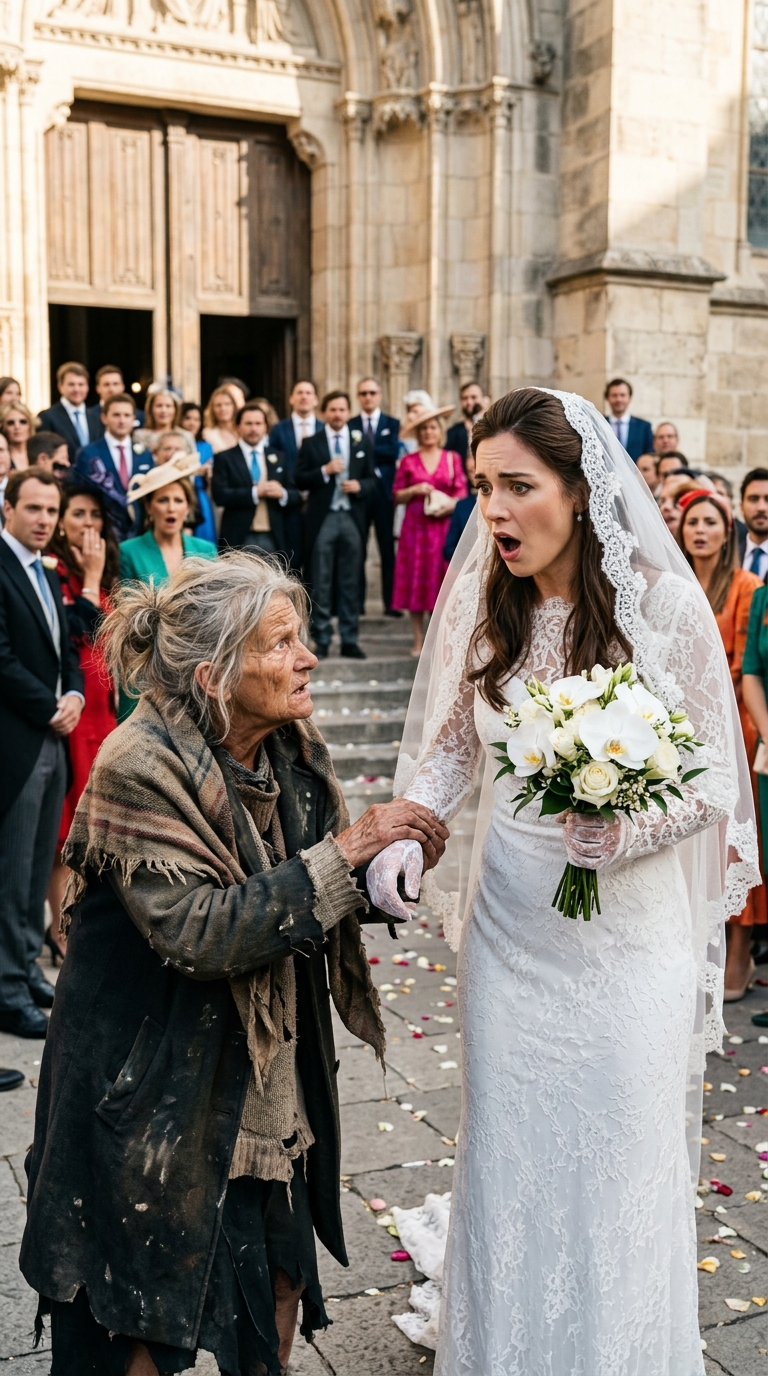
Only fifteen minutes remained until the signing of the marriage certificate. Mateo, who had been strangely quiet throughout the ride in his luxury SUV, stepped away toward the shade of a jacaranda tree to take an urgent call. Camila stayed alone near the entrance. That was when a disheveled woman approached, wearing a frayed coat that didn’t match the afternoon heat and with tangled gray hair.
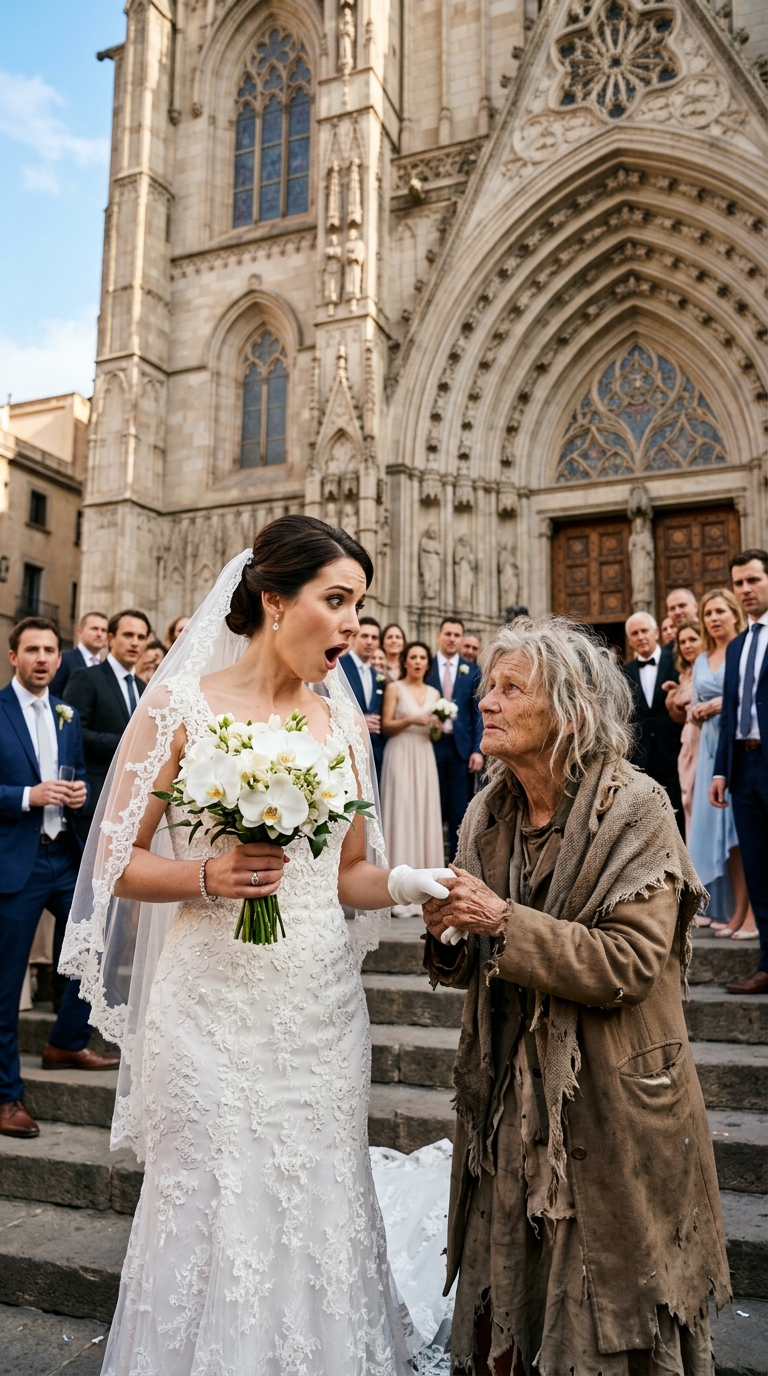
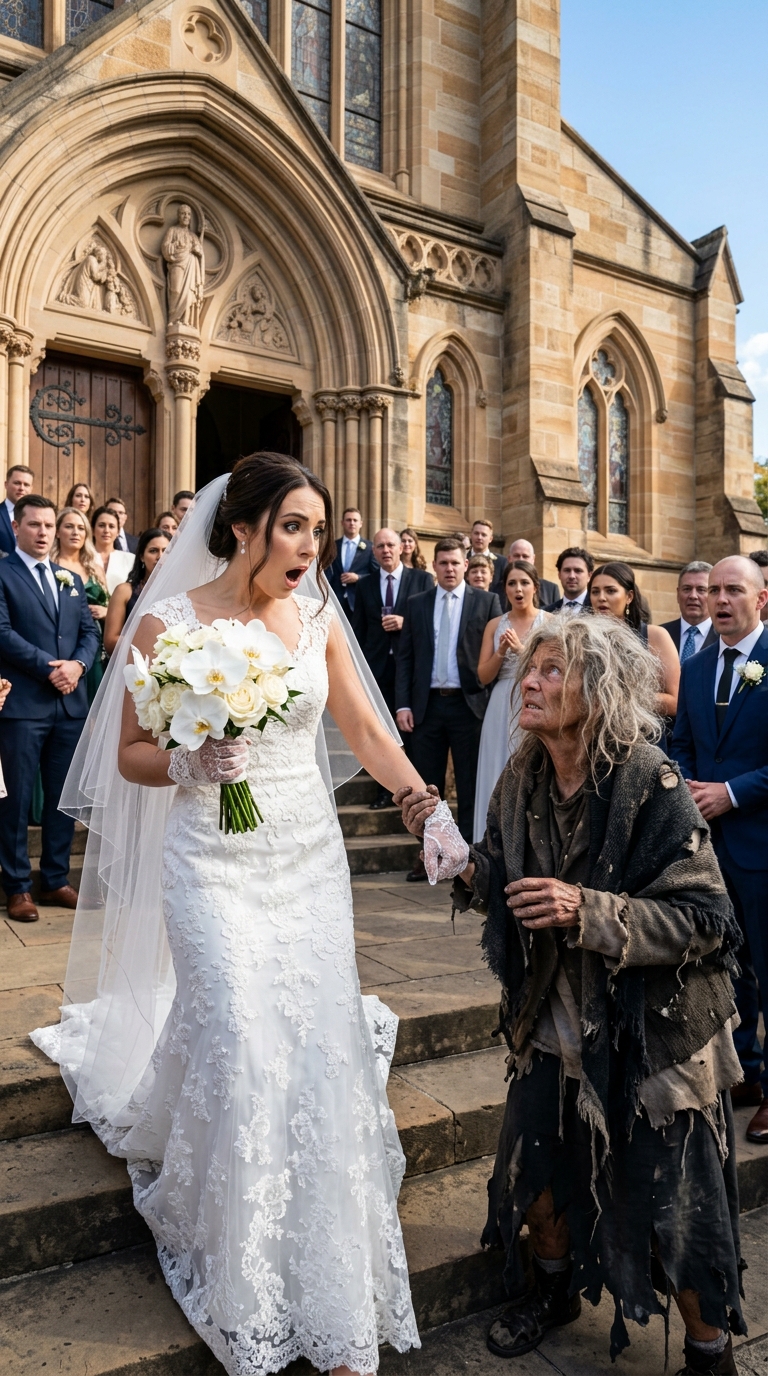
Camila thought she was going to ask for money, but the woman stopped just inches away. Her face was weathered from years of sleeping on the streets, yet her eyes held a terrifying lucidity. Without asking permission, the old woman grabbed Camila’s wrist with surprising strength.
“If you marry that man, you won’t live long,” the woman whispered, her voice raspy but firm.
Camila felt the air leave her lungs.
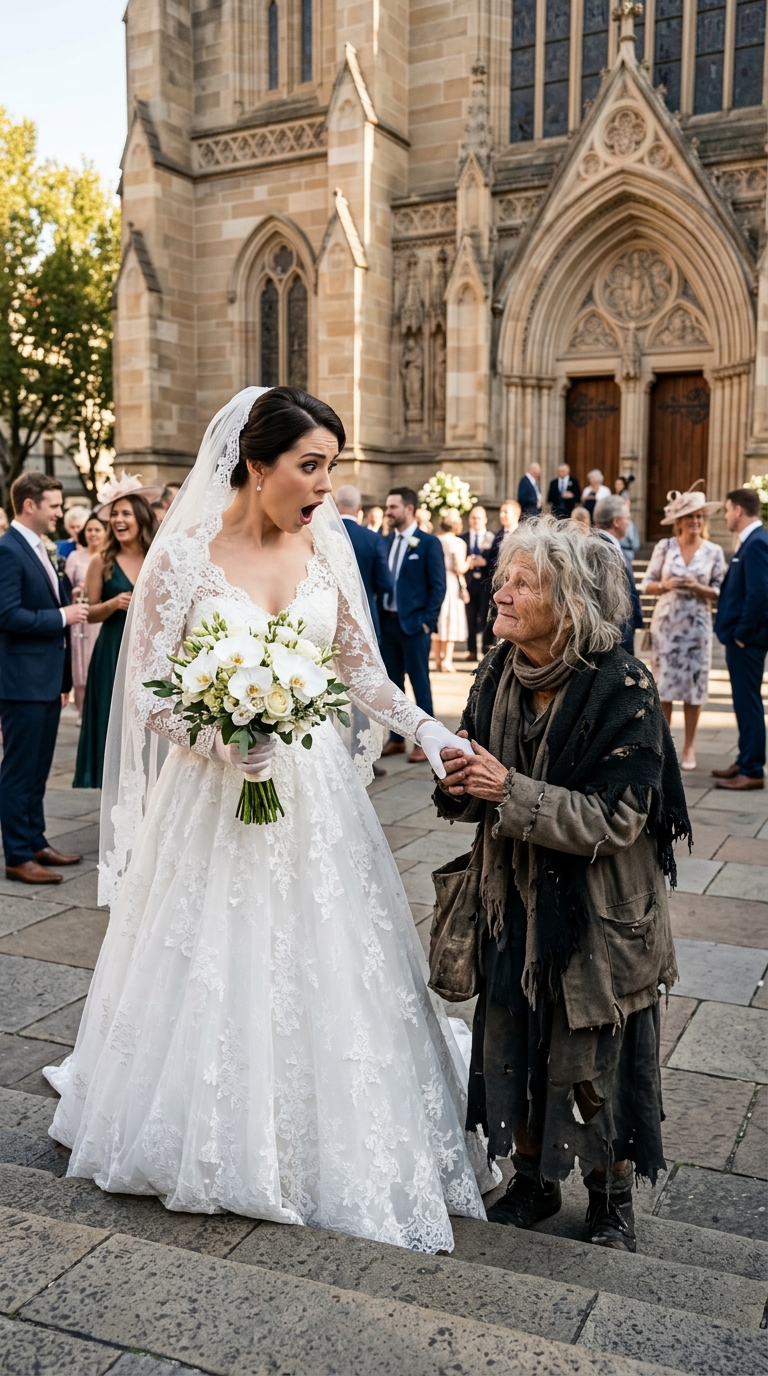
“What are you saying?” she managed to utter, trying to pull away.
“Listen to me carefully, child,” the homeless woman insisted, fixing her gaze on her. “If he puts a paper in front of you to sign today, don’t do it. Tell him tomorrow, tell him later. No matter how much he yells, no matter how much he pressures you in front of everyone. Don’t sign it.”
Before Camila could react, Mateo returned. He didn’t even glance at the woman; he simply took Camila by the arm with excessive pressure and pulled her inside the building.
The ceremony passed as if in a trance. Camila signed the marriage certificate. There was applause, a lavish reception, champagne toasts, and endless hugs. Mateo’s mother, the imposing Doña Leonor, looked at her with that aristocratic, calculating coldness that had always intimidated her. Everything seemed to follow the perfect script of a high-society wedding — until, already in the car on the way to their new apartment in Lomas de Chapultepec, Mateo pulled a leather folder from the glove compartment.
“My love, we just have one small formality left,” he said in a dangerously casual tone. “It’s a patrimonial succession agreement. Pure bureaucracy to protect your assets. Sign it now and we can forget about it and enjoy our night.”
The old woman’s words exploded in Camila’s mind like an alarm.
“I’m not signing anything today, Mateo. I’ll read it calmly tomorrow,” she replied.
The silence that filled the car was deathly. Mateo’s jaw tightened in a way Camila had never seen, transforming his prince-charming face into a mask of contained fury. He didn’t insist, but the atmosphere became suffocating.
Hours later, in the early morning, while Mateo was taking a shower, his phone — left forgotten on the marble kitchen island — lit up. Driven by irrational terror, Camila approached. It was a WhatsApp message.
It read: “So, did the fool sign?”
It was impossible to believe what was about to unfold…
PART 2
Camila stood frozen in front of the kitchen island. The distant sound of water drops from the shower seemed to mark the seconds of a time bomb. The contact in Mateo’s phone was saved as “Lic. Arturo V.,” the lawyer for her husband’s family. Mateo, in his infinite arrogance, never used a password on his phone, always boasting that “he who owes nothing, fears nothing.” With uncontrollably trembling hands, Camila swiped the screen and opened the conversation.
The first message she read left her breathless, but what followed completely shattered her world. She began scrolling back through the chat history, reading messages from three and four weeks earlier.
Arturo: “Is the total transfer clause ready?”
Mateo: “Yes. The key is to secure the Coyoacán mansion and the two plots in Tulum. If those don’t go into the trust, it’s useless to me.”
Arturo: “Does she even understand what she’s going to sign at the wedding today?”
Mateo: “Not at all. She’s blinded. She trusts me completely.”
Camila felt the ground disappear beneath her feet. They were talking about her assets — the inheritance her late father had built over decades of hard work, which she managed so carefully. But greed was not the worst discovery. The true horror appeared when she read the messages from the last five days.
Arturo: “Your mother, Doña Leonor, called me today. She’s hysterical. The casino lenders gave her only three months to pay off the 8 million she owes. If we don’t pay, they’ll seize everything — or something worse.”
Mateo: “Tell my mom to calm down. Without Camila’s signature, if anything happens to her, collecting the life insurance and fighting the succession will be hell. That’s why I need to close this today, right after leaving the registry.”
Arturo: “And what if she gets difficult and doesn’t sign?”
Mateo: “She’ll sign. She always gives in to avoid family scandals.”
Arturo: “Once everything is signed, how long do we wait?”
Mateo: “Two months, maximum. If it happens sooner, the police will be too suspicious.”
Arturo: “What scenario should we set up? Kidnapping? A roadside robbery?”
Mateo: “At home is faster and cleaner. A fall down the stairs or an accidental poisoning. There are fewer security cameras and zero witnesses.”
Camila’s stomach contracted so violently she had to cover her mouth to stifle a scream. She was married to a murderer. He and her mother-in-law — that society woman who paraded through the churches of Polanco every Sunday — had orchestrated a plan to kill her and settle their gambling debts.
She didn’t shed a single tear. Survival instinct numbed the pain and replaced it with pure adrenaline. She took out her own phone and began photographing Mateo’s screen, one by one. She captured more than 40 images, making sure to record dates, names, and details of the mentioned documents. Immediately, she sent all the photos to a secure cloud folder and forwarded the evidence to her friend Mariana, a relentless criminal lawyer.
She left Mateo’s phone exactly where she had found it, down to the millimeter. When he came out of the bathroom, drying his hair with a towel and wearing that magazine-perfect smile that now looked like a demon’s grimace to Camila, he asked:
“Why that face, my love? Aren’t you coming to bed?”
“I’ll be there in a bit,” Camila replied, managing a neutral tone she didn’t know she possessed. “I have a slight headache. I’ll make myself some tea.”
That same early morning, she waited three hours until she was sure he was breathing deeply. She packed a small backpack with her original property deeds, her passport, two bank cards, and her laptop. She left the apartment barefoot so as not to make noise. She only breathed once she was inside her car, driving along the empty Periférico at four in the morning, heading to Mariana’s house.
By nine o’clock that same morning, Camila was already sitting in front of specialized prosecutors at the Mexico City Attorney General’s Office. The process was an ordeal. Mariana warned her they couldn’t go to just any local public prosecutor’s office, as Mateo’s family had the influence and money to make the investigation file disappear in the blink of an eye. They presented the 40 screenshots.
The real hell was the family conflict. When Camila called her mother, Doña Elena, to tell her she had fled and was going to report Mateo, the reaction was devastating.
“You’re crazy, Camila!” her mother screamed over the phone. “It’s just wedding stress! You’re going to ruin our reputation — you’re the laughingstock of the whole family! Leonor just called me crying, saying you abandoned her son.”
Doña Elena didn’t believe her until two days later, when, sitting in Mariana’s office, she saw the printed chat messages and the official forensic report confirming their authenticity. That day, Camila’s mother fainted from shock and ended up in the emergency room.
Mateo tried everything. First he bombarded her with messages playing the lovesick victim. When he got no response, he turned to rage, threatening to sue her for defamation. But his act collapsed on the following Thursday afternoon when six investigators burst into his financial office in Reforma. They led him out in handcuffs in front of all his partners. Arturo, the lawyer, was arrested two hours later in a Lomas de Chapultepec restaurant. Doña Leonor did not go to prison due to lack of direct evidence linking her to the murder plot, but the scandal destroyed her social status and her creditors eventually seized all her properties.
The trial dragged on for fourteen grueling months. Camila had to endure her mother-in-law’s hate-filled stare at every hearing. However, the evidence was overwhelming. A judge sentenced Mateo to 12 years in prison for the crime of premeditated attempted femicide and fraud. Arturo received 7 years after accepting a deal to testify against Mateo.
The divorce was finalized while he was already wearing the standard prison uniform.
But for Camila, the real closure of this nightmare did not happen in a courtroom. It happened three weeks after the sentencing, when she returned to the San Ángel plaza to find the woman who had saved her life. It took her four days to locate her. Doña Carmen, as she was told the woman was called, was sitting outside a bakery eating a piece of hard bread roll.
Camila knelt in front of her, eyes full of tears, and thanked her. She asked if she had any gift, if she was clairvoyant or could read auras.
The old woman let out a small, sad laugh and squeezed her hands.
“I don’t read the future, girl. I don’t read palms either,” Doña Carmen confessed, looking at her with deep empathy. “What I saw was that man’s look when you denied him attention for a second, the way he grabbed your arm to force you inside. That same look, that same hidden rage behind an elegant suit — my husband had it thirty years ago. He also had a perfect face for the world and another one to beat me senseless. He took everything from me, even my sanity. I can spot a monster from a mile away.”
Camila then understood the magnitude of what she had lived through. She rented a small, safe room for Doña Carmen, bought her clothes, and arranged medical care, forging an unbreakable bond between two survivors from different generations and worlds.
Camila’s story spread like wildfire. The case became a brutal and necessary reminder in a society that often values appearances and “what people will say” more than the safety of its women.
Camila’s final message was clear and powerful: Sometimes danger does not hide in a dark alley at midnight. Sometimes the monster walks through the front door, perfumed, with a perfect smile, a diamond ring, and the approval of your entire family. And often, the only person capable of seeing the truth is the one society has chosen to make completely invisible. Never doubt that knot in your stomach; intuition is not fear — it is your instinct screaming at you to run for your life.
