


In the pristine, engineered silence of the Blackwood estate high above Aspen, Colorado, every detail existed by design. Adrian Blackwood had built his mountain mansion the same way he had built his tech empire: with absolute control. Marble floors stretched like sheets of ice underfoot. Floor-to-ceiling glass walls framed the jagged Rockies but kept the wild mountain wind firmly outside. No clutter, no fingerprints, no surprises. The air itself seemed filtered, cooled, and hushed.
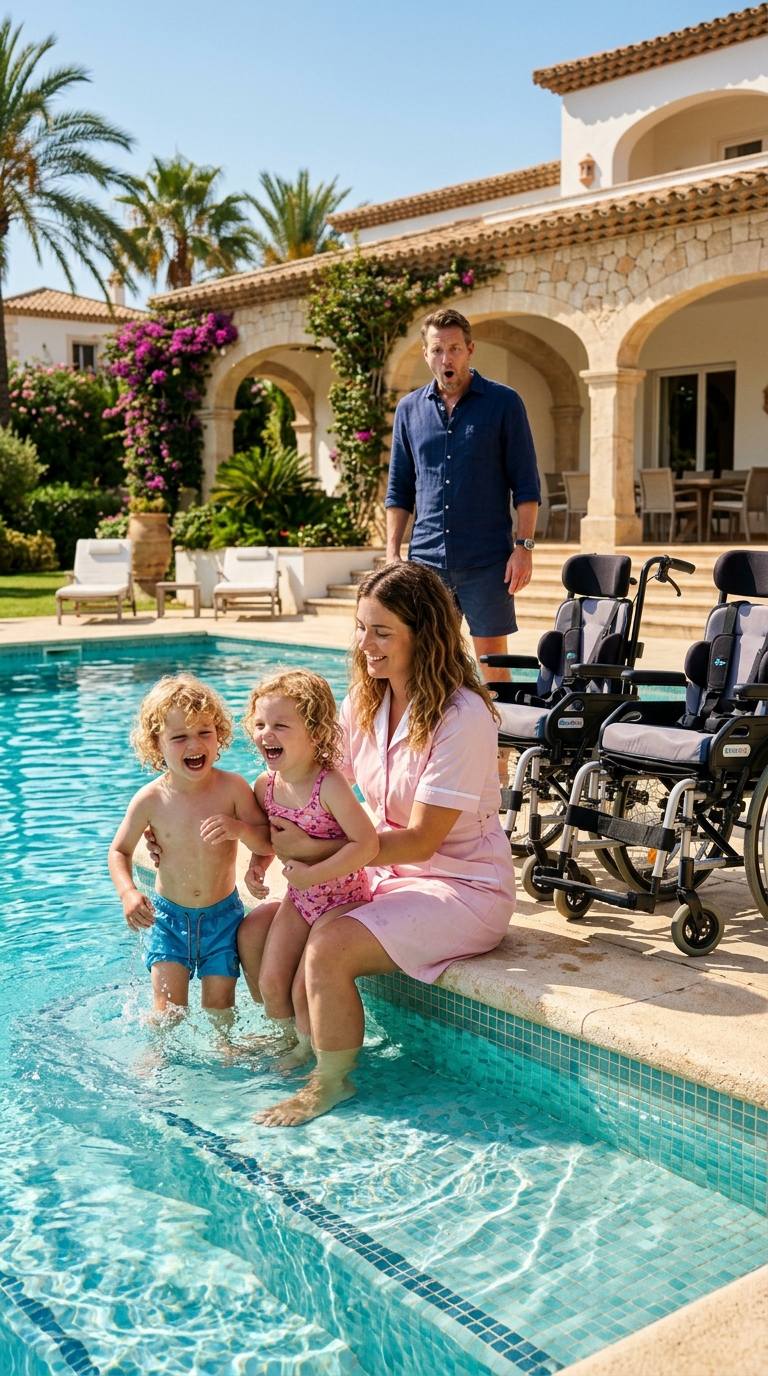
At the heart of this flawless fortress lived four-year-old twins, Clara and Owen. They sat side by side in custom-built mobility chairs, small hands resting on padded armrests, their faces solemn and watchful. The doctors called their condition “complex neurological impairment.” Teams of specialists had flown in from Boston, Geneva, and Singapore. Therapists filled thick reports with cautious language and incremental goals. Yet one devastating truth remained unchanged: Clara had never laughed. Not once in her short life. Owen’s rare smiles were faint and fleeting, like sunlight glimpsed through heavy clouds.
After losing his wife, Elena, in a horrific car accident two years earlier, Adrian had turned control into his only religion. Noise felt like danger. Chaos felt like the moment the phone call came that changed everything. So he eliminated both. The house ran on strict schedules. Toys were stored behind glass cabinets. Voices rarely rose above a murmur. The twins’ every need was anticipated and met with clinical precision.
What Adrian could not see was that his fierce protection had begun to feel like suffocation.
Only Isabel noticed.
Isabel Morales had worked as the Blackwood housekeeper for three years. She moved through the vast rooms like a quiet shadow—efficient, observant, nearly invisible to Adrian. But she saw everything. She noticed how Clara’s fingers tightened on her armrest whenever her father entered with another rigid instruction. She watched Owen press his forehead to the cool glass, staring at birds riding the mountain thermals with open longing. She saw two small children starving not for food, but for freedom.
And then there was the indoor pool.
To Adrian, it was a calculated risk, kept heated to precisely 88 degrees, surrounded by non-slip tiles and emergency alarms. To the twins, it was the only place in the mansion that refused to obey rules. Water moved. It shimmered. It reflected light in wild, dancing patterns.
One heavy afternoon in late summer, with thunderheads gathering over the peaks, Adrian left for a board meeting in Denver. The air felt thick, electric. Isabel looked at the twins—so pale against the dark leather of their chairs—and something deep inside her finally gave way.
She knelt between them, her voice soft. “Water doesn’t care if you’re perfect, mis niños. It just holds you.”
Before doubt could stop her, she lifted Owen into her arms. He tensed as she stepped into the shallow end, but he did not cry. The warm water rose around his legs, then his waist. His eyes widened. For the first time, his body was not strapped into plastic and metal. He floated, supported by Isabel’s steady strength.
A single splash.
Then another.
A sharp, bubbling sound burst from Owen’s throat—raw, startled, and unmistakably laughter.
Clara’s eyes flew open. Isabel brought her in next, cradling both children as they bobbed gently. Clara’s thin legs kicked once, twice. Then came her own raspy, delighted giggle, like the first crack in winter ice.
The sterile silence of the Blackwood mansion shattered in that moment. Water flew in bright arcs. Laughter echoed off the glass ceiling—beautiful, chaotic, alive. The twins’ limbs moved with a clumsy joy they had never shown on land. Isabel laughed with them, tears mixing with pool water on her cheeks.
The front doors slammed open.
Adrian stood in the entryway, briefcase still in hand, tie loosened from the mountain drive. He had returned early because the storm threatened to close the pass. What he saw froze him where he stood.
Empty chairs at the pool’s edge.
Water splashing wildly.
His fragile children—laughing.
His briefcase slipped from numb fingers and clattered across the marble. For one terrifying second, he was certain they were drowning. Then the truth hit him harder than any fear: they were not drowning. They were gloriously, messily alive.
“Dad!” Owen called, his voice bright with an excitement Adrian had never heard.
Adrian’s chest tightened so sharply he thought his ribs might crack. The perfectly controlled world he had built could not process the scene before him. He walked to the edge of the pool, shoes still on, and stared at Isabel.

She met his gaze without flinching. “They’re safe, Mr. Blackwood. They’re happy.”
That night, after the twins were dried, changed, and tucked into bed still buzzing with new sensations, Adrian sat alone in his glass-walled study. The storm raged outside, but inside, something quieter had broken open. He replayed the sound of their laughter on the security footage again and again. Each time, the knot in his chest loosened a fraction.
The weeks that followed were uncomfortable but necessary. Adrian began joining Isabel at the pool. At first he only watched, arms crossed. Then he rolled up his sleeves and stepped into the water. He learned how to support Clara’s head when she floated on her back. He felt Owen’s small body relax completely for the first time. Therapists were brought in to design water-based programs. The rigid schedule gained small pockets of unstructured play.
One evening, as golden light poured through the western windows, Clara looked up at her father and laughed—clear, ringing, unafraid. Adrian closed his eyes and let the sound wash over him like water. He understood, finally, that safety was not silence. It was the courage to let life move.
Miles away, in the sun-drenched hills of Beverly Hills, another mansion told a different kind of story.
Nine-year-old Sophie Bennett trembled in the corner of her bedroom, clutching her six-year-old brother Noah. Their stepmother, Candace, loomed over them, her perfectly manicured hand raised.
“Please,” Sophie whispered, voice cracking. “Don’t hurt us.”
Candace’s voice was ice. “Your father spoils you both. But he won’t always be here to protect you.”
The front door burst open downstairs.
Daniel Bennett, still in his tailored suit from a long day at his tech company, had come home early to surprise his children. He froze at the top of the stairs, taking in the scene.
“What the hell is happening?” His voice thundered through the house.
Sophie broke away and ran to him, burying her face in his chest. Noah followed, sobbing. “She was going to hit us again, Dad.”
Candace’s expression shifted instantly into wounded innocence. “They’re exaggerating, darling. I was simply disciplining them. You know how dramatic they can be since their mother—”
Daniel saw the truth in his children’s eyes. The fear was real. Bone-deep. For months he had dismissed the small signs—the way Sophie flinched when Candace entered a room, the way Noah had grown quieter, the unexplained bruises explained away as playground accidents. He had wanted so badly to believe that his second marriage would bring stability after losing his first wife to cancer.

Now the illusion lay shattered at his feet.
“Go upstairs,” he told his children gently. “I’ll handle this.”
Once they were safe, Daniel turned to Candace with a coldness he had never shown her before. “I ignored too many warnings. But I will never ignore my children being terrified in their own home.”
The divorce was brutal and public. Candace hired a shark of an attorney and tried to paint herself as the victim of spoiled, alienated children. She gave interviews hinting at Daniel’s “controlling nature.” But the evidence mounted. The nanny, Mrs. Delgado, provided a sworn statement detailing months of verbal abuse. A child psychologist documented emotional manipulation. Sophie’s drawings—bright family scenes with Candace violently crossed out in black crayon—were entered into evidence.
In court, Candace’s mask slipped. She snapped at the judge. That was enough.
The gavel fell. Daniel received full custody. Candace was granted a substantial settlement but no unsupervised contact with the children until she completed extensive therapy and evaluation.
On the drive home from the courthouse, Sophie squeezed her father’s hand. “She can’t hurt us anymore?”
Daniel pulled the car over, turned to both children, and spoke with fierce tenderness. “No, sweetheart. She can’t. And I’m sorry I didn’t see it sooner.”
Life in the Bennett house slowly brightened. Daniel reduced his travel schedule dramatically. He learned to cook simple dinners, helped with homework, and sat through endless animated movies. Laughter returned—tentative at first, then full-throated and frequent. Noah started sleeping through the night. Sophie began drawing pictures again, this time with everyone smiling inside the same bright yellow sun.
One quiet evening on the terrace, watching the sunset paint the hills in rose and gold, Noah leaned against his father’s side and whispered, “It feels safe again.”
Daniel closed his eyes, holding both children close. He thought of Adrian Blackwood, a man he had met once at a charity gala, and the story he had heard about a pool in Aspen that changed everything. Two very different fathers. Two very different mansions. The same hard lesson.
Protection was never about control or perfection. It was about presence. About showing up, even when it was messy. About choosing love over fear every single day.
Far apart, in Colorado snow and California sun, two families had learned the same truth: sometimes the most important sounds in a home are the ones that break the silence—laughter rising from water, small voices finally unafraid, and the steady heartbeat of a parent who chooses to listen.
