

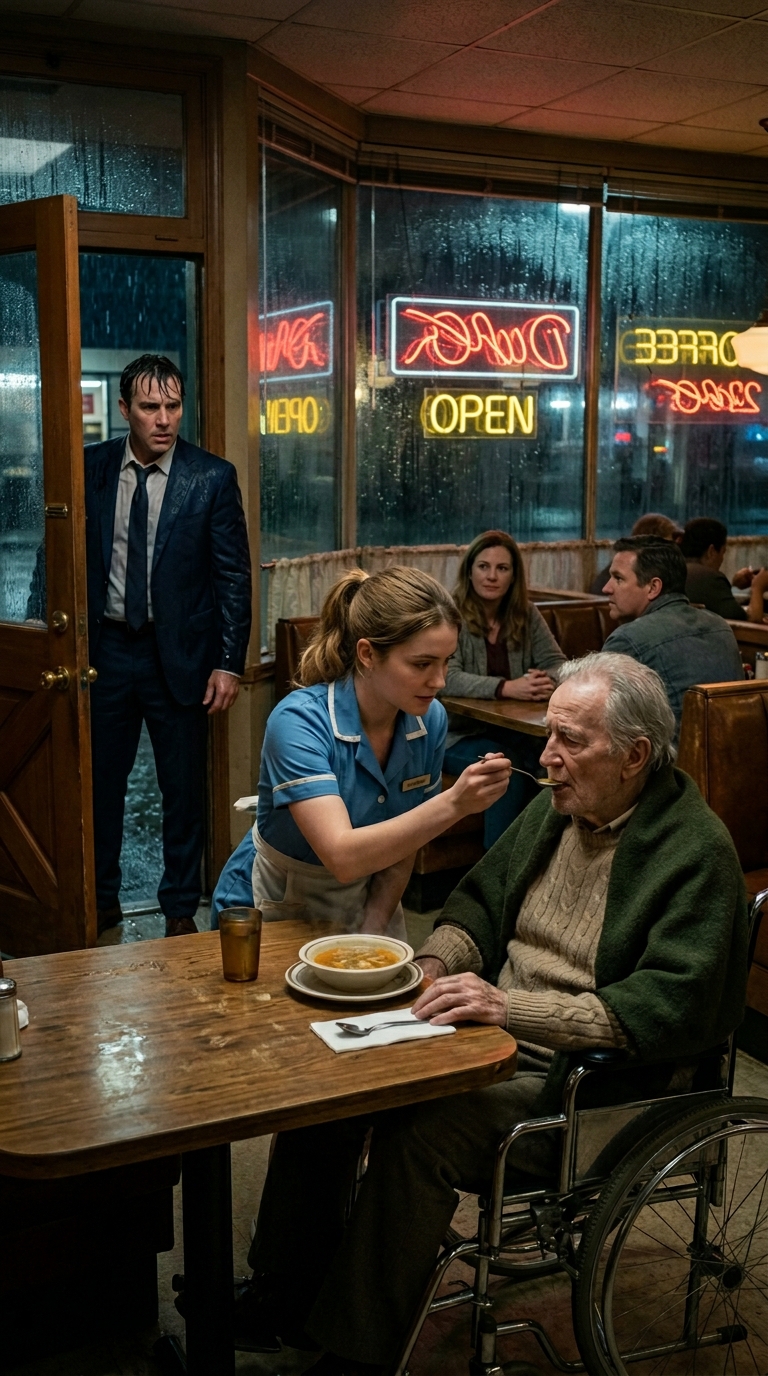
The storm did not come quietly. It arrived like the sky had been torn apart, rain pounding the ground relentlessly, thunder rumbling without pause, and flashes of lightning slicing the darkness into stark white moments.
Along a forgotten highway in rural Tennessee, a small diner stood stubbornly against the elements, like a memory that refused to fade. Its flickering neon sign only read FOOD, the rest long burned out and never replaced.
Water pooled across the cracked pavement. Headlights occasionally passed, then disappeared into the storm. Everything beyond that stretch of road felt distant, as if the outside world had been swallowed whole.
Inside, the diner carried the scent of burnt coffee, grease, and cleaning solution. The vinyl booths were worn, the ceiling fan creaked with each turn, and a faint country song drifted from a radio that sounded more tired than cheerful.
Behind the counter stood Natalie Price. At twenty-four, she looked worn down, wiping the same glass over and over even though it was already spotless. She kept moving because stopping meant feeling, and feeling meant remembering everything she was trying to endure.
Six months earlier, her life had been different. She was in medical training, full of plans, with notebooks filled with ambition and a mother who laughed loudly and loved deeply. Then illness came without warning. Savings vanished. School ended. Natalie worked double shifts to afford treatment, watching hospital monitors through sleepless nights. And then, one morning, her mother was gone. Grief followed, wrapped in bills, paperwork, and an eviction notice.
Natalie moved into a small room behind the diner kitchen. She worked every shift she could, smiled at customers, and learned to swallow her sadness like bitter coffee.
That night, as she counted the register, a sudden gust pushed the door open. The bell rang weakly. Cold rain drifted inside.
She stepped forward to close it—then froze.
Outside, beneath a dim streetlight, sat an elderly man in a wheelchair. Rain soaked through his thin jacket. His hands trembled. There was no car, no companion—just a fragile figure left alone in the storm.
Natalie’s breath caught. She ran outside without hesitation. “Sir,” she called, kneeling beside him. “Can you hear me.”
The man slowly lifted his head. His eyes were unfocused, his lips pale. He tried to speak, but no clear words came out.
Natalie didn’t wait. She grabbed the wheelchair and pushed with all her strength. The wheels resisted against broken pavement. Rain drenched her clothes. Thunder roared above. Still, she kept going, pulling him inside like she was dragging him back from the edge.
Once indoors, she wrapped him in the only blanket available.
“You are safe,” she whispered. “Stay with me.”
The kitchen had closed, the cook long gone, but Natalie turned the burner back on, reheated leftover soup, and carried it carefully to a booth.
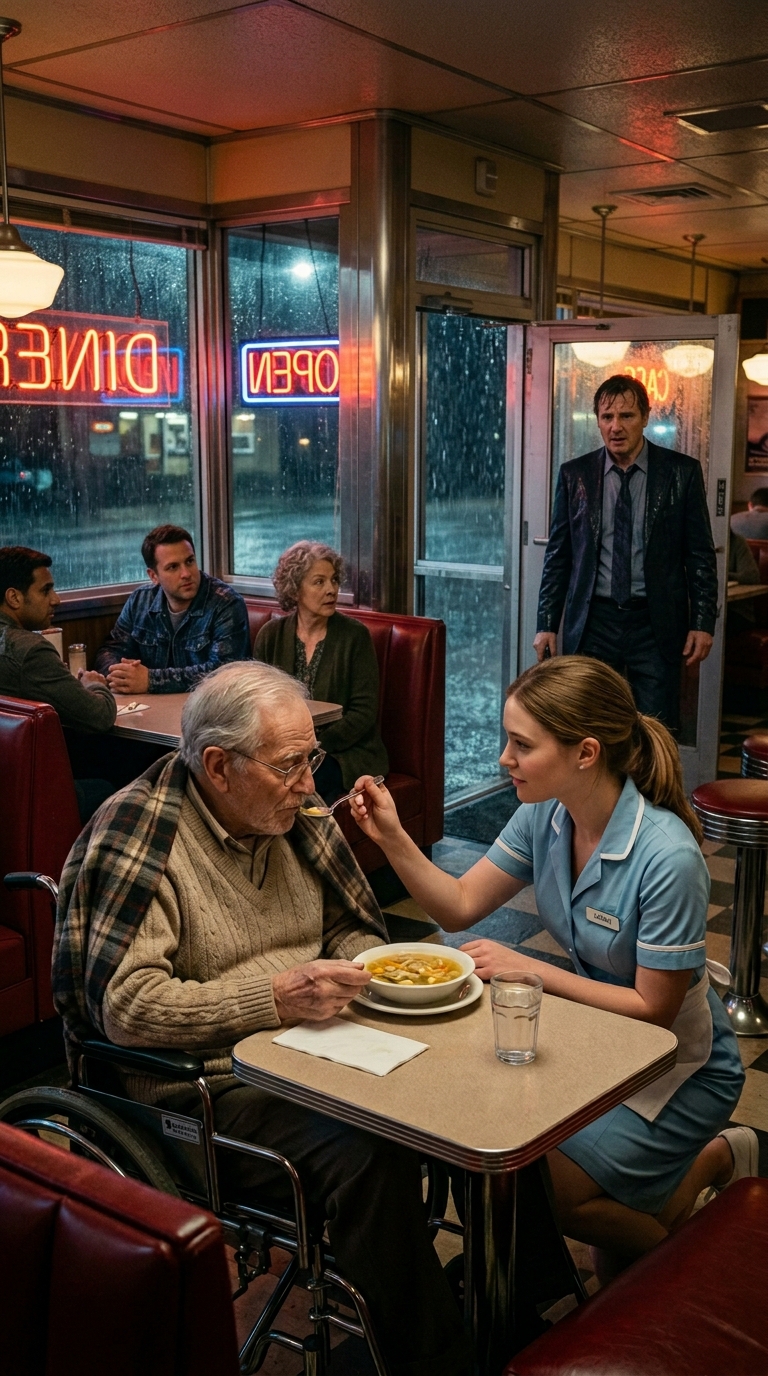
She sat across from him and fed him slowly. Her hands trembled from exhaustion, but her voice stayed gentle.
“Just a little more,” she said. “You are doing well.”
The man swallowed. His breathing steadied. His body relaxed under the blanket. Natalie watched him closely, as if he were family, because in that moment, kindness was the only thing she had to give.
She didn’t notice the black sedan pulling into the lot.
A man stepped out, soaked from the rain, moving with urgency. He was powerful, wealthy, known for building empires—but at that moment, he was simply a son terrified of losing his father.
An hour earlier, he had received a call.
“Your father is missing. We cannot locate him.”
He had trusted that money could guarantee care, that systems could replace presence. Now, his father was gone somewhere in the storm.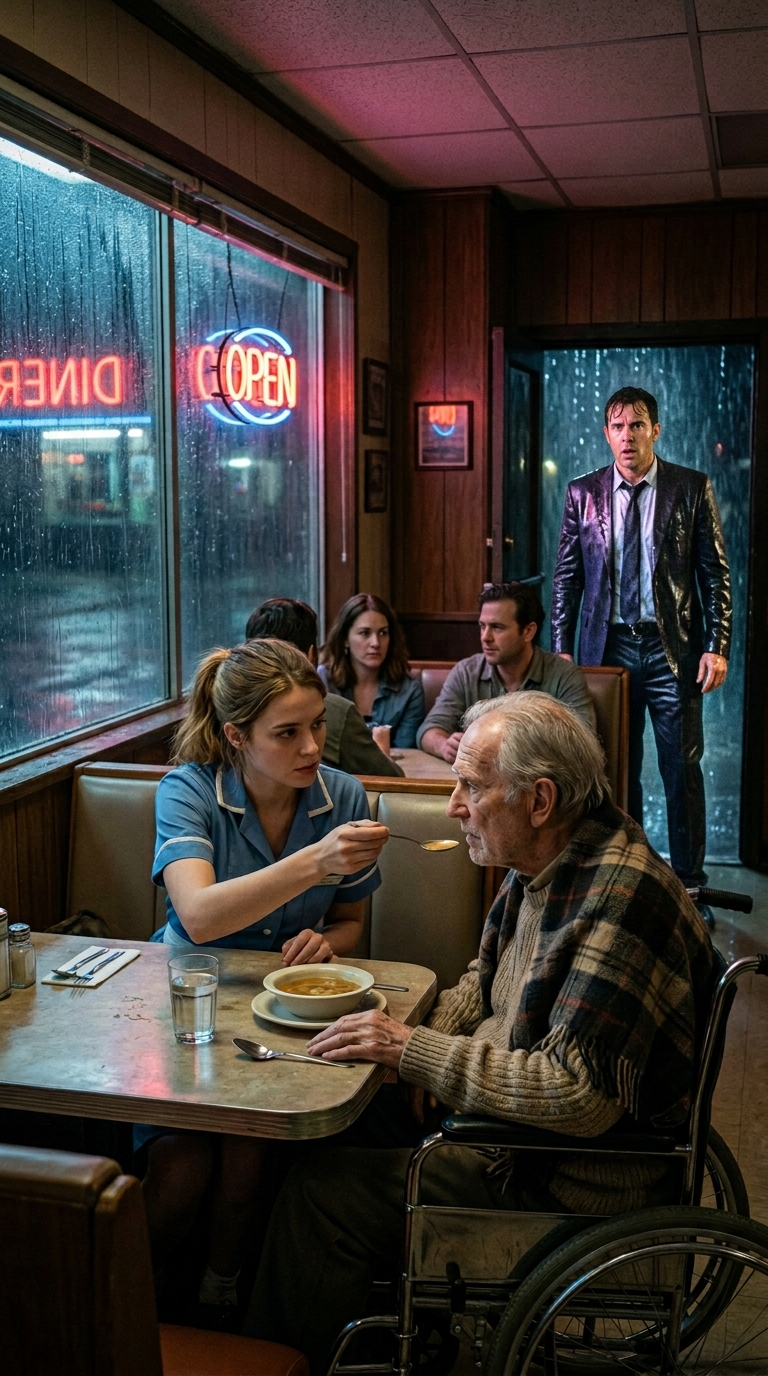
A patrol officer had reported seeing an elderly man in a wheelchair near the diner. He drove there without thinking, rain pounding his windshield, guilt growing heavier with every mile.
He pushed open the door and stopped.
His father sat wrapped in a worn blanket, being gently fed by a young waitress with tired eyes and steady hands.
For a moment, he forgot how to breathe.
His father looked peaceful—more peaceful than he had in months surrounded by clinical walls and distant caregivers.
He stepped closer. “Natalie,” he said, reading her name tag.
She turned, startled. “Are you family,” she asked.
He swallowed. “He is my father.”
The old man stirred at his voice. His eyes flickered, and a faint smile appeared. “Brandon,” he whispered.
He dropped to his knees, taking his father’s hand.
“I am here,” he said. “I am so sorry.”
Natalie spoke quickly, worried she had overstepped.
“I found him outside,” she explained. “He was freezing. I didn’t know where else to take him.”
He looked at her—really looked. The soaked uniform. The worn shoes. The exhaustion she carried.
“You saved his life,” he said quietly. “Thank you.”
That night ended quietly. He brought his father to the hospital. Natalie closed the diner and walked to the bus stop, shivering under the same rain that had brought a stranger into her life.
She thought it was over.
It wasn’t.
Two days later, he sat in his office reviewing reports. What he uncovered chilled him. A caregiver had left a door unlocked. A guard had fallen asleep. A facility that cost millions had failed at the simplest responsibility.
He took action. Lawsuits were filed. Executives were dismissed. Systems were rebuilt. Promises were made. His empire changed overnight.
But the most meaningful change was personal.
A week later, he returned to the diner. Morning light filled the windows. Natalie stood behind the counter pouring coffee.
She froze when she saw him.
“I wanted to see you,” he said. “And I wanted to do this properly.”
He placed a folder on the counter.
Inside were documents—paid debts, cleared rent, enrollment confirmation for nursing school, and a future job waiting.
“I took care of these,” he said. “If you choose to accept.”
Natalie stared in disbelief. “You don’t even know me,” she whispered.
He gave a faint smile. “I know you chose kindness when no one was watching,” he replied. “That tells me enough.”
Tears filled her eyes. “This is too much,” she said.
He shook his head. “This is not charity. This is gratitude.”
Natalie nodded slowly.
“Then I will work hard,” she said. “And care for people the way I cared for your father.”
He extended his hand. “I believe you.”
Years passed. Natalie became a nurse known for her compassion. Patients trusted her. Families asked for her by name.
He transformed elder care standards across the country, ensuring failures like that night would not happen again.
The old man lived long enough to see Natalie graduate, smiling proudly from the audience.
Sometimes, on rainy evenings, Natalie would pass by the diner—now restored, bright, and full. She would sit in a quiet corner, order soup, and remember the night she chose not to look away.
She thought she had saved a stranger.
In truth, she had changed her own life.
Because in a world driven by power and wealth, it is still a single act of kindness that can rewrite everything.
