

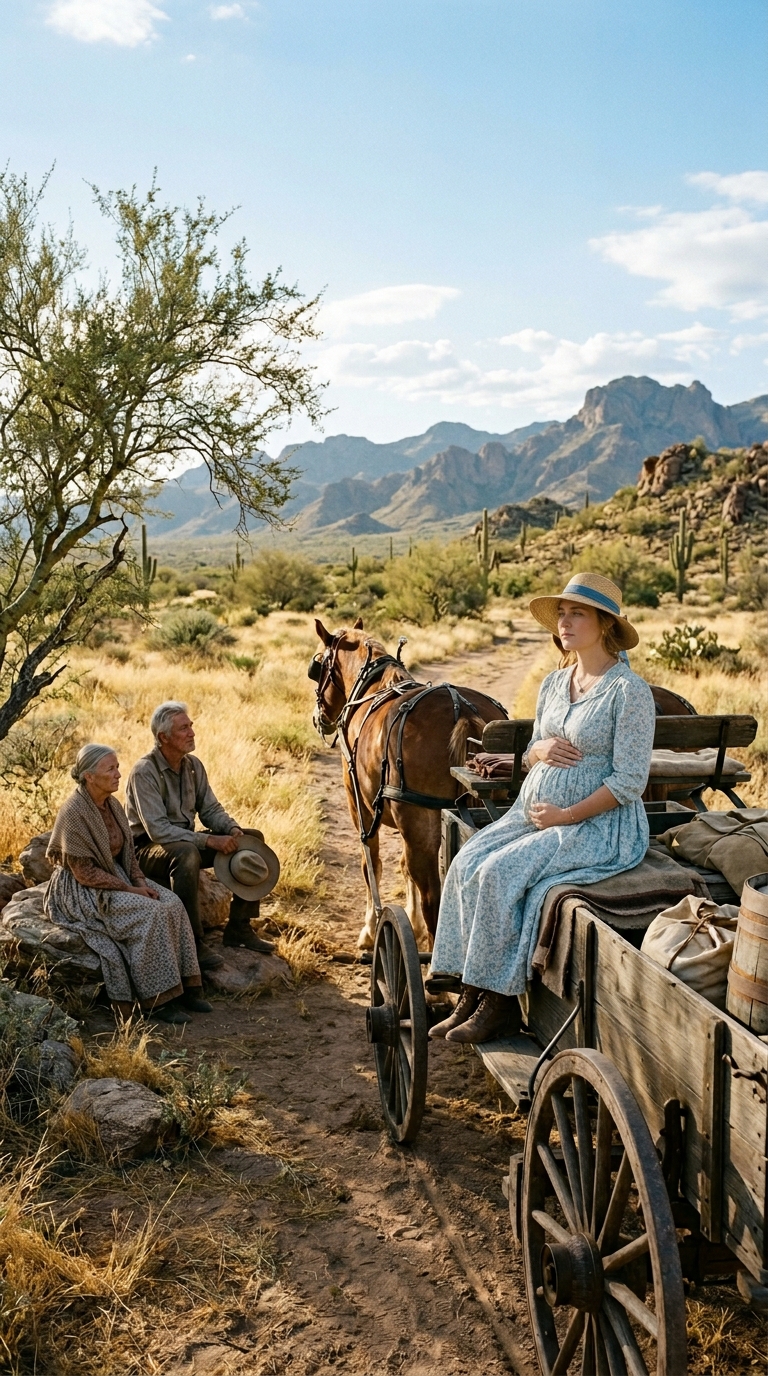
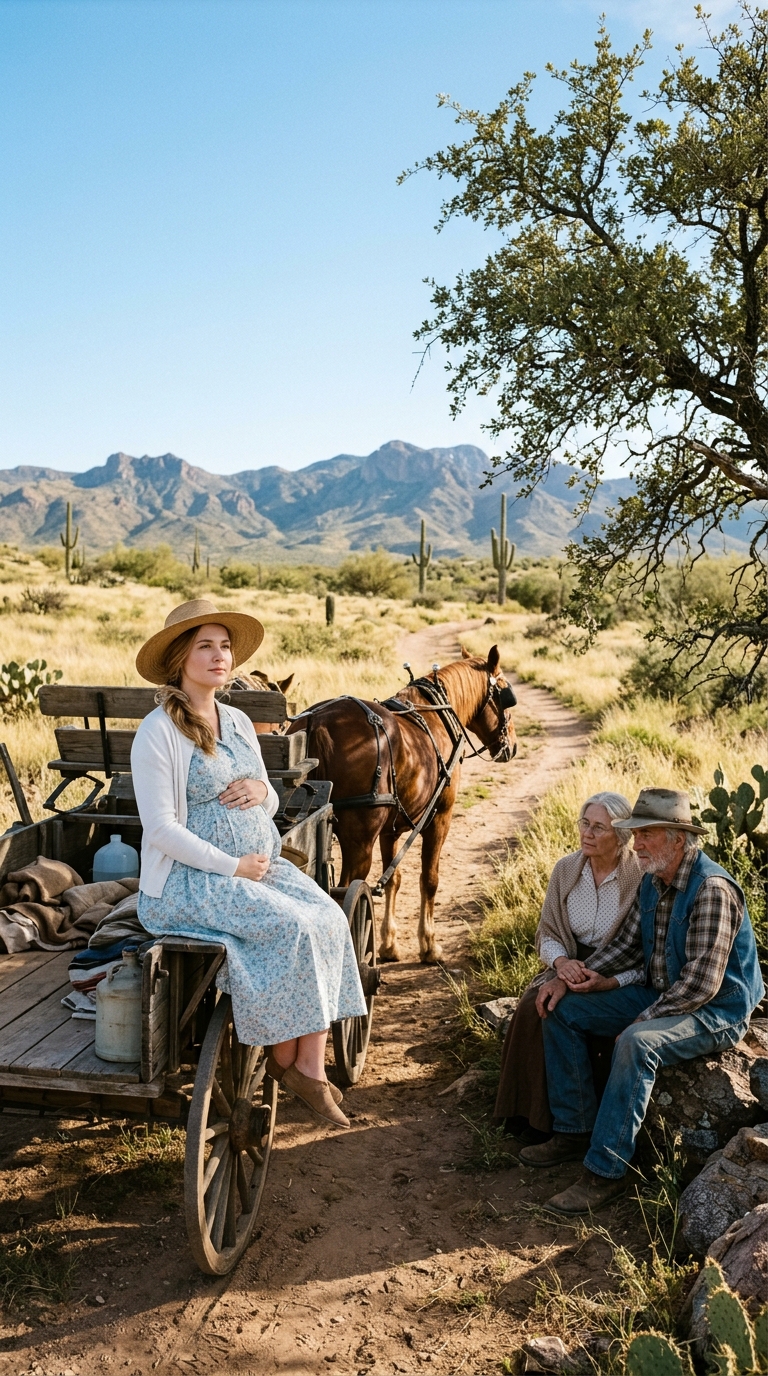
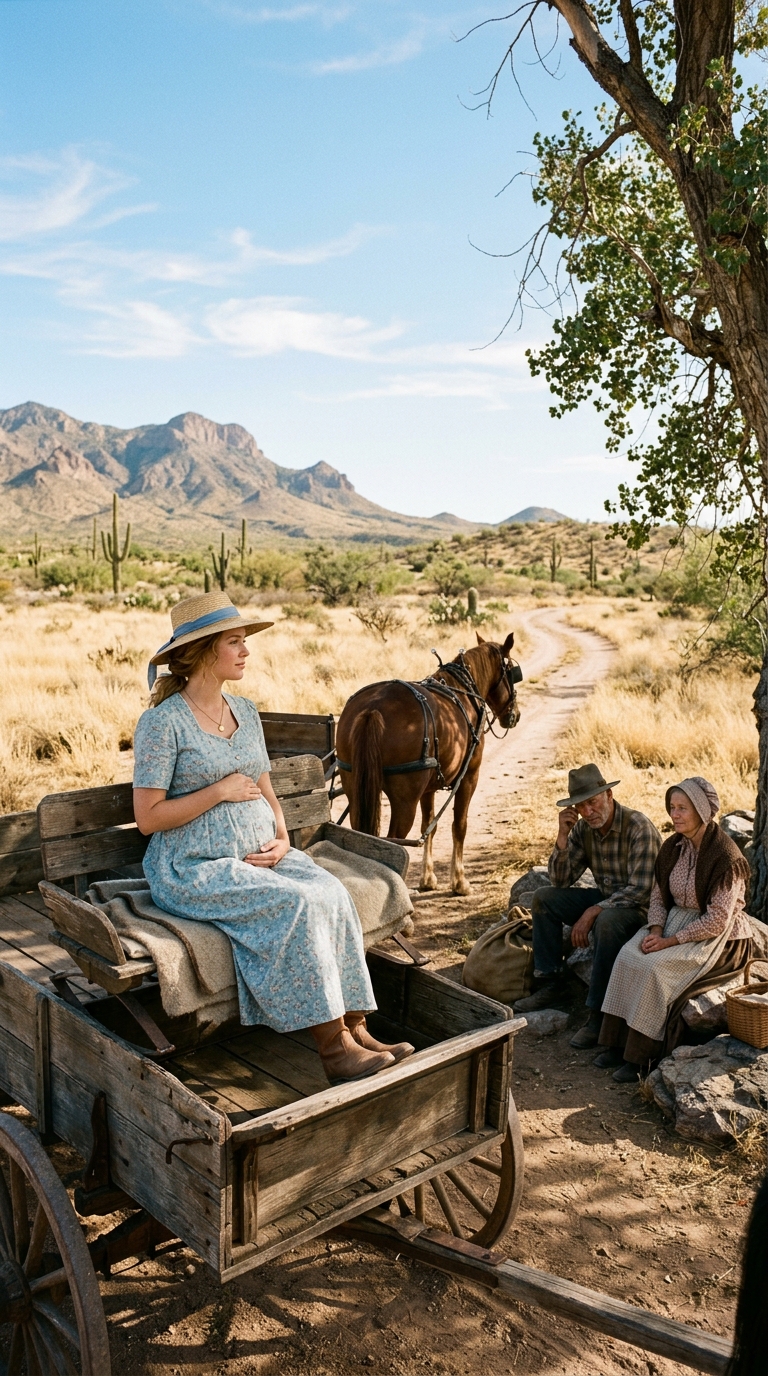
When Mariela Ortega found the two elderly people at the side of the road, the September sun beat down like lead on the dry earth and dust rose behind the old cart pulled by her mare, Lucera. She was traveling alone, seven months pregnant, her back burning, and a mental list of worries she already knew by heart: the flour was barely enough, the jar of cough syrup was almost empty, the bank had given her ten more days before starting the foreclosure, and the child inside her belly kicked as if to remind her that time waited for no one.
She was thirty-one years old and already a widow.
Her husband, Tomás, had died during the rainy season in just five days from a poorly treated fever that took him so quickly that Mariela still found herself listening for his footsteps at dusk. Since then, life had become something hard and silent, like carrying wet sacks uphill. Getting up alone, deciding alone, counting coins alone. Looking at the small plot on the outskirts of San Miguel de las Palmas and wondering every morning if that tired, stubborn land would give her enough not to lose everything.
The cart creaked as it rounded the bend by the big mesquite tree, and that was where she saw them.
At first she thought they were abandoned bundles. Two motionless figures under the scant shade of a huisache tree. Then the man lifted his head. He was a very thin old man with an uneven white beard and a hat worn down by the years. Beside him, a small woman in a faded dress and broken shoes held his arm with both hands, as if even sitting down required courage. Between them lay a small sack, so light it was heartbreaking.
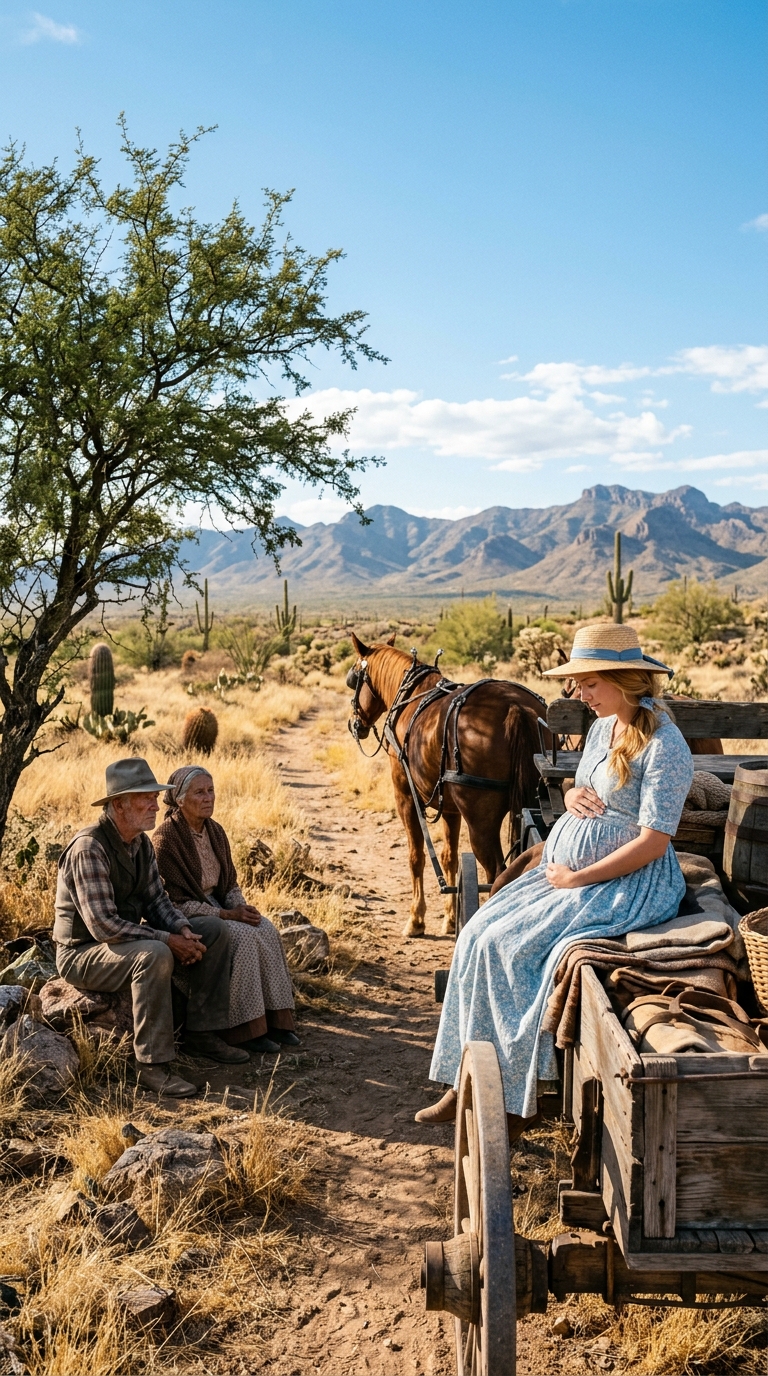
Mariela pulled on the reins.
“Are you all right?” she asked from the cart.
The old woman looked up. Her dark eyes were tired in a way that came not from one bad night but from an entire lifetime.
“We’re resting, daughter,” she answered in a thin voice. “We’ve been walking since dawn.”
“And where are you headed?”
The old man and woman looked at each other. He was the one who spoke.
“Nowhere in particular.”
There was something in that answer that sounded worse than hunger.
Mariela looked at the woman’s swollen feet, the man’s trembling hands, and the long, shadeless road ahead. Then she climbed down with difficulty, opened the back of the cart, and said without thinking twice:
“Get in.”
“We don’t want to be any trouble, ma’am,” the old man murmured.
“And I don’t want you dying on the road. Get in.”
That was how she met Don Jacinto and Doña Berta.
They said they had come from the bus station in Irapuato. Their son had left them there with a hundred pesos and the small sack. “I can’t take care of you anymore,” he had told them. “You’re a burden.” Then he left without looking back.
Mariela felt something hard strike her chest—an old anger that felt brand new at the same time. She didn’t continue toward town. She turned the cart around at the crossroads and took them straight to her plot. The house was small, made of adobe, with a tin roof and three humble rooms that Tomás had built with his own hands. It wasn’t much, but it had shade, well water, and it still smelled like home.
She helped them inside, gave them cool water, and heated what was left of the beans with some boiled potatoes. She divided the last tortillas, added salt and a little epazote. The old couple ate slowly, with a gratitude that made her feel ashamed.
That night, Mariela pulled the old mattress from the back room and laid it out in the living area. Doña Berta opened her small sack. There was only a patched blanket, folded with the care of a treasure.
“It’s all we have,” she said, embarrassed.
“Well, no one’s sleeping outdoors here,” Mariela replied. “Good night.”
She lay down in her room without undressing and stared at the dark ceiling, listening to Berta’s dry cough and Jacinto’s soft snoring. She thought about the debt, about the baby, about two more mouths to feed when she could barely feed one. She fell asleep late, praying that God hadn’t forgotten the way to her house.
The next morning she woke to the smell of coffee.
She got up alarmed, thinking she had left something on the fire, and found Doña Berta in the kitchen, stoking the fire with the natural ease of someone who had cooked for others her whole life. Outside, Don Jacinto was sweeping the patio with an old broom, straightening branches and gathering leaves, as if his tired body couldn’t shake the habit of being useful.
“I found a little coffee in the cupboard,” Berta said. “I made some for everyone. I hope you don’t mind.”
Mariela was about to say something about the reserves, about how that jar was for emergencies, but she stayed quiet. She sat down. Berta served her in a small mug, and the first sip tasted like something she hadn’t experienced in months: companionship.
The days began to fall into a new rhythm.
Don Jacinto fixed the chicken coop fence that had been loose for months. He repaired the back door that never closed properly. He straightened a wobbly table leg. He got the water pump working again, something Mariela had already given up on. He didn’t talk much, but his hands knew things.
Doña Berta turned scarcity into a miracle. From reheated rice she made a thick broth with mint. From quelite leaves she created a stew that smelled like childhood. The corn went further, the beans stretched for everyone, and somehow there was always a little left for the next morning.
At night they sat on the porch. Mariela with her hands on her belly, Berta with her rosary, Jacinto watching the hills darken. Sometimes they talked. Sometimes they didn’t. And the silence no longer felt heavy.
It was one of those nights when Mariela told them the truth: that Tomás had died suddenly, that the mare Lucera had been bought with a loan, that she owed eight hundred and fifty pesos and had only seventy saved. That the bank would come in ten days. That she might lose the land before her son was even born.
When she finished, no one spoke for a long time. Then Doña Berta reached into the pocket of her dress and pulled out a folded piece of paper, old and yellowed, written in pencil with a child’s handwriting.
“Read it,” she said.
Mariela opened it. It said:
“Dad and Mom, when I grow up I’m going to take care of you forever. You’ll never lack anything. I promise. Your son, Anselmo.”
Mariela handed the letter back without speaking.
“He grew up,” Jacinto murmured, staring into the darkness. “And he forgot.”
Mariela pressed a hand to her belly and silently promised herself that her son would never learn to abandon anyone.
Eight days remained until the foreclosure when a gray pickup truck appeared on the road.
Mariela was scattering corn for the chickens when she heard the engine. A man in his forties got out—sturdy, dark-skinned, wearing a blue shirt and eyes identical to Jacinto’s. He froze when he saw the elderly couple sitting on the porch.
“Dad?” he said, his voice breaking.
Jacinto stood up very slowly. Berta brought a hand to her mouth. No one moved at first. Then the old woman stepped forward and hugged him with a silent tremor that finally broke the man.
His name was Mateo.
He was the middle son. The only one who had not taken part in the abandonment.
That same afternoon, all of them sitting together in the kitchen, he told the whole story. The family ranch, La Esperanza, in the mountains of Guanajuato, had always been in Jacinto and Berta’s name. More than two hundred hectares of good land, spring water, an old hacienda house, and livestock. But his other children, Anselmo and his sister Rebeca, had grown tired of waiting for the inheritance. With a corrupt notary, fake documents, and tricks, they had seized the property. Then they arrived with police and a rigged legal order. Jacinto and Berta were thrown out of their own home as if they were intruders.
Mateo had tried to defend them. He looked for lawyers. He gathered evidence. He filed complaints. They threatened him. They burned down his workshop. His terrified wife took the children to her mother’s. And while he was trying to hold everything together, Anselmo took the elderly couple to the city and hid them in a miserable room. When he finally decided to get rid of them, he simply left them at the bus station.
“I’ve been looking for them for two years,” Mateo said, his eyes red. “I thought they were dead.”
He took out a thick envelope and placed it on the table.
“Now I have everything. The real deeds. Expert reports. Recordings. A lawyer in León put the case together. The ranch is still yours. It always was. And the others are going to answer for it.”
Mariela read the documents that night by the light of the oil lamp.
Rancho La Esperanza. 230 hectares. Commercial value: nine million pesos.
She looked then at the elderly couple sleeping in the living room with their patched blanket and their worn hands, and she felt a strange dizziness. How could two people who had a right to a fortune have arrived at her door with nothing but hunger and dignity?
The days that followed were a whirlwind of lawyers, signatures, and trips to the courthouse. And while the case moved forward, Mateo did something Mariela never expected: he went with her to the bank and paid off her entire debt, including interest and penalties.
When the manager stamped the seal and returned the deeds to her plot, Mariela walked out to the plaza with the papers in her hand and sat on a bench, unable to believe the land still belonged to her.
Don Jacinto sat down beside her.
“Are you going to sell?” he asked.
“I don’t know,” Mariela said. “It’s Tomás’s land.”
Jacinto nodded.
“You have a child now.”
Mariela looked at him—at that stooped, quiet old man who had arrived with nothing and had already become family.
“Yes,” she answered, swallowing hard. “You’re right.”
Two weeks later they went to the ranch.
The entrance had a large carved wooden gate and an old, half-fallen sign: Rancho La Esperanza. The hacienda stood abandoned, with overgrown grass, loose tiles, and broken windows, but the walls were still standing, thick and noble. Doña Berta walked slowly into the main living room and touched an empty wall.
“Our wedding photo used to hang here,” she whispered.
Jacinto didn’t want to go inside right away.
“There’s a lot of pain here,” he said. “But there are good memories too. And it’s time to bring them back.”
That night, back at the plot, Berta took Mariela’s hand.
“You’re coming with us.”
Mariela blinked, confused.
“Me?”
“You’re our daughter now,” Jacinto said from the porch, plain and direct. “The only one who opened the door when everyone else closed it.”
Mariela felt her eyes fill with tears.
“And what would I do there?”
Berta smiled with a tired but radiant tenderness.
“The same thing you did here. Give shelter.”
Then they told her their plan.
They didn’t want to return to the ranch to live in luxury or regain prestige. They wanted to turn the hacienda into a home for abandoned elderly people, lone widows, people thrown out of their houses, people forgotten by their own families.
“Because we know what that feels like,” Jacinto said. “And no one should spend their final days feeling like a burden.”
Mariela cried right there, without holding back. She cried for Tomás, for the fear, for the debt, for the exhaustion, for the son who would be born without a father. Berta hugged her as if she had been waiting for her all her life.
“You’re not alone anymore, daughter,” she whispered. “Not anymore.”
The restoration of the hacienda began a month later.
Mateo hired masons and carpenters from the region. Jacinto, with his trembling but expert hands, supervised beams, doors, and floors. Berta chose soft colors for the rooms and embroidered small tablecloths for the long dining table. Mariela cleaned, organized, planted rosebushes, basil, and rosemary in the front garden. Every afternoon she finished exhausted, with swollen feet and a broken back, but with something lit inside her chest that she had forgotten existed: purpose.
The baby was born on a Tuesday in November, in the largest room of the now-repaired hacienda. The village midwife arrived on time. Berta never let go of her hand. Jacinto waited outside, pacing like a new grandfather.
When the baby’s cry filled the room, the world finally seemed to settle into place.
It was a boy.
And Mariela named him Tomás, after his father.
When the midwife placed him in her arms, she looked at him in silence, with the sacred wonder of someone who understands that life, even when broken, keeps finding ways to begin again.
Jacinto entered slowly afterward.
He approached the bed, looked at the newborn, swallowed hard, and said only:
“Welcome, son. Here you will have a place to grow.”
Six months later, the hacienda opened its doors.
It wasn’t easy. There was paperwork, permits, inspections, malicious comments, and people saying no one would want to live in an old ranch lost in the mountains. But they persisted.
They prepared eight rooms. They bought sturdy beds, good mattresses, and new blankets. In the kitchen they installed a huge wood stove and a long table that could seat everyone. Doña Berta’s old patched blanket was tucked away in a drawer in the living room, along with Anselmo’s childhood letter. Not as a reminder of betrayal, but as proof that pain can be inherited or transformed, and they had chosen the latter.
The first resident was Don Hilario, a seventy-nine-year-old former railroad worker who had been sleeping on a market bench for months. He arrived with a plastic bag and an incredulous look.
“Is this really for me?” he asked when he saw the garden, the table, and the open view of the hills.
“This is for you,” Mariela answered.
Then came Doña Luz, a former seamstress; Don Ramiro, whose children had emigrated and never returned; Doña Ofelia, a widow with no home; and others. One by one they filled the hacienda with stories, slow footsteps, and unexpected laughter.
Jacinto taught carpentry in a small workshop beside the barn. Berta baked bread with the women, and the smell spread across the entire sierra. Mariela ran the kitchen, cared for the baby, solved problems, accompanied people to medical appointments, listened to confessions, and handed out affection and discipline in equal measure. Mateo came every Sunday with his children, who began calling Jacinto and Berta “Grandpa” and “Grandma” and Mariela “Aunt,” the brave woman who greeted them with warm bread.
Anselmo and Rebeca faced justice. They lost the ranch, the money, and the respect of the town. They disappeared from the region. No one ever mentioned them again.
One December night, almost Christmas, Mariela stepped out onto the porch after putting little Tomás to bed. The sky was clear and full of stars. From the kitchen came laughter, the clatter of dishes, and the sweet smell of freshly baked bread.
Jacinto came out with two mugs of coffee and sat beside her.
“What are you thinking about?” he asked.
Mariela looked at the dark fields, the lighted house, the murmur of so many lives inside.
“I’m thinking that a year ago I was driving along the road, counting the days until I lost everything,” she said. “And now I have more than I ever imagined.”
Jacinto took a sip and smiled faintly.
“You have a son, a family, and a home that no deed can contain.”
Mariela nodded in silence.
After a while she asked:
“Do you regret getting into my cart?”
Jacinto let out a low laugh.
“That’s something I should be asking you.”
Mariela thought about that huisache tree, the dust, the two elderly people standing still at the side of the road. She thought about what would have become of her if she had kept driving. The bank, the loneliness, the baby, the fear.
“No,” she said at last. “I don’t regret anything.”
Just then Berta poked her head through the door.
“Are you two coming in or are you going to stay out here letting the coffee and sweet bread get cold?”
They went inside.
The long table was full. Don Hilario was telling a terrible joke and everyone was laughing anyway. Doña Luz was playfully arguing with Don Ramiro over the last tamale. Little Tomás slept in a rebozo hanging near the stove. Mariela sat at the head of the table and looked at all those faces marked by life, those wrinkled hands, those smiles born after pain.
Then she understood something she would never forget: sometimes God doesn’t take away the burden. Sometimes He sends people to help you carry it. And what arrives at your door looking like one more responsibility can actually be the family you needed so you wouldn’t sink.
In San Miguel de las Palmas they still say that Hacienda La Esperanza stands strong, with a garden always in bloom and a table always full. They say Mariela never sold Tomás’s plot; she rented it to a young couple who work it with respect. They say little Tomás grew up among the elderly, learned from Jacinto how to use tools and from Berta how to bake anise bread. And that when someone asks him where he’s from, he always answers the same thing, with a calm smile:
“I’m from where they opened the door for me. And that’s the only place that truly matters.”
