

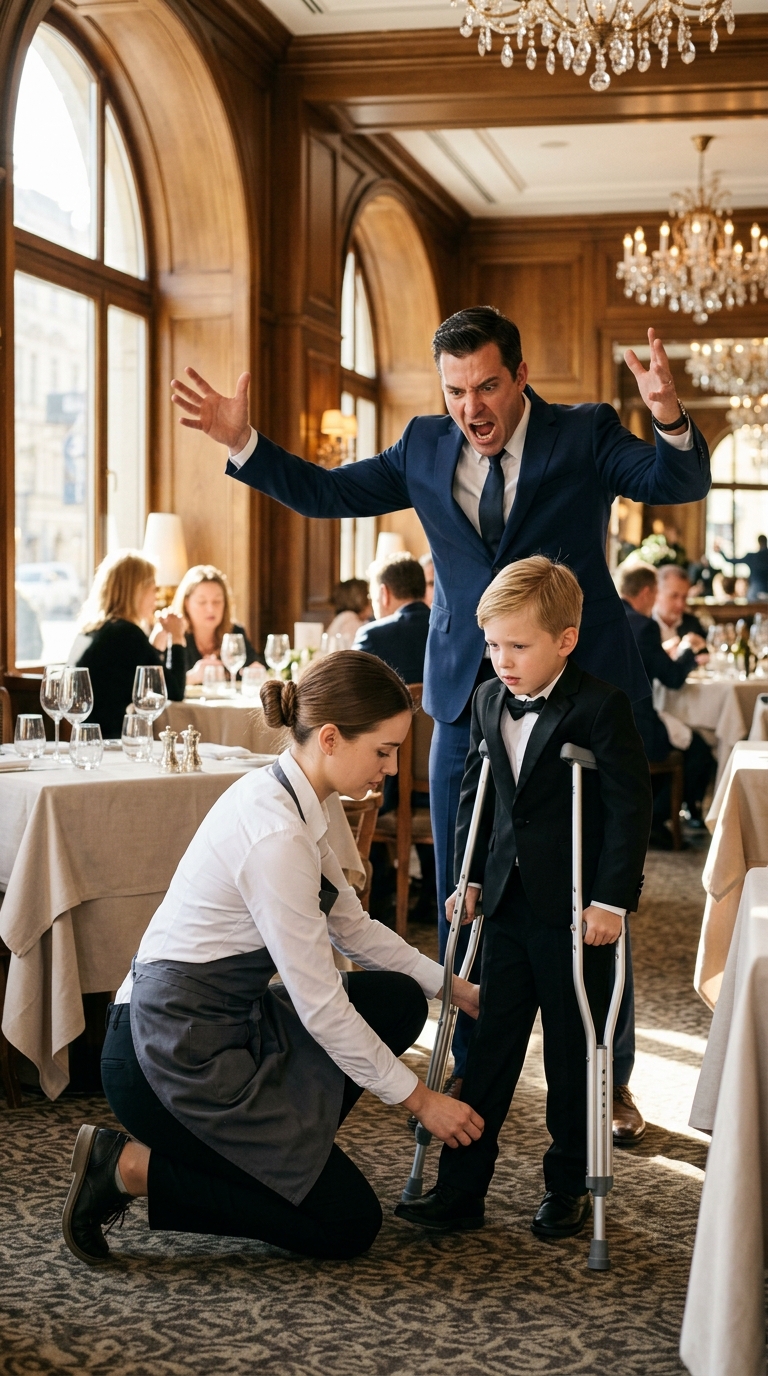
Marcus Sinclair straightened his Italian silk tie for the third time in ten minutes, the knot tightening around his throat like a silent accusation. Around him, Sinclair Medical Tower shimmered in marble and glass—a symbol of innovation, prestige, and the billion-dollar empire he had built from nothing.
Yet as he watched his seven-year-old son struggle down the corridor on a pair of crutches, Marcus felt like the poorest man in New York.
The irony was brutal. He owned the most advanced private medical facility on the East Coast. He had brought in neurologists from Boston, Zurich, and Tokyo. He had financed experimental treatments no insurance company would dare support.
And still—no one could explain why Timothy couldn’t walk without pain.
“Mr. Sinclair, the investors from Tokyo are waiting,” his assistant Rebecca said softly.
“Tell them to wait,” Marcus replied, his eyes locked on his son. “Or tell them to leave. I don’t care.”
Dr. Harrison, a respected neurologist with an impressive résumé and little warmth, approached with results from the latest experimental Swiss treatment. One glance at his face revealed everything.
Another failure.
Three years of searching. Three years of hope rising and collapsing.
“Dad,” Timothy said with a brave little smile, “can we go to the grilled cheese place?”
Marcus swallowed the ache in his chest. “Of course, buddy. Anywhere you want.”
Rosie’s Diner
Twenty minutes later, they walked into Rosie’s Diner, a humble spot in Queens with checkered tablecloths and the smell of burnt coffee. Marcus looked out of place in his tailored suit—but Timothy looked happy.
“Welcome back. The usual table?”
The voice was warm and perceptive.
Marcus looked up.
Her name tag read Emma.
She wore a simple diner uniform, her blonde hair tied back in a practical ponytail. But there was something about her posture—steady, attentive. Her green eyes didn’t drift lazily. They observed.
“You must be the grilled cheese expert,” she said to Timothy, kneeling to meet him at eye level—not with pity, but with genuine respect.
As they made their way to the booth, Marcus noticed something unusual. Emma wasn’t just leading them.
She was studying Timothy.
The way he shifted weight on his crutches. The tension in his shoulders. The alignment of his hips.
Clinical. Precise.
When Timothy struggled to open a packet of crackers, frustration coloring his cheeks, Marcus stepped forward to help.
Emma gently stepped in first.
“Can I show you a trick?” she asked softly. “Sometimes it’s not about strength—it’s about angle. Try activating from the base of your thumb, not the fingertips.”
She guided his hand with calm confidence.
The packet popped open.
Timothy beamed. “Dad! Did you see that?”
Marcus stared at her.
“Who are you?” he asked quietly. “Because waitresses don’t talk about muscle activation.”
For a brief moment, fear flickered across her face.
“I read a lot,” she replied. “And I’ve seen people struggle.”
But Timothy looked at her with pure hope. “Emma… could you teach me to walk better?”
That question changed everything.
The Agreement
Emma agreed—under conditions.
No sessions at the hospital. No publicity. No questions about her past. They met at a small community gym in Brooklyn.
What Marcus witnessed over the next month left him stunned.
Emma didn’t follow standard physical therapy routines. She used games. Subtle adjustments. Cognitive retraining methods. “Applied neuroplasticity,” Marcus murmured one morning, recognizing the science.
In just four weeks, Timothy made more progress than he had in three years.
But something else was happening.
Marcus found himself looking forward to Saturdays. Bringing her coffee. Smiling at her quiet humor. Watching the fierce protectiveness in her eyes whenever Timothy succeeded.
He was falling in love with the waitress who was healing his son.
The Email
One evening, after Timothy managed ten steps without crutches, Marcus returned to his Manhattan penthouse feeling something unfamiliar:
Hope.
Then his phone buzzed. He opened the email.
His wine glass shattered against the marble floor.
Attached were court documents. Newspaper clippings. A mugshot.
The headline froze his blood:
“Dr. Emma Richardson Stripped of Medical License After Malpractice Leaves 8-Year-Old Paralyzed.”
Marcus felt the room spin.
She wasn’t a waitress.
She was a disgraced doctor.
And according to those records—dangerous.
Rage consumed him. He called her immediately.
“Stay away from my son,” he snapped. “I know who you are, Dr. Richardson.”
Silence. Then a broken whisper. “Marcus… please let me explain—”
“You lied to me. You touched my child. If you ever come near him again, I’ll bury you in lawsuits.”
He hung up.
The Doubt
But in the days that followed, something felt wrong.
Timothy’s progress stopped. The light faded from his eyes.
And Marcus couldn’t reconcile the woman in those documents with the woman he had seen kneeling on a gym floor, celebrating every small victory.
His instincts told him something didn’t add up.
He hired his top private investigator.
“Find the truth,” Marcus ordered. “Not headlines. Facts.”
Forty-eight hours later, the investigator returned, pale.
“The anonymous email?” he said. “It came from Dr. Patricia Hendrix’s office. Emma’s former supervisor.”
“And?”
“She was framed.”
The truth was ugly.
Emma had developed a groundbreaking neurological treatment. Her superior wanted the patent—and the recognition. When Emma refused, Hendrix sabotaged a patient’s treatment and falsified records to place the blame on her.
Emma lost her license. Her reputation. Everything.
Marcus felt sick.
He had destroyed her all over again.
The Bus Station
By the time he found her, Emma was boarding a bus out of the city.
“Emma!” he called across the terminal.
She turned, her eyes filled with pain. “You’ve said enough.”
“I was wrong,” he said, breathless. “I know about Hendrix. I know you were set up.”
She froze.
“I should have trusted what I saw,” he continued. “Not what I read. I saw how you cared for my son. That’s the truth.”
Tears filled her eyes.
“My lawyers are already reopening the case,” he said. “We’re clearing your name.”
“Why?” she whispered.
He stepped closer.
“Because my son needs you. And because I do too.”
For the first time in years, Emma didn’t look afraid.
She looked like she had found somewhere to belong.
“I guess I’m missing that bus,” she said softly.
Marcus let out a shaky laugh. “Good. Because I’m not letting you disappear again.”
Six Months Later
The ballroom of the Sinclair Grand Hotel sparkled under crystal chandeliers.
But this wasn’t a corporate event.
It was a celebration.
Dr. Emma Sinclair’s medical license had been fully reinstated.
Timothy—walking confidently on his own—ran through the room, smiling brightly.
Marcus stepped up to the microphone.
“They say money can’t buy happiness,” he began, looking at his wife—radiant in emerald silk, four months pregnant.
“They’re right. Money couldn’t heal my son. It couldn’t mend my broken heart. The miracle came from a woman in a diner uniform who saw what everyone else failed to see.”
He turned to Emma.
“Thank you for teaching me that love is stronger than fear… and that you should never judge someone by the uniform they wear, but by how they use their hands to lift others.”
The applause thundered through the room.
But Marcus only saw his family.
As Timothy wrapped his arms around both of them, Marcus understood something deeply:
For the first time in his life, the richest man in the city finally had something truly priceless.
A complete family.
