

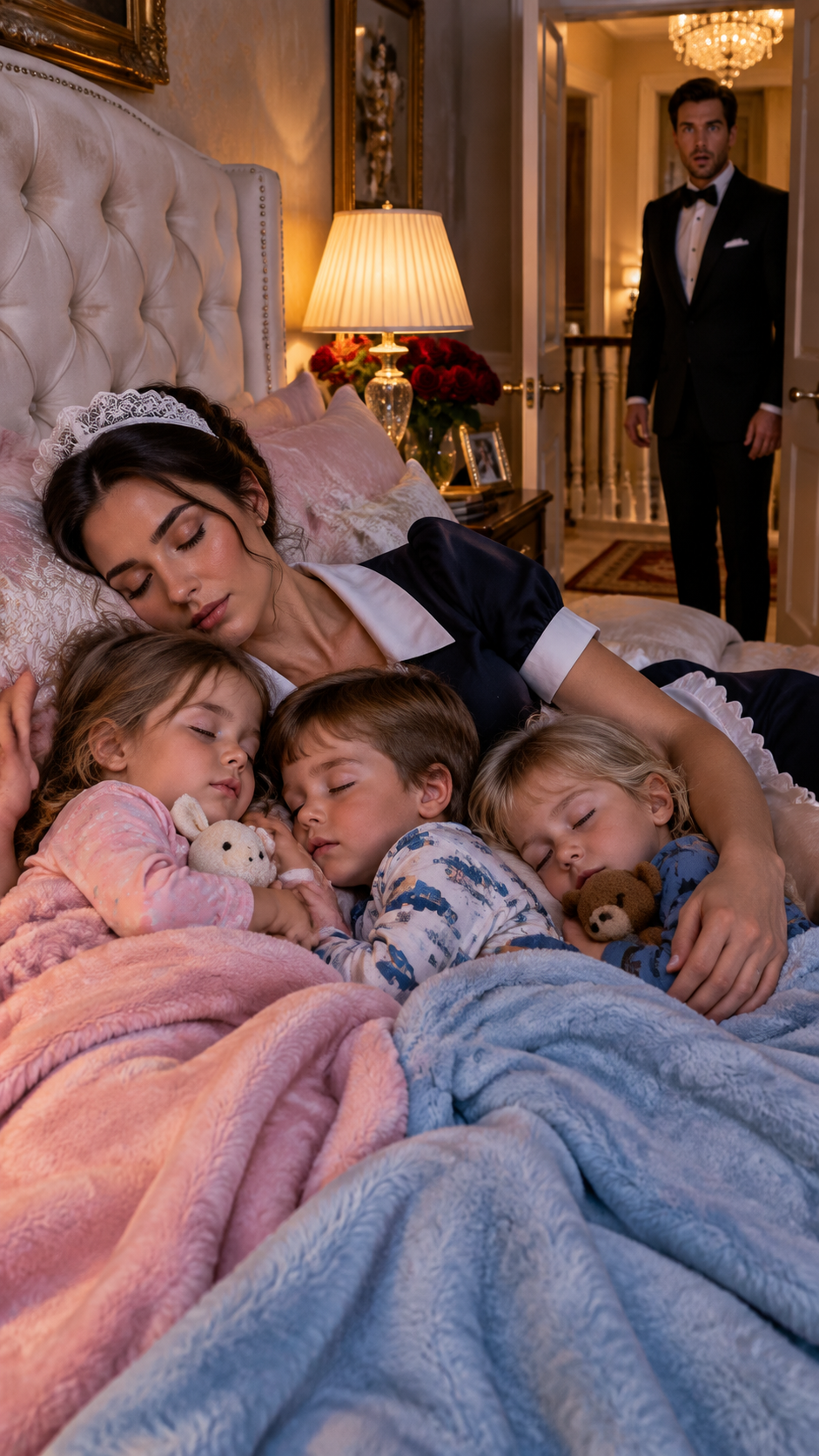
PART 1 — The House Everyone Quit
For nearly three weeks, the Whitaker estate overlooking the cliffs above San Diego had become something close to a whispered warning among domestic staffing agencies. Nobody officially called the house dangerous, but every woman who accepted the position left emotionally wrecked.
Some stormed out crying before the week ended. Others lasted only a few hours.
One nanny locked herself inside the laundry room and refused to come out until security escorted her to the gate. Another fled barefoot down the long marble driveway at sunrise, green paint dripping through her hair while she screamed that the children were cursed and the walls listened after midnight.
By the end of the second week, thirty-seven caregivers had quit.
From the glass walls of his home office, Jonathan Whitaker watched the latest taxi disappear through the iron gates. The Pacific Ocean shimmered beyond the hills behind his property, beautiful and distant, completely disconnected from the chaos living inside the mansion.
Jonathan was thirty-seven years old, founder of one of the fastest-growing cybersecurity companies in California. Financial magazines described him as visionary, disciplined, brilliant under pressure. Investors trusted him with hundreds of millions of dollars.
But none of that mattered when another loud crash exploded somewhere upstairs.
Jonathan closed his eyes.
Then came screaming.
Not frightened screaming.
Children fighting.
He walked to the hallway and stopped beneath a framed family photograph hanging near the staircase. It had been taken four years earlier on a beach vacation in Maui. His wife Maribel knelt in the sand laughing while all six of their daughters clung to her dress with sunburned cheeks and tangled hair.
Back then, the house still sounded alive.
Now it sounded wounded.
Jonathan touched the edge of the frame gently.
“I’m failing them,” he whispered to the empty hallway.
His phone rang almost immediately afterward.
Steven Lowell, his operations manager, spoke cautiously through the speaker.
“Sir… I’ve exhausted every licensed agency in Southern California. Legal advised me to stop contacting candidates.”
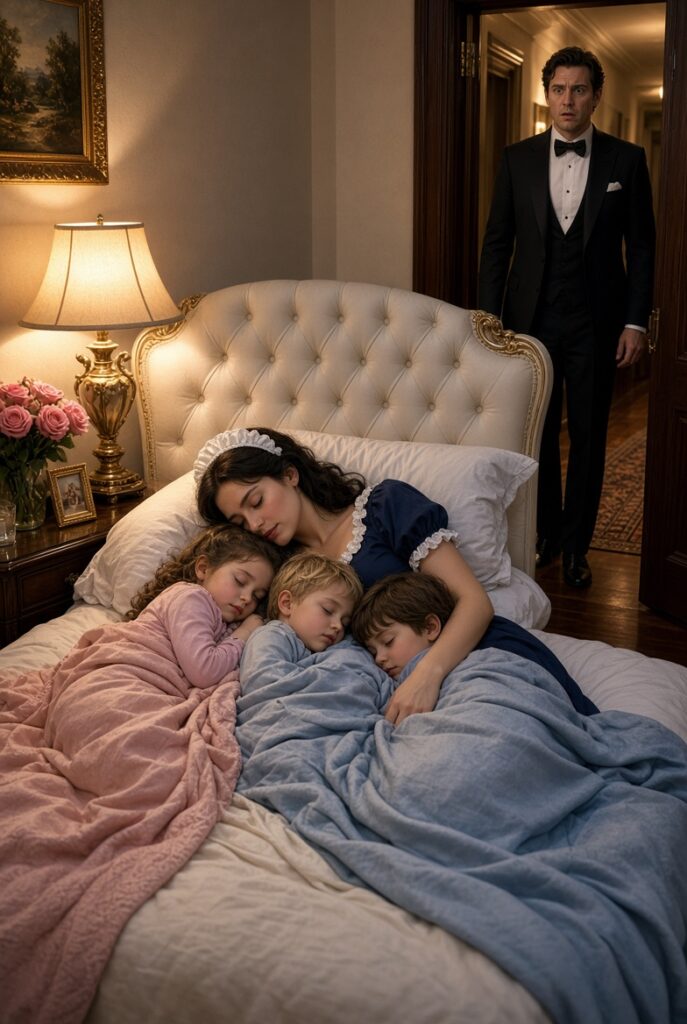
Jonathan rubbed tired fingers across his eyes.
“Then we stop hiring nannies.”
“There may be one remaining option,” Steven replied carefully. “A residential cleaner. No official childcare background.”
Jonathan glanced toward the destroyed living room where crayons stained the walls and broken toys covered the floor beneath overturned furniture.
“Hire whoever says yes.”
Across town in a narrow apartment above a laundromat near National City, Nora Delgado sat cross-legged on the floor highlighting psychology notes beneath flickering kitchen lights.
At twenty-six years old, Nora cleaned houses during the day and studied child trauma counseling at night through community college scholarships and loans she could barely afford. Bills covered nearly every surface inside the apartment.
Rent overdue.
Tuition balance.
Electric warning notice.
Her life existed in carefully measured survival.
When her phone buzzed, she almost ignored it.
The agency supervisor sounded exhausted.
“Emergency placement,” the woman said quickly. “Private estate. Immediate start. Triple pay.”
Nora looked toward the tuition invoice taped beside the refrigerator.
“What’s the catch?”
A pause.
Then:
“The children.”
Nora leaned back slowly.
“How bad?”
“Thirty-seven nannies quit in under three weeks.”
Most people would have hung up immediately.
Nora didn’t.
Fear stopped controlling her years ago.
When she was seventeen, a fire tore through her family’s apartment building while she was working a late restaurant shift. Her younger brother Mateo died trapped inside the smoke before firefighters reached him.
After that night, ordinary chaos stopped frightening her.
Pain became familiar.
Silence became heavier than noise.
“Send me the address,” Nora said quietly.
The Whitaker estate looked like the kind of property usually featured in architectural magazines. White stone walls. Floor-to-ceiling windows. Ocean views stretching endlessly beyond perfectly sculpted hedges.
Beautiful.
Cold.
Even before entering, Nora sensed something wrong.
Not danger exactly.
Grief.
The security guard opened the front gate slowly before muttering under his breath:
“Good luck.”
Inside, the mansion felt strangely abandoned despite its size. Expensive furniture sat crooked. Toys littered the marble floors. One hallway wall carried faint purple marker streaks someone had unsuccessfully tried scrubbing away.
Jonathan Whitaker appeared from the staircase wearing a dark dress shirt with sleeves rolled unevenly to his elbows. He looked exhausted in the way wealthy people rarely allow themselves to appear publicly.
“The position is technically housekeeping,” he explained quickly while leading her through the foyer. “Cleaning, laundry, basic maintenance. My daughters are… struggling.”
As if summoned by the sentence itself, something shattered upstairs.
Then came laughter sharp enough to cut glass.
Jonathan flinched automatically.
Nora didn’t.
“I’m not afraid of grief,” she said calmly.
For the first time since she arrived, Jonathan looked directly at her.
Something in the answer unsettled him.
Or maybe relieved him.
At the top of the staircase, six girls stood watching silently like suspicious little ghosts guarding the house.
Hazel, twelve, stood slightly ahead of the others with rigid posture and guarded eyes far too old for her age. Brooke, ten, kept tugging nervously at her sleeves. Ivy, nine, scanned Nora constantly without speaking. June, eight, looked pale and exhausted.
The twins, Cora and Mae, both six years old, smiled with identical expressions carrying far too much calculation for children.
And behind them all stood Lena, three years old, clutching a torn stuffed rabbit against her chest.
Nobody greeted Nora.
Nobody smiled.
They simply watched.
Nora set her bag down calmly.
“I’m Nora,” she said evenly. “I’m here to clean.”
Hazel crossed her arms.
“You’re number thirty-eight.”
Nora nodded once.
“Then I should probably start with the kitchen.”
That answer visibly confused them.
Good.
Children expecting abandonment often prepare themselves for emotional reactions. Fear. Anger. Frustration.
Calmness disrupts the script.
The kitchen looked like a battlefield abandoned halfway through evacuation. Dishes overflowed from sinks. Cereal hardened across countertops. Sticky juice stains covered cabinet handles.
But what caught Nora’s attention were the photographs taped carefully across the refrigerator.
Maribel baking cookies with flour covering her cheeks.
Maribel asleep in a hospital bed holding newborn Lena.
Maribel dancing barefoot in the backyard while the twins sprayed her with garden hoses.
The mother wasn’t hidden inside this house.
She remained everywhere.
Which meant nobody inside had actually learned how to survive losing her yet.
Nora cleaned quietly for nearly two hours while chaos echoed periodically upstairs. Then, while organizing kitchen drawers, she discovered a folded handwritten note taped beside a pancake recipe.
Banana animals for Lena. Strawberry stars for June. Chocolate chips only for Brooke.
Maribel’s handwriting.
Without fully deciding to, Nora started cooking.
When the girls wandered downstairs later, they froze near the dining room entrance.
Animal-shaped banana pancakes covered the table.
Nobody moved initially.
Then Lena climbed silently into a chair and picked up a fork with tiny trembling hands.
After the first bite, her eyes widened in shock.
“She made Mommy pancakes,” she whispered.
The room changed instantly.
Small.
But noticeable.
The twins recovered first.
Which made sense.
Children who create chaos professionally usually adapt fastest.
The next morning, Nora discovered a rubber scorpion hidden inside her mop bucket.
She picked it up carefully and examined it.
“Good craftsmanship,” she commented casually before placing it on the counter. “But fear only works with emotional investment. You’ll need stronger material.”
The twins stared at her like she’d started speaking another language.
Adults were supposed to yell.
Or panic.
Or quit.
Not critique prank quality professionally.
Three days later, green paint exploded from a trap above the laundry room doorway directly onto Nora’s hair and shoulders.
Silence filled the hallway while the twins waited breathlessly for her reaction.
Nora touched the dripping paint slowly.
Then nodded thoughtfully.
“Color choice is weak,” she said. “You should’ve gone darker for dramatic effect.”
For the first time in weeks, one of the girls laughed.
Not cruel laughter.
Real laughter.
Mae covered her mouth immediately afterward like she’d broken some invisible rule.
Nora pretended not to notice.
That night, Jonathan returned home early from work and stopped short in the hallway after hearing something unfamiliar inside the dining room.
Conversation.
All six girls sat around the table eating dinner together while Nora quietly helped Lena cut pancakes into smaller pieces.
Nobody was screaming.
Nobody was throwing things.
The silence nearly destroyed him more than chaos ever had.
Because it reminded him how long the house had gone without peace.
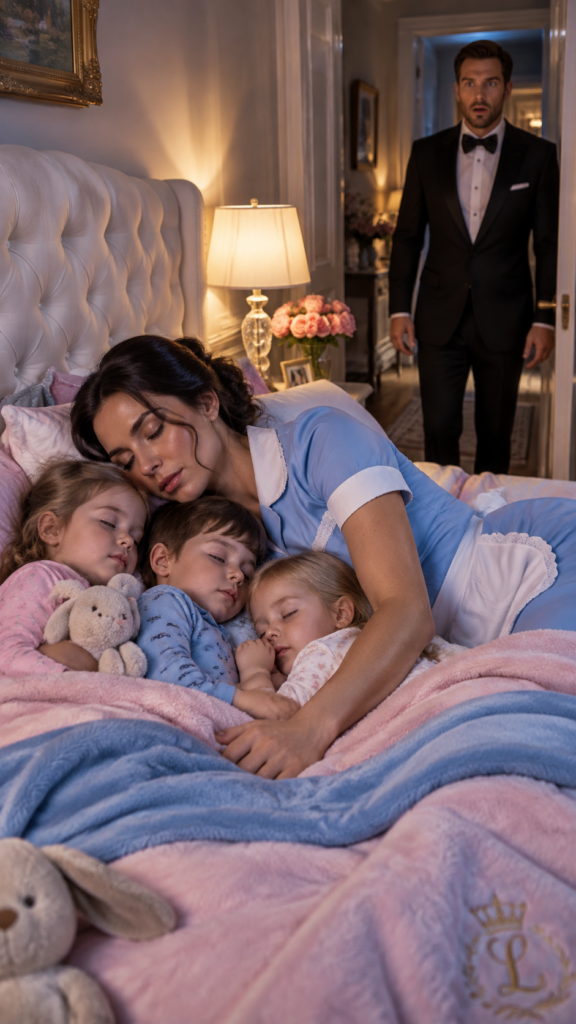
PART 2 — The Girls Who Stopped Trying to Scare Her Away
The first real breakthrough came with June.
At two in the morning, Nora woke to quiet crying echoing through the upstairs hallway. She stepped out of the guest room and followed the sound toward June’s bedroom, where pale moonlight spilled across tangled blankets and stuffed animals scattered on the floor.
June sat curled tightly against the wall wearing oversized pajamas, tears sliding silently down her face while dark stains spread across the mattress beneath her.
The child looked horrified.
“I’m sorry,” she whispered immediately. “Please don’t tell Dad.”
Nora understood the fear instantly.
Not fear of punishment.
Fear of becoming too exhausting to love.
Children carrying grief often translate accidents into evidence that they are burdens.
Without saying anything dramatic, Nora grabbed fresh sheets from the linen closet and sat beside the bed.
“Fear confuses the body sometimes,” she said softly. “Especially after trauma.”
June stared at her through wet eyelashes.
“You’re not mad?”
Nora shook her head once.
“When I was little after my brother died,” she admitted quietly, “I slept with the hallway light on for almost three years.”
June looked surprised.
“You were scared too?”
“All the time.”
Something fragile shifted in the girl’s expression then.
Trust beginning carefully.
They changed the sheets together in silence while rain tapped gently against the windows outside. Before leaving, Nora plugged in a small nightlight beside the bed.
June whispered something just before she closed the door.
“You don’t act like the others.”
The sentence followed Nora downstairs heavily because she understood exactly what June meant.
Most adults entered grief trying to control it.
Nora simply sat beside it.
Over the following weeks, the house slowly softened around her.
Brooke started playing piano again after months of silence. At first it was only hesitant notes drifting cautiously through the halls late at night when she thought nobody listened.
One evening Nora paused beside the music room doorway while Brooke stumbled through an unfinished version of Clair de Lune.
“You skipped the transition,” Nora commented gently.
Brooke froze instantly.
“You know classical music?”
“My mother cleaned hotels,” Nora answered. “One of the managers let me practice on the lobby piano after closing.”
Brooke stared at her carefully.
Then quietly moved sideways on the bench.
Nora sat beside her and played the missing section softly from memory.
After that night, music returned to the house little by little.
Ivy proved harder.
The nine-year-old suffered severe panic episodes that arrived suddenly and violently. Sometimes triggered by loud sounds. Sometimes by absolutely nothing visible at all.
One afternoon during a thunderstorm, Nora found Ivy crouched beneath the dining room table hyperventilating while lightning flashed outside the windows.
“I can’t breathe,” Ivy gasped. “Something bad’s happening.”
Nora dropped calmly onto the floor beside her instead of trying to pull her out.
“Okay,” she said evenly. “Then let’s focus on one thing at a time.”
Another thunder crack echoed overhead.
Ivy squeezed her eyes shut tighter.
Nora pointed toward the hardwood floor.
“Tell me five things you can touch.”
Ivy blinked rapidly.
“What?”
“Five things.”
“The floor,” Ivy whispered shakily. “My socks. The chair leg.”
“Good. Keep going.”
Slowly, painfully, Ivy’s breathing began stabilizing.
By the end of the episode, she leaned weakly against Nora’s shoulder looking emotionally exhausted.
“How do you know how to do that?” she asked quietly.
Nora hesitated briefly.
“Because somebody once did it for me.”
That wasn’t entirely true.
No one helped Nora properly after Mateo died.
But years of studying trauma taught her how desperately children needed calmness more than solutions.
The twins remained the most complicated.
Cora and Mae treated destruction like performance art. If silence lingered too long, they created chaos simply to force adults into emotional reactions.
One Saturday morning, Nora walked into the backyard and discovered every flowerbed destroyed. Mud covered the patio furniture while uprooted plants lay scattered across the grass like casualties after battle.
The twins stood nearby waiting tensely.
Watching.
Testing.
Jonathan appeared moments later looking furious.
“Enough,” he snapped. “Both of you inside right now.”
But Nora quietly stepped between them.
“Wait.”
Jonathan stared at her in disbelief.
“They ruined the entire garden.”
Nora crouched beside one of the broken flowerbeds carefully.
Then she looked toward the twins.
“You picked the wrong plants.”
Confusion replaced their defensive expressions instantly.
“What?” Mae asked.
“These flowers were dying already.” Nora pointed toward the roots. “See the rot here? If you wanted maximum emotional impact, you should’ve targeted the roses near the fountain.”
Silence.
The twins stared at her like she’d malfunctioned.
Nora stood slowly.
“Destruction means something,” she continued calmly. “You’re trying to prove nobody can make this house feel safe again.”
Neither child answered.
Because she was right.
Children grieving catastrophic loss often create external chaos matching the disaster inside them.
Not because they enjoy suffering.
Because unpredictability feels honest.
That afternoon, Nora handed both girls gardening gloves and drove them to a nursery across town.
“We’re rebuilding the backyard,” she said simply.
The twins exchanged suspicious looks.
“You’re not punishing us?” Cora asked cautiously.
“Oh, you’re absolutely fixing the mess,” Nora replied. “But punishment and repair are different things.”
By sunset, all three of them stood covered in dirt while newly planted flowers lined the garden beds.
For the first time since Maribel’s death, the twins smiled without cruelty hiding underneath it.
Jonathan watched from the kitchen window silently.
Later that night, after the girls went upstairs, he found Nora washing dirt from her hands at the sink.
“I don’t understand how you’re doing this,” he admitted quietly.
Nora dried her hands slowly before answering.
“I’m not trying to control their grief.”
Jonathan leaned heavily against the counter.
“I’ve spent almost a year trying to keep this family functioning.” His voice cracked unexpectedly. “And every day it feels like I’m losing them more.”
Nora studied him carefully.
“You’re trying to solve pain like it’s a business problem.”
The sentence hit harder than he expected.
Because it was true.
Jonathan built his entire career around fixing crises efficiently. Identify weakness. Apply strategy. Restore stability.
But grief ignored strategy.
“You think I don’t know that?” he asked bitterly.
“No,” Nora answered softly. “I think you know it too well.”
For several long seconds, neither spoke.
Then Jonathan asked the question quietly enough that it almost disappeared beneath the running water.
“What if they hate me for surviving when she didn’t?”
Nora’s expression softened immediately.
Children rarely blamed surviving parents rationally.
But they absolutely blamed emotional absence.
“They don’t need perfection,” she said gently. “They need presence.”
That night, Jonathan sat outside Lena’s bedroom long after everyone fell asleep.
For the first time in months, he stopped answering work emails.
Stopped reading investor reports.
Stopped pretending success somewhere else compensated for failure at home.
Instead, he listened to the quiet breathing of six grieving daughters finally sleeping peacefully beneath the same roof again.
And somewhere deep inside the mansion that thirty-seven women failed to survive—
something wounded slowly began learning how to breathe again.

PART 3 — The House That Learned How to Stay Alive
The illusion shattered on a rainy Thursday in November.
Jonathan was halfway through a board meeting downtown when his phone vibrated repeatedly across the conference table. At first he ignored it automatically. Investors were arguing over acquisition numbers, and years of corporate conditioning had trained him to prioritize crises measured in money.
Then he saw Nora’s name appear again.
And again.
Something cold moved through his chest instantly.
He excused himself mid-sentence and answered in the hallway.
Nora’s voice sounded frighteningly calm.
“Hazel took pills.”
The world stopped.
“What?”
“We’re in the ambulance now,” Nora continued steadily. “She’s conscious, but barely. Meet us at Mercy General.”
Jonathan didn’t remember leaving the building.
Later, he would vaguely recall terrified assistants chasing him through the lobby while he abandoned an entire shareholder meeting without explanation.
The hospital emergency room smelled like bleach and rainwater. By the time Jonathan arrived, Hazel was already behind closed doors while doctors moved urgently between curtains and monitors.
Nora sat alone in a plastic chair near the vending machines, streaks of rainwater still darkening her sweater sleeves.
Jonathan stared at her.
“Where are the girls?”
“My neighbor is staying with them.”
He nodded absently.
Then finally the question tore out of him.
“What happened?”
Nora looked exhausted suddenly.
“Hazel found one of Maribel’s old voicemail recordings.”
Jonathan physically flinched hearing his wife’s name aloud.
Nora continued quietly.
“She listened to it over and over while you were at work.”
The hallway blurred slightly around him.
Hazel had been carrying too much responsibility since the funeral. Too much silence. Too much pressure to become the stable one while everyone else collapsed around her.
Jonathan knew that.
And still somehow he missed how close she stood to the edge.
“I should’ve seen it,” he whispered brokenly.
Nora didn’t answer immediately.
Because sometimes guilt doesn’t need interruption.
Finally she spoke softly.
“She wasn’t trying to die.”
Jonathan looked up sharply.
“She was trying to stop hurting.”
That distinction nearly destroyed him.
Hours later, a doctor finally emerged and explained the overdose hadn’t caused permanent damage. Hazel would survive physically, but psychiatric intervention and long-term trauma counseling were now non-negotiable.
Jonathan sat down heavily after hearing the word survive.
As if his body suddenly forgot how standing worked.
For several minutes, neither he nor Nora spoke.
Then unexpectedly—
Jonathan started crying.
Not controlled tears.
Not silent grief.
Real collapse.
He bent forward in the hard plastic chair with both hands covering his face while years of exhaustion finally broke open inside him.
“I can’t lose another child,” he whispered hoarsely. “I can’t.”
Nora stayed beside him quietly.
No speeches.
No forced optimism.
Just presence.
That was always her gift.
Eventually Jonathan looked toward her with red exhausted eyes.
“What did you do,” he asked shakily, “that none of the others could?”
Nora leaned back against the hospital wall thoughtfully.
“I stayed.”
The simplicity of the answer hit harder than anything else that night.
Because every other caregiver entered the Whitaker house trying to stop the girls from grieving loudly enough to disrupt normal life.
Nora never demanded healing.
She simply refused to abandon them inside the pain.
Hazel remained hospitalized for four days.
When she finally returned home, the atmosphere inside the mansion changed permanently.
No more pretending things were manageable.
No more acting like time alone would repair six traumatized children and a father drowning in unresolved grief.
Therapists began visiting twice weekly. Jonathan cut his work schedule nearly in half despite furious protests from shareholders and executives. Family dinners became mandatory regardless of arguments or emotional meltdowns.
Slowly, painfully, honesty replaced survival mode.
One evening several weeks later, Hazel found Nora sitting alone beside the backyard fountain after everyone else had gone to sleep.
“You saved me,” Hazel whispered quietly.
Nora looked up immediately.
“No,” she answered gently. “You survived.”
Hazel shook her head.
“You called the ambulance before I even passed out.”
Moonlight reflected faintly across the water between them.
After a long silence, Hazel asked the question nobody had spoken aloud yet.
“Why are you still here?”
Nora understood immediately.
The real question underneath it.
Why didn’t you leave like everyone else?
She looked toward the glowing windows of the mansion before answering.
“When my brother died,” she said softly, “everyone treated my family like something broken they didn’t know how to approach anymore.”
Hazel listened silently.
“People disappeared because grief made them uncomfortable,” Nora continued. “Teachers stopped making eye contact. Friends stopped calling. Adults used softer voices around us like sadness was contagious.”
The fountain water rippled quietly beneath the lights.
“I promised myself if I ever met children carrying that kind of loneliness…” Nora swallowed hard. “I wouldn’t look away.”
Hazel’s eyes filled instantly.
Then, for the first time since her mother died, the twelve-year-old leaned forward and hugged someone without forcing herself to stay emotionally guarded afterward.
By spring, the house barely resembled the place Nora first entered.
Music drifted regularly from Brooke’s piano room again.
Ivy no longer hid beneath tables during thunderstorms.
The twins redirected their chaos into elaborate backyard obstacle courses instead of destruction campaigns.
June slept through entire nights without panic attacks.
And little Lena stopped asking whether dead mothers could still get lost trying to find their way home.
Even Jonathan changed.
The transformation happened gradually enough he barely noticed it himself.
He started cooking breakfast on Sundays despite being terrible at it. He attended school conferences personally instead of sending assistants. Some evenings he sat on the living room floor helping the girls with homework while paperwork remained untouched upstairs.
One rainy afternoon, Nora found him laughing in the kitchen while the twins covered his face with flour during a failed cookie experiment.
The sound startled her.
Not because wealthy men couldn’t laugh.
Because Jonathan Whitaker hadn’t sounded alive in months.
That same week, Nora graduated with honors from San Diego State University’s psychology program.
She expected a quiet ceremony.
Instead, the entire Whitaker family filled the front row wearing blue ribbons matching her graduation sash.
The twins screamed loud enough during her name announcement that several people turned around laughing. Brooke cried openly. Ivy carried flowers almost bigger than her torso. Jonathan stood applauding long before everyone else did.
But Hazel’s words afterward mattered most.
Under a blooming jacaranda tree outside the ceremony hall, the twelve-year-old approached Nora carefully while the others took photographs nearby.
“You didn’t replace Mom,” Hazel said quietly.
Nora felt tears rise instantly.
Hazel looked toward her sisters playing nearby.
“You just helped us survive missing her.”
The sentence shattered something tender inside Nora’s chest.
And for the first time since Mateo died years earlier—
her grief stopped feeling entirely lonely.
Months later, Jonathan and Nora officially opened the Maribel Whitaker Center for Childhood Grief and Trauma near downtown San Diego. Free counseling. Family support groups. Emergency mental health resources for children experiencing catastrophic loss.
On opening day, reporters asked Jonathan why a billionaire businessman invested so heavily in emotional recovery programs instead of another technology venture.
Jonathan looked toward the six girls laughing beside Nora near the entrance before answering.
“Because grief nearly destroyed my family,” he said simply. “And one woman taught us that healing begins when somebody stays.”
That night, after the ceremony ended and the center emptied quietly into evening light, Nora stood alone beneath the flowering jacaranda trees watching purple blossoms drift across the sidewalk.
Jonathan approached slowly beside her.
For several seconds, neither spoke.
Then finally:
“You changed everything,” he said softly.
Nora shook her head immediately.
“No. I just stayed long enough for all of you to change together.”
Jonathan looked toward the glowing windows of the counseling center carrying his wife’s name.
Years earlier, the Whitaker mansion became infamous among agencies as the house nobody survived.
Now children arrived there for support groups and family dinners and summer grief programs filled with noise and music and healing conversations.
The pain never disappeared completely.
It probably never would.
Maribel’s absence still existed in every room.
But love stayed too.
Longer now.
Stronger.
And somewhere upstairs inside the house that once chased thirty-seven women away, six little girls finally slept peacefully through the night knowing one terrifying truth had changed forever:
The people who loved them were no longer leaving.
