


The sudden collapse of billionaire Alexander Hail shattered the calm rhythm of his mansion, turning ordinary life into chaos in an instant. His new wife, Marissa Hail, didn’t hesitate to take control. Her trembling voice echoed through the marble halls as she accused the one person who had loyally served the family for years—Caroline Ward, the longtime housekeeper.
Caroline stood still, confused and shaken, unable to understand how years of quiet devotion had suddenly turned into suspicion. Whispers spread quickly, creeping through the house. Every familiar room began to feel unwelcoming.
Amid the turmoil, one figure remained silent.
Lena Hail, Alexander’s autistic daughter, sat in her wheelchair near the entrance, her calm eyes taking in everything. Many believed she didn’t understand much, that she was locked inside her own world. But Lena saw it all—the way Marissa clutched her chest too dramatically, how she repeated the same carefully practiced lines, how she refused to meet Caroline’s eyes.
In the days that followed, investigators questioned everyone, reporters gathered outside the gates, and Caroline’s life narrowed into fear. But Lena’s mind quietly replayed what others overlooked: unusual bottles hidden behind kitchen items, the soft sound of a drawer closing late at night, the way Marissa’s voice shifted whenever Alexander wasn’t around. As false accusations threatened to destroy an innocent woman, it would be Lena—the child no one believed could speak for herself—who would lead them back to the truth. She rarely spoke, but her silence carried truths the adults failed to see.
From the moment Alexander’s new marriage unsettled the house, Lena felt the shift long before anyone else acknowledged it. Her world depended on routine—quiet mornings, peaceful afternoons beside her father, the soft turning of pages as he worked. Marissa’s arrival was like a storm breaking through clear skies. Voices grew sharper. Footsteps became heavier. Spaces that once felt safe now pulsed with a tension Lena couldn’t name but felt everywhere.
She watched from her wheelchair as her father tried to adjust, believing companionship might restore balance. But whenever he stepped away, Marissa’s warmth disappeared. The gentle smile she showed Alexander faded into cold impatience—something Lena felt like pressure on her chest. Toys were moved out of reach. The wheelchair was pushed too firmly. Even the air seemed different when Marissa entered—thin, rushed, unsafe.
Lena said nothing. She observed and remembered with a clarity no one expected from a child who rarely spoke. She tracked where Marissa stood, what she touched, what she moved. She noticed bottles vanishing from shelves and reappearing in unfamiliar drawers. She collected sounds—the faint clink of glass, the quiet shut of a cabinet, footsteps late at night that didn’t belong to her father. Beneath it all, she carried a silent fear: losing the one person who had always been her steady light.
Alexander’s health declined, and Lena sensed it before anyone else. She couldn’t find the words to warn them, but in her mind, the truth was already forming—the truth that could save them all.
When Caroline was taken away under harsh fluorescent lights, she learned what fear truly sounded like: the silence of no one believing you. One moment she was preparing morning tea; the next, officers surrounded her, demanding answers she didn’t have. Marissa stood behind them, pale in all the right ways, whispering accusations sharp enough to cut through the air. Staff members Caroline had known for years avoided her gaze, unsure whether to trust or fear her. The home she had cared for so faithfully turned against her overnight.
At the station, the questions came without pause. Why was she near Alexander’s meals? Why had she been in the kitchen that morning? Why did her statements not fully align? Caroline tried to steady her trembling hands, tried to speak through her fear, but every word felt like a rope tightening around her throat. Years of care, loyalty, and protection meant nothing now. To the investigators, she was no longer a devoted housekeeper—she was the ideal suspect.
Back at the mansion, Lena watched the police cars take away the only adult who had ever understood her without needing words. Lena didn’t cry. She rarely did. But her hands shook against the wheelchair’s armrests. She knew Caroline was innocent. The fear in Caroline’s eyes wasn’t guilt—it was betrayal. And deep within her quiet mind, Lena held the images, sounds, and movements everyone else had missed—the truth no one had ever asked her to share.
In the days following Caroline’s arrest, Lena drifted through the mansion like a silent shadow—observing, remembering, quietly gathering strength. Adults passed her with hurried steps and sharp voices, convinced she was too fragile, too distant, too quiet to understand. But Lena understood more than anyone. Her father was gone. Caroline was gone. And Marissa’s presence now felt heavier, colder, as if even the walls shrank when she entered a room.
Lena’s new caregiver, Julia Benton, tried to reach her, struggling to interpret Lena’s subtle cues—small finger movements, the direction of her gaze, the way her breathing changed near the kitchen. Caroline had once understood all of this without effort. Now Julia watched uncertainly as Lena’s trembling hands hovered, as if mapping something unseen.
One afternoon, Lena tapped the arm of her wheelchair once, then again, before pointing urgently down the hallway. Julia’s heart skipped. Unsure but drawn forward, she followed. Lena led her to a plain cabinet tucked behind neatly stacked dishes. She fixed her gaze on it without blinking. Julia hesitated—then slowly opened it.
Inside, small bottles were hidden behind larger containers—some empty, others marked with faint residue clinging to the glass. Lena pointed again, this time toward a locked drawer. Julia searched until she found the key. More bottles. More containers. More evidence. A chilling realization settled over her. Lena hadn’t been silent because she was helpless. She had been waiting—for someone willing to see.
When the sealed box was placed on the courtroom table, the room seemed to fall into a heavy silence. The contents matched the poison found in Alexander’s bloodstream. Caroline, seated at the defense table, barely dared to breathe. Across the room, Marissa tensed. Her carefully crafted grief slipped for just a moment—but Lena caught it. She always did.
Marissa objected loudly, but the act no longer convinced anyone. Julia took the stand, explaining how Lena had guided her step by step to every hidden place. The courtroom’s attention shifted—not to Marissa, not even to the evidence—but to the small girl in the wheelchair who had found her own way to speak.
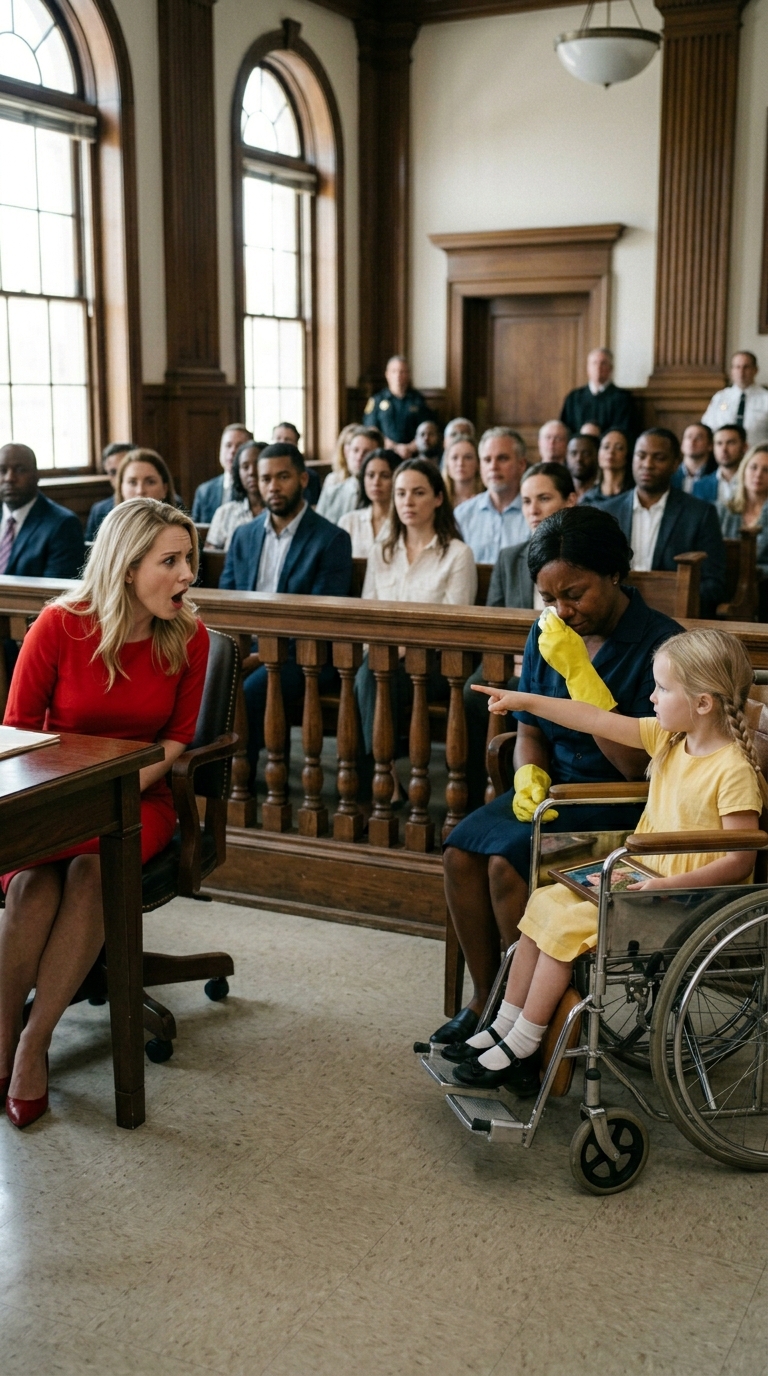
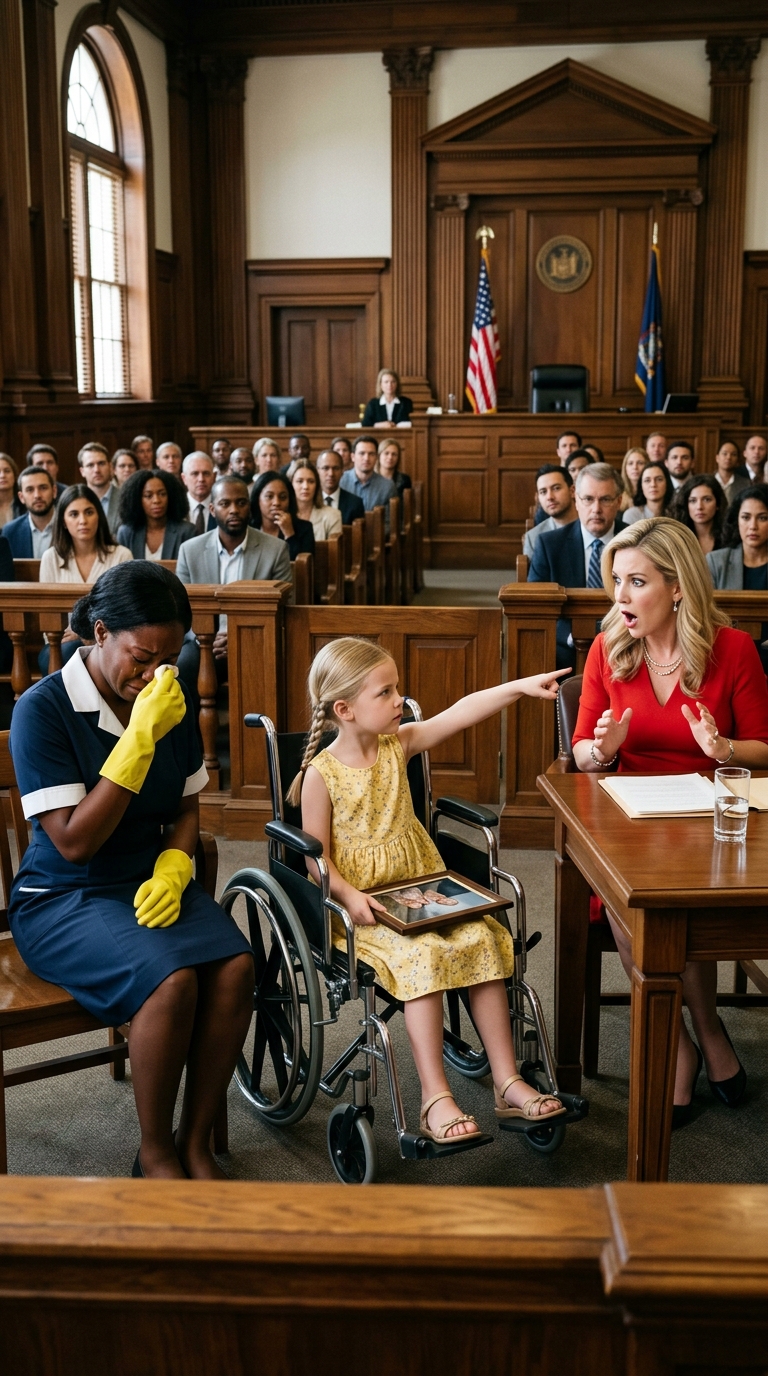
When Lena slowly lifted her trembling hand and pointed straight at Marissa, the entire room froze. She mimed opening a bottle, pouring, stirring, then closing a drawer with a soft click. No words were needed.

Panic flickered across Marissa’s face. The mask began to break.
Then the courtroom doors flew open.
Alexander Hail walked in—alive.
Gasps spread through the room as he revealed the truth: he hadn’t died. He had disappeared because he knew someone close to him wanted him gone. He had staged his collapse to uncover the truth without alerting the one person he could no longer trust.
Marissa shattered.
As officers fastened the cuffs around her wrists, Caroline broke down in stunned relief. The charges against her were dropped. Lena rolled forward, reaching toward her father.
“Finally,” she whispered. “Safe.”
Later, back at the mansion, the house felt like it was learning to breathe again. Healing came quietly—in teacups placed gently on tables, in a father brushing his daughter’s hair back, in the steady presence of a housekeeper who had never stopped caring.
The truth endured because a child who rarely spoke refused to forget.
And the house, once filled with betrayal, slowly became a home again.
This story is a reminder:
Strength is not always loud.
Truth is not always spoken.
And sometimes, the quietest person in the room carries the truth that saves everyone.
