


PART 1 — THE FUTURE HE EXPECTED ME TO FINANCE
“God, I hope never. I’d rather die than marry her.” My boyfriend made that announcement in front of twenty-three guests, laughing so hard his whiskey nearly sloshed over the rim. The laughter was not even the worst of it. He had his finger pointed directly at me. Three hours afterward, I would discover that the same man who considered marrying me a fate worse than death had supplied a mortgage lender with my private financial records without permission. But at 9:47 that Friday night, I knew nothing about that submission. All I knew was that someone I had loved for nearly three years had just told a roomful of people that spending his life with me would be unbearable.
My name is Mara Ellison. I was thirty-three, worked as a manufacturing engineer, and had apparently become the most embarrassing woman in Louisville, Kentucky. We were celebrating our friends’ engagement at a fashionable cocktail lounge in NuLu. Around us, guests displayed expensive watches and ordered cocktails that cost more than I sometimes spent on groceries for a week. Beside me stood Drew Kessler in the navy blazer I had bought for his birthday. Handsome, assured, completely comfortable. Drew had always found it easy to relax when someone else was paying. Gavin Roark had just announced his engagement to his longtime partner, Elise. During the congratulations, Drew’s closest friend, Parker Mays, raised his glass.
“All right, Drew. Gavin’s officially off the market. When are you finally going to propose to Mara?” Faces turned toward us. Somebody gave a little chuckle. Drew’s hand tightened briefly around my waist, and for one foolish second, I thought something tender was coming. Instead, he delivered the sentence that ended our relationship. “God, I hope never. I’d rather die than marry her.” Awkward laughter traveled around the table. Parker slapped the bar, Gavin lowered his glass, and Elise looked horrified. Drew mistook the attention for encouragement. “Come on, you guys know me. I’m not built for that boring suburban husband routine. Mortgage payments, grocery lists, mowing the lawn every Saturday.”
He looked over at me. “Mara’s great. Seriously. She’s dependable. But being married to someone that predictable?” He shook his head, allowing the pause to do its work. “That’s a life sentence.” Someone quietly said his name. Drew ignored the warning. “Besides, why buy the cow when the milk’s already free?” Something inside me moved into a different place. It did not shatter. It did not explode. It simply changed. I remembered covering expenses when he was unemployed, staying up late to prepare him for interviews, and organizing celebrations when he received promotions. I remembered expensive dinners and the wallet that somehow kept disappearing whenever the check arrived.
Then I remembered all our discussions about purchasing a home. Only two days earlier, he had kissed my forehead in our kitchen and whispered, “I can’t wait to build a future with you.” Now he was entertaining his friends with the horror of that very future. I looked down at my champagne and smiled. “You’re absolutely right, Drew.” He blinked. “What?” “I said you’re right.” I placed my glass on the bar. “Nobody should have to spend their life with someone they don’t want to marry.” The smile began sliding off his face. “Mara, come on.” “No, really. Thank you for being honest.”
I pulled forty dollars from my purse and placed the money beside my drink before meeting his eyes. “Don’t worry. You won’t have to marry me.” Then I started toward the door. Behind me, Drew laughed, but this time the sound was nervous. “Seriously? You’re doing this?” I kept walking. “Mara!” I reached the entrance. “Baby, it was a joke!” That made me turn around. “Then here’s another one.” The group went silent. “Congratulations. You’re single.” I stepped outside before he could answer. Cool air brushed my face. Traffic passed, music drifted from nearby restaurants, and my hands trembled. I would not cry there. Not in front of anyone.
Before I could request a ride, my phone vibrated. Drew: Are you seriously embarrassing me over a joke? A second message arrived. Drew: Get back in here. You’re making everyone uncomfortable. Then a third. Drew: We have important things to do Monday. Don’t start drama now. Monday. Somehow, that single word hit harder than his performance inside. According to Drew, we had an appointment with a mortgage broker on Monday morning. We had been looking at a four-bedroom house in a quiet suburb. I liked its wraparound porch, two-car garage, and space for a workshop. The asking price was $438,000. I had spent seven years putting money aside for a down payment.
Drew had spent seven months describing everything he would do with the garage. When I asked what he planned to contribute, he generally kissed my cheek and said, “We’re a team, sweetheart. Don’t turn everything into a spreadsheet.” I should have understood what that answer meant. Instead, I had chosen to trust him. I ordered a car and watched Louisville’s lights pass beyond the back-seat window. By the time I arrived home, eleven calls from Drew had gone unanswered. His expensive leather shoes were beside the sofa. Three empty energy-drink cans sat on the coffee table among bills he had assured me he would handle. The apartment looked painfully familiar.
I went into the spare room, the one Drew called my “little engineering cave.” My laptop waited on the worktable, and my motorcycle helmet rested beside a toolbox. Then I noticed a new email on my phone. The sender was Bluegrass Home Lending. Its subject line made my stomach tighten: Your Mortgage Prequalification Documents Have Been Received. For a moment, I only stared at it. Nothing was supposed to happen before Monday. I opened the message and read that my pay slips, employment verification, and available down-payment information had arrived. I had sent them none of those things. My pulse began beating faster as I continued reading.
The inquiry named me as the primary borrower. Drew was listed only as an additional occupant. I read that distinction three times. The man who had publicly ridiculed marrying me had privately started arranging a mortgage around my income, without telling me. My phone rang again, but this time the caller was Elise. “Mara?” she whispered. “Please tell me you haven’t signed anything for that house.” My mouth went dry. “No. Why?” The silence stretched before she answered. “Because Drew told Gavin what he plans to do after you buy it.” I gripped the phone. “What does he plan to do?” Elise took an uneven breath. “Mara, you need to hear this from someone who was there.”

“He said he wasn’t planning to stay with you forever,” Elise whispered. For several seconds, I could not find words. When I finally spoke, I asked the question that mattered. “How long has he been saying that?” “At least six months.” Six months. During that time, Drew had shown me pictures of remodeled kitchens, discussed hardwood versus tile, and decided where we should put our Christmas tree. Elise continued carefully. “Gavin told me Drew said you were going to buy the house because your credit was excellent and you had enough money saved. He wanted to use the garage as an office for a consulting business. He said once that business took off, he’d have more options.”
“What options?” I asked. Elise hesitated. “Other cities. Other relationships. Whatever he wanted.” I closed my eyes. “And the mortgage?” “He said that would be your responsibility because it would be your house.” I stared at my dark computer screen. His arrangement was almost breathtaking in its simplicity. He wanted everything commitment could provide without accepting any of its burdens. My income, my credit, my savings, my reliability, and a comfortable house would support him. Every financial risk would remain with me. Apparently, I was also expected to tolerate being the joke. “There’s more,” Elise said. For months, Drew had discussed the plan with Gavin and Parker as though it were a running comedy.
My budgeting amused them. So did my reliable job, my habit of tracking bills, and even my desire to own a home. “I should have told you sooner,” Elise said. “I thought Gavin was exaggerating. Tonight I realized he wasn’t.” I thanked her. She started crying, and I came close to breaking down myself. Hearing concern from her made Drew’s indifference feel even colder. After we ended the call, I opened my banking app. The balance was $54,680. Seven years of overtime, postponed trips, lunches carried from home, and deliberate spending. My money. Still safely outside Drew’s control. For once, I felt profoundly grateful that I had refused his repeated suggestions that we combine our savings.
I opened my email and began dealing with what I could control. First, I informed the lender that nobody had authorization to submit my records. I asked them to stop the inquiry, delete documents they were not legally required to retain, and obtain my direct approval before processing any application. Then I changed my banking passwords, checked account activity, and froze my credit. I saved records showing the household expenses I had paid: rent, utilities, groceries, Drew’s car insurance, and his portion of a medical bill from the previous winter. I was not assembling revenge. Before walking away, I wanted a truthful account of what had happened and what belonged to whom.
At 12:36 a.m., the front door opened. Drew came in smelling of bourbon and expensive cologne. “There you are,” he said. I kept typing. He stopped at the doorway. “Are you seriously still upset?” “No.” That caught him off guard. “Then why aren’t you answering my calls?” “Because we’re finished.” He laughed. “Okay. Very dramatic.” I turned my chair toward him. “I’m not being dramatic.” “Mara, everybody knows I was joking.” “Elise didn’t think so.” His expression changed immediately. “What did Elise say?” I watched him carefully. He had not asked whether I was okay. He had not apologized. He wanted to know what information had reached me.
I indicated the laptop. “Why did Bluegrass Home Lending receive my pay statements?” His face went still. “What?” “You heard me.” He glanced toward the exit. “I was just getting the process started.” “Without asking me?” “We already talked about buying a house.” “We talked about looking at houses. We didn’t agree to submit my private financial information.” He sighed as though I were making a simple matter unnecessarily difficult. “You’re making this sound criminal.” “I’m telling you it was dishonest.” He dragged a hand through his hair. “Fine. I should’ve asked. Happy?” “No.” “What do you want from me?” “The truth.” He folded his arms. “About what?”
“Did you tell Gavin you planned to live in the house I bought until your business took off, then leave whenever you felt like it?” The color drained from his face. I already had my answer. “Those guys twist everything,” he muttered. “Did you say it?” “Mara—” “Yes or no?” He stared at me before finally saying, “I said I didn’t want to be pressured into marriage.” “And you wanted me to take on a $438,000 house.” “That’s different.” “How?” His mouth opened, but no answer followed. I stood up. Throughout our relationship, I had been the calm one, the person who listened to work complaints, made plans when money frightened him, and found excuses when he let people down.
That night, there were no excuses left. “You told everyone you’d rather die than marry me,” I said. “But you were perfectly comfortable asking me to spend my savings on a house for us.” His voice softened. “You’re blowing this way out of proportion.” “No. I’m finally seeing the proportions correctly.” His jaw tightened. “So what? You’re throwing away almost three years because I made one stupid joke?” I slowly shook my head. “I’m ending three years because you told the truth when you thought I’d be too embarrassed to challenge you.” He looked at me as if he had never met me before. Then he rearranged his face into something gentler.
“Come on, baby. You know I love you.” My chest tightened. Before that evening, those words would have worked. “Maybe you do,” I said. “But you don’t respect me.” He reached for my hand, and I stepped back. “Don’t.” His expression hardened again. “You’re going to regret this.” “Maybe,” I said. I picked up the folder containing my birth certificate, passport, car title, and financial paperwork. “But at least whatever happens next will be my decision.” I carried it into the guest room and locked the door. For twenty minutes, Drew knocked. Apologies became arguments. Arguments became accusations that I had deliberately embarrassed him. Eventually, the knocking stopped.
At 2:14 a.m., while I searched for somewhere temporary to live, another email arrived from the lender. Attached were copies of Drew’s original submission. One document included a handwritten note: Primary borrower has strong income and substantial savings. She will handle the mortgage. I will contribute once my business becomes profitable. I kept looking at those words. There was no company. No investor. No capital. He had not even registered a business. There was only another promise that his contribution would come someday. Alone behind the locked door, I finally understood what he was frightened of losing. It was not me. It was everything I made possible for him—and he had not yet discovered that I was taking it all away.
PART 2 — THE WOMAN WHO STOPPED PAYING
By Saturday morning, Drew had rewritten the previous evening. In the messages arriving on my phone, he had done nothing humiliating. I was the one who had embarrassed him, disrupted the engagement celebration, offended his friends, and jeopardized our relationship over a harmless joke. His account to Parker was especially creative. Apparently, I had spent months demanding an engagement ring and had used Gavin’s party to trap him into proposing. I nearly laughed when I heard that. I had never asked Drew for a proposal. I had asked him to stop leaving wet towels on the bedroom floor. Somehow, even that ordinary request had required more follow-through than he seemed willing to provide.
At 8:15 that morning, I called my older brother, Caleb. “Can you help me move some things?” I asked. He answered without hesitation. “How many things?” “Enough to start over.” There was a pause. “Do I need to bring my truck?” “Yes.” “Do I need to bring a lawyer?” “Not yet.” “Okay. I’ll be there in forty minutes.” Caleb had never particularly liked Drew, but he had not made a habit of saying so. I appreciated that restraint now. My brother understood that people sometimes have to arrive at the truth themselves. He had let me reach my own conclusion, and when I finally did, he did not waste time telling me he had known all along.
When Caleb arrived, I was putting engineering textbooks into boxes. Drew stood in the hallway, looking offended by the entire operation. “You’re seriously bringing your brother into our business?” Caleb glanced at him. “Morning, Drew.” “She’s acting crazy.” My brother looked back at me. “You okay?” “Yes.” He nodded and picked up a box. That was the whole exchange. Drew looked almost let down. He had seemed ready for a confrontation, perhaps another chance to become the wronged party. Instead, Caleb carried my belongings to his truck without arguing. I continued packing. Clothes, tools, my computer, motorcycle gear, and furniture I had owned before Drew and I lived together.
I photographed everything I removed. The television, sofa, and shared appliances stayed behind. Anything replaceable was not worth a fight. Our lease still had six weeks to run, and both our names were on it. Leaving did not erase my obligations, so I confirmed the expiration date with the property manager and formally declined to renew. I arranged to pay my portion through the end. If Drew qualified for a new lease, he could sign one. That was his decision to make, not another problem for me to solve. By early afternoon, my things were in Caleb’s garage. I had reserved a furnished monthly rental that would be available on Tuesday.
Until then, Caleb offered me his guest room. As we drove away, Drew stepped onto the balcony and lifted his phone to film us. “Let him,” Caleb said. I watched Drew grow smaller in the side mirror. Somehow, without a responsive audience, he looked older. That night, Caleb and I ate pizza off paper plates at his kitchen table. He poured iced tea and finally asked what had happened. I told him about the party, the house, the financial documents, and Elise’s call. He listened without interrupting. When I finished, he rubbed his forehead. “Let me get this straight. He doesn’t want to marry you, but he wants you to take out a mortgage so he can have an office?”
“Apparently.” “And he thinks you’re the one making unreasonable demands?” “Also apparently.” Caleb leaned back in his chair. “Mara, you’ve spent three years trying to make that man comfortable. Maybe it’s time you found out what makes you happy.” I looked at him, surprised by how difficult such a straightforward question felt. Before Drew, I had loved weekend motorcycle rides. Caleb and I had spent Saturdays restoring a 1982 Honda CB750. I had enjoyed camping without needing luxurious bathrooms and teaching machine-tool skills to young women at a local technical college. Bit by bit, those things had disappeared. Drew thought motorcycles were loud, camping had inadequate internet, and volunteering took time away from “networking.”
Somewhere along the way, his preferences had become the rules of my life. “I think I want my bike back on the road,” I said. Caleb smiled. “Now that’s something I can help with.” Over the next three days, Drew worked through different kinds of messages. Insults came first: You’re destroying our relationship over your ego. Then guilt: After everything we’ve been through, you owe me a conversation. After that came the practical panic: How am I supposed to afford the apartment by myself? Eventually, he reached what he apparently considered the central issue. We still need to figure out the house. Don’t ruin our financial plans just because you’re upset.
I sent one reply. There are no house plans. I have withdrawn from the mortgage inquiry. I will pay my legal obligations under our existing lease, but I will not purchase property with you. Please communicate by email regarding any remaining shared expenses. His response appeared immediately: You can’t do this to me. I did not answer. On Tuesday, I moved into the furnished rental. It had beige walls, an ugly green sofa, and a balcony overlooking a parking lot. I loved it. Nobody objected to the way I arranged my tools. Nobody criticized the documentaries I watched. Nobody walked through the door expecting dinner to be waiting. That evening, I stood at the counter eating scrambled eggs and felt a peace that caught me off guard.
Then I cried for forty minutes. I was not grieving because I wanted Drew back. The quiet had finally given me room to understand what I had lost. I cried for the woman who believed him, for the hours I spent defending someone who mocked me, and for all the pieces of myself I had surrendered without noticing. After washing my face, I called Caleb. “Are we still working on the Honda this weekend?” “Absolutely,” he said. I smiled. Then a number I did not recognize appeared on my screen. I answered. “Mara, sweetheart, it’s Lorraine Kessler.” Drew’s mother sounded unusually stern. “I understand you’re refusing to go through with the house purchase.”
“That’s correct.” “Well, you can’t simply abandon your responsibilities.” I closed my eyes. “What responsibilities?” “Drew has already invested a considerable amount of money in that business you’re supposed to help him launch.” I sat down. “What money?” Lorraine sounded taken aback. “He didn’t tell you?” “Tell me what?” After a silence, she said, “He’s already spent $18,700 preparing his office for your new house.” I looked around my small rented apartment. At last, Drew’s determination to preserve that mortgage appointment made sense. “Let me understand something,” I said carefully. “Drew spent $18,700 on a business without consulting me, and now you believe that’s my responsibility?”

Lorraine huffed. “He made those investments because the two of you were building a future.” “Did he tell you I agreed to finance his business?” “Well, he said you were supporting him.” “Supporting someone emotionally isn’t the same as guaranteeing their debts.” She fell quiet. “Did he sign the financing agreements himself?” I asked. “Yes, but—” “Then those are his agreements.” Her tone changed. “I always thought you were a generous woman.” “I am. That’s why I spent months helping your son when he was unemployed. But generosity isn’t an obligation to fund every decision he makes.” “He’s devastated, Mara.” “So am I.” For the first time, she seemed unsure of herself. “You don’t sound devastated.”
I took in the unfamiliar walls, borrowed furniture, and boxes around me. “You don’t have to hear someone crying to know they’ve been hurt.” Then I ended the call. The next morning, Drew emailed a breakdown of the spending. Computers, office furniture, video equipment, software subscriptions, and a commissioned website for a consulting business with no clients. Most of it had gone onto credit cards and installment agreements bearing his name. He had intended to operate from the garage of a property financed with my earnings and savings. Then, among all those details, I found one more fact he had not thought necessary to mention before. Two days before the engagement party, he had resigned from his marketing job.
I read that sentence at least five times. When he stood in that cocktail lounge laughing at the thought of marrying me, he already knew his regular salary was about to disappear. Once again, he expected mine to carry him. He had publicly belittled the very woman whose income he intended to depend on. My reply was four sentences long. I did not agree to fund your business or guarantee any of its expenses. I was not informed that you resigned from your job. Please remove my name from any business materials or financial discussions. I will not be contributing money. He answered at once: So you’re really going to let me fail?
For almost three years, I had treated his success as something I was responsible for producing. Now I understood the distinction I should have seen much earlier. Wishing someone well did not mean paying for the life he wanted. I closed his message and went to work. My employer, Cumberland Dynamics, manufactured specialized industrial equipment. For nearly eight years, I had developed production systems and solved expensive manufacturing problems. That Thursday, my manager, Ruth Calder, called me into her office. “We’ve got a major project coming up,” she said. A major manufacturer needed an outdated production line replaced. The assignment would involve several demanding months, occasional travel, and leadership of a small engineering team.
“It’s a big opportunity,” Ruth said. “But I know you’ve been hesitant about taking on assignments that involve weekends.” I remembered opportunities I had turned down because Drew disliked my working hours. Then I thought of the man who had secretly left his own job while assuming my paycheck would finance his ambitions. “I’m interested,” I said. Ruth smiled. “Good. I was hoping you’d say that.” In the weeks that followed, I worked harder than I had in a long time. Strangely, those longer days left me less exhausted. There were no repeated calls about a supervisor who had criticized a presentation, no emotional emergencies over an invitation that never came, and nobody requiring me to organize his moods along with his finances.
I was tired because I had worked, not because I had spent the day managing another adult’s feelings. On weekends, Caleb and I returned to the Honda. When its engine finally started, he cheered loudly enough to bring a neighbor outside. I joined a local motorcycle club, and one Sunday we rode through rolling hills before stopping at an unpretentious roadside diner. Nobody there seemed impressed by expensive watches. That was where I met Miles Rourke, a quiet mechanic with a ridiculous collection of vintage helmets. He asked about my Honda, and I spent fifteen minutes explaining the restoration. He listened. Really listened. Then he asked a thoughtful question about synchronizing the carburetors.
I nearly laughed. I had forgotten how enjoyable a conversation could be when neither person was performing for an audience. I was not looking for a relationship, not then. Still, Miles reminded me that kindness did not automatically make everyone see an opportunity to take advantage. Meanwhile, Drew’s plans were unraveling. His consultancy did not have enough paying clients to cover its expenses. When our old lease ended, he could not qualify for a replacement and moved into his mother’s spare bedroom. Parker stopped responding to repeated requests for loans. Gavin eventually apologized for failing to speak up at the party. I accepted his apology without pretending it restored a closeness I no longer felt.
Elise had confronted Gavin about the months he spent laughing along with Drew. Whatever followed between them was theirs to work out. I no longer felt responsible for repairing everyone else’s relationship. Six weeks after I left, Caleb called one evening. “Have you checked your Facebook?” “No. Why?” “You need to see what Drew posted.” I opened the app. A video began playing. Drew appeared to be in his mother’s guest room. His eyes were bloodshot, and his voice shook as he stared into the camera. “I trusted someone with my future,” he said. “I built a business believing we were partners. Then she walked away, kept the money we’d saved for our house, and left me with almost twenty thousand dollars in debt.”
My stomach turned. “People need to understand how financially controlling someone can be while pretending to be the victim.” Then he said my name. He named my employer, too. Within hours, dozens of people had shared the video. Strangers called me heartless. Some claimed I had stolen his money. Others accused me of financial manipulation. I sat there watching the man who had publicly rejected me present himself as the victim of my abandonment. Then a message arrived from a colleague: Mara, someone tagged Cumberland Dynamics in Drew’s video. HR has been notified. Are you aware of this?
I put the phone down. Until that moment, leaving without making a spectacle had been enough. I had wanted distance, privacy, and the chance to rebuild my life without spending every spare moment responding to him. Now his accusations had reached the place where I had worked for nearly eight years, the career I had built through problems solved and responsibilities fulfilled. Drew had made a serious mistake. He had mistaken my refusal to argue for permission to rewrite the facts. What he did not know was that I had kept every record—and I was finally ready to let someone else read them.
PART 3 — THE RING AT MY OWN FRONT DOOR
The following Monday, I carried my evidence folder into an attorney’s office. Celia Wainwright was in her fifties, sharp-eyed and entirely unmoved by Drew’s online performance. After watching the video, she looked at me over her glasses. “Did you ever have a joint savings account with this man?” “No.” “Did you sign any agreement to invest in his business?” “No.” “Did you take any money belonging to him?” “Absolutely not.” “Then we have a fairly straightforward factual issue.” She reviewed my bank statements, the lease, the mortgage emails, and Drew’s messages. I had saved everything, not because I had planned a lawsuit, but because engineers document a problem before attempting to solve it. Celia explained that Drew could describe his feelings about our breakup. False statements of fact that damaged me were another matter. Her letter demanded that he remove the accusations, stop dragging my employer into them, and issue a correction. It also reserved my legal rights if he continued. I approved it and went to work.
Ruth had already spoken with HR. When she called me into her office, she was direct. “I don’t need details about your private relationship,” she said. “But I do need to know whether there’s any legitimate allegation involving company funds or confidential information.” “There isn’t.” I gave her the supporting documents. She reviewed them and nodded. “Then as far as I’m concerned, this is a private dispute. HR has documented your response.” My shoulders finally relaxed. Ruth leaned forward. “Now, can we get back to the production-line project?” I smiled. “Please.” That afternoon, I posted a short statement for the people who had been pulled into Drew’s accusations. The down-payment savings belonged to me. I had never promised to bankroll his business. The debts were his. I included no insults and exposed none of his private financial information. I corrected the record and declined to discuss the matter further in public.
Elise called soon afterward. “I’m sorry you had to do that,” she said. “So am I.” “For what it’s worth, Gavin told Drew to take the video down.” “Did he?” “Yes. He told Drew that blaming you wasn’t going to make his decisions disappear.” I was quiet for a moment. “How did Drew react?” “Not well.” Three days later, the video disappeared. A week after that, Drew posted an acknowledgment that the savings had been mine, I had stolen nothing, and I had never agreed to finance his company. There was no apology for the engagement-party humiliation and no mention of sending my financial records without permission. But the central accusations had been withdrawn. I saved the correction and stopped looking at his page. Keeping track of his opinions was no longer a job I wanted.
My own life needed attention, and now I had the energy to give it some. The production-line project became the most demanding assignment of my career. Technical failures, delayed supplies, difficult meetings, and long evenings tested all of us. I welcomed the work. There was real satisfaction in confronting problems that could actually be solved. When an automated inspection system began rejecting acceptable parts, I spent three days tracing the fault to a temperature-sensitive sensor. Correcting it prevented weeks of production disruption. Our team finished before the revised deadline. At the final review, Ruth announced that I was being promoted to senior engineering manager, with a substantial salary increase and a performance bonus. The room applauded. I smiled until my cheeks hurt. In the parking lot afterward, I called Caleb. “Guess what?” “You finally bought that fancy torque wrench?” “Better.” “Impossible.” “I got promoted.” He yelled so loudly that I pulled the phone away from my ear.
We celebrated that weekend with burgers and milkshakes at the diner we had visited as teenagers. No champagne, fashionable lounge, or carefully staged display. Just my brother and me laughing over fries. Six months after the party, I started looking at houses again. The four bedrooms and grand staircase no longer appealed to me. I wanted something practical, sound, and affordable enough that buying it would not wipe out my safety net. My agent, Fiona Hartley, eventually showed me a modest brick ranch built in 1958. It sat on a quiet street among mature trees and other unassuming homes. The kitchen needed work, the bathroom had terrible yellow tile, and the basement carried a faint cardboard smell. Behind the house stood a detached two-car garage with electricity, a solid concrete floor, and enough space for a motorcycle lift. The moment I stepped inside, I understood that I had found what I wanted.
Fiona watched me examining the breaker panel. “Most buyers start with the kitchen.” I smiled. “Most buyers don’t own a forty-year-old Honda.” The asking price was $319,000. After the inspection and negotiations concerning the aging HVAC system, the seller accepted $310,000. I used savings for the down payment, part of my bonus for closing costs and the first repairs, and left my emergency fund intact. The mortgage was mine alone because I had chosen it, not because someone else required a place to pursue his ambitions. On closing day, I spent almost an hour standing in the empty living room. I thought about the house Drew had wanted: the expensive kitchen, the garage he had claimed for his company, and the payments he had intended to leave with me. Then I looked around my smaller home and smiled. This was not the life I had settled for. It was the one I actually wanted.
Caleb helped paint. Miles repaired an old workbench in the garage. Elise brought food during our first renovation weekend. Within a month, the place felt like mine in more than the legal sense. I arranged a simple housewarming. Twelve people came. We grilled burgers, music played from a portable speaker, and motorcycles stood along the driveway. It was not elaborate, and nothing about it needed to impress anybody. While Caleb was opening a bag of chips in the kitchen, the doorbell sounded. He checked the security feed, and the smile left his face. “Mara.” I looked up. “What?” He turned the screen toward me. A man stood on the porch in a charcoal coat, carrying something small. At first, I barely recognized him. He had lost weight, and exhaustion showed in his face. Then he lifted his eyes toward the camera.
Drew. In his hand was a small black velvet ring box. Caleb looked at me. “Do you want me to tell him to leave?” I stared at the screen. Seven months earlier, this man had entertained a crowd by ridiculing the idea of marrying me. Now he was outside the house I had bought without him, apparently holding an engagement ring. I put down my glass. “No,” I said. “I’ll handle this.” I opened the door before he could ring again. For several seconds, we only looked at each other. Then he offered an uncertain smile. “Hey, Mara.” “Hello, Drew.” His eyes moved past me toward the sounds of conversation and music. My life was carrying on without him. “Looks like you’re having a party.” “It’s a housewarming.”
He swallowed. “Yeah. I heard you bought a place.” I gave a small nod. “How did you find my address?” “Your real estate agent posted a congratulations picture. Someone recognized the house.” I made a mental note to check the privacy settings on that post. He looked down at the box. “I know I shouldn’t have shown up like this.” “Then why did you?” He took an unsteady breath. “Because I needed to see you.” I remained in the doorway. His gaze traveled toward the garage. “Nice place.” “Thank you.” “Big garage.” “Yes.” He gave a sad little laugh. “Of course.” I said nothing. At thirty-six, he looked older than he should have. The man who once controlled every conversation now seemed unable to find an opening.
At last, Drew lifted the lid of the velvet box. Inside was a modest diamond ring, a small round stone in a vintage setting surrounded by tiny stones. “My grandmother’s,” he said quietly. “My mom gave it to me.” I looked from the ring to his face. “Mara, I’ve spent seven months thinking about what happened.” Behind me, Caleb came into the hallway. I glanced back. “I’m okay,” I told him. He hesitated, then withdrew, staying close enough to help if I needed him. Drew continued. “I know what I said was horrible. I know I humiliated you.” “Yes, you did.” The ring remained between us while the sounds of my housewarming drifted through the open doorway.
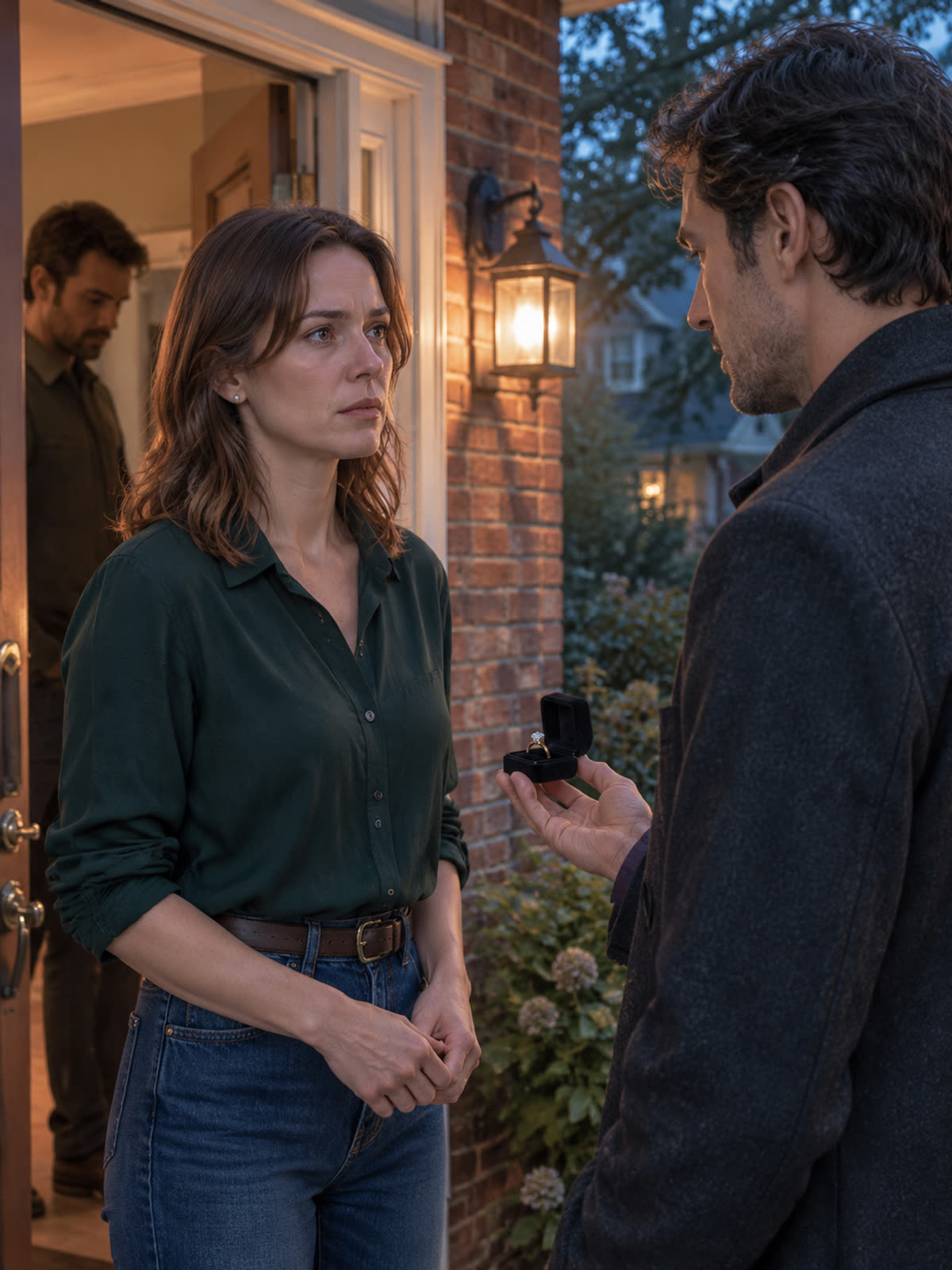
“I was trying to impress my friends.” “I know.” “I was insecure. Gavin was getting married. Parker kept teasing me. I felt like everyone expected me to settle down, and I just…” He stopped, and I did not fill the silence for him. “I wanted them to think I was still the guy who could do whatever he wanted.” “And you needed me to look pathetic for that to work?” Tears gathered in his eyes. “Yes.” That answer surprised me. For once, he had admitted what he had done without searching for a way to assign part of the blame to me. He looked at the ring again. “I’ve been working on myself.” “I’m glad.” “I’ve got a regular job again. I paid off some of the business debt. I’m seeing a counselor.” “That’s good, Drew.”
He moved a little closer. “I don’t expect everything to go back to normal. I know it would take time.” My stomach tightened. “But I love you, Mara. I always did.” He raised the open box. “And I want to marry you.” Everything around us seemed strangely quiet. Seven months earlier, he had made marriage to me the punch line in a crowded bar. Now, on the porch of a house I had purchased alone, he was offering the very commitment he had ridiculed. I studied the ring and then his face. “No.” His expression collapsed. “Please, just hear me out.” “I have heard you.” “Mara, I’m serious. I’m ready now.” I slowly shook my head. “That’s not the problem.” “What is?”
I drew a breath. “The problem is that you only started respecting my future when you realized you wouldn’t be part of it.” He looked wounded. “That’s not fair.” “It is.” I stepped onto the porch and pulled the door almost closed behind me. “I spent almost three years believing we were building something together. I paid bills, supported your career, celebrated your achievements, and made room for your dreams.” His eyes dropped. “You called me boring because I wanted stability. You mocked my hobbies because you didn’t understand them. You made plans involving my money without asking me.” “I know.” “And when I walked away, you didn’t ask how badly you’d hurt me. You asked how you were supposed to pay rent.”
A tear ran down his cheek. “I’m sorry.” “I believe you’re sorry.” Hope appeared in his face, and I hated that I had to extinguish it, but kindness could not mean leaving him room to misunderstand me. “But being sorry doesn’t mean we belong together.” The box trembled in his hand. “I thought you were the one person who would never leave me.” Those words revealed more than he seemed to understand. Suddenly, the foundation of our relationship was clear. He had not thought of me as someone freely choosing him each day. He had assumed I was someone who would never choose herself. “You were wrong about that,” I said softly.
He looked toward the house. “I could’ve been happy here with you.” Through the window, I could see Caleb laughing with Elise. Miles was helping carry food outside. Light spilled from the garage across my motorcycle and the workbench he had restored. I turned back to Drew. “You could have been happy with me before.” His lips parted. “You had a home. You had someone who loved you. You had opportunities to build a good life.” I gestured toward the driveway. “But you were too worried about what your friends thought to appreciate any of it.” His hand lowered, taking the ring with it. “Do you hate me?”
I considered the question honestly. There had been nights when I wished hatred came more easily. Anger might have felt simpler than grief. Hating him might have made the good memories less difficult to carry. But the truth was quieter than that. “No,” I said. “I don’t hate you.” He let out a breath. “But I don’t want to be with you, either.” His eyes closed. I continued. “I hope your new job goes well. I hope your business debts get paid. I hope counseling helps you understand why you treated someone who loved you that way.” He nodded faintly. “But those things aren’t my responsibility anymore.”
For a long moment, he looked down at the ring. Then he closed the box. “You’re really not coming back.” “No.” He managed a strained laugh. “I guess I deserve that.” “This isn’t about what you deserve, Drew. It’s about what I choose.” He looked at me one last time. “I’m sorry, Mara.” “I know.” Then I said the words I had been waiting seven months to say. “Please don’t come here again.” He nodded once, turned, and walked down the steps. I watched until his car pulled away into the night. There was no crowd to impress now, no clever line to rescue him, and no argument I needed to win. There was simply the end of a conversation that should have ended long before.
When I went back inside, Caleb was waiting near the counter. “You okay?” I looked around at my friends, my furniture, the photographs on the walls, and the life I had put together one decision at a time. “Yeah,” I said. For once, I was not offering the answer to make somebody else more comfortable. I meant it. A year later, the garage had become the workshop I had always wanted. I had restored two motorcycles, started a technical mentorship program for young women, and taken a three-day ride through mountain roads with Caleb and friends. The interests I had gradually abandoned had returned, not as guilty indulgences, but as ordinary parts of a life that belonged to me.
Eventually, Miles and I began dating. Slowly, without pressure or demands. He respected the things that interested me and never made fun of my spreadsheets. If I had a difficult day, he listened instead of steering the conversation back to himself. Sometimes we spent an entire Sunday working on separate projects in the garage with quiet music playing in the background. Drew would not have called it exciting. There were no dramatic social performances, expensive displays, or constant efforts to impress people we barely knew. But there was laughter. There was mutual respect, room to breathe, and the peace I had once mistaken for something I needed to earn.
One Sunday, Miles caught me standing outside, admiring the freshly painted garage door. “What are you thinking about?” he asked. I smiled. “Something someone said to me a long time ago.” “Good or bad?” “At the time? Pretty bad.” He took my hand. “And now?” I looked at the house, the garden I had planted, and the motorcycle waiting for our afternoon ride. Warm light lay across the porch. “Now I think it might have been the best thing he ever said to me.” Miles raised an eyebrow. “Really?” I nodded. That night in the lounge, Drew had thought he was humiliating a woman who would always remain available to him. Without realizing it, he had released me from pursuing a future I did not even want.
He had described my dreams as a prison. Standing outside my own home, surrounded by people who respected me, I finally understood the difference between belonging somewhere and being trapped there. Drew had been terrified of marrying me. I had been terrified of losing him. In the end, each of us received the freedom we had thought we wanted. He was free not to marry me. I was free to stop proving that I deserved to be married. The future no longer belonged to his expectations, his promises, or his plans for my money. It belonged to my choices. And now that I could finally choose for myself, what would I build next?
Disclaimer: This story is a work of fiction inspired by real-life themes. Names, characters, places and events are fictionalized, and any resemblance to real persons is purely coincidental. It does not represent any person or organization and does not encourage inappropriate behavior. Images are for illustration purposes only.
