


PART 1 — WHAT MY FATHER LEFT INSIDE THE BOAT
“The old man left you NOTHING, Claire! So take your son and get the hell out of my house!” My mother-in-law’s voice rang through the condominium as she flung my twelve-year-old son’s belongings down the stairs. A framed photograph of his dead father hit the railing, sending fragments of glass across the floor. Wyatt flinched. Grant Kessler, my husband, stood behind his mother and watched with the detached expression of someone waiting for an elevator. “Grant,” I whispered. “That’s Evan’s picture.” He shrugged. “Then pick it up.” Three hours earlier, that same man had held my hand in a probate attorney’s office and assured me we would face my father’s death together. Now he was throwing away our marriage because Dad had left his fortune to my son instead of me. Apparently, a wife without an accessible inheritance—and the child who actually possessed it—were no longer worth accommodating.
My name is Claire Hensley. I was forty, a paramedic in Norfolk, Virginia, and until that Thursday I had thought nothing could hurt more than losing my first husband while he saved another man’s life. I was wrong. “Please,” I said, looking at Grant. “Can we at least go inside and talk?” His mother, Marjorie, advanced in expensive silk pajamas. “Talk about what? Your father had millions, Claire. Millions! And he couldn’t leave his own daughter a penny? That should tell you something about what kind of woman you are.” Wyatt crouched to retrieve the broken photograph. “Don’t touch that garbage,” she snapped. He froze, and I stepped between them. “Don’t speak to him like that.” She laughed. “Oh, now you’re going to give me orders? You’re standing on my property, sweetheart.” I faced Grant. “Tell her who paid for this condo.” His jaw tightened. “Claire, don’t start.” “My father gave your mother the money to buy it. Every dollar.” Marjorie looked pleased with herself. “And the deed has my name on it. Your father knew exactly what he was doing.” For an instant, something like fear flickered across her face. Then it was gone.
Grant folded his arms. “I’m not raising another man’s kid for the rest of my life. I’ve done my part.” Wyatt looked up, his gray-blue eyes so much like my father’s. Grant continued without hesitation. “Five years. Five years of paying bills, buying groceries, helping with school. I think I’ve earned the right to stop.” I stared at him. “Earned? My son isn’t a business expense.” He looked away. “You’re making this harder than necessary.” In eighteen years of emergency work, I had seen terrible wrecks, pulled children from mangled vehicles, and stayed beside strangers as they died. None of it had prepared me for hearing my husband describe my son as a financial burden he had carried long enough. Marjorie dragged another suitcase into the hall. “Keys,” she demanded. When I did not move, she added, “Now, Claire.” Grant reached for my handbag. I pulled it away. “Don’t touch me.” He raised his hands. “Fine. Keep the keys. The locks are getting changed.” Then came the smile that had once made me feel safe. “We can discuss divorce paperwork through my attorney.”
Wyatt spoke before I could answer. “Grandma Marjorie?” She turned impatiently. “What?” “Can I have the little tugboat Grandpa made me?” Her expression changed. “The stupid wooden thing?” “Please.” She disappeared into his bedroom and returned holding the little harbor tug Dad had built: navy hull, white wheelhouse, yellow smokestack. It was a miniature version of the first commercial boat he had bought when he started his marine transportation company. I had always worried about the delicate brass mast. Marjorie tossed the boat at Wyatt. He caught it against his chest, bending the mast. “There’s your inheritance,” she sneered. “A toy boat.” He held it close. “Thank you,” he whispered. Grant gave a low laugh. “Unbelievable.” Then he shut the door, and two deadbolts slid into place. Within moments, my son and I had nowhere to live. For almost a minute, neither of us moved. Rain hammered the windows at the far end of the corridor.
Then Grant’s voice carried through the door, stripped of its earlier indifference. “Listen, Vince, the money’s locked up! The kid got everything. There’s a trustee involved. I can’t touch it!” He stopped to listen. “Don’t threaten me. I said I’ll figure it out!” Another pause. “Give me thirty days!” My stomach tightened. I had no idea who Vince was, why Grant needed my father’s money so desperately, or what could make him sound that afraid. “Mom?” Wyatt tugged my sleeve. “We should leave before Grandma comes back.” Every part of me wanted to pound on the door and demand answers. Instead, I gathered the broken photograph, wrapped it in my scarf, and took hold of our luggage. I had less than three hundred dollars in my account, with another week before payday. Grant had insisted on handling most of our savings. I could not access the shared emergency account. Whatever questions waited behind that locked door, keeping Wyatt safe had to come first.
By eight that evening, we had reached Norfolk’s EMS headquarters. My supervisor, Denise Carter, quietly brought us into the crew rest room and found sandwiches. She did not press me for an explanation. Her eyes moved from Wyatt’s wet shoes to the suitcases, then to my face. “You and that boy are staying somewhere safe tonight. We’ll deal with everything else tomorrow.” Wyatt curled onto an empty cot with the damaged tugboat in his arms. I thought he was asleep. At 2:13 a.m., however, he sat up. “Mom?” “Yes, sweetheart?” “Grandpa told me this was going to happen.” I stared at him. “What?” He climbed down. “He said Grant and Grandma would throw us out as soon as they found out about the inheritance.” My mouth went dry. “When did he say that?” “Before he went to the hospital.” He placed the boat between us. “He made me promise not to tell you until it happened.” “Tell me what?” He looked directly at me. “Grandpa gave me something. He said it could save us.”
Wyatt grasped the yellow smokestack and twisted it counterclockwise. A hidden compartment opened beneath the deck. Inside lay two brass keys, a sealed envelope, and a tiny black flash drive. Across the envelope, in handwriting I would have known anywhere, Dad had written: CLAIRE — IF THEY THREW YOU OUT, READ THIS. Beneath that instruction was a date from six months before his death. He had not simply suspected Grant might betray us. He had prepared for the moment. Whatever he had hidden was important enough to entrust to a twelve-year-old boy, without telling anyone else—not even me. I looked from the envelope to my son, trying to understand how the little wooden boat Marjorie had mocked could contain the answer to a disaster Dad had seen coming long before I had.
I had seen my father’s handwriting on birthday cards, shipping papers, hospital forms, and shopping lists written on scraps. Never had it frightened me. I opened the envelope. It held three handwritten pages, a folded legal agreement, and a business card. His letter began: Claire, If this letter has reached you, Grant has finally revealed his true character. I wish there had been a way to protect you without causing you pain. Your husband has been anticipating my death throughout the past five years, and his mother has assisted him all that time. I stopped. Five years meant our entire marriage. Wyatt watched without speaking while I forced myself onward. I’ve passed my estate to Wyatt because a trustworthy independent trustee would never allow Grant to use a child’s inheritance to finance his automobile dealership. Had I given everything to you, he would have exploited your affection for him. You’d have tried to preserve your marriage, trusted his assurances, and eventually lost everything to him. You needed to discover the truth yourself.
Tears blurred the page. Thomas Marlow had never been a soft-spoken or particularly gentle man. With a battered tugboat and borrowed tools, he had built Marlow Harbor Services into a marine transportation business worth millions. He believed in working before sunrise, paying debts before buying luxuries, and reading every document twice. When I married Evan Hensley at nineteen, Dad thought he wanted our family’s money. Evan was a mechanic on one of his tugboats; I believed Dad was an arrogant businessman who could not imagine his daughter loving a man without wealth. We barely spoke for almost four years. Then Evan died rescuing a dockworker trapped between a barge and a pier. Wyatt was three. Dad came to the funeral without being asked. After everyone else had gone, he approached with his arms open. “Let me hold my grandson.” He held Wyatt for nearly ten minutes before saying, “I was wrong about his father.” That was the first time I had ever seen him cry. After that, Wyatt became his constant companion. They repaired engines, fished along the Elizabeth River, and built model boats when rain kept them indoors. Dad called him Captain. Wyatt called Dad the Old Admiral. I had never realized those afternoons also contained lessons in protecting us.
I steadied the letter beside the open tugboat and read the next section. First, regarding the condominium. Because Marjorie’s name appears on the deed, she believes the property belongs to her without any outstanding obligations. That’s incorrect. I supplied $460,000 for its purchase. Although she wanted the money treated as a gift, I required her to execute a loan agreement. She agreed and signed it. You’ll find the original enclosed. The agreement requires repayment within thirty days of written demand. I never made that demand. The outstanding obligation now passes to my estate and eventually to Wyatt’s trust. I unfolded the legal paper with shaking hands. There was Marjorie’s signature, beside the amount and the promise to repay it. For years she had bragged that my father bought her the condominium because he respected her business sense. Apparently, he had respected it enough to insist she put her obligation in writing. Wyatt stayed close while I studied the proof, the keys and flash drive resting beside the little boat that had carried it safely past them.
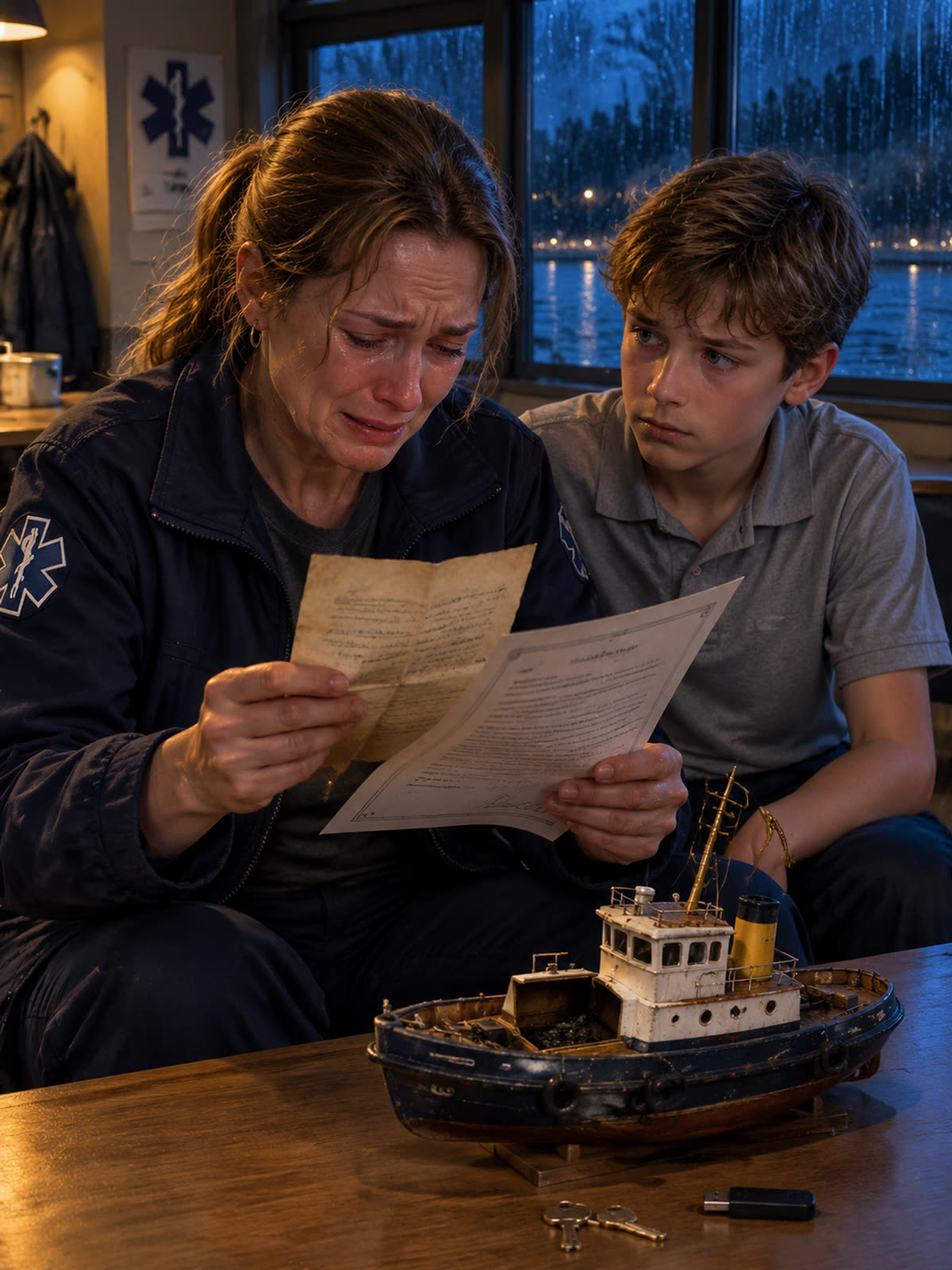
Dad’s next warning concerned Grant. Second, Grant’s financial obligations are severe, far more serious than you realize. He visited my hospital room and requested that I sign empty documents. I wouldn’t do it. Should he present documents suggesting I owed him money, dispute them. I’ve provided a sworn declaration alongside authentic samples of my signature. Over the last two years, I’ve deliberately added a small ink dot beneath my signature’s first letter. My lawyer is aware of this precaution, but Grant isn’t. I read that passage twice before continuing. Third, deliver the flash drive to Simon Halbrook, a retired judge and my longest-standing friend. He’ll understand how to proceed. Fourth, those keys open my property in Ghent. Under the trust’s provisions, you and Wyatt may occupy the townhouse throughout his childhood. Our neighbor, Florence Doyle, expects you and has agreed to assist. We had shelter. We had someone to call. Dad had left a route through the wreckage, even though I had not known there was danger until the door closed behind us.
The last lines hurt most. I was unable to explain these matters to you during my lifetime. You stood up for Evan when I judged him, and your judgment proved correct. You also defended Grant when I expressed concerns about him. I feared another period of estrangement. My heart was deteriorating, Claire. I couldn’t afford to lose another four years with you. Therefore, I created one last opportunity for you to discover the truth. Had Grant remained loyal after you received nothing, I would have known my suspicions were mistaken. If he abandoned you, you would regain your freedom. I love you, my daughter. I regret not telling you more frequently. Dad. I pressed the pages to my lips. For years, I had mistaken his stubbornness for a need to control me. Now I could see the fear underneath it: he could not bear to lose me again. Wyatt put his hand on my shoulder. “Are you mad at Grandpa?” “No.” “Because he didn’t leave you the money?” I pulled him into my arms. “Sweetheart, your grandfather gave me something more important.” “What?” “The truth.” At last, I cried—not over Grant or the condominium, but because Dad had spent his failing months finding a way to protect us.
The next morning, Denise drove us to Ghent. Dad’s three-story brick townhouse stood on a quiet street beneath tall oaks. I unlocked the front door with the first brass key and stopped. Drawers had been emptied. Books covered the floor, cupboards hung open, and papers were strewn through the hall. In the study, someone had slit the material under his antique desk and taken apart framed photographs. Wyatt picked his way over the scattered pages. “Mom?” His voice was faint. Dad’s captain’s hat lay crushed beneath an overturned chair. Someone had searched the house with the determination of people certain something valuable was hidden there. Florence Doyle appeared at the entrance. Seventy-eight and barely five feet tall, she gasped. “Oh, Claire. They came back?” I turned. “Who came back?” She gripped the doorway. “Your husband and his mother. They were here twice after the funeral.” A chill spread through me. “Did they say what they wanted?” “Documents. They said they were collecting documents for you.” “Did they find anything?” “No. But the second time, I heard your husband yelling.” “What did he say?” She swallowed. “He said, ‘That old bastard couldn’t have hidden it from us. Somebody has the evidence.’” Wyatt tightened his arms around the boat. They had torn apart a house looking for something they had practically thrown into our hands.
I arranged to have every lock replaced, called Reese Latham, the attorney administering Dad’s estate, and contacted Simon Halbrook. A retired Virginia circuit court judge, Simon lived near Williamsburg among books, nautical charts, and photographs of fishing boats. He opened his door wearing an old Navy sweatshirt. His face softened when he saw Wyatt. “Well, I’ll be damned. Little Thomas.” Wyatt looked puzzled. “My name’s Wyatt.” Simon smiled sadly. “You’ve got your grandfather’s eyes, son.” In his study, I explained the will, the eviction, the wrecked townhouse, and everything hidden in the tugboat. He spent two hours listening and examining the papers. Tapping Marjorie’s agreement, he said, “Your father was a careful man.” “Can we get the condo back?” “Not automatically. Marjorie owns the property. But the estate has a substantial claim against her, and we can pursue repayment through the proper legal process.” It was not the instant reversal I wanted, but it was an honest answer, and by then honesty felt like something solid under my feet.
After looking at Dad’s signature samples, Simon picked up the flash drive. “Did you listen to it?” “Not yet.” His computer displayed forty-one audio files, most identified only by numbers. He opened the first. “First winter I worked the harbor, the ice froze right around the tug’s rudder…” I covered my mouth. Dad’s voice filled the room so clearly that for a moment the loss felt impossible. He talked about storms, failing engines, and men at sea he had loved like brothers. Simon stopped the file. “Your father knew how much this family meant to him. He also knew you wouldn’t listen to someone else telling you your husband was dangerous.” He handed back the drive. “Listen to every recording. Somewhere in there is the reason he hid it.” Then he called his daughter, Audrey Halbrook, a litigation attorney who handled estate disputes. By that evening, she had agreed to work with the estate’s lawyer to protect Wyatt’s interests. For the first time since the eviction, I felt we had somewhere to turn.
Nine days later, Reese called. “Claire, I need you to sit down.” “What’s wrong?” “Grant has submitted a creditor’s claim against your father’s estate.” I closed my eyes. “How much?” “One million two hundred and fifty thousand dollars.” I struggled to breathe while he explained. “He alleges that your father borrowed the money privately and signed a promissory note promising repayment.” “That’s impossible.” “He submitted a signed document.” “My father didn’t borrow money from Grant.” “I understand. Audrey needs to review it immediately.” The emailed document arrived within an hour: one typed page, a staggering amount, and a signature that looked remarkably like Dad’s. But the small ink dot was missing. Then I noticed the date—October 3. I checked my calendar. That was the day I had taken Dad to the hospital after his final cardiac emergency. Grant’s document claimed he had delivered cash to Dad’s townhouse at eleven that morning. At that hour Dad had been unconscious in intensive care. He never returned home before he died. Grant had attached his lie to a day I could prove.
I called Audrey. “I can prove he lied.” She listened and then gave advice that guided everything I did afterward. “Claire, don’t confront him. Preserve the document, and let us secure the admissible medical and emergency-service records.” “Why?” “Because someone willing to fabricate a million-dollar debt may be willing to do considerably worse when that fabrication fails.” By the following morning, I understood. Child Protective Services contacted me about accusations of homelessness, emotional instability, neglect, and leaving Wyatt alone during night shifts. The complaint specifically mentioned the night at EMS headquarters. I suspected Marjorie immediately, but I cooperated with the required assessment. I also contacted Wyatt’s school counselor and limited pickup authorization to me and the adults I expressly approved. Two hours later, the school called. An older woman claiming to represent CPS had asked whether Wyatt looked frightened, hungry, or poorly clothed. The school had refused to answer. CPS confirmed that the caller was not their investigator.
Then Grant called. “Claire, sweetheart. We need to stop fighting.” The tenderness in his voice turned my stomach. “What do you want?” “Come home. We can work things out.” “You threw my son into the rain.” “Mom got emotional.” “You told Wyatt he wasn’t your responsibility.” “I said things I regret.” I waited, and his tone changed. “There’s a legal solution to all this.” “Which is?” “You challenge the will. Say your dad wasn’t mentally competent when he signed it.” I stared at the phone. “Why would I do that?” “Because the estate should belong to you. You’re his daughter.” “And then?” “We negotiate the disputed debt. I withdraw my claim, we settle everything, and we stay married.” There it was. He wanted me to dismantle my son’s inheritance so he could get control of it through me. “What about the CPS complaint?” I asked. He paused. “Mom can straighten that out.” Through the kitchen doorway, Wyatt sat at Dad’s desk doing mathematics. “I’m not sacrificing my son to save your dealership.” Grant’s warmth vanished. “Then don’t expect me to save you when the court takes that house.” He hung up.
That night, I listened to recordings until nearly three in the morning. At the start of file twenty-eight, I heard hospital equipment. Then Grant spoke. “Thomas, it’s just paperwork. Sign at the bottom. We’ll fill everything else in later.” Dad sounded calm. “I built a company from a sinking boat, Grant. I didn’t do that by signing blank paper.” Grant laughed softly. “Don’t make this difficult.” A chair scraped. “You won’t be around forever, Thomas. And when you’re gone, Claire will do whatever I tell her.” Dad’s voice rose. “Get out.” After a silence, Grant spoke again. “Your signature is beautiful, Thomas. Good thing my mother kept that birthday card you signed.” The recording ended. I sat motionless. Now I knew where the signature on the fraudulent note had come from. And I knew who had helped him obtain it. Marjorie had not merely stood beside him while he destroyed our marriage. She had supplied the means to steal my son’s future.
PART 2 — THE WOMAN WHO HAD ALREADY LIVED MY NIGHTMARE
Audrey warned me not to mistake Grant’s behavior for ordinary anger over a lost inheritance. “He isn’t merely angry that he lost access to your father’s money,” she explained. “He’s desperate. And desperate people make reckless decisions.” Three days later, a process server arrived with papers concerning the estate claim. Grant’s lawyers wanted limits placed on the trust’s ability to sell or transfer disputed assets while the matter was litigated. Grant accompanied him in a tailored coat and expensive watch, wearing the same assured smile I had once trusted. “Nice place,” he said. “Enjoy it while you can.” I held the papers against my chest. “Get off the property.” He stepped nearer. “You know, Claire, I could make all your problems disappear.” “By stealing my son’s inheritance?” “By being reasonable.” He indicated the townhouse. “Big property dispute. CPS investigation. A single mother working dangerous shifts. That’s a lot of pressure.” I kept my face still. “Are you threatening Wyatt?” “Of course not.” His grin widened. “I’m offering to protect him.” I shut the door as carefully as I could, refusing to give him the satisfaction of seeing how badly I wanted to slam it.
Simon called later that afternoon. Through former contacts, he had learned something about Grant’s past. “Your husband was married before,” he said. “I know. He told me they divorced because she cheated.” “Her name is Rachel Wynn. She lives in Fredericksburg.” “What about her?” “She inherited property after her father died. Less than a year later, she lost almost everything.” The next morning, I drove to Fredericksburg. Rachel lived in a modest townhouse with peeling porch paint and an overgrown flower bed. She opened the door cautiously. When I said I was Grant’s wife, she began closing it. “Please,” I said quickly. “He’s trying to take my son’s inheritance.” She stopped and looked at me for a long moment before letting me inside. Nothing about her home resembled the comfortable life Grant liked to imply he provided. Yet I recognized the caution in her face immediately. It was the expression of someone who had learned that a familiar voice could conceal a threat.
We sat in her kitchen. Rachel was fifty-one, with tired green eyes and a pale impression where a wedding ring had once rested. “My father owned three auto repair shops,” she began. “When he died, I inherited the business and a house.” Grant had appeared soon after the funeral. He repaired her car, brought flowers, and promised she would not have to face her grief alone. The resemblance made me feel ill. “Six months after we married,” she continued, “Grant brought me a document. It said my father had borrowed money from one of Grant’s business associates.” “Was it true?” “My father hated borrowing. But his signature was on the paper.” She took a photocopied promissory note from an old folder. I laid Grant’s claim against my father beside it. The wording was almost the same, right down to the assertion that cash had been delivered to the borrower’s home. Rachel looked from one page to the other. “My God.”
“Did you pay?” I asked. She nodded. “I sold Dad’s house. Grant said he negotiated the debt for me. Later I discovered the company that received the money was connected to him.” “Did you report it?” “I was ashamed. By the time I understood, he’d divorced me and disappeared.” She wiped her eyes. “I spent ten years thinking I was stupid.” I asked whether she remembered anyone helping Grant prepare documents. Her expression hardened. “Toby Merrick. Graphic designer. He worked with Grant on dealership titles and advertising.” She hesitated before continuing. “Once, I walked into the garage and saw Toby tracing my father’s signature from an old birthday card.” I went rigid. Another father. Another inheritance. Another birthday card. “Rachel,” I said, “would you tell that to a detective?” She glanced toward the window, then nodded. “Yes. I’m tired of being afraid of him.” Her answer changed the room. For years, she had carried the damage in silence. Now the same method Grant had used against her might help expose what he was doing to us.
On the way back, I contacted Detective Celia Ortega, who had been assigned to the suspected forgery after Audrey helped us make a formal complaint. She listened without interrupting. “Have Ms. Wynn contact me directly,” she said. “We’ll follow up with the document examiner and investigate Merrick.” For the first time, I could see more than a way to defend Dad’s estate. Rachel’s account suggested a pattern, and patterns left people, records, and connections behind. I had spent so much time reacting to whatever Grant did next that it felt unfamiliar to know something he did not realize we had found. Still, Audrey’s warning remained with me. A man who had repeated this scheme might not stop simply because someone had begun recognizing it. Before I had time to believe we were safer, he approached the person I had been trying hardest to protect.
Grant parked his black SUV near the pickup area outside Wyatt’s middle school and waited. When Wyatt came out, he called, “Hey, buddy!” My son stopped. Grant approached with the friendly expression he used to wear when they went to baseball games. “How about a ride home?” “My mom said not to go anywhere with you.” “Your mom’s just upset.” He leaned closer. “Listen, I know Grandpa left you something. Important papers, maybe? Something hidden in that little boat?” Wyatt said nothing. Grant produced a thick envelope. “There’s a thousand dollars in here. Yours. Just hand me whatever Grandpa gave you.” “No.” His smile faded. “Come on. Don’t be difficult.” “No.” “Your mother doesn’t have to know.” “Grandpa told me not to hide things from Mom unless he said it was an emergency.” Grant’s expression hardened. “Your grandfather is dead.” Wyatt stepped back. “He also told me you might say that.”
Grant grabbed Wyatt by the shoulder. “You think that old man can protect you now?” From the entrance, a school security officer shouted, “Sir! Let go of that student!” Grant released him and tried to laugh it away. “Family misunderstanding.” The officer kept them apart while Wyatt’s teacher called the office. Grant left. Later, at home, Wyatt placed his phone on the kitchen counter. “Mom, I recorded it.” I listened to every word: the offered money, the demand for Grandpa’s papers, the threat, and the sound of Grant grabbing him. I played it twice before pulling my son into my arms. “I’m proud of how you handled yourself,” I whispered. “But I wish you hadn’t had to.” He leaned against me. “Grandpa said Grant might come looking for the boat.” “Did he tell you what to do?” “He told me to stay near adults, call for help, and never go anywhere alone with him.” I closed my eyes. Even this possibility had occurred to Dad. Audrey sent the recording to Detective Ortega that evening, and the school provided statements from the officer and teacher. We also arranged supervised dismissal for Wyatt.
I thought the school incident must finally have taken Grant too far. The following morning, Denise was waiting outside the medical director’s office when I came to work. Her face told me otherwise. “Claire, you need to come inside.” On the desk lay an anonymous letter sent to state health officials. It accused me of taking controlled medications from ambulances and selling them to support what it called my unstable lifestyle. It referred to Dad’s death, the eviction, and my financial difficulties—information known to very few people. The medical director looked miserable. “Claire, until we investigate this, we have to remove you from field duties involving controlled substances.” My knees nearly gave way. Grant had attacked our home, my son, my marriage, and Dad’s legacy. Now he had reached for the profession I had spent eighteen years building. He did not merely want money anymore. He wanted to strip away everything that showed I was capable of caring for Wyatt.
While the accusation was investigated, I was moved from ambulance duty to dispatch. Some colleagues stopped meeting my eyes. People who had trusted me with critically ill patients whispered when I walked into a room. Someone asked whether I had been arrested. I wanted to shout, but instead I requested a complete audit: every controlled medication issued during my shifts, every administration entry, every recorded dose, every witnessed disposal, and whatever surveillance footage was available. “If somebody thinks I stole something,” I told the medical director, “then check every single record. I don’t want a partial investigation.” For almost two weeks, I helped reconstruct the records. Every vial was accounted for. There were no missing medications, unexplained discrepancies, or signs of theft. The facts were clear, but the humiliation did not disappear with them. I still had to work among people who had briefly wondered whether I was the sort of person I had spent my career protecting patients from.
One afternoon, Denise brought me a copy of the complaint. “Claire, look at this.” She pointed to a sentence: She regularly carries stolen medication in a blue insulated lunch bag. I frowned. “I don’t use a blue lunch bag.” “You did last summer.” Then I remembered. During Wyatt’s day camp, I had packed his lunches in an old insulated bag for one week. Denise nodded. “Exactly. And do you remember who worked temporary administrative coverage at our station that week?” I shook my head. “Marla Bell.” The name sounded faintly familiar. “She used to work in medical billing,” Denise continued. “But before that, she worked in a bridal boutique.” I looked at her. “Marjorie’s boutique?” “They’ve been friends for thirty years.” The detail that had made the accusation sound personal and convincing had also given us a path back to the person behind it. I stared at the letter while Denise stood beside me, realizing that the attempt to destroy my reputation had carried a trace of its own origin.

We gave investigators what we knew. Marla initially denied involvement. Eventually, she admitted that Marjorie had dictated the accusations and persuaded her to send the letter, though Marla insisted she believed them. Her statement was documented. My employer completed the investigation and formally cleared me of theft, misconduct, and missing medication. I returned to field duty, and the medical director apologized publicly. I accepted, but I could not forget how quickly an anonymous claim had damaged eighteen years of professional trust. Being cleared mattered. So did knowing how easily I had been made to defend a life of work against a lie. The apology could restore my assignment; it could not erase the memory of walking into rooms where conversations stopped. Still, the records had held. Marjorie had counted on suspicion doing what evidence could not, and this time the evidence had survived her.
CPS finished its assessment as well. Patricia Langford, our caseworker, visited the townhouse and found Wyatt’s room orderly, his assignments organized, food in the refrigerator, and reliable arrangements documented for every night shift. She spoke privately with him about the eviction, his grandfather, and what happened outside school. When she returned, her expression was gentler. “Ms. Hensley, I don’t see evidence of neglect. I see a mother who has gone to extraordinary lengths to keep her child safe.” I finally let out the breath I had been holding. The case closed without adverse findings. That evening, Wyatt and I ate pizza at Dad’s kitchen table, and he laughed for the first time in weeks. I had missed that sound more than I could explain. It did not mean the danger was over. It meant that, for one evening, my son could be twelve again instead of a boy measuring every adult’s words for a hidden threat.
Three weeks later, Grant’s contested creditor claim came before the court. Audrey arrived at the Norfolk courthouse with two thick binders. Grant wore a creased suit. His eyes looked hollow, and although he smiled at me, his hands shook as he adjusted his tie. His attorney presented the original promissory note, professionally formatted and bearing a persuasive imitation of Dad’s signature. Grant insisted that he had personally delivered the cash at eleven that morning. Audrey stood. “Your Honor, the estate disputes the authenticity of this instrument, and we have evidence establishing that the alleged transaction could not have occurred as described.” She introduced certified emergency medical records obtained through proper channels. An ambulance had been dispatched to Dad’s house at 6:52 a.m. He reached the hospital before eight in critical condition and never went home again. At eleven, he was unconscious in intensive care. Audrey paused before stating, “Mr. Marlow could not have been at his residence accepting this money.”
Grant stared down while his lawyer looked toward him. Audrey then offered genuine examples of Dad’s signature, each carrying the tiny ink mark absent from the disputed note. After that came the hospital recording. The room heard Grant ask Dad to sign blank papers. Everyone heard the reference to the birthday card, Dad’s refusal, and Grant’s boast that he would control me after Dad died. Grant’s lawyer asked for a recess, and the judge allowed a short one. When proceedings resumed, Audrey requested forensic examination of the original document and further discovery into how it had been made. She also disclosed the school confrontation and the continuing criminal investigation. The judge ordered preservation of the note, set deadlines for additional evidence, and rejected Grant’s attempt to obtain immediate repayment. We had not finished the case, but the lie was no longer standing uncontested behind a convincing signature.
Outside the courtroom, Grant came toward me. “You think you’ve won?” I looked him in the eyes. “I think you’ve been lying for a very long time.” His expression twisted. “You have no idea what I’m dealing with.” “Then stop making it my son’s problem.” He caught my wrist. Audrey stepped between us. “Remove your hand from my client.” He released me. For a moment, I saw something beneath his anger that frightened me more than the anger itself. He was terrified. Then he walked away. Detective Ortega called that evening. “We interviewed Rachel Wynn. Her account supports a similar pattern. We’re also investigating Toby Merrick’s role in producing the documents.” “Is there enough to charge Grant?” “Not yet. But we’re getting closer.” I thanked her and ended the call. Being closer was not the same as being safe, but it was more than we had possessed when Wyatt and I stood outside a locked condominium door with our lives in suitcases.
Ten minutes later, Denise called. “Claire, you’re going to want to hear this.” Marla, who was now cooperating with investigators, had provided something else. The estate’s demand for repayment had enraged Marjorie. With the loan’s thirty-day deadline nearing, she had arranged to transfer the condominium to her younger sister, Pamela, before collection proceedings could begin. “She thinks if she gives it away,” Denise said, “there won’t be anything left for your son’s trust to recover.” I checked the calendar. The transfer was set for Friday morning, less than forty-eight hours away. I called Audrey immediately. Her answer was firm. “Claire, we’re filing for emergency relief.” “Can we stop her?” “We can try. But we have to move quickly.” I looked at Dad’s photograph above the fireplace. He had spent four decades dealing with people who wanted to evade what they owed. One lesson had stayed with me: never threaten consequences unless you were prepared to enforce them. We were finally prepared. The question was whether we could act before Marjorie signed the property away.
PART 3 — THE TRUTH THEY COULD NO LONGER HIDE
Friday arrived under a flat gray sky. At 8:30 that morning, Audrey filed the estate’s collection lawsuit and an emergency application to prevent Marjorie from transferring the condominium to avoid repayment. The contractual thirty-day notice period had expired. Marjorie had ignored the demands and was trying to give away the asset most able to satisfy her obligation. The court temporarily blocked the transfer that morning, and Audrey arranged for the order to be served and delivered to the appropriate recording office. At 10:57, I entered the county administration building. Marjorie stood at the recording counter with Pamela, who held the property documents. Dressed in a luxurious cream coat, Marjorie looked thoroughly pleased with herself. Then she saw me, and her expression changed. “What are YOU doing here?” I placed a certified copy of the order in front of them. “Stopping you from transferring property to escape a debt.”
Marjorie’s smile disappeared. Pamela looked confused. “What debt?” Her sister caught her arm. “Don’t listen to her. She’s been harassing me for months.” I spoke directly to Pamela. “My father provided the money for that condominium. Marjorie signed an agreement to repay it. The estate has demanded payment, and she’s trying to transfer the property into your name to keep it out of reach.” Pamela read the order and turned toward her sister. “You told me it was a gift.” “It is!” “You told me we’d put it in my name temporarily and change it back later.” Marjorie blanched. “Pamela, lower your voice.” Pamela stepped away. “Are you using me to hide property from a court?” Marjorie reached for her. “Don’t be ridiculous.” But Pamela was already speaking to the clerk. “I’m withdrawing from this transaction.” “Pamela!” “I said I’m not signing anything!”
People nearby had stopped to watch. Marjorie looked as though she might explode. “You did this!” she shouted at me. I shook my head. “No, Marjorie. You did.” Then a familiar voice sounded behind us. “Mrs. Kessler?” Detective Ortega approached with another investigator. “I’d like to speak with you regarding an ongoing forgery investigation.” Marjorie fell silent. For once, she had no immediate accusation, no cutting remark, no declaration that everything around her belonged to her. The papers in front of the clerk could no longer be used to make the debt disappear. Pamela had withdrawn, the court had intervened, and the matter Marjorie had treated as a family dispute now had investigators standing beside it. I had arrived to stop a transfer. Watching her face, I understood that the order was not the only thing she had failed to prepare for that morning.
Two hours later, Wyatt and I returned to the condominium with a police civil standby arranged so we could collect the belongings withheld after our eviction. He wanted his winter boots, his school awards, and Evan’s acoustic guitar. Grant sat in the living room when we entered. His hair was unwashed, his eyes bloodshot, and empty alcohol bottles stood across the coffee table. “Well,” he muttered. “The little prince comes home.” Wyatt ignored him and went to his former bedroom. He found his father’s guitar behind a stack of boxes. Marjorie watched from the kitchen, glaring. “You’ve ruined this family.” I looked around the expensive home my father’s money had made possible. “No. We were never family to you. We were a business opportunity.” Grant rose abruptly. “Don’t talk to my mother like that!” Before he could come farther, three hard knocks sounded at the door.
Detective Ortega entered with two officers and a search warrant. “Grant Kessler, we need you to remain where you are.” Grant stopped. “What is this?” Ortega opened her papers. “Toby Merrick has given investigators a detailed statement. We also recovered materials used to reproduce Thomas Marlow’s signature.” Marjorie gripped the kitchen counter. “No…” The detective continued. “Among those materials were traced signature samples, document templates, and records connecting Mr. Merrick to earlier transactions involving Rachel Wynn’s family.” Grant lowered his eyes. “The document examiner’s preliminary findings are also consistent with the disputed signature having been mechanically traced.” One officer began documenting the living room while the other kept Grant away from the corridor. Ortega turned toward Marjorie. “We have additional authority to search for the birthday card bearing Mr. Marlow’s signature.” Marjorie closed her eyes. The card that had once held an ordinary family greeting had become part of something neither she nor Grant could dismiss as a misunderstanding.
Grant suddenly shouted, “Mom, tell them! Tell them it was your idea!” Marjorie’s eyes flew open. “My idea?” “You told me to marry Claire! You told me her father was worth millions!” “Because you said you’d take care of me!” “You gave Toby that birthday card!” “YOU asked for it!” They talked over each other, louder and louder, each trying to push the responsibility onto the other. Five years of calculation came spilling into the room. Once Marjorie learned what Dad’s business was worth, she had encouraged Grant to pursue me because everyone expected me to inherit. His dealership was failing, his creditors were pressing him, and he planned to persuade me to pour my inheritance into his business. The comfort, promises, and carefully presented devotion had existed beside an expectation neither of them had bothered to question: someday my father would die, and his daughter’s money would become available to them.
During Dad’s illness, Grant had begun looking for a way to control the estate without needing my agreement. After Dad died, he instructed Toby to create the false promissory note using the signature from the birthday card. Then the will named Wyatt as beneficiary, placing the wealth behind a trustee Grant could not manipulate through marriage. That had destroyed the plan. The conversation I overheard through the condominium door, the frantic search of the townhouse, the note for more than a million dollars, and the offer to welcome us home all belonged to the same effort. Marjorie began crying. “I only wanted my son to have a better life.” I faced her. “You already had a home. You had food. You had people who cared about you.” She said nothing. “You wanted my father’s money more than you wanted your own grandson to have somewhere safe to sleep.”
“He’s not my grandson,” Marjorie whispered. The room went quiet. Wyatt stood beside me holding Evan’s guitar, and I rested my hand on his shoulder. “You’re right,” I said softly. “He isn’t.” There was no reason left to defend a relationship she had just denied in front of him. Grant turned toward me. “Claire, please. You know I loved you.” I studied the man who had held me at Dad’s funeral, watched our belongings tumble down the stairs, and threatened a child for protecting his grandfather’s last gift. “No,” I answered. “You loved what you thought I was worth.” For so long I had searched his face for the husband I believed I knew. Standing there with Wyatt beside me, I no longer needed another explanation from him. His actions had given us the answer repeatedly. I had simply needed enough distance from his promises to hear it.
Detective Ortega arrested Grant on charges connected to the fraudulent documents. As the officers led him toward the door, he stopped. “Claire?” I did not answer. “We had five years.” I nodded. “We did.” His voice cracked. “Wasn’t any of it real?” I remembered flowers, holidays, and all the reassurances I had once accepted without suspicion. Then I thought of Dad spending his final months arranging protection for a daughter who did not know she needed it. “Whatever you felt,” I replied, “it wasn’t enough to make you treat my son like a human being.” Grant lowered his head, and the officers took him away. Wyatt still held his father’s guitar. The home we had been expelled from had not become ours again, nor had the years suddenly returned. But the man who had locked us outside no longer controlled the story of why we had left.
Several months later, forensic examination confirmed that the signature on the million-dollar agreement had been traced rather than written by Dad. The estate defeated Grant’s claim. He eventually pleaded guilty to forgery and fraud-related offenses and received a prison sentence. Toby cooperated with prosecutors. Marjorie’s role in supplying the signature and arranging false accusations brought criminal proceedings, probation, and restrictions against further harassment. The estate also won its civil collection case against her. Under court supervision, the condominium was sold, and the recoverable proceeds went back to the estate for Wyatt’s trust. My divorce became final. The claims that had once seemed capable of taking everything from us had been answered with records, testimony, and the evidence Dad made sure would survive him. Grant’s polished appearance and Marjorie’s certainty had not been proof. The small things they dismissed—a dot of ink, a birthday card, a boy’s toy boat—had mattered far more.

Rachel came to Grant’s sentencing. Afterward, outside the courthouse, she wrapped her arms around me. “I spent ten years believing he was smarter than I was,” she whispered. I shook my head. “He was just better at lying.” She smiled through tears, and for the first time she seemed at peace. Her willingness to tell the truth had helped us, but I hoped hearing the truth spoken in court had returned something to her as well. She had sold her father’s house because she trusted the man who claimed to be protecting her. For ten years, she had treated his dishonesty as evidence of her own failure. I knew how easily that could happen. I had replayed my marriage, too, looking for the exact point when I should have understood. Yet the shame belonged to the person who had manufactured the lie, not the person who had believed someone she loved.
Six months after Dad’s death, the administration of his estate moved toward its final stages. Wyatt’s trust received his investments, his lake property, and the remaining assets from the sale of Marlow Harbor Services. It was more money than my son would need for a comfortable childhood. Still, inheriting it did not mean he could simply take unrestricted control. The independent oversight Dad had established remained in place, and I supported it. I knew too well what other people’s expectations could do to a family. The fortune could provide security without becoming the measure of Wyatt’s life. Dad had not handed a child a pile of money and left him to manage it. He had arranged protection, a home, and adults whose responsibility was to safeguard his interests. What Grant had seen as an obstacle was exactly what made the inheritance safe.
I kept working as a paramedic, and Wyatt and I remained in Dad’s townhouse. Florence still brought cookies when he was having trouble at school. Simon taught him to fish. Every Sunday afternoon, we sat at Dad’s workbench and built miniature boats. Those hours did not erase the loss, but they gave it somewhere to rest. The tools, the unfinished models, and the familiar workbench belonged to a part of Dad’s life that had never been about valuations or legal papers. They belonged to the afternoons when he had called Wyatt Captain and taught him to make something carefully with his hands. We had spent months examining his precautions. At the workbench, we could remember the man who had taken pleasure in a straight mast, a painted hull, and his grandson sitting beside him.
On a warm Saturday in May, we finished the passenger ferry Dad had left partly painted. Wyatt carefully brushed his late father’s name across the hull: EVAN HENSLEY. Then we carried the model to a quiet stretch of waterfront near the place where Evan had died saving a stranger. Sunlight glimmered over the Elizabeth River. Far away, a real tugboat sounded its horn. Wyatt lowered the ferry into the water with a thin line attached. For a while, neither of us spoke. So much of the previous months had required words—statements, complaints, testimony, explanations of things no child should have needed explained. Beside the river, there was no claim to rebut and no accusation to answer. There was only the small ferry, the water moving beneath it, and the names and memories of the men who had loved my son without calculating what he might someday be worth.
Eventually, Wyatt looked up. “Mom?” “Yeah, sweetheart?” “Do you think Grandpa knew everything was going to happen?” I thought about the letter, the hidden keys, the recordings, the signature samples, the trust, and the little wooden tugboat that had carried his final precautions. “No,” I said. “I think he knew what kind of people we were dealing with. But he couldn’t know every choice they would make.” Wyatt considered that. “Then why did he trust me with the boat?” I crouched beside him. “Because he knew you would protect something important.” “The money?” I smiled. “No, honey.” I drew him close. “He knew you would protect the truth.” Wyatt leaned against my shoulder. After a moment, he said something I knew I would remember for the rest of my life. “Grandpa told me a real captain doesn’t abandon his crew.” I held him tighter. “And you’re my crew, Mom.”
My eyes filled, and this time I let the tears fall. I had lost my father, my marriage, and the comforting belief that the people beside us would remain there when life became difficult. Yet what remained was worth more than the wealth everyone had fought over. Love was not proved by promises made when money seemed plentiful. It was revealed by the people who refused to leave when there appeared to be nothing left. Dad had known that. Wyatt knew it, too. As the little ferry moved on the river and my son rested against me, I finally understood what my father had truly left in our keeping—and why the answer had been hidden inside a boat all along…
Disclaimer: This story is a work of fiction inspired by real-life themes. Names, characters, places and events are fictionalized, and any resemblance to real persons is purely coincidental. It does not represent any person or organization and does not encourage inappropriate behavior. Images are for illustration purposes only.
