

Part 1: The Check on the Library Table
On the afternoon my marriage came to an end, my father-in-law set a check for ten million dollars on the polished walnut table between us. The sum was large enough to change almost anyone’s life, yet what I remember most vividly is not the number printed across that slip of paper. It is the way my husband could not stop staring at the floor, as though the pattern of the rug held an answer he was too afraid to read aloud.
His name was Graham Caldwell, and for three years I had loved him with the quiet certainty of a woman who believed she had already found the person beside whom she would grow old. Graham came from one of the wealthiest families in New England, a family whose fortune stretched through commercial real estate, medical technology, and private investment firms. Yet when we first met at a charity dinner in Boston, he had seemed almost embarrassed by the Caldwell name. He told me he wanted a marriage built far away from the expectations that had shaped his childhood, and I had believed him completely, because he said it like a man confessing something heavy.
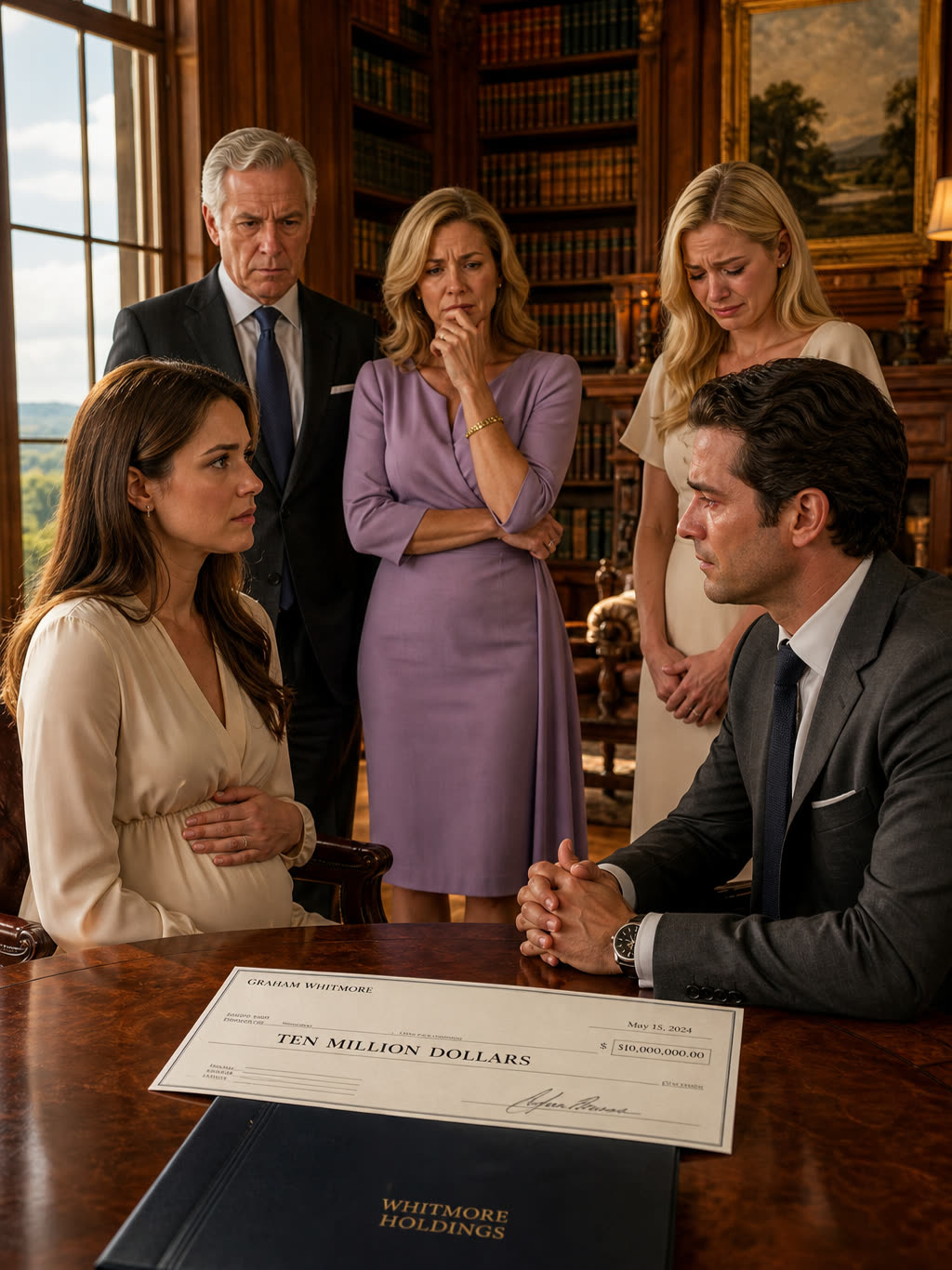
That promise felt painfully distant as I sat in the library of his parents’ estate outside Greenwich, Connecticut. Tall shelves of leather-bound books rose behind them, and the afternoon light fell in pale bars across the carpet. Facing me were Graham, his mother and father, and a young woman named Serena Cole, who kept her hands folded very tightly in her lap, as if she were afraid they might betray her.
Serena had worked as Graham’s executive coordinator for almost two years. She was also twenty-two weeks pregnant, and she was carrying three boys. It was an astonishing detail, the kind that might have made strangers smile, but in that room nobody smiled. The word hung over the table like a verdict that had already been delivered before I arrived.
Graham’s mother, Eleanor, kept returning to that detail as though nothing else in the world mattered. Her voice was soft, almost reverent, the voice of someone speaking in a church.
“Three grandsons,” she said softly, almost reverently. “You understand what this means for the family.”
I did understand. I understood that Serena was carrying the children everyone in that room believed belonged to my husband. I understood that Graham had been involved with her during our marriage, while I sat at our kitchen table believing that every late evening at the office was only work. And I understood that after three years of treating me as family, the Caldwells had apparently decided I could now be removed from it like an inconvenient paragraph in a contract, struck out neatly with a single line of ink.
Graham’s father, Richard, slid a folder across the walnut toward me, and the motion was so smooth and practiced that it made my stomach turn. He had clearly done this sort of thing before, in boardrooms, with strangers, with people whose names meant nothing to him.
“This gives you ten million dollars, the apartment you already own in Boston, and complete financial independence. In return, the separation remains private and uncomplicated.”
Eleanor added her own gentle cruelty.
“You would never need to work again.”
I almost smiled. I had spent eight years building my career as an architectural consultant before I ever married Graham, years of late nights over drawings and difficult clients and earning respect one project at a time. Yet somehow his mother imagined that permanent idleness could serve as compensation for being quietly replaced.
But there was something none of them knew. My period was six days late. For several mornings the smell of coffee had turned my stomach, and the perfume I had worn for years suddenly seemed overwhelming. I had been falling asleep before nine despite doing nothing unusually tiring. That very morning I had taken a pregnancy test from the bathroom cabinet and set it beside the sink, intending to use it before breakfast, but Graham’s message had arrived first.
We need to talk. Please come to my parents’ house.
Now, while his father calmly explained the financial terms of my disappearance, I rested one hand unconsciously against my stomach. Then I looked at Graham, and I saw that his eyes were red. Somehow that made everything worse, because it meant he felt something, and he was going to let it happen anyway.
“Tell me not to sign it.”
Richard stopped speaking. Eleanor’s expression tightened, and Serena looked down at her hands. For a long moment no one moved, and the clock on the mantel seemed to grow louder. Graham finally met my eyes, and I gave him one last chance.
“Tell your father to put the check away. Tell me this marriage still matters enough for you to fight for it. I’m not asking you to explain everything right now. I’m asking whether you want me to stay.”
For one brief moment, I saw the man I had married. Something gentle and honest crossed his face, and I felt hope rise in me like a tide I had not given permission to move. He leaned forward. His lips parted. I held my breath.
Then Serena began crying. It was not loud. It was just a soft, frightened sound, but it filled the room completely.
Graham turned toward her immediately.
“Serena, hey. You’re okay.”
He reached for her hand. Something inside me became very quiet, the way a house goes quiet after a door closes for the last time. There was no anger in it yet, only a calm so deep that it felt like falling.
I picked up the pen. Graham looked back at me, and I could see in his face that he understood what he had just done.
“Claire…”
“I already asked you to stop me.”
Then I signed. Every page.
That evening I left the Boston townhouse Graham and I had shared with two suitcases, one garment bag, and the pregnancy test I had never used. I did not slam any doors, and I did not leave a note. I simply walked out through rooms that suddenly felt like a stage set from a play I no longer belonged to.
My closest friend, Dr. Hannah Pierce, owned a small women’s health practice in Providence, and above the clinic there was a furnished apartment that visiting physicians occasionally used. She handed me the keys without asking how long I intended to stay, and I have loved her for that ever since.
Graham called fourteen times that night. I answered none of them. I watched the phone light up on the table, buzz against the wood, and fall silent again, and I felt the strange numbness of someone who has already said everything she had to say.
At nearly midnight, sitting alone on the bathroom floor beneath a light that was much too bright, I finally opened the test. I waited with my back against the cold tub, counting my own breaths. Two lines appeared. I stared at them until the room seemed to tilt.
The Caldwell family had just paid me ten million dollars to leave because another woman was carrying three sons. And I was pregnant too. The thought was so absurd and so enormous that I did not know whether to laugh or to cry, so for a long while I did neither.
The next morning Hannah brought me downstairs before her first appointment.
“It may be too early to see much,” she warned as she prepared the ultrasound. “So if we don’t—”
Then she stopped. I turned my head.
“What?”
Hannah leaned closer to the monitor.
“Claire…”
There was a pause that seemed to last for years.
“One.”
My fingers tightened around the edge of the table. Then she whispered, “Two.”
I stared at her.
“Hannah?”
Her eyes moved across the screen.
“Three.”
I stopped breathing normally. Then her expression changed again.
“Oh.”
“Oh what?”
She looked at me, almost laughing from disbelief.
“Four.”
I blinked.
“Four what?”
She reached for my hand.
“Four babies.”
For several seconds neither of us spoke. Four. Four tiny beginnings. Four children belonging to the man who had sat silently while his family paid me to disappear. I cried then, but not entirely from sadness. Fear was part of it, certainly, because carrying four babies would be complicated, and my whole life had been rearranged in less than twenty-four hours. But underneath the fear was something surprisingly strong. They were mine. Whatever happened next, they were mine.
I did not call Graham. Perhaps I should have. For years afterward I questioned that decision more than any other I ever made. But I remembered Serena crying and Graham reaching for her hand while mine rested alone in my lap, and I could not bear the thought of presenting my pregnancy as another argument in a competition I had never agreed to enter.
Three weeks later I moved to a quiet town outside Portland, Maine, where Hannah connected me with a maternal-fetal medicine specialist she trusted. I changed my phone number. I rented a cottage near the water. And I disappeared, as completely as the Caldwells had hoped I would, though for reasons entirely my own.
Months later Benjamin, Oliver, Sophie, and June arrived safely, two boys and two girls, each tiny and determined, each somehow carrying a different piece of the man I had tried so hard to forget. Benjamin had Graham’s serious little frown. Oliver had his chin. Sophie loved music almost from infancy. June had the same gray-blue eyes as Eleanor Caldwell, and every time she looked at me, I felt the odd sting of that inheritance.
For nearly two years I raised them quietly. I never spoke badly about their father. When Benjamin eventually pointed at a photograph tucked inside an old book and asked, “Daddy?” I told him only that his father lived far away. That was true. Just not in the way he understood.
My silence might have lasted much longer if Hannah had not sent me a photograph one Tuesday morning. It was a wedding announcement. Graham Caldwell and Serena Cole were finally getting married at the Caldwell family estate. By then Serena’s three boys were nearly two, and according to the society pages, Richard Caldwell had begun reorganizing several family trusts around his grandchildren. His three grandchildren.
I sat at my kitchen table while four toddlers argued over blueberries and stared at Graham’s photograph. He looked older. So did I. For the first time I realized that my silence was no longer protecting my children from chaos. It was erasing them from a family structure that could shape their entire future.
So I contacted an attorney. Then I arranged legally recognized DNA testing. The result was clear. Probability of paternity: greater than 99.99 percent. Graham Caldwell was the biological father of all four children. I read the page three times, then folded it carefully and placed it in a white envelope, the way one handles something that might explode.
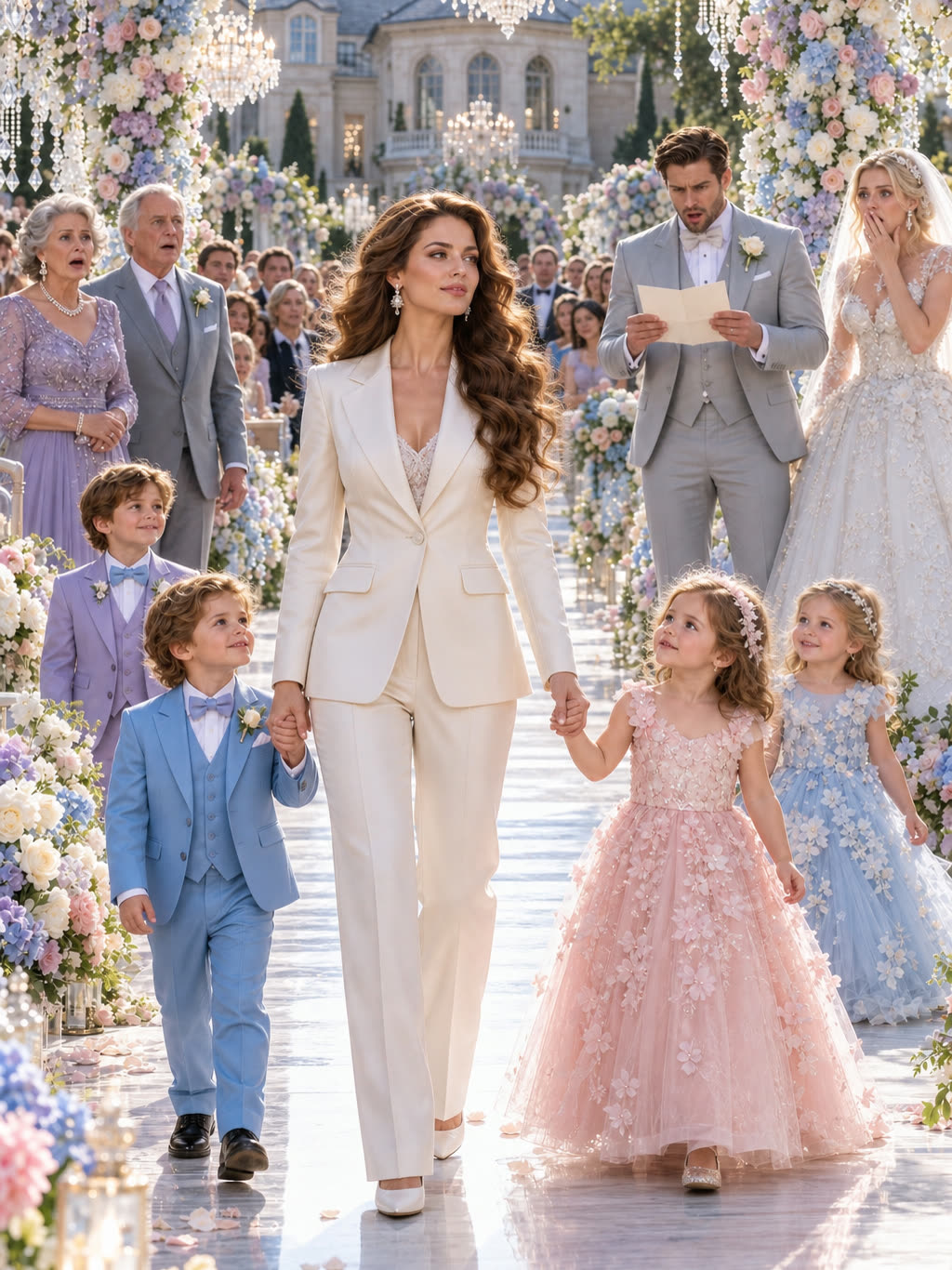
I did not call him. Instead, on the afternoon of his wedding, a black SUV carried the five of us down the long driveway toward the Caldwell estate. I wore an ivory pantsuit. Benjamin held my left hand. Sophie held my right. Oliver and June followed with our nanny. My heart was beating so hard that I could feel it in my throat.
By the time we reached the lawn the ceremony had not yet begun, but hundreds of guests were already seated beneath white flowers and pale linen canopies. The whispers started first, rippling outward from the nearest rows like wind through tall grass. Then Eleanor saw us. The champagne glass slipped from her fingers and broke against the stone terrace.
Graham turned. I watched recognition move across his face, followed by confusion as he noticed the children around me.
“Claire?”
“Hello, Graham.”
Richard approached quickly.
“What are you doing here?”
I reached into my handbag and removed a white envelope.
“I brought something Graham should have received a long time ago.”
Graham barely looked at the envelope. He was staring at Benjamin. Then Oliver. Then Sophie. Then June.
“Who are they?”
I told him their names. His voice became almost inaudible.
“How old?”
I said nothing. He did the arithmetic himself, and I watched his face lose its color, as if someone had drawn the blood out of it.
“Claire…”
I handed him the envelope.
“Read it.”
His fingers closed around the paper, and the whole garden seemed to hold its breath as he began to open it.
Part 2: The Question No One Had Asked
His hands trembled as he opened the DNA report. For a long moment there was no sound except wind moving through the trees, and the faint clink of a glass somewhere far behind us, the last sound of a celebration that had not yet realized it was over.
Then Graham looked at me.
“They’re mine?”
“Yes.”
He closed his eyes. When he opened them again they were wet.
“Four?”
I almost laughed at the absurdity of the question.
“Four.”
But I was no longer watching him. I was watching Serena. The bride standing several yards away was not angry. She was afraid, and not in the way a woman is afraid when her wedding has been interrupted. It was a deeper fear, the kind that comes from being seen.
The moment I saw her face, I understood that my children had revealed a problem I had never anticipated. If Graham had four biological children no one knew about, people would start examining dates. DNA. Trusts. And perhaps Serena had reasons to fear those questions.
The wedding was postponed before anyone reached the aisle. Guests were guided quietly toward the house, murmuring among themselves, while the white flowers swayed gently over rows of empty chairs. Richard moved the immediate family into the same library where my marriage had ended two years earlier, while staff took all seven children into another part of the house.
I stood in that room again, among those same shelves, beside that same walnut table, and it felt as if the years in between had been folded away. Only this time I was not the one waiting to be chosen. Graham stood near the window, still holding the DNA report as though it weighed far more than paper should.
Finally he turned toward me.
“When did you know?”
“The night I left.”
His face tightened.
“You knew that night?”
“I knew I was pregnant. Hannah discovered there were four the next morning.”
He stared at me.
“And you never told me.”
The old anger rose in my chest, hot and familiar.
“I asked you to choose our marriage before I signed those papers.”
“Claire—”
“You took her hand.”
“She was pregnant and frightened.”
I looked at him.
“So was I. I just didn’t know it yet.”
He lowered his eyes. For once he had no answer, and the silence that followed was the most honest conversation we had had in years.
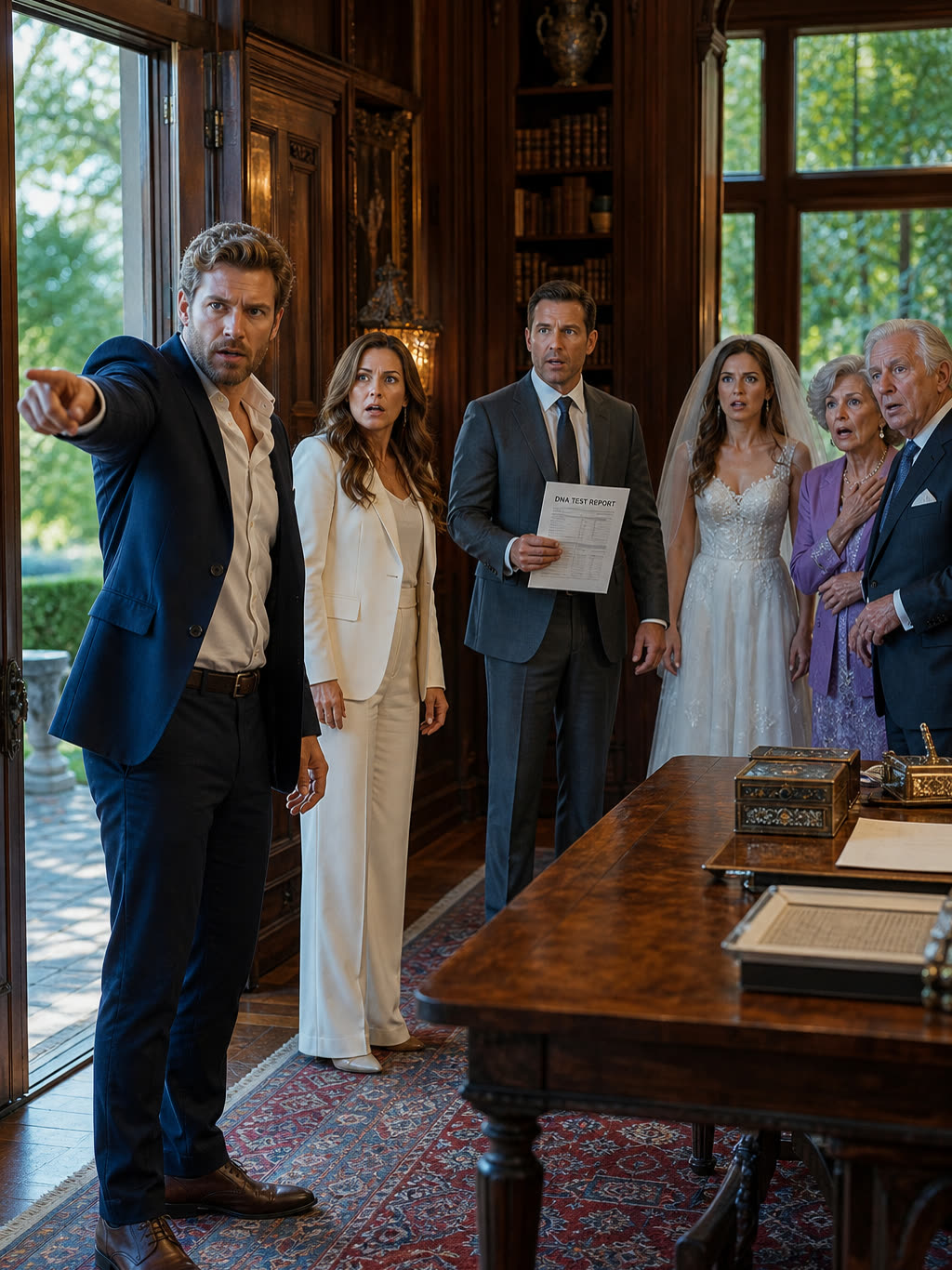
Then a man’s voice came from the doorway.
“You should test Serena’s boys.”
Everyone turned. The man in the doorway was Caleb Foster, a former financial analyst who had once worked with Serena before she joined Graham’s company. He stood very straight, like someone who had rehearsed this moment a hundred times and still did not feel ready for it.
Serena immediately stiffened.
“You shouldn’t be here.”
Caleb ignored her. He looked directly at Graham.
“Serena and I were together during the period when the boys were conceived.”
Graham became completely still.
Serena began shaking her head.
“It wasn’t like that.”
“Then tell him what it was like.”
Richard demanded an explanation, and slowly, painfully, the truth began emerging, one broken sentence at a time. Serena had been involved with Caleb before working for Graham, and their relationship had briefly resumed around the same time she became close to Graham. She had never known with certainty which man was the biological father.
But there was more. Eleanor had discovered the uncertainty before my divorce. I saw it in the way she refused to look up, in the way her fingers worried the pearls at her throat. Graham turned toward his mother, and I will never forget the sound of his voice.
“You knew?”
Eleanor looked suddenly much older.
“I knew there was a possibility.”
“And you still pushed Claire out?”
“Serena was carrying three boys. Your father was reorganizing the succession plan, and everything was becoming unstable.”
Graham stared at her.
“You destroyed my marriage because stability mattered more than truth?”
Eleanor’s composure finally cracked.
“I thought I could fix it.”
Richard gave a bitter laugh.
“That sentence has probably damaged more families than any other.”
Then another secret surfaced. Eleanor had known about my pregnancy. I felt the room narrow around me, the shelves leaning closer, the air thinning out.
“What?”
She looked at me reluctantly.
“A laboratory connected to our family medical foundation processed your early bloodwork. I learned you were pregnant the day after the divorce.”
Graham stepped toward her.
“You knew?”
She nodded.
“Later, I learned there were four.”
The expression on Graham’s face was worse than anger.
“You knew I had four children for almost two years.”
“I tried to locate Claire.”
I stared at her.
“You never contacted me.”
“Because by the time I found you, you were in Maine, the babies had arrived, and you looked peaceful. I convinced myself that leaving you alone was kinder than dragging you back into this family.”
I could hardly believe what I was hearing. All those months of quiet mornings by the water, and someone had been watching from a distance and deciding what I could bear.
“You decided what was best for all of us again.”
Eleanor looked down.
“Yes.”
That single word was the first honest thing I had heard from her.
Independent testing was arranged for Serena’s three boys, carefully and privately, because Graham insisted that whatever mistakes the adults had made, the children would not be treated like evidence in a courtroom drama. He said it with a firmness I had not heard from him before. Nobody argued, not even Richard.
The days that followed were strange and suspended. The house was full of children’s voices and adult silences. I watched the four toddlers I had raised in secret explore a place that should have been theirs from the start, and I watched the Caldwells watch them, as if looking at four small mirrors.
Several days later the results arrived. A thin envelope was placed in Graham’s hands, and nobody in the library breathed. Serena sat rigid. Caleb looked at the floor. Eleanor gripped the arm of her chair.
The boys were not Graham’s. They were Caleb’s.
Serena sat in silence for a long time after hearing it. Graham did too. Then he stood, walked out of the library without a word, and climbed the stairs, leaving the rest of us in a room that felt as if it had just been emptied of air.
Part 3: We Did Not Go Back
I found Graham later, sitting on the floor outside the nursery. Benjamin, Oliver, Sophie, and June were sleeping in one room. Serena’s boys were sleeping in another. Seven children beneath one roof, connected by decisions none of them had made. Graham rubbed his hands over his face.
“I missed almost two years.”
I sat several feet away.
“Yes.”
“Their first steps?”
“Most of them.”
“First words?”
I nodded. His eyes filled.
“Because I was too weak to stand up to my family.”
I could have comforted him. Instead, I told him the truth.
“That was part of it.”
He looked at me.
“And the rest?”
“I chose silence too.”
That surprised him. It surprised me as well.
For two years I had told myself that everything was Graham’s fault, because anger was easier to carry when responsibility belonged entirely to someone else. But he had not known about our children. I had made sure he did not. That did not erase his betrayal or his failure in the library, but it complicated the story in a way I could no longer ignore.
A small cry came from the next room. One of Serena’s boys. Graham stood immediately and lifted the child, who wrapped sleepy arms around his neck and murmured, “Daddy.” Graham closed his eyes, and I saw how much that single word cost him and how much it gave.
Later, Caleb asked whether Graham intended to step away now that the DNA results were clear. Graham answered without hesitation.
“No.”
Caleb frowned.
“They’re my sons.”
“Biologically, yes. And you deserve the chance to know them.”
Graham glanced toward the nursery.
“But I’ve been their father since the day they came home. I’m not disappearing from their lives because a laboratory gave us new information.”
That was the first moment I saw clearly how much Graham had changed. Or perhaps how much of the man I had once loved was still there beneath his mistakes. I did not know which it was, and I did not yet trust myself to decide.
The adults eventually reached an arrangement that no family handbook could have designed. Caleb entered the boys’ lives slowly. Graham remained their everyday father. Serena moved into a nearby townhouse and began counseling, while Eleanor, for perhaps the first time in her life, stopped trying to manage everyone else’s choices. Richard froze the old family trust structure and created equal protections for all four of my children without asking me to surrender control over their lives.
As for the ten million dollars they had paid me to disappear, I used part of it to establish a foundation supporting women rebuilding careers after financially dependent marriages. Richard nearly choked when I told him.
“So my divorce settlement became a nonprofit?”
“Part of it.”
“I suppose I deserve that.”
“You absolutely do.”
Graham and I did not reunite. Not then. That would have been too easy, and easy was what had caused much of the trouble in the first place. Instead, he came to Maine. At first he visited only on weekends. He learned that Benjamin hated peas, Oliver loved airplanes, Sophie needed music before bed, and June could persuade almost any adult to give her another cookie simply by staring at them long enough.
He changed diapers without being praised for it. He attended pediatric appointments. He learned preschool schedules. He arrived when he said he would. Most importantly, he stopped asking me to forgive him. I noticed that last thing more than all the others, because it meant he finally understood forgiveness could not be demanded.
One evening, almost a year after the wedding that never happened, we stood in my kitchen while four children slept upstairs. Graham placed his coffee on the counter.
“I owe you an apology.”
I folded my arms.
“You’ve apologized before.”
“No. I’ve explained before.”
That made me look at him. He continued.
“I told you I was confused. I told you Serena was pregnant. I told you my parents pressured me. I told you I thought I was protecting children. Every one of those things may be true, but none of them changes the fact that you asked me to stand beside you and I didn’t.”
He swallowed.
“I failed you.”
Nothing followed. No excuse. No request. No expectation. Strangely, that was the first apology that reached me, and I stood in the lamplight of my own kitchen feeling something loosen in my chest that had been tight for years.
It still took another year. Trust, once damaged, does not return because someone delivers the right speech. It returns in small, almost boring pieces. Graham remembered school forms. He sat beside sick children at two in the morning. He never once used money to solve an argument. When Eleanor interfered, he stopped her before I had to. When I disagreed with him, he listened instead of retreating.
And slowly, against my better judgment, I began laughing with him again. That frightened me more than anger ever had, because anger had been safe, a wall I understood, while laughter was an open door.
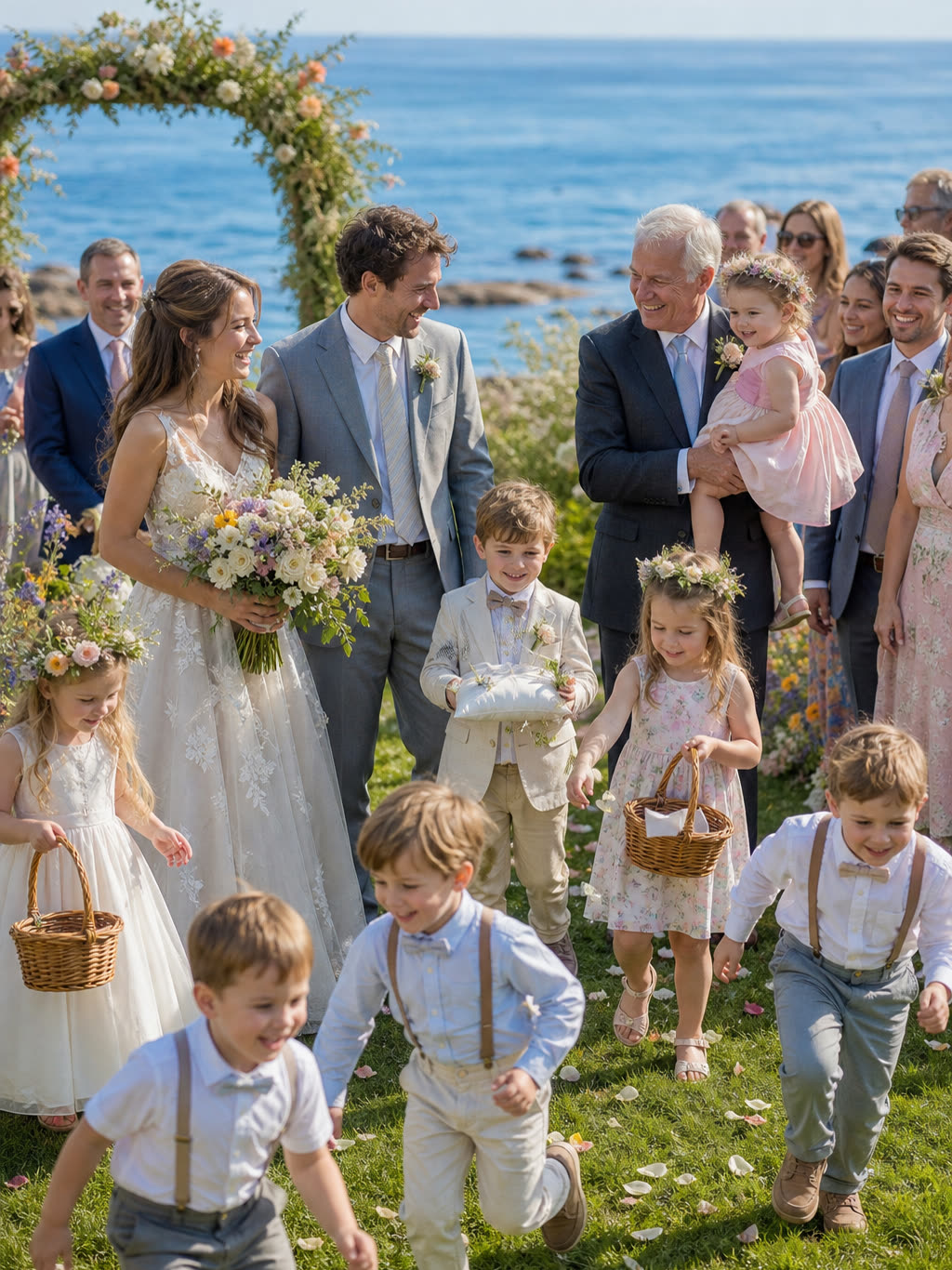
Three years after our divorce, Graham and I married again. Not at the Caldwell estate. Not in front of hundreds of guests. We chose a small garden overlooking the Maine coast, with thirty people and seven children who behaved exactly as seven excited children should. The sea glittered beyond the flowers, and the air smelled of salt and cut grass.
Benjamin carried the rings. Oliver nearly lost one. Sophie scattered flower petals before anyone told her to. June refused to walk down the aisle unless Richard carried her, so one of the most powerful businessmen in New England entered my wedding wearing a tiny flower crown his granddaughter had placed on his head.
Serena came. So did Caleb. Their three boys ran across the grass with mine as though the complicated history among their parents had nothing to do with them. Maybe it didn’t. I watched them tumble together in the sunlight and thought that children are often wiser than the adults who arrange their lives.
Before Graham signed the marriage certificate, he looked at me and smiled.
“Last chance. Tell me not to sign.”
For a second I was back in that library, hearing my own voice ask him to stop me. The memory still hurt. Perhaps it always would. I placed my hand over the certificate.
“Don’t sign.”
His smile disappeared. Then I added, “Not until I do.”
He laughed. So did I. And we signed together.
Years later our home became the sort of place I could never have imagined while sitting alone on Hannah’s bathroom floor with a positive pregnancy test in my hand. There were shoes everywhere. Someone was always hungry. Someone was always accusing someone else of taking a charger. Richard, who once spoke endlessly about heirs and succession, became a grandfather who let children cover his expensive office furniture with stickers. Eleanor learned that loving a family was different from arranging one. Serena eventually built a quiet career helping women regain financial independence. Caleb became a steady presence in his sons’ lives without trying to erase Graham. And Graham never stopped being their father simply because biology had rewritten part of their story.
One summer evening, while the seven children chased one another across our backyard, Graham sat beside me beneath an old maple tree.
“Do you ever think about that ten-million-dollar check?”
“Sometimes.”
He smiled.
“Worst deal my father ever made.”
I looked at the children.
“I don’t know. It bought me enough distance to figure out who I was without all of you.”
His expression softened.
“Would you still have left if you hadn’t been pregnant?”
I thought about the woman I had been that afternoon. The woman waiting for her husband to choose her.
“Yes.”
Graham nodded. He understood. Then I asked, “Would you have married Serena if I never came back?”
He watched the children for a long moment.
“Probably.”
“Would you have been happy?”
Another pause.
“I think I would have spent years telling myself I was.”
I appreciated the answer because it did not try to make our story prettier than it had been. The truth was messy. Graham had betrayed me. I had hidden his children from him. Serena had built security around a lie. Eleanor had treated people like pieces on a board. Richard had once believed money could close almost any wound. Yet the children forced all of us to become better than the choices that had brought them together.
That was the part I eventually understood. Family was never really about who carried the right surname, who appeared in a trust document, or whose DNA matched whose. Richard chose Graham every day simply by being his father. Graham chose three boys even after learning they were not biologically his. Caleb learned that being a biological parent did not give him the right to erase the man who had raised them. And I chose Graham again, not because I forgot what happened in that library, and certainly not because love magically repaired everything. I chose him because over time he became a man I could trust with what came next.
As the sun disappeared behind the trees, June opened an upstairs window.
“Mom!”
I looked up.
“What?”
“Oliver took my charger!”
From somewhere inside the house came Oliver’s voice.
“I DID NOT!”
Sophie shouted, “YES, YOU DID!”
Then one of the boys yelled something about missing ice cream.
Graham closed his eyes.
“There goes the peaceful evening.”
I stood and held out my hand.
“You wanted a big family.”
He took it.
“I don’t remember requesting seven at once.”
I laughed. Before we reached the house, he stopped me.
“Claire?”
“What?”
“I’m glad you came to my wedding.”
I smiled.
“Even though I ruined it?”
“Completely.”
“I improved it.”
He laughed and followed me inside.
Years earlier, Eleanor Caldwell’s champagne glass had broken against the stone when she saw me walking toward that wedding with four little children. At the time, I thought that sound marked the moment their perfect family began falling apart. I eventually understood it differently. It was the moment the truth finally entered a family that had spent too many years arranging appearances, protecting plans, and deciding what everyone else should know.
The truth did not make us perfect. It did something better. It made pretending impossible. And from that point forward, every relationship that survived had to survive honestly.
The Caldwell family once offered me ten million dollars to disappear because they believed three unborn boys represented their future. I disappeared. Then I returned with four children of my own. But the strangest part is that I did not return to destroy anyone, even though at the time I thought I wanted justice. I returned because my children deserved to exist openly.
What followed changed all of us. Three boys discovered that fatherhood could belong to more than one man without becoming a competition. Four children gained a father who spent years earning the privilege of knowing them. A grandmother learned that control was not love. A grandfather learned that inheritance meant very little compared with the way a child remembered being treated. And I learned that forgiveness did not mean pretending the past had never happened. It meant deciding whether the person standing before me had become someone different from the person who had hurt me. Graham had. So had I.
And whenever people now ask how we managed to separate, have four children in secret, interrupt another wedding, uncover the truth about three more children, and somehow end up married again, Graham gives them the shortest possible version.
“My wife showed up at my wedding with quadruplets and turned my entire life upside down.”
I always correct him.
“Your life was already upside down.”
He smiles.
“Fine. She turned it right side up.”
That version, I let him keep. Because after everything we had hidden, misunderstood, lost, and slowly rebuilt, it was finally a family story that did not require anyone to lie.
Disclaimer: This story is a work of fiction inspired by real-life themes. Names, characters, places and events are fictionalized, and any resemblance to real persons is purely coincidental. Images are for illustration purposes only.
