

The Night He Wouldn’t Get Up
The night I found my fifteen-year-old daughter curled up on the bathroom floor, retching and clutching her stomach, my husband didn’t even bother to stand up from his recliner. The television murmured in the living room, the lamp glowed warm over his shoulder, and the sounds of my child’s suffering carried down the hallway to him as plainly as any cry for help could. He heard every one of them. He stayed exactly where he was.
“Leave her alone, Paula. She’s overreacting again,” Curtis said, without looking up from his phone. “We’re not throwing money away on the ER over a tantrum.”
Something inside me gave way. It wasn’t loud, and it wasn’t dramatic. It was the quiet snap of a rope that had been fraying for years, and I only noticed it was gone once I felt myself falling. I stood in the hallway with a damp washcloth in my hand and understood that a door had closed somewhere in my marriage, and that I would never be able to open it again.
Sadie had been complaining for almost a month. It began with nausea after breakfast, the kind a mother brushes off as a stomach bug or a case of nerves before a test. Then she stopped finishing her meals. She started coming home from high school pale and quiet, dropping her backpack by the door and heading straight for the couch. By night she was lying on her side with a heating pad pressed against her abdomen, her knees drawn up as if she were trying to fold herself smaller than the pain. Three times I had pushed to take her to a doctor.
Every time, Curtis found a reason to put it off, and every reason came in the same calm, patient voice, the voice of a man explaining something obvious to a slow child. “It’s nerves.” “She’s trying to get out of school.” “At that age, everything hurts when they want attention.” He said these things so smoothly, so often, that I had begun to hear them in my own head, and on bad days I almost believed them.
But that night Sadie did not look like a spoiled teenager angling for sympathy. The bathroom light was harsh and white, and it showed me everything. Her lips were dry and cracked. Her T-shirt was plastered to her back with sweat. Her breathing came in short, ragged gasps, as though each breath had to squeeze past something that didn’t want to let it through. No performance could have been that exhausting, and no tantrum could have drained the color from her face that way.
I dropped to my knees on the cold tile and crouched beside her, my hand finding her damp hair. My heart was pounding so loudly I was sure she could hear it. All the arguments I had lost, all the times I had let Curtis’s certainty outweigh my own instincts, crowded into my chest at once and left me almost unable to speak.
“Look at me, honey.”
Her eyelids fluttered, and she turned her head toward me with visible effort. In her face I saw a fear so large and so private that it frightened me more than the pain did.
Sadie raised her eyes. “It feels like something is pulling me from the inside.”
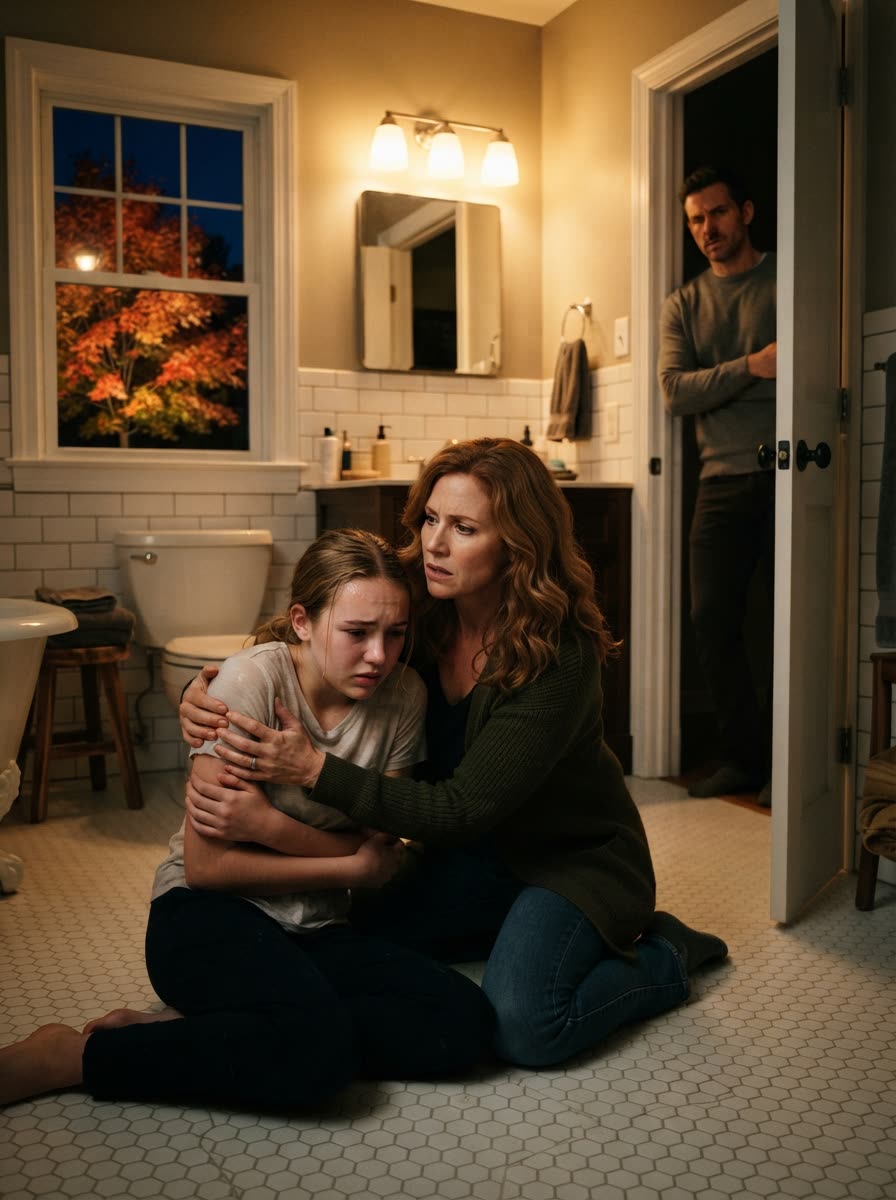
Curtis appeared in the doorway then, a dark shape against the hall light. He let out a long sigh, the sigh of a man inconvenienced by weather. “And now there are two of them.”
I didn’t argue. I had learned over seventeen years that arguing with Curtis at night, with his jaw set and his phone in his hand, only taught Sadie to be afraid of raised voices. So I swallowed everything I wanted to say. I waited until she was steady enough to stand, then put my arm around her thin shoulders and walked her down the hall to her room, one slow step at a time. I sat on the edge of her bed in the dark and stayed there, stroking her hair, until her breathing evened out and she finally slept. I did not sleep at all.
The next morning I told Curtis I was taking her to buy sneakers, because hers were falling apart. It was a small lie, easy to tell, and he accepted it without a glance. “Nothing expensive,” he answered. He said it the way he said everything about money, as an order disguised as a casual remark.
As soon as we left our house in Dublin, Ohio, I drove straight to St. Luke’s Regional Medical Center. My hands were steady on the wheel, which surprised me, because inside I was shaking. The autumn trees along the road burned red and gold in the morning light, and I remember thinking how absurd it was that the world could look so beautiful on a day like this.
Sadie noticed when I took the wrong exit. She sat up in the passenger seat, her face still gray with fatigue, and watched the signs go by. “Mom, Dad’s going to be mad.”
“Let him be mad at me.”
“He said it wasn’t necessary.”
“Today a doctor is going to decide that.”
She said nothing more. She turned toward the window and let her forehead rest against the glass, and I could not tell whether what I saw on her face was relief or dread.
In the emergency room, the triage nurse stopped asking questions the moment she laid her hand on Sadie’s abdomen. My daughter curled up in pain, a thin cry escaping her, and the nurse’s expression changed from routine to urgent in a heartbeat. Within minutes we were swept past the waiting area and into a curtained bay, where everything began to move very fast.
They drew blood. They placed an IV in the back of her small hand, and I watched the tape go down over her pale skin and had to look away. They ordered an ultrasound. Then, based on what they saw on that screen, the technician’s silence growing heavier by the minute, they ordered a CT scan. I paced the corridor outside, counting floor tiles, bargaining with a God I rarely spoke to.
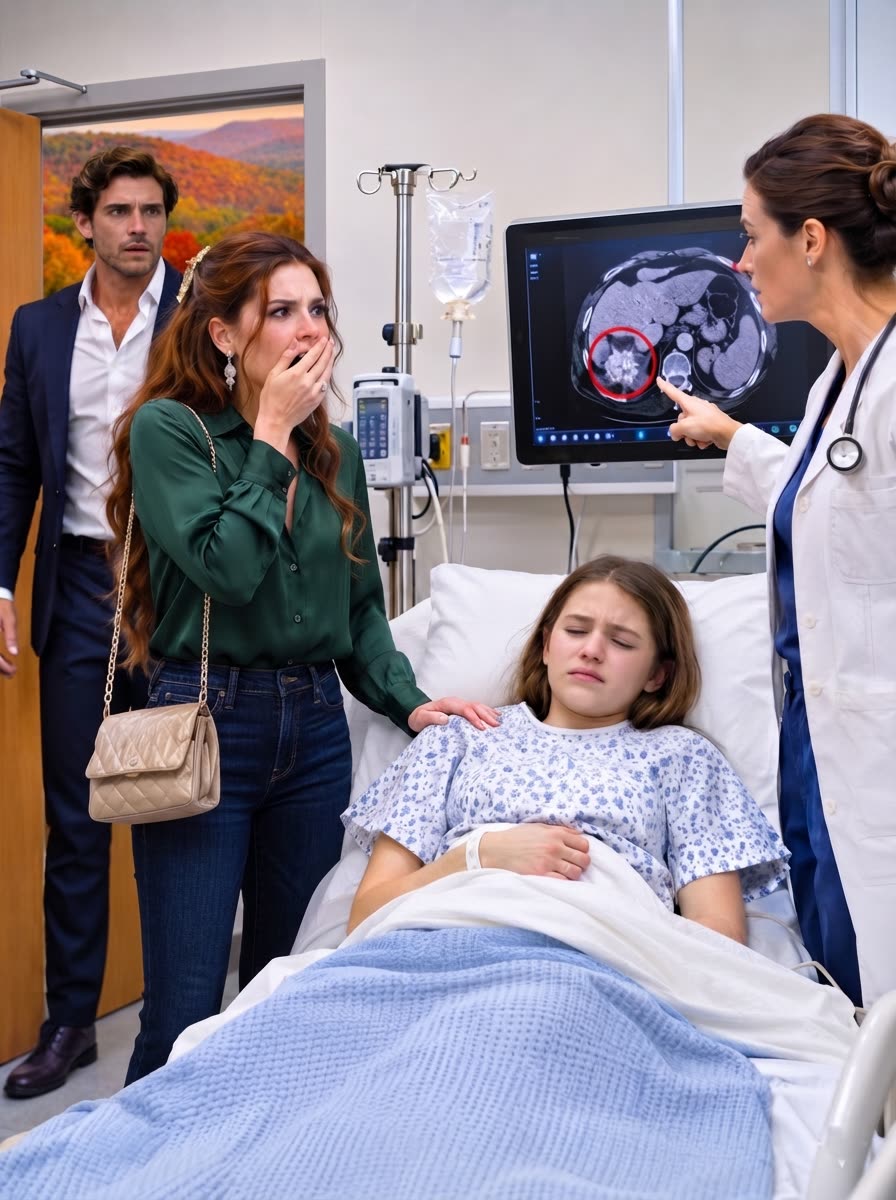
Forty minutes later, a pediatric gynecologist named Dr. Priya Raman came in with another specialist. Neither of them was smiling, and that told me more than any words could have. I felt my stomach drop before anyone had said a thing.
The doctor pulled up a chair and sat close to us, her hands folded, her voice gentle but unhurried. “Mrs. Dunleavy, we found a large mass in Sadie’s abdomen.”
I froze. The words seemed to arrive from very far away, and my mind refused to assemble them into meaning. “A tumor?”
“It’s a possibility, but we don’t yet know what kind of lesion it is. It appears to originate near the right ovary. We need to run more tests and consider surgery.”
Sadie squeezed my hand so hard that my knuckles ached. “Is it cancer?”
“We can’t say that. There are benign masses that can grow very large. What’s urgent is understanding why it’s causing so much pain.”
The room felt as though it were shrinking around me. The walls leaned in, the fluorescent lights hummed too loudly, and I could hear my own pulse. I made myself ask the only question that mattered to me. “How long has she been like this?”
The doctor looked at me carefully, as if weighing how much the truth would cost me. “Judging by the size, it didn’t appear this week.”
Sadie lowered her eyes, and her fingers loosened slightly in mine. “Dad knew it hurt before that.”
I turned to her slowly. “Before you told me?”
She nodded. “When you went to take care of Grandma, he took me to a clinic.”
My heart skipped. For a moment I could not breathe. “What clinic?”
“I don’t know. It was out on Highway 33. They examined me and said I needed an ultrasound. Dad got upset.”
Dr. Raman didn’t interrupt. She simply waited, her attention steady, giving my daughter the room to speak. “And then what happened?”
Sadie began to cry, the tears sliding silently down her temples into her hair. “He told me not to tell you, because you’d make a big drama and spend money we didn’t have.”
Before I could even begin to process it, my phone buzzed against my thigh. I glanced down. Curtis. Three missed calls, stacked on top of one another like accusations. Then a text slid onto the screen. Where are you?
My thumbs felt clumsy as I typed: At the hospital. Sadie has an abdominal mass.
The reply came almost instantly. Don’t authorize anything until I get there.
I stared at the screen until the letters blurred. He didn’t ask if she was stable. He didn’t ask if I was scared. He didn’t ask what exactly they had found inside our child. He just wanted to stop everything, to freeze the whole hospital in place until he arrived to manage it.
Dr. Raman read my expression and leaned forward. “Is something wrong?”
I turned the phone around and showed her the message. She read it once, and her mouth tightened into a thin, careful line.
Sadie let go of my hand. “Mom…” Her voice was shaking. “There’s something else.”
“What?”
She glanced at the door, as if expecting her father to appear in it at any second. “Dad was giving me pills so the pain would go away.”
“What pills?”
“I don’t know. He said they were for my stomach. Afterward I got really, really sleepy.”
The doctor leaned in. “Do you still have them?”
Sadie shook her head. “He gave them to me out of a bottle with no box.”
A brutal chill ran through me, from my scalp to the soles of my feet. I thought of all the evenings Sadie had gone to bed early, and of how grateful I had been that she was finally resting. I thought of how I had mistaken drugged silence for peace.
And then my daughter said, almost without a voice: “The last time I asked to go back to the doctor, Dad told me that if you found out what was going on, ‘it would sink all of us.’”
The sentence hung in the air like smoke. Nobody moved. Somewhere beyond the curtain a monitor beeped, a cart rattled by, and a child laughed in another room, all of it unbearably normal.
At that moment, the door opened.
Curtis was standing there, his coat still on, his chest rising and falling as though he had run from the parking lot. And from the way he looked first at the monitor and then at Sadie, I understood that he hadn’t come to find out anything.
He had come to see how much we had discovered.
The Money, the Bottle, and the Signature
“What did you do to her?” Curtis asked, walking in without a greeting.
He didn’t hug Sadie. He didn’t ask whether he could come closer. He looked at the IV line, the chart, and the monitor the way a man inspects damage after a car accident, searching for what would be expensive and who would be blamed for it. Not once did his eyes rest on his daughter’s face.
Dr. Raman stood up, putting herself, deliberately and calmly, between him and the bed. “Your daughter is stable. We’re completing her tests.”
“I want everything suspended until I talk to another doctor.”
“The patient has significant pain and a mass that requires surgical evaluation.”
Curtis clenched his jaw, and a muscle jumped beneath his ear. “I already took her to get checked. It wasn’t urgent.”
The silence was immediate. It fell over the room so completely that I could hear the faint hiss of the oxygen line and the soft tick of the IV drip. I looked at him, really looked, the way I should have done years earlier.
“So you did take her?”
It took him half a second too long to answer, and I counted every fraction of it. “To a clinic. As a precaution.”
“And why did you hide it from me?”
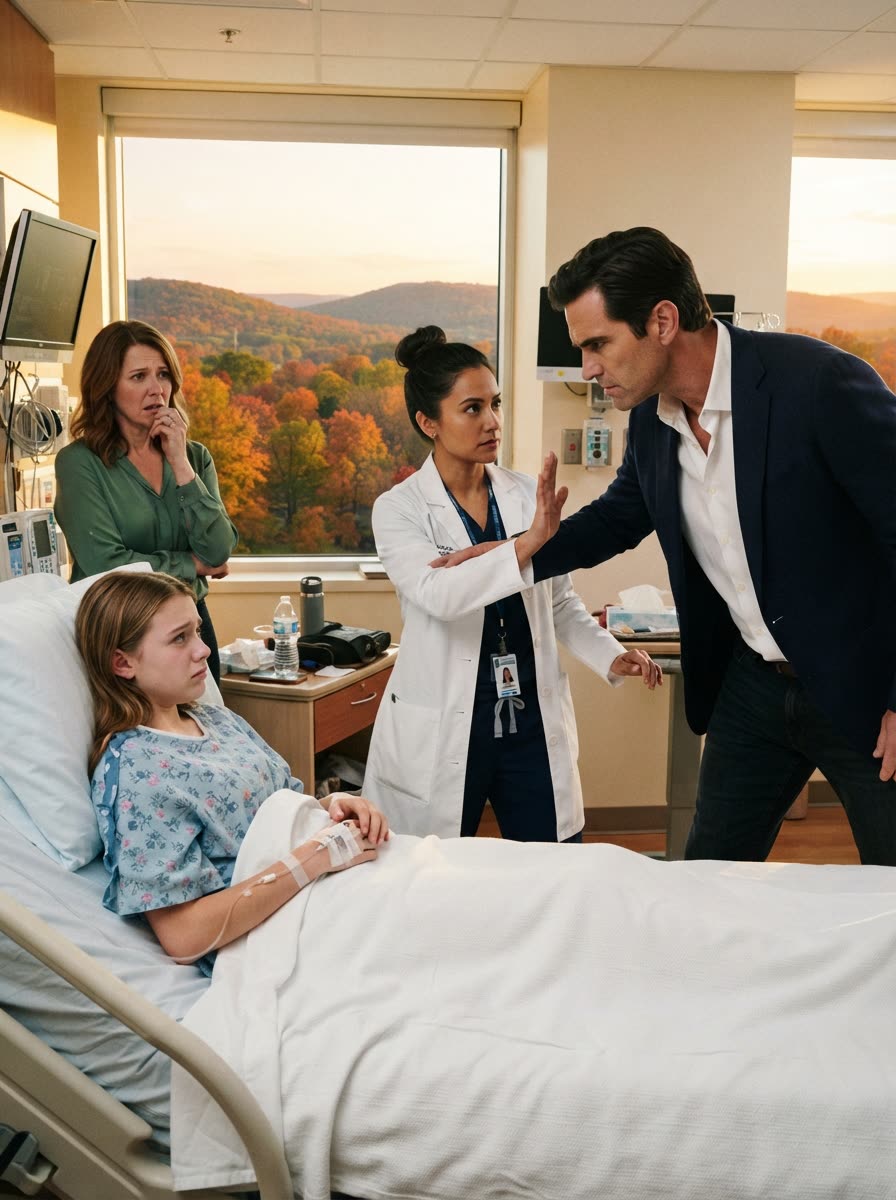
“Because you make a tragedy out of everything.”
Sadie shrank beneath the sheet, drawing it up toward her chin as though the thin cotton could shield her from his voice. The doctor noticed. “Sir, I need you to wait outside.”
“I’m her father.”
“And she’s asking for space.”
Curtis turned toward the bed, and his voice dropped into the low, level tone I knew so well, the tone that had taught our daughter to doubt her own body. “Tell them nothing’s wrong.”
My daughter started breathing fast, her chest fluttering, her fingers twisting in the blanket. For a terrible moment I thought she would obey him out of sheer habit. Then she lifted her chin, only a little, and her eyes met his. “I don’t want you here.”
It was the first time in my life I saw Curtis without an answer. His mouth opened, then closed. Something flickered across his face, not hurt, not shame, but calculation, as though he had just discovered that a piece he’d counted on had moved on the board. Then he turned and stormed out, the door swinging behind him.
The hospital social worker arrived soon after. She did not turn the room into an interrogation. She spoke slowly, pulled a chair to the side of the bed instead of the foot, and let Sadie set the pace of every answer. She confirmed something that hurt me more than any argument could have: for weeks, my daughter had learned to measure her pain by her father’s mood, deciding each day how much suffering was allowed.
Sadie explained that the clinic visit had been six weeks earlier. She remembered a green sign by the road, a receipt Curtis had stuck in the glove compartment, and a doctor who insisted on an ultrasound “as soon as possible.” She remembered the drive home, too, her father’s hands tight on the steering wheel, saying nothing at all.
She also told them about the pills. From her description, Dr. Raman did not want to guess what they were. She only noted, her voice even, that we needed to find the container.
I wasn’t going to wait for Curtis to tell me anything. I stepped into the hallway, my legs not quite steady, and called my sister Dana. I asked her to go to the house. I told her where to look, in the bathroom, in the places where a man hides what he does not want to explain. She didn’t ask a single question. She just said she was already getting her keys.
Within the hour she texted me photos. She had found the bottle in the drawer of Curtis’s bathroom vanity, tucked next to receipts and papers. She had photographed the label from three angles, her careful way of being useful. I zoomed in on the small print with my heart hammering. It was a sedative prescribed to him months earlier. Not to Sadie. To him.
I showed it to the doctor. She frowned deeply. “That should never have been given to her without medical direction.”
I felt sick. It wasn’t just that he had ignored her pain. He had tried to keep her asleep and quiet, to blur the edges of her suffering so that nobody would have to look at it, least of all him.
At nine the next morning, the records from the private clinic arrived. I read them standing in the hallway, my coffee going cold in my hand. The note was clear, and each phrase landed like a small stone: persistent abdominal pain, palpable mass, “priority pelvic ultrasound,” and a recommendation to go to the emergency room if the pain worsened.
At the bottom was a signature acknowledging receipt. Curtis Dunleavy. Six weeks earlier.
It was no longer my word against his. For years, whenever we disagreed, it had come down to my feeling against his certainty, and certainty always won. Now I held a piece of paper with his own name on it, and for the first time the weight of the argument was on my side.
Still, something didn’t add up. Curtis earned a good salary as a purchasing manager at a packaging company. We had health insurance. We had never been rich, but we weren’t on the edge of ruin either. Why had a doctor’s visit terrified him so much? Why would a man who could afford it deny his daughter a scan?
The answer turned up in something as simple as a banking notification. I opened the app for our joint account, intending only to pay a hospital deposit, and the number on the screen made me think the app had glitched. Available balance: $6,143.
I blinked. I refreshed the screen. The number did not change. We’d had nearly $90,000 in savings, the cushion we had built over seventeen years, dollar by careful dollar.
I scrolled through the transactions with growing disbelief. Transfers to a company called Horizon Nine Capital. Payments to credit cards I didn’t recognize. Withdrawals of $8,000, $12,000, $15,000. And, over four months, deposits from our account into a company called Northgate Development Partners.
My hands went cold. I called our accountant, Gordon, and when I said the name of the company, he went quiet, a silence that told me everything before he spoke. “Paula, did Curtis explain that investment to you?”
“No.”
“I thought you knew.”
I sat down on the nearest chair. Gordon told me, in the careful voice of a man who realizes too late that he is delivering a catastrophe, that Curtis had come in as a minority investor in a retail strip-center project in the suburbs. The project had fallen behind. It had lost tenants. It had started demanding extra capital contributions, and Curtis had kept feeding it.
“How much did he put in?”
“I don’t have the full figure.”
“Tell me what you do have.”
“More than a hundred and ten thousand dollars between savings, credit lines, and cash advances.”
I felt the floor disappear. The corridor seemed to tilt, and I pressed my palm against the wall to steady myself. “Loans in whose name?”
“One personal loan. Two credit cards. And a title loan against a vehicle.”
“The house?”
“Not that I know of. But check.”
I hung up and went back to the history, scrolling with a kind of desperate precision. And then I saw another charge. The same clinic where Sadie had been seen. Date: six weeks earlier. Next to it, two days later, a transfer of $23,000 to Northgate.
I stared at those two lines, one above the other, until the truth rose out of them like a shape out of fog. Curtis hadn’t been afraid of a medical bill. He had been afraid that I’d start looking at the accounts just as he was emptying them. A sick daughter meant paperwork, deductibles, statements, questions. It meant I would open the books, and he could not allow that.
I sent the screenshots to a family law attorney my sister recommended. Then I froze every joint transaction that required my authorization and asked the bank to review account access. My voice, I noticed, was perfectly calm. Fear had burned off something inside me and left only clarity.
At four in the afternoon, the surgeon sat down with me and explained that Sadie needed an operation the next day. The mass was compromising the ovary, and there was a risk of complete torsion. Every hour mattered now, and each of those weeks we had lost suddenly had a cost I could not bear to total.
I signed. Without calling Curtis. Without asking his permission. Without negotiating. The pen moved across the consent form with a steadiness that felt like it belonged to somebody braver than me.
That night he texted me: You’re destroying this family by blowing an illness out of proportion.
I took a screenshot. And as I looked at the message glowing in the dim room, with Sadie asleep beside me and the monitor tracing its steady green line, I understood something new. He was no longer trying to convince me. He was leaving a paper trail, building a version of events in which he was the reasonable one.
What he didn’t know was that I had been collecting paper too. And the surgery was scheduled for dawn.
What I Chose to Hold On To
Sadie’s surgery began at seven-thirty in the morning. The corridor outside the operating wing was washed in early gold light from a tall window, and beyond the glass the hills of central Ohio glowed with color, as though the world had decided to be beautiful on purpose.
I walked with her as far as they would let me, one hand on the rail of the gurney. She looked so small under the blanket, her hair tucked beneath a paper cap. Before she went in, she gently tugged my hand. “Mom, if Dad comes, I don’t want to see him when I wake up.”
“You won’t have to if you don’t want to.”
“Are you going to stay?”
“The whole time.”
She let go only when a nurse explained I couldn’t go any farther. The double doors swung shut, and I stood in front of them with my arms hanging at my sides, feeling like a woman who had handed over the only thing she owned.
In the waiting room, Dana pressed a coffee into my hands, and it went untouched, cooling in the paper cup while I watched the clock. At that same hour, across town, my attorney, Ellen Marsh, was going through the documents I had sent her: bank statements, screenshots, the clinic records, and Curtis’s messages. I pictured her at her desk, highlighter in hand, building a wall one page at a time.
She didn’t promise miracles. When we spoke briefly that morning, she was direct and unhurried. She explained that the first priority was to protect Sadie and stop any further movement of our shared money. The divorce and the fight over the debts would come after. One thing at a time, she said. That was the only way anyone survived something like this.
At ten to twelve, the surgeon appeared in the doorway, still in her scrubs, her mask pulled down around her neck. “It went well.”
My legs nearly gave out, and Dana caught my elbow. The surgeon told us that the mass had measured almost nineteen centimeters, about seven and a half inches. It had been causing intermittent torsion, twisting and untwisting, which explained Sadie’s severe attacks of pain and nausea. They had been able to remove it without major complications and preserve functional ovarian tissue.
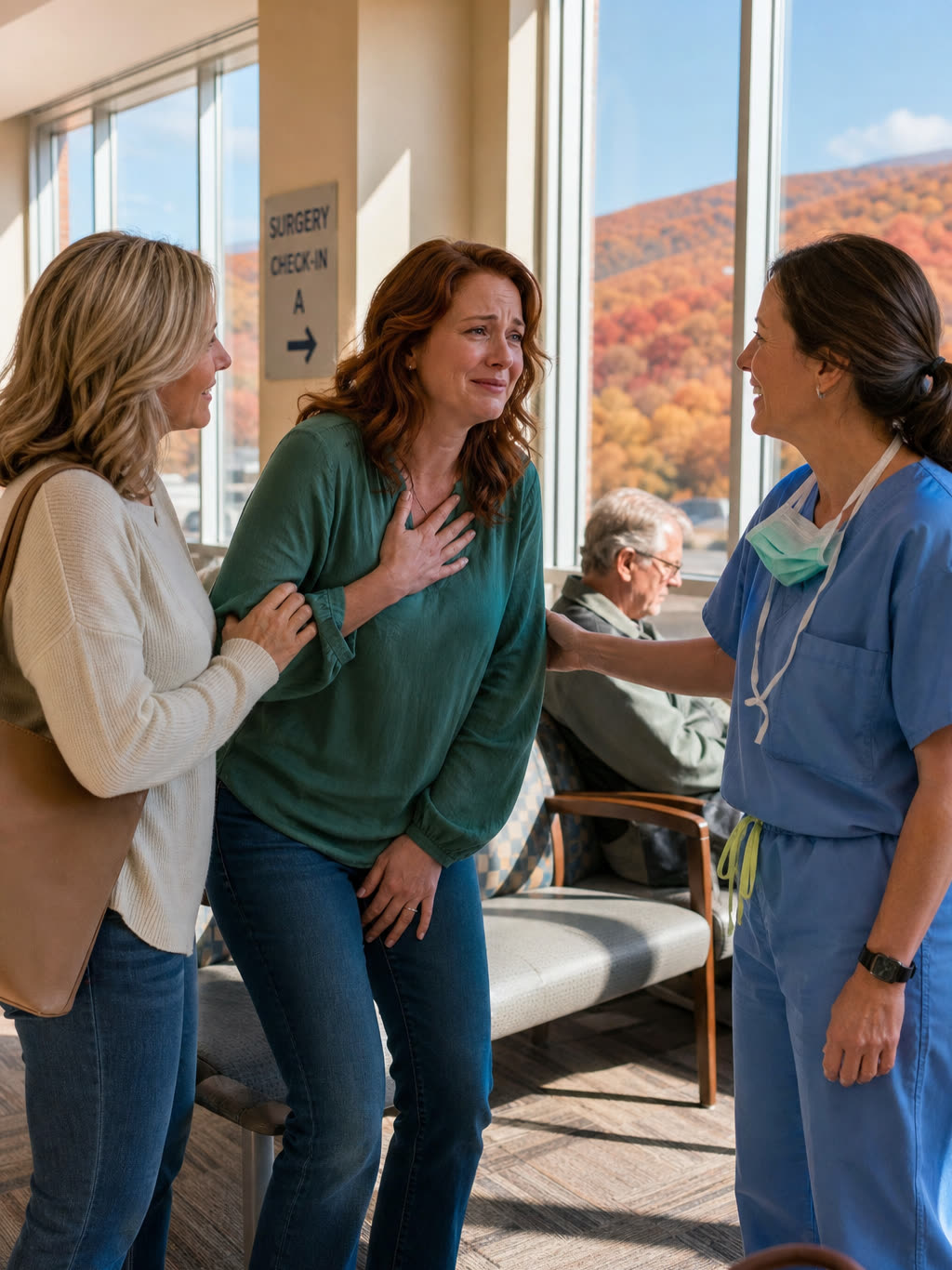
“Was it cancer?”
“From its appearance, it doesn’t look malignant. Pathology will give us the final answer.”
When I finally saw Sadie in recovery, she was drowsy, her eyes half open, her hair damp against her forehead. Her voice was a thread. “Is it over?”
“It’s over.”
“They took that thing out?”
“Yes.”
“And you’re still here?”
I laughed through tears, my face hot and wet. “I told you I wasn’t going anywhere.” She smiled faintly and drifted off again, and I sat there watching her chest rise and fall, each breath easy and unforced, and thought it was the most beautiful movement I had ever seen.
Curtis arrived an hour later with flowers and a bag of juice boxes, as though the right props could rewrite the last two days. The social worker informed him, politely and firmly, that Sadie did not want visits from him. He took it with a stiff nod, and his eyes went hunting for me.
He found me in the hallway. “We need to talk.”
“Here.”
He looked around at the nurses, the families, the squeaking carts. “I’m not going to argue in front of people.”
“Then don’t argue.”
“You’re letting your sister manipulate you.”
I opened the folder in my hands. It was a plain manila folder, and I had never held anything that felt so heavy. “We found the bottle.”
His face changed. The color shifted, the expression slid, and for an instant I saw the frightened man under the confident one. “It was to help her rest.”
“It was your medication.”
“I didn’t hurt her.”
“You’re not a doctor.”
I showed him the clinic note, holding the page where he could read his own signature. “The doctor recommended a priority ultrasound. You signed that you received the instructions.”
Curtis looked away, toward the window, toward anything but the paper. “She wasn’t like this back then.”
“She asked to go back and you told her not to tell me.”
“I was handling it.”
I took out the bank statements and fanned them in my hand. “You were handling this, too.”
He went rigid, every muscle in his shoulders drawing tight. “You went into my accounts?”
“Our accounts.”
“They were investments.”
“Over a hundred thousand dollars without telling me isn’t a shared investment.”
“I was going to get it back.”
“Two days after Sadie’s clinic visit, you transferred twenty-three thousand dollars to Northgate.”
Curtis clenched his jaw. “You don’t know how the project works.”
“I know how a date works.”
I pointed at the documents, my finger steady. “Six weeks ago, a doctor told you our daughter needed a test. You decided not to get it. Then you moved money into the project. Then you spent weeks telling everyone she was faking.”
“It wasn’t like that.”
“Then explain why you tried to stop her tests the moment you found out we were here.”
He opened his mouth, but nothing came out. The hallway noise filled the gap, an intercom chime, a distant laugh, the soft rubber squeak of someone’s shoes. He stood there holding his flowers like a man who had wandered into the wrong building.
I didn’t need a confession. I already had documented decisions. The records showed he had been warned. The bank showed when he moved the money. The bottle proved he gave her a medication that wasn’t prescribed for her. His texts showed he tried to halt her care. Four separate threads, and every one of them led back to him.
“Ellen Marsh will be contacting you,” I said. “I’m filing for divorce.”
He looked at me as though I had betrayed him. “You’re going to throw away seventeen years over a bad investment?”
“No. I’m ending them because when your secret competed with Sadie’s health, you chose your secret.”
“She’s my daughter.”
“Then accept that right now she needs distance.”
Curtis looked down at the flowers, at their bright, useless petals. “You’re destroying the family.”
This time I didn’t hesitate. “I’m stopping you from sinking her any further.”
He left without going in to see her. I watched him walk down the long corridor, the bag of juice boxes swinging at his side, until the elevator doors closed on him.
Three days later, pathology came back. Mature teratoma. Benign. Dr. Raman explained that Sadie would need follow-up monitoring, but no chemotherapy. The surgery had resolved the main problem. My daughter cried. So did I.
“Mom, you’re squeezing my hand again.”
I let go at once. “Sorry.”
“I’m going to bill you for physical therapy on my fingers.”
It was the first joke she had made since we walked into the hospital, and it was worth more to me than anything in any account Curtis had ever emptied.
That night, when she finally fell asleep, I stepped into the hallway and breathed against the wall. I didn’t feel victory. I felt exhaustion, guilt, and an immense gratitude that we still had time to repair what could be repaired.
Recovery didn’t end when the mass was removed. For weeks, Sadie asked before taking any medication, even if it came in its original box. If someone said “it’s nothing,” she tensed up, her shoulders rising toward her ears. Sometimes she slept with her door ajar. I took her to a psychologist who specialized in teenagers. Not to force her to forgive Curtis, but so she could learn to trust what she felt again.
I had to learn, too. For years I had mistaken Curtis’s confidence for being right. He made the budgets, picked the insurance, managed the accounts, and told me how much we could spend. I worked as an interior designer and put a good part of my income into the family fund, yet somehow I had let myself become a guest in my own finances. When he said I was exaggerating, he lowered his voice. Sadie had seen that. So when her father told her that her pain didn’t deserve a doctor’s visit, she began to doubt herself.
I couldn’t change those years, but I could change what I did next. I opened an account in my own name, went over every debt, and gave my attorney every transaction. We petitioned the court for orders blocking any further unilateral withdrawals while the divorce moved forward.
There was no dramatic arrest and no overnight ruin. There were months of paperwork. Northgate suspended the project, and its partners had to renegotiate their obligations. Curtis sold his truck to cover part of a loan and moved into a smaller apartment. I didn’t celebrate. His fall didn’t heal Sadie. What mattered was that he could no longer make decisions for us in secret.
The divorce moved forward with bank statements, forensic accounting, and arguments over which obligations belonged to whom. We didn’t recover all the money, but we stopped further losses and documented where the funds had gone.
Curtis asked to see Sadie several times. She said no for two months. Then she agreed to a video call with her psychologist present. I didn’t take part. Afterward she told me only a little.
“He said he was under a lot of pressure.”
“And you?”
“I told him I was, too. I had a nineteen-centimeter thing inside me.”
I couldn’t help laughing. “Are you going to talk to him again?”
She shrugged. “Maybe. But when I want to.”
That was enough for me.
Eight months later, Sadie went back to high school full-time. She regained weight, returned to volleyball, and stopped carrying the heating pad around the house. One Saturday I found her holding it in front of her closet.
“Should we throw it out?”
“No. It’s good in December.”
“That’s what I thought.”
“No, you were about to cry.”
“It’s dust.”
“Sure.”
The house went back to ordinary arguments: dirty dishes, homework, curfews, clothes on the floor. I never thought I could be so grateful for the ordinary.
A year after that morning, we returned to the hospital for a follow-up ultrasound. Dr. Raman came in and Sadie raised an eyebrow. “Before you say anything, is there something inside me?”
The doctor smiled. “Organs. The normal ones. And everything looks great.”
Sadie let out a breath. I started to cry. “Mom.” “I know.” The scan was clear and her recovery was excellent.
On the way out, Sadie stopped in the parking lot. “We’re missing something.”
“What?”
“The sneakers.”
It took me a few seconds to understand. The day I took her to the hospital, I had lied and said we were going to buy sneakers. We never bought them. So we went to a mall nearby. Sadie tried on four pairs and picked white ones with green details. She looked at the price tag. “They’re expensive.”
For a moment I heard Curtis’s voice. Nothing expensive. I looked at my daughter in the mirror. She had color in her cheeks, a scar she no longer hid, and enough appetite that she’d already asked about tacos before we walked in.
“If they fit, get them.”
“Are you sure?”
“I’m sure.”
At the register, while I waited for the receipt, I thought about everything that had changed. Curtis was still her father. Maybe someday they would rebuild part of their relationship. Maybe it would be limited. That wasn’t mine to decide. What was mine to decide was never again teaching her that love means doubting yourself.
In the car, Sadie opened the box again. “Mom.”
“What?”
“Thanks for not listening to Dad that day.”
“Thanks for not giving up when it hurt.”
She was quiet for a moment. “I almost did.”
I put my hand over hers. “Never go quiet again just to make someone else comfortable.”
Sadie nodded. I started the car. There was no last phone call from Curtis, and no new secret came to light. Just Saturday traffic, two milkshakes in the cup holders, and a box of sneakers on the back seat.
For weeks, my daughter had learned that feeling pain could be expensive, annoying, or exaggerated. A year later she was arguing with me over the color of her shoelaces. Nothing so ordinary had ever seemed so precious.
It took me longer than I’d like to admit to hear her over Curtis’s certainty. But once I understood, I acted. And ever since, whenever Sadie says “something’s not right,” my first response is no longer to look for a comfortable explanation. It’s to listen.
Disclaimer: This story is a work of fiction inspired by real-life themes. Names, characters, places and events are fictionalized, and any resemblance to real persons is purely coincidental. Images are for illustration purposes only.
