

PART 1: THE GATE CODE THAT NO LONGER WORKED
After my husband died, my daughter locked me out of my own 300-acre cattle ranch in Wyoming. She told me through the gate speaker that I could come home once I gave her husband power of attorney. So I pulled my truck off the road, ate my ham sandwich, and called the man my husband had made me promise to call.
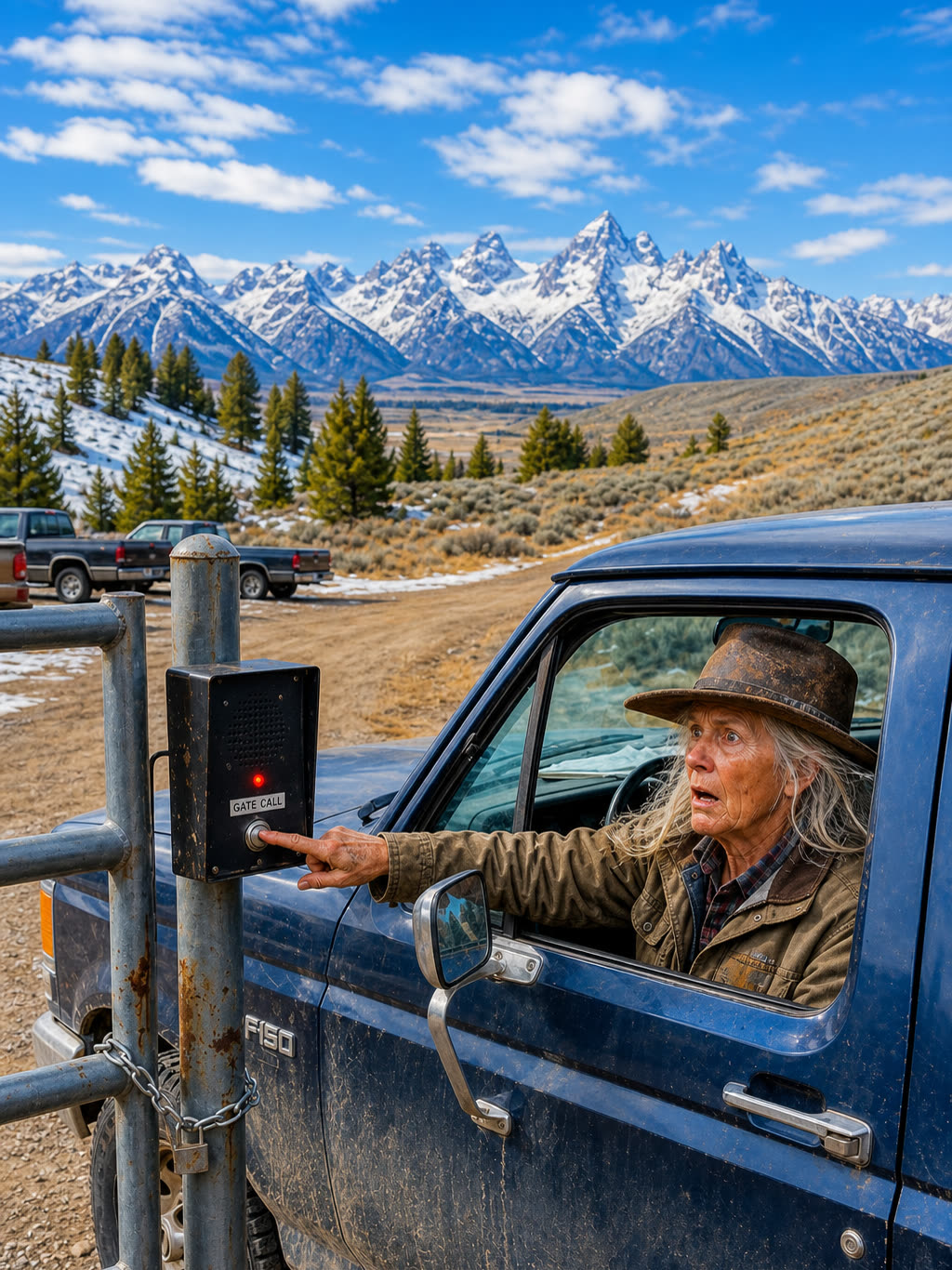
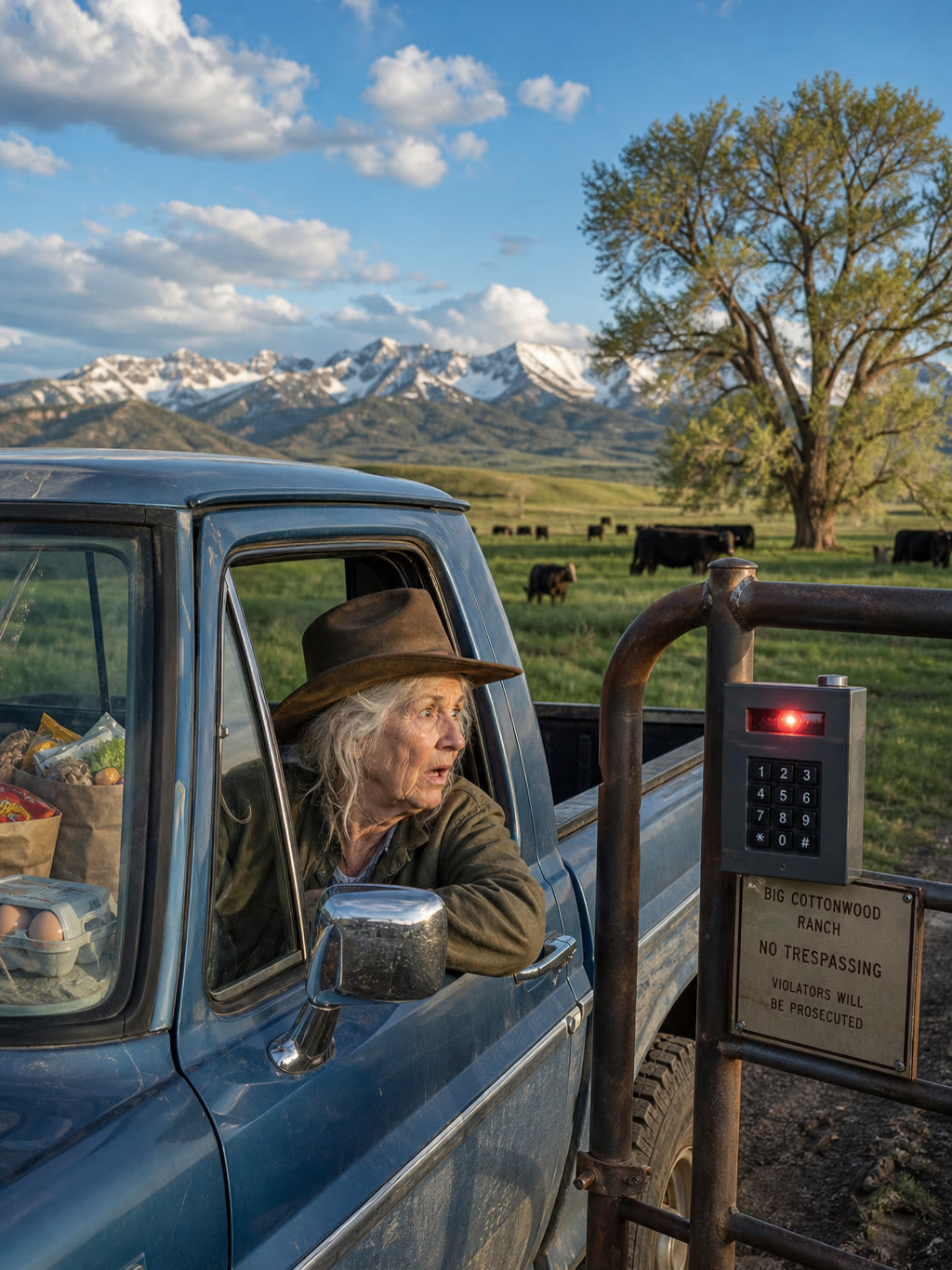
That morning, I had driven into Sheridan to shop at the Safeway. It was an ordinary errand on an ordinary day, the kind I had run a thousand times. By the time I turned back toward the ranch, the eggs were warming on the passenger seat in the afternoon sun, and I was already working out what I would cook for supper. The road home was long and familiar, and I felt something close to contentment, which was rare in those first months of being a widow. When I reached the gate, I rolled down my window and leaned out of my Ford to punch in the code that Russ and I had used for forty years. It was our wedding date.
The light on the keypad flashed red.
I tried it again, slower this time, as if my fingers had simply slipped. The light flashed red a second time. I sat there with my hand still hanging out of the window, and then the speaker crackled, and I heard my daughter’s voice.
“I changed it, Mom,” Kristy said through the speaker. “We’ve talked about this. You’re seventy-nine. You shouldn’t be out here by yourself.”
I looked at the little metal box as if it might explain itself. We had not talked about this, not the way she meant. Nobody had ever sat me down and told me I was too old for my own home. I kept my voice even, the way I had learned to with spooked heifers and with grieving daughters.
“Open the gate, honey.”
“Brett and I spoke to a lawyer. Once you sign the power of attorney, you can come home. He’ll take care of the ranch and the cattle sale.”
I thought I’d misheard her. The words did not fit together, and my mind kept trying to rearrange them into something that made sense. “What cattle sale?”
“He already has a buyer. You’ll have an allowance, Mom. A good one.”
My name is Dolores Kincaid. In 1974, Russ and I bought that ranch outside Buffalo with money borrowed from his uncle and a handshake at the bank. We were young and short on everything except nerve. Over the decades we raised two daughters, three hundred head of Black Angus, and so many orphan calves in the kitchen that I finally stopped buying rugs for it. Every inch of that land had cost us something, and every inch had paid us back in ways no allowance ever could.
Russ welded that gate himself in 1981. There was a little bump on the top rail where he had gone back over a weld because it bothered him, and from the cab of my truck I could see that bump plain as day. I stared at it while my daughter’s voice faded into static. It seemed strange that a piece of iron my husband had shaped with his own hands was now being used to keep me out.
Russ died in March, after three years of dialysis. Twice a week, every week, I drove him ninety miles each way to the clinic and ninety miles back. I knew every pothole on that road and every place where the cell signal dropped away. Some days he slept the whole way home, his head against the window. Other days he talked about nothing, about the weather, about a calf he remembered, and I held on to those words like coins.
After the funeral, Kristy and Brett stayed on for two weeks. I was grateful for the company then, and for the casseroles, and for the way the house was not so quiet. Brett sold farm equipment up in Billings, so it seemed natural enough when he started walking the property with a clipboard and a tape measure. He counted fence posts and paced off the pastures. I even thanked him for taking an interest. I remember saying it out loud, in the kitchen, and meaning it.
Then his voice came through the speaker, taking the place of my daughter’s.
“Dolores, Russ left debts you don’t know about. The equipment needs replacing. If I don’t sell the herd now, you’ll lose everything by spring. Sign the paper and let the adults handle it.”
I had helped calve heifers in a blizzard the previous February, with ice in my eyelashes and my arms in up to the elbow. I could have told him that. I could have told him a great many things. But I was tired of talking into a box, tired of being spoken to like a child by a man who had never once spent a night in the barn. I put the truck in reverse and backed away from the gate, and I parked under the big cottonwood where Russ used to leave the stock trailer.
The shade was cool and the engine ticked as it cooled. I did not cry, though I thought I might. Instead I unwrapped my ham sandwich, the one I had made at the kitchen counter that morning without any idea of how the day would end, and I poured coffee from my thermos into its lid. The coffee was still hot. The small ordinary comfort of it nearly undid me.
That was when I remembered a drive home from dialysis the previous November. We were outside Kaycee, on a stretch of road where the hills open up and the sky seems to go on forever. Russ had been quiet for almost an hour, and I had let him be. Then, as the sun dropped behind the Bighorns and turned the whole sky the color of embers, he turned his head slowly and asked me to make him a promise.
He had never asked me for anything like that in all our years together. I remembered how thin his hand looked on the seat between us, and how serious his face had been in that failing light.
If anyone ever locked me out of the ranch, I was to call Amos Redcloud.
I had laughed at the time, or tried to. It sounded like the kind of strange thing a tired, sick man says. Now I sat under the cottonwood with a cold sandwich in my lap and a locked gate in front of me, and I felt the hair rise on my arms. Russ had not been confused that evening. He had known something. He had seen something coming that I had refused to see.
“Who on earth would lock me out of my own ranch?” I’d asked Russ that evening outside Kaycee.
He kept his eyes on me until I stopped smiling. “Promise me, Dolly. If it ever happens, call Amos first.”
So I had promised. I had said the words and squeezed his hand and then turned my eyes back to the road, because it hurt too much to look at him any longer. Then we drove the rest of the way home in silence, and Russ never mentioned it again.
Amos Redcloud had lived south of us for fifty years. He was eighty-four by then, a lean, quiet man with a long gray braid and a face as lined as a dry creek bed. He and Russ had been branding calves together since 1975. They could spend a whole afternoon fixing a fence and come back with hardly a word between them, and somehow both of them seemed to have said everything they needed. If Amos said he would be there at daylight, you could have the coffee ready at daylight.
I scrolled through the contacts on my phone, my thumb clumsy and slow. I found his number under “Amos (fence),” a name Russ had typed in years ago when we first got cell phones. Seeing it there, in my husband’s own careless shorthand, made my chest ache. I pressed the screen before I could lose my nerve.
He answered on the second ring.
“Dolly.”
He did not say hello. He said only my name, in a voice so steady and so unsurprised that it frightened me a little. I swallowed.
“Kristy’s locked me out. Russ told me to call you.”
For a moment, all I could hear was the faint sound of a television in his living room. Then Amos turned it down, and the silence that followed felt heavy and deliberate.
“He said you might,” he told me. I heard his chair scrape against the floor. “Stay where you are, Dolly. Keep that phone handy and leave their papers alone. I have to go to the bank in Buffalo first.”
“What’s at the bank?”
“Russ put something in my safe deposit box. He made me promise to leave it there until you called and told me what you just did.”
The line went dead, and I sat holding the phone against my ear, listening to nothing. Through the windshield, the gate stood closed and shining in the sun. Whatever my husband had left in that box, he had been afraid enough to hide it, and certain enough to wait.
PART 2: WHAT AMOS BROUGHT FROM THE BANK
After he hung up, I looked through the windshield at the house. I could see a corner of the roof from the road, the same green metal roof Russ and I had put on ourselves the summer before Kristy was born. Somewhere beneath it were my kitchen and my bed and forty-nine years of my life, and I could not reach any of it.
For three years, coming home from dialysis had meant getting Russ inside and settled before I went back out for whatever I had left in the truck. I knew that routine as well as I knew my own name. It had taken me weeks after he died to stop reaching across the seat for his thermos. Even now, my hand sometimes drifted there on its own, and found only the cold vinyl.
I waited under that tree for three hours. The shadows slid slowly across the grass, and I watched the afternoon go by from behind my steering wheel like a stranger parked outside someone else’s property. A hawk circled over the north pasture. A few cattle drifted down toward the stock tank. It was beautiful, and it was not mine to walk into.
Brett went along the north fence on the four-wheeler, slowing down wherever cattle had gathered. He would stop, count, and write something on his clipboard. Then he would drive on a little farther and do it again. I knew how many animals were in that pasture. I had known them as calves, most of them, and had named a few. I wondered what number he had already promised his buyer.
Then Kristy came out of the barn carrying her father’s saddle. It was heavy enough that she had to rest it against the bumper of the Tahoe before she could lift it into the back. I watched her struggle with it, her face tight with effort, and I felt a pang I could not name. She had always been the one who wanted to ride beside her father. Now she was loading his saddle into a vehicle as though it were something to be taken away.
I watched her shut the hatch and go back inside. She did not look toward the road. I told myself she could not see me from there, that the cottonwood hid my truck. But I knew better, and the knowing sat in my stomach like a stone.
I ate half my sandwich and wrapped the rest. The coffee had gone lukewarm. I kept looking at the road to the south, and each time a cloud of dust rose, my heart lifted and then fell back when it turned out to be nothing but wind.
Around four, a dusty red pickup came up the county road from the south. I knew that truck. I knew the dent in the tailgate and the rust along the wheel wells. Amos pulled alongside me and rolled down his window, and he held a long yellow envelope out toward me. Russ had written my name across the front in the same square letters he used to label the freezer beef.
I took it in both hands. The paper was soft at the corners, as though it had been handled many times, or carried a long while. I turned it over and saw that it was sealed, and that Amos had not opened it.
“You ready?” Amos asked.
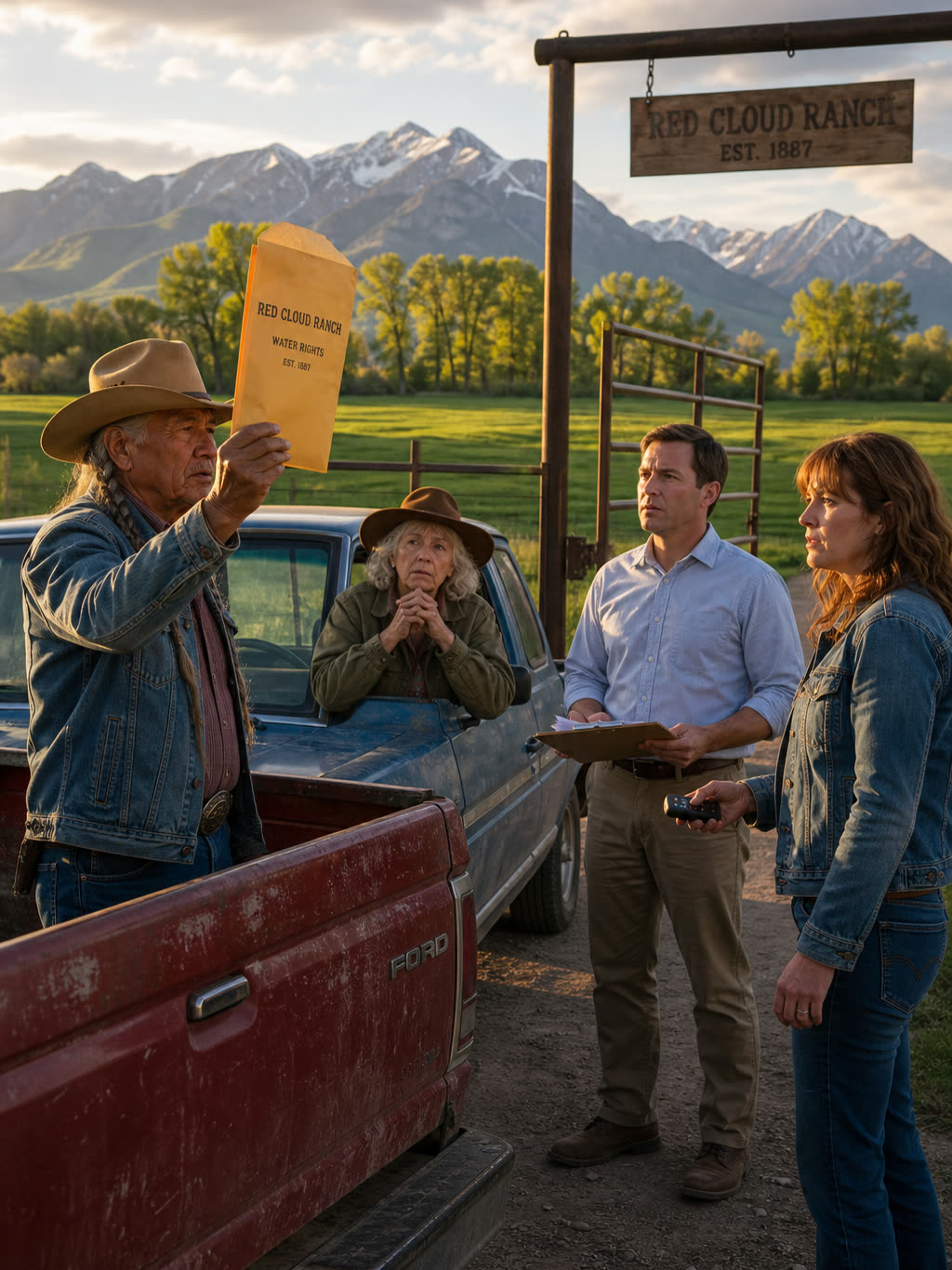
I put the lid back on my thermos and followed him up to the gate. My hands were shaking, and I gripped the wheel to steady them. He leaned on his horn, a long, flat blast that carried across the whole valley, until Brett came down the drive, clipboard still tucked under his arm. Kristy followed a few steps behind him with the remote in her hand, and she looked small beside her husband, and unsure.
Amos stepped out of his truck and looked straight at her. He was an old man in a worn denim jacket, and yet he seemed to stand taller than anyone there.
“Open the gate, Kristy. Your father left you a letter, and I think you ought to read it with your mother standing beside you.”
Brett turned toward her. I saw something cross his face, a flicker of calculation, and I realized he was waiting to see which way she would go. Kristy stared at Amos, and then at me through the windshield. For a long moment nobody moved.
Then Kristy had already pressed the button. For the first time that day, the gate began to move. It swung slowly on Russ’s hinges, groaning faintly, and the bump on the top rail caught the light as it passed.
Amos waited for the gate to swing clear, and then he opened the envelope on the hood of his truck. His hands were steady and slow. The first paper he took out was a copy of the ranch trust. He handed it to me and showed me where Russ and I had signed, and I recognized my own younger handwriting with a lurch. I had signed it years ago, trusting my husband to handle the details, as I had trusted him with so much. The second paper was folded separately, with Kristy’s name on the outside.
She still had the gate remote in one hand when she unfolded her letter. I watched her eyes move across the first line. Her face changed. She read the first line, and the remote slipped from her fingers and cracked against the dirt.
“If you’re reading this, Kristy, you’ve changed the code on the gate.”
Brett bent to pick up the remote. Amos set one boot on it, and Brett straightened without a word. His jaw tightened, but he said nothing. Kristy covered her face with both hands, her shoulders shaking, so Amos passed the letter to me. My own hands were trembling when I took it. I read the rest aloud.
“My girl, I know you love your mother. I also know how scared you get when you think there isn’t enough money. I should have sat you down while I still could and told you what your mother and I own and what we owe.”
Russ had written that the ranch was paid off. There was no mortgage and no lien on the land. I had to stop for a moment because my voice caught, hearing him speak so plainly from beyond the grave. The trust held the property, and I was its trustee for the rest of my life. If Brett had said the ranch was about to go under, Russ wanted Kristy to ask him where he had gotten that idea.
“He was sick when he wrote that,” Brett said.
His voice was quick and smooth, a salesman’s voice. Nobody answered him. Amos took a folder from the truck and laid the bank records on the hood, smoothing them flat with his palm so the wind would not take them. I could see the final payment dated 2019 and the zero balance underneath. Kristy looked at the page for a long time. Then she looked at Brett, who had spent two weeks measuring fence lines and somehow never produced a single bill.
The letter went on. Russ had arranged for Kristy to have the house in Sheridan in her own name and thirty thousand dollars at First Interstate. After my death, the ranch would pass to a land trust so it could stay ranch land. If Kristy put in the work, she could live there, help run it, and lease the south pasture. Russ wrote that he believed she was capable of doing all three. I read that line slowly, and I saw her flinch as if it had struck her.
By then Kristy had sat down in the dirt in the good jeans she had worn that morning. She did not seem to notice. Amos waited until I had finished reading before he took out the final page. It was the provision in the trust dealing with anyone who tried to take control of the ranch by pressuring me to sign a power of attorney or by keeping me off the property.
Amos laid a copy of Brett’s lawyer’s letter beside it.
“Russ’s attorney has a copy of this, too,” he said. “What happened here today suspends Kristy’s rights under the trust to live on, work, or lease the ranch. Dolores can restore those rights when she sees fit.”
Kristy raised her head. “What about the house in Sheridan?”
“The house and the money your father set aside are still yours,” Amos said.
Kristy wiped her face with the heel of her hand. Her eyes were red and swollen, and something in them had hardened. I did not know yet whether that hardness was aimed at me, at herself, or at the man standing beside her. Then she picked up the bank statement and turned it around so Brett could read the balance himself.
PART 3: LEAVE THE SADDLE
“You said the debts would take the ranch by spring,” Kristy told Brett. She held the bank statement by one corner, and the breeze kept lifting the other. “You told me Mom was getting confused. I watched you walk that fence with a tape measure, and I believed you were figuring out how to help her.”
Brett glanced at the paper. His face had lost some of its color. “Kris, I was trying to protect us.”
“Take the Tahoe and go,” she said. “Leave Dad’s saddle.”
For a moment, he looked at me as though I might send her inside and talk the whole thing through with him. I knew that look. It was the one he had worn at the kitchen table, all those weeks, when he wanted something from me. I stayed beside Amos’s truck and said nothing. I had no words that he deserved.
After a while, Brett went back up the drive. His steps were slower than they had been that morning, and the clipboard hung loose at his side. He took the saddle out of the Tahoe, set it across the fence rail, and drove off with one bag. The dust from his tires hung in the air long after the sound of the engine had faded.
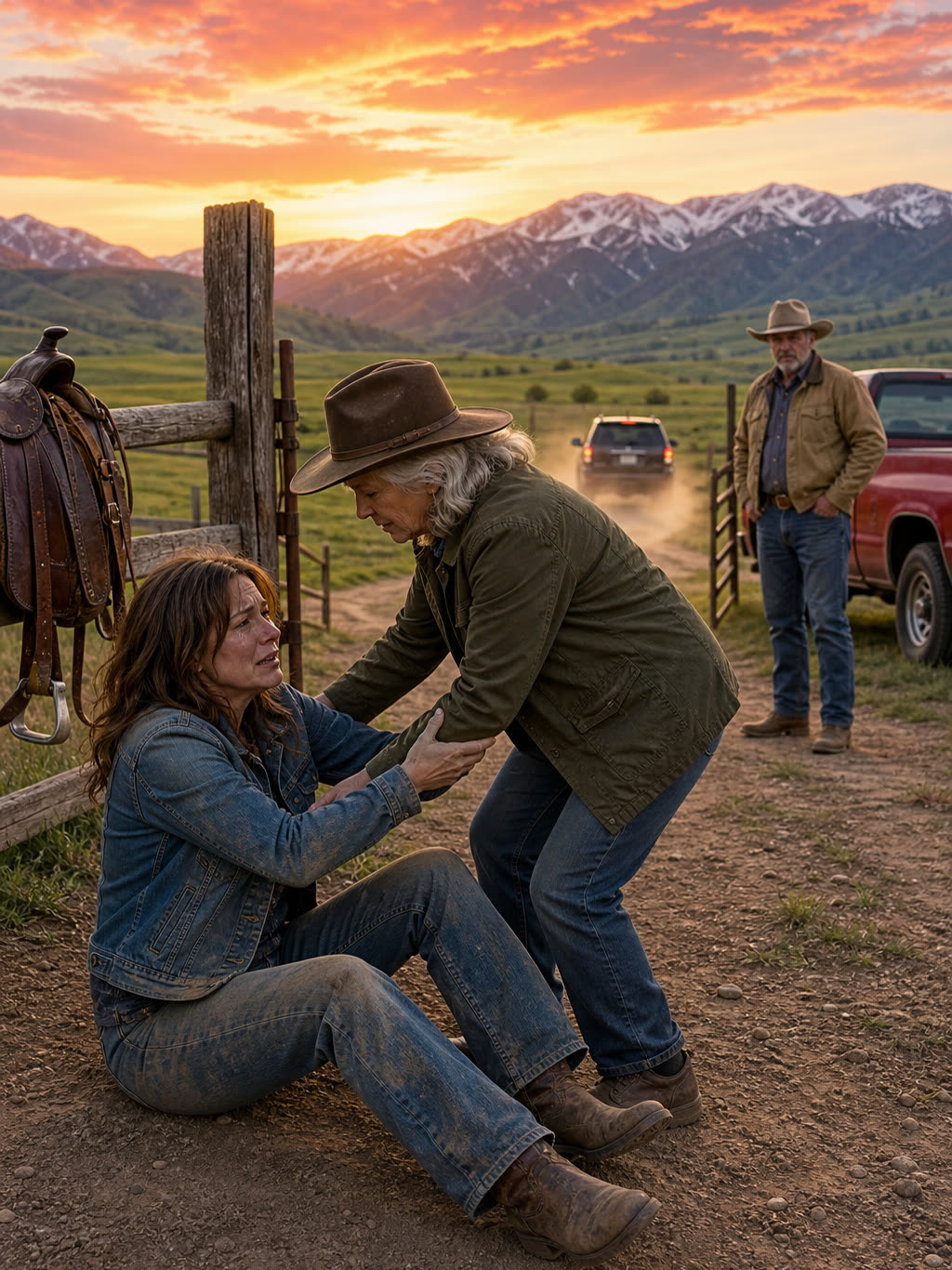
Kristy was still down in the dirt. She sat with her knees drawn up and her good jeans ruined, and she stared at the place where the Tahoe had gone. I walked over to her slowly, because my knees were not what they used to be, and I stood beside her without speaking.
She said she was sorry. She said it quietly at first, and then again, her voice breaking. I took her by the elbows and helped her stand. There was dust on the knees of her jeans, and she kept brushing the same spot with her hand, over and over, as though cleaning it might undo the day.
“I believe you, honey,” I told her. “I need you to understand what it felt like to hear your voice through that speaker.”
She looked back at the box. It sat on its post, small and gray and silent, the same box that had spoken to me with her voice only hours earlier. “I could see your truck from the kitchen,” she said. “I knew you were sitting out there.”
That was the part that hurt most, and she knew it, and she said it anyway. I did not forgive her in that moment, not completely. But I did not turn away either. We stood side by side in the late light, a mother and daughter with nothing left to hide.
We stood for a little while after that. Amos had gone quiet and was studying the gate hinges as though they interested him. Then I invited him to supper, and he said he had never turned down a meal after a fence. It was the closest thing to a joke I had heard from him all day, and it loosened something in my chest.
While I put a skillet on, Kristy reset the keypad to our wedding date. I watched her through the kitchen window. She walked out to the road and tested it herself, standing alone by the gate with her hand raised to the buttons. I heard the gate motor from the kitchen and saw her come back up the drive on foot, her head down, her steps unhurried.
The eggs from the Safeway had survived the afternoon, a small and ridiculous miracle. I scrambled them with onions and set out bread. Amos sat in Russ’s chair without being asked, and nobody mentioned it. Kristy ate with her eyes lowered. The house felt different, as though it had been holding its breath and could finally let it out.
At four thirty the next morning, I knocked on the door of her old bedroom.
“Calving,” I said.
“Mama, it’s April.”
“It is. And we’ve got a hundred and twelve heifers due.”
I heard her groan into the pillow, and I almost smiled. A part of me wanted her to refuse. A part of me wanted to see what she would do. After a long pause, the floorboards creaked, and the door opened.
She came out in borrowed boots, too big for her, and a coat she had found on a hook in the mudroom. By breakfast, there was mud halfway up the backs of her jeans. She worked from before daylight until well after supper, long enough to learn how often a job you think you have finished sends you back across the same muddy yard. She did not complain. I watched for it, and it never came.
A late snow started after supper. It came down thick and quiet, the way it does in Wyoming in the spring, covering everything in white. One of the heifers had a calf coming backward, and Kristy worked beside Amos in the barn by lantern light. I stood nearby with a towel and my heart in my throat. Amos spoke to her in a low, steady voice, and she did exactly as he said.
When the calf was finally clear, she stayed down in the straw beside it until she saw its ribs move. For a long moment, none of us breathed. Then the little chest rose and fell, and a little later, the calf gathered its legs under itself and got up, wobbling so hard she reached out both hands before stopping herself.
“Mama,” she said, laughing and crying at the same time, “I didn’t know.”
“I know, honey,” I said. “Keep watching.”
She stayed where she was until the calf found its mother. By then there was snow gathering on the sill, and I had left the barn door open just wide enough for the two of us to see it coming down.
Brett never came back to the ranch. Russ’s attorney filed a report about the attempt to pressure me into signing the power of attorney, and the state looked into it. I later heard Brett lost his job selling equipment in Billings. In June, Kristy filed for divorce and stayed on at the ranch in the bedroom she had grown up in.
She carried her father’s saddle back to the barn herself. I saw her stop by the fence to shift its weight against her hip, the same way I had seen her do it at the back of the Tahoe. This time, she took it through the barn door and set it on Russ’s saddle stand.
“It’s heavier than I remember,” she said.
“You used to get him to lift it for you,” I told her.
“I remember that part,” she said, and ran a hand over the seat before she came back outside.
For five months, Kristy got up when I knocked. After a while, I would come into the kitchen at four thirty and find the coffee already on. She learned which stretch of the south fence needed checking after a storm and how to tell when a heifer was about to go off on her own. Some mornings she asked what Russ would have done. Other mornings she made a decision and told me about it over breakfast.
In the fall, I called Russ’s attorney. He drove out with the paperwork, and I signed at the kitchen table to restore Kristy’s rights under the ranch trust. The house in Sheridan and the money her father set aside had been hers all along. What I could give back was her right to stay and work here and, when she was ready, lease the south pasture.
That October, we branded a hundred and forty calves. It was Kristy’s first branding, and Amos tended the fire the way he had with Russ for years. By midmorning, half the neighborhood seemed to be leaning on the fence. I brought coffee out and saw Kristy stop what she was doing to open the gate for a neighbor who had come to help.
The remote she dropped that afternoon still hangs on a nail in the barn. The keypad still takes our wedding date. Before winter, Kristy painted a new sign in white letters on a green board and asked me to hold one end while she put in the screws. It reads KINCAID RANCH. ALL WELCOME.
Every so often, I take my coffee out to the fence around sunset. From there I can see the cottonwood where I parked that day, and sometimes I can hear Kristy close the barn door behind me. I usually stay a little longer, until the last few cattle come in and the pasture goes quiet.
Disclaimer: This story is a work of fiction inspired by real-life themes. Names, characters, places and events are fictionalized, and any resemblance to real persons is purely coincidental. Images are for illustration purposes only.
