

Part 1
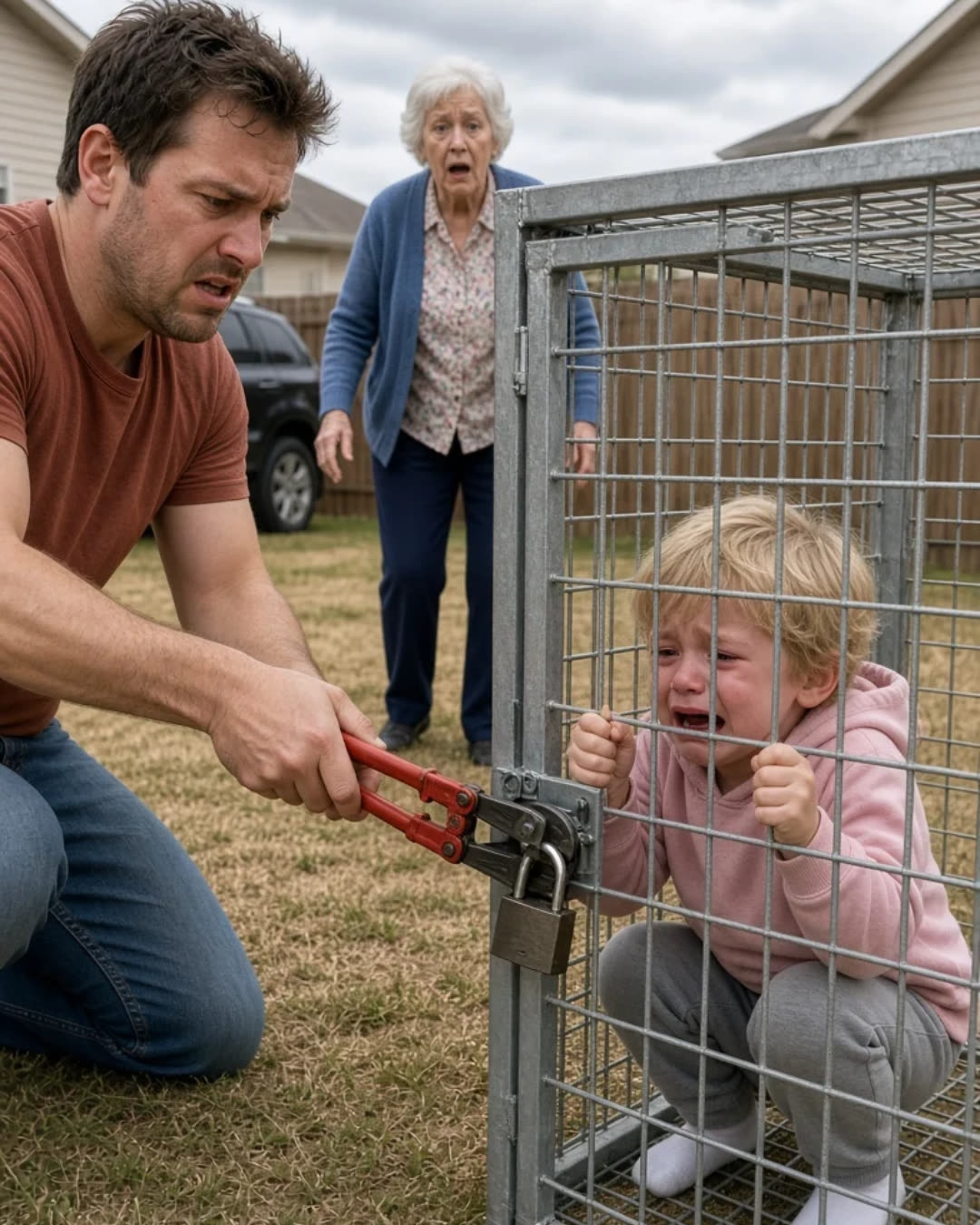
For three days, my ten-year-old son did not pick up a single one of my calls. On the third day I raced to his mother’s house and found Owen locked inside a metal cage in the backyard. I snapped the padlock and pulled him against my chest. He stared past my shoulder at the cloudy swimming pool and whispered, “Daddy, please don’t look.” That was when I saw several black bags resting beneath the water.
Ever since the divorce, I had worked hard to keep every disagreement with Dana from becoming another fight. I swallowed my pride more often than I care to admit, because a calm co-parenting arrangement seemed like the best gift I could give Owen. Dana had since remarried a man named Curtis, and in front of other adults he came across as perfectly pleasant, the kind of person who shook hands firmly and remembered names.
Still, something about him never sat right with Owen. Whenever I brought Curtis up, my son grew quieter, as if somebody had turned down the volume inside him. I noticed it, and I told myself it was only the awkwardness any child feels with a new stepfather. I wanted so badly to believe that explanation that I never pushed.
Looking back now, the warning signs were all there, and I should have treated them far more seriously. Owen kept asking whether he could stay with me one more night, then one more after that. Each time I asked how things were going at his mother’s house, his shoulders would stiffen, his eyes would drift away, and his answers would turn vague and short.
By Sunday, three full days had gone by without one call or one text from him. That kind of silence was not like my son at all, so I got in the car and drove straight to the house. Curtis’s SUV was sitting out front. The curtains were pulled shut, and a chain had been looped across the front gate, as though the whole place had been sealed off from the world.
I knocked again and again, and no one came to the door. I stood there listening to my own knuckles against the wood, feeling more foolish and more frightened with every second. Then their longtime neighbor, Mrs. Doyle, hurried across her lawn toward me and told me she had been hearing loud arguments coming from inside the house for several weeks.
She went on to say that Owen had stopped playing outside altogether, which was strange for a boy who used to spend every afternoon in the yard. Not long ago, she explained, Curtis had put up tall privacy panels along most of the backyard. Now nobody living nearby could see what was happening back there. Her mouth was a thin, worried line as she said it.
Then Mrs. Doyle lowered her voice until I could barely hear her. “Last night, I saw Curtis carrying several large black trash bags into the backyard. He threw them into the swimming pool.”
A cold weight settled in my stomach and refused to lift. Mrs. Doyle pointed to a lower stretch of fence between her property and theirs, and I did not waste another second. I climbed over and dropped into the yard. It looked neglected, with weeds pushing up between the patio stones, brittle dead leaves piled in every corner, and a swimming pool that had turned a murky green. I started toward the water, but something in the far corner snagged my attention before I got close.
A blue tarp had slid partway off a big metal dog enclosure, and behind the bars sat a small boy with his knees pulled tight against his chest. Owen. His hair was tangled, his lips were dry, and he looked thinner than I remembered. What frightened me most was how silent and still he was. “Owen, buddy. It’s Dad.” His eyes lifted slowly, as if it took everything he had. “Daddy?” I ran to the door and grabbed it, only to find a heavy padlock holding it shut. I looked wildly around until I spotted a pair of gardening pliers nearby. I wedged them around the lock, bore down with all my strength, and forced it open.
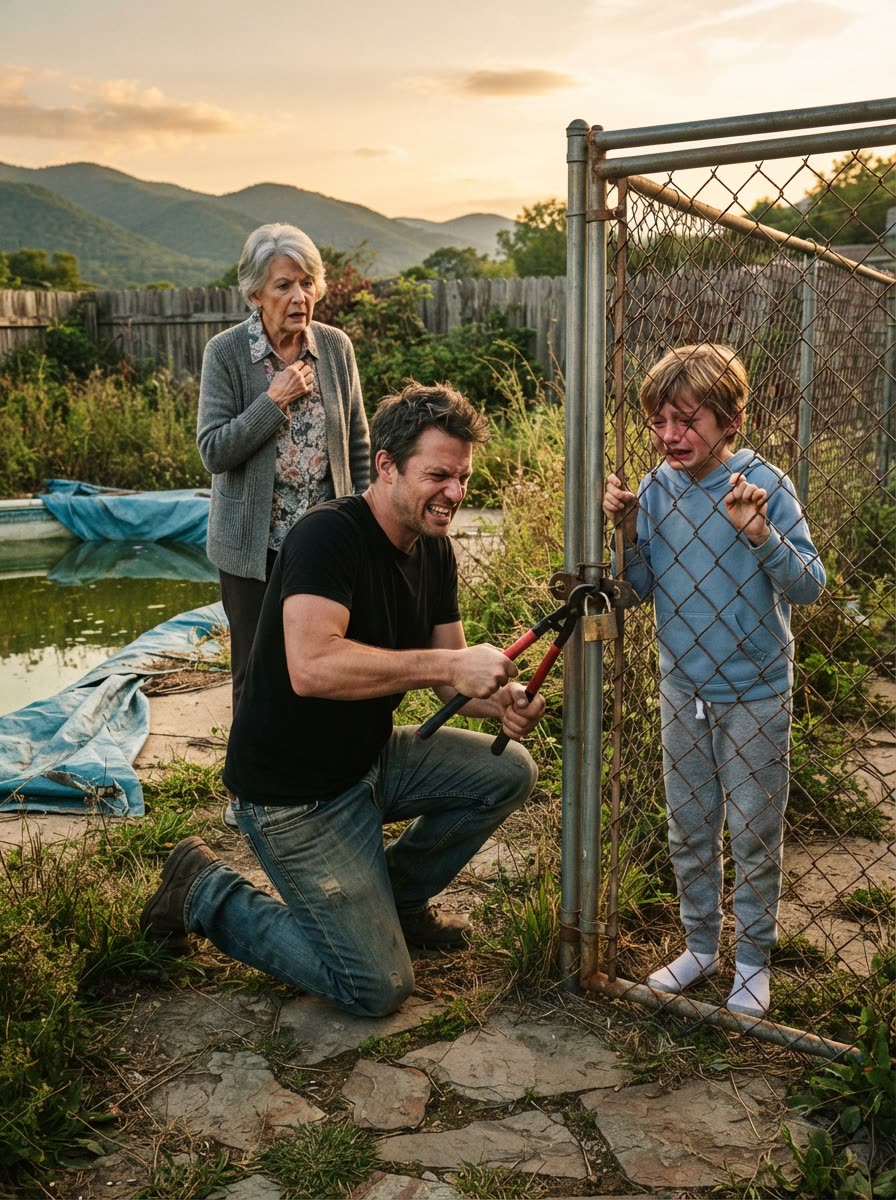
The door swung wide, and I pulled my son into my arms. Owen wrapped both arms around my neck and clung to me so tightly that I could feel his small heart pounding. A hundred questions crowded my mind, but none of them mattered more than getting him away from that house.
“I’ve got you. We’re leaving.”
I turned toward the fence, ready to carry him out, but Owen suddenly went rigid against me. His eyes were locked on the swimming pool. I followed his gaze and saw the water, thick and cloudy, with a strange film drifting across the surface. Beneath it I could just barely make out several large dark shapes, and Mrs. Doyle’s words came rushing back to me.
Owen began to tremble. “Daddy, please don’t look at the pool. Just take me away.”
I held him closer and asked what he was so afraid of, but he only buried his face in my shoulder and refused to answer. Whatever he believed was lying under that water seemed to terrify him even more than the cage had. I felt his tears soaking through my shirt, and my own throat burned.
Three days earlier, all I had wanted was to understand why my son had stopped calling. Now he was finally safe in my arms. Yet the house behind us was completely silent, Dana was nowhere in sight, and several black bags lay beneath the cloudy water. Every instinct told me to run, and every instinct also told me I could not leave without knowing the truth.
Then Owen leaned in close to my ear and whispered words that froze me where I stood. “Daddy… Mommy tried to stop him.”
And in that moment, I understood that finding Owen might only have been the beginning.
Part 2
I wanted to lift Owen over the fence and put as much distance as possible between us and that house. Before I could take a step, though, a car door slammed somewhere out front. Owen tightened his arms around my neck and whispered Curtis’s name. I pulled out my phone and called 911, telling the dispatcher I had found my ten-year-old son locked in a metal enclosure and believed the person responsible might be returning.
The dispatcher told me firmly not to search the property and not to confront anyone. I did what she said. I carried Owen toward Mrs. Doyle’s yard, and by the time we reached the fence she had already dragged over a small ladder so that I could hand Owen across without making him climb. Her hands shook as she steadied it, but her eyes never wavered.
Police officers and an ambulance reached us within minutes. The paramedics wrapped Owen in a blanket and began checking him over, while officers moved through the backyard, photographing the enclosure, the broken padlock, the tarp, and everything around the spot where I had found him. I watched the whole scene from a distance, my pulse still racing.
Owen never let go of my hand. Not for a second.
“Please don’t make me go back inside.”
“You’re not going back there, buddy.”
The paramedics told me he was dehydrated, with bruising around his wrists and ankles and signs that he had not been eating properly. Nothing looked immediately life-threatening, they said, but they wanted him evaluated at the hospital, because nobody yet knew how long he had been confined or what had happened before I arrived. I nodded at every word, grateful and sick at the same time.
Before we left, one of the officers asked whether Owen had said anything about the swimming pool. I explained that he had begged me not to look at it. The officer’s expression grew noticeably more serious when Mrs. Doyle repeated what she had seen the night before, Curtis throwing several black bags into the water.
The police secured the property while Owen and I were taken to the hospital. In the ambulance I fought the urge to question him, because a detective had warned me that a trained child interviewer needed to hear Owen’s account without anyone, even me, accidentally shaping his memory. So I simply held his hand and watched the streetlights slide past the window.
Dana still had not appeared, and I could not stop turning Owen’s last words over in my mind. He had said his mother tried to stop him. That meant Dana might not have known what Curtis was doing until it was already happening, and it meant she might be in danger of her own.
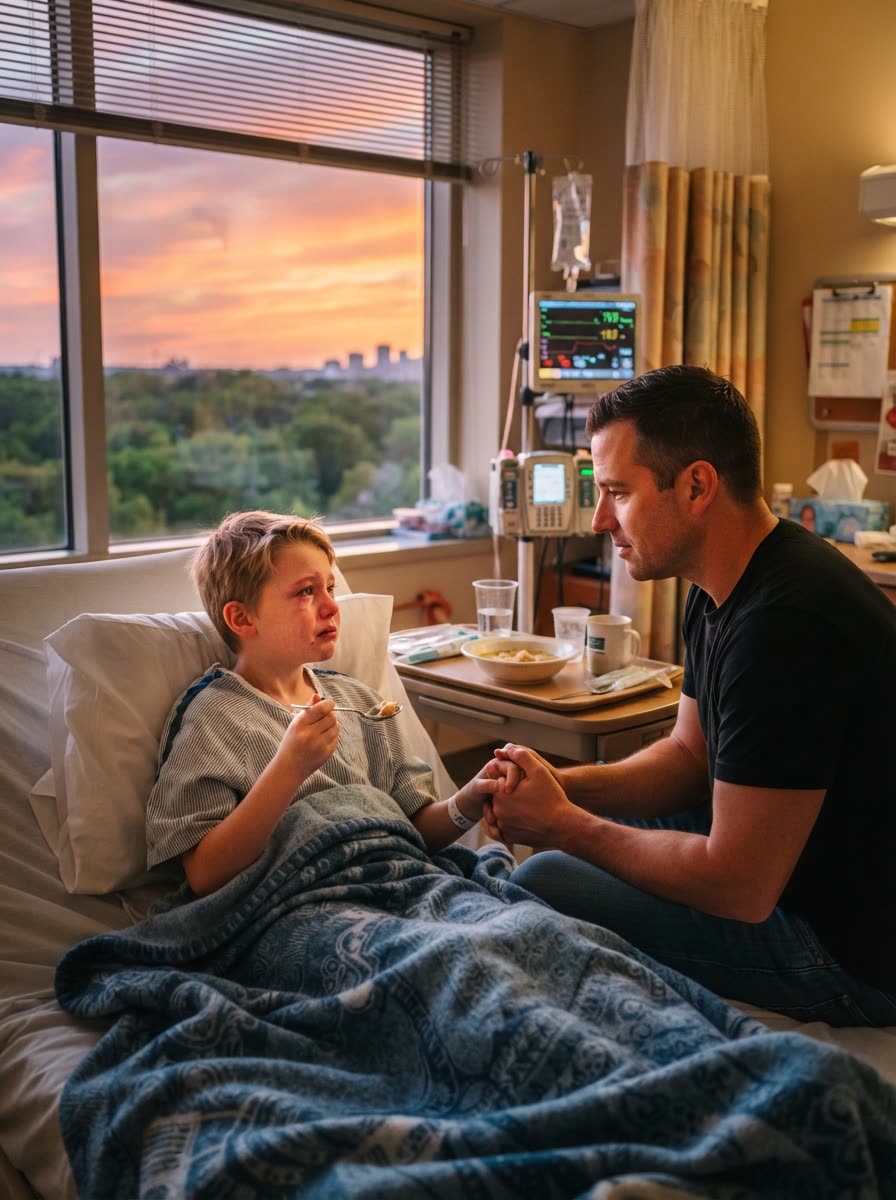
At the hospital, doctors gave Owen fluids and carefully recorded his condition while a social worker stayed close. Eventually he managed to eat a little soup, and I sat on the edge of his bed, watching every spoonful as though it were a small victory. After a while, in a very quiet voice, he asked whether the police had found his mother.
“I don’t know yet, buddy. They’re looking for her.”
Owen lowered his eyes to the blanket covering his legs.
“Mom tried to help me.”
Until that moment, part of me had been terrified that Dana had somehow let all of this happen. Hearing Owen defend her changed that fear completely, though it left a new and heavier one in its place. I stopped myself from asking for details and told him he could explain everything whenever he felt ready.
About an hour later, Detective Renata Soto came into the room. She told me that officers had searched the house and found signs that a serious confrontation had taken place in the kitchen, along with Dana’s phone, broken, beneath one of the cabinets.
Neither Dana nor Curtis was inside the house.
Then Detective Soto brought up the swimming pool. Officers had pulled the black bags out of the water and opened them as part of their search.
My stomach clenched as every terrible possibility raced through my mind, each one worse than the last.
“What was inside them?”
Soto paused before answering, almost as though she already knew what I was afraid she would say.
“Clothes,” she said at last. “Mostly clothes, and some documents.”
I stared at her. “Clothes?”
“Women’s clothing, Owen’s school things, a laptop, and a stack of file boxes. Nothing that was ever alive.” She let that settle before going on. “I’m sorry. I know what you were bracing for.”
My knees went weak, and I had to lower myself into the hospital chair. For three hours I had carried a fear I could not name, and it drained out of me so fast that I felt dizzy.
“Then why would he throw them in the pool?”
“That’s what we’re trying to understand. The laptop and papers are waterlogged, but our forensic team thinks some of it can be recovered. Mr. Dawson, has your son ever mentioned Curtis’s work?”
“Only that he travels a lot. Dana said he handled accounts for a construction company.”
Soto nodded slowly, as if that confirmed something. “We’re still looking for both Dana and Curtis. Her car is gone from the driveway, and his SUV was found two blocks away with the engine still warm. Someone slammed that car door, and then he vanished on foot.”
“He saw the police coming.”
“Possibly. Or he saw you.”
I looked at Owen, finally asleep in the hospital bed with one hand still curled around the edge of my sleeve. Whatever had happened in that house, my son had paid for it.
The child interviewer was a gentle woman named Ms. Okafor, who spoke to Owen in a small room with soft chairs and a box of crayons. I watched through a window beside Soto, and twice I had to step out into the hallway to catch my breath.
What Owen told them came out in pieces, the way children tell hard things.
Three weeks earlier, he was supposed to be asleep. He crept downstairs for a glass of water and saw Curtis in the study, the door open, papers spread across the desk and a duffel bag of cash beside his foot. Owen asked what it was. Curtis smiled and said it was a surprise for the family.
But Owen had heard the arguments afterward. His mother had asked questions, quietly at first. Where did the money come from? Why did a company call at night? Why were there accounts in her name that she had never opened?
“Mom found the papers,” Owen told Ms. Okafor. “She said she was going to call someone. Curtis said she was being dramatic.”
On Wednesday night, the arguing turned physical. Owen heard something crash in the kitchen. His mother ran upstairs, pulled him out of bed, and shoved her old phone into his pajama pocket.
“She said, ‘Run to Mrs. Doyle’s. Don’t stop,’” Owen said. “But Curtis caught me at the back door.”
Dana had thrown herself between them. That was the part Owen kept returning to, his voice wobbling each time. His mother had grabbed Curtis’s arm and screamed at him to let go, and in the struggle Owen had been pushed through the doorway and onto the patio. Curtis had lifted him by the shoulder and carried him to the dog kennel, a heavy thing he had bought months earlier and never explained.
“He said it was just for a little while,” Owen whispered. “He said I talked too much and needed to learn to be quiet.”
“And your mom?” Ms. Okafor asked gently.
“I don’t know. I heard the car leave. I think he took her.”
Through the glass, Soto’s jaw tightened.
“Did you see the phone, Owen? The one your mother gave you?”
Owen reached into the pocket of the hospital gown, where a nurse had tucked his belongings, and pulled out something small and scuffed. It was a cheap prepaid flip phone with a cracked screen.
“She said if I ever needed help, I should call the number saved first.”
The number belonged to Dana’s sister, Leah, who lived two hours north in a small town on the lake. Soto called her from the hallway while I stood beside her, barely breathing. Leah answered on the second ring, sounding exhausted, and when Soto said who she was, a long, terrible silence followed.
Then Leah started crying.
“She’s here,” she said. “Detective, Dana is here. She turned up on my porch at four in the morning. She’d gotten out of the car at a gas station and walked eleven miles. Her face was bruised, and she kept saying Owen’s name. I wanted to call the police, but she begged me to wait. She said Curtis had friends in the sheriff’s office.”
Soto went completely still.
Part 3
“I was trying to find a way to reach her ex-husband safely,” Leah said, her voice thin through the speaker. “She doesn’t have his number memorized. She’s been sitting at my kitchen table for hours, staring at the door.”
I could picture it too clearly: Dana, worn down and bruised, watching a doorway as if it might burst open at any moment, with her son’s name still on her lips. My chest ached for her, and for every hour she had spent not knowing.
“Keep her there,” Soto said. “Lock your doors. I’m sending a unit now.”
Soto ended the call and made another one immediately, speaking in low, clipped sentences while I stood in the corridor with my hands pressed against my face. The hallway smelled of antiseptic and burnt coffee. I thought about how close we had come to losing everything, and how thin the thread had been.
When she finished, I asked if I could speak to Dana. Soto hesitated, then nodded. She told me to keep it short and to say nothing that might give away where Owen was, in case anyone was listening.
I borrowed a nurse’s phone and asked Leah to put her on. I heard a muffled sound, a chair scraping, a few footsteps. My heartbeat thudded so loudly in my ears that I could barely think. I had no idea what I was going to say.
A moment later I heard breathing, shaky and fragile, and then a voice I had not heard in three years without anger in it.
“Mark?”
“He’s safe, Dana.” My voice cracked. “Owen’s safe. He’s right here. He’s eating Jell-O and complaining about the hospital blanket.”
She made a sound I will never forget, half sob and half laughter, the sound of a person who has been holding her breath for days. “I tried,” she said. “I tried to get to him. He wouldn’t let me. I’m so sorry, Mark. I’m so sorry.”
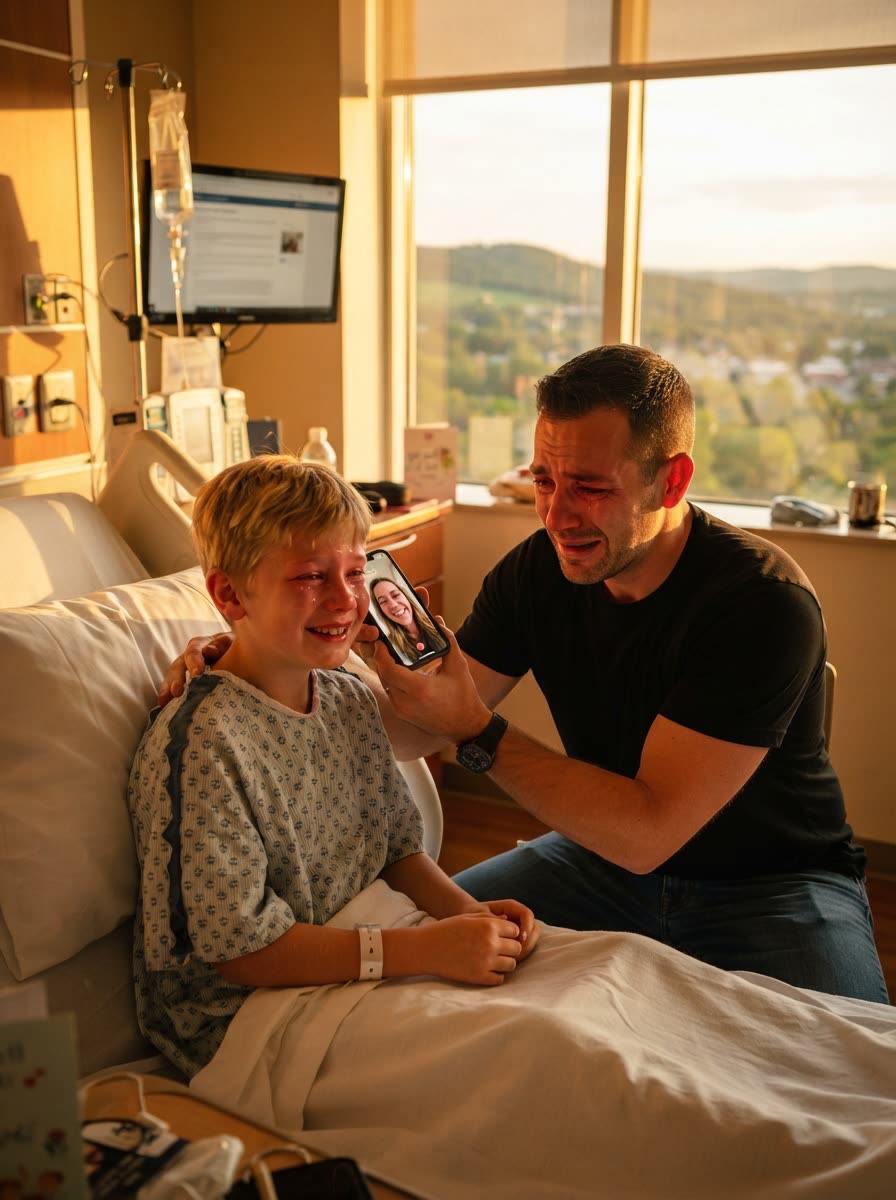
“You gave him the phone,” I said. “You told him to run. You did everything right.”
I carried the phone into Owen’s room and held it so that he, awake now, could hear her. His whole face crumpled and then opened, the way a flower turns toward light. The next ten minutes I will keep private.
They arrested Curtis Hale that evening at a motel off the interstate, forty miles from the lake. He had been trying to pay for a room in cash, and the clerk recognized his face from a news alert that Soto’s team had pushed out to local stations.
The investigation that followed was bigger than any of us had imagined.
Curtis had spent four years embezzling from the construction company that employed him, routing money through shell accounts, some of them opened in Dana’s name without her knowledge. He had married her, Soto explained, partly because a spouse’s name made the paper trail easier to hide. When Dana found the documents, he panicked, and the panic turned into violence.
The black bags had been his attempt to destroy evidence before the company’s auditors arrived, along with Dana’s belongings, which he planned to claim she had packed before leaving him. The story would have been simple: she ran off, abandoned her son, and he was the wounded husband left to explain.
Mrs. Doyle ruined it.
“I’ve lived on that street twenty-six years,” she told the detectives, arms folded, chin lifted. “I know what a trash bag looks like when it’s full of garbage and what it looks like when somebody’s afraid of what’s inside.”
The sheriff’s deputy Curtis had counted on turned out to be a golf partner, nothing more, and he cooperated fully once he understood the scale of what had happened. Nobody else on the force was compromised. Curtis had simply been boasting.
He was charged with kidnapping, unlawful imprisonment of a minor, assault, and fraud. The prosecutor told me the unlawful imprisonment charge alone carried a sentence long enough that Owen would be a grown man before Curtis walked free. The evidence included the broken padlock, the photographs of the kennel, Owen’s interview, Dana’s testimony, and the recovered laptop, whose contents the forensic team had pulled almost entirely intact.
I wasn’t interested in the sentence. I was interested in the next time I could hold my son’s hand without him flinching.
It took Owen a long time to sleep in a room alone.
For the first two months, he stayed with me, and then with Dana and me together at my place, because neither of us could stand to be apart from him. We never talked about whether we were getting back together. We talked about school pickups, and therapy appointments, and what he would eat for dinner.
Dana and I were never going to be what we once were. But something between us had changed. She stopped apologizing for everything and started letting me help. I stopped keeping score. Somewhere in the middle of all that, we became something I hadn’t expected, two people who would do absolutely anything for the same child.
Owen went to therapy every week with a counselor named Dr. Bell, who kept a bowl of smooth stones on her desk and never once rushed him. He drew pictures at first. The kennel appeared in almost all of them, small and gray, with a little boy sitting inside.
After a few months, the drawings changed. The kennel got smaller. The boy was outside it.
In the spring, he asked if we could plant something in the backyard of my house, which had never had a garden. We bought tomato seedlings and a bag of dirt, and Owen knelt in the grass with a trowel, digging holes slowly and carefully.
“Dad,” he said, not looking up. “I’m glad you came.”
“Me too, buddy.”
“Even though I told you not to look at the pool.”
I laughed, and my voice caught. “Especially then.”
He pressed the soil around the roots with both hands. “I didn’t want you to see what was in it. I thought it was something bad. I thought if you saw it, you’d stay there and Curtis would come back.”
My throat tightened. “You were trying to protect me.”
“Mom told me to be brave. So I tried.”
I put my arm around his shoulders. We sat in the grass as the afternoon light stretched across the garden.
At the sentencing in June, Owen didn’t have to testify. Dana did, in a clear, steady voice, with her hands folded in her lap. When she described the night in the kitchen, she didn’t cry. When she described the moment she lost sight of her son, she did.
Mrs. Doyle sat in the second row in her church dress. She had brought a tin of lemon bars for the prosecutor, the detective, and, for reasons she never explained, the bailiff.
Afterward, Soto found me on the courthouse steps.
“I’ve done this job for nineteen years,” she said. “Most of the time, the people who save the day are professionals. Cops, doctors, social workers.” She looked toward the parking lot where Dana was buckling Owen into my car. “Sometimes it’s a neighbor who notices the wrong trash bags. Sometimes it’s a mother who hands her kid a phone. Sometimes it’s a father who climbs the fence.”
“Or a ten-year-old who doesn’t want his dad to look in the pool,” I said.
She smiled. “That one too.”
That night, Owen fell asleep in his own bed for the first time without the hallway light on. I stood in his doorway for a long time, listening to him breathe.
Three days of silence had nearly cost me everything. Three days of wondering, of knocking on a locked gate, of climbing a fence.
I would climb it again. I would climb a hundred.
THE END
Disclaimer: This story is a work of fiction inspired by real-life themes. Names, characters, places and events are fictionalized, and any resemblance to real persons is purely coincidental. Images are for illustration purposes only.
