

PART 1: THE SLAP IN THE KITCHEN
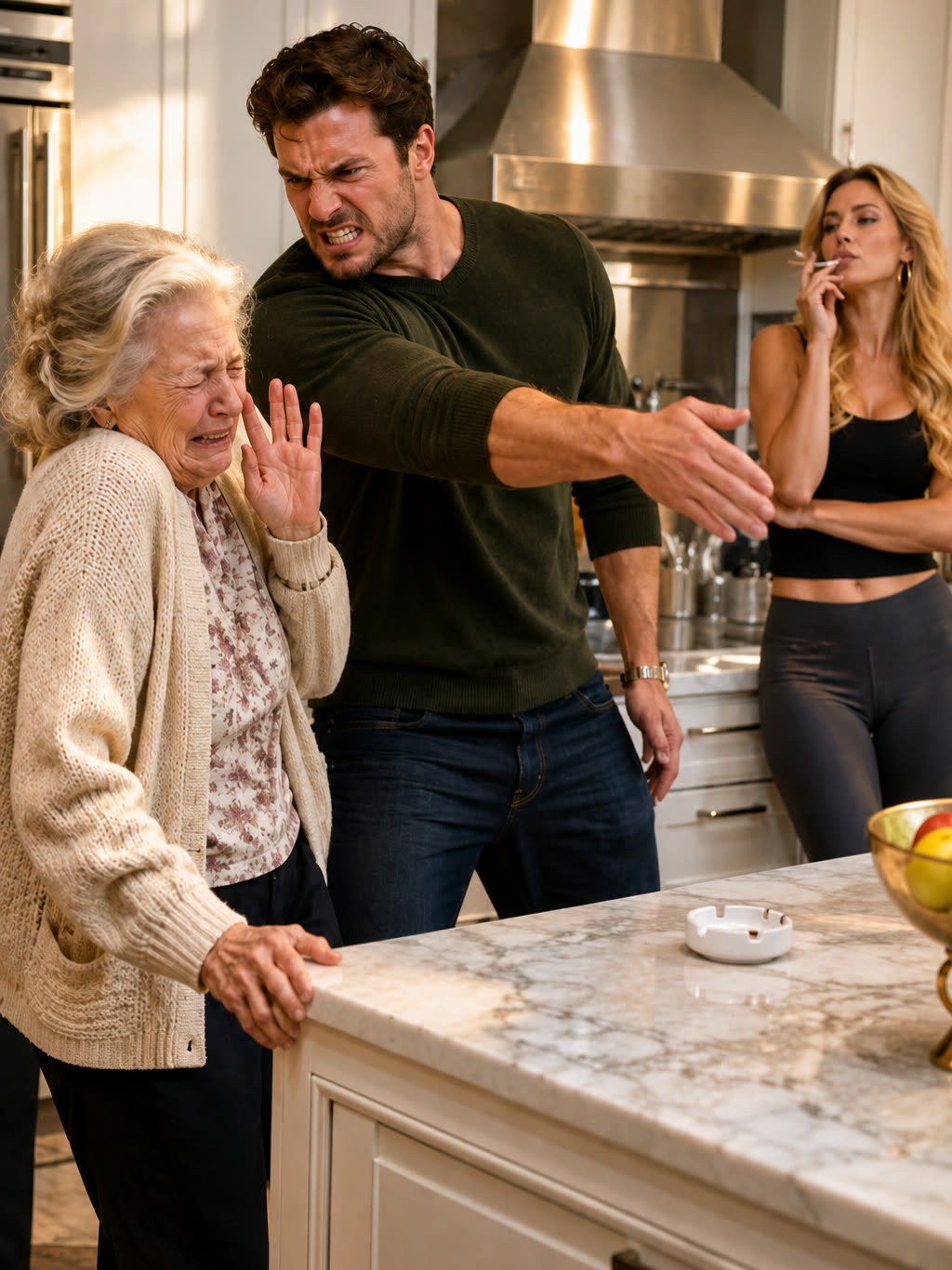
“Brielle, would you do me a favor and not smoke in the kitchen? The smoke is very bad for me,” I said.
I kept my voice soft. I never raised it. I hadn’t even finished telling her why each breath had grown so hard when I saw my son’s shadow cross the floor.
My son walked straight across the kitchen and struck me with an open hand.
The sound cracked through the room. My face snapped to one side, and I had to grab the marble countertop to keep my knees from giving out. My cheek burned, and my heart beat so loudly that I could barely hear the hum of the refrigerator.
Brielle kept smoking.
She stood there in her expensive leggings, her hair perfectly done, wearing the bored expression she put on every time I needed anything from her.
“Maybe that’ll teach you to keep quiet,” my son said.
He didn’t shout. He didn’t look like a man who had lost control. He said it as calmly as someone asking a neighbor to turn the television down.
Then he turned to his wife, kissed her on the forehead, and asked, “Want to go out for dinner?” She smiled and stubbed out her cigarette on a little saucer I had washed that very morning.
Fifteen minutes after the slap, I heard the two of them leave, laughing. His truck started in the driveway, and the engine faded down the street. I was left alone with the smell of smoke, a swollen cheek, and a thin, shallow breath.
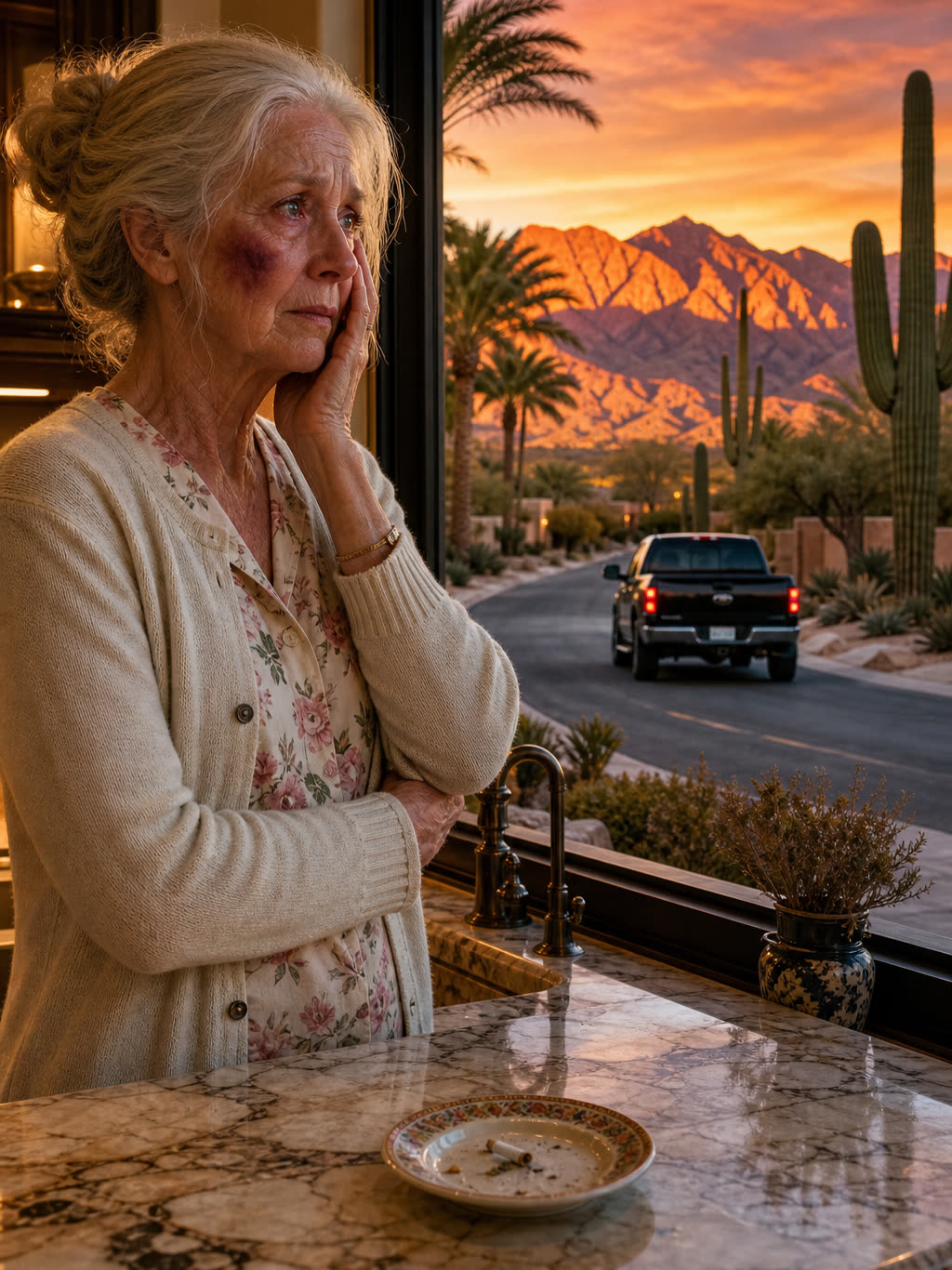
My name is Bernadette. I am seventy-three years old, and I raised that man by myself in a small apartment in Columbus, Ohio. There were years when I worked three jobs to pay the rent and keep the heat on. I never imagined I would spend my last years like this.
Six months before, I had moved in with him and Brielle, into their enormous house in Scottsdale, Arizona. He had insisted it would be best for my health. He promised me peace, company, and a home where I would never have to worry about a thing.
The truth turned out to be very different.
They gave me a small, cold guest room without a single object in it that felt like mine. The window wouldn’t close properly. The bathroom was so cramped that I could hardly turn around in it. And still, every month, I handed my son money for the household expenses, and I helped with the cleaning.
I rarely complained. I told myself that if I stayed grateful, they would eventually treat me like part of the family. Gratitude was the only currency I thought I had left.
That afternoon, standing alone in that huge kitchen, I finally let myself think about my lungs. My doctor had explained that so many years of breathing factory dust had damaged them badly. Asking people not to smoke near me was not a whim, and it was not an attempt to control anyone. It was simply what I needed in order to breathe.
I walked slowly to my room and sat down in front of the portrait of my son’s graduation. There we were, the two of us: him in his gown, me hugging him, proud beyond words that I had gotten him this far.
I stared at his smile for a long time.
I couldn’t understand when the boy who used to throw his arms around me, crying with joy, had turned into the man who had just hit me. I searched that photograph for some sign, some small crack, and found nothing but a happy young face.
Then my eyes fell on my phone.
For years I had helped people who were not my own blood. There was a boy I took in when he had nowhere to sleep. There was a young girl whose mother I cared for so that she could finish school. And there was a college student who ate at my table because he could barely afford his books.
All three had built lives for themselves. I almost never asked anything of them, but I had kept their numbers all this time, the way you keep a spare key to a door you hope you’ll never need.
The first, Gregory, had become a lawyer.
The second, Tessa, worked as a journalist.
The third, Raymond, made his living investigating financial transactions.
I sat with the phone in my lap for several minutes. Shame is a heavy thing. It kept telling me that nobody wanted to hear this from an old woman, that I should be quiet, that I should endure it as I had endured everything else.
But my cheek throbbed under my fingertips, and the throbbing was louder than the shame.
With trembling fingers, I dialed Gregory’s number.
“Bernadette? It’s so good to hear from you. Are you all right?”
I opened my mouth to give the usual answer: “Yes, honey, everything’s fine.”
But I touched my cheek and felt the pain.
“No, Gregory. I’m not all right. I need help.”
I heard his breathing change on the other end of the line. The warmth in his voice went still and serious.
“Tell me where you are and what happened.”
I told him enough for him to understand. I didn’t cry, though my voice shook on the word kitchen. He listened without interrupting. When I finished, he said only, “Stay where you are. Don’t argue with anyone. I’ll take care of the rest.”
Then I called Tessa. She said my name twice, quietly, as if she were testing whether it was really me. Then I called Raymond, who was silent for so long that I thought the call had dropped, before he said, “Tell me everything, Bernadette. Slowly.”
When I hung up the last call, I was still afraid. My hands were still cold. But I no longer felt completely alone, and that was a feeling I hadn’t known in six months.
That night, my son and Brielle came home chatting cheerfully about their dinner. I heard the front door, the clink of keys on the counter, her laughter in the hall. Nobody knocked on my door.
I lay in bed with the lamp dimmed, scrolling through the photographs I had taken over the last six months: the broken window, the bathroom they had assigned me, the receipts for the money I gave them, and the tiny space where I kept all my belongings.
I used to look at those pictures as reminders of what I was putting up with, little records of my own patience.
That night I began to see them differently.
They weren’t reminders of my patience anymore. They were a record. Each one said, quietly and clearly, that this had really happened, that I had not imagined it, that I was not the difficult old woman Brielle liked to call me.
I hardly slept. Every time the house creaked, I held my breath. But toward morning something in me settled, the way a room settles when the furniture has finally been moved to where it belongs.
The next morning, my cheek had turned a dark, ugly purple. I took a photo of it in the bathroom mirror, my hand steady this time. Then I put on the cardigan my son had given me many years ago, smoothed the front of it, and walked into the kitchen.
He was looking at his phone. Brielle was eating yogurt, scraping the bottom of the cup with a small spoon.
Neither of them asked about my face.
I wasn’t surprised. I made coffee, the same way I had every morning for six months, and sat down at the table. Then I folded my hands and waited.
The kitchen clock ticked. The coffee cooled. My son scrolled, and Brielle scraped her spoon, and the whole house seemed to be pretending that yesterday had never happened.
At nine o’clock sharp, the doorbell rang.
My son looked up, annoyed, a crease forming between his eyebrows.
“Are you expecting someone?”
I set my cup down on the table, carefully, so that it wouldn’t rattle.
“Yes,” I answered. “I invited them.”
The doorbell rang again, longer this time, and I watched my son’s expression begin to change.
PART 2: THREE VISITORS AT THE DOOR
When I opened the door, Gregory was standing there with a folder under his arm, his gray overcoat buttoned against the morning chill.
Beside him stood Tessa, the girl whose mother I had cared for so many years ago. Out on the street, Raymond waited in his car, close enough to see everything, far enough not to crowd me.
My son jumped to his feet so quickly that his chair scraped the tile. “What are you doing here?” he asked.
Gregory didn’t answer him right away. First he looked at me, and then at the bruise on my cheek, and I watched his jaw tighten.
“Bernadette, would you like us to come in?”
I nodded. It was such a simple question. And yet for six months, nobody in that house had cared what I wanted. That morning, for the first time, the decisions were mine.
My son hurried to the doorway and tried to block their way. He said it was a private family matter and that I was exaggerating, that old people sometimes got confused and made things bigger than they were.
Brielle appeared behind him, still holding her cup of yogurt. “Your mother has been making trouble for months,” she said.
Gregory opened his folder but did not argue with either of them. He turned to me and asked, in front of everyone, what had happened.
“My son hit me because I asked you not to smoke in the kitchen,” I answered.
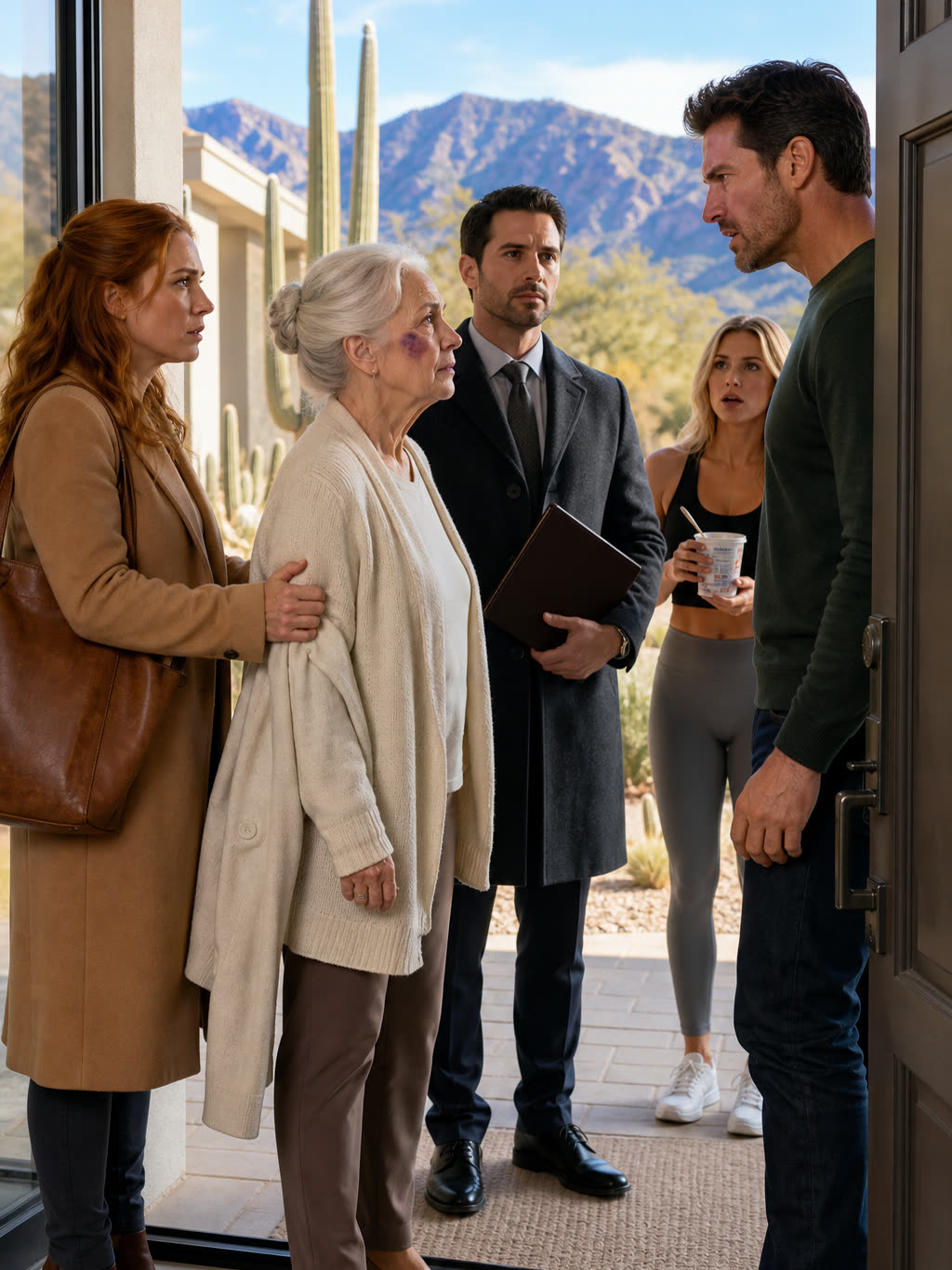
He rushed to interrupt: “I barely pushed her away. She’s making it up.”
Tessa looked at my face and pressed her lips together. She didn’t pull out a camera. She didn’t say a word to him. She simply came and stood beside me and held my coat while I caught my breath, and that small kindness nearly undid me more than anything else had.
Then my son made a mistake. “Besides, she lives here for free. We give her absolutely everything and she still complains.”
I looked down, not out of shame, but to open the folder of receipts on my phone. I had transferred eight hundred fifty dollars every month for six months, five thousand one hundred dollars in all, not counting the groceries. Raymond had offered to review those transactions using only my own bank statements and the authorizations I gave him.
Gregory scrolled through the receipts slowly. “We’re not here to argue about who owns this house,” he said, evenly. “We’re here because Bernadette has the right to live free from violence.”
The word violence seemed to hang in the air above the kitchen table. My son opened his mouth, then closed it. Brielle set her cup down on the counter, and for the first time her bored expression slipped.
My son was silent for a few seconds. Then he accused me of arranging the whole thing just to humiliate him.
That was when I took out the photo of my cheek, taken at dawn, and the picture of the little saucer where Brielle had put out her cigarette. I also had photographs of the window that wouldn’t close, the cramped bathroom, and the room where they had made me feel like an unwelcome guest.
Not all of it proved a crime, and Gregory explained that to me clearly, without softening it. He had told me on the phone that he would never promise me something he couldn’t deliver. But taken together, the pictures showed what I had been living through.
“Are you going to believe them over your own son?” he asked me.
“Yesterday I believed you were incapable of hitting me,” I answered. “I can’t rely on your words alone anymore.”
He flinched, as though I had been the one to slap him. I didn’t say it to wound him. I said it because it was true, and because I was finished pretending otherwise.
I told them I wanted to gather my things. My son insisted that nobody could take me out of his house without his permission, as if my freedom belonged to him too.
Gregory stayed calm. He explained that I was free to leave of my own will and to take my belongings with me. It was not a request for permission. It was a statement of fact.
When my son stepped too close to me, Tessa took her phone out, in case we needed to call for help. He stopped where he stood. His hands hung open at his sides, and for a moment he looked less like an angry man than like a lost boy.
I went to the room and collected my documents, my medications, a few photographs, and the cardigan he had given me years before. I left a great deal behind, to deal with later. I didn’t want to carry that house out on my back.
Before leaving, I looked once more at the portrait of his graduation. I tucked it carefully among my clothes. I didn’t want to lose the memory of the son I had once known.
That morning I was taken to get medical care. The doctor examined the bruise and listened to my breathing for a long while. He documented the injuries he observed and asked whether I felt safe going back to that house.
“No,” I said.
It was the first time I had said it aloud, and the word felt strange and steady in my mouth, like a stone I could finally stand on.
With Gregory, I received guidance on filing a police report and asking about a protective order. Nobody promised me that my son would be arrested right away, or that one photograph would settle everything. What did change was that, for the first time, my account existed outside of that kitchen.
Tessa offered me a quiet place to spend the first few days. She gave me a bedroom with a window that closed properly and a blanket that smelled of laundry soap. That night I slept without wondering who might open my bedroom door.
Raymond went over the six deposits and the purchases I had paid for. I expected him to uncover something dramatic, but he didn’t find a hidden fortune or a spectacular fraud. He found something simpler and, to me, far more important: I was not the financial burden my son claimed I was.
My income and savings would allow me to rent a modest apartment if I budgeted carefully. He said it kindly, in the voice of a man who understood that numbers could be a form of comfort.
When my son learned I wasn’t coming back, he began sending messages saying that I had been manipulated by outsiders. Tessa refused to publish our story without my permission. Gregory also refused to turn my pain into a spectacle. Both of them respected my decision to keep the matter private while the police report moved forward.
Three days later, I received a voicemail from my son.
“Mom, I shouldn’t have hit you, but you pushed me over the edge. You didn’t have to bring strangers into my house.”
I listened to it twice. The first time, I cried. The second time, I recognized the same old excuse, dressed in different clothes.
I shared the recording with Gregory and kept the original file safe. “It matters that he admits what he did,” he explained, “but he’s still trying to blame you.”
Later, Brielle wrote me a message saying that I had made them look bad and that my son was going through a hard time. I replied only that I was going through one too, and that I needed to recover away from the smoke and the blows.
A week later, I went back for my belongings, accompanied by Gregory and Tessa. My son avoided looking at me. Brielle no longer smiled.
Without my monthly contributions, they had to rearrange some of the expenses for that enormous house. That was a consequence of my leaving, not a revenge I had planned. I had never wanted to hurt them. I only wanted to stop being hurt.
My son tried to hug me and said that we could forget the whole thing. I took a step back.
“I don’t want you to forget what happened,” I told him. “I want you to accept that it was wrong, without blaming me.”
He didn’t respond. His eyes went to the floor. I took my clothes, my books, the photograph of his graduation, and the small things I had kept for a lifetime, and I carried them out to the car myself.
I found a simple apartment in Tempe, with windows that actually opened, a small kitchen, and just enough room for a pot of basil. The police report followed its course, and I didn’t pretend to know the outcome.
With Gregory’s help, I organized my documents and set clear boundaries for any contact with my son. Tessa kept visiting me, Raymond helped me sort out my finances, and slowly, I started to breathe a little easier.
One morning I made coffee, sat by the window, and looked at the portrait of my boy in his graduation gown. I still loved him. But I understood that loving a child doesn’t mean handing him the right to hurt you. At seventy-three, after a lifetime of taking care of everyone else, I had finally learned to take care of myself.
I thought the worst was behind me. I truly did.
Then my phone rang, and Gregory’s voice on the line was tight in a way I had not heard before.
“Bernadette, I need you to sit down. Your son’s lawyer has filed something with the court. He’s not backing away from this. And he’s asking the judge to hear from you in person.”
I looked at the little pot on the windowsill, at the tiny green leaves that had barely begun to grow, and felt my breath catch in my chest.
PART 3: THE BASIL ON THE WINDOWSILL
The hearing for the protective order was scheduled for the second week of December.
I had never been inside a courtroom in my life. In seventy-three years, I had been inside churches, factories, hospitals, and the unemployment office on Cleveland Avenue more times than I could count, but never a place where a stranger in a black robe would listen to the worst moment of my life and decide what it meant.
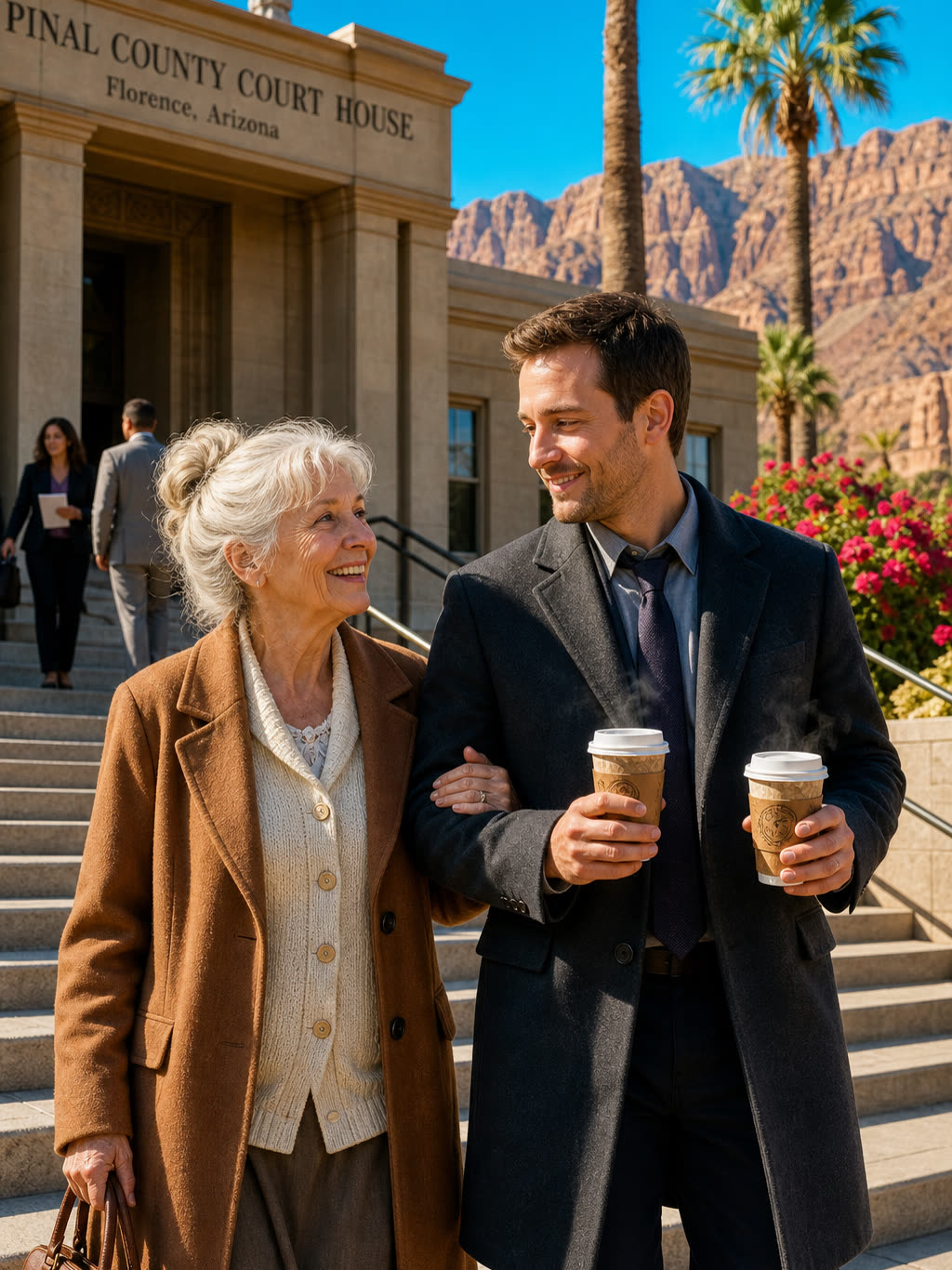
Gregory met me on the courthouse steps in a gray overcoat, holding two paper cups of tea.
“Drink this,” he said. “Then breathe. You don’t have to be impressive. You just have to be honest.”
“I’m too old to be impressive.”
“That’s the spirit.”
I laughed, and my lungs punished me for it with a short, rattling cough.
Gregory waited patiently until it passed, the way he had waited at sixteen when I taught him to tie a tie on my kitchen table, the night before his first job interview.
He offered me his arm, and I took it. I felt very small and very old beside him, and also, strangely, very proud of the man he had become.
We climbed the steps together in the thin winter sunlight, my tea steaming in my hand, and I tried to keep my breathing slow and even the whole way up.
Inside, the courtroom smelled of floor wax and old paper. My son was already seated at the other table with a lawyer I didn’t know. He wore a suit I had never seen before. He looked thinner, and he kept his eyes on the wood grain in front of him. Brielle was not there.
I sat down, folded my hands in my lap, and listened.
The judge was a tired-looking woman with reading glasses on a beaded chain. She let me speak first. I told her what had happened in the kitchen, plainly, without decoration. I told her about the cigarette, the slap, the marble countertop, and the saucer. I told her that my cheek had stayed purple for nine days.
When I finished, the judge asked, “Mrs. Bernadette, do you feel safe having contact with your son?”
I had rehearsed an answer. I had written it on an index card. Standing there, I forgot every word of it.
“I love my son,” I said. “But no. Not right now. Not alone with him.”
Nobody in the room said anything. My son’s shoulders moved, just slightly, like a man bracing against wind.
His lawyer argued that it was a single incident, an isolated lapse in judgment, a family disagreement that had been blown out of proportion by outsiders. The judge listened with her chin on her hand. Then she asked to hear the voicemail.
It was thirty-one seconds long.
Mom, I shouldn’t have hit you, but you pushed me over the edge.
She played it once and removed her glasses.
“Mr. Prescott,” she said to my son, “you have admitted striking your mother, and in the same breath you have assigned her responsibility for it. I would like you to sit with that sentence for a while.”
He didn’t answer. His lawyer touched his sleeve, but my son just stared at the table, and I thought I saw his lips tremble.
She granted the order for one year. No contact except through counsel, no approaching my residence, and a requirement that he complete an anger management program.
It wasn’t a victory, exactly. It was a boundary, written down by someone with the authority to enforce it.
Outside, Tessa was waiting with her arms crossed against the cold.
“Well?”
“A year,” I said.
She hugged me so carefully, as if I might crack, that I had to tell her I wasn’t made of glass. Then I let her hold on for another full minute anyway.
Raymond came by my apartment that Sunday with a folder, which was, I had learned, how he said everything he didn’t know how to say out loud.
“I’ve put your finances into a simple budget,” he said, spreading the pages across my little kitchen table. “Rent, groceries, medications, a small cushion. You’ll be fine, Bernadette. Not rich. But fine.”
“I was never rich.”
“No.” He smiled. “But you used to feed a skinny kid who couldn’t afford a calculus textbook. I’d say you’re richer than most.”
I looked at the columns of numbers. In all my years of work, I had never once seen my life laid out so neatly, with nothing missing and nobody else’s name in the margins.
“There’s one more line,” Raymond said. “I set aside a little each month for the pulmonologist. Dr. Alvarez at the clinic on Mill Avenue. She has an opening in January.”
“I don’t need a new doctor.”
“You need someone who isn’t going to tell you it’s just age.” He tapped the page. “Humor me.”
I did.
Dr. Alvarez was a small, brisk woman who listened to my lungs for a long time and then looked me in the eye. She told me plainly that the damage from the factory years was permanent. It would not heal. But it could be managed, and the single most important thing I could do was stay away from smoke.
“Any smoke,” she said. “Cigarette, wood, cooking fumes. Your lungs have very little margin left.”
I thought of that kitchen. The saucer. Brielle’s bored expression.
“I asked for that,” I said quietly. “In the house. I asked, and I got hit.”
Dr. Alvarez set down her stethoscope.
“Mrs. Bernadette, you asked for clean air. That is not a request that deserves punishment. It’s a medical need, and you were right to say it out loud.”
I nodded, because my throat had closed.
On the way home, I stopped at a hardware store and bought a small air purifier for the bedroom. It cost sixty-two dollars. I paid for it with my own money, from my own account, and carried it up the stairs myself.
Winter in Arizona is gentle compared to Ohio, but it has its own quiet. Evenings came early. I learned the sounds of my building: the neighbor’s television through the wall, the radiator ticking, a child practicing scales on a keyboard two floors down.
I began cooking again. Small things first: soup, cornbread, a roast chicken I couldn’t finish alone and shared with the woman across the hall, a retired schoolteacher named Opal who turned out to know every bad joke ever written. We started having lunch together on Wednesdays.
I joined a breathing exercise group at the community center. I met a man named Walt who played harmonica and complained about everything with great affection. I sat in the sun on a bench outside the library and read an entire novel in one afternoon, something I hadn’t done in thirty years.
And every few days, I thought of my son.
Not with anger, mostly. Anger is a fire that needs fuel, and I was too tired to feed it. What came instead was a kind of ache, steady and low, like a bruise that has stopped being purple but still hurts when pressed.
I wondered if he was sleeping. I wondered what Brielle was cooking for him, or whether she was cooking at all. I wondered if he ever walked past the guest room and thought of me.
I did not call. The order said I couldn’t, and more than that, I didn’t trust myself yet.
In March, a letter arrived through Gregory’s office.
It was three pages, handwritten, and I knew the slant of the letters before I read a word. I had seen that handwriting on permission slips, on birthday cards, on a note left on my pillow when he was nine that said sorry I broke the lamp, I will pay you back when I’m rich.
Gregory had read it first, as the order required. He handed it to me across his desk with no expression.
“You don’t have to read it today,” he said. “Or ever.”
“I’ll read it.”
I took it home. I sat by the window, where the basil had grown tall and fragrant in its little pot, and I read.
Mom,
I’ve started the classes. The counselor asked me to write down the first time I remember wanting to hurt someone, and I sat there for forty minutes with a blank page. Then I wrote about Dad.
You never talked about him, so I don’t know if you remember the way he used to talk to you. I do. I was six. I remember thinking that was how a man was supposed to speak to a woman in a kitchen. I never decided that. I just absorbed it.
That’s not an excuse. I know it isn’t. I hit you because I wanted you to be quiet, and for one second, I believed I had the right. That’s the part I can’t get out of my head. Not that I lost control. That I didn’t.
Brielle left in February. She said she couldn’t live in a house where I’d done that, which is a strange thing to hear from someone who watched it happen and kept smoking. I’m not angry at her. I think I’m angry at all of us.
I’m not asking you to forgive me. I’m not asking for anything. I just wanted you to know that I finally understand what you were trying to say that day in the kitchen. You weren’t making trouble. You were asking not to be hurt.
I’m sorry. I’m so sorry, Mom.
The letter had no signature, just his first name, written small at the bottom as if he wasn’t sure he was allowed.
I read it twice. Then I folded it, put it in the drawer beside the graduation portrait, and went into the kitchen to make tea.
My hands were steady. That surprised me.
I didn’t answer right away.
I let the letter sit for three weeks. I talked it over with Gregory, with Tessa, with Opal over Wednesday soup, and with Dr. Alvarez, who raised an eyebrow and said, “Healing isn’t a race, but neither is it a trap.”
In the end, I wrote one page, by hand, and sent it through Gregory.
I received your letter. Thank you for writing it honestly.
I am not ready to see you, and I don’t know when I will be. The order stays in place, and I want it to. That isn’t punishment. It’s the space I need to feel safe, and the space you need to prove to yourself that the work is real.
Finish the classes. Not for me. For the man you want to be when you’re sixty, and for anyone who might someday need you to be gentle.
I love you. I have never stopped. But love is not the same thing as access, and I learned that too late and too slowly.
If you still want to write in six months, I will read it.
Mom
I sealed the envelope and gave it to Gregory. He tucked it into his folder without a word.
“You okay?” he asked.
I thought about it honestly.
“No,” I said. “But I’m all right.”
He smiled, because he understood the difference.
The seasons turned. The year of the order ticked toward its end.
On a bright morning in late autumn, I was sitting by my kitchen window with my coffee, watching Opal’s grandchildren chase each other across the courtyard below. The basil on the sill had finally gone to seed. I had saved the seeds in a paper envelope and written spring on it in blue pen.
My phone buzzed. A message from Tessa: Dinner Friday? Raymond’s cooking. Gregory’s bringing dessert. Warning: it’s store-bought.
I smiled, typed Wouldn’t miss it, and set the phone down.
On the wall across from me hung a small framed photograph. It wasn’t the graduation portrait, which I had kept but moved into a drawer. It was a snapshot Tessa had taken the day I signed the lease on this apartment, in an empty room, with sunlight pouring across the bare floor. I was holding a single key and laughing, my cheeks pink, looking like someone who had just stepped out of a very long dark.
I thought about the three phone calls I had made that afternoon, with a bruised face and trembling fingers. A lawyer, a journalist, and a man who understood numbers. I had expected help. I hadn’t expected to find that the people I once fed at my table had been quietly holding a place for me all along, waiting for the day I would finally ask.
I didn’t know what the future held for my son and me. Maybe someday we would share a meal at a table in a public place, with a careful distance and a long list of rules. Maybe not. I had made my peace with not knowing.
What I knew was this.
I was seventy-four years old now. My lungs were damaged, and they always would be. But the air in this apartment was clean, the windows opened, and nobody who loved me was ever going to put out a cigarette on a saucer I had washed.
I picked up my coffee. I breathed in.
And for the first time in a long time, the whole breath came.
Then the phone buzzed again, and this time it wasn’t Tessa. It was a number I knew by heart, and a voicemail notification, thirty-one seconds long, just like the last one.
My thumb hovered over the screen. I thought of the letter in the drawer, of the six months I had promised, of the little paper envelope marked spring.
I took one more slow, clear breath, and pressed play.
Disclaimer: This story is a work of fiction inspired by real-life themes. Names, characters, places and events are fictionalized, and any resemblance to real persons is purely coincidental. Images are for illustration purposes only.
