

PART 1
The smell of burnt coffee and lemon disinfectant always clung to our kitchen, a sour perfume that masked the house’s deeper decay. It was seven o’clock on a Tuesday evening when my father, Robert Vance, dropped a glossy booklet onto the laminate table. The slap echoed against the yellowing cabinets.
I looked down from my stack of anatomy flashcards. On the cover, bathed in artificial studio light, sat a pearlescent white luxury crossover.
“Forty-five thousand dollars,” Robert said. He didn’t sit down. He towered over me, his hands planted firmly on his belt, his posture designed to make me feel small, ungrateful, and cornered. “The dealership on Route 9 has one left in stock. Sabrina picked the cream leather interior. You’re going to co-sign the financing and cover the thirty percent down payment tomorrow morning.”
I blinked, waiting for the punchline that never came. My younger sister, Sabrina, was curled up on the faux-leather sofa in the adjoining den, tapping her phone screen with French-manicured acrylic nails. At twenty-one, she had successfully avoided holding a job for more than three consecutive weeks. Her primary occupation was documenting her lifestyle on social media—a lifestyle funded entirely by overdrafts, credit lines, and my labor.
“Dad, that’s absurd,” I said, keeping my voice carefully measured. “I’m working sixty hours a week between the clinic reception desk and the night shift at the distribution warehouse. Every spare cent I have is locked away in my tuition escrow for nursing school. I don’t have fifteen thousand dollars for a down payment, and I certainly can’t take on a seven-hundred-dollar monthly car note.”
My mother, Diane Vance, emerged from the pantry, wiping her hands on an apron embroidered with the phrase Home is Where Love Grows. Her eyes were rimmed with pink, her lips pressed into the familiar tight line of manufactured martyrdom.
“Sabrina deserves this, Hannah,” Diane said softly, though the sweetness carried razor wire beneath it. “She’s been through so much anxiety this past year. She needs a dependable, elegant car to build her confidence. You’ve always been tough. You survive anything. But your sister is delicate.”
“Being delicate doesn’t pay a four-hundred-dollar car insurance premium,” I shot back. “If she needs a car, she can buy a ten-year-old compact like mine. Mine has one hundred and eighty thousand miles on it, the air conditioning smells like damp leaves, but it gets me to my twelve-hour shifts.”
Robert’s face darkened, veins throbbing at his temples like swollen earthworms. He leaned across the table until his breath—stale tobacco and wintergreen mints—washed over my face.
“We didn’t take you in out of the kindness of our hearts so you could lecture us on budgeting,” he snarled.
The room seemed to shrink. There it was. The eternal trump card. The debt that could never, ever be marked as paid.
I was six years old when the state placed me in their home after my biological mother died of complications from pneumonia. By eight, I was legally adopted. But in the Vance household, adoption wasn’t an act of love; it was an open line of credit they drew against whenever they needed a scapegoat or a servant. Whenever I questioned a curfew, asked for lunch money, or dared to dream of an education beyond high school, the same poisoned barb was fired.
Remember where you came from. Remember what you owe.
“If you refuse,” Diane added, stepping beside her husband, her gaze cold and pitiless, “you can pack your two milk crates of junk and go find an adult shelter. Or maybe we can call the social services board and ask them where former orphans go when they refuse to honor their families.”
“I’m twenty-four,” I said through dry lips. “You can’t threaten me with an orphanage anymore.”
“We can throw your things onto the asphalt tonight,” Robert warned, tapping the glossy brochure with a blunt, nicotine-stained fingernail. “You have forty-eight hours until Sabrina’s party. Secure the loan. Put down the money. Or you are dead to this family. You choose: are you our daughter, or are you a squatter?”
Sabrina didn’t even look up from her phone, but I saw the cruel curl of her lips in the reflection of the glass coffee table. She expected me to break. She expected me to cry, plead, and empty my hard-earned savings into her lap, just as I had done when she wrecked her graduation sedan, just as I had done when she ran up a three-thousand-dollar balance on Diane’s department store card.
I stared at the brochure. Then I looked at Robert’s sneering jaw and Diane’s predatory eyes. Something inside me—a brittle, exhausted part that had spent eighteen years begging for their approval—finally snapped clean off. In its place grew a terrifying, absolute calm.
“Fine,” I said quietly, gathering my flashcards into a neat, squared pile. “I understand what’s required. I’ll make sure Sabrina gets exactly what her behavior deserves on her birthday.”
Robert smirked, nodding in smug satisfaction. “Good girl. I knew you’d remember your place.”
I picked up my bag and walked up the creaking stairs to my attic bedroom. I locked the door behind me, leaned against the wood, and didn’t shed a single tear. Instead, I pulled out my laptop, my burner phone, and a small notebook containing numbers I had spent months gathering.
They wanted a show of gratitude. They wanted a brand-new vehicle in the driveway.
I was going to give them a lesson they would never forget.
The morning sun barely cut through the grimy window of the warehouse breakroom when my phone buzzed on the break table. It was Marcus Cole.
Marcus was five years older than me, a former military technician who now served as the lead field operations supervisor for Vanguard Fleet Security, an outfit specializing in high-value asset monitoring, commercial vehicle surveillance, and experimental telemetry. We had met two years prior when I worked night security at the medical plaza where his company held a contract. Marcus was pragmatic, fiercely loyal, and held an intense contempt for people who abused authority.
“Hannah,” his deep voice crackled over the receiver. “You sounded completely numb on that voice memo last night. Talk to me. Did Robert put hands on you?”
“No,” I whispered, staring into my bitter black coffee. “Nothing physical. Just the usual psychological extraction. They’re demanding a forty-five-thousand-dollar vehicle for Sabrina’s birthday. Down payment from my tuition account, financing entirely in my name. The deadline is tomorrow night.”
A low whistle escaped Marcus’s teeth. “Forty-five grand? Are they legally insane? You’re barely scraping together rent and tuition on minimum wage plus warehouse differentials. What did you tell them?”
“I told them I’d handle it.”
“Hannah…”
“Hear me out, Marcus,” I interrupted, my heart beating in a steady, cold rhythm. “I’m not paying a cent. I’m done paying. But I know my father. If I just say ‘no’ at the dinner table, he’ll lock me out, seize my car keys under the pretense that my current beater is parked on his property, and destroy whatever he can lay his hands on. He’s done it before when I tried to leave for college at eighteen.”
“So what’s the play?” Marcus asked, his tone shifting from protective concern to professional curiosity.
“I need to borrow one of your company’s decommissioned evaluation units,” I said. “The ones you outfit with the prototype multi-angle HD recording packages for insurance simulations.”
The line went silent for three seconds. When Marcus spoke again, I could hear the faint rustle of clipboards on his end.
“You mean the silver Sentra DX fleet unit? The one with the five-channel optical rig? Hannah, that thing has four continuous wide-angle cameras behind the grille, two inside the rear headrests, one wide-lens dash cam behind the rearview mirror, and an independent cellular-linked black box that records directly to our company servers in real time. It’s an active asset under corporate registration.”
“Exactly,” I said, leaning closer to the phone. “My parents are bullies, Marcus. But their arrogance makes them predictable. When Robert feels cheated or humiliated, he doesn’t use words. He uses tools. He destroys things. He thinks anything in that driveway belongs to him to break.”
“And if he touches a commercial asset owned by Vanguard Fleet?” Marcus mused aloud, a sudden, dangerous edge creeping into his voice. “That’s not a domestic dispute over a daughter’s property. That’s felony property destruction of a registered commercial entity. The district attorney doesn’t drop those charges just because a mother cries in the precinct hallway.”
“Can you sign it out to me under a temporary forty-eight-hour evaluation loaner agreement?” I asked.
“I can do one better,” Marcus replied. “I can log it as an off-site overnight sensor calibration test assigned to me, with you listed as the authorized secondary operator for transit testing. It’s totally by the book. It’s fully insured by Vanguard’s corporate underwriters. But Hannah—if they cross the line, there’s no walking it back. The servers upload offsite. I can’t delete the footage even if you beg me to later.”
“Marcus, I’ve been begging them to love me for eighteen years,” I said, my voice hardening like cured cement. “I promise you, I will never beg for them again.”
“Bring your license down to the garage at three o’clock,” Marcus said. “Let’s build the trap.”
After my warehouse shift ended at two in the afternoon, I drove my beat-up hatchback to the quiet home of Mrs. Gable, an elderly woman three blocks from my house whose lawn I had mowed for years without charge. She smiled through the screen door as I parked my car behind her overgrown hedge, completely hidden from the street.
“Keep it there as long as you need, sweetheart,” she said, handing me a glass of sweet tea. “Your father’s truck was roaring up and down the avenue earlier. Looked like a man spoiling for a fight.”
“He won’t have to look far, Mrs. Gable,” I said softly.
By four o’clock, I was pulling the sleek, silver evaluation sedan out of the Vanguard maintenance depot. From the outside, the car looked like any modern mid-sized vehicle—clean, modest, and completely ordinary. But when Marcus tapped the screen under the dash, five separate high-definition camera angles sprang to life, displaying a three-hundred-and-sixty-degree perimeter with thermal indexing and audio pickup sensitive enough to catch a whisper at thirty paces.
“The black box is live,” Marcus told me, tapping the glass. “It transmits every vibration, every impact, every decibel straight to our secure Amazon Web Services cloud bucket. The local memory card can be pulled and stomped on; it won’t matter. The cloud catches every frame.”
“Thank you, Marcus.”
“Don’t thank me yet,” he said, looking at me with genuine gravity. “Just remember: when the glass starts flying, stay inside the safe zone. Don’t try to be a hero. Let the machinery do its job.”
With the silver sedan parked neatly in the Vance driveway directly beneath the harsh glare of the motion-activated floodlights, I walked upstairs to my room.
I took out a small, metallic silver jewelry gift box. Inside, resting on a bed of cheap white cotton, I placed a bright pink, plastic toy SUV I had purchased for three dollars at the corner pharmacy. Under the toy, I folded a small index card. On it, written in clear, precise blue ink, were nine words:
Here’s what entitlement looks like when you hold it.
I wrapped the box in lavender ribbon—Sabrina’s absolute favorite shade—and tied a meticulous, symmetrical bow. Tomorrow night was her official birthday dinner at The Brass Lantern, an overpriced steakhouse in the downtown district. Robert had booked the prime table to impress the country club crowd he desperately tried to imitate.
Sitting at my desk, I pulled my social security card and birth certificate from my nightstand drawer, slipping them into the lining of my boot.
Then I saw something strange.
Tucked behind my childhood immunization records was a torn envelope from an institution called Apex Credit Services, addressed to Hannah Vance. The date on the postmark was three weeks old. The seal had been opened with a butter knife and crudely pressed back together.
I slid the paper out. My throat closed.
It was a final notice for an unsecured personal loan application in the amount of twenty-two thousand dollars, flagged for suspicious activity due to mismatched banking references.
The phone number listed as the primary contact wasn’t mine.
It was my father’s cell phone.
PART 2
The chandelier above Table 12 at The Brass Lantern cast a sickening amber glow over the white linen cloth. Sabrina sat at the head of the booth, wearing an emerald satin dress that cost more than my monthly grocery budget, her fingers wrapped around a strawberry daiquiri she wasn’t legally supposed to be served without proper validation, though the manager had looked the other way when Robert flashed a twenty-dollar bill.
“Everyone is asking where we’re going for my reveal,” Sabrina purred, checking her reflection in the polished soup spoon. “Chloe got a convertible for her graduation, but a crossover is so much more elevated. It screams young executive.”
“You deserve nothing less, sweet pea,” Diane gushed, reaching across the bread basket to stroke Sabrina’s arm. “You’ve worked so hard on your mental wellness this year. Hasn’t she, Robert?”
“Damn right,” Robert muttered, slicing into a prime rib with excessive force, his knife scraping loudly against the china. He didn’t look at Sabrina. His predatory eyes were locked squarely on me, sitting across the table in my plain black administrative blazer.
“Hannah’s been very cooperative,” Robert said, his voice laced with venomous satisfaction. “She saw reason. She realized that family comes before her personal little selfish projects.”
I chewed my dry roll in silence, maintaining a neutral, submissive expression. In the psychology textbooks I had been reading for my prerequisite courses, they called this gray rocking—becoming as interesting and responsive as a lump of gravel so the abuser finds no purchase for their emotional hooks.
“Did you get the premium sound package?” Sabrina demanded, turning her cold hazel eyes on me. “I told Dad I need the twelve-speaker setup. My lifestyle vlogs sound terrible through factory audio.”

“I made sure the vehicle arranged for tonight reflects your true contribution to our lives, Sabrina,” I said calmly.
Diane let out a theatrical sigh of relief, dabbing the corners of her mouth with a linen napkin. “Oh, thank the Lord. I knew our Hannah had a heart buried in there somewhere. When we get home, Robert, we should let her keep her old room through the summer. As a reward.”
“We’ll see,” Robert grunted, washing down red meat with a mouthful of cabernet. “Depends on whether the interest rate she negotiated is acceptable. If she took a high-rate note, she’ll be covering the spread out of her clinic paychecks.”
The bill arrived. Robert pushed it toward my side of the table without breaking eye contact.
“Take care of the tip,” he ordered. “The car payment starts next month, so you can afford seventy bucks for the waitress tonight.”
I pulled two crisp twenty-dollar bills from my wallet, set them on the leather folder, and stood up. From my purse, I retrieved the small, lavender-ribboned silver box. The dining room around us had quieted down somewhat, several elderly patrons glancing over at our lavish table.
“Why are you giving it to me here?” Sabrina whined, though her eyes flared with greed. “I thought the keys were in the driveway!”
“A milestone birthday requires a milestone presentation,” I said, my voice ringing clear and steady through the dining alcove.
Diane beamed, clapping her hands together in small, manic bursts. “Look, Robert! She’s giving her the key fob in a jewelry box! Oh, take a picture for Facebook, quick!”
Sabrina snatched the box from my hand. Several diners at adjacent tables smiled politely, expecting a tearful sisterly embrace. Sabrina pulled the lavender ribbon with a sharp yank, tore off the silver foil paper, and pried open the lid.
The smile on her face didn’t merely fade; it curdled.
Inside the bed of cotton, the cheap, bubblegum-pink plastic toy car sat perched like a joke on display. Sabrina’s fingers trembled as she pulled out the folded white index card beneath it.
She read the words aloud in a stunned, breathless whisper: “Here’s what entitlement looks like when you hold it.”
The silence that followed was suffocating.
Sabrina’s mouth worked soundlessly for three seconds before a shrill, hysterical shriek tore from her throat. She threw the plastic toy straight at my chest. It bounced off my blazer and clattered against Robert’s wine glass, splashing dark red liquid across the spotless tablecloth.
“What is this?!” Sabrina screamed, her voice cracking into pure rage. “What is this garbage?!”
Robert shot out of his chair with such violent momentum that the mahogany table lurched, tipping a water goblet into Diane’s lap. Heads snapped around from every corner of the restaurant. The maitre d’ froze mid-stride near the kitchen doors.
“You ungrateful, sick little orphan bitch,” Robert roared, his face turning an apocalyptic shade of purple. “Where are the keys? Where is the paperwork?!”
“There are no keys to a forty-five-thousand-dollar car, Robert,” I replied, looking directly into his bulging eyes. “I am not an ATM. I am not your co-signer. And I am not Sabrina’s personal trust fund.”
Diane stood up, soaked in ice water, her face contorted into something genuinely grotesque. All her delicate, polished suburban charm peeled away like cheap wallpaper.
“You evil, calculating monster!” Diane hissed, leaning over the table, her fingernails clawing at the air inches from my face. “After everything we did for you! We took you out of the county system! You would have been trash on the street!”
“You took me because the county subsidy paid the second mortgage on this house,” I said clearly, ensuring every diner in the room heard every syllable. “And you kept me because you needed someone to clean the bathrooms and absorb the abuse your golden daughter couldn’t stomach.”
Robert grabbed my arm, his fingers digging into my muscle like iron calipers. “You’re coming home right now. You’re signing whatever I put in front of you, or I swear to God I’ll break every bone in your hands.”
“Touch me again in front of thirty witnesses,” I said, whispering so low only he could hear, “and the police will take you out of this dining room in irons before the check is settled.”
Robert recoiled slightly, realizing for the first time that several patrons were already holding up their phones, filming the altercation. The restaurant manager was hurrying toward us with two security guards.
Robert let go of my sleeve, his teeth grinding with a sickening crunch.
“Get in your car,” Robert hissed through clenched teeth. “Get in your piece-of-shit car and follow us home. When we get to that driveway, you are done. Your life in this town is over.”
They stormed toward the exit, Sabrina sobbing hysterically, Diane loudly proclaiming to the entire foyer that their adopted daughter was a sociopath.
I stood alone by the table. I picked up my purse, dropped another five dollars onto the table for the terrified young waitress, and walked calmly toward the parking lot.
The evaluation sedan was waiting. The cameras were hot. The trap was set.
The night air was unusually heavy, thick with the smell of an impending summer thunderstorm. By the time I turned the silver Sentra onto our residential street, my parents’ black pickup truck was already idling aggressively across the front lawn, its high beams illuminating the front porch like a prison execution yard.
I pulled into the driveway and put the sedan in park directly under the central motion floodlights, leaving fifteen feet between my bumper and the garage door.
I didn’t turn off the ignition. I left the telemetry active.
On the dash, the small green light pulsed steadily—the Vanguard cloud server was receiving a thirty-frame-per-second, high-definition data stream across four exterior wide-angle lenses and three directional parabolic microphones.
I stepped out of the vehicle, locked the doors with the remote, and took ten steps backward into the shadows of Mrs. Gable’s hedge line across the narrow property line.
The truck doors slammed open with deafening bangs.
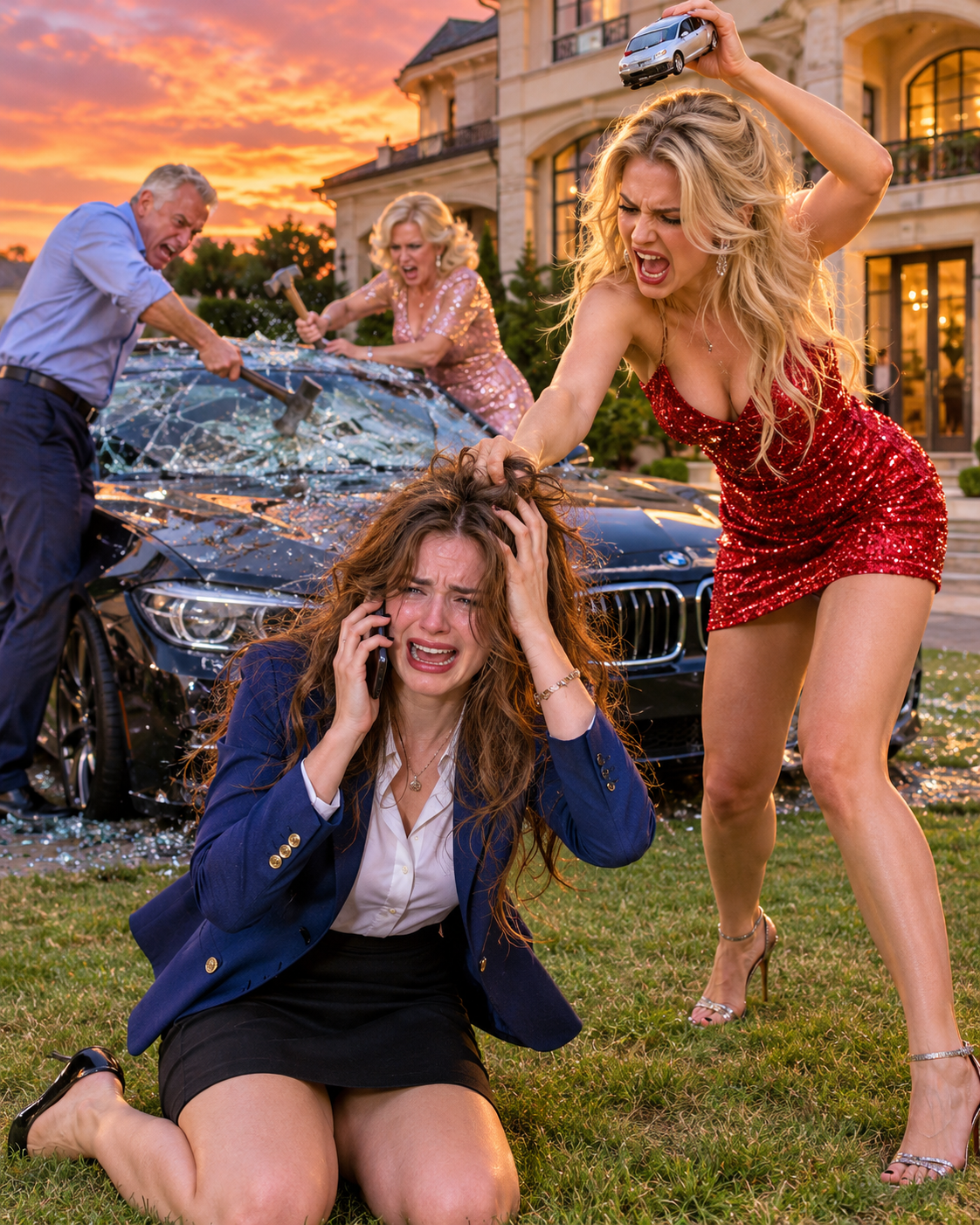
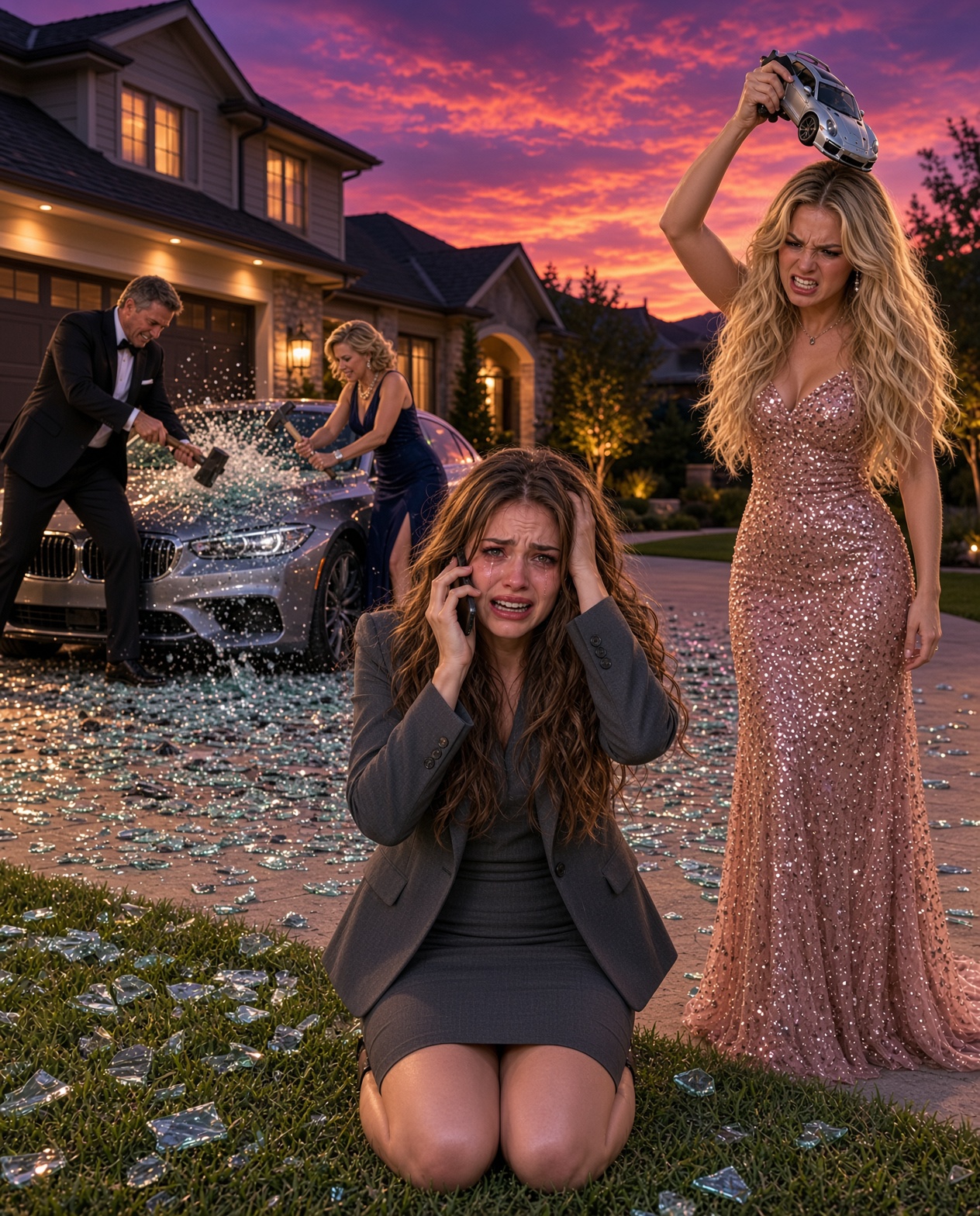
Robert didn’t walk; he charged. In his right hand, he carried a heavy, four-way steel lug wrench he had snatched from the truck bed. His shirt was half-unbuttoned, sweat plastering his graying hair to his forehead. Behind him came Diane, holding a heavy carpenter’s framing hammer from the workshop bench.
Sabrina leaned against the truck bed, arms crossed over her emerald dress, her face swollen with petulant tears.
“Smash it, Dad!” Sabrina screamed into the quiet suburban night. “Smash that piece of trash! Show her what happens to her precious car!”
Robert didn’t utter a single word of warning. He reached the hood of the silver sedan and brought the cross-shaped steel lug wrench down with terrifying, two-handed force.
CRACK.
The sound echoed through the sleepy neighborhood like a high-caliber gunshot. The tempered safety glass of the windshield exploded into a million shimmering fractures, spider-webbing instantly from the point of impact.
Inside my pocket, my phone vibrated violently. It was Marcus.
I answered and held the phone to my ear, watching the carnage unfold under the glaring halogen lights.
“Hannah!” Marcus shouted over the line. “The telemetry alarms just tripped three separate impact sensors! G-force exceeds eight Gs on the front windshield frame! Where are you? Are you safe?!”
“I’m standing thirty feet away on the neighboring property line,” I said calmly. “I’m completely safe. Marcus… they’re taking turns.”
“Stay right there. I have two squad cars rolling from the precinct four blocks away. Keep your distance!”
Across the driveway, Diane stepped up to the driver’s side door. With a shrill, guttural shriek that sounded entirely inhuman, she swung the steel framing hammer straight into the side-view mirror. Plastic housing shattered, scattering black shards across the asphalt, leaving the reflective glass dangling by two colored copper wires.
“Selfish little bitch!” Diane screamed, hammering the driver’s side door panel. THUD. THUD. THUD. Each blow caved the sheet metal in, gouging deep trenches through the silver clear-coat. “You think you can embarrass us?! You think you can make a fool of my family in public?!”
Robert was at the rear now. He swung the lug wrench like a baseball bat, obliterating the left taillight cluster in an explosion of red polycarbonate plastic. Red fragments rained over the driveway, catching the floodlight like spilled rubies.
Sabrina laughed—a high, manic, hysterical braying that drifted into the night. “Look at her car! Look at it! Go live in it now, Hannah! Go sleep in the ditch where you belong!”
Neighbors’ porch lights were flicking on down the street. Curtains were twitching. Mr. Henderson from across the cul-de-sac stepped onto his porch in a bathrobe, shouting, “Robert! What in God’s name are you doing?!”
“Mind your own business, Frank!” Robert bellowed back, wiping sweat from his eyes with his forearm before driving the steel wrench into the rear quarter panel, leaving a six-inch crease in the metal. “Disciplining my kid! Family business!”
And standing there, leaning against Mrs. Gable’s cedar fence, I did something I hadn’t done in years.
I laughed.
It started as a small, breathless vibration in my chest, and then it bubbled up into a full, genuine laugh. It was the purest sound I had ever produced.
Robert paused, his arm raised for another strike at the rear window, looking across the lawn into the shadows where I stood. The sight of me laughing seemed to short-circuit his brain entirely. His face twisted from fury into sheer, unadulterated bewilderment.
“You think this is funny?” Robert roared, spitting onto the hood. “Your car is scrap metal! You have no ride! You have no roof! You have nothing!”
“Robert,” I called out across the brightly lit yard, my voice ringing clear and crystal-sharp through the quiet suburban street. “Look at the registration sticker on the lower right corner of the windshield you just pulverized.”
Robert frowned, lowering the wrench slightly. Diane froze, hammer resting against the dented roof.
“What are you babbling about?” Diane snapped, her chest heaving.
“Take a look at the front bumper,” I said, pointing a finger toward the ruined vehicle. “Look at the license plate bracket. Read the commercial fleet decal.”
Before Robert could move, the sharp, wailing scream of dual sirens tore through the night air.
Blue and red strobe lights flooded the cul-de-sac, painting the white siding of our house in violent, flashing colors. Two patrol cruisers rounded the corner at high speed, their tires chirping as they cut off the driveway exit, their spotlights instantly pinning Robert, Diane, and Sabrina in blinding white beams.
“Police! Drop the weapons! Drop them right now!”
The voice boomed through an external cruiser loudspeaker, authoritative and non-negotiable. Two officers emerged from behind their ballistic doors, hands resting on their holstered duty weapons, their flashlights cutting through the settling dust of broken glass.
Robert stood frozen, the heavy four-way lug wrench still gripped in his right fist, his knuckle bleeding where a shard of flying glass had grazed him. Diane dropped the hammer instantly; it hit the driveway asphalt with a dull, heavy clatter that sounded like a lead weight falling into an empty bucket.
“Officers, wait!” Diane yelled, stepping forward with her palms held high, her voice instantly sliding back into that soft, weeping-mother cadence she had perfected over decades of PTA meetings and church socials. “Thank God you’re here! This is a private family matter! Our daughter had a severe psychological breakdown at dinner tonight! She ran away, and we were simply… we were dealing with her personal property to prevent her from driving under the influence!”
The senior officer, a burly sergeant named Miller, didn’t even look at Diane. His eyes locked entirely on Robert’s hand.
“Sir, set the iron on the ground. Step three paces back. Right now.”
Robert, his chest heaving, his face pale with sudden, terrifying adrenaline, slowly bent down and laid the lug wrench across the shattered glass. He took three clumsy steps backward, stumbling against the truck’s front bumper.
“Listen to me, Officer,” Robert said, his voice dropping into that hearty, good-old-boy tone he used whenever he was pulled over for speeding. “I’m Robert Vance. I own the machine shop over on Fourth. This is my property. That’s my daughter standing over there by the fence. She’s adopted, she’s emotionally unstable, and we purchased this car for her. If I choose to destroy my own daughter’s vehicle on my own private driveway, that is a civil issue, not a criminal one.”
Sergeant Miller glanced at the wrecked sedan: the caved-in roof, the demolished windshield, the shattered lights, the hammered doors.
“Is this your vehicle, sir?” Miller asked calmly.
“I paid for it!” Robert lied without missing a single beat, his confidence swelling again. “My money, my daughter, my driveway! Now tell those neighbors to go back inside and clear these cruisers off my lawn before I call the councilman!”
A third vehicle pulled smoothly into the cul-de-sac. It was a dark blue corporate SUV bearing the silver shield of Vanguard Fleet Systems.
Marcus Cole stepped out. He was dressed in his sharp charcoal field supervisor uniform, a rigid black clipboard tucked under his arm, his company badge gleaming beneath the emergency strobes.
“Good evening, Sergeant Miller,” Marcus said, nodding respectfully to the officer.
Robert’s eyes narrowed. “Who the hell are you? Get off my property!”
Marcus ignored him completely. He approached the sergeant, flipping open the clipboard to display a laminated folder of official documentation.
“My name is Marcus Cole. I am the Lead Fleet Operations Director for Vanguard Fleet Security. The vehicle currently being vandalized in this driveway is a 2024 Vanguard Evaluation Platform, Vehicle Identification Number ending in 8-8-4-1. It is the sole corporate property of Vanguard Systems, registered under commercial fleet operating license alpha-niner.”
Diane’s mouth fell open. Sabrina stopped sniffling, her eyes darting between the uniform and the wrecked sedan.
“What?” Robert gasped, taking an involuntary step forward. “No. No, that’s Hannah’s car! That’s the piece of crap she brought home!”
“Hannah Vance is an authorized secondary transit driver operating under an active evaluation agreement signed at our regional depot this afternoon,” Marcus continued in a cold, professional monotone. “She holds zero equity in this vehicle. The vehicle is valued at thirty-eight thousand dollars. The onboard instrumentation and proprietary optical arrays installed across the chassis are valued at an additional twenty-four thousand dollars.”
Sergeant Miller turned back toward Robert, his eyebrows slowly climbing up his forehead.
“You destroyed a sixty-two-thousand-dollar commercial asset with a tire iron, Mr. Vance?” Miller asked, his tone shifting from routine domestic caution to severe administrative finality.
“She set us up!” Robert roared, his finger stabbing violently in my direction. “She parked it here on purpose! She knew we thought it was hers! Officer, look at her! She’s standing there laughing at us!”
I stepped out from the hedge line into the full glare of the cruiser lights. My face was calm, my posture straight.
“Officer,” I said, pulling my driver’s license and my signed copy of the Vanguard transit authorization from my blazer pocket, handing them to Miller’s partner. “I arrived home twenty minutes ago. Before I could even enter the residence, my parents exited their truck with tools they brought from the garage and began an unprovoked physical assault on the vehicle. I retreated to safe ground immediately to avoid physical violence, as Robert Vance threatened to break my bones less than an hour ago at The Brass Lantern restaurant.”
“That’s a lie!” Diane shrieked, her voice reaching an ear-piercing pitch. “She’s trying to destroy our lives! Robert, tell them! Tell them she’s lying!”
“Sergeant,” Marcus added, tapping his tablet screen. “The vehicle’s internal telemetry array has recorded the entire event in four-channel 4K video with integrated audio. The files were uploaded via cellular relay to our offsite legal server five minutes ago. I have the footage queued on this screen right now.”
Marcus turned the tablet toward the two officers.
On the screen, in terrifyingly sharp clarity, Robert’s face filled the frame, lug wrench raised high, teeth bared, screaming: Disciplining my kid! Family business! Behind him, Diane could be seen methodically smashing the side-view mirror with the framing hammer, while Sabrina danced on the truck bed, shouting for them to break every window.
Sergeant Miller let out a slow breath through his teeth. He closed the tablet and looked at his partner.
“Cuff him,” Miller said.
“What?!” Robert yelled, flinching backward as the second officer stepped forward, unhooking a pair of steel handcuffs. “You can’t arrest me on my own property! I didn’t know it wasn’t her car! It was a mistake! A domestic misunderstanding!”
“Ignorance of ownership is not an affirmative defense for felony criminal mischief, Mr. Vance,” Miller said coldly. “Turn around. Hands behind your back.”
“No! No!” Diane began to wail, dropping to her knees on the driveway gravel, her manicured hands clawing at Miller’s trouser leg. “Please! We have a standing in this community! We go to Saint Jude’s! Robert has high blood pressure! Take her! She’s the one who caused this!”
“Ma’am, get off the officer right now or you will be charged with obstruction of justice and resisting without violence,” the second officer warned sharply.
Sabrina backed away, her emerald dress catching on the truck’s tailgate latch, ripping the fabric with a loud tear. “Mom! Do something! Mom!”
Robert’s wrists were wrenched behind his back. The steel ratchets clicked—one, two, three, four—snug against his skin. The man who had spent eighteen years lording his absolute power over my meals, my clothes, my bedroom door, and my self-worth was forced down onto the hood of his own pickup truck, his face pressed against the cold metal.
“Hannah!” Robert bellowed, his voice muffled against the paint. “Hannah, tell them to stop! Tell them we’ll pay for the car! Call Marcus off! You owe us this! We raised you!”
I walked up to the edge of the police cruiser door. I looked down at the man who had terrified my childhood, who had made every meal taste like charity and every night feel like probation.
“You didn’t raise me, Robert,” I said softly, loud enough only for him and the arresting officer to hear. “You housed an investment. And tonight, your account was closed.”
The officer pushed Robert into the back of the cruiser. The heavy door slammed shut.
Diane was placed in the second vehicle, still weeping hysterically, her apron stained with grease and road grime.
The cul-de-sac fell strangely quiet, save for the crackle of police radios and the gentle hum of the thunderstorm rolling across the hills.
The Vance house had never felt so vast, or so completely dead.
PART 3
By two in the morning, the police cruisers had cleared the street. Sabrina had locked herself in her second-floor bedroom, her loud, ragged sobs occasionally breaking through the floorboards before descending into angry, muffled phone calls to her equally vacuous friends.
Marcus had stayed until the flatbed tow truck hauled the battered evaluation sedan away.
“Hannah,” he had told me before leaving, his hand resting reassuringly on my shoulder, “our corporate legal team is filing the formal criminal complaint at eight o’clock tomorrow morning. The district attorney’s office will receive the complete unedited video files by nine. With damages exceeding thirty thousand dollars, this is a Class 3 felony. He isn’t walking away with a fine. If you stay in this house tonight, lock your door.”
“I’m not staying, Marcus,” I had replied. “I just need to collect what is legally mine.”
Now, inside the quiet house, I stood in the small wood-paneled study off the front hallway. This was Robert’s private sanctuary—the room where he calculated the family expenses, drank his scotch, and kept the steel filing cabinet locked with a small brass key he always hid inside an empty brass shell casing on the bookshelf.
I reached behind the leather-bound encyclopedias, found the heavy shell casing, and tipped the small brass key into my palm.
The cabinet drawers slid open with a metallic scrape.
I wasn’t looking for sentimentality; I was looking for the paper trail that the unopened Apex Credit Services envelope had hinted at. I pulled out my phone, switched on the flashlight, and began methodically sorting through the hanging green folders.
Taxes. Insurance policies. Sabrina’s private high school receipts.
And then, tucked behind an old vehicle title from 2018, I found a thick, unmarked manila folder labeled simply: H.V. – Escrow & Records.
My hands trembled slightly as I untied the string closure.
The first document was my legal adoption decree, stamped by the county family court eighteen years ago. Beneath it was the state subsidy ledger. I stared at the numbers in the dim flashlight beam, my breath catching in my throat.

The state had not merely given my parents a small monthly stipend to offset my food and clothing. Because I had entered the system with documented respiratory trauma from my early childhood, I had been classified under an enhanced medical care placement tier. The county had paid Robert and Diane twelve hundred dollars every single month until my eighteenth birthday.
Over twelve years, they had received more than one hundred and seventy thousand tax-free dollars specifically designated for my upkeep, medical care, and post-secondary educational trust.
Every time Diane had sighed over the cost of my winter boots… every time Robert had slammed his fist on the table because my asthma inhaler cost forty-five dollars… every time they reminded me that I was eating their bread and drinking their milk… they were banking twelve hundred dollars of state money.
And where had that money gone?
I flipped through the bank statements attached to the back of the ledger. In July of 2018—the month I turned eighteen—the remaining balance of my state education escrow account, seventy-one thousand dollars, had been transferred via wire transfer into an account named Vance Machine & Tool Capital Expansion.
Robert had used my college trust to bail out his failing machine shop.
I pressed the heels of my hands into my eyes, forcing back the burning wave of nausea. But there was worse.
Beneath the escrow records lay a series of credit card applications from the past six months.
Three cards: a Platinum Visa, a retail store card, and an online line of credit. All three were issued under the name Hannah Vance.
All three bore my correct social security number.
The mailing address was this house.
The signature on the application line was a crude, heavy-handed forgery of my handwriting—the loops too wide, the pressure points digging deep into the cardstock. Robert’s hand.
The total outstanding balance across all three accounts was thirty-four thousand, six hundred and twelve dollars.
The purchases were itemized on the latest monthly statements: high-end clothing boutiques, resort reservations in Miami, payments to an aesthetic clinic for cosmetic procedures, and five separate deposits to an auto lease brokerage.
Sabrina hadn’t been looking for a new car because she was turning twenty-one.
Sabrina had already ruined my credit score to buy her designer clothes, and when the cards reached their maximum limits two weeks ago, Robert had tried to take out a twenty-two-thousand-dollar personal loan in my name to pay off the minimum balances. When the bank flagged that loan for mismatched voice verification, Robert had pivoted to the ultimate brute-force solution: bully me into walking into the dealership in person to sign for a brand-new crossover, using my clean nursing school loan eligibility to hide the rot.
They hadn’t just tried to force me to buy a car.
They were systematically burying me alive under an avalanche of identity theft and financial fraud, ensuring that I could never qualify for an apartment, never secure a student loan, and never, ever leave their control.
“What are you doing in Dad’s desk?”
The voice made me jump.
Sabrina stood in the doorway of the study. Her makeup was smeared across her cheeks like greasepaint, her eyes red and puffy, her emerald dress crumpled and ruined. She held a glass of tap water in her hand, her knuckles white.
I looked up from the documents, slowly sliding the manila folder into my canvas backpack.
“Sabrina,” I said, my voice dead and cold. “Did you know about these?”
I held up the Platinum Visa statement with her name listed on the authorized user card.
Sabrina flinched, her eyes darting away from the paper to the floorboards. She took a slow sip of water, her jaw working defensively.
“Dad said… Dad said it was family money,” she muttered, though there was zero conviction in her voice. “He said you owed the house for all the years they took care of you. He said you wouldn’t miss it because you were just going to be a nurse anyway.”
“A nurse anyway?” I repeated, stepping out from behind the desk.
“You think you’re better than us!” Sabrina suddenly hissed, the shame vanishing beneath a surge of childish, vicious petulance. “You always have! Sitting up in your room with your books, looking down your nose at me! Dad should have left you in the group home! You’re getting him sent to prison! Do you know what that means for me?! How am I supposed to pay for my apartment next month?!”
I walked past her, my shoulder brushing hers. She smelled of stale alcohol and synthetic perfume.
“You’d better update your resume, Sabrina,” I whispered into her ear as I crossed the threshold into the hall. “Because tomorrow morning, Detective Alvarez is going to ask you why your signature is on seventy charges at the luxury mall in Oakbrook. And I’m not going to be here to pay the bill.”
I walked up the stairs, grabbed my single packed suitcase containing my clothes, my textbooks, and my clinical scrubs, and walked out the front door into the summer rain without looking back.
The precinct house smelled of wet wool, commercial floor wax, and lukewarm coffee. At eight-thirty the following morning, I sat in a small interview room across from Detective Alvarez, a sharp-eyed investigator with the county financial crimes unit.
Marcus sat beside me, dressed in a clean suit, representing Vanguard Fleet’s legal interests.
Detective Alvarez closed the manila folder I had handed him thirty minutes prior. He let out a long whistle, rubbing the bridge of his nose where his wire-rimmed glasses rested.
“Miss Vance,” Alvarez began, leaning back into his vinyl chair, “I see a lot of ugly domestic situations in this chair. Spouses hiding assets, siblings fighting over an inheritance. But this… this is calculated, multi-year aggravated identity theft combined with custodial embezzlement.”
“What is the realistic timeline, Detective?” I asked, keeping my hands flat on the laminate table to hide the faint tremor in my fingers.
“The criminal mischief charges from last night are already moving forward,” Alvarez replied, glancing at Marcus. “The surveillance video Vanguard provided is open-and-shut. Mr. Vance’s own statements on the audio track—shouting that he was ‘disciplining’ his daughter while destroying a sixty-thousand-dollar fleet vehicle—eliminate any defense of mistake of fact. The municipal judge set bail at twenty-five thousand dollars this morning. Your mother was released on her own recognizance because she doesn’t have a prior record, but Robert is still in the holding cell.”
“And the financial records?” Marcus asked.
“That’s the hammer,” Alvarez said, tapping my folder. “We’ve already pulled the emergency subpoenas for the IP addresses used to submit those three credit card applications. Two came directly from the router registered to Robert Vance’s home address. The third came from a cellular IP matching Sabrina Vance’s phone. Furthermore, the twenty-two-thousand-dollar personal loan application that was denied three weeks ago used your forged signature and listed Robert’s personal cell number as the verification contact.”
The door opened, and a junior officer poked his head inside. “Detective? Diane Vance and her attorney are in the lobby. They’re demanding to speak with Hannah before the formal arraignment.”
Alvarez looked at me, his dark eyes questioning. “You don’t have to face them, Miss Vance. You have an active victim protection petition pending.”
I took a deep breath. For eighteen years, I had shrunk back from Diane’s quiet, poisonous guilt-trips. I had lived in terror of her sighs, her martyr’s tears, her subtle reminders that I was an intruder in their family portrait.
“I want to see her,” I said firmly. “Here. In this room.”
Five minutes later, Diane Vance was escorted into the room.
She looked ten years older than she had twenty-four hours ago at The Brass Lantern. Her hair was pulled back in a messy, unwashed clip, her eyes swollen and red, wearing an oversized sweatshirt that looked rumpled and damp. Her attorney, a cheap strip-mall practitioner named Bauer, sat awkwardly beside her with a battered briefcase.
Diane saw me and immediately reached her hands across the table, her face crumpling into dramatic despair.
“Hannah… baby,” she sobbed, her voice trembling with manufactured agony. “Look at what’s happening to us. Your father is sitting in a cold cell with common criminals. They took his blood pressure medication away! Sabrina has been throwing up all morning! How could you let it go this far? Over a car? Over an argument?”
“It wasn’t an argument, Diane,” I said, my voice flat, empty of all affection. “It was a crime.”
“We’ll pay for the car!” Diane cried, clutching a wet tissue. “We’ll take out a second mortgage! Mr. Bauer is drawing up the papers right now! We will repay Marcus’s company every single penny! Just tell the detective it was a misunderstanding! Tell them you gave Robert permission to get rid of the vehicle!”
Mr. Bauer cleared his throat uncomfortably. “Miss Vance, if you could attest that there was implicit domestic consent regarding the handling of family transport on the property, we believe the district attorney might reduce the charges to misdemeanor property disturbance—”
“Mr. Bauer,” Detective Alvarez interrupted, his voice dropping into a dangerous baritone. “I strongly advise you to caution your client before she attempts to suborn perjury in an active police interview room with three recording devices running.”
Bauer’s mouth snapped shut. He looked at Diane and shook his head sharply.
I opened my backpack, retrieved the copies of the three credit card statements, and slid them across the table until they tapped against Diane’s trembling knuckles.
Diane glanced down. The color drained from her face so completely she looked like a corpse.
“What about these, Diane?” I asked softly. “Are these a misunderstanding, too?”
“I… I don’t know what those are,” Diane stammered, pulling her hands back into her sleeves as if the paper were hot iron.
“Thirty-four thousand dollars in my name,” I said. “Sabrina’s clothes. Sabrina’s hair appointments. The weekend trip to Fort Lauderdale you took last Easter—paid for with a card opened using my social security number while I was working sixteen-hour weekend shifts at the clinic.”
“We were going to pay it back!” Diane suddenly burst out, the tears vanishing instantly, replaced by that familiar, vicious sneer of entitlement. “We raised you! We gave you our name! If it weren’t for Robert and me, you would have grown up in state foster homes with strangers! You owe us everything you have! What kind of monster audits her own mother?!”
“A mother?” I leaned forward, my eyes locking onto hers with such absolute intensity that Diane flinched backward into her chair. “You took twelve hundred dollars a month from the county for twelve years. You stole seventy-one thousand dollars from my state education trust to keep Robert’s bankrupt shop open. You didn’t raise a daughter, Diane. You ran a human trafficking franchise out of your guest bedroom.”
Diane gasped, clutching her chest. “How dare you… how dare you speak to me like that!”
“Here is what is going to happen,” I continued, ignoring her theatrics entirely. “I have signed full affidavits for identity theft, bank fraud, and grand larceny. Marcus’s company is filing federal commercial destruction charges for the evaluation vehicle. If you or Sabrina ever call my phone, approach my workplace, or come within five hundred feet of my residence again, the protective order becomes an immediate arrest warrant.”
I stood up. I didn’t feel rage. I didn’t feel hatred. I felt the profound, cleansing emptiness of an infected wound that had finally been lanced clean to the bone.
“Enjoy the mortgage, Diane,” I said. “Because you’re going to need it for the legal fees.”
As I walked out of the room, Diane’s shrieks of rage and despair echoed down the corridor, muffled only when the heavy security door clicked shut behind me.
The county courthouse was a monument of gray limestone and polished granite, built to make the individuals walking up its steps feel insignificant against the machinery of the law.
Three weeks had passed since the night in the driveway.
I sat in the third row of the courtroom gallery, wearing a simple gray skirt and pressed white blouse. Beside me sat Marcus, holding a leather portfolio containing Vanguard’s final restitution assessment.
Across the wooden divider, Robert Vance sat at the defense table.
He was unrecognizable.
Without his hair dye, his gray roots showed starkly against his sallow, sun-deprived scalp. He wore an ill-fitting navy suit that hung loosely from his frame; he had lost fifteen pounds in the county jail before Diane managed to secure a second mortgage on the house to post his twenty-five-thousand-dollar bond. His shoulders were slumped, his hands resting flat on the mahogany table, trembling with a steady, uncontrollable palsy.
Diane sat in the row behind him, wearing a dark veil and a modest black dress, clutching her rosary beads like a prop in a community theater production. Sabrina was nowhere to be seen.
The bailiff called the docket number: “State of Illinois versus Robert Vance. Case number 24-CF-1109.”
Judge Evelyn Mercer, a no-nonsense jurist with silver hair and razor-sharp eyes, reviewed the file on her bench.
“We are here for entry of plea regarding the amended charges,” Judge Mercer said, her voice cutting through the hushed courtroom. “Mr. State’s Attorney, outline the agreement.”
The prosecutor, a sharp young woman named Reyes, stepped forward to the podium.
“Your Honor, pursuant to negotiations with defense counsel, the defendant, Robert Vance, has agreed to enter a plea of guilty to Count One: Felony Criminal Mischief over twenty thousand dollars, and Count Three: Attempted Identity Theft to Defraud a Financial Institution. In exchange, the State has agreed to suspend the eight-year statutory penitentiary sentence in favor of the following conditions:
“First, the defendant will serve twelve months in the county correctional facility, with work-release privileges revoked. Second, the defendant and his co-defendant spouse shall make immediate full restitution to Vanguard Fleet Systems in the verified amount of sixty-two thousand, four hundred and eighty dollars. Third, the defendant shall execute a complete confession of judgment in favor of Hannah Vance in the amount of one hundred and five thousand, six hundred and twelve dollars, representing the embezzled state educational trust funds and the fraudulent credit balances accumulated in her name.”
A sharp gasp escaped Diane’s lips in the gallery. She leaned forward, whispering frantically to the defense attorney, but Bauer simply held up a hand to silence her. He knew, and Robert knew, that if this went to a jury trial with the 4K video footage and the digital IP logs, Robert would be leaving the courtroom in an orange jumpsuit for a decade.
Judge Mercer looked down at Robert over the rims of her glasses.
“Mr. Vance, do you understand that by entering this plea, you waive your right to a trial by jury, your right to confront witnesses, and your right against self-incrimination?”
Robert stood up slowly. His voice was cracked, raspy, stripped of every shred of the arrogant authority he had wielded at the kitchen table three weeks ago.
“Yes, Your Honor,” he whispered.
“Did you, on the night of June twelfth, deliberately and with malice use a steel tool to destroy a vehicle parked in your driveway, knowing you did not hold title or ownership of that vehicle?”
Robert swallowed hard. He turned his head slightly, his hollow, defeated eyes finding mine in the gallery for a fraction of a second. I didn’t blink. I didn’t look away. I gave him nothing.
“Yes, Your Honor,” Robert choked out.
“And did you unlawfully use the personal identifying information of Hannah Vance to apply for financial instruments without her authorization?”
“Yes, Your Honor.”
Judge Mercer’s gavel descended with a sharp, heavy crack that reverberated through the wood of the benches.
“The court accepts your plea, finding it to be knowing, voluntary, and supported by overwhelming factual basis. Mr. Vance, your conduct in this matter demonstrates an appalling degree of domestic coercion, deceit, and arrogance. You treated a young woman entrusted to your care not as a daughter, but as a financial resource to be exploited and discarded.”
The judge looked directly at Diane in the gallery.
“Let this sentence serve as notice to all parties involved: blood or legal custody does not grant ownership over another human being’s labor or future. Defendant is remanded to the custody of the county sheriff for immediate transport.”
Two bailiffs stepped forward. Robert took off his watch, handed it to his attorney, and placed his hands behind his back. The steel handcuffs clicked shut.
Diane buried her face in her hands, letting out a long, wailing sob that the bailiff silenced with a sharp warning.
I stood up quietly, smoothed my skirt, and walked out the double oak doors into the sunlight.
On the courthouse steps, Marcus offered me a bottle of water. “How do you feel?”
I looked out over the city square—the buses rolling past, the students carrying backpacks toward the community college campus three blocks away, the breeze rustling through the green oak trees.
“I feel clean,” I said. “For the first time in my life, Marcus. I feel completely clean.”
Two months later, the world had fundamentally rearranged itself.
I stood in the center of my new studio apartment, a small, bright fourth-floor space with exposed brick walls and hardwood floors, located two blocks from the university medical center. The smell of fresh paint and lavender floor soap had completely replaced the sour coffee and lemon bleach of the Vance household.
A small secondhand wooden dining table sat near the window, covered not with bills or demands, but with heavy textbooks: Advanced Medical-Surgical Nursing, Pathophysiology, and Pharmacology for Clinical Practice.
The legal restitution process had moved with surprising speed.
To pay the mandatory Vanguard settlement and satisfy the first fifty-thousand-dollar installment of my educational trust judgment, Robert and Diane had been forced to sell the family machine shop at a steep loss to an industrial competitor. The house on Elm Street was currently listed on the market, its price slashed twice, as Diane could no longer afford the property taxes on her clerical salary alone.
Sabrina had been forced to move into a tiny, two-bedroom apartment near the expressway with two roommates she despised.
She had shown up at the hospital clinic where I worked three weeks ago, waiting for me near the staff parking structure. The emerald dresses and salon hair were gone; she was wearing an apron from a fast-food coffee chain, her eyes sunken with real, exhausting labor.
“Hannah,” she had pleaded, her hands trembling as she held a paper cup. “Mom is losing her mind. She barely speaks. Dad has ten months left in the work camp. Can’t you… can’t you just drop the civil judgment? They’re going to take the house. Where am I supposed to go if the house sells?”
I had paused beside my car—a modest, reliable four-year-old hatchback I had purchased entirely in my own name with a clean, low-interest auto loan secured through the nursing union credit union.
“You’re twenty-one, Sabrina,” I had said gently, without malice, but without an ounce of compromise. “You’re an adult. You spend eight hours a day on your feet now, don’t you?”
“My legs hurt every night,” she had whispered, tears welling in her eyes. “It’s horrible.”
“That’s what labor feels like,” I said. “I did it for eight years so you could sleep until noon. Welcome to the world you were living off of.”
I had driven away, leaving her standing on the concrete, the ledger finally balanced.
Now, sitting at my desk in my quiet apartment, my phone buzzed. It was an email notification from the National Student Financial Aid Office.
I clicked the link.
Dear Miss Vance: We are pleased to inform you that following the formal expungement of fraudulent credit inquiries and the verification of your court-ordered educational restitution escrow, your complete academic grant and federal nursing scholarship have been fully reinstated for the fall semester.
I closed the laptop screen.
I looked down at the corner of my desk. Sitting beside my microscope slides and my stethoscope was the small, bubblegum-pink plastic toy car from Sabrina’s birthday party.
I hadn’t thrown it away.
I kept it right there on the polished wood—a three-dollar piece of molded plastic that had brought an empire of emotional blackmail crashing down to the pavement.
Every morning when I wake up, before I put on my scrubs and head out the door to learn how to heal broken bodies, I look at that pink toy car.
It reminds me of the shattered windshield glittering like diamonds in the driveway floodlights. It reminds me of the tire iron in Robert’s hand, the hammer in Diane’s fist, and the hollow sound of their power collapsing under the weight of their own rage.
They thought love was a contract you enforced with threats.
They thought family was a cage where the strongest got to eat the weakest.
They thought the car they destroyed that night was mine.
They were wrong.
The vehicle they destroyed was the illusion that I would ever belong to them again.
And in that driveway, amid the shattered glass and the flashing blue lights, I didn’t lose a family.
I found myself.
