

PART 1 — THE GENERAL MY FATHER DIDN’T RECOGNIZE
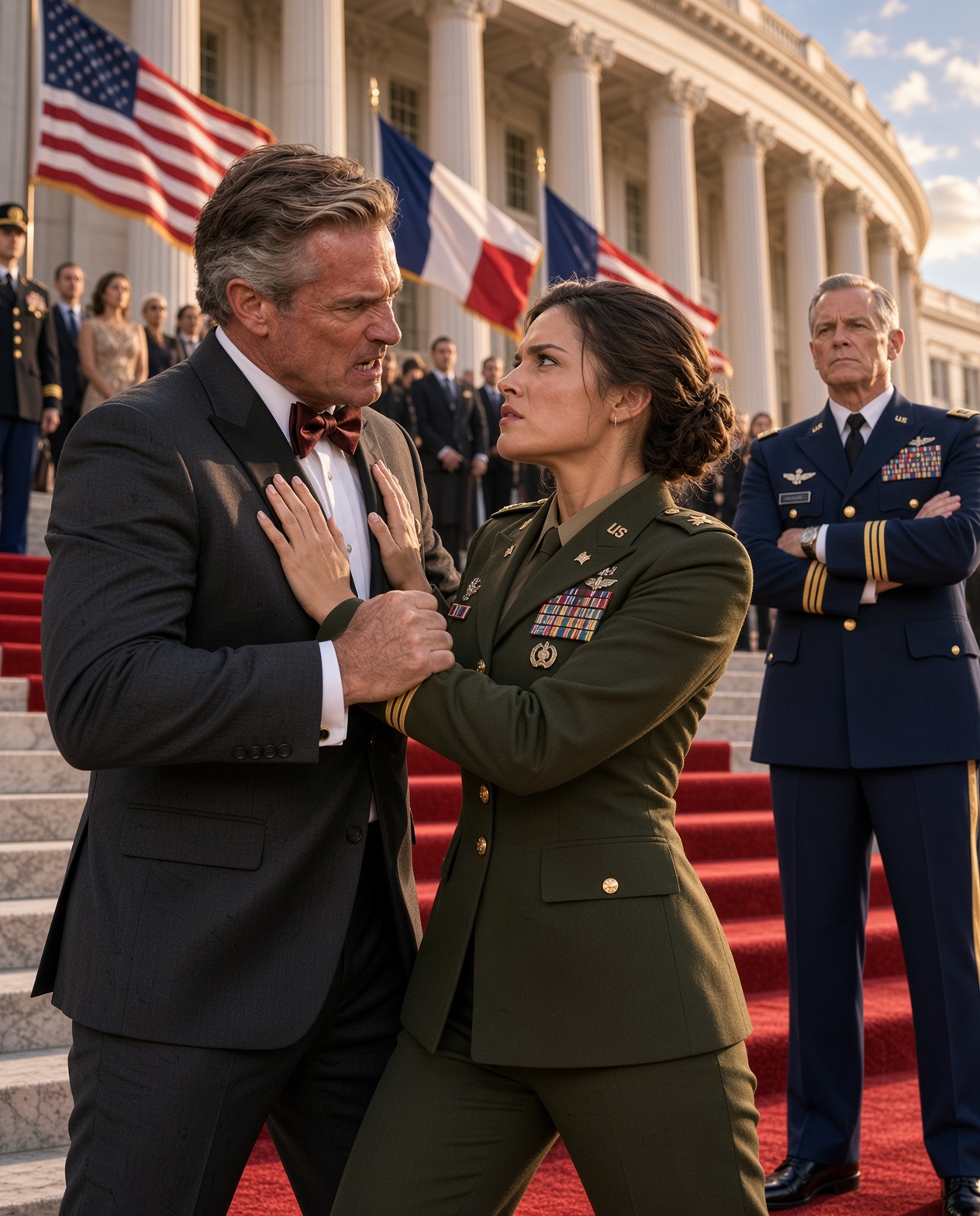
Twenty-six years after my billionaire father disowned me for joining the military, we crossed paths again at a White House VIP event. The moment he noticed my uniform, he sneered at me as though I were nothing more than a “mall cop,” then hissed, “Pretend you don’t know us.” He had no idea that the four-star general walking toward us was about to expose the truth about the daughter he had spent decades pretending didn’t exist.
“Step aside, uniform. You’re in the VIP lane,” an aggressive voice barked.
A hard shove struck my right shoulder immediately afterward.
After twenty-six years in the United States Army, maintaining my balance had become second nature. The impact barely shifted me. I adjusted my footing, straightened my dress blues, and faced the young man attempting to push his way through the White House East Gate security checkpoint.
His tuxedo was absurdly expensive and badly tailored.
I recognized him instantly.
Trevor.
My stepbrother.
Before I could fully process seeing him again, a powerful hand clamped around my upper arm. The fingers dug into the fabric of my uniform with enough force to hurt.
“I told you to move, you useless—”
The voice abruptly stopped.
I looked up.
Arthur Mercer stood directly in front of me.
My father.
More than two decades had passed since I had last been this close to him. Yet the wealthy CEO of Mercer Defense Tech appeared almost exactly as I remembered: an immaculate Italian suit, an air of unquestionable authority, and the same expression of contempt he reserved for anyone he considered beneath him.
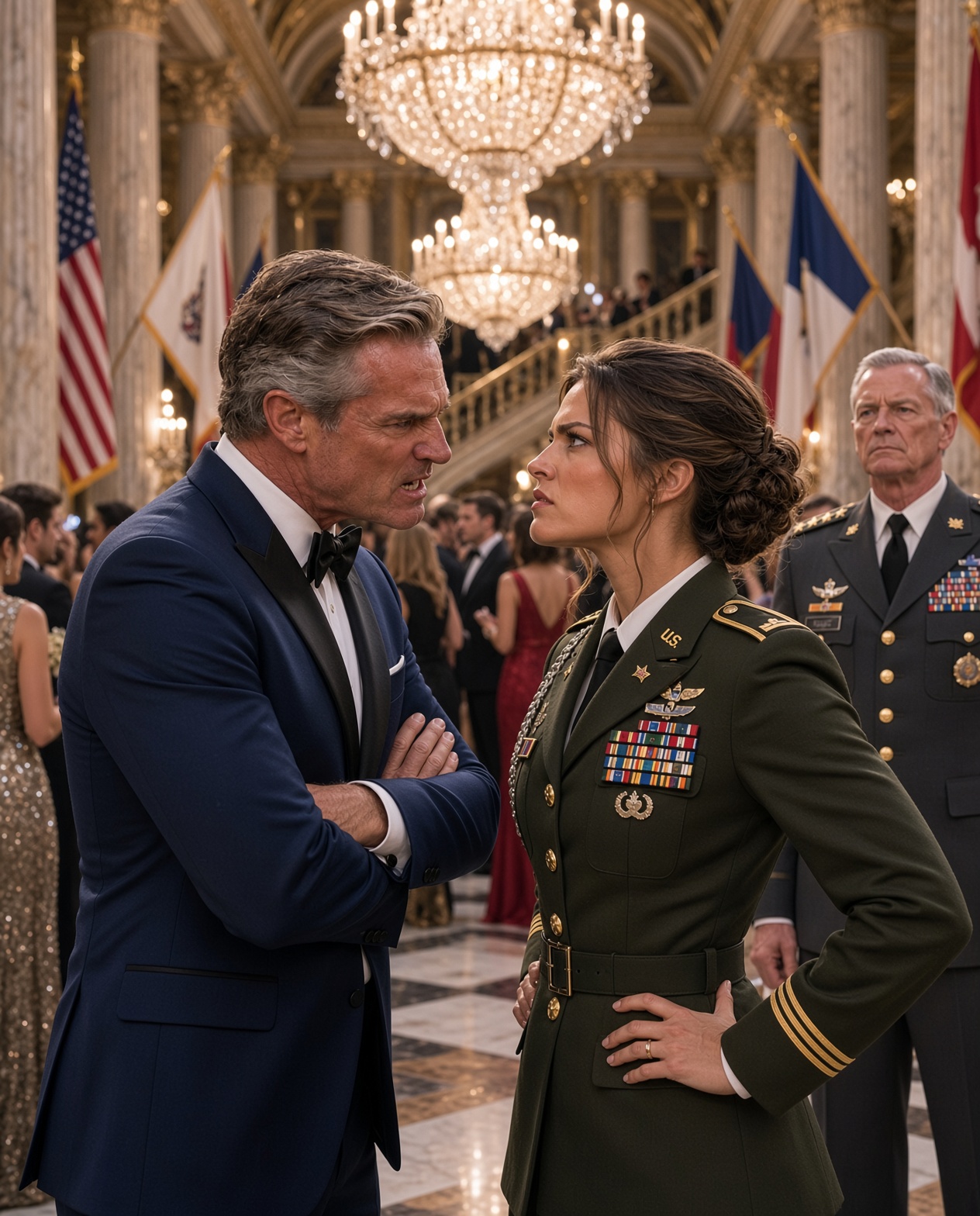
Behind him stood Evelyn, his second wife, draped in pearls. She examined me with the disgust someone might show toward a stain on an expensive carpet.
“Kate?”
Arthur’s grip tightened.
His eyes darted toward the Secret Service personnel, the detection dogs, and the security scanners before returning to my uniform.
Recognition gave way to fury.
“What the hell are you doing here?”
“I’m here for the event, Arthur,” I answered evenly.
I looked pointedly at his hand gripping my arm.
After several uncomfortable seconds, he released me.
“The event?” Evelyn gave a sharp, mocking laugh, tightening her hold on Trevor. “Oh, Arthur, come on. She’s clearly part of security. Just look at her. Nothing more than an overpaid guard dog.”
My father studied me with cold disapproval.
Twenty-six years earlier, I had refused the life he had carefully designed for me.
He wanted me to attend Wharton, earn an MBA, and eventually occupy an executive office at Mercer Defense Tech.
Instead, I accepted an ROTC scholarship.
To Arthur Mercer, that decision was unforgivable.
He removed me from his will, installed Trevor as his successor, and began telling his wealthy friends that he no longer had a daughter.
“Now listen to me, and listen closely,” he whispered viciously.
He seized my elbow again and dragged me toward the shadow of a marble pillar.
The smell of expensive scotch accompanied every word.
“I spent fifty thousand dollars on these donor tickets. I came here to meet the Joint Chiefs and lock down an enormous DOD contract. I will not have some bottom-rank sentry destroying my reputation.”
“You have absolutely no idea what brought me here,” I replied.
My posture remained straight, and I kept my face carefully neutral.
“I know perfectly well that you’re a disappointment,” he snapped.
His finger jabbed my chest, landing directly above my military decorations.
“You abandoned an entire dynasty just to pretend to be a soldier crawling around in the dirt. And look at us now. I’m an invited VIP inside the White House, while you’re standing at the entrance inspecting ID badges. So listen carefully to what happens next. You step away, keep your mouth closed, and pretend you’ve never met us. Don’t talk to me. Don’t even glance in my direction. And under no circumstances will you humiliate me today.”
I was about to respond when a Secret Service agent near the main scanner shouted:
“Code Red verification! Clear the lane! Everyone stand down!”
Heavy security barriers slammed shut.
Alarmed murmurs spread among the wealthy guests waiting for admission. Trevor stumbled backward and nearly knocked over a stanchion.
Arthur puffed out his chest, visibly irritated that his important arrival had been interrupted.
Then the massive oak doors opened.
A senior military officer emerged, surrounded by four armed security personnel.
His uniform carried an impressive array of decorations.
Four polished silver stars gleamed on his shoulders.
General Thomas Vance.
A serving member of the Joint Chiefs of Staff.
Arthur’s annoyance disappeared.
In its place came the broad, ingratiating smile he used whenever he encountered someone more powerful than himself.
He pushed toward the front, ignoring the Secret Service agent attempting to maintain the line.
“Ah! General Vance!” he called, stretching out his hand. “Arthur Mercer, Mercer Tech! What an extraordinary honor to have you come all this way to welcome me personally!”
General Vance continued walking.
He passed my father’s extended hand without acknowledging it.
His attention remained fixed on me.
As he approached, the stern expression on his face relaxed into a faint smile.
He stopped directly in front of me.
“General Mercer,” he announced, his voice carrying across the entire checkpoint. “The President has asked for you twice in the last ten minutes. Are you trying to get me fired in my final year?”
The entire entrance fell silent.
Even the breathing of a detection dog near the scanner seemed unusually loud.
I snapped to attention.
“My apologies, sir. I wanted to walk in through the front door like everyone else.”
“Of course you did.”
Vance shook his head and offered his hand.
I accepted it.
Nineteen years earlier, that same steady hand had hauled me out of a flooded ditch in Kandahar. I had been a young captain, and Vance had been a colonel who refused to abandon anyone under his command.
“You never could take the easy door, Kate.”
Behind him, Evelyn made a strangled noise.
“General?” she managed. “There must be some mistake. She’s… she’s security.”
A Secret Service agent with graying temples stepped forward. His identification plate read HALE.
He looked deeply embarrassed.
“Ma’am,” he addressed me, ignoring Evelyn, “my sincere apologies. We were told you’d be arriving through the South Grounds with the official party. If I’d known you were in the public line—”
“You did your job perfectly, Agent Hale,” I assured him. “Everyone in this line went through the same scanner. That’s exactly how it should be.”
Then I turned toward my father.
Arthur had never bothered learning anything about military uniforms.
To him, everyone serving in the Army belonged to one indistinguishable group of people who simply followed orders.
He had looked at my dress blues and assumed I was a security guard.
He had failed to recognize the two silver stars on my shoulders.
He had overlooked the Ranger tab, the combat patch, and the Bronze Star with “V” device positioned above my heart.
The very spot he had jabbed with his finger moments earlier.
Now his gaze traveled across those decorations.
His expression slowly collapsed.
“Mr. Mercer,” Vance said, finally acknowledging him. His tone became noticeably colder. “You’re the Aegis bid, aren’t you?”
“Yes. Yes, sir.”
Arthur recovered quickly.
Years of corporate negotiations had taught him how to conceal panic behind a smile.
“And General Mercer here, well, she’s my daughter. My Katie. We’re very proud.”
Trevor appeared to choke on his own breath.
I met Arthur’s eyes.
“Twenty seconds ago you asked me to pretend I’d never met you, Arthur,” I said softly. “I’m a woman of my word. I’d hate to disappoint you twice.”
Then I turned away and entered the White House beside General Vance.
Inside, the corridors smelled faintly of lilies and freshly polished floors.
Vance’s security detail surrounded us.
We walked in silence until he finally spoke.
“That was your father.”
“That was my father.”
“I read your file when you made colonel. ‘No living family listed.’ I assumed…”
“Everyone assumes,” I replied without looking away from the corridor ahead. “He’s alive. He just stopped being mine.”
Vance gave a low grunt.
Then his tone became serious.
“You know what today is for.”
I knew.
In twenty minutes, the President would present me with the Distinguished Service Medal for my leadership during the defense of Outpost Sentinel.
He would also announce my nomination for a third star and command of the newly established Joint Counter-Drone Task Force.
If the Senate confirmed me, I would have final recommendation authority over a $4.2 billion defense contract.
The system was called Aegis Shield.
And one of the competing companies was Mercer Defense Tech.
My father’s corporation.
“You knew his company was in the running,” Vance observed.
“I’ve known for six weeks. I filed a conflict-of-interest disclosure with the General Counsel the same day,” I answered. “I didn’t hide anything, sir.”
“I know. That’s why I’m comfortable.”
He paused before we reached the next hallway.
“But Washington doesn’t care what’s true, Kate. It cares what it can print. Be careful.”
Outside the East Room, my aide was waiting.
Captain Daniel Ortiz was thirty-one, exceptionally capable, and the only person I trusted to keep my chaotic schedule under control.
Today, however, he looked unusually pale.
“Ma’am,” he said, approaching while Vance went to greet several senators. “Your guests are seated. Mrs. Turner and Noah are in the front row.”
My chest tightened.
Lena Turner.
The widow of Sergeant First Class Eli Turner.
Eighteen months earlier, Eli had died at Outpost Sentinel while protecting three fellow soldiers with his own body.
His son Noah was only nine.
I had personally invited them because the medal I was about to receive belonged to Eli as much as it belonged to me.
“Good,” I said. “What else? You look like you’ve seen a ghost.”
Daniel leaned closer.
“Ma’am, there’s a woman here with the Mercer Defense Tech delegation. Engineer. She cornered me by the coat check.”
He hesitated.
“She said to tell you the counter-drone system that failed at Outpost Sentinel—the one that got Sergeant Turner killed—wasn’t a foreign knockoff like the after-action report said.”
I felt my entire body become still.
“Then what was it?”
Daniel swallowed.
“She says it was theirs, ma’am. Mercer’s. And she says she can prove it.”
The words struck harder than anything my father had said outside.
Outpost Sentinel had been a remote desert installation surrounded by concrete barriers and protective fortifications.
Two hundred and twelve soldiers had served under my command.
At 0347 on a March morning, eleven explosive drones approached from the east.
Our counter-drone jammer should have disrupted their signals before they reached us.
Instead, the equipment flickered, restarted, and shut down.
Seven drones penetrated our defenses.
Eli Turner saw one descending toward a bunker occupied by three sleeping privates.
He ran toward the danger rather than away from it.
The three soldiers survived.
Eli returned home beneath an American flag.
The official investigation blamed a counterfeit jammer supplied through Halcyon Ridge Systems, a subcontractor suspected of providing equipment of foreign origin.
For eighteen months, Lena had lived without knowing who had supplied the defective machine.
Now someone was claiming that my father’s company was responsible.
Before I could ask Daniel another question, the ceremony began.
“Ladies and gentlemen,” the announcer declared, “the President of the United States.”
The East Room filled with applause.
I entered beneath the chandeliers and saw Noah in the front row.
His navy blazer was far too large for him.
He waved enthusiastically until Lena gently lowered his arm.
I forced myself to breathe.
The ceremony proceeded with practiced solemnity.
The President spoke about courage, duty, and the soldiers who had defended Sentinel.
When he mentioned Eli Turner, Lena covered her mouth.
After placing the medal around my neck, he handed me the microphone.
I had prepared a speech.
I abandoned it.
“My grandfather, Sergeant Walter Mercer, came home from Vietnam with a Bronze Star and wounds nobody could see,” I began. “My family didn’t know how to talk about him. So they stopped. I joined the Army partly because I wanted to understand the man nobody would talk about. What I found was people like Eli Turner. This medal is his. I’m just the one who gets to wear it.”
At the back of the room, my father visibly flinched.
Despite spending fifty thousand dollars on donor tickets, he hadn’t secured a front-row seat.
After the ceremony, the room filled with conversations and champagne glasses.
Noah rushed toward me and wrapped his arms around my waist.
“Mom says you knew my dad really good,” he murmured against my uniform.
I knelt beside him.
“I knew him really well,” I told him. “He was the bravest man on that base. And he talked about you every single day. Every day, Noah.”
Lena watched us through tears.
She wasn’t looking at me with anger.
Somehow, her forgiveness felt heavier than blame.
“Well. If it isn’t the general who never calls.”
I turned toward the familiar voice.
Colonel Sam Whitaker stood behind me.
He was a trauma surgeon at Walter Reed, broad-shouldered, with gray beginning to spread through his beard.
He had served at Sentinel and spent forty minutes trying to save Eli after the attack.
“You came,” I said.
“Wouldn’t miss it.”
He smiled, then glanced over my shoulder.
“Though I think someone else has been waiting to talk to you. Man in the Italian suit. He’s been circling like a shark that forgot how to swim.”
Arthur approached moments later.
Evelyn and Trevor remained several steps behind him.
“Kate.”
His voice had changed completely.
Gone was the venom from the checkpoint.
Now he sounded like a businessman trying to rescue a negotiation.
“That was a moving speech. Very moving. Listen, let’s not be foolish about the past. Family is family. You’re going to be overseeing counter-drone procurement, and Aegis is the finest system on the market. The two of us—”
“Arthur,” I interrupted calmly. “My recommendation on Aegis will be based on test data. Nothing else. Not you, not me, not twenty-six years.”
His smile tightened.
“Then I have nothing to worry about. Our data is flawless.”
“I’m glad to hear it.”
He turned away.
Almost immediately, a slim woman wearing a simple black dress stepped out from behind Evelyn.
She appeared to be around forty, with exhausted eyes and a Mercer Defense Tech identification badge.
“Dr. Priya Nair,” she introduced herself. “Chief test engineer. Congratulations, General.”
She extended her hand.
As I shook it, something small and solid slipped into my palm.
“Not here,” she whispered while maintaining a pleasant expression. “Tonight. Eleven o’clock. Lincoln Memorial, north side. Come alone, please.”
She disappeared into the crowd.
I opened my hand just enough to identify the object.
A flash drive.
Across the room, Trevor stood motionless near a marble fireplace.
He had a phone pressed against his ear.
And he was watching me.
At eleven that evening, I arrived at the Lincoln Memorial wearing jeans and a dark jacket.
Daniel remained nearby in a car on Henry Bacon Drive.
Priya had requested that I come alone.
She had not asked me to abandon common sense.
She waited beside a pillar on the northern side, hugging herself against the night air.
“You came,” she said.
“You said you could prove who killed one of my soldiers. I’d have come if you’d said Antarctica.”
A nervous laugh escaped her.
She removed a tablet from her bag.
“Did you look at the drive?”
“Not yet. I wanted to hear it from you first.”
Priya inhaled deeply.
“Aegis Shield is built on a core jamming module we call Sentry-3. Three years ago, Sentry-3 failed Army qualification testing. It overheated and rebooted under sustained load. Classic thermal cascade. It needed a redesign. Eighteen months, maybe two years.”
“But it didn’t get one.”
“No. Trevor didn’t want to wait. He’d promised investors revenue. So the early units were sold anyway, through a company called Halcyon Ridge Systems, so Mercer’s name wouldn’t be on the paperwork.”
My stomach tightened.
“Halcyon Ridge supplied the jammer at Sentinel.”
“I know.”
Her voice trembled.
“I read the after-action report. ‘Likely of foreign origin.’ It wasn’t foreign, General. It was ours. It was a Sentry-3. It did exactly what I warned them it would do. It got hot, it rebooted, and it took ninety seconds to come back online.”
Ninety seconds.
Eli Turner had survived less than twenty.
I forced myself to remain composed.
“And Aegis?”
“Aegis still runs on Sentry-3. Same thermal flaw, prettier box. The testing data submitted to the Pentagon claims a ninety-four percent intercept rate.”
She turned the tablet toward me.
“This is the real data. Sixty-one percent. Under sustained swarm conditions, it drops to forty.”
I studied the figures.
“Who changed the numbers?”
“Trevor ordered it. I refused. My deputy did it instead and got a promotion.”
She displayed another file.
“But that’s not the part I’m scared of. Every falsified report, every Halcyon sale, every approval… they’re all signed with your father’s digital signature.”
On the screen appeared a name I knew better than almost any other.
ARTHUR J. MERCER, CEO.
APPROVED.
I stared at it.
For twenty-six years, I had considered my father cruel, arrogant, and incapable of accepting anyone who challenged him.
But I had never imagined he could knowingly sacrifice soldiers to protect his company’s profits.
A small part of me still remembered him teaching me to ride a bicycle along our driveway in Great Falls.
That memory resisted what the evidence suggested.
“Why come to me?” I asked. “Why not the Inspector General? The press?”
“I tried the IG hotline fourteen months ago. Two weeks later, my security clearance was flagged for ‘review’ and my office was moved to the basement.”
Her hands shook.
“Somebody has a friend somewhere. You’re the first person I’ve seen who has more power than they do and doesn’t owe them anything.”
Her phone vibrated.
She checked the message.
Her face drained of color.
She showed me the screen.
Nice night for a walk. Say hi to the General.
I immediately reached for my phone.
“Daniel,” I ordered. “Bring the car up. Now.”
Thirty seconds later, we were leaving the memorial.
A gray sedan followed us for several blocks.
Daniel made three rapid turns through Foggy Bottom before we lost it.
“Where are we going?” Priya asked.
“Somewhere with locks and a doctor.”
I dialed another number.
“Sam? I need a favor. A big one.”
Sam opened the door of his brick rowhouse near Walter Reed wearing a Navy sweatshirt.
He didn’t ask unnecessary questions.
He made tea, offered Priya the guest bedroom, and joined me at the kitchen table.
I called a number I had hoped never to need.
“Special Agent Rosa Delgado, Defense Criminal Investigative Service,” a woman answered.
“This is Major General Katherine Mercer. I need to report fraud against the United States and a possible cover-up in the death of a soldier under my command. And Agent Delgado, I have a personal conflict you should know about immediately. The CEO of the company involved is my father.”
Silence followed.
“Then I’m going to need you to touch nothing, General. Bring me everything at six a.m.”
Meanwhile, Daniel examined the flash drive.
When I ended the call, he was staring at his laptop.
“Ma’am,” he said. “Halcyon Ridge Systems. I found the ownership filing in Delaware. It’s buried under two holding companies, but there’s one name on the original registration.”
“Who?”
“A man named Graham Pike.”
He turned the laptop toward me.
“And there’s a wire transfer memo from last spring. Two point six million dollars out of Halcyon Ridge. The beneficiary account is in the name of Evelyn Mercer.”
My father’s signature appeared on the approvals.
His wife’s name appeared on the money.
And somewhere between those two pieces of evidence lay the truth about the machine that had killed Eli Turner.
But I had no idea that exposing it would soon threaten everything I had spent twenty-six years building.
PART 2 — THE BETRAYAL BEHIND THE EMPIRE
At precisely six the following morning, I delivered Priya’s flash drive to Special Agent Rosa Delgado in a windowless conference room in Alexandria.
Delgado was a woman in her fifties, meticulous and composed, with reading glasses suspended from a beaded chain.
She listened without interrupting while I explained the falsified testing records, the Halcyon transactions, and the death of Sergeant Turner.
“You understand what happens now,” she said.
“I recuse myself from every decision touching Aegis, Mercer, or Halcyon,” I answered. “I’ve already drafted the memo.”
She regarded me carefully.
“Most people in your position would have deleted that drive and called their lawyer, General. It’s your family.”
“It was my soldier first.”
Before lunchtime, General Vance had approved my recusal.
He examined the document twice before removing his glasses.
“They’re going to come after you, Kate,” he warned. “Mercer has eleven lobbyists on the Hill and friends on the Armed Services Committee. Your confirmation hearing is in sixteen days. If they can’t kill the investigation, they’ll try to kill your credibility.”
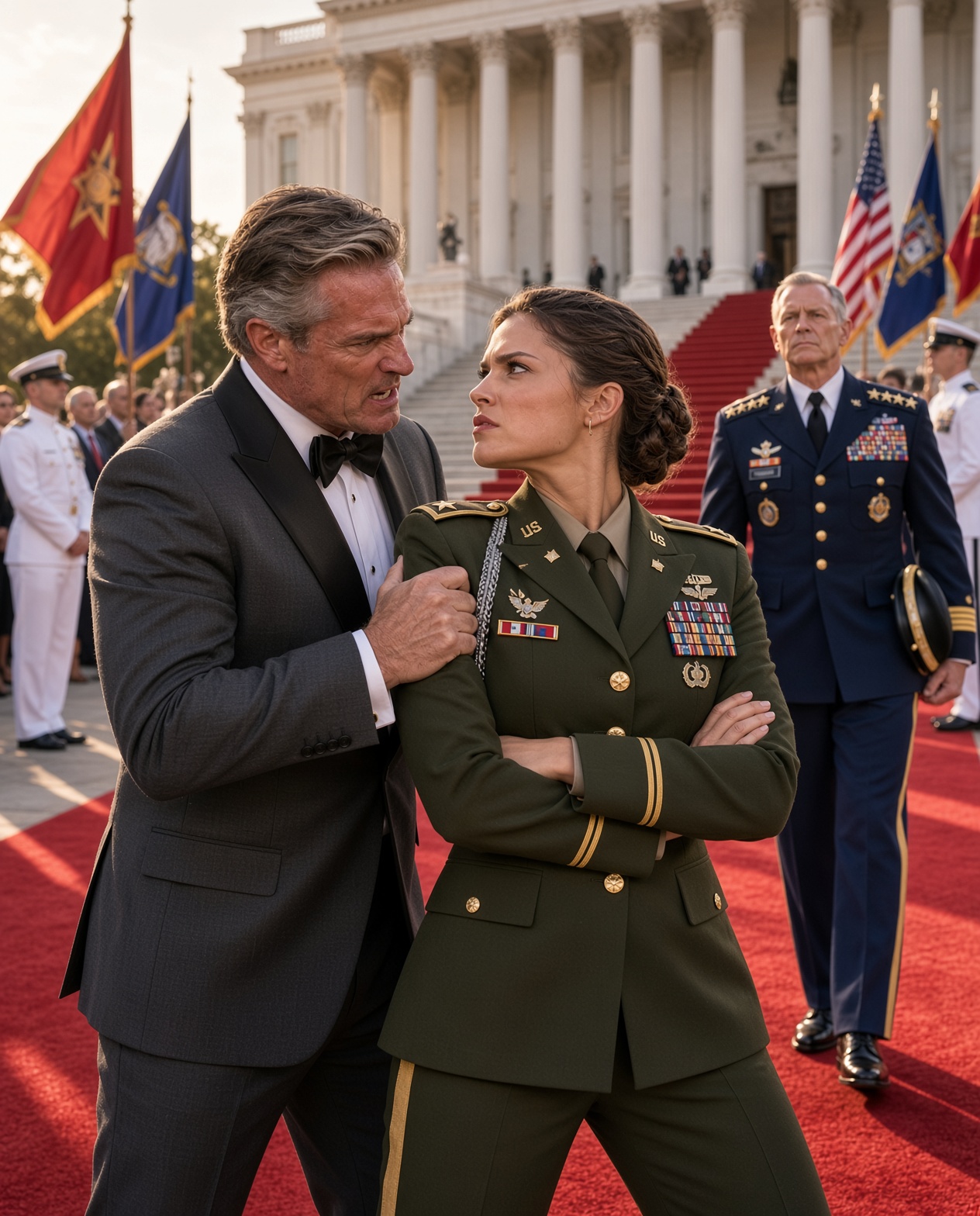
His prediction proved accurate almost immediately.
The next morning, a political news website published a story accusing me of concealing my connection to Mercer Defense Tech.
The headline read:
NEW COUNTER-DRONE CHIEF HIDES TIES TO FATHER’S DEFENSE GIANT.
Anonymous sources close to the Mercer family claimed I was exploiting my new authority to punish my father over an old personal grievance.
The article conveniently ignored the conflict-of-interest disclosure I had filed weeks earlier and my formal recusal.
Daniel paced angrily through my office.
“How did they get this so fast?” he demanded. “Someone fed it to them last night.”
“Someone who knew I’d report it,” I said, folding the printed article. “Which means someone knew Priya came to me.”
That evening, I returned to my quarters at Joint Base Myer–Henderson Hall.
A white Bentley was parked outside my modest brick duplex.
Evelyn Mercer stood beside it in an elegant camel coat.
“Hello, Katherine,” she greeted me. “We should talk like adults.”
I refused to invite her inside.
We remained on the walkway beneath the porch light.
“Your little complaint,” she began, “is going to destroy a company that employs four thousand people. It’s going to destroy your father. Is that what you want? Revenge for being cut out of the will?”
“I don’t want the money, Evelyn. I never did.”
“No. You want something else.”
She opened her handbag.
Then she removed an old envelope.
The sight of the handwriting stopped my breath.
I recognized those graceful, looping letters immediately.
My mother had written that way on birthday cards, shopping lists, and the little notes she tucked into my school lunches.
Across the envelope were the words:
To Katie, when she’s grown.
“Your mother wrote eleven of these in the hospital before she died,” Evelyn said. “One for each birthday she knew she’d miss. Arthur never gave them to you. He kept them in his safe for thirty-two years. I found them.”
I had been sixteen when my mother died.
Once, I asked Arthur whether she had left anything for me.
He told me she hadn’t.
He claimed she had been too ill.
“Withdraw the complaint,” Evelyn demanded. “Tell your investigator the engineer is a disgruntled employee with a grudge. And I’ll give you all eleven.”
For one terrible moment, I wanted to agree.
I wanted those letters more than I had wanted anything in decades.
Then I remembered Noah Turner wearing his oversized blazer.
“My mother,” I answered, “would never forgive me for buying her words with a soldier’s life. Get off my property, Evelyn.”
Her expression hardened.
“You’re exactly like him, you know. Stubborn, proud, and alone.”
She dropped the envelope onto my doorstep.
“Keep that one. Think about the other ten.”
The Bentley drove away.
I remained on the steps for a long time before opening the letter.
It was dated one week before my mother’s death.
Her handwriting was unsteady, but I could hear her voice in every sentence.
Katie, my brave girl. By the time you read this you’ll have figured out a lot of things on your own. But there’s something I need you to know, because I don’t think your father will ever tell you. He’s going to make the Army sound like the enemy. Please don’t believe him.
Your father isn’t the man you think he is, sweetheart. And Walter isn’t the man your father thinks he was. Ask him about the letters in the blue box. Ask him why he never opened them.
The following evening, I drove to Great Falls.
I hadn’t traveled up that gravel driveway in twenty-six years.
The oak trees had grown taller.
The enormous stone house overlooking the Potomac somehow appeared smaller than I remembered.
It was nearly ten o’clock.
A housekeeper I didn’t recognize informed me that Evelyn and Trevor were in New York.
Arthur was in his study.
I found him behind the same walnut desk where he had rejected my decision to join the Army.
A glass of scotch stood beside him.
Firelight cast shadows across the shelves.
He glanced up without appearing surprised.
“Come to arrest me, General?”
“I came to ask you about a blue box.”
His expression froze.
Then he gave a bitter laugh.
“Evelyn’s been talking to you.”
“Evelyn tried to bribe me with Mom’s letters.”
I placed the envelope on his desk.
“You told me she didn’t leave anything. I was sixteen, Dad. I asked you, and you looked me in the eye and lied.”
The word Dad hung between us.
I hadn’t called him that in more than two decades.
He picked up the envelope.
His fingers trembled slightly as he read.
“She took your side,” he murmured. “Even dying, she took your side. She knew you wanted the Army. She knew, and she encouraged it. And I couldn’t… I couldn’t let her take you away from me from the grave.”
“So you took her away from me instead.”
He said nothing.
I placed Priya’s tablet on the desk.
One by one, I showed him the original test results, the falsified numbers, the Halcyon documents, and the approvals bearing his signature.
I explained the jammer’s ninety-second failure.
Then I described Eli Turner running toward the bunker.
My father had always seemed indestructible.
That night, I watched his composure begin to fracture.
“I didn’t know,” he whispered. “Kate, I swear to God. I sign two hundred documents a week. Trevor runs the Sentry program. Evelyn handles the board. They bring me summaries, I sign. I didn’t know about Halcyon. I didn’t know a soldier…”
His voice failed.
He covered his mouth.
“Your name is on all of it,” I reminded him. “That’s what you need to understand. Whether you knew or not, your name is the one they’re going to put in front of a jury.”
He rose abruptly.
Crossing to a bookshelf, he removed several false leather-bound volumes, exposing a hidden safe.
He entered the combination.
Then he went still.
“They’re gone,” he whispered. “Margaret’s letters. They were here. Right here. Next to…”
He reached inside and removed a battered cardboard box.
Its once-bright blue surface had faded with age.
“Next to these.”
He placed it between us.
“These are my father’s,” he explained. “Walter’s. My mother threw him out when I was fourteen. He drank. He woke up screaming. He broke a window once, during a thunderstorm. She told me he’d chosen the bottle over us, and I believed her. I hated him. When he died in a VA hospital in Richmond, I didn’t go to the funeral.”
He lifted the lid.
Dozens of envelopes lay inside.
Every one was addressed to Arthur Mercer in careful block lettering.
None had been opened.
“He wrote to me for nine years,” Arthur continued. “Every month. My mother kept them from me. I found them after she died, when I was already thirty and running my first company. And I couldn’t open them. I was afraid of what they’d say. That he’d hated me. Or that he hadn’t.”
His voice broke.
“The Army took my father and sent back a stranger, Kate. And then it took my daughter. I made the Army my enemy because it was easier than admitting I was the one who walked away from both of you.”
We sat in silence while the fire slowly burned down.
Eventually, I picked up the earliest envelope.
It was postmarked 1969.
I held it out.
“Then open it now.”
Arthur accepted it.
His hands shook too much to tear the flap.
I opened it for him.
Before he could read the letter, his phone began vibrating.
One notification followed another.
He checked the screen.
The color disappeared from his face.
“What is it?” I asked.
“An emergency board meeting,” he replied numbly. “In New York. Tonight. Evelyn called it.”
He showed me the announcement.
Mercer Defense Tech’s board had unanimously removed Arthur J. Mercer as CEO following allegations of financial irregularities.
Trevor had been appointed interim chief executive.
The company announced its cooperation with federal investigators.
The next morning, I read the statement repeatedly.
Evelyn had prepared this long before the investigation began.
Every misleading document and concealed transaction had been positioned to implicate Arthur.
Rosa Delgado agreed to meet us at a diner off Route 7.
My father arrived unshaven, wearing a wrinkled shirt.
He looked a decade older.
“I want to cooperate,” he told her. “Fully. Whatever you need.”
Delgado studied him.
“Mr. Mercer, I’m going to be honest. Right now the paper trail says you’re the one who did this.”
“I know.”
“And your wife has already given us a statement, through her attorneys, saying you personally directed the Halcyon sales over her objections.”
He closed his eyes.
“I know that too.”
Delgado opened another folder.
“There’s something else.”
She looked at me.
“General, you may want to be here for this.”
Inside were years of financial records.
Graham Pike, the registered owner of Halcyon Ridge, had paid Trevor’s private-school tuition, college expenses, and the down payment on his Manhattan apartment.
There were also personal emails between Pike and Evelyn dating back nearly thirty years.
One message, written when Trevor turned twenty-one, read:
He has your eyes more every year. Our son is going to inherit an empire, Graham. Be patient.
Arthur read it several times.
Then he placed it carefully on the table.
“I married her when Kate was eighteen,” he murmured. “Trevor came eleven months later. Premature, they told me.”
A hollow laugh escaped him.
“I disowned my own daughter. I wrote her out of everything. I gave it all to a boy who isn’t mine, raised by a woman who was building a trap around me the whole time.”
His eyes filled with tears.
“I threw away the only real thing I had.”
I had imagined confronting him for twenty-six years.
Yet there was no satisfaction in watching him collapse.
Only exhaustion and sadness.
Delgado leaned forward.
“Pike and Evelyn are the ones we want,” she explained. “But right now, all we have is paper, and paper can be argued. We need them on tape, admitting what they did.”
“Then put a wire on me,” Arthur answered immediately.
“Mr. Mercer—”
“There’s a Mercer Foundation gala on Friday at the Willard. It’s been on the calendar for a year. Evelyn won’t cancel it; it would look like guilt. Pike will be there. He’s always there.”
His expression hardened.
“Let me walk in like a beaten man begging for a deal. Evelyn has never once in thirty years believed I could outthink her. Let’s use that.”
Later, Sam drove me back to my quarters.
He made coffee while I reread my mother’s letter.
“You don’t have to talk about it,” he said.
“She wrote this when she was dying,” I replied. “And she was still worried about him. Not just me. Him.”
I read the final paragraph aloud.
Your father loves you in the only language he ever learned, which is control. Don’t let him make you small, Katie. But don’t let his smallness make you hard, either. Somebody in this family has to be brave enough to be soft.
Sam remained quiet.
Then he said, “That’s the kind of thing you read at a funeral. Or a wedding.”
I noticed the faint pink rising above his beard.
“Sam Whitaker,” I asked, “Are you flirting with me during a federal investigation?”
“I tried to flirt with you during a drone attack. You told me to put pressure on a femoral artery.”
He smiled.
“I figured this was an improvement.”
For the first time in days, I laughed.
Then my phone rang.
Priya.
Her voice shook.
“General. Trevor just called me. On my personal phone.”
She paused.
“He wants to meet. Alone. Tonight. He says Pike is going to kill the whole company and he’s scared. He says…”
Her voice became a whisper.
“He says he’s scared of his own mother.”
We arranged the meeting at a twenty-four-hour diner in Arlington.
Priya did not go unprotected.
Delgado positioned agents in nearby booths.
Daniel waited at the counter.
I sat opposite Trevor.
Without his expensive tuxedo and arrogant attitude, he looked much younger than twenty-nine.
His leg bounced beneath the table.
“I didn’t know about the soldier,” he said immediately. “I swear. I knew the jammer had issues, everyone knew, but Graham said they’d go to a training base. Practice units. I didn’t know they went to a combat outpost until after.”
He looked at me desperately.
“When I read about Sergeant Turner, I threw up in my office.”
“And then you falsified the Aegis data,” I replied.
He flinched.
“Mom said if Aegis failed, the whole company would collapse and Dad would go to prison for Halcyon. She said the only way to protect him was to win the contract and bury the old units under the new revenue.”
He laughed bitterly.
“Protect him. She’s been setting him up the entire time, hasn’t she? And I helped her.”
“Why call Priya now?” Delgado asked.
Trevor leaned forward.
“Because Graham is planning something bigger. He’s got a buyer for the full Sentry-3 design package. A broker in Dubai, fronting for someone none of us want to know. The files go Saturday, the morning after the gala. Mom thinks the money is their exit.”
He wiped his face.
“I’m not a good person, Kate. I know that. But I’m not going to help sell our military’s secrets to God knows who.”
It was the first time Trevor had ever addressed me by my name.
On Friday evening, the Willard InterContinental sparkled with chandeliers, expensive jewelry, and Washington’s political elite.
Arthur entered alone.
A recording device was concealed beneath his collar.
I monitored the operation from a surveillance van on F Street beside Delgado.
Through the headset, I could hear his heartbeat.
He approached Evelyn near the bar.
“Arthur. I didn’t think you’d have the nerve,” she said.
“I came to make a deal,” he replied, sounding exhausted and defeated. “You’ve won. I know it. I just want to avoid prison. Tell me what you need.”
Graham Pike joined them.
“What we need, Arthur, is for you to keep doing what you’ve always done. Sign where we tell you.”
He laughed.
“Every Halcyon document has your signature. Every falsified report. You’re the face of it. You plead guilty, you take eight years in a minimum-security facility, and your son keeps the company.”
“My son,” Arthur answered.
Silence followed.
Then Arthur asked:
“And the Sentry files? The buyer. Saturday.”
Evelyn’s voice sharpened.
“Who told you about Saturday?”
I heard footsteps and fabric moving against the microphone.
Then Evelyn spoke directly beside the recording device.
“Oh, Arthur. You never could keep your collar straight.”
Static exploded through the headset.
The transmission died.
Delgado immediately ordered her agents inside.
By the time they reached the ballroom, Pike had escaped through a service corridor.
Evelyn stood beside her attorney, calmly holding champagne.
Arthur sat alone at the bar with his collar torn open.
“She knew,” he whispered when I reached him. “She felt it the second she hugged me. Kate, I’m so sorry.”
“You did everything right,” I assured him. “We have Pike on tape admitting—”
“General Mercer.”
I turned.
Delgado stood in the doorway.
Her expression made my stomach sink.
“Evelyn Mercer’s attorney just delivered a package to the Washington Post and to my supervisor,” she said. “Bank records. Two years ago, a Delaware account in your name received two million dollars from Halcyon Ridge Systems.”
She paused.
“The story is that you were paid off, and the whistleblowing is a cover for a deal gone bad.”
“That’s a lie.”
“I believe you,” she replied. “But until we prove it, the Pentagon has suspended your nomination, and I’m required to ask you for something I really don’t want to ask for.”
She extended her hand.
“I’m going to need your passport, General.”
For the first time in my military career, I faced the possibility of losing everything.
My promotion.
My reputation.
My ability to honor the soldier who had died under my command.
And the woman responsible had just made me look like the criminal.
PART 3 — THE TRUTH THAT BROUGHT US HOME
On Monday morning, I entered the Pentagon knowing that my name had become a scandal.
The previous week, officers had saluted me proudly.
Now many avoided eye contact.
Some suddenly became fascinated with their phones as I passed.
The headline appeared everywhere:
DECORATED GENERAL TOOK $2 MILLION FROM DEFENSE FIRM AT CENTER OF SOLDIER’S DEATH.
Lena Turner’s name appeared in the article.
That was the part I could barely endure.
I could accept losing my promotion.
I could survive public humiliation.
But imagining Lena reading those accusations while Noah ate breakfast was almost unbearable.
General Vance met me in the corridor.
He couldn’t overturn the suspension.
He didn’t pretend otherwise.
Instead, he walked beside me through the Pentagon’s E-Ring, making certain everyone saw his four stars alongside my two.
At my office door, he shook my hand.
“Twenty-six years,” he said loudly. “I’ve never seen you take the easy door once. I’m not going to start doubting you now.”
That evening, Lena called.
I nearly let the phone ring unanswered.
“I read it,” she began. “Kate, I want you to know something. Eli wrote me a letter every week from Sentinel. Every week, he mentioned you. He said you walked the perimeter every night yourself because you didn’t trust anyone else to check on his guys. A woman like that doesn’t take money to cover up their deaths.”
Her voice grew stronger.
“Tell me what you need. I’ll say it to anyone.”
After the call, I sat on my kitchen floor and cried.
It was the first time I had allowed myself to break down since Sentinel.
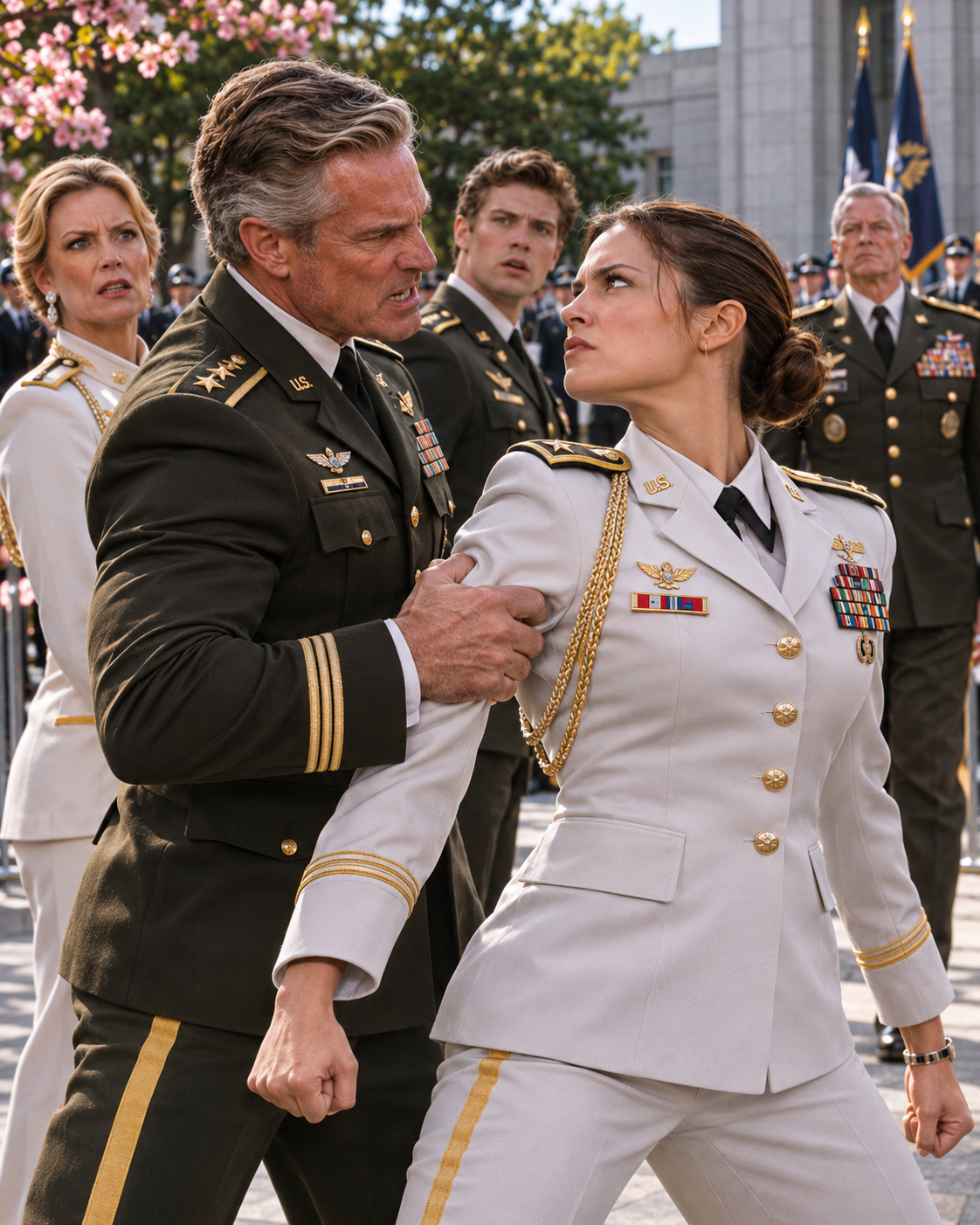
Then I stood up.
There was work to do.
Daniel and Priya had transformed Sam’s dining room into an improvised investigation center.
Documents covered the walls.
Laptops filled the table.
Coffee cups occupied every available space.
Sam kept everyone fed and had long since stopped concealing his feelings for me.
Daniel examined the Delaware bank records.
“The account was opened at a bank branch in Wilmington,” he explained. “In-person opening. Signature card, notarized, with your Social Security number and a copy of your old passport.”
“Where would they get my Social Security number?”
“The Mercer family trust,” Arthur answered from the doorway.
He had been staying in a hotel to avoid reporters but visited every evening, quietly helping with photocopies and paperwork.
“It was set up when you were born. Evelyn has had access to the trust files for—”
“What’s the date on the account opening?” I interrupted.
Daniel checked.
“March fourteenth, two years ago.”
I stopped moving.
Then I began laughing.
“Ma’am?”
“March fourteenth,” I repeated. “Two years ago, I was at Outpost Sentinel. I hadn’t left that base in four months. There’s a signed troop movement log, a satellite phone record, and two hundred and twelve soldiers who can testify I was standing in the desert eating a powdered-egg breakfast at the exact minute someone wearing my name signed a card in Delaware.”
Priya shouted with relief.
Daniel immediately began typing.
By midnight, forensic investigators had traced the account’s online activity to a laptop at the Great Falls residence.
Evelyn’s laptop.
The notary who certified the forged signature admitted receiving five thousand dollars from “a blonde woman in pearls” to stamp the paperwork without witnessing the signer.
Trevor then signed a full cooperation agreement.
He surrendered a hard drive containing two years of encrypted communications from Graham Pike, including information about the planned transfer of the Sentry-3 technology.
Nine days later, the Senate Armed Services Committee resumed my confirmation hearing.
I had requested the opportunity to address the accusations publicly under oath.
One senator, whose campaigns had received substantial contributions from Mercer Defense Tech, began with an extended attack disguised as a question.
Halfway through his remarks, the hearing-room doors opened.
Arthur Mercer entered.
He walked directly toward the witness table carrying a thick binder.
“Madam Chair, my name is Arthur Mercer. I founded Mercer Defense Tech. I would like to testify, under oath, voluntarily, about crimes committed under my signature. I’m told I may need a lawyer. I’ve decided I’d rather tell the truth first.”
The room erupted in whispers.
After a brief pause, the chairwoman administered the oath.
Arthur explained the Halcyon transactions, the Sentry-3 defects, the falsified testing results, and the fraudulent bank account.
He accepted responsibility for signing documents without examining them.
“I signed documents I didn’t read because I believed I was too important to read them,” he admitted. “A sergeant named Eli Turner died because of a system with my company’s name hidden behind someone else’s. I can’t give him back. I can only stop pretending I’m not responsible.”
Then he turned toward me.
“And twenty-six years ago, I disowned my daughter because she chose to serve this country. Last month, at the White House, I called her a mall cop and told her to pretend she didn’t know me.”
His voice cracked.
“She is the finest person I have ever known. Every word against her in that newspaper was planted by my wife. I’m asking this committee to judge her by her record, and to judge me by mine.”
I watched the man who had spent decades protecting his pride finally surrender it in front of the country.
Lena Turner testified afterward.
So did Priya Nair.
Late that afternoon, Delgado leaned forward from the row behind me and handed me her phone.
A field agent had sent a message.
Evelyn Mercer and Graham Pike just boarded a private jet at Dulles. Flight plan filed for Dubai. Carrying two hard-sided cases. Wheels up in forty minutes.
They never took off.
I remained in the Senate hearing room with Arthur beside me and Lena behind us.
Delgado placed her phone on speaker so we could follow the operation.
Two black SUVs crossed the taxiway at Dulles.
Agents from DCIS, Homeland Security Investigations, and the FBI boarded the aircraft.
Graham Pike was detained in the rear cabin.
Two hard-sided cases contained the complete Sentry-3 engineering package.
Evelyn was discovered in the front cabin, loudly insisting that the authorities had made a mistake and demanding to contact her senator.
I later heard that the senator declined her call.
The investigation continued for months.
Justice arrived slowly, without the drama of newspaper headlines.
Graham Pike was convicted of wire fraud, conspiracy to defraud the United States, and attempted illegal export of defense technology.
He received twenty-two years in federal prison.
Evelyn was convicted of fraud, identity theft, obstruction, and conspiracy.
Her sentence was fourteen years.
At her sentencing, the judge read from Eli Turner’s final letter home, which Lena had requested be included in the record.
Evelyn never lifted her eyes.
Trevor pleaded guilty to falsifying test data.
He received a three-year sentence, reduced because of his cooperation.
Before entering prison, he asked to meet Lena.
She agreed, provided I attended.
They sat opposite each other in a lawyer’s office.
Trevor offered no excuses.
He apologized and promised to spend his remaining years trying to become worthy of forgiveness.
Lena listened.
Then she said:
“My husband would have wanted you to be better. So be better.”
Nothing more was necessary.
Trevor began writing to Arthur every month from a correctional facility in West Virginia.
My father opened each letter as soon as it arrived.
Meanwhile, investigators recovered the remaining ten letters my mother had written.
Evelyn had concealed them in a New York safe deposit box.
A DCIS agent personally delivered them in an evidence bag.
I struggled not to cry while he stood awkwardly in my doorway.
For ten nights, I read one letter before bed.
The last had been written for my fortieth birthday.
That birthday had passed eight years earlier.
It read:
I hope you’re happy, Katie. I hope someone makes you laugh. I hope your father finally learned how to say he’s proud of you. If he hasn’t yet, give him time. He’s slower than you, but he gets there.
Mercer Defense Tech narrowly survived.
A federal monitor was appointed to oversee the company.
Priya Nair became its chief technology officer.
Over fourteen months, she completely redesigned the Sentry system.
When the new equipment finally underwent Army qualification testing, it achieved a ninety-seven percent interception rate under sustained drone-swarm conditions.
This time, the numbers were genuine.
Priya sent me the raw results.
Her message contained only two words.
For Eli.
The Aegis contract returned to open competition.
I remained completely removed from the procurement decision.
I never asked which company ultimately won.
Eleven weeks after the Senate hearing, my nomination was confirmed by a vote of ninety-four to three.
My promotion ceremony took place at Joint Base Myer on a bright, cold morning in early spring.
Traditionally, family members attach a general’s new stars.
I asked Noah Turner to pin the star on my right shoulder.
He practiced for an entire week.
When the moment arrived, he concentrated so fiercely that his tongue stuck out between his teeth.
The room laughed affectionately.
For my left shoulder, I chose my father.
Arthur approached slowly.
He had lost weight and resigned from every corporate board on which he served.
He had sold the Great Falls mansion.
Most of his fortune had been transferred into the Eli Turner Fund, which provided full college scholarships for children whose parents died during military service.
Noah was the fund’s first scholarship recipient.
Arthur had insisted.
His hands trembled as he struggled with the clasp.
“Hold still, soldier,” he muttered.
“I am holding still. You’re the one shaking.”
“I’m seventy-one. I’m allowed.”
He finally secured the star.
Then he stepped back.
For the first time since I was a little girl learning to ride a bicycle, my father looked at me without disappointment.
He raised his right hand.
His salute was terrible.
His elbow was incorrectly positioned, and his fingers weren’t properly aligned.
Yet it was the most beautiful salute I had ever received.
“Lieutenant General Mercer,” he said, fighting tears. “I’m proud of you. I should have said it twenty-six years ago. I’m going to keep saying it until you’re sick of hearing it.”
I leaned toward him.
“Mom said you’d get there,” I whispered. “She said you were just slower.”
He laughed through his tears.
“Your mother was always right. It was her most irritating quality.”
That afternoon, Arthur and I traveled to Arlington National Cemetery.
A request for Veterans Affairs records had revealed something neither of us knew.
Walter Mercer had been reinterred at Arlington in 1998 at the request of his former platoon.
My father had never been informed.
We walked between the endless rows of white headstones until we found his grave.
The inscription read:
SGT WALTER J MERCER
VIETNAM
BRONZE STAR
PURPLE HEART
Arthur carried the faded blue box.
During the preceding months, he had opened Walter’s letters one at a time, usually on Sundays.
Sometimes he read them aloud to me over the phone.
They weren’t letters from a man who had willingly abandoned his son.
They were written by a veteran struggling to recover from war.
Walter repeatedly asked whether Arthur had joined the baseball team, whether he was completing his schoolwork, and whether he might visit at Christmas.
My father knelt beside the grave.
He placed the final unopened letter against the headstone.
It had been mailed in 1978, one month before Walter died.
“I read all the others,” Arthur said softly. “I couldn’t read this one. I thought maybe you’d do it with me.”
I knelt beside him.
Together, we opened it.
Son, they tell me I don’t have long. I’m not writing to make you feel guilty. I’m writing to tell you that I’m proud of you, and that none of it was your fault. Not one bit. If you ever have children, tell them the truth about me. Tell them I was a soldier who got lost and spent the rest of his life trying to find his way home. And then love them louder than I was able to love you.
Arthur lowered his head onto his knees.
He cried for his father.
For my mother.
For the twenty-six years we had lost.
And for Eli Turner.
I held him as he wept.
When I was little, he had comforted me after nightmares.
Now, for the first time in decades, I could comfort him.
Thanksgiving arrived that November.
I hosted dinner at my quarters, although the house was far too small for everyone who came.
Lena and Noah arrived with a pie Noah had baked himself.
It contained considerably more crust than filling.
Priya brought her husband and twin daughters.
Daniel arrived with a girlfriend he had somehow managed to keep secret from me for months.
General Vance, now retired, spent much of the afternoon teaching Noah chess.
Arthur arrived an hour early.
He wore an apron borrowed from Sam.
After accidentally setting a kitchen towel on fire, he was promptly forbidden from helping with dinner.
And Sam was there.
Of course he was.
By then, he had become a permanent part of my life.
Sometime between the turkey and dessert, he reached beneath the table and took my hand.
When I looked at him, he placed a small velvet box beside my plate.
Every conversation stopped.
Noah whispered far too loudly:
“Is that a ring?”
I looked at Sam.
“Colonel Whitaker,” I asked, struggling to steady my voice. “Are you proposing to a lieutenant general in front of witnesses?”
He smiled.
“I tried to propose during a drone attack. You told me to apply pressure. I figured this was an improvement.”
I said yes.
There had never been any doubt.
My father stood at the head of the table.
Tears ran down his cheeks.
He raised his glass.
“To family,” he said. “Not the one you’re born into. The one that shows up.”
I looked around the crowded room.
At Lena and Noah.
At Priya, Daniel, and General Vance.
At Sam.
And finally, at Arthur Mercer.
The man who had once denied having a daughter was now standing among the people who had become my family, openly celebrating the life he had tried to prevent me from choosing.
Sometimes people ask what I would tell the young woman I was twenty-six years earlier.
The girl standing in her father’s study in Great Falls, holding an ROTC acceptance letter while he turned his back on her.
I know exactly what I would say.
Your value was never something another person had the power to remove.
Not your father.
Not his fortune.
Not a newspaper filled with lies.
Self-respect isn’t arrogance.
It’s the quiet determination to choose what is right, even when no one is watching and the cost seems unbearable.
And genuine love has nothing to do with control or inheritance.
It’s a sergeant rushing toward danger to save three sleeping soldiers.
It’s a widow who refuses to abandon her faith in you.
It’s a dying mother writing letters for birthdays she knows she will never see.
It’s an elderly man finally learning, at seventy-one, how to salute his daughter.
Coming home is still possible, no matter how many years have passed.
Sometimes the journey simply takes longer than anyone expected.
THE END
