

Part One: The Woman Who Stayed Kind
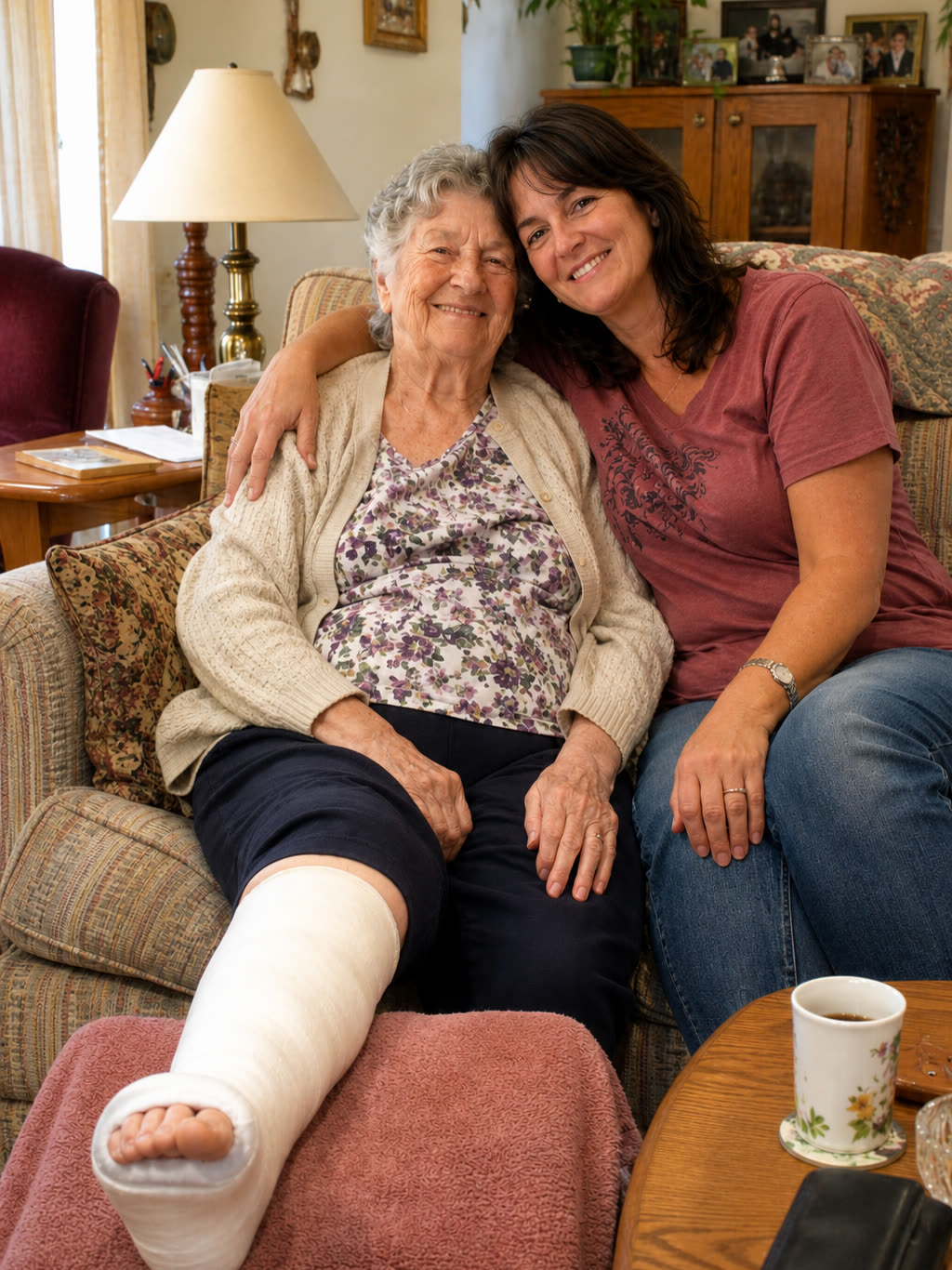
My ex-mother-in-law, Elora, was always kind to me, even after my marriage fell apart. That is the first thing you should know about her. Some women lose a son’s marriage and decide the wife was to blame. Elora Whitaker never did that. Not once.
Five years ago, I divorced her son, Shane, after discovering he had been having an affair. It was not dramatic. No screaming in the driveway, no thrown dishes. While doing laundry I found a receipt in his work jacket pocket: dinner for two at a steakhouse in downtown Grand Rapids, on a night he had told me he was at a job site in Holland.
Her name was Kayla. She was the office manager at his landscaping company. She was twenty-six.
When Elora found out, she drove to my house that very night. She sat at my kitchen table in her church coat, purse still on her lap, and cried harder than I did.
“I’m ashamed of what my son did to you,” she said. “You deserved so much better, Mara.”
I will never forget that. His own mother, at my table, saying it aloud. She still loved Shane, of course. He was her middle child, her only boy, raised alone after her husband died when Shane was ten. But she never defended what he did, not to me and, from what I heard, not to him.
We stayed close after the divorce. She called every few weeks, and sometimes we met for coffee at a little bakery in Eastown, where she bought a cinnamon roll and cut it in half to share. My one condition was that we never discuss Shane, his new wife, his business, or the lake house I heard he bought two years after we split. She respected that every single time.
And she never stopped being a grandmother to my daughter, Ivy. Ivy was four when Shane left and is nine now. She has my dark hair, Shane’s blue eyes, and a laugh exactly like her grandmother’s. “She laughs like me,” Elora would say. “Poor thing.”
Shane saw Ivy every other weekend, then monthly, then only on birthdays and Christmas when he remembered. He married Kayla, had a baby boy, and moved to a big house on a lake north of the city. Ivy stopped asking when her dad would come. But Elora never stopped coming. She attended every school play and soccer game, and picked Ivy up on Wednesdays for the library and ice cream. She taught her to knit, make pie crust, and play gin rummy and cheat just a little.
I am a respiratory therapist at Butterworth Hospital, working twelve-hour shifts. Elora filled every gap without being asked. “That’s what grandmothers are for,” she would say.
Then, one day in late September, Elora called me crying while I sat in the hospital cafeteria. She never called during the day. I answered at once.
“Honey,” she said, her voice shaking. “I’m sorry to bother you at work.”
“Elora, what’s wrong? Are you okay?”
“I broke my leg,” she said. “Last week. I fell on the back steps taking out the recycling.”
I put my sandwich down. “Last week? Why didn’t you tell me?”
“I didn’t want to worry you. But I’m having a really hard time managing on my own. I can’t do the stairs. I can’t drive. I can barely get to the bathroom.”
She is seventy-two and lives alone in a small two-story house in Wyoming, south of Grand Rapids, with the only bathroom upstairs. She has three children within thirty miles: Lisa, forty-six, a real estate agent; Shane, forty-three; and Kenny, thirty-nine, an insurance adjuster.
“Can’t one of your kids help?” I asked.
“I’ve asked all three,” Elora said quietly. “They all have their reasons why they can’t take me in.” Lisa was remodeling her kitchen. Kenny’s wife did not want a houseguest. And Shane said the lake house was not set up for it.
My heart broke for her. “Listen,” I said. “Why don’t you stay with me for a while? At least until you’re back on your feet.”
“Oh, sweetheart. I couldn’t possibly ask you to do that.”
“You’re not asking. I’m offering.”
She was silent for a long time. “Are you sure?”
“I’m sure. Ivy would love it. And I’ve got a bedroom on the first floor.” I did not think twice. I should have wondered why she sounded so relieved, as though I had said exactly what she had hoped to hear.
She moved in that Saturday, with a cast from ankle to knee, a walker with tennis balls on its feet, two suitcases, and a big canvas tote bag she would not let me carry. “Just some things to keep me busy,” she said, holding it on her lap the whole drive.
Ivy had taped a sign to the guest room door: WELCOME GRANDMA ELORA! with a drawing of a cat, because Ivy draws a cat on everything. Elora cried when she saw it.
For four weeks I cooked, cleaned, did her laundry, and helped her shower with a plastic chair in the tub. I drove her to orthopedic appointments, physical therapy, and the hair salon, because Elora would sooner die than go a month without her hair set. Every night she and Ivy played gin rummy and watched old movies, and Ivy fell asleep on her shoulder. It was nice. For two weeks.
Halfway through, strange things began. One Tuesday the hospital sent me home at noon. When I pulled in, my neighbor Patricia Okafor’s car was parked out front. Patricia is sixty-eight, a retired paralegal and widow with a garden full of tomatoes and a cat named Judge. We were friendly but not close. I did not know she and Elora knew each other.
Inside, I heard low, fast voices in the back hallway. They stopped. Elora sat on her bed, Patricia stood by the dresser, and both looked at me as if I had caught them stealing.
“Mara!” Elora said, too bright, too loud. “You’re home early!”
“They sent me home. Hi, Patricia.”
“I was just bringing Elora some tomatoes,” Patricia said, holding up a paper bag. There were three tomatoes in it.
That evening Elora asked my schedule for the week. “Thursday and Friday. Seven to seven.” “The whole day?” she said, and looked relieved.
The next week I came home early for a forgotten badge. Patricia’s car was out front again. I heard a heavy thump from upstairs, then footsteps. Elora sat on the couch with a magazine upside down in her lap. Patricia came down, brushing dust off her slacks. “Just using the bathroom,” she said. There is a bathroom on the main floor.
Elora kept asking when I would be out, and seemed jumpy whenever I came home unexpectedly. Then I found gray, gritty dust on her cardigan shoulder, the kind from an attic. Elora had not climbed stairs in three weeks. I told myself she was simply uncomfortable in someone else’s home.
At four weeks her doctor cleared her to go home. The cast came off for a walking boot. Lisa finally offered to drive her, now that no help was needed. In the hallway Elora hugged me tighter than ever, shaking.
“You have no idea,” she said into my ear, “what this means to me.”
I smiled, thinking she was grateful. She held my face in both hands, eyes wet. “You’re a good woman, Mara. You always were. Better than any of us deserved.” She kissed Ivy’s head and walked out with the canvas bag she never let me touch. Lisa waved through the windshield without looking at me.
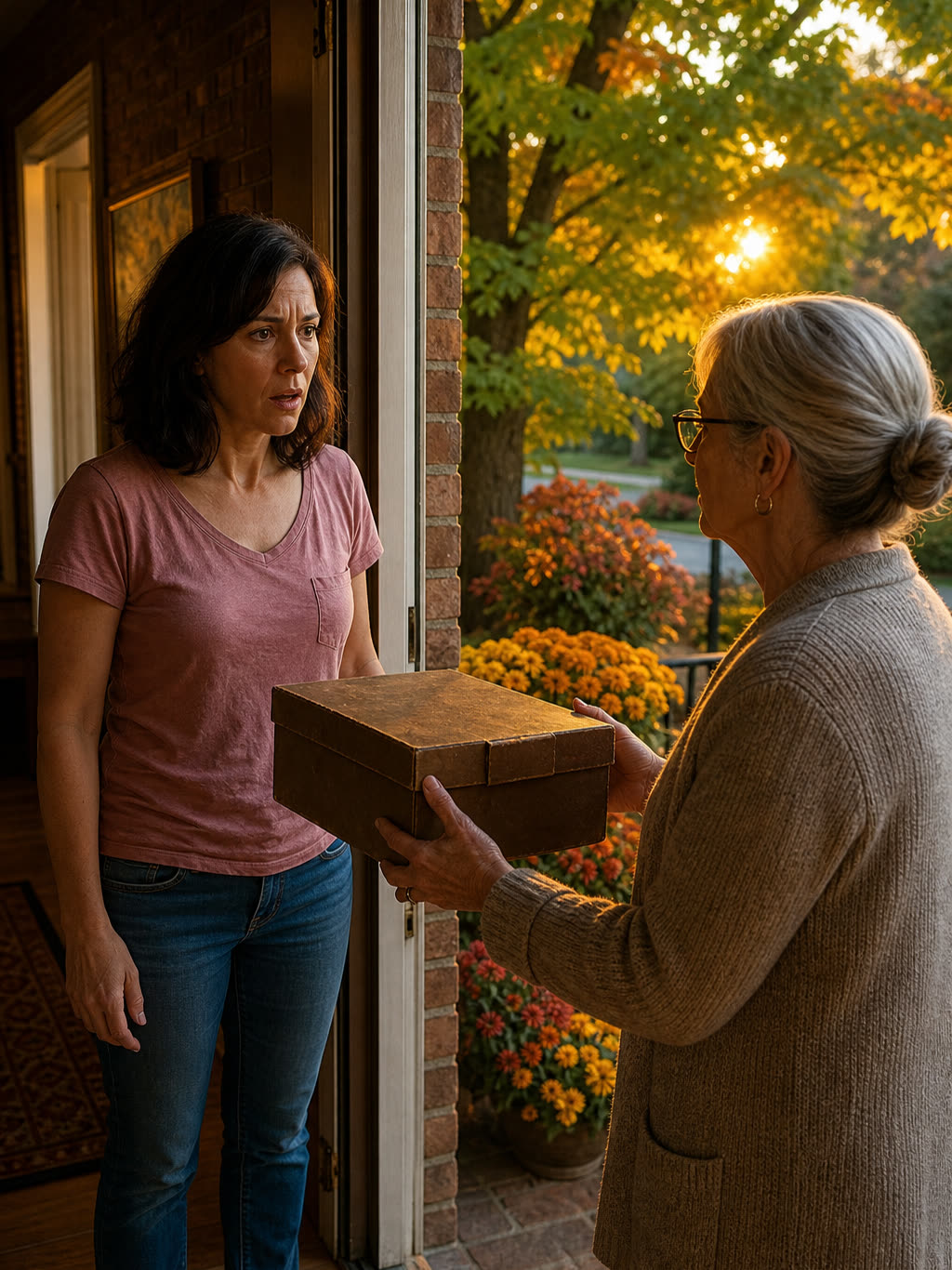
That afternoon the doorbell rang. Patricia stood on my porch holding an old brown Nike shoebox, corners soft and bent, wrapped twice in a rubber band. Her face was pale.
“Mara,” she said. “I’m sorry. But there’s something you need to know about Elora.” She held out the box. “And I think you need to see this.”
She glanced over her shoulder at the street, then lowered her voice. “She never wanted you to know the real reason she came to stay with you. She’d planned it all along.”
Part Two: What the Box Held
I let her in. We sat at the same kitchen table where Elora once cried and said she was ashamed of her son. Patricia set the shoebox between us without opening it.
“Before you look inside, I need to tell you how I know her. I worked thirty years at Hartwell, Simmons and Ruiz, downtown on Monroe Avenue. I was a paralegal in family law. Five years ago I worked on a divorce. Shane Whitaker. My firm represented him.”
I sat very still. “You worked on my divorce? For Shane’s side?”
“I did. I didn’t move in next to you by any plan. I’d lived here three years before. I only figured out who you were when I saw the name on the file. I never said anything. It would have been a breach of confidentiality.”
“So what does this have to do with Elora?”
“In August, Elora knocked on my door. She’d learned I worked on the divorce, from an old letter in Shane’s files. She asked if I remembered the financial disclosures, the paperwork Shane filed with the court. In a divorce, both people list everything they own, under oath. Do you remember what Shane listed?”
I thought back. “He said the landscaping business was barely making money. About four thousand dollars in savings. His truck and equipment were financed. Nothing to split but the house. I kept it, refinanced it in my own name, and he said he was being generous. I’ve worked extra shifts five years to pay for it, and he pays three hundred dollars a month in child support because his income was so low.”
Patricia slid the rubber band off. “Elora found out he lied. About all of it.”
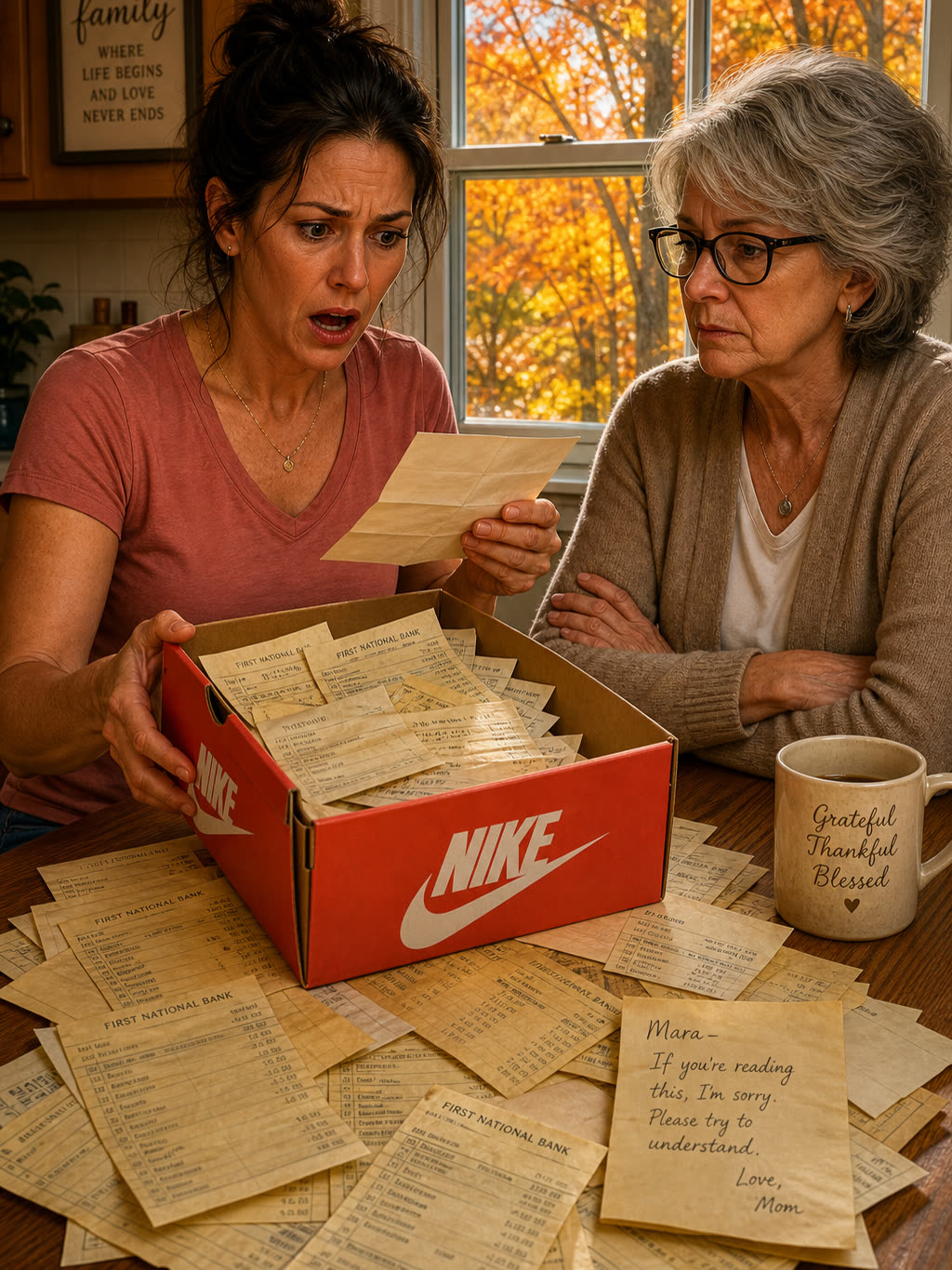
I lifted the lid. Bank statements, yellowed and coffee-stained, envelopes from Lake Michigan Credit Union, printouts, a few photographs. On top lay a folded sheet of notebook paper. In Elora’s shaky cursive: Mara. Please read this first.
Mara, I’m sorry I lied to you. About why I came to stay. About why I kept asking when you’d be out. About Patricia. I did break my leg. But my children didn’t refuse to take me in, not the way I told you. I never asked them. I wanted to stay with you. Because I needed to get into your attic.
I looked up. “My attic?” Patricia nodded. I kept reading. Shane had kept a gray metal filing cabinet in his office, the room Elora had slept in. When he left, he left it behind. I had put it in the attic, saying I could not throw it away because it might hold Ivy’s medical records. It did not. It held Shane’s real ones.
My hands shook. “What did she find?” Patricia pulled out a stack of statements held by a paper clip. Lake Michigan Credit Union. Account Holder: Kenneth A. Whitaker.
“Kenny. Shane’s brother.”
“Look at the deposits.” Six months before we separated, large deposits began: ten thousand, fifteen, twenty, each transferred from Whitaker Lawn & Landscape LLC. They continued through the divorce, until two months after it was final. At the bottom Elora had written a number in red pen and circled it twice: $146,000.
“He hid it,” I whispered.
“He moved money from his business into his brother’s name before filing, so it wouldn’t appear on his disclosures. Then he swore he had four thousand dollars and a business barely breaking even.”
The next page was a deed record for a property on Lake Bella Vista, bought two years after our divorce by Shane and Kayla Whitaker for $389,000. Down payment $140,000. Source of funds: gift from Kenneth A. Whitaker, brother. The lake house. The one not set up for his mother with a broken leg. Bought with money that should have been split. Half of it mine. Half of it Ivy’s.
Patricia made coffee without asking. I did not drink it. “How did Elora find out?”
“Kenny told her, by accident, last Easter. He’d had too much wine at Lisa’s while Shane and Kayla bragged about the lake house and the boat. He said, ‘You’re welcome for the down payment. I’m still paying taxes on that account, you know.’ Elora asked what he meant. He laughed it off.”
“But Elora’s not stupid. She raised three kids alone and did the books for a dental office for twenty-two years. She asked Lisa, who told her nothing. She asked Kenny sober, and he told her to stay out of it. In June she asked Shane at the lake house if he’d hidden money from you.”
“What did he say?”
“He told her to mind her own business. He said if she brought it up again, she wouldn’t see her grandson. ‘You’ve always liked Mara better than your own son. Now pick a side.’”
I put my hand over my mouth. “That’s why none of her kids would take her in. She called Lisa and Kenny after she broke her leg. They said they were angry with her for asking questions, for siding with you. Her own children cut her off for trying to do right by you.”
“So she called me crying,” I said, “and I offered before she asked.”
“She said that’s when she knew. She’d spent three months trying to figure out how to reach your attic, and you opened the door. She remembered Shane kept every bank statement since 2010. He’s paranoid about the IRS. But with a broken leg she couldn’t climb the ladder.” Patricia looked at me. “I could.”
“Elora came to me in August and asked if the disclosures looked right. I told her I couldn’t talk about it. But I said if someone found evidence in their own family’s papers that a person lied under oath, it could be taken to a judge. Then she slipped on her steps and called me from the hospital: ‘Patricia, I think God just handed me a key to Mara’s attic.’”
“Every time you were at work, I climbed into your attic and went through Shane’s cabinet one drawer at a time. Elora sat at the bottom of the ladder in a chair telling me what to look for. She insisted on climbing once and got three rungs up with her cast before I stopped her.”
“And the canvas bag?” “Copies from the library. We put the originals back where we found them, in case you looked. The originals are in the box now. She wanted you to have them.”
I picked up Elora’s letter again. There was more on the back. I didn’t tell you because I was ashamed. Ashamed my son did this, that my other son helped him, that my daughter knew and said nothing. I was scared you’d think I was a crazy old woman, or stirring up trouble. Scared I’d lose my son, my grandson, maybe all my children.
But then I watched you for four weeks. You got up at five to make my coffee. You helped an old woman in and out of the shower. You paid a mortgage alone on a house my son said he was generous to let you keep. And I watched Ivy, who wears thrift store shoes because her father’s child support is three hundred dollars a month, while her half brother has a nursery with a view of the lake.
I can’t fix what Shane did. But I can give you the truth. What you do with it is up to you. Whatever you decide, I’ll stand by you. Even if it costs me my son. He made his choice five years ago. I’m making mine now. With all my love, Elora. P.S. The extra blue envelope is for Ivy. Please don’t open it until her tenth birthday.
I put my face in my hands and cried at my kitchen table, the way Elora had five years before.
Patricia gave me the name of a family law attorney, Grace Delgado, the best in Kent County at finding hidden assets. “She’s tough. And she doesn’t like liars.” I went the next week. Grace, in her forties, with short dark hair and a navy suit, read through the shoebox for an hour in silence.
She removed her reading glasses. “Ms. Whitaker, your ex-husband committed fraud on the court. Concealing marital assets by transferring them to a family member is perjury, and grounds to reopen your settlement.”
“It’s been five years. Isn’t it too late?” “In Michigan, when the fraud is this serious, the court can set aside a judgment. You couldn’t have known. The evidence was in his filing cabinet.” A small, sharp smile. “In your attic.”
“There’s something else. The child support was based on his reported income. His real income was closer to a hundred and ten thousand a year, not thirty-eight. He should have paid about eleven hundred a month, not three hundred.” Eight hundred dollars a month for five years. Forty-eight thousand dollars, for Ivy.
I thought of Ivy in thrift store shoes, the extra shifts, the house I nearly lost twice. I thought of Shane on his boat. And of Elora at the bottom of my attic ladder, knowing it might cost her everything.
“Yes,” I said. “I want to pursue it.” Grace filed in November. Shane was served at his office in front of his whole staff, including Kayla. That night, his name lit my phone. I answered.
“What the hell is this, Mara?” His voice shook. “This is my mother. She put you up to this.” I said nothing. “She stayed at your house a month, and now you’re suing me.” “I’m asking the court to look at what you did.” “That money was Kenny’s. It was a loan.” “Then you won’t have any problem explaining it to the judge.”
“You’re going to destroy my family,” he said finally. “Kayla’s furious.” “Shane, your daughter wears shoes from a thrift store. While you bought a lake house. Your mother watched her for four weeks, and she couldn’t stand it anymore.” He hung up.
The next day Lisa told Elora she was never welcome in her house again. Kenny’s wife blocked her number. Shane sent one text: You chose her over your own son. I hope it was worth it. I found Elora on her back porch in a heavy coat, boot on a stool, looking at the bare maple and the empty bird feeder. She had been crying.
“I’m so sorry, Elora. This is my fault.” “Mara. Honey. None of this is your fault. If you hadn’t filed, my son would have gotten away with stealing from his own daughter. I’d rather lose my children than keep a secret like that.” “But you have lost them.” “For now. Maybe forever.” She took my hand. “But I didn’t lose all of my family.”
The hearing was set for February. As I walked into the courtroom, I saw Shane at the opposite table, and then I saw who he had brought with him in the gallery. Kenny. And Kenny’s lawyer was whispering urgently in his ear.
Part Three: The Truth in Court
The hearing took place in Kent County Circuit Court, family division, in a small fourth-floor courtroom with wood paneling and a judge named Patricia Brennan. A different Patricia.
Shane sat with a heavyset lawyer in an expensive suit. Kayla sat behind him, and Kenny beside her. I sat with Grace. Behind me in the first row sat Patricia Okafor in a gray suit she had not worn since her retirement party, and Elora in her church coat, cane across her lap.
Shane saw his mother and stopped. She looked back and did not look away.
His lawyer argued the transfers were legitimate business loans to help Kenny through a hard time. Grace stood and held up a single page from the shoebox, handwritten in Shane’s hand on company letterhead, dated three weeks before he filed. She read it aloud.
Kenny — Moving another 20K tonight. Keep it in your account until the divorce is final. Don’t touch it. Don’t tell Lisa. Don’t tell Mom. — S.
Shane’s lawyer objected. The judge overruled. Shane put his head in his hands. Then Grace called Kenny to the stand, where he sat under oath, advised that lying would make him an accessory, staring at his hands.
“Mr. Whitaker. Was the money your brother transferred into your account a loan to you?” Kenny looked out at his mother in the front row. She was looking right at him.
“No,” Kenny said quietly. “It wasn’t a loan. It was Shane’s money. He asked me to hold it until after the divorce.”
Judge Brennan ruled from the bench. She set aside the original property division, finding Shane had concealed $146,000. She awarded me half, seventy-three thousand dollars plus interest and attorney’s fees. She recalculated child support from his real income: forty-seven thousand, eight hundred dollars in back support, and eleven hundred and twenty dollars a month going forward.
Then she looked at Shane over her glasses. “Mr. Whitaker, I’m referring this matter to the Kent County Prosecutor’s Office. Perjury in a family court proceeding is a felony in Michigan. I strongly suggest you pay this judgment promptly.”

Shane went pale. He paid in full within sixty days, selling the boat and taking a second mortgage on the lake house. The prosecutor declined to file charges, because he paid and it was a first offense, but the referral stays on his record.
I had never seen that much money. So I did what Elora would have done: I sat at my kitchen table with a pad and calculator. I paid off my car and paid down the mortgage enough to drop to three shifts a week. I opened a 529 college account for Ivy and put every dollar of the back support into it, because it was always hers. And I bought her real shoes: purple sneakers with silver laces, the ones she had eyed for a year at Woodland Mall. She cried when she opened the box.
I set aside ten thousand dollars in an envelope and drove it to Elora. She refused. “Absolutely not. That’s your money. And Ivy’s.” “Your roof leaks. Your furnace is twenty-five years old. Your back steps are still broken, the ones you fell on. You lost your children over this. Who’s going to fix your steps?” She looked at the envelope a long time. “You will,” she said. “If you’ll come over and help.”
So on a Saturday in April, Patricia, Ivy, and I fixed her steps with lumber, a drill Patricia inherited from her late husband, and a YouTube video. We measured wrong twice. Ivy hit her thumb with a hammer, cried, and then laughed. Patricia swore so creatively that Elora made her put a dollar in a jar. By sunset the steps were wide and solid with a rail on both sides.
Elora walked down them slowly, holding both railings, then turned around and walked back up. “They’re perfect. Thank you. All of you.” That night Elora made pot roast standing at her stove for the first time since September, Patricia brought salad, and Ivy made a pie. We played gin rummy until eleven. Elora cheated. Just a little.
Ivy turned ten in June. We held a party in my backyard with balloons, a cake shaped like a cat, and Judge watching from the fence. After the kids left, Elora sat Ivy on the porch steps. “Sweetheart, I have one more present for you. From a long time ago.” I brought the blue envelope I had kept eight months in my dresser, unopened.
Inside was a letter and, wrapped in tissue, a thin gold ring with a tiny sapphire, worn smooth. “That was my mother’s, and her mother’s before that. It was always supposed to go to the oldest granddaughter. That’s you.” Ivy read the letter aloud in her careful voice.
Dear Ivy, your mother took me in when nobody else would. She made me coffee every morning, helped me in the shower, and never once made me feel like a burden. That’s the kind of woman you come from. Your father did something wrong. He took something that belonged to you and your mother, and I found it and gave it back. That’s not breaking up a family, sweetheart. That’s what family is supposed to do. Family isn’t who shares your blood. Family is who tells you the truth. Even when it costs them. Wear the ring when you’re grown, and when someone is treated unfairly and everyone is quiet, look down at it. None of us ever stayed quiet. All my love, forever and ever, Grandma Elora.
Ivy slid the too-big ring on and held it to the light. “It’s beautiful, Grandma,” she said, and threw her arms around Elora’s neck. Fireflies came out over the grass. Elora cried. So did I. So did Patricia, pretending to wash dishes in the kitchen doorway.
It has been a little over a year. Lisa does not speak to Elora. Kenny sends a birthday card with no note. Shane called in October. Over cinnamon roll at the bakery, Elora told me he said Kayla had left him in August, taking the baby to her parents’ in Muskegon, and that he finally understood what it felt like to be alone in a big house with nobody coming.
“I said I’d always be his mother. And that he was welcome at Thanksgiving, if he could sit at the same table as you and say he was sorry. Is that all right? I should have asked you first.” I thought of the extra shifts, the shoes, and the woman at the bottom of my attic ladder. “It’s all right,” I said.
Shane came to Thanksgiving with a store-bought pie and a bottle of wine he could not open. Ivy showed him her purple sneakers and the ring on a chain around her neck. After dinner he stood. “Mara. I’m sorry. For the money. For the lies. For five years of letting you carry everything. For her shoes.” I did not say it was okay. It might never be. “Thank you for saying it,” I said. He stayed for pie and one hand of gin rummy. Ivy beat him badly, and Elora laughed so hard she put down her cards.
People think it is a story about money. It is not. It is about a seventy-two-year-old woman who knew the truth and could not stay quiet, who planned it all along, not to take something from me, but to give something back.
Last week, moving the old gray filing cabinet in my attic, I found a sticky note taped to its back in Elora’s shaky cursive. Thank you for letting me stay. I’m sorry about the dust. — E. I left it there. Sometimes the people who love you most don’t tell you everything. Not because they’re hiding something from you, but because they’re finding something for you.
Disclaimer: This story is a work of fiction inspired by real-life themes. Names, characters, places and events are fictionalized, and any resemblance to real persons is purely coincidental. Images are for illustration purposes only.
