


PART 1 — THE CALL HE CHOSE TO IGNORE
My name is Elena Romano.
For seven years, I had been married to Victor Romano, one of the wealthiest and most influential businessmen in New York.
My husband owned luxury hotels, investment companies, commercial properties, and exclusive private clubs across several states.
He could summon executives with a single phone call.
Powerful investors waited weeks for fifteen minutes of his attention.
He lived in a world where almost everything could be negotiated, purchased, or controlled.
There had been a time when I was the exception.
In the early years of our marriage, Victor called simply because he missed hearing my voice.
He called between meetings.
From airports.
During business trips.
Sometimes he called for no reason beyond wanting to know how my day was going.
I used to believe that no matter how powerful he became, I would always remain the person he wanted to come home to.
That belief had been fading for months.
And on one rainy evening in Manhattan, it nearly cost me my life.
At 7:12 p.m., Victor sent a message.
Late meeting. Don’t wait up.
I stared at the screen.
Dinner was already prepared.
Two plates waited on the dining table.
The food had begun cooling.
Again.
For six months, late meetings had become Victor’s favorite explanation.
I had stopped asking when he would return because I already knew the answer.
He would arrive after midnight.
Offer a distracted apology.
And disappear into his study.
That evening, I was standing barefoot in our enormous kitchen when an uncomfortable pressure developed beneath my breastbone.
At first, I assumed it was indigestion.
I had barely eaten.
I was exhausted.
And the past several weeks had been unusually stressful.
Then the pressure intensified.
I placed one hand against the marble counter.
The room tilted.
“Okay,” I whispered.
But nothing was okay.
My heartbeat felt wrong.
My breathing became shallow.

A cold weakness spread through my arms.
I reached for my phone.
Victor was the first person I called.
No answer.
I tried again.
Nothing.
A third call.
Still nothing.
By the fourth attempt, my knees had given way.
I was sitting on the kitchen floor, struggling to keep the phone in my trembling hand.
Finally, someone answered.
“Victor’s phone.”
A woman.
My stomach dropped.
I had spent months trying to dismiss my suspicions about Victor and Selena Vale.
Now those suspicions had a voice.
“Victor?”
“He’s unavailable.”
I struggled to draw air into my lungs.
“Please…” I struggled to breathe. “Put him on.”
There was a pause.
Then the woman answered almost sweetly.
“He doesn’t want to talk to you.”
The call ended.
For a moment, I stared at the dark screen.
Then another wave of pain moved through my chest.
I tried to stand.
I couldn’t.
The world blurred around me.
Somewhere beyond the kitchen, the apartment seemed impossibly distant.
I managed to reach the emergency button connected to our building’s security system.
Then I collapsed.
The last sound I remembered was someone pounding on the penthouse door.
After that, darkness.
Across Manhattan, Selena Vale was still wearing Victor’s white dress shirt when she disconnected the call.
Victor looked at her.
“What the hell was that?”
She shrugged.
“She’s your wife, not your parole officer.”
Then Victor’s phone illuminated.
A red emergency notification appeared.
It came from Mercy Harbor Medical Center.
ELENA ROMANO. PATIENT RECEIVED THROUGH ER. CONDITION CRITICAL.
Victor stopped moving.
A second notification arrived.
PATIENT FOUND UNCONSCIOUS. POSSIBLE CARDIAC EVENT.
For several seconds, he could only stare.
Later, he would tell me that my voice replayed in his mind.
Please… put him on.
And then Selena’s reply.
He doesn’t want to talk to you.
Twenty-three minutes before the emergency notification, building security had received the alert from our penthouse.
At 7:23 p.m., the security team entered.
They found me unconscious on the kitchen floor.
Emergency services were contacted.
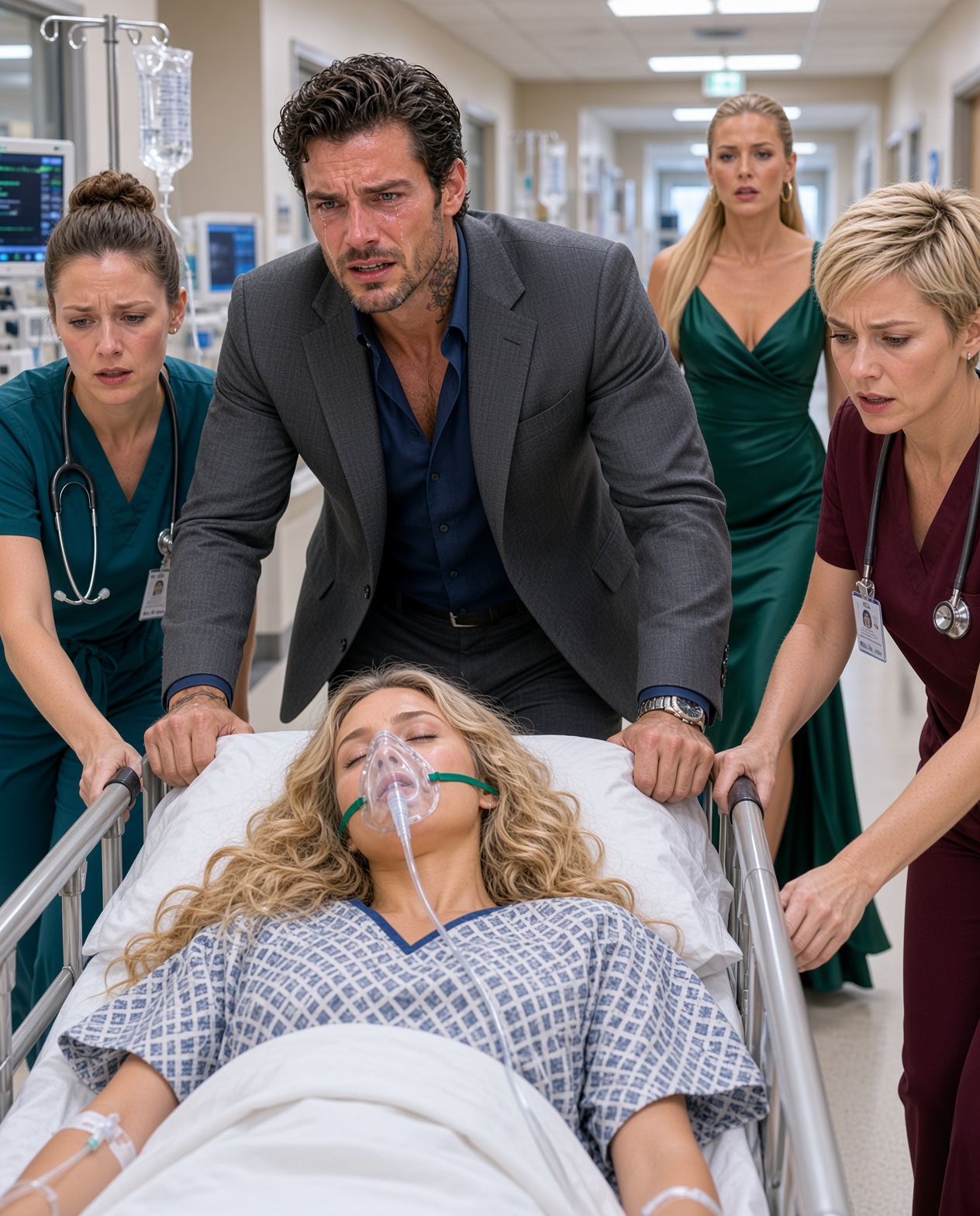
By 7:34 p.m., paramedics were transporting me to Mercy Harbor.
Victor had spent those minutes ignoring his wife’s calls while sitting with his mistress.
Now he was driving through Manhattan’s rain-soaked streets, desperate to reach me.
Selena called twice.
He rejected both calls.
When he reached the hospital, he hurried through the entrance and ran toward the emergency department.
“My wife,” he said to the first nurse he saw. “Elena Romano.”
The nurse checked her computer.
“Room eight. Cardiology is with her.”
Victor swallowed.
“What happened?”
The nurse looked toward the closed emergency-room doors.
“She’s stable for the moment,” she said. “But the doctors are still working to understand what caused the episode.”
Victor gripped the counter.
“Stable?”
“She arrived unconscious. Her heart rhythm was irregular, and her blood pressure dropped dangerously low. The cardiology team is with her now.”
“Can I see her?”
“Not yet.”
“I’m her husband.”
“I understand.”
The nurse remained professional.
“Please wait here.”
Victor moved toward the emergency-room doors.
Through the narrow glass panel, he could see medical staff moving around a hospital bed.
He couldn’t see my face.
For seven years, he had believed he knew everything about me.
He knew how I raised an eyebrow when I disagreed.
How I smiled when trying to make someone comfortable.
How my mouth trembled when I was close to tears.
But during the previous year, he had stopped paying attention.
He had mistaken my silence for contentment.
He had interpreted my growing distance as maturity.
He had assumed that because I remained in the marriage, everything was fine.
Now he stood helplessly outside the room where doctors were trying to keep me alive.
His phone vibrated.
Selena.
He ignored it.
Then he opened my messages.
At 7:09 p.m., I had written:
Are you still at the office?
At 7:11 p.m.:
Victor, please call me when you see this.
At 7:15 p.m., another missed call.
He read them repeatedly.
Then he opened the security report.
7:21 p.m. — Emergency alert activated from Romano residence.
7:23 p.m. — Security entered penthouse.
7:26 p.m. — Medical services contacted.
7:34 p.m. — Patient transported to Mercy Harbor Medical Center.
Victor stared at the timestamps.
He had seen my name on his phone.
He had known I was calling.
And he had deliberately chosen not to answer.
The emergency-room doors opened.
A physician stepped into the corridor.
He was in his forties, with tired eyes and a tablet held against his chest.
“Mr. Romano?”
Victor stood.
“Yes.”
“I’m Dr. Malik. I’m overseeing your wife’s care.”
“How is she?”
“She’s conscious now, but very weak. The immediate danger appears to have passed.”
Victor exhaled.
“Can I see her?”
“In a few minutes.”
“What happened?”
Dr. Malik explained that I had suffered a serious cardiac episode and that further testing was necessary to determine the cause.
He asked whether I had experienced previous symptoms.
“Chest pressure? Shortness of breath? Fatigue? Dizziness?”
Victor remembered several moments from the past few months.
Me pausing halfway up the stairs.
Me sitting upright in bed at night.
Me pressing a hand against my chest in the kitchen.
Once, he had asked whether I was all right.
I had said I was tired.
He accepted the answer because he didn’t want to interrupt his own schedule.
“I don’t know,” he finally admitted.
Dr. Malik’s expression tightened.
“Someone should know.”
Victor tried to explain that I had been under stress.
The doctor cautioned him against assuming stress was the only cause and requested my medical history.
Then he asked whether I had family nearby.
“My wife’s sister lives in Brooklyn.”
“Please contact her.”
Victor knew Clara’s number by heart.
He had avoided her for nearly a year.
At Thanksgiving, she had looked him directly in the eyes and warned:
“You’re losing her.”
He had dismissed her.
Now he called.
Clara answered on the second ring.
“Victor?”
“Clara, it’s Elena.”
“What happened?”
“She’s in the hospital.”
“What do you mean, she’s in the hospital?”
“She collapsed at home.”
“What happened?”
“They think it was cardiac.”
“Is she awake?”
“Yes. She’s stable.”
“I’m coming.”
Victor started to speak.
“Clara—”
“Don’t tell me to stay calm. I’m already on my way.”
She ended the call.
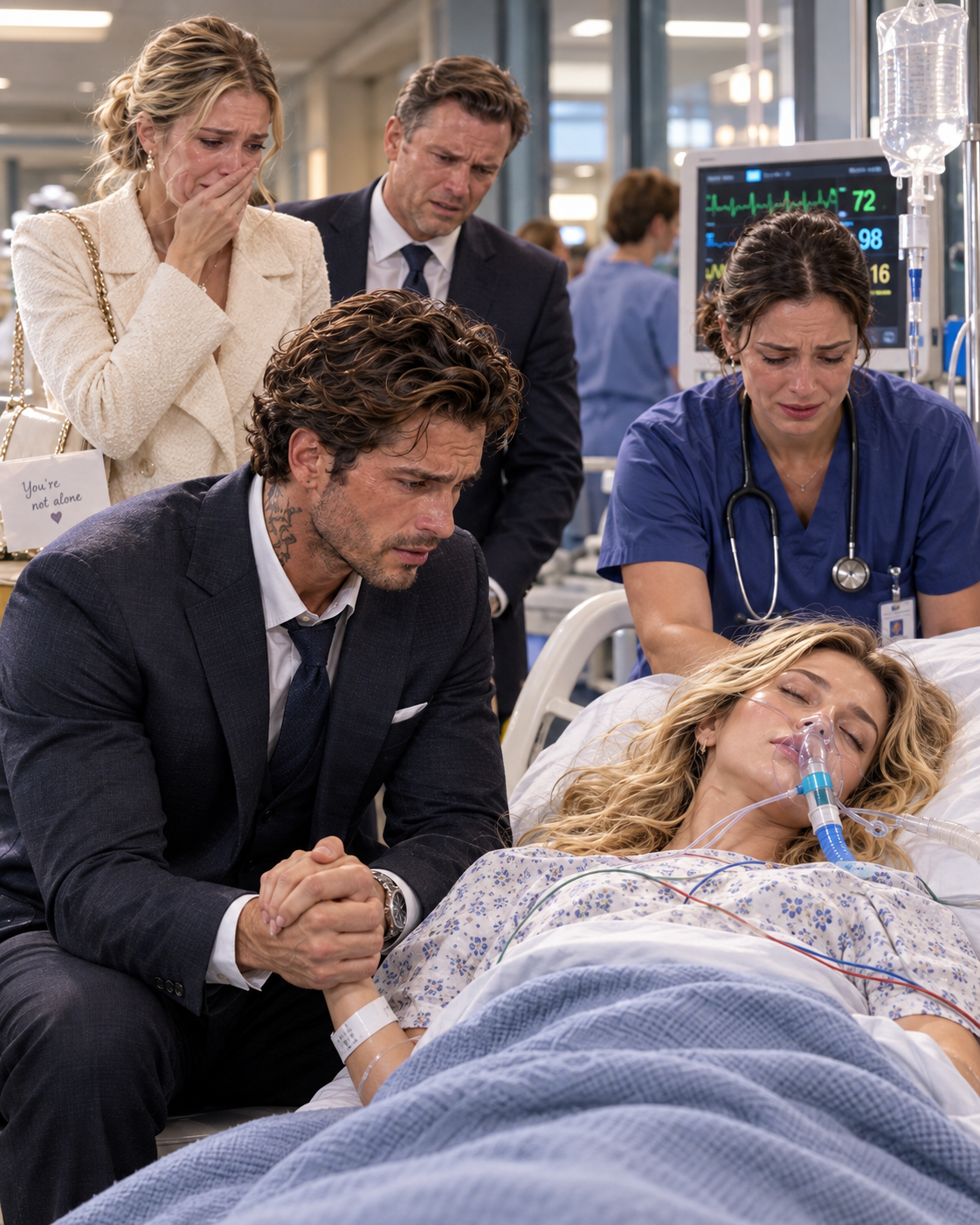
Shortly afterward, Dr. Malik allowed Victor into my room.
I lay beneath a white blanket.
Wires were attached to my chest.
An IV ran into my arm.
A small oxygen tube rested beneath my nose.
Victor stopped at the doorway.
All the words he had rehearsed during the drive disappeared.
I opened my eyes.
For several seconds, I stared at the ceiling.
Then I noticed him.
“Elena.”
I looked at him.
“You came,” I whispered.
His throat tightened.
“Of course I came.”
My mouth moved slightly.
“Eventually.”
Victor sat beside me.
“I’m sorry.”
I looked toward the rain-covered window.
Then I asked the question he had been dreading.
“Did Selena tell you to come?”
“Elena—”
“Was she there?”
He could not lie.
“Yes,” he admitted.
I closed my eyes.
“I knew it.”
Victor leaned forward.
“There’s nothing between us that—”
“Don’t.”
The word was quiet.
But it stopped him.
“I don’t want explanations tonight,” I said. “I don’t want promises. I don’t want you telling me it’s not what I think.”
“It isn’t what you think.”
I looked at him again.
“You weren’t answering my calls.”
“I was in a meeting.”
“With her.”
Victor lowered his eyes.
I smiled bitterly.
“Seven years of marriage, Victor. You still think the worst part is whether I can prove anything.”
He reached for my hand.
I moved it away.
The gesture was small.
But it was the first time I had deliberately refused his touch.
“I’m sorry,” he repeated.
“I know.”
He looked surprised.
“You know?”
“I know you’re sorry now.”
“And before?”
“Before, you were sorry whenever I noticed.”
Victor flinched.
For months, I had endured late meetings, concealed calls, and the increasingly obvious absence of affection.
I had questioned my instincts.
Made excuses.
Told myself I was overreacting.
And every time I tried to speak, Victor offered just enough reassurance to end the conversation.
“I should have answered,” he whispered.
“Yes.”
“I should have been there.”
“Yes.”
“I should have known something was wrong.”
I studied his face.
“You should have asked.”
That sentence stayed with him long after I fell asleep.
Forty minutes later, Clara arrived.
She entered wearing her work coat and rain-soaked boots.
When she saw Victor beside my bed, her expression hardened.
After hearing the doctor’s explanation, she asked what had really happened that evening.
Victor tried to leave Selena out.
Clara immediately recognized the omission.
“You can lie to the board,” she said quietly. “Don’t lie to me.”
“I didn’t lie.”
“You omitted.”
“She doesn’t need more stress.”
“She needs the truth.”
“She almost died tonight.”
“And you think finding out about your mistress would be more stressful than discovering she was right all along?”
Victor fell silent.
Clara folded her arms.
“How long?”
He didn’t answer.
“How long has Selena been involved?”
“Six months.”
“Does Elena know?”
“She suspects.”
“That wasn’t my question.”
“No.”
Clara looked toward me.
“She has been sick for months.”
Victor’s head lifted.
“What?”
“She told me she was having trouble breathing.”
“When?”
“Several times.”
“Why didn’t she tell me?”
Clara’s expression turned cold.
“She tried.”
Suddenly, Victor remembered a conversation from three weeks earlier.
I had been standing near the kitchen counter.
“I’ve been feeling strange,” I told him.
He was reading an email.
“You should see a doctor.”
“I thought maybe you could come with me.”
He had looked irritated.
“I can’t keep canceling meetings, Elena.”
I smiled.
“I know.”
And he returned to his phone.
At the time, Victor believed the conversation was finished.
Now he understood that he had ended it.
Clara told him about my upcoming appointment with Dr. Levin, a cardiologist in Manhattan.
I had been waiting for Victor to return from Chicago.
He had returned two days earlier.
But I had still been afraid to ask him again.
“Why didn’t she go sooner?” Victor asked.
Clara stared at him.
“Because she wanted you with her.”
That answer struck harder than anything else.
He had built a fortune capable of purchasing entire hospitals.
Yet I had delayed a medical appointment because I wanted my husband to sit beside me.
And he had been too busy with another woman to notice.
At 2:18 a.m., I woke.
Clara was asleep in a chair.
Victor stood beside the window.
“Victor.”
He turned immediately.
“I’m here.”
I studied him.
“You should go home.”
“I’m not leaving.”
“Your company needs you.”
“It can wait.”
I looked at him.
“You’ve never said that before.”
He came closer.
“I should have.”
For a moment, he resembled the man I married.
His tie was gone.
His sleeves were rolled up.
His expensive watch sat crookedly on his wrist.
He looked tired.
Human.
Almost vulnerable.
That made the conversation harder.
I asked whether he had contacted my mother.
He hadn’t.
I told him not to frighten her unnecessarily.
Then I asked whether he had told Clara about Selena.
He admitted he hadn’t.
“Why not?”
“I didn’t know how.”
“You knew how to tell me you were working late.”
Victor lowered his eyes.
“I was going to end it.”
I looked away.
“People always say that after they’re caught.”
He insisted he was telling the truth.
He said he had been confused.
“About what?” I asked.
“About myself. About the life I was living.”
“That’s a very comfortable kind of confusion.”
“I know.”
“No, you don’t.”
I explained what his confusion had cost me.
He had been free to question his feelings while I struggled to preserve our marriage.
He had enjoyed another woman’s admiration while I doubted my own instincts.
Then I asked:
“Did you love her?”
Victor hesitated.
“I cared about her.”
“That wasn’t my question.”
He closed his eyes.
“No.”
“Are you sure?”
“I was lonely,” he said. “And she made me feel admired.”
I stared.
“You were admired by everyone.”
“Not by you anymore.”
The words escaped before he could stop them.
I became very still.
Then I smiled sadly.
“I admired you until I realized admiration was the only thing you wanted from me.”
Victor tried to deny it.
I asked what he wanted.
Finally, he whispered:
“I wanted you.”
My eyes filled.
“You had me.”
He lowered his head.
“I know.”
“You had me, and you treated me like something that would never leave.”
He reached for my hand.
This time, I didn’t pull away.
But I didn’t hold on either.
By morning, Dr. Malik returned with preliminary results.
There was no evidence of a blocked artery.
That was encouraging.
But my abnormal heart rhythm required additional investigation and monitoring.
Victor immediately offered to arrange everything.
Specialists.
Private nurses.
Any treatment money could provide.
I looked at him.
“I can make my own arrangements.”
He seemed startled.
For years, Victor had treated providing money as proof that he was fulfilling his responsibilities.
Now I needed something he had never learned to give.
Space.
Respect.
And the freedom to make decisions without his approval.
I told Clara I wanted to stay somewhere other than the penthouse after discharge.
Victor objected.
I refused to argue.
Eventually, we discussed the guesthouse.
I made my conditions clear.
No staff reporting to Victor.
No strangers managing my recovery.
No attempts to control my movements.
Then I said:
“I need one thing from you.”
“Anything.”
“Don’t make this about winning me back.”
Victor went quiet.
I explained that he had spent his entire life pursuing goals.
He could buy companies.
Negotiate deals.
Overcome competitors.
But my recovery was not a business objective.
Nor was reconciliation something he could purchase.
“And if I decide I can’t stay married to you?” I asked.
He swallowed.
“I’ll accept it.”
“Will you?”
“I don’t know how. But I will try.”
I looked away.
“Trying is not the same as changing.”
“I know.”
For the first time, I sensed that he might finally have heard me.
But neither of us knew that the worst secret in our marriage had not yet been uncovered.
Later that afternoon, Victor returned to the penthouse to collect my belongings.
The dinner table remained set.
Two plates.
Two glasses.
Cold food.
One of my slippers lay near the kitchen counter.
The other rested beside the emergency button.
Victor stood there for a long time.
Then he noticed a white envelope beneath the fruit bowl.
His name appeared on the front.
Victor — please read this before you come home.
Inside was a letter.
And a small brass key.
He unfolded the paper.
The first sentence made his heart pound.
I’m not writing this because I want to leave you.
He continued reading.
I’m writing because I’m afraid that if I say these things aloud, you’ll interrupt me, reassure me, or promise to change before you understand why I’m hurting.
Then came the words he had feared.
I know about Selena.
I had discovered the affair six months earlier.
But the letter revealed that my concerns extended beyond my marriage.
I had been investigating missing funds from the Romano Foundation.
A charitable organization Victor created as an anniversary gift two years earlier.
He had provided the money.
I had built its programs.
The foundation supported cardiac research and housing assistance for women escaping unsafe situations.
I had spent countless hours reviewing applications and working with community organizations.
Then I discovered suspicious withdrawals.
The money appeared to have been transferred through consulting companies I didn’t recognize.
One was linked to Adrian Vale.
Selena’s brother.
The brass key belonged to a storage room in an old Romano-owned building on West Forty-Third Street.
I had found records there.
And I had intended to show them to Victor that evening.
The final paragraph frightened him.
If something happens to me before we speak, please don’t trust the first explanation you’re given.
Victor lowered the letter.
Then his phone vibrated.
An unknown number had sent a message.
You found the letter. Good. Now check who authorized the first transfer.
A second message appeared.
It wasn’t Selena.
Victor stared at the screen.
The affair was real.
But someone else had been using the chaos in our marriage to conceal something much larger.
And whoever sent those messages knew exactly what I had discovered.
PART 2 — THE FOUR-POINT-EIGHT-MILLION-DOLLAR LIE
Victor tried calling the anonymous number.
It was unavailable.
He returned to my letter.
The Romano Foundation had once been little more than a financial gift from a wealthy husband.
But over time, I had transformed it into an organization with genuine community partnerships.
Victor knew how much he had donated.
He had rarely asked how the work was done.
That realization filled him with shame.
He opened the foundation’s secure financial portal.
The system required two-factor authentication.
The verification code would be sent to my phone.
For a moment, he considered calling the hospital.
Then he stopped.
He had already spent years interrupting me whenever it suited him.
He would not use my illness to demand access to my accounts.
Instead, he called Margaret Liu, the foundation’s chief financial officer.
She answered after four rings.
“Victor?”
“I need you to access the foundation ledger.”
Margaret hesitated.
“Is something wrong?”
“Possibly. I need the complete transaction history for the past eighteen months. Not a summary. Every transfer, every approval, every vendor record.”
Her response was cautious.
“Are you asking as chairman?”
“I’m asking as a trustee.”
“That distinction matters.”
“I know.”
Margaret asked where he was.
Then she asked whether I was all right.
Victor explained that I had suffered a cardiac episode.
She expressed sympathy.
Then she revealed something unexpected.
The foundation’s transaction review was already scheduled.
I had requested it two weeks earlier.
Margaret had been preparing the audit.
Victor was stunned.
He had known nothing about my investigation.
Margaret explained that I suspected irregularities involving outside contractors.
She had already found transfers that did not match normal procedures.
Victor asked why nobody had informed him.
Margaret said she tried.
Three weeks earlier, she contacted his office.
His assistant Daniel told her Victor was traveling.
The matter never reached him.
Then Victor asked who authorized the suspicious transfers.
The electronic approvals appeared to use his executive credentials.
Secondary confirmations carried my trustee authorization.
But I had denied approving them.
“How much?” Victor asked.
Margaret hesitated.
“How much, Margaret?”
“Four point eight million dollars.”
Victor sat down.
Four point eight million.
Money intended for charitable programs had been redirected through three companies.
Northstar Advisory.
A Delaware investment vehicle.
And a Connecticut charitable services company.
Northstar’s managing partner was Adrian Vale.
Selena’s brother.
Victor asked whether Selena officially worked for Northstar.
Margaret said she did not.
But she had attended two foundation meetings as a guest of his investment group.
And she had introduced Adrian to Daniel.
The connections were becoming difficult to ignore.
Margaret explained that the records contained valid-looking digital approvals.
Yet the transactions had been structured to avoid ordinary review thresholds.
Victor requested the complete documentation.
Margaret sent preliminary ledgers and access logs.
He examined each transfer.
One payment caught his attention.
$185,000 to Northstar Advisory.
It was described as an emergency housing initiative.
The date matched the week I discovered his affair.
Victor remembered ignoring my calls during that period.
Another transfer involved $240,000 paid to Vale Strategic Services for donor relations consulting.
There was no supporting contract.
A third payment carried the description:
Legal reserve — confidential beneficiary matter.
Victor opened the authorization.
His digital signature appeared.
But the recorded approval claimed he had signed from a Chicago hotel at 2:14 a.m.
He had been in New York that night.
Someone had used his credentials.
Then Margaret sent the access logs.
The suspicious transactions came from two devices.
One belonged to Victor’s executive office.
The other was a foundation laptop assigned to me.
That was the moment he understood why my letter warned him against accepting the first explanation.
Someone had arranged the records to implicate both of us.
Victor called Margaret again.
She confirmed that my laptop had been accessed remotely.
The connection originated through a private network linked to a residential building on the Upper East Side.
When she sent the address, Victor recognized it.
Selena lived there.
Margaret cautioned him.
The connection did not establish guilt.
Other people in the building might use the same network provider.
Victor agreed.
He asked her to hire an independent forensic investigator who had never worked for Romano Holdings.
Then he called Daniel.
“Did you know Elena requested a foundation audit?”
Daniel hesitated.
“I knew she had asked for financial records.”
“Why wasn’t I told?”
“I thought she was handling it through Margaret.”
“You thought?”
Daniel apologized.
Victor asked whether anyone else could use his executive credentials.
Daniel eventually admitted that Robert Hale, Victor’s former chief of staff, once possessed administrative access.
Robert had left Romano Holdings two years earlier.
His account should have been disabled.
But Daniel could not confirm that it had been.
Victor ordered an immediate review.
Then he entered our bedroom.
My clothes remained carefully arranged.
My shoes lined the shelves.
My coat still hung where I had left it.
He opened a drawer and noticed my leather notebook.
For years, I had carried it everywhere.
He had never read it.
He hesitated before opening it.
The first pages contained ordinary reminders.
Appointments.
Names.
Foundation meetings.
Then the entries became more concerning.
Chest pressure again. Lasted six minutes.
Victor says he’ll be away until Thursday.
Ask Margaret about Northstar.
Selena knows too much about the foundation.
A later entry read:
The access logs show someone using my credentials after midnight. I need proof before I accuse anyone.
The final note had been written the day before my collapse.
The key is ready. If Victor refuses to listen, I will show him.
Victor closed the notebook.
I had planned to confront him.
Not merely about Selena.
About the foundation.
About missing money.
And about someone using my name to authorize transactions I had never approved.
A knock sounded at the door.
Clara stood outside holding coffee and a canvas bag.
“You look terrible,” she told him.
“I haven’t slept.”
“Neither have I.”
She entered and noticed the envelope.
After reading my letter, she looked at him.
“She found the transfers.”
“Yes.”
“And she thought someone was framing her.”
“Yes.”
“Did you believe her?”
“I do now.”
“That isn’t the same as believing her before.”
Victor lowered his eyes.
“No.”
Clara asked whether he had loved me while cheating.
He answered yes.
She told him that wasn’t enough.
Then she asked what he intended to do.
Victor said he would protect the foundation, investigate the financial irregularities, and ensure I retained control over my finances and medical care.
“And your marriage?” she asked.
Victor looked toward the bag of clothes he had packed.
“I don’t get to decide that.”
Clara studied him.
“That may be the first honest thing you’ve said in years.”
Then Daniel called.
Robert Hale’s former administrator account had never been fully disabled.
It remained active under a legacy profile.
More importantly, Robert now worked for Vale Strategic Services.
Adrian Vale’s company.
Daniel also discovered that someone had accessed the foundation’s archived donor records at 11:37 the previous night.
Victor immediately forwarded the information to the investigator.
The investigator recommended preserving the system before more records could be changed.
Victor ordered foundation access frozen, with exceptions for Margaret and the independent investigators.
Then he called the hospital.
A nurse answered.
He asked to speak with me.
After a brief pause, my voice came through.
“Victor?”
“I’m here.”
“Is something wrong?”
“I found your letter.”
“And?”
“I believe you.”
I remained silent.
Then he added:
“I’m sorry it took a crisis.”
“So am I.”
Victor asked about the storage room.
I warned him not to go alone.
Then I told him about a blue folder hidden in the old property records cabinet.
I didn’t know what it contained.
But someone had moved it recently.
I also mentioned a second key I had discovered.
Then I asked whether he had spoken to Selena.
He hadn’t.
“Don’t,” I told him.
Victor seemed surprised.
He wanted to know why I was convinced Selena wasn’t the person responsible for the missing money.
I took a careful breath.
“Because she warned me.”
Victor went completely still.
Three weeks earlier, Selena had visited our penthouse.
She warned me that Adrian was using Victor’s name to move money through the foundation.
She claimed Adrian had threatened to frame her if she exposed him.
Selena was frightened.
She didn’t know whether Victor was involved.
And neither did I.
She gave me another name.
Robert Hale.
Victor looked at Clara.
The connections were tightening.
But then I said something that changed everything.
“Victor,” I whispered.
“I’m listening.”
“I didn’t write the final page of the letter.”
His breath caught.
“What do you mean?”
I explained that I had written the letter, but the last warning sentence had appeared afterward.
Someone had accessed the document.
Someone knew I intended to speak to Victor.
Then the lights in the penthouse flickered.
Victor’s phone lost signal.
The screen went black.
And from somewhere near the entrance came a faint metallic sound.
A key turning inside a lock.
Clara grabbed Victor’s arm.
“Don’t.”
He stopped.
The lights flickered again.
Victor looked toward the security panel.
It was dark.
The lock turned once more.
Then the front door opened.
A silver-haired man in a dark raincoat stepped inside.
Victor recognized him immediately.
“Robert.”
Robert Hale froze.
“I didn’t know you were here.”
Victor’s voice hardened.
“You used a key.”
Robert claimed he had entered to inspect backup access after the building’s security system failed.
Victor reminded him that he no longer worked there.
Robert admitted that Adrian had called him.
The subject was my investigation.
Then Victor asked whether Robert had entered the apartment looking for the blue folder.
Robert hesitated.
Finally, he admitted that he had.
But he claimed he wanted to prevent Adrian from finding it first.
Clara challenged him.
“Why should we believe you?”
Robert looked exhausted.
He admitted that he was responsible for maintaining the administrative access that allowed the foundation’s records to be compromised.
He had accepted consulting work from Adrian after leaving Romano Holdings.
He had been resentful toward Victor.
Adrian exploited that resentment.
Robert explained how Northstar identified vulnerable foundations connected to wealthy donors.
The group would introduce consultants, gain access to financial systems, and gradually redirect funds through shell entities.
The transfers were divided into amounts unlikely to trigger automatic reviews.
The Romano Foundation had been one target among several.
But I had become a problem.
I reviewed the records too carefully.
I asked questions.
And I refused to accept explanations that didn’t match the underlying documents.
Robert claimed the conspirators intended to blame the missing money on me.
The forged digital approvals had already been created.
If the fraud became public, they would portray me as an unstable trustee whose health problems had affected my judgment.
Victor’s hands tightened.
“Who was above Adrian?” he demanded.
Robert said he never learned the person’s real name.
Adrian called him the architect.
Then another anonymous message arrived.
Ask Robert who signed the original access agreement.
Victor showed Robert.
Robert closed his eyes.
The original agreement had been signed using Victor’s authorization.
But the paperwork had been prepared through his legal counsel.
Martin Kessler.
A respected attorney who had advised Romano Holdings for years.
Kessler had supposedly retired eighteen months earlier.
Victor struggled to understand why a retired lawyer would be involved.
Before Robert could explain, Daniel called again.
The foundation’s server was being accessed.
Someone was using Victor’s credentials.
This time, however, the connection did not originate from Northstar.
It came from Mercy Harbor Medical Center.
Victor went cold.
Daniel traced the device to the hospital’s guest network.
Its registration identified a physician.
Dr. Martin Levin.
The cardiologist I had planned to see the following week.
Victor looked toward Clara.
His expression changed.
Someone connected to the missing money was now attempting to access the foundation’s records from the same hospital where I was recovering.
And Victor realized that the conspiracy might extend far beyond financial fraud.
PART 3 — THE ARCHITECT BEHIND THE FOUNDATION FRAUD
Victor, Clara, and Robert reached Mercy Harbor less than twenty minutes later.
Clara drove.
Victor sat beside her, staring at his phone.
Robert remained in the back seat, speaking with the independent investigator Margaret had hired.
At the hospital, an administrator met them near the cardiology unit.
Security had already restricted access to my room.
But Dr. Levin was missing.
According to the hospital’s records, he had entered at 6:02 that morning.
He had signed in as a consulting physician.
He wasn’t assigned to my care.
Yet a nurse reported that a man introducing himself as Dr. Levin had entered my room.
He asked questions about my medical history.
My memory.
My ability to manage financial responsibilities.
Then he asked about a blue folder.
Victor hurried inside.
I was sitting upright against the pillows.
Pale.
Exhausted.
But conscious.
“What did he ask you?” Victor demanded.
I looked at him.
“He wanted to know where I kept the blue folder.”
“Did you tell him?”
“No.”
“Did he touch you?”
“No. He was polite.”
That last word seemed strange under the circumstances.
I explained that the man questioned whether I had experienced confusion or memory problems.
He asked whether I had struggled with financial decisions.
Then he suggested that Victor would understand why certain people shouldn’t be trusted with complicated responsibilities.
I told him to leave.
A nurse came after hearing the raised voices.
The man departed before security arrived.
Dr. Malik entered and confirmed that Levin was not part of my treatment team.
The hospital began preserving access records.
Victor explained the suspected financial fraud and the possible misuse of my medical information.
I listened.
Then I made one request.
“Please don’t let this become public.”
I didn’t want reporters outside.
I didn’t want strangers speculating about my health.
Victor promised to protect my privacy.
I looked directly at him.
“You can’t control everyone.”
“No,” he answered. “But I can stop paying people who sell stories.”
A faint smile touched my mouth.
“Victor.”
He lowered his head.
“I know. That’s not what you meant.”
For the first time, he seemed able to recognize the difference between listening to me and trying to solve everything with money.
The investigator arrived two hours later.
He carried a thin folder.
Inside was the original administrative access agreement.
The investigation showed that the document had been altered after execution.
What began as a limited accounting-review arrangement had been expanded to include remote administrative privileges.
The added provisions allowed unauthorized access to financial records.
The investigator explained that the credentials used to make the alteration were connected to Dr. Levin.
Dr. Malik looked confused.
Why would a cardiologist have anything to do with a charitable foundation’s financial platform?
Then came the next discovery.
Dr. Levin had changed his surname eleven years earlier.
His previous name was Martin Kessler.
Victor stared at the investigator.
The retired corporate attorney.
The consulting cardiologist.
The architect.
The separate identities were connected.
The investigator also recovered a message sent from Levin’s device to Adrian Vale.
It read:
The husband has the letter. Proceed with the medical narrative.
The purpose became clear.
The conspirators wanted to discredit me.
They planned to use my health problems to suggest that I had become incapable of managing the foundation.
The missing funds would then be blamed on financial decisions supposedly made while I was confused or unstable.
But I had preserved records.
I had questioned the approvals.
And Victor had finally stopped dismissing what I told him.
Adrian was located at Northstar’s office and detained for questioning.
Kessler had disappeared.
By the following morning, the foundation’s accounts were secured.
Hospital access logs were preserved.
Financial crimes investigators had agreed to examine the evidence.
The conspiracy was no longer hidden.
Selena arrived shortly before noon.
Clara met her in the hallway.
They spoke quietly before Selena entered my room.
She looked nothing like the confident woman who had answered Victor’s phone.
Her face was pale.
Her eyes were tired.
She stopped several feet from my bed.
“I’m sorry,” she said.
I studied her.
“For which part?”
Selena swallowed.
“For answering the phone. For what I said. For staying with Victor when I knew he was your husband.”
Victor stood near the window.
He said nothing.
Selena explained that she had believed Victor had chosen her.
Eventually, she realized he had not truly chosen anyone.
He had simply been escaping the responsibility of facing his marriage honestly.
I listened.
Then I asked why she had warned me about Adrian.
Selena admitted that fear had initially motivated her.
Adrian threatened to involve her in the fraud.
He used her connection to Victor to gain access to people and information.
She grew frightened as she learned more about the scheme.
But eventually, she also grew tired of pretending not to understand what was happening.
“Will you testify?” I asked.
“Yes.”
“Even if it exposes the affair?”
Selena’s eyes filled.
“Yes.”
I nodded.
“That matters.”
Before leaving, she turned toward Victor.
“I never loved you the way you thought I did.”
He looked at her.
Selena continued.
“I loved how you looked at me when you wanted to forget your life. That isn’t the same as loving the person you are.”
Victor accepted the words.
There was no argument.
No dramatic reconciliation.
Only three people acknowledging the damage caused by decisions they could not undo.
Selena left.
And for the first time, I felt that at least one part of the deception had finally ended.
I remained in the hospital for five days.
The doctors determined that I had experienced an electrical heart rhythm disorder aggravated by prolonged stress and exhaustion.
They arranged monitoring, treatment, and follow-up care.
I was instructed to take time away from foundation work.
Victor attended medical discussions only when I wanted him present.
He stopped sending staff without asking.
He gave me access to every financial account connected to my name.
He supported an independent trustee taking temporary control of the foundation while the audit continued.
And when I asked him to leave, he left.
That was new.
For years, Victor had treated his presence as something I should always welcome.
Now he was learning that respect sometimes meant stepping away.
Three weeks later, I moved into Clara’s apartment in Brooklyn.
The guesthouse remained available.
But I wanted somewhere ordinary.
Clara’s apartment was smaller than our penthouse.
There were books stacked on the floor.
Grocery bags near the door.
A kitchen window facing another brick building.
No private elevator.
No marble entrance hall.
No staff waiting for instructions.
And somehow, I slept better there than I had in months.
Victor visited twice a week.
Sometimes he brought flowers.
Sometimes he arrived with nothing.
We discussed my treatment.
The foundation.
The investigation.
But we avoided talking about reconciliation.
I wasn’t ready.
And for once, Victor didn’t push.
The investigation continued.
Records established that Northstar had received diverted funds through unauthorized administrative access.
Robert Hale agreed to testify.
Adrian Vale cooperated with investigators.
Selena provided information about his activities and the threats he had made.
Eventually, Martin Kessler was located in Connecticut.
He faced charges connected to fraud and identity theft.
The investigation revealed how the access agreement had been altered and how the financial records had been manipulated to implicate me.
Most of the missing money was recovered.
And the final audit cleared me of wrongdoing.
One rainy evening in early spring, Victor arrived at Clara’s apartment carrying a folder.
I was sitting on the sofa.
“What is that?” I asked.
“The completed audit.”
I looked at it.
“Do I need to read it tonight?”
“No.”
“Then why bring it?”
He explained that the final report cleared me completely.
The transfers had been traced.
Most of the money had been recovered.
The foundation could continue operating.
I exhaled slowly.
“And Kessler?”
“Found in Connecticut. He has been charged with fraud and identity theft. Adrian accepted a cooperation agreement. Robert is testifying.”
“Selena?”
“She is cooperating too. She has left New York.”
I looked toward the window.
“Will the foundation survive?”
“It will.”
“Without you controlling it?”
Victor gave a small smile.
“It will survive better without me controlling it.”
I turned back.
“What does that mean?”
“I resigned as chairman.”
I stared.
“Victor.”
He explained that Margaret Liu had become interim chair.
Independent trustees were being appointed.
Clara might join the board if she agreed.
I smiled faintly.
“Clara would terrify them.”
“She already does.”
Then I asked about Romano Holdings.
Victor still owned the company.
But he was beginning to delegate decisions to qualified executives.
He no longer believed ownership meant he needed to control everything personally.
“That sounds almost healthy,” I said.
“I’m trying something new.”
The room grew quiet.
Victor sat opposite me.
Then he said:
“I need to say something without asking you for anything.”
I waited.
“I loved you badly,” he said. “Not because my feelings weren’t real, but because I treated love like a possession. I assumed you would remain while I chased everything else. I made you prove your patience instead of proving my devotion.”
I looked down.
“I don’t want you to say this because you’re afraid of losing me.”
“I am afraid of losing you.”
I raised my eyes.
“But that isn’t why I’m saying it.”
Victor continued.
“I can’t promise that changing will repair our marriage. I can promise that I won’t make you responsible for my change. You don’t have to comfort me while I learn how to become honest.”
My eyes filled.
“That’s a better promise.”
“I know it may not be enough.”
“Not yet.”
He nodded.
“I understand.”
For a long moment, I studied him.
Then I asked:
“Do you still love me?”
“Yes.”
“Even if I never come back?”
He answered without hesitation.
“Yes.”
That was the first answer I truly believed.
I looked toward the kitchen.
Rain tapped softly against the window.
“I don’t know what our marriage becomes.”
“Neither do I.”
“I’m still angry.”
“You should be.”
“I still remember every time you didn’t answer.”
“I remember too.”
“I don’t trust you.”
“I know.”
I took a slow breath.
“But I don’t hate you.”
Victor lowered his eyes.
“That matters more than you think.”
“It shouldn’t be enough.”
“It isn’t.”
We sat quietly.
Then I reached toward the folder.
“Give me the audit.”
Victor handed it to me.
Our fingers touched.
Neither of us moved away immediately.
After a moment, I said:
“Stay for dinner.”
He looked surprised.
“Are you sure?”
“No.”
A quiet laugh escaped him.
“But you can stay anyway.”
Victor nodded.
“I can do that.”
EPILOGUE — THE ONE THING MONEY COULD NEVER BUY
That evening, Victor prepared dinner in Clara’s small kitchen.
It was nothing extraordinary.
Vegetables.
A simple meal Clara had left in the refrigerator.
Two plates.
Two glasses.
No elaborate dining room.
No private chef.
No expensive restaurant.
Victor washed the vegetables while I watched from the doorway.
He didn’t ask whether I forgave him.
He didn’t announce that he had changed.
He didn’t tell me how many meetings he had canceled or how much money he had spent resolving the foundation crisis.
For once, he simply listened.
When I grew tired, he stopped talking.
When I needed to sit, he helped only after asking.
When I wanted silence, he allowed it.
We ate together.
And for the first time in a long while, dinner didn’t feel like another appointment squeezed between more important obligations.
That didn’t mean our marriage was repaired.
It wasn’t.
I still remembered the unanswered calls.
The nights I waited alone.
The way Selena’s voice sounded when she told me my husband didn’t want to speak to me.
I still remembered waking in the hospital and realizing how close I had come to dying.
Those memories couldn’t be erased by a confession.
Nor could they disappear simply because Victor was finally frightened of losing me.
But something had changed.
He had stopped treating reconciliation as a prize he could win.
And I had stopped believing my responsibility was to make him comfortable.
Over the following months, I continued treatment and attended my medical appointments.
Sometimes Clara accompanied me.
Sometimes I went alone.
Victor came when I invited him.
He learned to accept the days when I didn’t.
The Romano Foundation resumed its programs under independent oversight.
Margaret Liu strengthened its financial controls.
New trustees reviewed grant decisions.
The recovered funds were returned to projects supporting cardiac research and women seeking safe housing.
I remained involved only to the extent my health allowed.
For the first time, I understood that devotion to a good cause did not require sacrificing myself.
Victor continued working on his own life.
He sought professional help to understand why he had spent years avoiding emotional responsibility.
He learned that admitting guilt was only the beginning.
Changing meant behaving differently when nobody was watching.
It meant answering difficult questions.
Accepting boundaries.
And allowing the people he loved to make decisions he might not like.
Some weeks, we made progress.
Other weeks, we barely spoke.
There were moments when I wondered whether too much damage had been done.
Victor never asked me to pretend otherwise.
One afternoon, several months after my hospitalization, we returned to the penthouse together.
The kitchen had been cleaned.
The furniture was unchanged.
The enormous windows still overlooked Manhattan.
But I no longer saw the apartment as proof of a perfect life.
It was simply a place.
A beautiful place.
One that had witnessed years of loneliness.
Victor stood beside the dining table.
He looked toward the kitchen counter where security had found me.
Then he turned to me.
“I used to think this place was everything you needed.”
I looked around.
“It was everything you thought I should want.”
He nodded.
“Yes.”
For a while, neither of us spoke.
Then I walked toward the window.
The city stretched beneath us.
Thousands of lights.
Thousands of lives.
People hurrying home.
People waiting for someone.
People hoping the person they loved would notice when something was wrong.
Victor approached, stopping a respectful distance away.
“Elena.”
I turned.
“I don’t know whether we’ll stay married,” I told him.
“I know.”
“I don’t want you waiting for me to give you a date when everything becomes normal again.”
“I won’t.”
“And I don’t want gratitude to become another obligation.”
He looked at me.
“It won’t.”
I nodded.
Then I offered him my hand.
Not as a promise.
Not as forgiveness.
Simply as a choice I was willing to make that afternoon.
He took it gently.
For seven years, I had believed marriage meant always being available to the person I loved.
I had waited.
Made excuses.
Adjusted my expectations.
Convinced myself that a husband’s absence was merely the price of his success.
But lying on that hospital bed had taught me something I should have understood long before.
Love was not measured by the size of the house.
The cost of the gifts.
Or the number of people willing to obey your husband.
It was measured in ordinary moments.
Whether someone listened when you said you weren’t feeling well.
Whether they answered when you called.
Whether they respected the boundaries you set.
Whether they remained honest when the truth was uncomfortable.
Victor had once controlled companies, buildings, and entire boardrooms.
He could move millions with a signature.
He could purchase almost anything he wanted.
But he couldn’t purchase my trust.
He couldn’t order me to forgive him.
And he couldn’t negotiate away the consequences of his choices.
If we ever rebuilt our marriage, it would happen slowly.
Through honesty.
Patience.
And the willingness to accept that love did not guarantee ownership.
I looked at the man beside me.
For the first time in years, he wasn’t asking me to admire him.
He was simply waiting to hear what I wanted to say.
And this time, when I spoke, Victor listened.
Because the night I collapsed alone on our penthouse floor, he nearly lost something his billions could never replace.
Not his reputation.
Not his business empire.
Not his carefully constructed image of success.
He nearly lost the woman who had loved him before any of those things existed.
And I had nearly lost myself trying to keep him.
That was the part of the story neither of us would ever forget.
Victor did not receive a perfect ending.
Neither did I.
We received something more uncertain.
A chance to decide what came next.
And for the first time, that decision belonged to both of us.
