

PART 1
The Truth Before the Doors Opened
“Your mother commands Army Special Forces? Come on, Owen. You can tell us the truth.”
The laughter filled the history room before I could answer.
I stood holding a photograph, unsure whether anyone would believe me.
I was a fourteen-year-old boy in a room full of classmates, suddenly feeling very small.
My mother, Colonel Rebecca Ellery, had served in the United States Army for more than twenty years, including a command assignment with Special Forces soldiers.
I knew little about the work; at home we talked about homework and ordinary life.
Her uniform hung in the back of her closet, and her decorations stayed in a wooden box on a high shelf.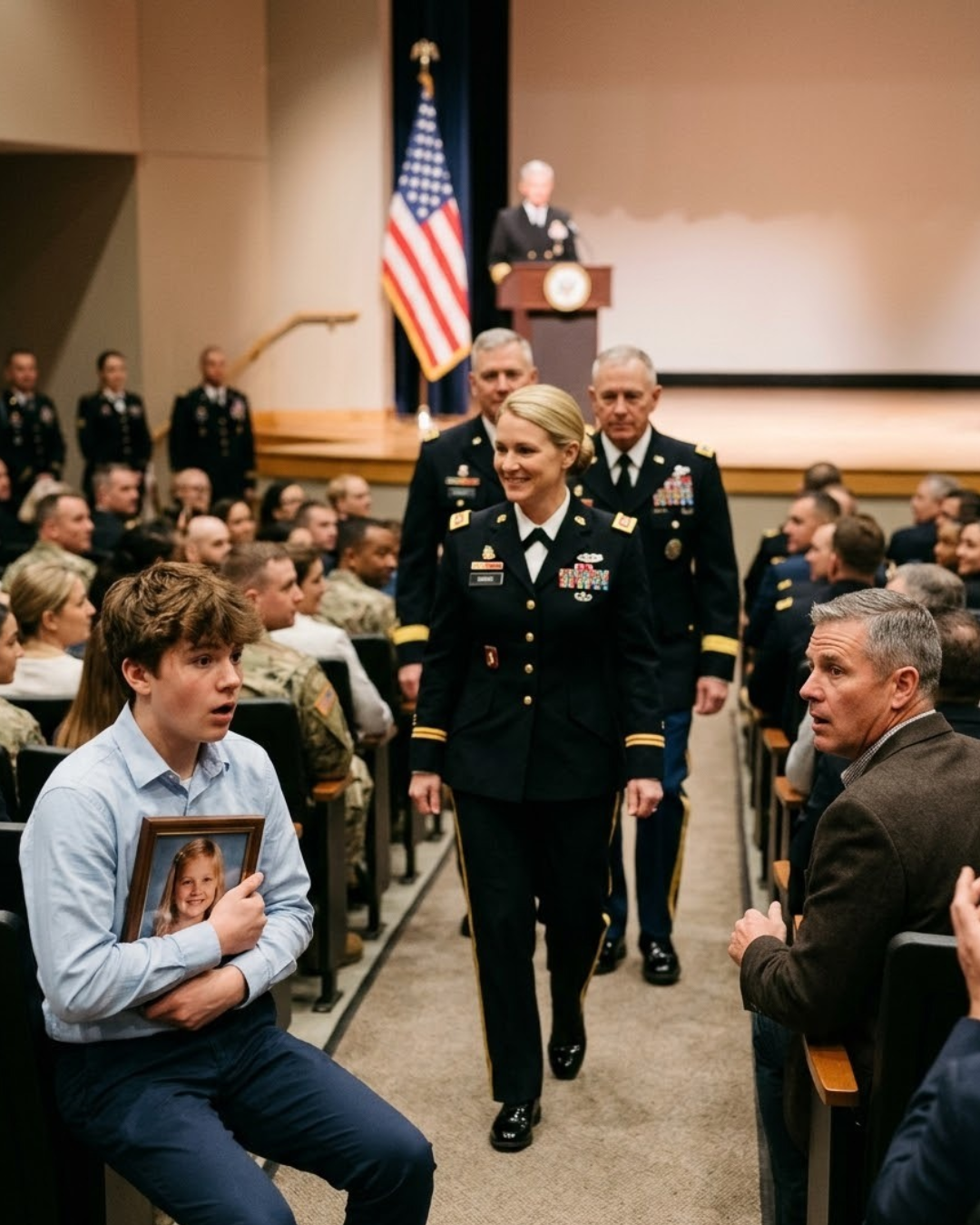
At home she was simply Mom, leaving notes beside my cereal and watching school plays by video when she was away.
She had one rule: I should never use her career to make myself seem important.
“You don’t need somebody else’s title to have your own worth, Owen.”
So for Westbridge High’s Heroes Week assignment, I brought no medals or records, only a photograph from an Army post years before I was born.
Mom stood between three other soldiers, her hair pulled back and her smile wider than the ones she wore in our family pictures.
When my turn came, I held it up.
“My hero is my mother, Rebecca Ellery. She’s a colonel in the Army, and she once commanded a group of Special Forces soldiers.”
My teacher, Mr. Paulson, leaned on his desk with an amused expression.
“Your mother commanded Special Forces?”
“Yes, sir.”
He laughed.
“Owen, come on. You can tell us the truth.”
A classmate muttered that Mom probably worked in an office, and my face grew hot.
I wanted to list the years she had spent away and the respect officers showed her, but I remembered what she had said after someone accused me of copying my science project.
“If someone refuses to believe you, don’t trade your dignity for a chance to win an argument. Let the truth have room to show up.”
I folded my notes and returned to my seat.
The whispers followed me through the morning, but I kept my eyes on my notebook, telling myself Mom would never want me to use her work as a weapon.
That afternoon, the auditorium filled for the Heroes Week ceremony.
Students, families, veterans, and military guests gathered beneath paper stars made by the art club.
I sat with my class, wishing I could slip out unnoticed, while Admiral Thomas Kessler read the program.
He paused when he reached my name, glanced at the side entrance, and the room grew quiet.
The girl beside me whispered:
“Owen, that’s your mom.”
The Woman in the Dress Uniform
Mom stood in the doorway in her Army dress uniform, its rows of decorations bright beneath the auditorium lights.
Two senior officers waited behind her.
She looked formal and unmistakably in command, yet when our eyes met, her expression was the same one she wore when she picked me up after practice.
Mr. Paulson seemed to forget how to breathe.
Admiral Kessler rose from the stage.
“Colonel Ellery.”
Mom had been invited weeks earlier; she had not come because I told her what happened.
The admiral turned to my teacher.
“Did Owen tell you his mother had served in a command role with Army Special Forces?”
Mr. Paulson glanced at me.
“He did, sir. It sounded extraordinary, so I was encouraging him to be accurate.”
“Did you check before accusing him of making it up?”
“No, sir.”
“Then you were making an assumption in front of a roomful of students.”
Mom remained calm.
“Thomas, Owen came here for a school ceremony. I don’t want his day to become a public argument.”
Mr. Paulson hurried to explain that students sometimes exaggerated their parents’ jobs and that Mom’s assignment was unusual.
She looked at him steadily.
“Then you could have asked about my service. I would have confirmed what can be discussed publicly. Owen’s assignment was about the person he admires, not my credentials. He deserved the same patience as every other student.”
The principal, Dr. Miriam Bell, came forward and apologized for not knowing what happened.
Mom said she had only learned moments earlier.
The admiral confirmed Mom’s Army command work and praised her habit of crediting her team.
“That’s generous, Thomas,” Mom said.
“It’s also accurate.”
A little laughter eased the room.
Then the admiral said he admired most that Mom never mistook a uniform or title for proof that one person mattered more than another.
He looked toward my row.
“Owen’s teacher doubted a statement that happened to be true. I believe Owen is owed an apology.”
Mr. Paulson walked to the microphone.
“Owen, I’m sorry. I called your statement false without checking, and I let the class laugh instead of stopping them. That was unfair.”
Being doubted hurt, but being left alone while everyone laughed hurt more.
Applause spread through the auditorium; Mom watched me, and when it faded, she asked to speak.
“Owen didn’t ask me to defend him, and he didn’t tell me what happened this morning. I’m proud he wanted to talk about me, but prouder that he didn’t use what happened as an excuse to humiliate someone else. Courage doesn’t always look dramatic. Sometimes it means choosing not to become cruel when you’ve been hurt.”
After the ceremony, Mom hugged me.
“You all right, buddy?”
“Everybody laughed.”
“I know.”
“I thought you wanted me to stay quiet.”
A sadness crossed her face, but Dr. Bell asked us to meet privately before she could answer.
Mom put one hand on my shoulder.
“Owen should be part of the conversation.”
What Fairness Looks Like
In a conference room, Dr. Bell apologized and promised to document what happened, speak with witnesses, and evaluate my assignment fairly.
Mom made one thing clear.
“I don’t want Owen treated specially because of my rank. I want him treated fairly because he’s a student here. Follow the same process you would if his mother worked at a grocery store.”
She asked what happened.
I described the photograph, the laughter, and the comments afterward, then asked the question that had been sitting in my throat.
“Would you have believed me if Mom hadn’t walked in?”
“I hope I would have listened.”
“That isn’t the same thing.”
She lowered her eyes.
“No, it isn’t. You were telling the truth before your mother arrived, and I should have taken that seriously.”
Her answer mattered more than the applause.
I needed an adult to admit I deserved a fair hearing.
Outside, Admiral Kessler greeted me, and we shared a brief laugh about the drone I had once flown into our neighbor’s rosebush.
Then Mr. Paulson asked whether he could speak with me.
Mom let me decide.
I agreed, and he said he meant his apology.
“I didn’t ask you questions, and I shouldn’t have laughed.”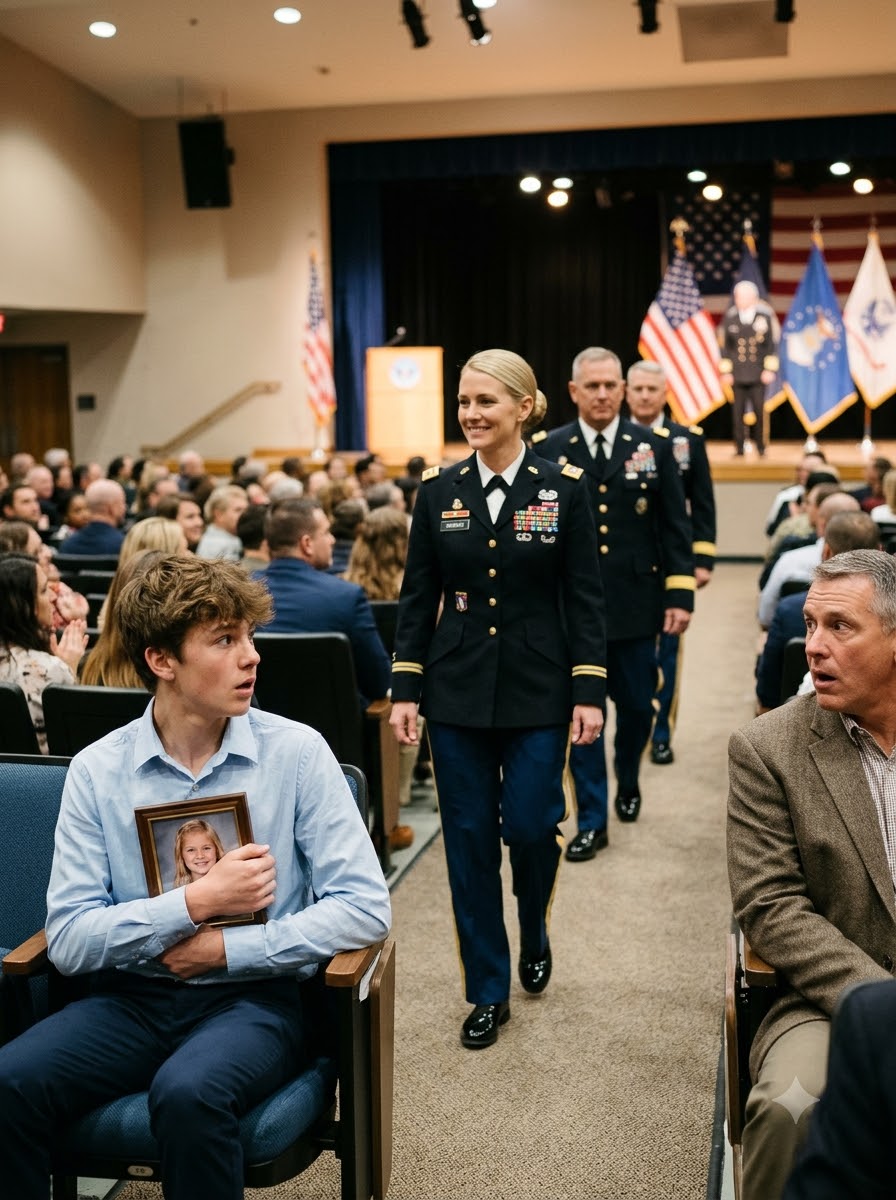
I told him he had made me feel stupid.
“You should never have needed an admiral and your mother standing in the auditorium for me to recognize that you deserved respect.”
He promised to address the class without making me stand up and to reevaluate my work fairly.
Mom said his actions would matter more than another apology.
After he left, I asked Mom whether she was angry.
“Yes.”
“You didn’t yell.”
“Being angry and losing control aren’t the same thing.”
I asked whether she could get him in trouble.
She said she had no authority over the school and would not use her rank to interfere with an employee.
We could follow the complaint process and ask for a fair response.
“We’re asking for fairness, not revenge. Fairness means acknowledging what happened and correcting what we can. Revenge means wanting someone else to suffer because we suffered.”
At the car, I asked why she had not told me she was coming.
The school had invited her weeks earlier, and she had arranged leave after missing many of my events, the empty chairs I had quietly remembered.
“Were you embarrassed by what happened?” Mom crouched until we were eye to eye.
“There is nothing embarrassing about being treated unfairly. You didn’t embarrass me, and you are never responsible for protecting my reputation by pretending someone hasn’t hurt you.”
She apologized for how she had phrased her rule.
I should not use another person’s accomplishments to put myself above anyone, she said, but telling the truth was not showing off.
“I never wanted you to think you had to hide who your family is, or that defending yourself meant breaking one of my rules.”
“I thought you wanted me to stay quiet.”
“No. I wanted you to know you don’t have to impress people to matter. I should have explained that better.”
I asked if she would have been angry if I had called her for help.
She said no; if I needed her, she would find a way to call back.
Then I hugged her, and we stood beside the car until the light faded.
A note waited beside my cereal the next morning.
Be yourself. Tell the truth. And remember that asking for help is never weakness.
Underneath, Mom had drawn a lopsided drone crashing into a rosebush.
I laughed despite dreading school.
PART 2
At lunch, my classmate Bryce, who had laughed during my presentation, found me.
“Your mom really is a big deal.”
“She’s my mom.”
“You should’ve told us.”
“I did.”
His smile faded.
“Yeah, I guess you did. I’m sorry.”
I asked why he laughed.
“Everybody else was laughing.”
“That’s what made it worse.”
He nodded.
“For what it’s worth, I was being a jerk.”
“Yeah. You were.”
We did not become best friends, but he had finally looked at me as a person instead of a punch line.
A Lesson That Stayed With Me
Mr. Paulson apologized to the class for accusing me without checking and letting others laugh.
My presentation had been reevaluated, and I had earned an A.
The school met with witnesses and arranged classroom observations.
I decided to stay in his class; I liked history and would not let one mistake decide where I belonged.
A week later Mr. Paulson returned my assignment with a note saying it had been thoughtful and that he had failed to recognize its value at first.
I was not ready to pretend everything was fine, but I could see he was trying.
That Thursday, Mom was in the kitchen in an old Army T-shirt and fuzzy socks, arguing with a jar of pasta sauce.
“Owen, help me open this.”
“You’re a Special Forces commander.”
“Former assignment, current problem.”
She handed me the jar.
“Leadership is knowing when to delegate.”
After I got the lid loose, I raised the jar.
“Mission accomplished.”
“Outstanding work, soldier.”
We laughed, and I noticed her wooden box on the counter.
It held letters, old photographs, a folded flag from a retirement ceremony, and a few challenge coins.
I found the picture from my presentation and asked who stood beside her.
She pointed to a tall man.
“Major Paul Garrison led our team.”
Then to a woman.
“Lieutenant Anne Whitlock. Serious until you knew her.”
“Where are they now?”
Mom paused before saying Anne had retired and Paul had not returned from a later assignment.
I asked whether that was why she rarely talked about the Army.
“Partly. There are people I miss, and some memories are hard to carry into an ordinary evening. People focus on the exciting parts, but most of the work is planning, training, listening, and making sure the people beside you have what they need.”
They looked like people who joked together, missed home, and grew tired.
“Did you ever get scared?”
“Of course.”
“But you’re always so calm.”
“Being calm doesn’t mean you aren’t scared. Sometimes you’re scared and still know what you need to do.”
I thought of standing before the class, wanting to disappear but choosing not to lash out, and asked if she thought I had been brave.
“You were hurt, but you showed more restraint than many adults. Yes, I think that took courage. But courage isn’t always staying quiet. Sometimes it’s asking for help or standing beside someone when everyone else walks away.”
I asked for a copy of her photograph.
“Why that one?”
“Because you look happy.”
Her eyes softened.
“All right. We’ll make you a copy.”
Standing Beside Someone
The following Monday, I saw a new student named Peter by a cafeteria table while three boys looked at a photograph he was trying to get back.
He had transferred a few weeks earlier and rarely spoke.
The picture showed his grandfather beside an Army maintenance truck.
“Give it back,” Peter said.
“Relax, we’re just looking.”
One boy held the photograph over his head.
“Is this your grandpa? He was in the Army?”
“Yes.”
Another boy laughed.
“Sure he was.”
I considered walking past.
I was tired of being school gossip, but I remembered Mom’s words about standing beside someone when others walked away.
“Give him the picture.”
The boy grinned.
“Look, it’s Colonel Mom’s kid. You going to call an admiral?”
My face warmed, but I held out my hand.
“No. I’m getting the lunch supervisor if you don’t return it.”
He glanced toward the staff member by the cafeteria doors and handed me the picture.
I passed it to Peter.
“Your mom really is a colonel?”
“Yeah.”
He looked at his grandfather’s photograph.
“My grandpa was a mechanic in the Army. Those guys think that’s nothing.”
“It isn’t nothing. If a truck doesn’t work, people don’t get where they need to go.”
Peter smiled a little.
“He used to say nobody notices a good mechanic until something breaks.”
We spent lunch talking about games and school, then walked to class together.
I had not needed a famous person or uniform to help; I only had to decide the moment called for it.
That evening I told Mom what happened.
She asked if Peter got his picture back and whether I had told the lunch supervisor.
When I said yes, she nodded.
“Are you proud of me?”
“Very. You helped someone who needed it without turning the moment into a fight.”
I grinned.
“So I handled it like a Special Forces commander?”
She raised an eyebrow.
“You handled it like Owen Ellery.”
A few weeks later, Dr. Bell asked me to speak at a small veterans’ gathering.
I nearly declined, then thought about Mom’s photo and Peter’s grandfather, and agreed.
Mom came from work in a dark sweater and jeans.
Peter sat with his grandfather, Raymond Becker, a veteran.
“Army maintenance?”
“Thirty years between active duty and civilian service.”
She shook his hand.
“Rebecca Ellery. Thank you for your service.”
He smiled.
“And you’re Army, I’m guessing?”
“That obvious?”
“The handshake gave it away.”
Peter leaned toward me.
“Your mom seems nice.”
“She is.”
Mom looked at us.
“Should I be concerned about what you’re saying?”
“Definitely,” I said, and she laughed.
When my name was called, I walked to the front, hands shaking.
“I used to think the most important thing about my mother was her Army command, because that sounded like what people would remember. But what matters most isn’t her rank; it’s the way she treats people. She taught me that strength means knowing when to stand up, listen, and admit a mistake.”
I lifted her photograph.
“These were her friends. One didn’t return from a later assignment, and another retired. I used to think about how impressive they were; now I think about how much they meant to each other. Every person who serves has a story, even if nobody knows their name. My mom is my hero, not because she is important to the Army, but because she is important to me.”
The room was quiet, then applause rose from the folding chairs.
Mom wiped beneath one eye and hugged me when I returned.
“That was the best speech I’ve ever heard.”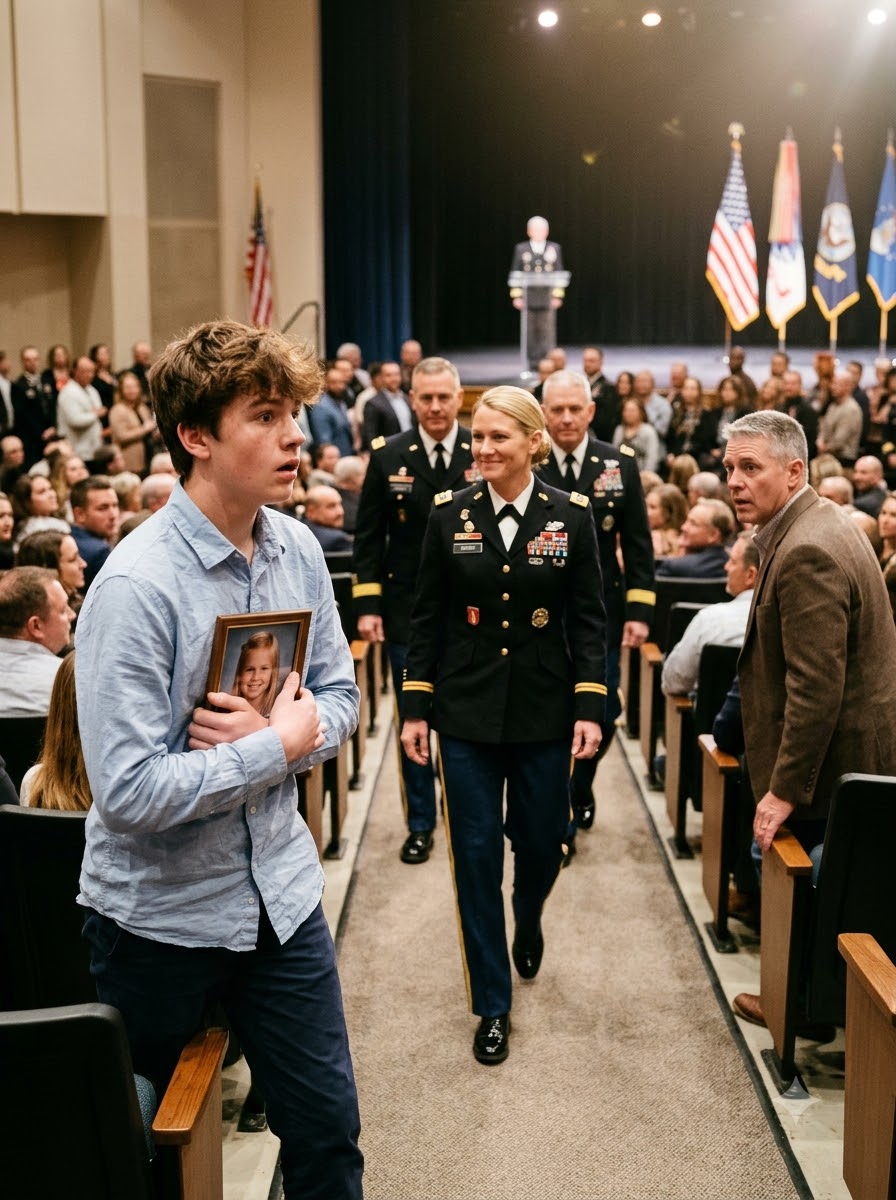
“Better than the admiral’s?”
“Much better.”
I smiled.
“And you’re still bad at opening pasta sauce.”
She leaned close.
“For the record, I’m perfectly capable of opening pasta sauce.”
Across the room, Mr. Paulson gave me a small nod.
I returned it; we did not need to make the moment bigger.
The Truth Was Already There
Afterward, Peter introduced Mom to his grandfather.
Dr. Bell said the school would train teachers to handle personal claims fairly and privately, and that she would remember my question about treating students fairly without knowing who their parents were.
On the drive home, I held the photograph in my lap while Mom kept both hands on the wheel.
She asked if I had felt confident during my speech.
“I was terrified.”
“You hid it well.”
I asked whether she ever wished she had chosen a different job.
“Sometimes I wish I’d had more time at home. I don’t regret joining the Army, but loving your work doesn’t mean you never wish some things had gone differently.”
I thought about birthdays she had missed and the fifth-grade play she watched by video.
“You sent flowers.”
“I know.”
“And you watched the recording.”
“I did. I still wish I’d been there.”
After a quiet moment, she reached across at a red light and squeezed my hand.
“That’s one reason I’m glad I came today. I got to see my son.”
A month later, I put a copy of the photograph above my desk beside the Heroes Week assignment Mr. Paulson returned with an A.
The grade mattered less than the sentence I wrote beneath his note: the truth does not become true when someone important confirms it.
I remembered Mom telling me I never had to protect her reputation by pretending I was fine, Mr. Paulson admitting he was wrong, and Peter holding his grandfather’s picture with pride.
Most of all, I remembered the mother who taught me to ride a bicycle, made terrible pancakes, and reminded me that I mattered.
One Sunday afternoon, I found her on the back porch with coffee and a book, sunlight sinking through the trees.
I sat beside her and asked whether she remembered what she had told me about letting the truth have room to show up.
“I do.”
“I think I understand. It doesn’t mean you have to stay quiet forever. It means you don’t have to lie or become cruel just because someone doesn’t believe you.”
She smiled.
“That’s a pretty good way to put it.”
I considered that.
“And sometimes you should tell a teacher when people are being jerks.”
She laughed and put an arm around my shoulders.
“That too.”
We sat as evening settled over the yard, with no uniform or audience, only my mother and me.
She had asked me to tell the truth, treat people fairly, and stand beside someone when it mattered.
Her rank did not make my life important; her belief in me helped me believe in myself when no one was watching.
