

Part One: The Coffee Can
Every year, Rhonda ran the raffle. She sold the tickets, kept the coffee can full of stubs, and drew the winning name herself, up front with the microphone.
For eleven years that was how it went at Grace Lutheran in Belden, Iowa, ever since Rhonda took over the Fellowship Committee from old Ruth Kessler. Ruth handed down the job together with her recipe for scalloped corn and a firm belief that nobody else could be trusted with either.
So when the church supper wound down that Saturday night in October, with the pie plates scraped clean and the folding chairs scraping across the floor, Rhonda stepped up to the little podium at the front of the fellowship hall. She had a red Folgers can in one hand and the microphone in the other.
“All right, everybody,” she said. “This is the moment you’ve all been waiting for.”
The quilt hung on the wall behind her. My quilt. They had strung a clothesline between two coat hooks and draped it over, so it fell all the way to the floor. A Double Wedding Ring in soft colors: pale yellow, sage green, and a rose pink so faint it was nearly white. Interlocking rings spread across the whole top, and every ring was built from thirty-two little curved pieces.
It was the prettiest thing in that room, and I don’t say it to brag. Everybody said so. All night, women had been drifting over to touch the edge of it and run their fingers along the binding. “Joan, how did you ever get those curves so even?” Edna Stoltz asked me during the meatloaf. “Patience,” I told her. “And my mother’s thimble.”
I had pieced that quilt all through the winter. Every curved seam by hand, ten stitches to the inch. I began the second week of November, once the corn was in, and I didn’t put the last stitch in the binding until the first week of March. Four months of evenings in the rocker by the woodstove in our front room, with the lamp turned up and the radio low, while Dale read the Farm Bureau Spokesman and dozed in his chair. My mother’s thimble sat on my finger the whole time, a silver one worn thin on top from forty years of her pushing needles through cotton. She gave it to me the year before she died.
The quilt was for the furnace fund. The furnace at Grace Lutheran was older than I was. It was an oil burner put in during 1958, the size of a pickup truck, squatting in the basement beside the Sunday school rooms, and every winter it took three men and a prayer to get it going. Last January it quit altogether during the Christmas program, and the children sang “Silent Night” in their coats while you could see their breath. In February the council got an estimate for a new one: fourteen thousand, eight hundred dollars, from Kaufman Heating in Waverly. For a country church with sixty-three members on the rolls and about forty in the pews on a good Sunday, that was a mountain. So everybody pitched in with bake sales, a pancake breakfast, a free-will offering at Easter, and the fall supper raffle with my quilt as the prize. Two dollars a ticket, three for five. We sold five hundred and seventy-three, more than eleven hundred dollars, Rhonda announced proudly after the pie. “Because that’s the prettiest quilt we’ve put up in years,” somebody said from the back. Harlan Moeller, I think. Everybody clapped. I looked down at my shoes.
Now Rhonda stood holding the can up for all to see. She wore her good fall sweater, the orange one with little embroidered leaves, and her hair was set the way she does it for church, in stiff blonde waves. “Before I draw,” she said into the microphone, “I just want to thank Joan Hartwig for donating this beautiful quilt. Joan, stand up so everybody can see you.” I was by the coffee urn at the back with a dish towel on my shoulder, having refilled cups all night. I raised my hand a little, and everybody turned and clapped again. “Isn’t she something?” Rhonda said. “My brother’s a lucky man.”
Then she reached into the can, and I watched her do it. I want to be clear about that. I stood in the back of that fellowship hall with a dish towel on my shoulder and watched every second. She didn’t shake the can. Not once. When you draw a raffle ticket, you shake the can first, and everybody knows it. You shake it hard so the stubs get mixed, so the ones on the bottom have the same chance as the ones on top. You hold it over your head so nobody can say you looked, and you close your eyes or turn away. That’s how Ruth Kessler did it for thirty years. Rhonda didn’t shake it. She didn’t lift it. She tipped it toward herself, reached in with her right hand, and felt around a second while looking down into it.
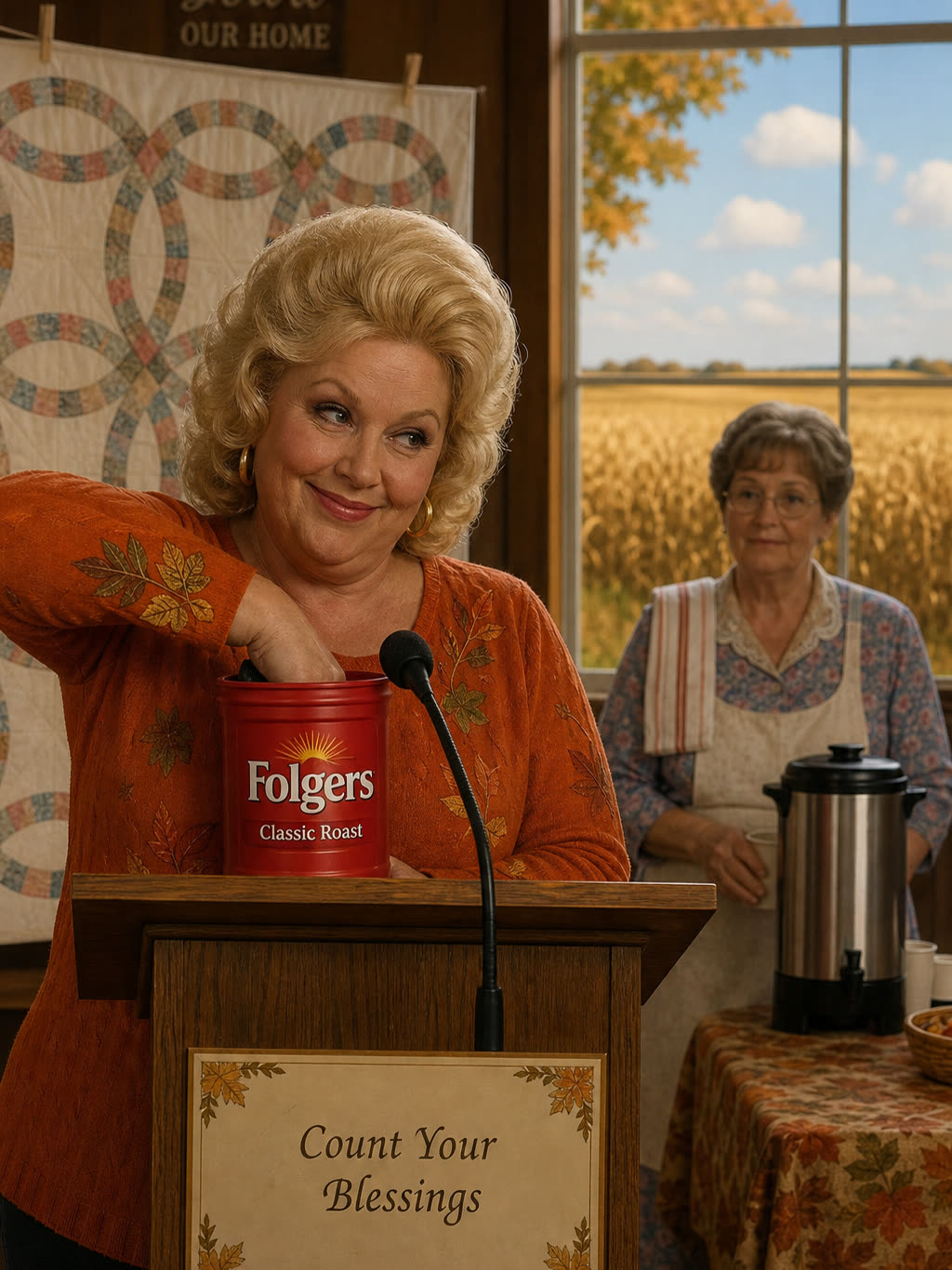
Then she pulled out one stub. She unfolded it slowly, read it, and put her hand on her chest.
“Oh my goodness,” she said into the microphone. “Oh, you all are not going to believe this.”
She looked up at the crowd, her eyes shining. “The winner,” she said, “is Katie.”
Katie is her daughter. Twenty-three years old, getting married in June to a boy named Tyler Brandt who worked at the John Deere plant in Waterloo. She sat at the second table from the front beside her fiancé, wearing a sweater the exact same orange as her mother’s. Her face went red and she put both hands over her mouth.
People clapped. Some of them, anyway. I heard a few laughs without much behind them. I heard Edna Stoltz say, “Well, isn’t that something,” in a voice that meant something else entirely.
Rhonda laughed into the microphone. “I swear I didn’t plan it! A wedding quilt for my girl! Honest to goodness, the Lord works in mysterious ways.”
I stood by the coffee urn with the dish towel on my shoulder, and I smiled. I know how to smile with nothing behind it. I learned at my own mother’s funeral, standing three hours in the receiving line. You lift the corners of your mouth, keep your eyes soft, and nod, and you can do it a long time if you have to. I smiled while Katie came up and Rhonda hugged her, while they took my quilt off the clothesline and Katie held it against herself, and while everybody clapped again. Then I turned around and filled the coffee urn, even though it was already full.
Chapter Two: The Drive Home
I did not see her slip a stub. I want to be honest about that, because honesty is about all I have in this story. I never saw Rhonda take a ticket from her pocket or her sleeve. I didn’t see her mark one or pull it from the top of the pile where she’d put it. Nobody did. But a fair person shakes the can first, and she didn’t. I would swear to that in church with my hand on the Bible. Swearing isn’t proof, though. I know that too.
Dale drove us home in the dark. We live four miles out of Belden on a gravel road, in the farmhouse his grandfather built in 1922. We farmed three hundred and twenty acres of corn and beans for thirty-eight years. Now Dale rents most of it to the Hoffman boys and keeps forty acres and a few beef cows, because his knees aren’t what they were. He drove his old Silverado with the window cracked, the way he always does, even in October. The headlights swept across the ditches, and the fields on both sides lay gray and flat with stubble under a half moon.
He said nothing for the first two miles, and neither did I. Then, just past the Mueller place, he cleared his throat.
“You going to say something,” he said. It wasn’t really a question.
“Say what,” I said.
He didn’t answer right away. He reached over and turned down the radio, which was already off.
“That I think she pulled her own girl’s name?” I said.
There it was, out loud, in the cab of the truck in the dark. Dale kept his eyes on the road.
“She didn’t shake it,” he said quietly.
“No.”
“Ruth always shook it. Every year. Like she was mixing paint.”
“I know.”
He was quiet another half mile. Rhonda is his little sister, six years younger. He taught her to ride a bike, drove her to her prom, and walked her down the aisle when their father was too sick to do it.
“Pastor Dahl could ask her,” Dale said finally. “Quiet. Just ask her.”
“And then what,” I said.
I’d been thinking about it since the moment she said “Katie.” I’d thought about it while I washed forty coffee cups in the church kitchen.
“She cries,” I said. “Katie cries. Rhonda says how dare anybody accuse her, after eleven years running that raffle for free. She says she’s never been so hurt in her life.”
Dale said nothing. He knew his sister.
“And half the church takes her side,” I said. “Because she’s done the funeral lunches for twenty years. Because she brings scalloped corn to every potluck. Because she cried.”
“And the other half,” Dale said.
“Takes mine. Because I made the quilt. Because Edna Stoltz saw it too. Because a lot of people have been waiting a long time to say something about Rhonda.”
I looked out at the dark fields. “And come Easter,” I said, “we have two churches in one building. Sitting on opposite sides. Not talking at coffee hour. Arguing at council meetings about the furnace. Over a quilt.”
We’d seen it happen. In 1997, Grace Lutheran nearly split over whether to put carpet in the sanctuary. The Heinrichs and the Volkmanns didn’t speak for six years, and three families left for the Methodist church in Denver. Over carpet.
“I can’t prove she rigged it,” I said. “And I won’t split the church over a quilt.”
Dale nodded slowly. “So you’re going to say nothing.”
“I’m going to say nothing.”
He reached across the bench seat and laid his big rough hand over mine. He held it the rest of the way home.
For a week I scrubbed things that were already clean. That’s what I do when something sits wrong in me, and my mother did it too. I scrubbed the kitchen floor on my hands and knees. I took every plate out of the cupboard, washed it, and put it back. I cleaned the oven. I washed the windows inside and out, though it was forty degrees and the wind was blowing. On Wednesday Dale came in from the barn and found me on a ladder scrubbing the top of the refrigerator.
“Joan,” he said.
“I’m fine.”
“Nobody’s been up there since 1985.”
“Then it needed it.”
He stood in his barn coat looking at me a long while. Then he went back out.
It wasn’t the quilt. Not really. I mean, it was. Four months of my evenings, now on Katie Pfeiffer’s bed, and I won’t pretend that didn’t sting. But it wasn’t the cheating either. Rhonda has bent little rules her whole life. She takes the biggest piece of pie. She cuts in line at the pancake breakfast. She got her picture in the paper for the food drive even though Edna did all the work. None of that kept me up at night. What kept me up at night was Pearl.
Chapter Three: Sixty Dollars in Quarters
Pearl Wendt is eighty-one. Nine years ago she lost her husband, Vern, in a bean field. He was walking beans on a hot July afternoon, pulling volunteer corn out of the rows by hand the way the old-timers still did. He was seventy-five, and his heart gave out somewhere in the middle of the field. Pearl found him at suppertime when he didn’t come in, walking out to look for him in her house shoes. She said later he was lying on his back between the rows looking up at the sky, as if he’d just decided to rest. His seed corn cap was still on his head.
They had rented their farm and never owned land. When Vern died, the landlord’s son rented the ground to somebody else, and the farmhouse went with it. So Pearl moved to town, into half a house on Third Street, a little white duplex near the grain elevator, built in the forties, with a sagging porch and a storm door that wouldn’t latch. She rented the east half for four hundred and fifty dollars a month from a man in Cedar Falls she’d never met. She lived on Vern’s Social Security, nine hundred and twelve dollars a month, with no pension and no savings to speak of. They had spent everything on his bypass surgery in 2009.
I didn’t know Pearl well before that October. I knew her the way you know people at church. She sat in the back row on the left, same spot every Sunday. She wore the same navy blue coat every winter and always brought a pan of plain bars to the potluck, oatmeal or peanut butter, never anything fancy. She didn’t serve on committees or sing loud. She came early, left late, and smiled at everybody.
Then, at the fall supper, I saw her buy raffle tickets. It was before the meal, at the card table by the door where Rhonda was selling them. I was carrying a tray of coffee cups past, and I stopped, because Pearl was counting out money in quarters. She had them in a little cloth coin purse and was stacking them on the card table in fours, one dollar, one dollar, one dollar, little silver towers in a neat row like she’d practiced. She stacked up sixty dollars. Two hundred and forty quarters.
“Pearl,” Rhonda said, laughing. “That’s a lot of tickets, honey.”
“It’s for the furnace,” Pearl said. “And I’ve had my eye on that quilt since you hung it.”
She looked over at the wall where my Double Wedding Ring hung in its soft colors. “I never owned a quilt somebody made new,” she said. She said it so simply, not complaining, just a fact like the weather.
“Vern’s mother had some old ones,” she said. “But they were all worn through by the time they came to me. I’ve been sleeping under one with a hole in the middle for forty years.” She smiled. “I’d like to sleep under something new before I go. Just once.”
Rhonda counted the quarters and tore off the tickets. At three for five, sixty dollars should have bought thirty-six. She gave Pearl thirty. I noticed. I said nothing.
Pearl folded her stubs carefully into her coin purse and went to sit in the back row with a plate of meatloaf. She didn’t win either. When Rhonda said “Katie,” I looked at the back row, I couldn’t help it. Pearl sat with her coin purse in her lap. Her face didn’t change, not a flicker. And then she clapped for Katie, slowly and politely from the back row, the way you clap at a funeral when somebody finishes a hymn.
That was the part I couldn’t let go of. Not the cheating, not my four months of evenings, not even Rhonda saying the Lord works in mysterious ways. The sixty dollars. A widow’s grocery money, two hundred and forty quarters saved probably one at a time, from God knows where, spent on a paper chance at a quilt she’d never own. That’s what had me on a ladder scrubbing the top of the refrigerator.
Chapter Four: The Visit
The second week, I drove into town on a Tuesday. I told Dale I needed thread from the Ben Franklin, and that was true. But I drove past the Ben Franklin, turned left on Third Street, and parked across from the little white duplex by the grain elevator. I sat in the car a long time without knowing what I would say.
Then Pearl came out onto her porch in her navy coat, carrying a plastic Hy-Vee bag full of something. She came slowly down the steps with one hand on the railing and walked toward the end of the block. I followed her, slowly, in the car, like a fool. She walked two blocks to the Casey’s General Store on Main Street, not inside but around the back, to the redemption machine by the dumpster where you return your pop cans.
She opened her Hy-Vee bag and fed in cans one at a time. The machine sucked each one in with a little rattle and spat out a ticket. Five cents a can, that’s what Iowa pays under the bottle bill. She had maybe forty cans. Two dollars. When she was done she took the ticket into the store and came out with two dollars in quarters, put them in her cloth coin purse, and walked home.
I sat in my car in the Casey’s lot and cried so hard I had to turn the engine off. Two hundred and forty quarters. Twelve hundred cans. She walked the ditches, I found out later, along Highway 3, the county road past the cemetery, and the ball diamond after the Little League games, picking up cans other people threw away. Every day, for years. She took that money and bought raffle tickets for a quilt, for the furnace fund, for the church.
That night I couldn’t sleep. I lay beside Dale listening to him snore and the wind push at the old windows. I thought about Pearl’s quilt with the hole in the middle. Forty years. I thought about my mother, about sitting on the floor of her sewing room in Clarksville when I was eight, sorting scraps by color into coffee cans while she worked. I thought about the sound of her treadle machine and the way she’d hold a finished quilt up to the window and squint at it.
“A quilt is just a prayer you can sleep under,” she told me once. “Every stitch is a little wish for whoever’s going to use it.”
Around two in the morning I got up. I went downstairs in my robe, turned on the lamp in the front room, and opened the closet under the stairs. I pulled out my scrap bins, six big plastic tubs of fabric sorted by color the way my mother taught me. I couldn’t undo the drawing. I couldn’t prove anything. I couldn’t make Rhonda shake the can. But nobody could stop me from making another quilt.
So I did. And I had no idea who else would soon be watching me sew.
Part Two: The Second Winter
Chapter Five: The Second Winter
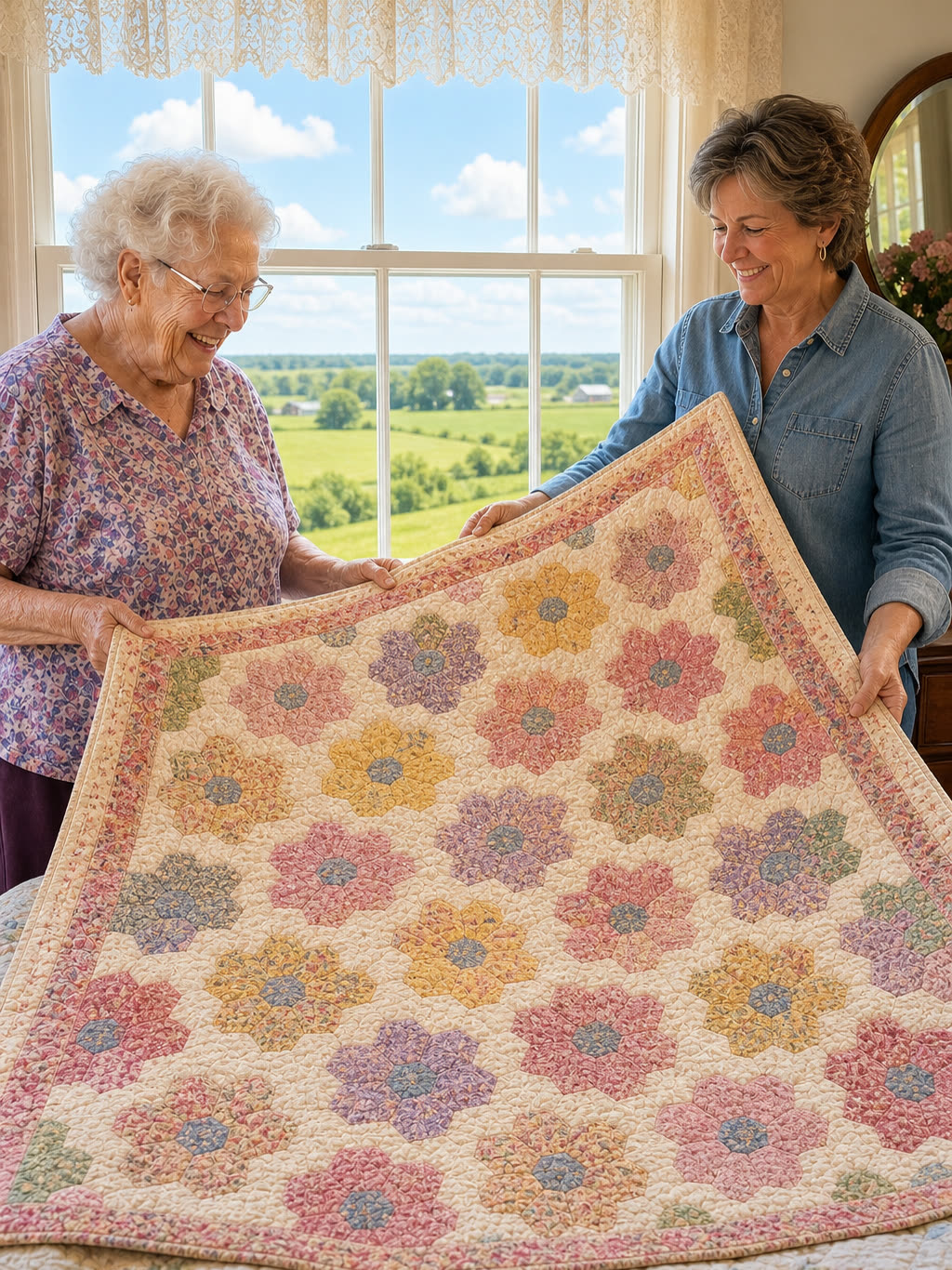
I started the next night, after Dale went up to bed. This time I chose Grandmother’s Flower Garden, the oldest pattern I know. My grandmother made one, and my mother made three. I’d never made one myself because it takes forever.
It is built from hexagons, little six-sided pieces each about the size of a half dollar. Seven of them sewn together make a flower, one in the center and six around it. A ring of green hexagons goes around that for leaves, and then the flowers are joined with white hexagons between, like garden paths. A queen-size Flower Garden takes about two thousand hexagons, each cut by hand, basted over a paper template, and whipstitched to its neighbor. One flower at a time.
I chose the colors carefully. The petals were every color I had: pinks and yellows and lavenders, old feed sack prints from my mother’s bins, a green check from a dress I wore in high school, a red calico from Dale’s mother’s apron. Little flowers from everybody’s life, all mixed together.
But the centers were all the same, every single flower. A soft, faded blue with a tiny white dot, cut from my mother’s old housedress, the one she wore every day in her kitchen for twenty years. She had it on in the last picture I have of her, standing at her stove in Clarksville, laughing at something my father said. After she died I couldn’t throw it away. I kept it folded in my cedar chest for eleven years. Now I cut it into hexagons, one for the heart of every flower.
Dale found me the first night. He came downstairs at midnight for a glass of water and saw the lamp on. He stood in the doorway in his long underwear and looked at me in the rocker, my lap full of paper hexagons and Mom’s thimble on my finger.
“Another one,” he said.
“Another one.”
He didn’t ask who it was for. He knew. He went to the kitchen and filled his glass, and on his way back through he stopped and put more wood in the stove. Then he went up to bed. He did that every night that winter, adding wood on his way to bed and never saying a word about it.
The winter was long that year. It snowed the week before Thanksgiving and didn’t stop, and by January the drifts against the machine shed stood higher than Dale’s head. I sewed through all of it. Some nights I finished a flower, some nights only half of one. My eyes aren’t what they were, the hexagons are small, and my mother’s thimble was wearing thin on top, just as hers had.
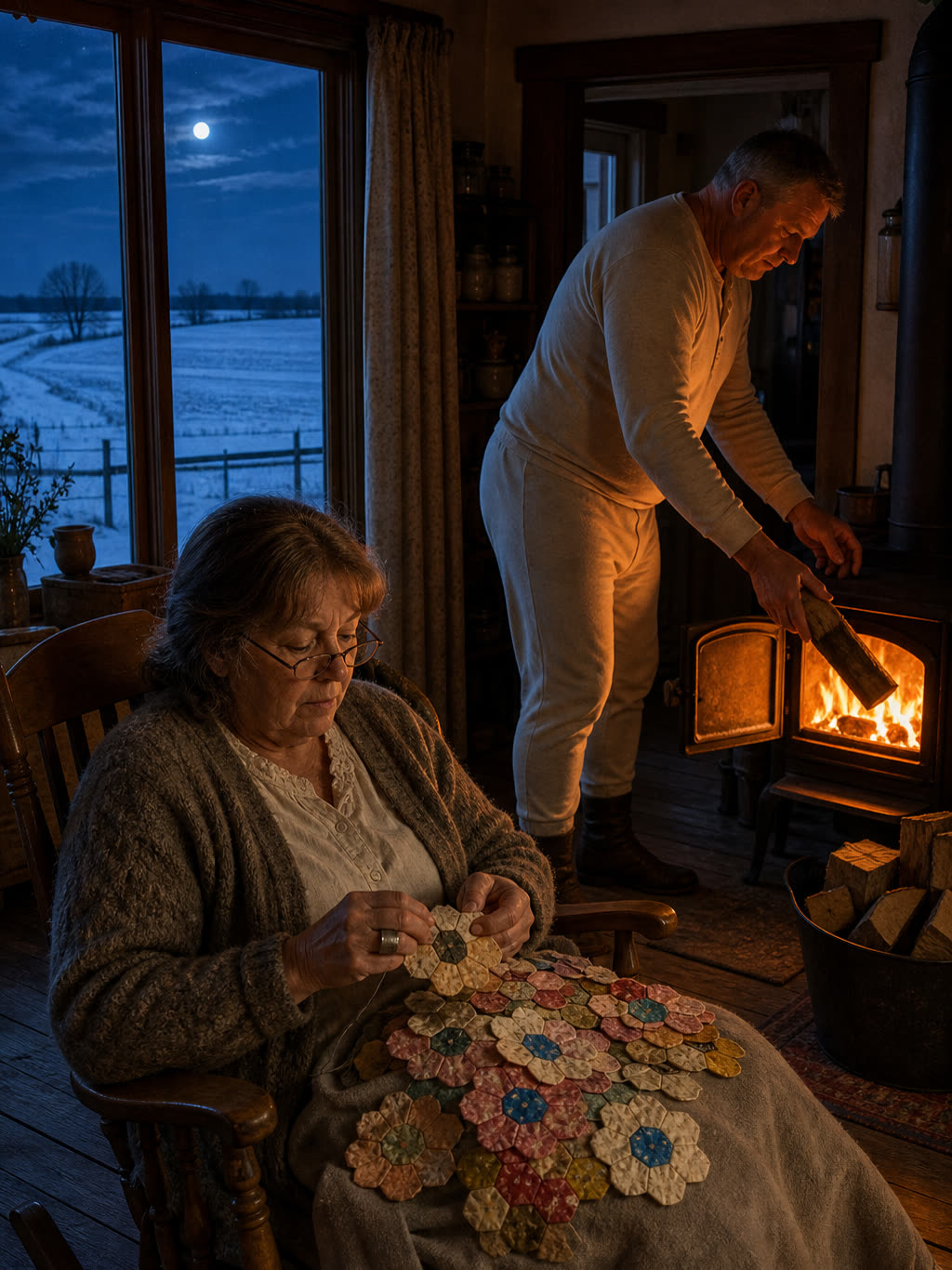
I counted them the way she taught me: stitches to the inch, hexagons to the flower, flowers to the row. When I reached fifty flowers I laid them out on the dining room table, and Dale came in from chores and stood looking. “That’s a lot of little pieces,” he said. “Two thousand and four,” I said. He whistled.
In December, the church council met to talk about the furnace. The raffle had brought in eleven hundred and forty-six dollars. With everything else, the bake sales, the free-will offerings, and a gift from the Hoffman family, the fund held about nine thousand, still almost six thousand short. Kaufman Heating said they couldn’t hold the price past spring.
Dale was on the council that year. He came home from the meeting in a quiet mood, hung his coat on the hook by the door, and stood warming his hands at the woodstove.
“Rhonda gave a report,” he said. “On the raffle. She said it was the most successful fundraiser in church history.” He paused. “She thanked you three times.”
I didn’t look up from my hexagon.
“And she said,” Dale went on, “that Katie’s going to put the quilt on the gift table at the wedding. So everybody can see the beautiful prize she won.”
My needle stopped. I said nothing. I put in three more stitches and set it down.
“Dale,” I said. “Do you know anything about Pearl Wendt’s house? The heat?”
He looked surprised. “Why?”
“I drove by on Tuesday. All her windows have plastic on them. And there’s frost on the inside of the front one.”
Dale was quiet a moment. “That’s Howard Brenner’s duplex,” he said. “Out of Cedar Falls. He doesn’t fix anything. Folks say that furnace has been on its last legs for years.”
I picked up my needle again. “Somebody should look at it,” I said.
Chapter Six: The Wedding
Katie Pfeiffer married Tyler Brandt on the second Saturday in June, at Grace Lutheran, with the reception afterward in the fellowship hall. The same hall, the same folding tables, the same coffee urn. We went, of course. Dale is her uncle. He wore his good suit and I wore my blue dress, and we sat on the bride’s side three rows back. Rhonda cried through the whole ceremony. Katie looked beautiful. I want to say that clearly. She’s a sweet girl, always has been. She used to follow me around my kitchen when she was little, asking to lick the beaters.
At the reception the gift table stood along the back wall, right where the clothesline had been in October. My quilt was on it, folded on top, with a little card propped in front in Rhonda’s curly handwriting. Handmade Double Wedding Ring Quilt. Won by the bride at the Grace Lutheran Fall Raffle! Made by her Aunt Joan. A sign from above!
People stopped to look at it all evening, and women ran their fingers along the binding. “Isn’t that the luckiest thing,” I heard Doris Engel say. “A wedding ring quilt, for a wedding.”
“I always say the Lord has a sense of humor,” somebody else said.
I stood by the punch bowl and smiled. Across the room I saw Pearl sitting alone at a corner table in a flowered dress that must have been thirty years old. A piece of wedding cake sat in front of her, untouched. She was looking at the gift table, at my quilt. Then she looked away.
Halfway through the dancing, Katie found me by the punch bowl. She was flushed and happy, her veil off and her shoes in her hand, and she hugged me hard.
“Aunt Joan,” she said. “Thank you so much for coming. And thank you for the quilt. I’m going to keep it forever. I mean it.”
“I’m glad you like it, honey.”
She pulled back and looked at me. Something crossed her face, just for a second. “Aunt Joan,” she said, quieter. “Can I ask you something?”
“Of course.”
She opened her mouth. Then she glanced over her shoulder. Rhonda was across the room laughing with the Lutheran Women, looking our way. Katie closed her mouth.
“Never mind,” she said. “It’s nothing. I’ll ask you sometime.” She went back to the dance floor.
Dale drove us home that night in the dark with the window cracked. Just past the Mueller place he spoke.
“She knows,” he said.
“Who?”
“Katie. She knows. I watched her face when she was talking to you.”
I looked out the window. “Maybe,” I said.
I finished the Flower Garden in March, on the first warm day of the year, with the windows open for the first time since October. I put the last stitch into the binding at four-thirty on a Thursday afternoon. Then I carried it out to the clothesline in the backyard and hung it in the sunshine, the way my mother always did with a new quilt, to let the air through it and let it breathe.
Dale came around the corner of the barn and stopped. He stood a long time in his work boots, looking at two thousand and four hexagons, every flower a different color, every heart the same faded blue.
“Your mother’s dress,” he said finally.
“Yes.”
He walked over and laid his hand flat on one of the blue centers, gently, as if he were touching her. “She’d have liked that,” he said.
Chapter Seven: The Storm Door
In April I folded it into a pillowcase, a plain white one, ironed, from my linen closet. I folded the quilt in thirds and then in thirds again and slid it in the way you’d lay a baby in a bassinet. On a Wednesday afternoon I drove to Pearl’s side of town, to Third Street and the little white duplex by the grain elevator.
The plastic was still on the windows, grayer now after a whole winter and peeling at one corner. Her storm door hung open about an inch, and the wind pushed it back and forth so it tapped against the frame. Tap. Tap. I went up the sagging porch steps and stood with the pillowcase under my arm. My heart was going as if I were walking into a job interview. I don’t know why. She was only an old woman, a widow from church. I knocked.
I heard her coming, slow, a shuffle, a pause, another shuffle, one hand along the wall. I could hear her fingers brushing the wallpaper. The latch turned and the inside door opened a few inches. Pearl looked out through the gap in a gray cardigan buttoned wrong, two pairs of socks, and the same navy coat she wore to church. Indoors. The air that came out was cold, colder than the April afternoon outside.
“Joan Hartwig,” she said, blinking at me. “Is something wrong? Is it Dale?”
“No,” I said. “Nothing’s wrong. Can I come in, Pearl?”
She opened the door the rest of the way. Her half of the duplex was small, a front room, kitchen, bedroom, and bathroom, neat as a pin. A little television, a recliner with a crocheted afghan over the back, and a picture of Vern on the wall in his seed corn cap, squinting into the sun. And a little electric space heater plugged in by the recliner, its coils glowing orange, the only warm thing in the room.
“Pearl,” I said. “Is your furnace working?”
She looked embarrassed. “It works some,” she said. “Some days. Mr. Brenner says he’ll get somebody out. He’s been saying it since Thanksgiving.” She waved her hand. “I’ve got my heater. And my coat. I’m fine.”
I didn’t argue. Not yet. I held out the pillowcase. “I made you something,” I said.
She looked at it, then at me, and didn’t take it. “Joan,” she said. “What is this?”
“Open it and see.”
She carried it to the kitchen table and set it down very carefully, as if it might break. She untucked the end of the pillowcase and pulled out the corner of the quilt, just the corner. Three flowers, a pink one, a yellow one, a lavender one, each with a faded blue heart. Her hands stopped. She stood at her kitchen table in her coat, holding that corner, and didn’t move for a long time.
Then she drew out the rest of it slowly, unfolding it, and held it up against herself the way Katie had held up the Double Wedding Ring at the raffle. It went all the way to the floor.
“This is new,” she whispered.
“Brand new,” I said. “Every stitch.”
“Who made it?”
“I did. This winter.”
She looked at me, her eyes very wet. “For who?”
“For you, Pearl,” I said. “Only ever for you.”
Chapter Eight: What Pearl Saw
She sat down at the kitchen table with the quilt in her lap and ran her hand over it flower by flower, touching every blue center as if she were counting them.
“Joan,” she said. “Why?”
I didn’t know how to answer at first. I pulled out the other chair and sat across from her.
“Because you bought sixty dollars of tickets,” I said. “In quarters. And you said you’d never owned a quilt somebody made new.”
She looked down at her hands.
“And because you didn’t win,” I said quietly. “And I didn’t think that was right.”
Pearl was quiet a long time. The space heater ticked. Outside a grain truck rumbled past toward the elevator.
“You know,” she said finally. “Don’t you? About the drawing.”
I didn’t answer. I didn’t have to.
“I was in the back row,” Pearl said. “I could see her hands. I’ve got good eyes for an old woman. Vern always said I could spot a weed in a bean field from the road.”
She looked up at me. “She reached in her apron pocket,” Pearl said. “Before she reached in the can. Just for a second. Her right hand. Then into the can, and out.”
My breath stopped.
“I saw it,” Pearl said simply. “Plain as day.”
“Pearl,” I said. “Why didn’t you say something?”
She smiled, a small, tired smile. “Who would I say it to? Rhonda? Pastor Dahl? The whole fellowship hall?” She shook her head. “I’m an eighty-one-year-old widow who rents half a house from a man in Cedar Falls. Rhonda’s been running that church kitchen for twenty years. Who do you think they’d believe?”
“I would have believed you.”
“I know you would,” she said. “I watched your face by the coffee urn. You smiled the way I smiled at Vern’s funeral.”
She folded her hands on top of the quilt. “And if I’d said something, then you’d have had to choose. You and Dale. Between his sister and the truth. In front of the whole church.” She shook her head. “I’ve seen a church split, Joan. In 1997. Over carpet. I wasn’t going to be the reason it happened again. Not over sixty dollars.”
“It wasn’t just sixty dollars, Pearl. I saw you at the Casey’s. With the cans.”
She went red and looked away. “Well,” she said. “It’s honest money.”
“That’s twelve hundred cans.”
“Fourteen hundred,” she said. “Some of them were bottles. Those are bigger.” She almost laughed. “And I didn’t buy those tickets to win, Joan. Not really. I bought them for the furnace.”
I didn’t understand.
“The church furnace,” Pearl said. “You know where I go on Wednesday afternoons? When it’s cold?”
I shook my head.
“The church,” she said. “The fellowship hall. I go sit in there and read. Pastor Dahl leaves the side door unlocked for me. He knows. He’s the only one who knows.” She looked at her space heater. “It’s warmer than here. When the church furnace works.”
She smoothed the quilt over her knees. “Last January it quit,” she said. “During the Christmas program. And I thought, if it goes, I lose my Wednesdays. So I bought sixty dollars of tickets. For the furnace.” She smiled. “The quilt was just a bonus. A dream. I didn’t really think I’d win it.”
Chapter Nine: Katie
I stayed at Pearl’s two hours that afternoon. She made coffee on her stove, which still worked, thank God, and we drank it at her kitchen table with the Flower Garden spread across both our laps. She told me about Vern, how they met at a barn dance in Tripoli in 1961, how he proposed in a hayloft, how he wore that seed corn cap even to church until the pastor made him take it off. I told her about my mother, the treadle machine, the coffee cans of scraps, the blue housedress.
“Every heart,” Pearl said, touching a blue center. “Every single one.”
“Every one,” I said.
“So your mother’s in every flower.”
I couldn’t answer. I only nodded.
When I left, I made her promise to call Dale if the furnace went out again. She promised. I didn’t believe her. I drove home and found Dale in the machine shed working on the baler, and I told him about the cold, the frost on the inside of the window, the space heater. He put down his wrench.
“How old’s that furnace?” he asked.
“I don’t know. Pearl said Mr. Brenner bought the duplex in 1994. It was there before that.”
Dale wiped his hands on a rag and was quiet a long time. “I know a guy at Kaufman’s,” he said.
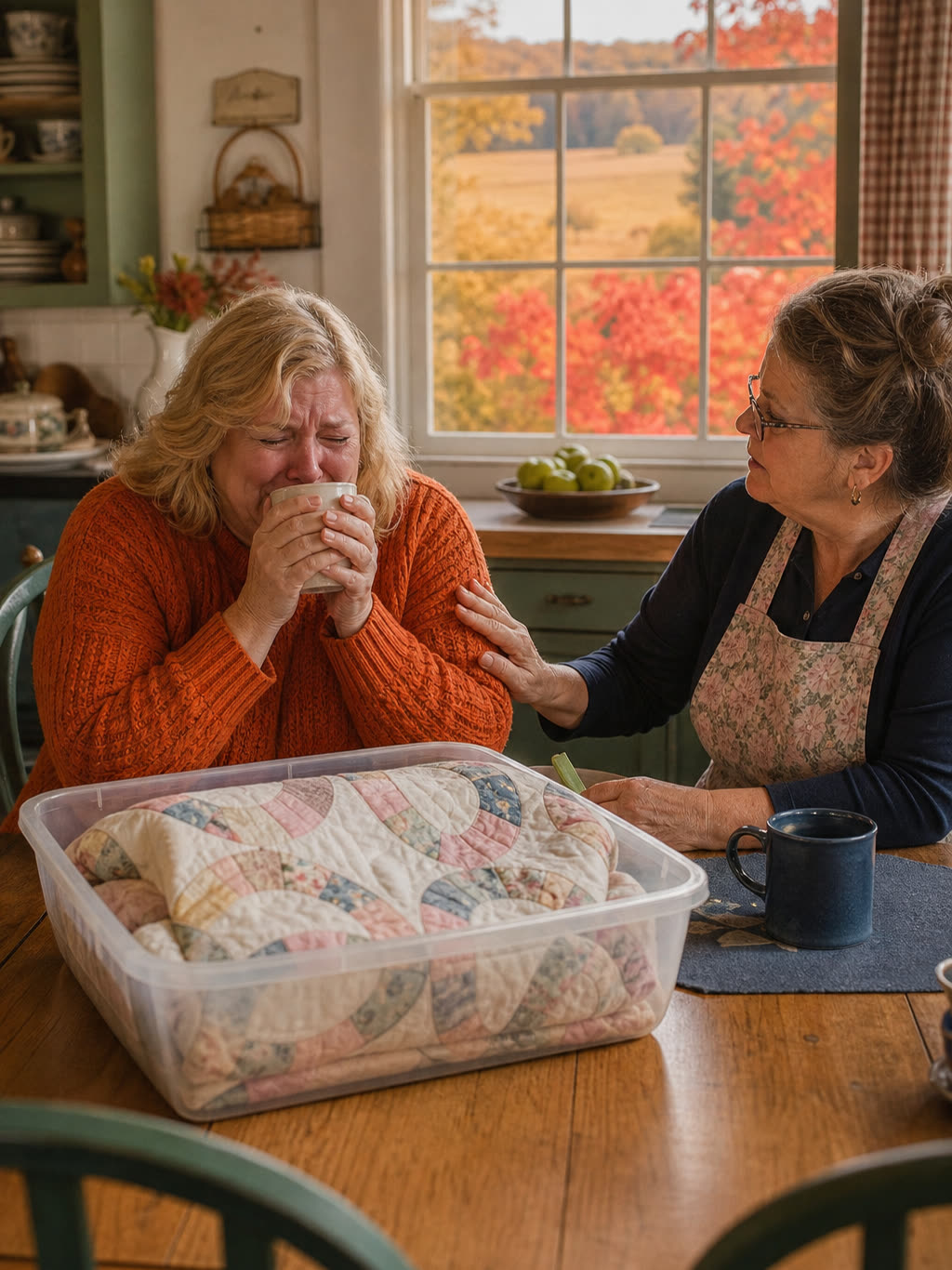
But before Dale could call Kaufman’s, someone knocked at our door. It was a Saturday morning, three days later. I was in the kitchen making bread and Dale was out with the cows. I wiped my hands on my apron and opened the door. Katie stood on our porch holding a big plastic tub, the kind you keep sweaters in. Inside, folded, was my Double Wedding Ring.
“Aunt Joan,” she said. “Can I come in?”
I let her in. She set the tub on the kitchen table and didn’t sit. She was already crying, not loud, just tears running down her face that she kept wiping away with the back of her hand.
“I found the stub,” she said.
I said nothing.
“In Mom’s apron,” she said. “The orange one she wore at the supper. She asked me to wash it last week, because she was helping me move into our new apartment and didn’t have time.” She took a breath. “I went through the pockets. Like you’re supposed to. And there it was. A raffle ticket. Folded up small. With my name on it.”
She reached into her jeans pocket and pulled out a little red stub, folded in quarters, and laid it on the table beside the tub.
“It wasn’t the one she drew,” Katie said. “That one she gave to me. I’ve got it in my wedding scrapbook. This was a second one. Like a spare.” Her voice broke. “In case the first one fell out of her hand or something.”
I sat down and unfolded the stub. Katie Pfeiffer, in Rhonda’s curly handwriting.
“I knew,” Katie said. “Aunt Joan, I think I knew the whole time. When she said my name. She didn’t shake the can. Everybody always shakes the can.” She wiped her eyes. “I wanted to say something at the wedding. When you were by the punch bowl. But I couldn’t. Not with her right there. Not on my wedding day.”
“I know, honey.”
“Did you know?”
“I didn’t know,” I said. “I thought.”
She looked at the quilt in the plastic tub. “I can’t keep it,” she said. “I can’t sleep under it. Tyler asked me why I keep folding it up and putting it in the closet. I told him I was afraid of getting it dirty.” She laughed through her tears. “That’s not why.”
She pushed the tub across the table toward me. “I want to give it back,” she said. “Or give it to someone. Or put it in the raffle again. I don’t know. I just want to make it right.”
I looked at my niece, twenty-three years old, married eight weeks.
“Have you talked to your mother?” I asked.
She shook her head. “I’m scared to,” she said. “She’ll cry. She always cries. And then I’ll end up apologizing to her.”
I didn’t know that by Monday morning I would hear a car door slam in my driveway hard enough to rattle the kitchen windows.
Part Three: The Furnace and the Can
Chapter Ten: Rhonda
Rhonda came on Monday. I heard her car in the driveway at nine in the morning, her white Buick with the bumper sticker that says Proud Grandma of an Honor Student, though she has no grandchildren yet. The car door slammed so hard I heard it in the kitchen. She didn’t knock. She came straight in the back door, the way family does, carrying a plastic tub. The same plastic tub, with my quilt in it.
“What did you say to her?” Rhonda said.
No hello, no good morning. She set the tub on my kitchen table so hard the salt shaker jumped.
“I didn’t say anything to her, Rhonda. She came to me.”
“She came to you with this.” She pointed at the tub. “And then you sent her home with it? And she comes to my house in tears and gives it to me and says she can’t keep it? Says she found something in my apron?”
“She did find something.”
“She found nothing!” Rhonda’s voice cracked. “A spare ticket! I wrote her name on an extra one because I was going to give it to her as a keepsake! For her scrapbook!”
I didn’t argue. I’d learned that from Pearl. You don’t fix a crooked seam by yanking on it. You pick it out slow, one stitch at a time. “Rhonda,” I said. “Sit down. I’ll make coffee.”
“I don’t want coffee.”
“Sit down anyway.”
She stood there breathing hard, then sat, right in Dale’s chair at the head of the table, the way she always does. I made coffee and set a cup before her, two sugars and a splash of milk. She looked at it.
“You remember how I take it,” she said.
“Thirty-one years, Rhonda.”
I sat across from her and let the quiet sit there. It sat a long time. Rhonda picked up her cup and held it in both hands without drinking.
“Mom never made me a quilt,” she said finally.
I looked at her.
“Did you know that?” She was looking at her coffee. “Dale’s and my mother. Viola. She made a quilt for every one of the grandkids. Every wedding. Every baby. She made one for Dale when he went to college. She made two for you.”
“I know.”
“She never made one for me,” Rhonda said. “Not one. Not for my wedding. Not for Katie when she was born. I asked her once. She said I’d only ruin it.”
I hadn’t known that. In thirty-one years, I never knew that.
“She gave her quilts to you,” Rhonda said. “Her daughter-in-law. Not her daughter. She said you were the only one in the family who knew what they were worth.” She laughed, short and bitter. “When she died, she left you her quilting frame. And her patterns. And all her scraps. And me she left a set of Corelle dishes.”
“Rhonda…”
“So when you made that quilt for the raffle,” she said, “and hung it up on that wall, and everybody was standing around touching it, saying it was the prettiest thing they’d ever seen…” Her voice broke. “I just thought, that’s one more. One more quilt in this family that’ll never be for anybody of mine.”
She put her cup down, her hands shaking. “I wrote her name on two tickets before the supper,” she said. “I put one in my apron. And when I reached in the can, I just held on to it.” She closed her eyes. “I didn’t even think about it. I just did it. Like my hand decided.”
Tears ran down her face now, real ones, not the kind she cries at funerals. “And then I stood up there and said the Lord works in mysterious ways.” She shook her head. “In His own church. With the microphone.” She put her face in her hands. “And now my daughter won’t look at me,” she said through her fingers. “She says she can’t sleep under it. She says every time she sees it, she thinks of Pearl Wendt clapping from the back row.”
I reached across the table and laid my hand on her arm. I’d been angry at Rhonda for eight months. I’d scrubbed the top of the refrigerator over Rhonda. I’d spent a whole winter sewing two thousand and four hexagons because of Rhonda. But sitting at my kitchen table crying into her coffee, she didn’t look like a cheat. She looked like a little girl who’d asked her mother for a quilt and been told she’d only ruin it.
“Rhonda,” I said. “What do you want to do?”
She lifted her face, mascara running. “I want to make it right,” she said. “I just don’t know how. Not without everybody knowing. Not without the whole church…”
“Then let’s think about it,” I said. “Together.”
Chapter Eleven: Making It Right
We sat at my kitchen table three hours that morning, Rhonda and I. Dale came in from chores at eleven and stopped in the doorway. He looked at the tub on the table, at his sister’s face, at mine. He didn’t say a word. He poured himself a cup of coffee, went to the front room, and turned on the farm report.
Here’s what we decided. First, Rhonda would go see Pastor Dahl, privately, and tell him the truth, all of it. She was scared to death, but she agreed. Pastor Dahl has been at Grace Lutheran sixteen years. He’s buried most of our parents, and he keeps things to himself. Second, Rhonda would give back what the raffle cost Pearl. Not sixty dollars, more. She would pay Pearl’s sixty out of her own pocket and then match every dollar of it to the furnace fund. Third, the Double Wedding Ring would go back in the raffle at the fall supper that October, and this time somebody else would draw.
“Who?” Rhonda asked. “Who draws?”
I thought about it. “Pearl,” I said.
Rhonda looked at me for a long time. Then she nodded slowly. “Pearl,” she agreed.
Rhonda saw Pastor Dahl on Wednesday and told him everything. Afterward she told me he listened without a single word, and when she finished he took off his glasses and cleaned them on his tie.
“Rhonda,” he said, “I’ve been a pastor for thirty-one years. I’ve heard people confess things that would curl your hair. Robbing banks. Leaving spouses. You know what’s the hardest thing to confess?”
She shook her head.
“The small ones,” he said. “Because we tell ourselves they don’t count.”
He didn’t make her stand up in church and he didn’t tell the council. He said what lay between Rhonda and God was between Rhonda and God. But he did one thing. That afternoon he called Kaufman’s Heating himself.
Pearl’s furnace was replaced the second week of May. Dale’s friend from Kaufman’s, a man named Gary Lutz who’d been fixing furnaces in Bremer County for forty years, took one look at the old unit in Pearl’s basement and shook his head.
“Cracked heat exchanger,” he said. “This thing’s been leaking carbon monoxide. Probably for a couple years. It’s a miracle she’s still alive.”
Pearl, standing on the basement stairs in her coat, went white.
Howard Brenner, the landlord in Cedar Falls, didn’t want to pay for a new one. Gary told him what Iowa law says about landlords and furnaces and carbon monoxide. Then Pastor Dahl called him too. Then Dale did. Then I sat down at my kitchen table with Pearl’s lease and the phone number for Legal Aid in Waterloo. I keep books. I know how to find the wrong number. Howard Brenner paid for the furnace, four thousand, one hundred and seventy dollars, installed in two days.
While we were at it, I helped Pearl fill out the application for the Iowa energy assistance program. She’d never heard of it. She qualified for help with her heating bills every winter and had been eligible since Vern died. Nine years of winters in her coat, and nobody ever told her.
The church furnace got its money too. Rhonda wrote a check to the furnace fund for sixty dollars and then another for six hundred. She said it was ten for every one, and she never told anybody why. She dropped it in the offering plate in an envelope with no name. But the fund was still short, and Kaufman’s needed the money by June first or the price would rise. Pastor Dahl announced it on the last Sunday in May: five thousand, two hundred dollars still to go.
The next Sunday there was a plain white envelope in the offering plate, no name on it. Inside was a cashier’s check from the Bremer County Bank for five thousand, two hundred dollars. Nobody ever found out who it came from, and Pastor Dahl wouldn’t say. But when I looked over at Rhonda in her pew that morning, she was staring straight ahead at the altar with her chin up. And Dale, sitting next to me, squeezed my hand. Rhonda had cashed in a CD, I found out years later, the one her mother left her, the money that came with the Corelle dishes.
Chapter Twelve: The Can
The fall supper fell on the second Saturday in October again, a year to the day. Same fellowship hall, same folding tables, same coffee urn, same meatloaf and scalloped corn and seven kinds of pie. The new furnace was running in the basement, and you could hear it hum. For the first time in sixty-four years the fellowship hall was warm in October without anybody starting it with a prayer.
The Double Wedding Ring hung on the clothesline again, right where it had been. People came up to touch it just like before. Some gave me little sideways looks, as if they wanted to ask something and didn’t know how. Katie stood beside it most of the evening and told anybody who asked that she’d decided to give it back to the raffle. “It belongs to the church,” she said. “I want somebody else to have a chance.” Tyler stood next to her with his arm around her and didn’t ask why.
Rhonda sold the tickets again at the card table by the door, two dollars a ticket, three for five. When Pearl came to the table, Rhonda looked up at her for a long time. Pearl wore a new coat, a red wool one. I’d bought it for her at the Younkers in Waterloo in September, and she’d argued with me for twenty minutes in the parking lot about it. She’d lost. Pearl opened her cloth coin purse. Rhonda put her hand over it.
“Not this year, Pearl,” Rhonda said quietly. “This year, your tickets are on me.”
She tore off a long strip of tickets without counting, folded them carefully, and put them in Pearl’s hand. Pearl looked at her. Rhonda looked back. Neither said anything. They didn’t need to.
After the pie, Rhonda stood at the little podium at the front of the fellowship hall with the red Folgers can in her hand, the same can. She didn’t take the microphone this time.
“Before we draw,” she said, and her voice shook a little, “I want to ask somebody else to do it this year. I’ve been doing it for eleven years. It’s time somebody else had a turn.”
She looked toward the back row. “Pearl,” she said. “Would you come up?”
The room went quiet. Pearl stood slowly and came up the center aisle between the folding tables in her new red coat, one hand on the backs of the chairs, the way she walks along her walls at home. At the podium Rhonda handed her the can. Pearl held it a moment and looked down into it, five hundred and some stubs, folded small. Then she looked straight back at me, by the coffee urn, with a dish towel on my shoulder.
Pearl lifted that Folgers can over her head, as high as an eighty-two-year-old woman can lift anything. And she shook it. She shook it hard, like she was mixing paint, like Ruth Kessler used to, like she was shaking a whole year out of it. The stubs rattled and rattled. Somebody in the back laughed, then somebody else, until the whole fellowship hall was laughing and clapping while an eighty-two-year-old widow in a red coat shook a coffee can over her head for a full fifteen seconds. Then she closed her eyes and reached in.
She unfolded the stub and held it out at arm’s length, because she’d left her reading glasses on the table. “Well,” she said. “Would you look at that.” She read the name out loud. “Lisa Kowalski.”
Nobody knew who that was. Then, at the very back table, a young woman stood up, maybe twenty-five, with a baby on her hip and a toddler holding on to her jeans. She’d moved to Belden in August. Her husband worked nights at the ethanol plant, and she’d come to the supper because she saw the sign at the Casey’s and couldn’t afford to cook that night. She’d bought one ticket, two dollars. She stood with her baby, mouth open, staring at the quilt on the wall.
“Me?” she said. “Really?”
“Really,” Pearl said. “Come on up, honey. It’s yours.”
The whole room clapped, really clapped this time, not the polite kind. Lisa Kowalski came up the aisle with her baby on her hip. Katie took the quilt down from the clothesline, folded it, and put it in her arms. Lisa started crying. Then Katie started. Then Rhonda. Then me, by the coffee urn. I couldn’t help it.
When it was over, the tables folded and the urn empty and the furnace humming below, Katie found me in the church kitchen. I was washing cups. She picked up a dish towel and began drying.
“Aunt Joan,” she said. “Will you teach me?”
“Teach you what, honey?”
“To quilt,” she said. “I want to learn. The real way. By hand.”
I turned off the water and dried my hands on my apron. Then I reached up to the windowsill above the sink, where I’d set my mother’s silver thimble while I washed. Worn thin on top, from her forty years and my thirty. I held it out to Katie. She looked at it, then at me.
“Your mother’s thimble?”
“It’s yours now,” I said. “If you want it. It’s a family thimble. And you’re family.”
She took it and slid it onto her middle finger. It fit.
That was three years ago. Katie comes out to the farm every Tuesday night. She sits in the rocker by the woodstove, I sit in Dale’s chair, and we sew. She’s made two quilts so far, a simple Nine Patch and a Log Cabin. Her stitches are crooked, seven to the inch, maybe six. She’ll get there. I didn’t reach ten until I was forty. Rhonda comes sometimes too. She doesn’t sew. She just sits with us, drinks coffee, and tells stories about her mother. Some of them are even nice.
Pearl died last winter, in January, eighty-four years old, in her sleep, in her bed, in the east half of the little white duplex on Third Street. The house was warm when they found her. The new furnace was running, and she was lying under the Grandmother’s Flower Garden, two thousand and four hexagons, every heart the same faded blue. The coroner said she looked peaceful, like she’d just decided to take a rest.
At her funeral Grace Lutheran was full, every pew, people standing in the back: men from the elevator, women from the Lutheran Women, the man from Kaufman’s, Lisa Kowalski with her two little ones. Rhonda did the funeral lunch, ham sandwiches, scalloped corn, seven kinds of bars. She didn’t sit down once. When I tried to help, she shooed me out of the kitchen.
“Go sit with Dale,” she said. “This one’s mine.”
Pearl had no family left, no children, no nieces or nephews. Only a note in her nightstand drawer in shaky handwriting, addressed to Pastor Dahl. Bury me with Vern in the Tripoli cemetery. Give my good dishes to the church kitchen. And please give the quilt back to Joan Hartwig. She’ll know who needs it next.
It’s in my cedar chest now, folded in thirds and then in thirds again, in a plain white pillowcase. I don’t know who it’s for yet. I’m waiting. But on Tuesday nights, when Katie and I are sewing by the woodstove and Dale’s asleep in his chair, I sometimes get up and open that chest and unfold just the corner. Three flowers, a pink one, a yellow one, a lavender one, each with a faded blue heart. I touch them one at a time. Then I fold it back up and close the lid, and I go back to my rocker, pick up my needle, and watch my niece push hers through the cotton with my mother’s thimble on her finger.
And I don’t say anything at all. There’s nothing that needs saying. It’s all in the stitches, every one a little wish for whoever’s going to need it next.
Disclaimer: This story is a work of fiction inspired by real-life themes. Names, characters, places and events are fictionalized, and any resemblance to real persons is purely coincidental. Images are for illustration purposes only.
