

PART 1
My husband and I have four children all under the age of five, and one incident that unfolded during a twenty-minute shower forced me to question everything I believed I understood about our marriage.
We have a four-year-old daughter, three-year-old twin girls, and a one-year-old son.
I am a stay-at-home mom, and nearly every aspect of our children’s daily routine falls to me, from the moment they open their eyes until they finally fall asleep. My husband works in an office, and over time we had settled into a pattern I was simply too drained to challenge.
In his view, bringing home a paycheck means he has already fulfilled his role. The moment he walks through the door after work, he considers his day finished. He expects dinner ready, the house orderly, and his evenings quiet and free of demands.
My responsibilities, by contrast, never truly stop. I adore our children, yet caring for four little ones nearly around the clock has left me physically and emotionally depleted.
By last Tuesday I was utterly spent. I had not managed a proper shower in more than two days because someone always needed feeding, a diaper change, comfort, or watching.
Then, around seven that evening, a brief opening finally appeared.
All four children had already had their baths, changed into pajamas, and settled in the living room.
Our youngest sat contentedly in his playpen while the three girls watched their cartoons without fuss.
For once that day, no one required me right away.
My husband was resting in his usual recliner, so I asked whether he could stay nearby and keep an eye on the children for twenty minutes while I showered.
I was not asking him to cook, clean, or invent activities.
All I needed was for him to remain close and ensure they stayed safe and comfortable.
He exhaled an impatient sigh before agreeing, barely glancing in my direction.
I went straight to the bathroom.
I cannot remember ever showering so quickly.
There was no chance to savor the warm water or relax.
I simply moved through the motions as fast as possible, afraid one of the children might need something before I finished.
I returned to the living room in under twenty minutes.
Every one of our four children remained exactly where I had left them.
But my husband had shifted to the couch. He sat rigidly, looking plainly annoyed.
I asked softly whether anything had happened.
He answered at once with clear frustration.
He said I had been thoughtless to expect him to watch four children when he had planned to unwind after a long day at the office.
According to him, looking after them had been extremely difficult.
He claimed that during those twenty minutes they had been yelling, fighting over toys, climbing all over him, and refusing to calm down.
He also insisted that my brief “spa session” had completely ruined the peaceful evening he had been counting on.
His words left me feeling deeply guilty.
Instead of questioning what he described, I apologized again and again.
I told him I had not meant to make things hard for him and promised I would not ask him again.
Afterward I took the children upstairs, settled them into bed, and felt ashamed that I had needed twenty minutes simply to take care of my own basic hygiene.
Later that evening I was alone in the kitchen, finishing the dishes.
My husband had already gone upstairs to bed, still looking irritated, while I continued handling the remaining household tasks.
As I washed the plates I kept replaying his complaints and wondering whether my request had truly been unreasonable.
Then I remembered that our youngest had lost his pacifier somewhere in the living room.
We had installed a security camera that offered a wide-angle view of most of that space.
It occurred to me that the recording might show where the missing pacifier had landed.
I picked up my phone, opened the security camera app, and began watching the footage from those twenty minutes.
The timestamp showed 7:04 p.m. when I left the frame. The four-year-old sat cross-legged on the rug in front of the television, chin propped on her hands. The twins shared a small pile of soft blocks between them, stacking and knocking them down with quiet concentration. The baby stood in his playpen, gnawing on a teething ring and occasionally waving it at the cartoon characters. No one was crying. No one was shouting.
My husband remained in the recliner. For the first three minutes he did not look up from his phone. At 7:07 the four-year-old stood, walked over, and held out a book. He did not take it. He shifted his phone to his other hand and said something too low for the camera’s microphone to catch clearly, then pointed back toward the television. She returned to the rug without protest.
At 7:11 one of the twins stood and toddled toward the playpen. She reached through the mesh and offered the baby a block. The baby took it, examined it, and dropped it. The twin laughed once, a short, bright sound, then went back to her sister. Still no raised voices.
I watched the minutes tick forward. At 7:15 my husband rose, crossed to the kitchen doorway just out of full view, and returned thirty seconds later with a glass of water. He did not check the children. He sat on the couch this time, phone still in hand. One twin approached and rested her head against his knee. He moved his leg. She sat on the floor instead and continued playing.
By 7:19 the only sounds the microphone picked up were the low murmur of the cartoon and the occasional soft click of blocks. The baby had sat down and was rubbing his eyes. The girls remained absorbed. My husband scrolled. When the front-door lock clicked at 7:23—my return—he set the phone face-down, straightened his posture, and fixed his expression into the tight, irritated look I had walked in on.
I paused the footage and replayed the last thirty seconds three times. The children had not climbed on him. They had not fought. They had not shouted. The “chaos” he described had not occurred.
My hands were shaking when I set the phone on the counter. The guilt I had carried upstairs with the children began to curdle into something colder. I finished the dishes on autopilot, then checked on the kids. All four were asleep. The pacifier was still missing; the camera had not shown it either, or I had been too focused on the rest of the scene to notice. I left it.
I did not confront him that night. I lay on my side of the bed, wide awake, while he slept. Every time I closed my eyes I saw the quiet living room and the way he had manufactured irritation the moment he heard me return. The imbalance we had lived with for years suddenly felt less like an unspoken arrangement and more like a deliberate choice on his part.
The next morning the routine resumed. I got the children dressed, fed them, and walked the older three to the end of the driveway for the preschool bus while he left for work with a brief goodbye. The baby stayed home with me. Around ten I sat at the kitchen table with the baby on my lap and opened the camera app again. I scrolled backward through the previous evenings, not every minute, but enough to sample.
Most nights followed the same pattern once he arrived home. He took his place in the recliner. The children played nearby or watched something. He stayed on his phone. When one of them approached, he redirected them with a gesture or a short phrase. On two evenings in the past week he had stepped outside onto the back patio for longer stretches, leaving the three older children unsupervised in the living room while the baby napped in the playpen. The camera’s field of view did not include the patio, but the sliding door opening and closing was visible, and the timestamps showed intervals of twelve and eighteen minutes.
I did not find dramatic mistreatment. I found consistent, low-level absence. The evening before my shower had not been an exception; it had been the rule, only this time he had been asked to notice the difference and had chosen to punish me for the request instead.
When he came home that evening I had dinner ready as usual. The children were already bathed and in pajamas again. He sat down, ate, and asked how my day had been. I answered briefly. After the children were in bed I waited until he was on the couch with his phone before I sat across from him.

“I watched the camera footage from last night,” I said.
He looked up. “Why?”
“I was looking for the baby’s pacifier. I saw the twenty minutes you were watching them.”
He set the phone down. “And?”
“They weren’t yelling. They weren’t fighting or climbing on you. They were quiet the whole time. You were on your phone.”
He was quiet for several seconds. “They were being difficult before you left. You just didn’t see it.”
“I left at 7:04. The footage starts then. They were already settled.”
“Maybe the camera didn’t catch everything.”
“It catches the whole room. I watched it twice.”
PART 2
He rubbed his face. “I had a long day. I needed a break. You springing that on me when I was already sitting down wasn’t fair.”
“I asked for twenty minutes so I could shower. I hadn’t showered in two days.”
“You could have waited until they were in bed.”
“They go to bed at eight. I would have been waiting until after I put them down, then cleaning up, then showering at nine or later. That’s what I do most nights.”
He stood and walked to the kitchen. I heard the refrigerator open. When he came back he had a beer. “I work all day. When I get home I should be able to sit without being put on duty.”
“You are their father. Sitting in the same room while they play is not a special duty. It’s the baseline.”
“I never said I wouldn’t help. I said last night was a lot.”
“The footage shows it wasn’t.”
He took a long drink. “So what do you want me to say? That I exaggerated? Fine. I exaggerated because I was annoyed you asked. Happy?”
The admission landed without relief. “I want you to stop treating any request for basic involvement like an imposition. And I want you to actually watch them when you say you will, instead of scrolling and then acting like they ruined your night.”
“I was in the room.”
“You redirected them away from you and then told me they had been chaotic. That’s not watching them.”
He set the beer down harder than necessary. “I’m not going to sit here and be lectured about parenting by someone who doesn’t have a job outside this house.”
The sentence hung between us. I had heard versions of it before, usually softer, usually when I was too tired to answer. Tonight I answered.
“I have a job. It starts when they wake up and it doesn’t end when you walk in the door. The difference is I don’t get to decide I’m finished.”
He did not reply. He picked up his phone again. I went upstairs, checked the children once more, and slept in the guest room.
The following days were careful and quiet between us. He still came home at the usual time. He still ate the dinner I prepared. He interacted with the children more than he had in months—sitting on the floor for ten minutes here, reading one short book there—but the interactions felt observed rather than chosen. I stopped apologizing for existing in the same space. When I needed to shower I told him the time and left the room without waiting for a sigh of permission. Twice he followed through without complaint. Once he texted from the living room twenty minutes in to ask when I would be done because the baby was “fussy.” I came out to find the baby standing in the playpen, perfectly calm, and my husband already back on the couch.
I began keeping a simple log on my phone: times I asked for help, what I asked for, and what actually occurred. It was not dramatic. It was twenty minutes of supervision, a single diaper change while I started dinner, ten minutes of holding the baby so I could help the twins with a puzzle. Most entries ended with him either declining, postponing until it was no longer useful, or agreeing and then disengaging. The log made the pattern impossible to soften in my own mind.
One evening my sister called while I was folding laundry. I stepped onto the back patio so the children would not hear. She asked how things were. I told her about the camera, the conversation, the guest room. She was quiet for a moment.
“You’ve been describing this for two years,” she said. “The only new part is you have proof.”
“I keep thinking if I just explain it clearly enough he’ll see it.”
“He saw the footage. He still made it about his long day.”
We talked for forty minutes. She did not tell me to leave. She asked what I would need in order to stop negotiating for the smallest pieces of time. I did not have a full answer yet. When we hung up I stayed outside until the automatic light clicked off.
That weekend my parents visited. They live two hours away and come once a month. My mother noticed the guest-room pillow on the couch and asked, carefully, whether everything was all right. I gave her the short version while we prepared lunch and the children played in the yard under my father’s supervision. She listened without interrupting. When I finished she said, “You used to call me crying because you felt guilty for wanting a break. Now you have a recording that shows you weren’t asking for anything unreasonable, and you’re still the one adjusting.”
I nodded. The children ran past the window, the twins holding hands, the four-year-old carrying a stick she had declared a magic wand. My father followed at a distance, pointing out something in the grass. Inside, my husband was on a work call in the office with the door closed.
After my parents left I sat with the baby while he napped and opened the camera app one more time. I did not watch old footage. I looked at the live view of the empty living room, the recliner, the couch, the playpen. Then I closed the app and opened a notes document. I listed what I needed in concrete terms: shared evening responsibility three nights a week so I could leave the house for an hour, one full weekend morning a month when he handled all four children without me in the building, and an agreement that any claim about the children’s behavior could be checked against the camera if we disagreed. I also listed what I would do if those things did not happen: I would stop preparing his dinner on the nights he refused evening help, I would use the guest room without discussion, and I would begin pricing childcare so I could work part-time outside the house.
I did not present the list as an ultimatum that night. I waited until the children were asleep and he was scrolling again. I read it aloud, slowly, and set the phone between us so he could see the words. He listened. When I finished he said he needed time to think. I told him he could have until Sunday.
On Sunday evening he came into the kitchen while I was packing the next day’s preschool bags. He said he had thought about it. He agreed to the three evenings and the monthly morning. He did not agree to the camera clause; he said it felt like he was being monitored. I said the camera had already been there for a year and had only become relevant when his account and the recording diverged. He said he would try. I said trying was what he had offered before. He asked what I wanted instead of trying. I said consistent follow-through for thirty days, after which we could revisit. He nodded once and left the room.
Thirty days is a short time and a long time with four children under five. Some evenings he sat with them and stayed present. Some evenings he agreed, then spent most of the hour on his phone until I returned. On the morning he was supposed to handle all four alone I woke to the sound of the four-year-old calling my name from the hallway at 6:40 a.m. He had gone for a run and left a note saying he would be back by eight. I got up, started breakfast, and did not mention the note until the children were occupied. When I did, he said he had needed the run for his mental health and that eight was still morning. I marked the day in the log and did not argue further in front of the children.
By the end of the thirty days the pattern had improved in small, measurable ways and remained unchanged in others. He was more likely to notice when the baby needed a bottle. He was less likely to describe ordinary toddler noise as a crisis. He still defaulted to his phone the moment the children were quiet, and he still treated any request that interrupted his default as a favor he was granting. The guest room stayed made up. I used it three nights.
I began interviewing for part-time remote work that could be done during the baby’s nap and after the older children were in bed. I told him I was looking. He said he supported it as long as it did not affect the household. I said the household had always been affected; the only question was who absorbed the effect. He did not answer.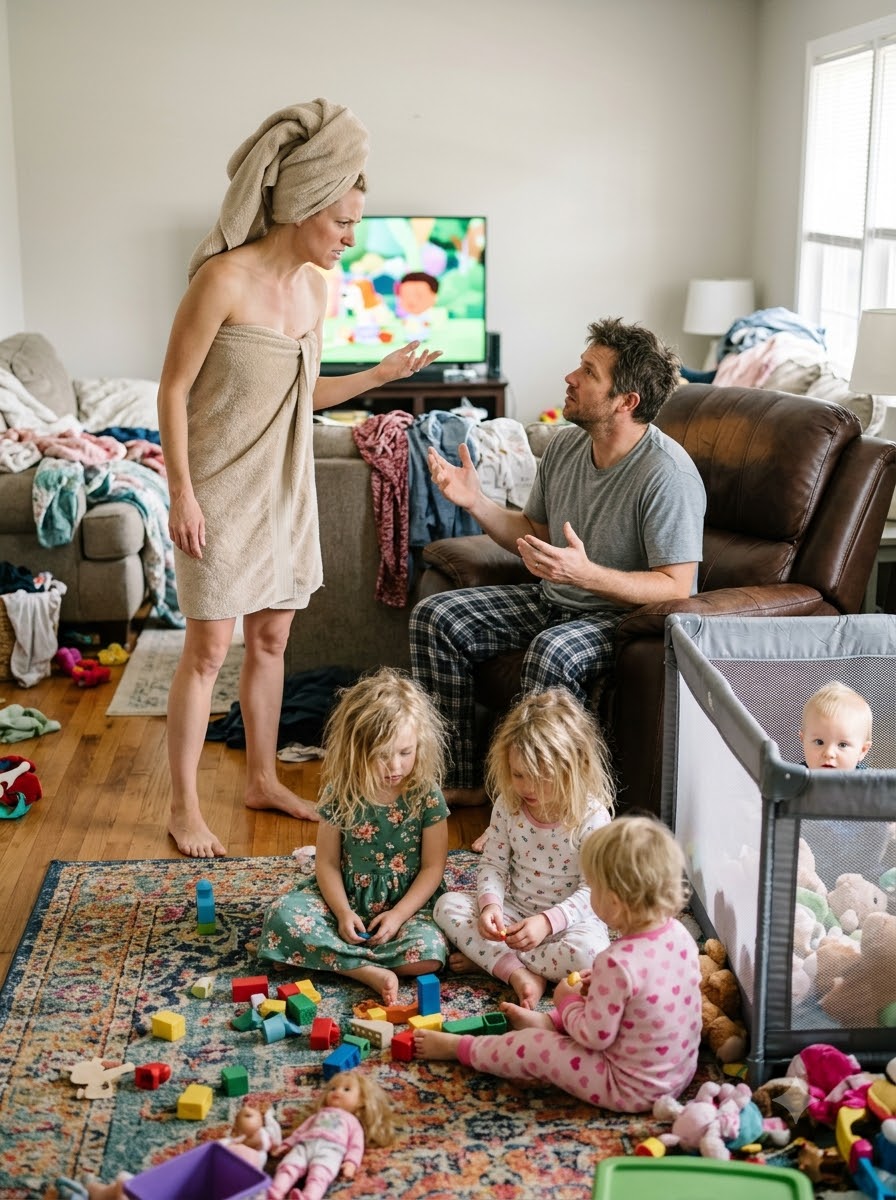
One afternoon the twins had a rare joint meltdown over a single toy. I was on a call with a potential employer, muted, while I separated them and redirected. When I unmuted, the interviewer asked whether everything was all right. I said yes, that I was a parent of young children and occasional noise was part of the arrangement. She laughed and said her own children were the reason she worked from home. We scheduled a second interview. After I hung up I sat on the floor with the twins until they were calm, then I texted my sister the update. She sent back a single line: “You’re allowed to want a life that isn’t only reaction.”
That evening I watched the camera live while I folded laundry in the bedroom. My husband was in the living room with all four children. The four-year-old was explaining a drawing. He was looking at her and nodding. The twins were building. The baby was in the playpen with a board book. For eleven minutes the scene matched what I had asked for weeks earlier. Then his phone lit up. He glanced at it, typed briefly, and set it down again. The eleven minutes became twelve, then fifteen. I stopped watching.
I do not know whether the marriage will continue in its current form. I know the version in which I apologize for needing twenty minutes no longer exists. The camera still runs. The log still updates. The guest room is still available. The children still need baths and dinners and someone who stays in the room when they are asked to stay. Some nights that someone is me. Some nights it is him. The difference is that I no longer treat his presence as a gift that must be earned by my silence, and I no longer accept a rewritten version of an evening I can watch for myself.
The pacifier turned up two weeks later, wedged behind the playpen. No one had ruined anything by looking for it.
