

Part 1 of 3: The Photograph in the Flower Shop
On the afternoon I ended my seven-year marriage, I wired $150 million into my wife’s account and told her to treat it as a settlement. I honestly believed that a sum that large could turn a painful decision into something tidy, final, and even generous. Three years later, a photograph of two children outside a flower shop in Cleveland would show me how little I had grasped about what I was ending.
My name is Andrew Bellamy, and I had spent most of my adult life building a thriving real estate and hospitality company. I could read a contract, spot a weak negotiating position, and keep my voice level while other people lost control of theirs. I had confused that calm with wisdom. At home, it usually meant I could sidestep a hard conversation without ever admitting that I was sidestepping it.
Elise had been unlike anyone I had ever known. She remembered the names of the people who worked in our building, and she always asked whether I had eaten before she asked how my meeting had gone. She loved peonies, handwritten notes, and the kind of quiet Sunday mornings I used to insist I had no time for. During the years we tried to have a child, she held on to hope long after I had begun to resent how much of our life revolved around it.
I would sit beside her after another disappointing appointment and tell her she was enough for me, and I believed I was being kind. What I never told her was that I had quietly interfered with her fertility treatment, because I feared a child would bind me permanently to a marriage I was no longer sure I wanted. I called it caution. I did not call it what it really was: a decision I had made for both of us while letting her believe we were facing the same future.
Then Rachel, a woman I had dated years before I met Elise, came back into my life. I told myself the old affection between us had never fully faded, and that recognizing this meant I had to stop pretending my marriage could be mended. I made my choice with the same confidence I brought to business. I sent the money, wrote the message, and went home with divorce papers.
That afternoon, while I rode across town with Rachel, I straightened her coat around her shoulders and brushed a strand of hair from her face. I never saw Elise standing across the street. She was holding an ultrasound envelope beneath her coat, and by the time I got home she was already beginning to understand that the future she longed to share with me might have no room left for her.
“Sign these,” I said, laying the papers on the table.
Elise looked at them, then at me. For a moment she seemed to be waiting for the husband she had married to walk into the room and explain why a transfer receipt had taken his place.
“Did you ever love me?”
I turned toward the window. “I gave you a good life.”
“That wasn’t what I asked.”
Any answer I had would only sound like another excuse. So I told her the truth I had been hiding: I had made certain she would not become pregnant, because I did not want a child tying us together if we separated.
Her face changed, and something inside her went quiet.
“You let me blame myself,” she said.
I tried to explain that I had thought it was practical, that I had been afraid, that I had never meant to hurt her. The words sounded thin even to my own ears.
Elise signed the papers. Then she sent the money back.
“You’ll need it,” I said.
“I would rather begin again with nothing than live on the price you put on our marriage.”
At the door she stopped and looked back at me.
“Remember this day, Andrew. One day, you’ll understand what you chose.”
I let her go. For three years I told myself that her words were only the anger of someone who had been wounded, and that keeping my distance was the most respectful thing I could do.
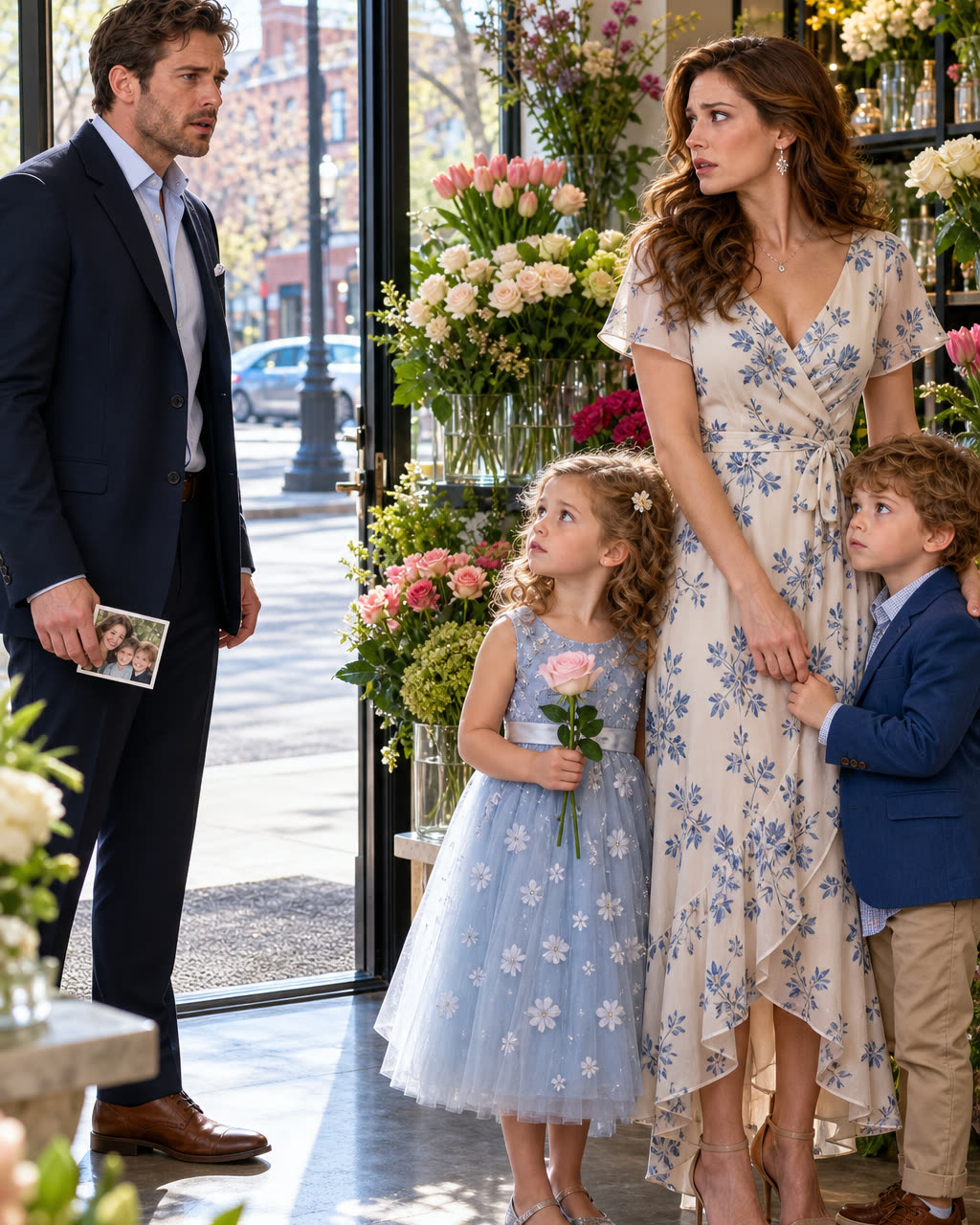
The photograph reached my desk on an ordinary Tuesday evening. My assistant, Martin, had found it while trying to learn whether Elise had remarried. She had not. She owned a small flower shop in a neighborhood near the lake, and someone had photographed her outside it with two children pressed against her sides. The little boy had dark hair and a solemn expression I recognized from my own childhood pictures. The girl wore a yellow sweater and kept one hand wrapped around Elise’s coat. Both looked about two years old.
I picked up the photograph, put it down, and picked it up again.
“How old are they?”
“A little over two,” Martin said.
The dates began arranging themselves in my mind. Elise had left three years earlier. She had been pregnant on the night I brought her the divorce papers. I remembered her hand resting over her stomach, which I had dismissed at the time as a sign of nerves. I remembered how she had begun to speak and how I had cut her off with my decision.
I pushed back from the desk so hard that my chair struck the wall.
“Where is the shop?”
The drive across Cleveland felt far longer than it should have. I held the photograph in my lap, bending one corner without meaning to. Every few minutes I looked down at the two small faces, as though a closer look might reveal what I had missed for three years.
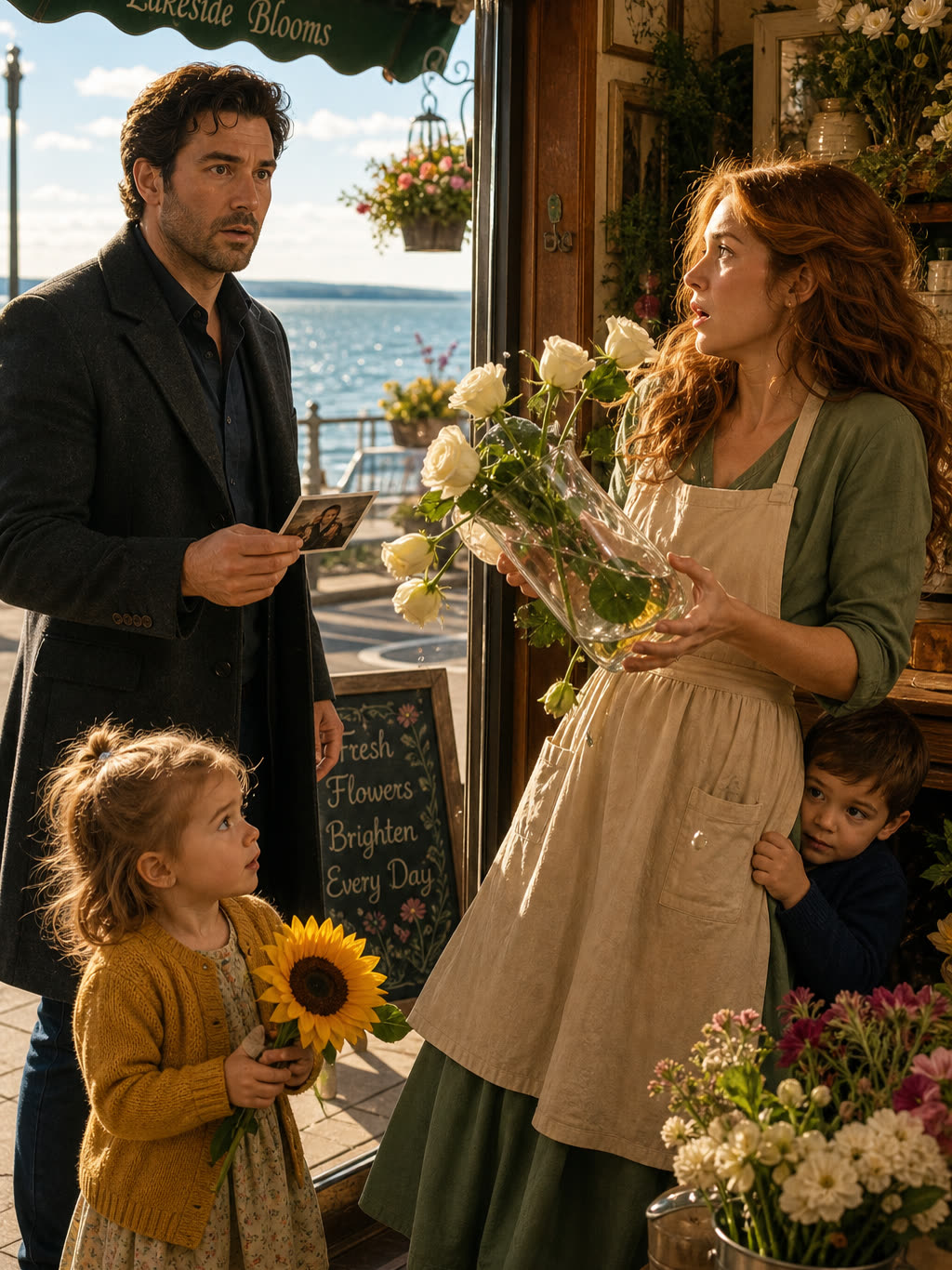
The shop had a faded green awning and crowded windows, with roses, daisies, and little handwritten cards tucked among the displays. Through the glass I saw Elise setting white flowers into a vase while the little girl stood close beside her. The boy sat at the counter, sorting ribbon by color.
I opened the door, and a small bell rang overhead.
Elise looked up. The vase nearly slipped from her hands.
“Andrew.”
My name in her voice carried no welcome. It was simply the name of someone who had turned up where he had no right to expect an open door.
“I need to talk to you.”
“You should have called.”
“Would you have answered?”
“No.”
The boy edged closer to her. The girl kept studying me.
“Mommy,” she asked, “who is he?”
That one word seemed to fill the whole shop.
Elise bent down beside her daughter. “Someone who used to know me.”
The girl thought about that. “Is he a customer?”
“No.”
The boy looked back and forth between Elise and me. “Why does he look like me?”
I gripped the counter.
“Elise,” I said, “are they my children?”
She looked at me for a long time before she answered.
“Yes.”
The girl’s name was June. The boy was Owen. They were two years and four months old, and they had been born while I sat in meetings, signed documents, and carried on as if my life had ended exactly where I had placed the period.
“Why didn’t you tell me?”
Elise’s expression tightened.
“I tried.”
She told me she had sent messages and made calls before I ever came home with the papers. She had tried to tell me that very evening, too, but I had interrupted her. I had been so sure of my decision that I never noticed what she was trying to say.
“Were you pregnant when I left?”
“Almost nine weeks.”
I remembered telling her that I had made sure a pregnancy would never happen. I remembered how she had gone completely still. I had taken her silence for acceptance. Now I understood that she had been standing there with two children already on their way, trying to make sense of the man in front of her.
“I didn’t know,” I said.
“You knew enough to hurt me.”
She moved nearer to the children, placing herself between them and me.
“They don’t know who I am?”
“They know there was someone in my life before. They don’t know your name.”
I looked at June, who had found a sunflower and was holding it in both hands.
“Do you like flowers?” she asked.
“I do.”
“What kind?”
I had answered far harder questions without hesitation, yet I could not think of one useful thing to say.
“White roses.”
“Those are Mommy’s favorite,” June said.
For a moment Elise’s face softened. Then the moment passed.
“You need to leave.”
I wanted to ask for another chance, but I saw Owen watching me closely, and I finally understood that I was not the only person in that room who could be frightened by what I wanted.
“I’m sorry,” I said.
Elise’s gaze stayed on mine.
“You keep saying that.”
“I keep finding new reasons to mean it.”
She turned to lead the children toward the back of the shop. I walked out without asking her to change her mind. Through the window, June glanced over her shoulder once. Owen did not.
Back in the car, I told Martin to find every message, call, and record connected to Elise from the months before our divorce. He hesitated before he answered, and that pause told me there was something he had not said.
At the office, the records showed that Elise had sent an email with an ultrasound image attached three days before I ended the marriage. The message had never been opened. It had been moved into an archive folder from my assistant’s account.
A second message had arrived on the morning I came home with the papers: I need to tell you something about the baby.
A call from Elise had been blocked by an application Martin had installed after I asked him to screen my calls. I had told him I wanted no more arguments. I had never told him to hide a pregnancy from me, but I had made it easy for him to believe the only thing I wanted was silence.
“You knew she was trying to reach me,” I said.
Martin stared at the screen. “I knew she had called. I didn’t know why.”
I looked at the archived email, at the small gray image of two tiny shapes I had never seen, and a cold certainty settled over me. Martin had closed one door. Someone else, I began to fear, had been quietly closing the others.
Part 2 of 3: The Letter Elise Kept
“Did you open the messages?”
“No.”
I could not know whether he was telling me everything, but I knew his choices had helped shut a door I had already been trying to close.
That night I asked a family attorney, Judith Cole, to meet me. She listened without interrupting, then asked whether I wanted legal confirmation that the twins were mine or whether I wanted to build a relationship with them.
“Both,” I said.
“Those are different things,” she replied. “A test can establish biology. It cannot make children trust you.”
The next day I went back to the shop in an ordinary car, carrying two picture books. Elise opened the door only halfway.
“I found the messages.”
She held my gaze. “So now you know I tried.”
“Yes.”
“And now you want a paternity test.”
“If you agree.”
“That does not mean you get to step into their lives whenever you want.”
“I understand.”
“You won’t send expensive gifts. You won’t show up at their school. You won’t make me feel as if my own children depend on your money.”
“I won’t.”
She studied me carefully.
“You shouldn’t expect me to believe you yet.”
“I don’t.”
That seemed to surprise her more than any promise could have.
June wandered up to the door. “Are you coming inside?”
“Not today,” Elise said.
“Why?”
“We have things to take care of.”
Owen joined them, staying close enough to reach for his mother’s hand.
“Why do you keep coming here?”
I crouched so that we were nearly eye to eye.
“Because I would like to know you.”
“Do you know my name?”
“You’re Owen, and she’s June.”
June smiled. Owen did not.
“Are you honest now?” he asked.
I drew a breath. “I’m trying to be.”
He weighed this as if it were a promise he would have to test.
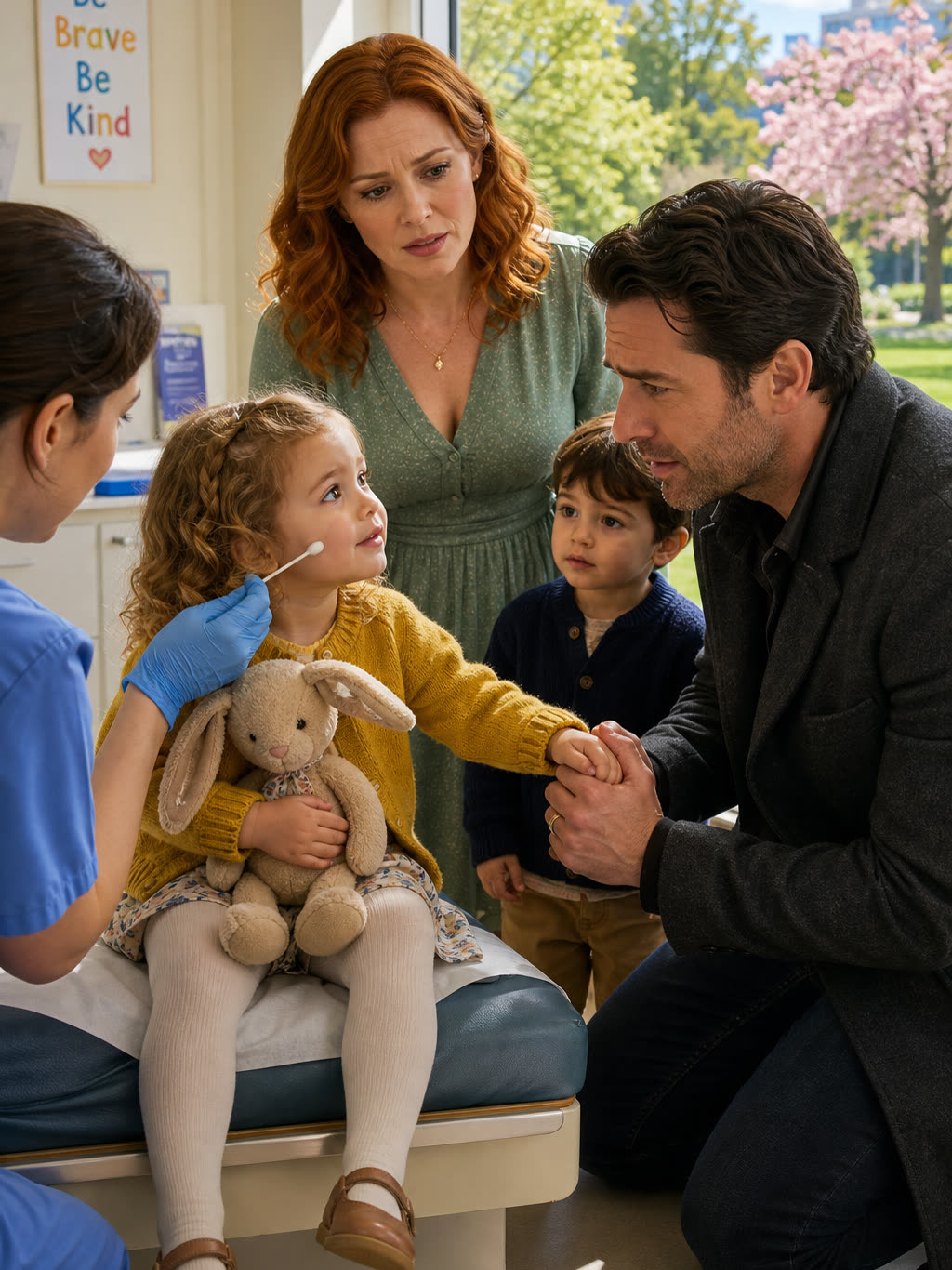
Elise agreed to a private paternity test. At the appointment she sat beside the children while a nurse explained the simple cheek swabs. June clutched a stuffed rabbit with one bent ear. Owen watched me as though he expected me to leave before the nurse came back.
When the nurse swabbed June’s cheek, the little girl reached out and took my hand.
“Are you scared?”
“A little.”
“Of the test?”
“Of what it might say.”
June looked up at me with the uncomplicated certainty of a small child.
“I know what it will say. It will say you’re Andrew.”
Owen glanced up from his chair.
“Is he staying?”
“No,” Elise said.
“Is he coming back?”
She did not answer right away.
“If your mother allows it,” I said.
“Will you take care of us?”
I looked to Elise, but she did not step in to rescue me from the question.
“I want to,” I said. “I don’t know how yet, but I will learn.”
The results arrived six days later. They confirmed that Owen and June were my children. The report was precise, but it did not tell me what to do next.
Judith advised me to begin with small, predictable steps and to let Elise decide what the children could handle. When I asked to spend an hour with them at the shop, Elise agreed, so long as she stayed with us. I promised not to be late.
Then she told me that Rachel had visited the shop.
“She knew about the pregnancy,” Elise said.
I stared at her. “How?”
Elise showed me a copy of a message she had sent Rachel the week before our divorce. She had seen Rachel and me together and, frightened and confused, had asked her to tell me about the pregnancy. Rachel had replied that Elise was trying to manipulate me into staying.
I read the message twice, hoping the words might change.
They did not.
Rachel had never told me Elise was pregnant. She had never mentioned the message or the children. I could not yet understand why she had lied, but I could no longer pretend the truth had simply failed to reach me by accident.
I began visiting the flower shop once a week. At first I sat near the counter while Elise worked, and Owen and June played within her sight. I brought no gifts unless she agreed in advance. I asked questions and learned to wait for the answers instead of filling every silence with what I wanted to say.
Owen liked buses and preferred to line them up with their wheels perfectly straight. June named every flower she could recognize, then invented names for the rest. She loved yellow and believed every room looked better with a sunflower in it.
I learned that Elise drank tea after closing and often forgot to eat when she was worried. I had once imagined that money could meet any need if I offered enough of it. In that shop I began to see how often real help meant doing exactly what someone had asked, and then stopping.
One afternoon Elise told me that Rachel had claimed she had warned me about the pregnancy. The story made no sense until the records from my office confirmed the archived messages and blocked calls. Rachel’s lie had deepened the separation, but it had not created it. I had already decided that Elise’s voice was an inconvenience.
Elise had kept a letter she wrote after the twins were born. She had sent it to my office, hoping someone would place it in my hands. In it she described the first appointment she had attended alone, when a technician told her there were two heartbeats. She wrote that she had waited for me to call, then stopped waiting when every attempt to reach me led nowhere.
“I called once,” I said.
“You left a message,” she answered. “You asked if I was well and said you hoped I had found peace.”
I could not remember making the call. Elise said I had sounded tired and possibly had been drinking. Whoever answered when she phoned again had told her I had moved on.
“I’m sorry,” I said.
“I know you are.” She kept her eyes on the letter. “I needed you to understand what it was like to be pregnant and believe the person I loved had chosen not to hear me.”
I had no defense. I had mistaken my intentions for innocence, as though not knowing the whole truth could erase the harm I had done with the truth I did know.
Elise also had a folder of medical records from the fertility clinic. She had believed the treatments had simply failed, but one report showed that a treatment cycle had been stopped before she knew she was pregnant. Another note indicated that her prescription had been changed. The authorization appeared to carry my signature, though I had never signed it.
The clinic’s specialist, Dr. Caroline Webb, agreed to meet with us. She told us that a corporate medical liaison named Gordon Price had contacted her on my behalf, claiming I had requested that Elise’s treatment stop. He had supplied a document bearing a copy of my signature and instructed the clinic to route all its communications through him.
I had never spoken to Gordon about Elise’s treatment.
Dr. Webb also admitted she had tried to reach Elise after realizing a pregnancy might have begun, but Gordon had answered one of those calls and said Elise had transferred her care. The clinic had relied on his word instead of contacting Elise directly.
“Why didn’t you verify the authorization with me?” I asked.
Dr. Webb lowered her eyes. “I should have. I believed I was following a confidential request from your office, and I let that belief replace a basic check.”
The company had paid the clinic through an executive family-care account that Gordon controlled. By my standards it was not a fortune, but it had been enough to make an informal instruction look official. After Gordon left the company, an internal review had been started and never finished.
Elise turned the report over in her hands.
“I spent years thinking my body had failed me,” she said. “You spent years thinking I wanted a child to keep you trapped. Neither of us knew what had actually happened.”
I wanted to reach for her, but I did not.
“I can’t change those years,” I said.
“No,” she replied. “But you can decide what you do with the years in front of you.”
We pursued an independent review of the clinic’s records and the company account, with Elise’s attorney guiding her side of the process. The clinic sent her a written apology. My company acknowledged that its safeguards had failed and replaced the family-care system with independent oversight. I dismissed the executives who had ignored the irregularities. We kept the matter private and focused on correcting the record.
No finding could return the time Elise had spent alone, and no explanation made what I had done acceptable. Still, the facts mattered. They gave Elise back the truth about her treatment, and they gave both of us something better than the stories we had been telling ourselves.
Then one evening, as I was about to leave the shop, Elise stopped me at the door. She held a thick envelope with a development company’s name printed in the corner. She had received an offer to sell the flower shop and its building. She was considering a move to Wisconsin, where her cousin lived, and a florist in Oregon had written to her about needing a partner.
The bell above the door chimed softly as the wind pushed it. I stood there with the picture book I had meant to leave for June, realizing that the place I had only just found my way into might be taken away, and that I had no right to ask her to stay.
Part 3 of 3: The Home We Chose
When I asked how much the offer was, she looked at me steadily.
“That’s exactly what I mean. You turn everything into a number.”
I stopped. “You’re right. I’m sorry.”
“I may still leave.”
“I know.”
“You could challenge the move.”
I could have. My lawyers could have made the process exhausting. My resources could have turned a disagreement into a contest she could never win.
“I won’t use them to stop you,” I said.
“Even if it means you see the children less?”
I wanted to tell her I could not bear to lose them again. But that would have made my fear the center of a choice that belonged to her and the children.

“I would rather have less time with them than teach them that love is something a person can force,” I said.
Elise studied me, but she did not answer.
I asked Judith to prepare a co-parenting agreement that Elise could review with her own attorney. It gave her primary authority over the children’s home, education, and medical care. My visits would begin as short, regular afternoons and grow only if Elise and the children felt comfortable. Financial support would be transparent and kept separate from access. There would be no gifts, purchases, or promises used to sway her decision about where to live.
Elise negotiated every clause with care. She did not take my lawyer’s counsel and chose someone of her own. It took three weeks. When she finally signed, she looked tired, but she did not look cornered.
After the paperwork was done, we sat across from each other in Judith’s office.
“It isn’t romantic,” I said.
“No.”
“But it’s honest.”
“That matters more.”
She still had not decided whether to leave Cleveland. She said she needed to know that leaving was possible, even if she eventually chose to stay.
I understood that this was not a test I could pass with a grand gesture. Trust would come, if it came at all, through ordinary days in which I did what I had said I would do.
So I arrived on time. When Owen was frightened by a thunderstorm, I sat beside his bed and counted the seconds between the flash and the rumble until he grew sleepy. When June wanted to wear the same yellow sweater several days in a row, I let her. When Owen asked me to fix the wheel on his wooden bus, I brought the small tools he liked and let him hold the screws.
I stopped sending flowers to Elise’s apartment. I stopped asking whether she might reconsider our marriage. I learned that being a father did not give me ownership of the children’s time, and that being sorry did not make Elise responsible for comforting me.
One evening, after I repaired the bus, Owen ran across the shop and hugged my legs. I stood still for a moment, startled by how much that small gesture mattered.
“Thank you,” he said.
“You’re welcome.”
June came over with a handful of dandelions.
“These are for you.”
I accepted them as carefully as if they were the rarest flowers in the shop.
“Are they my favorite?”
“No,” she said. “They’re yours.”
That was when I began to understand that love was not simply finding what two people shared. Sometimes it was learning to receive what belonged only to someone else.
A year after we signed the agreement, Elise told me she had turned down the offer from Oregon and decided to stay in Cleveland. She was closing the shop for the evening, tying a bundle of lavender with twine.
“I’m staying,” she said.
“Because of the children?”
“Partly.”
I did not ask what the other part was. It was enough that she had made the choice herself.
The shop grew slowly. Elise opened a small room in the back for weekend workshops, where children planted herbs in painted pots. I offered to invest, but she accepted only after we built an arrangement that left her in control. I learned to be useful without insisting that usefulness made me indispensable.
Three years after I first saw the twins through the shop window, I asked Elise to walk with me after closing. June and Owen were spending the evening with her aunt Beatrice, who had grown fond of letting Owen carry her cane and letting June choose her scarf.
We walked along the river as the last light drained from the buildings.
“You’re quiet,” Elise said.
“I’m trying to decide whether to say something.”
“That has never stopped you before.”
I stopped beside a bench and took a small ring from my coat. It was simple, with a modest stone and no audience waiting to see what she would say.
Elise looked at it, then at me.
“Andrew.”
“I’m not asking you to forget what happened.”
“I know.”
“I’m not asking you to reward me for finally becoming someone I should have been years ago.”
She watched me closely.
“I’m asking if you would consider building a future with me, one that doesn’t pretend the first one never happened.”
“What would be different?”
I thought of all the promises I had once made because I believed that saying them was the same as keeping them.
“I would tell you the truth, even when it made me uncomfortable. I would let you make your own choices. I would never use the children to make you stay, and I would keep earning the place you give me instead of assuming I own it.”
Elise looked down at the ring.
“I can’t promise I’ll never be afraid.”
“I wouldn’t ask you to.”
“I can’t promise I’ll never remember.”
“I would never ask you to forget.”
She was quiet for a long moment, and I did not try to fill it.
“If we marry,” she said, “we can’t go back to who we were.”
“We won’t.”
“We’ll have to build something new.”
“Something honest.”
She took the ring from my hand.
“Yes.”
The word did not arrive like thunder. It felt like morning light finding its way into a room that had been closed for far too long.
We married six months later in the flower shop. There was no ballroom, no line of business associates, and no photographer waiting outside. Beatrice wore a blue dress and cried before the ceremony began. Dr. Webb sent white roses with a handwritten apology, and Elise set them near the front window.
Owen carried one ring. June carried the other, wearing a flower crown she had chosen herself. Halfway down the aisle her crown began to slip, and she stopped to fix it before going on. Owen’s tie was crooked, but he refused to let anyone straighten it.
Elise stood beneath an arch of greenery in a simple ivory dress. When I reached her, I took her hands. They were warm and steady.
“I love you,” I said.
“I know,” she replied, then smiled. “And now I believe you.”
Our vows were brief. We promised to speak before silence could become a wall, to tell the truth even when it was inconvenient, and to let the children be children instead of asking them to repair what we had broken. When the officiant pronounced us married, June clapped so loudly that everyone laughed.
At the reception Owen announced that the cake had too much frosting. June gave each guest a dandelion. I danced with both children until Owen grew tired and June fell asleep against my shoulder.
After everyone had gone, Elise and I stood among the flowers, looking at our reflection in the old shop windows. We did not look like the couple we had once been. We looked like two people who had chosen to make a life after learning what their choices could cost.
“Do you ever regret staying?” I asked.
Elise leaned against me.
“Sometimes I wonder what our lives might have looked like if you had told me the truth from the beginning.”
“So do I.”
“But that isn’t the life we were given.”
“No.”
She lifted her face toward mine.
“This one is still beautiful.”
I kissed her forehead. The gesture was familiar, yet it no longer belonged to our first marriage. It belonged to the life we had built after the hidden messages were found, after the apologies had been tested by time, and after two children had taught me that a family could not be bought or protected by pride.
I had once transferred $150 million to make Elise disappear from my life. In the end, money did not bring us back together. The truth did. So did the children, who deserved more than the mistakes we had made, and the quiet, daily choice to keep showing up.
Outside, Cleveland glowed beneath the night sky. Upstairs, Owen and June slept in adjoining rooms above the flower shop. Elise rested her head against my shoulder, and the scent of roses filled the quiet.
For the first time, I understood that home was not a place where no one had ever hurt you. It was a place where the truth could be spoken, forgiveness could be earned, and love could choose to stay.
Disclaimer: This story is a work of fiction inspired by real-life themes. Names, characters, places and events are fictionalized, and any resemblance to real persons is purely coincidental. Images are for illustration purposes only.
