

Part 1: The Statue Game
The dining room of the Sterling-Vance Estate carried the scents of roasted rosemary lamb, French beeswax polish, and a stifling, ever-present dread.
Under Victoria’s rule, dinner was never simply a meal; it was a nightly evidentiary hearing run with the rigid protocol of a military tribunal. The table, fourteen feet of hand-rubbed mahogany rescued from an eighteenth-century English courthouse, shone like dark glass beneath the glare of an imported crystal chandelier. Elbows had to stay exactly four inches from the beveled edge. Napkins had to lie across the left thigh, folded into precise triangles. Nobody spoke until the presiding magistrate granted leave.
For three months, I had talked myself into believing that this order was the salvation my family needed.
I was thirty-eight years old, the Chief Forensic Crime Scene Investigator for the State Police Forensics Division. For fourteen years my life had been measured in millimeter scales, alternate light wavelengths, latent fingerprint powders, and the cold, chaotic finality of violent crime scenes. When my late wife, Sarah, died of sudden cardiac arrhythmia two years ago, my world caved in around me, a shapeless, dust-choked void. I was left alone with our three-year-old son, Leo Vance, drowning in grief while I tried to survive forty-hour shifts processing mass-casualty homicides and hit-and-run fatalities.
Then I met the Honorable Victoria Sterling, a celebrated State Circuit Court Judge known across the capital as the “Iron Maiden of the Third District.” She seemed like a lighthouse rising over an angry sea. Victoria was forty-two and impeccably tailored in bespoke charcoal wool, and she moved through high-society charity galas and state legislative hearings with the poise of an aristocrat. She talked about structure, civic responsibility, and the moral imperative of discipline. She took an immediate, focused interest in Leo. She told me that grief had made me permissive, and that a growing boy needed boundaries as unyielding as granite to feel safe in an unpredictable world.
I was so blind, so thoroughly worn down by grief, that I mistook absolute control for maternal devotion. I had actually bragged to my colleagues at the regional crime laboratory that Victoria had worked an educational miracle: my once-hyperactive, boisterous boy had turned quiet, obedient, and perfectly still.
Now, sitting across from him in the chill of that formal dining room, the silence felt less like discipline and more like the vacuum in a chamber just before the glass shatters.
Six-year-old Leo sat perched on the edge of his high-backed Queen Anne chair. His small frame was swallowed by a stiff, starched Oxford collar that chafed red against his throat. His knuckles were pale, and his tiny fingers shook with such severe, rhythmic tremors that the sterling-silver salad fork in his right hand rattled against the rim of his porcelain plate. He hadn’t touched his meat. His large hazel eyes, once so bright and mischievous, were hollow, fixed straight ahead on the oil portrait of Victoria’s great-grandfather above the mantle.
“Posture, Leo,” Victoria said softly. She delivered the command without raising her voice, and she did not even look up from her plate. Her silver knife carved through the pink center of the lamb with surgical precision, the blade whispering across the china with a dry, rhythmic hiss. Victoria was a strikingly handsome woman, with high cheekbones, immaculate alabaster skin, and dark hair pinned into a severe, architectural chignon. Not a single strand was out of place. There was never an uncalculated gesture, never an uncontrolled breath.
Leo flinched as if a whip had cracked inches from his ear. He snapped his spine upright, his small shoulder blades pressing hard against the unforgiving mahogany splat of the chair. He drew a short, shallow breath through his nose, his chest hitching. CLATTER. The silver fork slipped from his sweating fingers. It tumbled across the gold rim of the plate and spilled three minted peas onto the white damask runner, then struck the hardwood floor with a sharp, ringing chime that echoed off the vaulted ceiling like a gunshot.
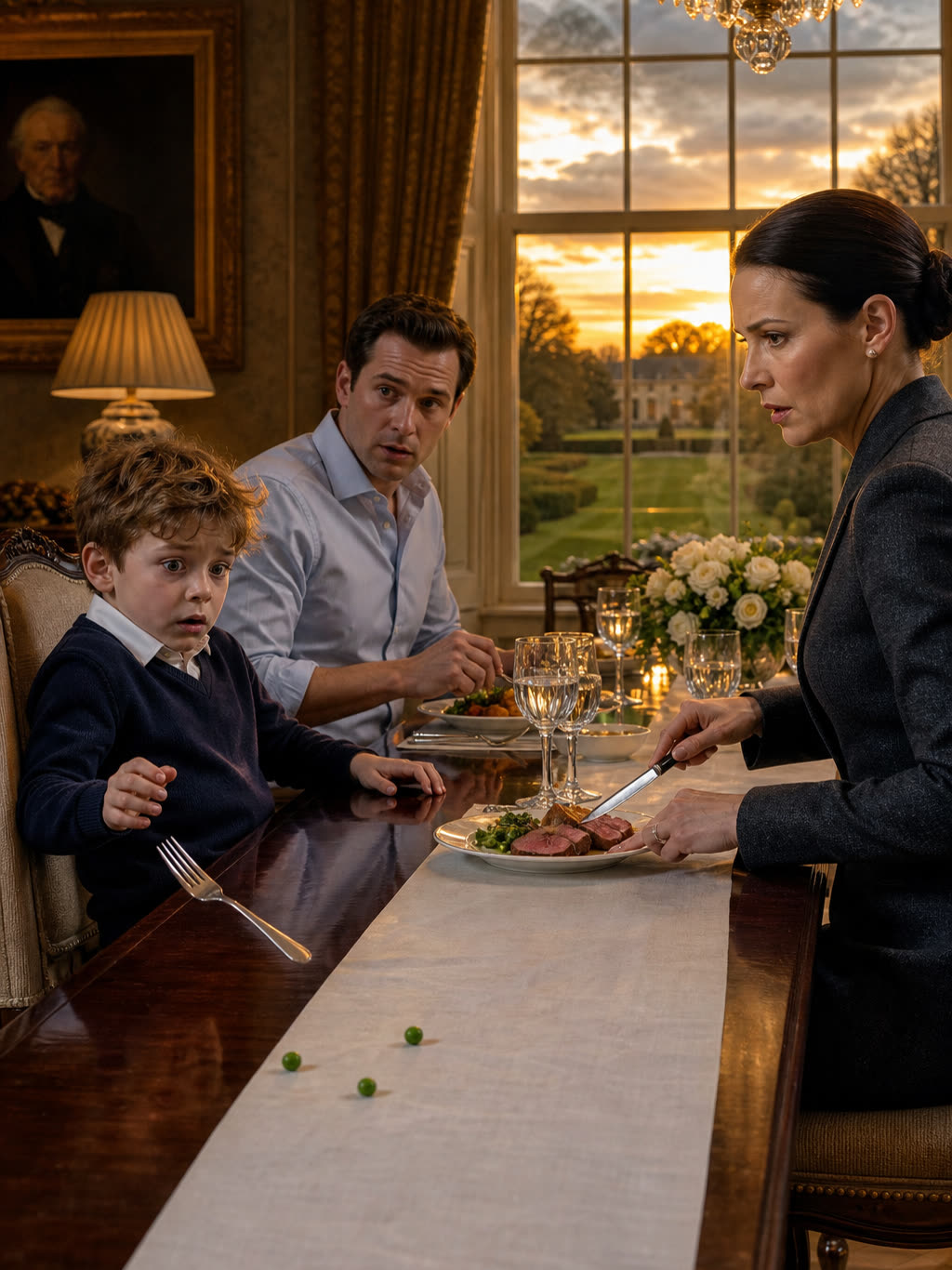
The dining room went dead. Across the table, Victoria’s knife froze mid-cut. She did not yell. She did not sigh. Very slowly her eyelids lifted, and her dark, flint-gray eyes locked onto my son with the flat, unblinking focus of an apex predator that has just registered movement in the brush.
The color drained from Leo’s face at once, leaving his skin the shade of damp parchment. A soft, high whimper caught in the back of his throat. His whole body locked into a catastrophic tremor, and his chin quivered so violently that his teeth clicked together in rapid, irregular bursts. He began to hyperventilate, dragging in air in ragged, silent gasps, his pupils swollen until the hazel of his irises was almost entirely swallowed by black.
“Victoria,” I said, offering an easy, placating smile as I reached down to pick up the fallen fork. “It’s fine. He’s tired. He had a double shift of reading drills at the preparatory academy today. I’ll get him a fresh fork from the pantry.”
“A dropped utensil is not an accident of fatigue, David,” Victoria said, her voice smooth, low, and completely devoid of inflection. “It is a deliberate failure of focus. Focus is a muscle. If it is not exercised, it atrophies. And when muscles atrophy, they require… correction.”
Her phone buzzed on the sideboard, a discreet, muted vibration. Victoria glanced at the lit screen. “The presiding appellate judge,” she murmured, wiping her fingers with her linen napkin and rising from the table. “Do not touch that plate, Leo. We will address your lack of motor discipline the moment I conclude this conference.”
The heels of her Italian leather pumps clicked down the hardwood corridor and vanished into the east-wing library. The heavy pocket door slid shut with a definitive, airless thud.
The instant it closed, the artificial composure in the dining room collapsed. Leo hurled himself sideways out of his chair. He didn’t run for the door; he scrambled into my lap with the frantic, clawing desperation of an animal escaping a rising tide. His tiny fingers bunched into the fabric of my cotton shirt, and he buried his face in the hollow of my neck. His skin was burning hot, yet he shivered uncontrollably, his tears soaking through my collar.
“Hey, buddy,” I whispered, wrapping my arms around him, my heart aching at the sheer velocity of his pulse against my ribs. “Hey, it’s just a fork, Leo. Look at me. Nobody gets in trouble over a fork. I’ll talk to Victoria. It’s okay.”
“No, Daddy, no, no, don’t talk to her!” he choked out, his voice a ragged, desperate rasp against my skin. He pulled back, his eyes darting toward the hallway door, his breath coming in jagged, wheezing sobs. “Daddy… remember the Statue Game? You have to make me play the Statue Game!”
A cold prickle of unease crawled up the back of my neck. “The Statue Game? What are you talking about?”
“She says… she says if I move, or if I cry, or if I make a single sound while you’re at the lab, I lose the game,” Leo whispered, his lips brushing my ear as his tiny hands gripped my jaw with shocking strength. “And when I lose… she locks me back inside the dark box in the basement… Daddy, the box is so hot… she plugs the iron box into the wall and says bad boys have to burn the badness out…”
My breath stalled in my lungs. Before I could process the words, the library door slid open down the hall. Leo gasped, terror flashing across his face, and scrambled back onto his chair just as Victoria’s heels clicked into the room again. She swept in, her silk blouse rustling, her face perfectly composed. She reached across the center of the table, and her long, manicured fingers closed deliberately around the heavy silver salt cellar.
In that split second, six-year-old Leo threw both arms over his head, let out a raw, blood-curdling scream of pure, animal terror, and dropped to the floor beneath the table, curling into a tight, shaking ball.
“Leo!” I yelled, dropping to my knees on the hardwood.
“David, leave him,” Victoria commanded from above, her tone as dry and matter-of-fact as an administrative dismissal. “He is staging a temper tantrum to evade accountability for his insolence. If you coddle him now, you undo months of behavioral progress. Get back in your chair.”
I didn’t answer her. The sound that had just burst from my son’s mouth was not the cry of a spoiled child dodging bedtime. It was the reflexive shriek of a creature that believed it was about to be destroyed.
I reached under the table, gathered his trembling body against my chest, and lifted him out into the overhead light. Leo was sobbing so hard he gagged, his arms locked over his ears, his knees pulled up to his ribs.
“Leo, look at me,” I said, my voice shaking as I set him down on the table right beside the fine china, ignoring Victoria’s sharp intake of breath. “Look at Daddy. Look at my eyes, Leo. Nobody is hurting you. Look at me!”
“My back, Daddy! Don’t let her touch my back!” he shrieked, arching away from the mahogany, refusing to let his spine touch anything solid. “The iron! The iron box!”
Fourteen years of processing homicides, industrial explosions, and domestic assaults slammed into my conscious mind with the force of a hydraulic ram. My hands, usually so steady with a scalpel and a macro lens, trembled as I gripped the hem of his stiff cotton polo shirt.
“David,” Victoria’s voice dropped an octave, losing its polished veneer and taking on an ugly, commanding edge. “I ordered you to stop this theater immediately. You are indulging his hysteria.”
I ignored her. I grabbed the collar of Leo’s shirt and pulled the fabric up over his head in one swift motion.
What I saw tore every drop of air from my lungs and shattered my reality into jagged, bleeding pieces. Across my six-year-old son’s delicate spine, running from the space between his shoulder blades down to his lower lumbar vertebrae, were five perfectly geometric, two-inch square burn marks.
They were not accidental scalds. They were not domestic abrasions. They were systematic, deliberate contact burns, set in a precise vertical column along the line of his spine. The top three were older, their margins showing the thick, hyper-pigmented keloid scarring of second-degree burns left to heal without clinical debridement. The fourth was roughly two weeks old, crusted with yellow serous exudate and cracked along the edges.
The fifth burn, seated squarely over his fourth lumbar vertebra, was fresh. Its center was an angry, necrotic white, ringed by violent, blistered, cherry-red inflammation. The unmistakable cross-hatched grid of an industrial heating element was stamped into the middle of his skin. The air smelled faintly of medical ointment masking scorched keratin.
My vision tunneled. A high-pitched ringing erupted in my ears and drowned out the noise of the house. In fourteen years of forensic work I had seen cartel executions, vehicular manglings, and the worst depravities human beings could inflict on one another. But looking at the geometric branding of my own little boy’s flesh, I felt as though my soul had been ripped out through my throat.
“My God… Leo…” I choked, my voice cracking into a ragged, broken sob. My fingers hovered a millimeter above the fresh wound, terrified that even my breath would cause him agony. “Who did this to you? Who did this?!”
Leo buried his wet face in my bicep, his body convulsing with shuddering gasps. “The iron stamp, Daddy… in the dark room… she said bad boys get branded like cattle so the angels know they’re bad… she said if I told you, she’d put the stamp on my face…”
The dining room went completely, terrifyingly silent. I slowly turned my head.
Victoria did not look panicked. She did not drop her fork. She did not even blink. She lifted her crystal glass of Cabernet Sauvignon to her lips, took a measured, delicate sip, and set it down on the linen runner with an almost imperceptible clink. She picked up her embroidered napkin, dabbed the corners of her mouth, and looked across the table at me with eyes as cold and flat as slate headstones.
“Be exceptionally careful about what you say next, David,” Victoria said, her voice an intimate, venomous whisper that seemed to chill the air of the room. “And think very carefully about what you do.”
“You branded him,” I whispered. The words tasted like ash. “You locked my six-year-old son in a cellar and you branded him with an electric iron.”
“I am socializing an undisciplined child who lacked maternal guidance,” she replied, her tone matter-of-fact, as if discussing the pruning of an unruly rosebush. “Your late wife raised an animal. You were too weak, too consumed by self-pity to instill the fear of authority into him. Pain is the oldest and most effective regulatory mechanism in biological history. He learned to sit still, didn’t he? He learned to keep his mouth shut.”
A violent roar of homicidal rage surged through my blood. Every muscle in my body coiled to vault across the mahogany and tear her throat out with my bare hands. As if sensing the lethal tension in my posture, Victoria leaned forward and rested her forearms on the table, a thin, triumphant smirk playing on her manicured lips.
“Go ahead, David,” she murmured, her voice dripping with mocking condescension. “Lose your temper. Put your hands on me. Give me the domestic violence charge I need to strip you of custody by tomorrow afternoon.”
She tilted her head, her eyes narrowing into cold slits. “Look at the board, David. You are a state police technician. I am the senior presiding circuit judge of this county. I have lunch with the District Attorney every single Tuesday. The Chief of Police owes his appointment to my judicial endorsements. The Child Protective Services regional director sits on the board of my youth foundation.”
She picked up her dessert spoon and turned it over in the soft light. “If you take that boy to an emergency room in this county, I will have an emergency protective order filed against you before the triage nurse finishes her report. I will allege that your grief over Sarah drove you to psychotic child abuse, and that I was preparing to file for his sole custody to protect him from your violent instability. Who do you think the local magistrate will believe? A grieving, overworked crime-scene tech who handles gore for a living… or a decorated, sitting Circuit Court Judge?”
She leaned in, her gaze pinning me to the floorboards. “No jury in this state will ever believe the delusions of a traumatized toddler over a sitting circuit judge. Put his shirt down. Clean up those peas. And finish your dinner.”
I looked down at Leo. His tear-streaked face was pressed against my chest, his little hands clutching my shirt like a life raft in a hurricane.
Fourteen years of crime-scene discipline locked into place. In an instant the red fog of blind fury receded, replaced by the glacial, lethal clarity of a professional hunter. If I struck her now, she would win. If I called the local sheriff’s department, her connections would sanitize the file, Leo would be placed in state custody under her influence, and I would be behind bars while my son was left utterly defenseless. She controlled the county. She controlled the local courts. She controlled the regional investigators.
She didn’t control the federal government.
I slowly pulled Leo’s shirt back down over his back, agonizingly careful not to brush the weeping blister on his spine. I lifted him into my arms, kissed his cold, sweat-soaked temple, and looked across the table straight into Victoria’s smiling, arrogant eyes. My face went completely slack. My voice was a dead, unblinking flatline.
“You’re right, Victoria. Let’s finish.”
Part 2: Room Zero
By midnight, the Sterling-Vance estate was as quiet as a mausoleum.
Victoria had retired to the primary master suite on the second floor at precisely 10:30 PM, following her nightly ritual of two milligrams of prescription lorazepam washed down with three fingers of dry gin. I had watched from the doorway as her breathing slowed into the deep, chemically induced rhythm of narcotic sleep.
I didn’t waste a second. I carried Leo into the locked guest bedroom at the far end of the west wing and laid him on his stomach across the soft down comforter. From my personal field kit I spread a sterile layer of silver sulfadiazine burn cream over his lower spine, then gave him a dose of pediatric ibuprofen. Beside his bed I set up a portable, military-grade wireless passive infrared motion sensor, linked directly to an encrypted receiver that vibrated in my front pocket.
“Daddy will be right back, Leo,” I whispered, kissing his forehead. “You don’t have to play the game ever again. I swear to you on your mother’s life. Nobody is ever going to hurt you again.”
He nodded weakly, his eyelids heavy with exhaustion and pain, his small hand finally loosening its grip on my sleeve.
I locked the bedroom door from the outside, pocketed the brass key, and descended the grand staircase into the basement.
The basement of the estate was a labyrinth of restored fieldstone foundations, modern climate-controlled wine cellars, and cedar storage closets. But I wasn’t looking for wine.
Two weeks earlier, while replacing a blown circuit breaker in the main utility room, I had noticed an architectural anomaly: a six-foot discrepancy between the exterior foundation wall and the interior stud framing behind the secondary wine rack. At the time I had dismissed it as the eccentric remnant of a nineteenth-century coal chute. Now, standing in the cold dampness of the subterranean corridor, I knew exactly what it was.
I pulled a pair of sterile purple nitrile gloves from my pocket and snapped them over my hands. I reached behind the third shelf of vintage Bordeaux and ran my fingertips along the recessed wood trim until my index finger caught a spring-loaded magnetic latch. With a soft, metallic click, a three-foot section of drywall and shelving swung silently outward on greased industrial pivot hinges.
The stench hit me instantly. It rolled out of the dark opening like the breath of an open grave: the unmistakable copper-and-ozone tang of scorched human hair, dried sweat, industrial electrical insulation, and damp, unventilated concrete. I drew my state-issued forensic Alternate Light Source, an omnidirectional, multi-wavelength LED torch, from my leather tactical belt and slipped heavy orange polycarbonate barrier goggles over my eyes. I clicked the toggle to 450 nanometers, pure, coherent blue light, and stepped through the threshold into Room Zero.
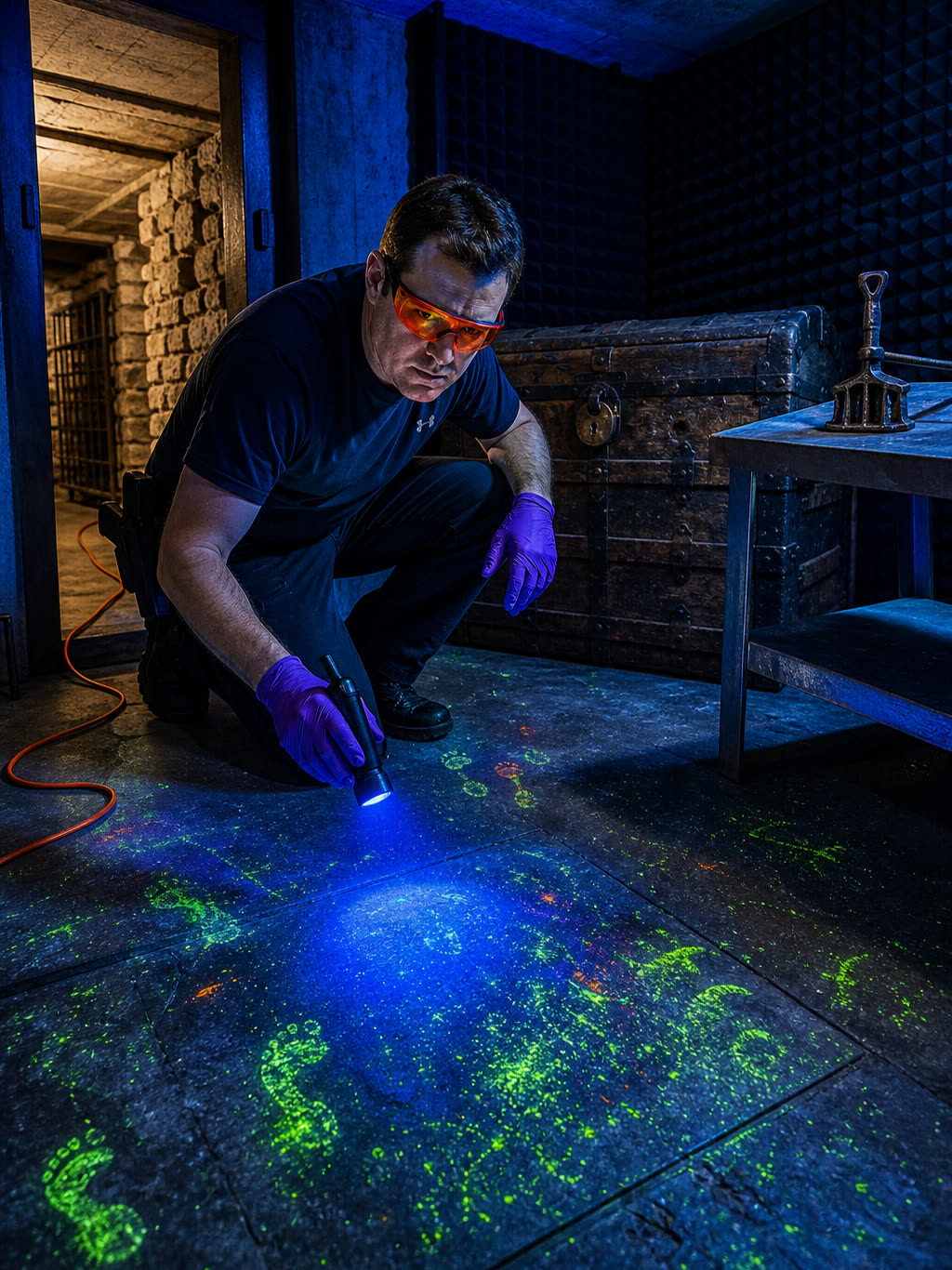
The hidden vault was roughly six feet wide by eight feet long, completely windowless, with six-inch acoustic sound-dampening foam glued directly to the ceiling and concrete walls. There was no heating vent, no air return, no light fixture. The only source of power was a heavy-duty orange 12-gauge industrial extension cord snaking across the floor from an exterior junction box.
I swept the blue light across the concrete. Beneath the forensic beam, the dark room flared into a horrific landscape of fluorescent green and amber traces. Perspiration, saliva, and protein exudates glowed violently against the dull floor. In the center were distinct, tiny pediatric knee prints and handprints where a six-year-old child had crawled, shivering, in the pitch black.
In the far corner sat an antique, iron-reinforced oak steamer trunk, the “dark box.” Its brass hasp was scratched raw from small fingernails trying frantically to pry the lid open from the inside.
My heart pounded with such fury that my vision pulsed red against the orange goggles, but my hands stayed entirely steady. Chain of custody. Authentication. Irrefutable admissibility. Every motion had to be flawless. A single procedural error would hand Victoria’s appellate lawyers the technical loophole they needed to suppress the evidence. I drew my high-resolution Nikon forensic camera, fitted with an 85mm macro lens and an integrated millimeter scale ruler, and approached a metal utility table against the far wall.
On the galvanized steel surface, beside an industrial variable-voltage transformer, lay the weapon. It was a commercial-grade, heavy-duty livestock marking iron fitted with a customized two-inch square cast-steel heating head. The brand face was etched with a sharp, cross-hatched grid designed to maximize thermal transfer. Clinging to the steel edges of the die were microscopic, charred fragments of biological tissue and tiny fibers from Leo’s navy-blue school uniform.
I set the forensic scale beside the iron. Snap. Flash. Snap. Macro photographs at zero degrees, forty-five degrees, and oblique angles. I pulled a sterile DNA swab from its sealed plastic sheath, moistened the tip with forensic-grade deionized water, and systematically swabbed the rubberized handle of the iron, the exact grip where Victoria’s fingers had rested. I sealed the swab in a paper evidence envelope and labeled it with the date, the time (01:42 AM), and my state investigator badge number.
Then I looked up. Mounted in the upper corner of the concrete vault, hidden inside the casing of a faux carbon monoxide detector, was a tiny, wide-angle lens.
Victoria was a control freak, a jurist obsessed with documentation and total dominance. She wouldn’t just lock him in the dark; she would want to watch him break from her iPad in the master bedroom. I followed the micro-coaxial cable out of the detector and traced it down the baseboard to a hidden Network Attached Storage drive tucked behind an empty paint can. The drive was connected directly to the home’s smart-grid automation server.
I pulled my tactical field tablet from my satchel, plugged a high-speed forensic write-blocker into the drive’s USB-C diagnostic port, and ran a low-level physical bit-stream image of the hard drive. My screen scrolled with hundreds of megabytes of raw data.
Victoria had tried to delete the video logs two days earlier, but she was a lawyer, not a forensic digital analyst. Deleting an index file in a consumer operating system does not overwrite the raw magnetic sectors. With my forensic carving software, I recovered ninety days of high-definition, thermal-infrared surveillance footage. I clicked on the file labeled Vault_Cam_0412.mp4.
The screen flickered. The image was clear as day. It showed Victoria Sterling, in her tailored gray silk bathrobe, standing inside the soundproofed vault. She was calmly plugging the branding iron into the wall, checking its temperature with an infrared surface thermometer, and pulling a screaming, terrified Leo out of the oak trunk by his hair. My breath caught in a silent, suffocating gasp, and a cold sweat broke out across my ribs.
I didn’t call the county sheriff. I didn’t call the city police. I didn’t even call my own laboratory director. I opened an encrypted satellite link on my field tablet, bypassing all local internet service providers, and reached the private, classified terminal of the United States Department of Justice.
Fourteen months earlier, I had served as the lead state forensic expert on a joint federal task force with FBI Special Agent Marcus Jenkins, prosecuting a corrupt state supreme court justice for extortion and wire fraud. Jenkins had told me then: “If you ever find institutional filth the state system is too cowardly to touch, you bring it directly to my desk.”
I uploaded thirty-four gigabytes of uncompressed forensic evidence: macro photographs of the fresh and scarred burns on Leo’s spine, DNA profiles matching Victoria’s skin cells to the handle of the brand, high-resolution photos of Room Zero, and forty-five minutes of recovered digital video showing the systematic, felony torture of a minor. Beside the evidence I typed a three-page federal affidavit alleging violations of Title 18, U.S. Code, Section 242 (Deprivation of Civil Rights Under Color of Law) and Title 18, U.S. Code, Section 2241, establishing federal jurisdiction through her use of interstate commerce facilities, federal judicial grant funds used in her household, and her active obstruction of justice using the power of a state court bench.
I hit TRANSMIT. For ten agonizing minutes the screen showed only a blinking blue progress bar. Outside, the wind rattled the basement window wells, carrying the cold scent of coming rain.
At 3:42 AM the terminal screen flared bright green. A high-priority, encrypted alert popped onto the display: FILE RECEIVED AND VERIFIED: UNITED STATES DISTRICT COURT FOR THE NORTHERN DISTRICT. EMERGENCY INDICTMENT SIGNED BY CHIEF DISTRICT JUDGE VAUGHN. FEDERAL ARREST WARRANT ISSUED: DEFENDANT VICTORIA STERLING-VANCE. CHARGES: AGGRAVATED TORTURE, FELONY CHILD DEPRIVATION, OBSTRUCTION. TACTICAL INTERCEPTION STAGED FOR 09:30 AM. STAND BY TO SECURE THE SUBJECT.
I stared at the glowing green letters in the dark basement, the orange goggles hanging around my neck. Victoria had said that no jury in the state would ever believe a child over a sitting circuit judge. She was right. They wouldn’t have to.
At 9:15 AM the following morning, the Third District Circuit Courthouse hummed with the self-important, bureaucratic energy of a typical Tuesday docket. The corridors smelled of industrial floor wax, stale coffee, and expensive wool suits. Private defense attorneys in bespoke pinstripes huddled near marble pillars, whispering plea deals with assistant prosecutors, while bailiffs in crisp brown uniforms leaned against the mahogany double doors, checking IDs with bored indifference.
Inside Courtroom 301, the atmosphere was suffocatingly grand. High above the well of the court, upon an elevated bench carved from century-old dark walnut, sat Judge Victoria Sterling. She was magnificent in her absolute authority. Her black judicial robes fell around her shoulders in sweeping folds of heavy silk. Her hair was pinned into its flawless chignon, her reading glasses perched with aristocratic casualness on the bridge of her nose. Behind her hung the gold-fringed state flag and the massive brass seal of the state judiciary. She looked like an empress presiding over a court of commoners.
“In the matter of State versus Ramirez,” Victoria announced, her voice rolling through the courtroom with the resonant, terrifying clarity that had made her a legend in the state bar. She glanced down at a nervous public defender at the podium. “Counselor, your motion for an evidentiary suppression hearing is not merely procedurally deficient; it is an insult to the intelligence of this bench. Bail is denied. The defendant will be remanded to the custody of the county sheriff pending trial.”
She raised her heavy rosewood gavel, preparing to strike the sounding block with practiced finality.
BAM. The heavy, ten-foot double oak doors at the back of Courtroom 301 exploded inward against the brass wall bumpers with the sound of a mortar blast. The entire gallery jumped. Lawyers dropped their legal pads, the court reporter’s fingers froze over her stenotype machine, and three bailiffs instantly reached for their sidearms, their faces white with shock.
Marching down the center aisle were eight United States Marshals in tactical body armor, their black plate carriers emblazoned with bold, reflective gold lettering: U.S. MARSHAL. They moved with the cold, mechanical precision of a federal breach team, carbines held at the low-ready, eyes sweeping the gallery. Directly behind the lead element walked FBI Special Agent Marcus Jenkins, a towering, broad-shouldered man in a charcoal suit, a crimson-jacketed legal folio in his left hand.
“What is the meaning of this?!” Victoria’s voice cracked across the room like a whip. She slammed her gavel onto the block, and the wood splintered under the force of the strike. Her face flushed a furious, mottled crimson. “Bailiffs! Clear these armed men from my courtroom immediately! You are in contempt of court! Put those weapons down or I will have you all remanded to the county jail!”
The two county bailiffs took half a step forward, hands resting on their holsters, terrified and hopelessly outmatched.
“Step aside, boys,” Agent Jenkins barked, his voice cutting through the panic like a ship’s horn in fog. He flashed a heavy gold federal credential. “United States Marshals Service and the Federal Bureau of Investigation. Anyone who interferes with the execution of this federal warrant will be arrested on site for felony obstruction of justice.”
The county bailiffs froze, traded a horrified look, and backed flat against the jury box, their hands lifting completely clear of their duty belts.
Victoria rose to her feet behind the bench, her silk robes billowing, her eyes flashing with pure, imperial rage. “You have lost your minds!” she snarled, leaning over the carved walnut railing. “I am a constitutional officer of this state! You have no jurisdiction in my courtroom! Who authorized this circus?!”
I stepped through the double doors at the back of the room. The gallery gasped. An eerie, breathless silence fell over the fifty spectators, attorneys, and reporters, who recognized me immediately. I wore my full State Police Class-A dress uniform: dark navy wool, silver buttons, the gold chief investigator chevron on the sleeve, and my silver badge pinned over my heart. In my hands I carried a ruggedized federal field terminal linked directly into the courthouse’s primary audio-visual routing switch.
“I authorized it, Victoria,” I said.
My voice was not loud, but in the dead silence of Courtroom 301 it hit her with the force of a sledgehammer. Victoria’s breath caught in her throat. Her eyes narrowed into slits of venomous hatred, though a tiny, nearly imperceptible flicker of genuine terror sparked deep in her gray irises.
“David…” she hissed through clenched teeth. “You pathetic, hysterical little man. You dare bring your domestic tantrums into my courtroom? Bailiff, arrest him!”
“Agent Jenkins,” I said, ignoring her completely as I plugged the display cable into the court clerk’s central console. “Execute the warrant.”
Part 3: The Fall from the High Bench
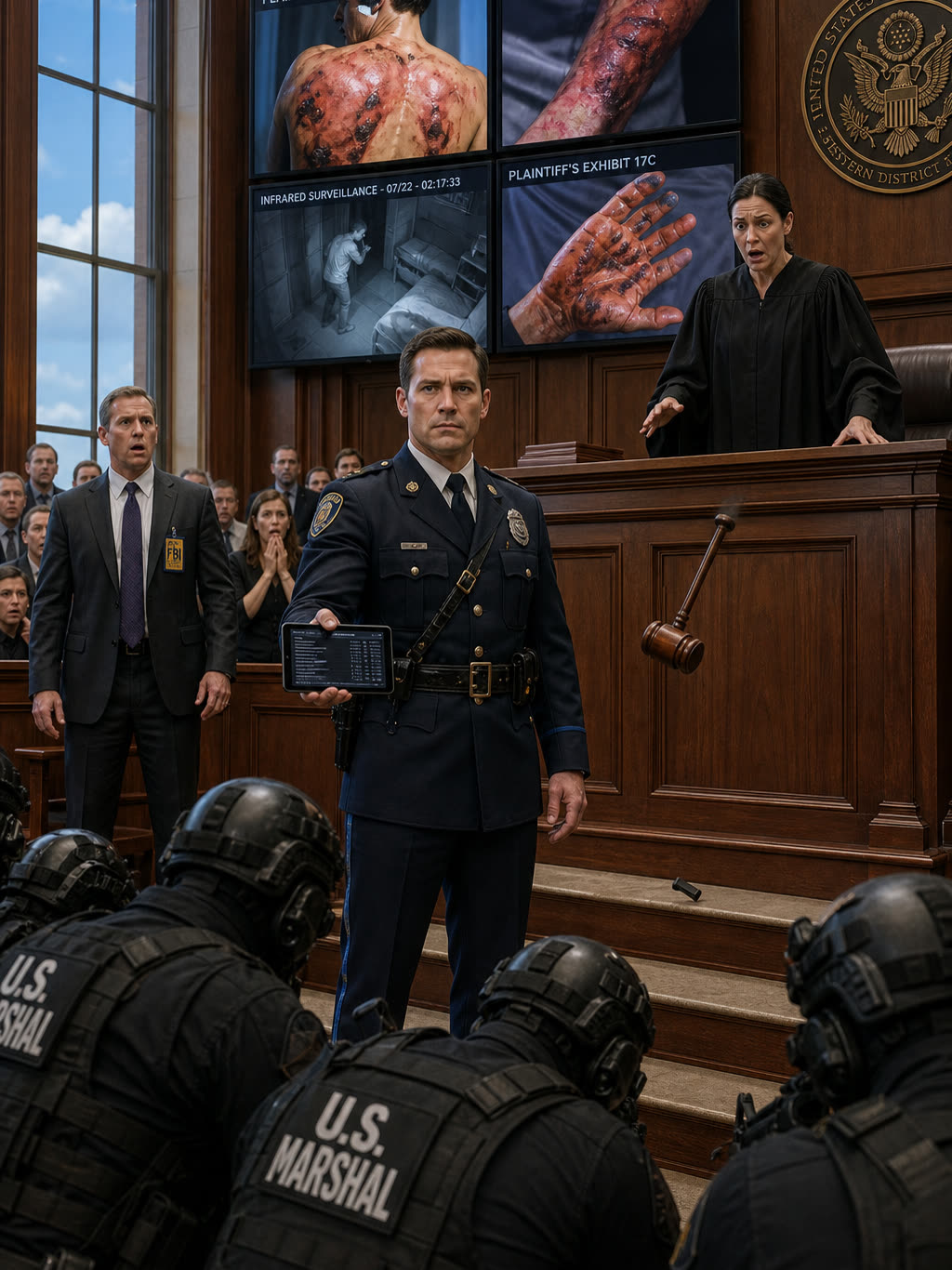
CLICK. The four eighty-inch high-definition monitors mounted throughout the courtroom, installed just six months earlier with state modernization funds that Victoria had personally secured, flared to brilliant, blinding life. A collective, visceral scream of horror ripped through the gallery.
A female public defender at the defense table covered her mouth with both hands and burst into audible tears. Two reporters from the Daily Herald bolted upright in their seats, faces drained of color, staring open-mouthed at the screens.
Spread across ten feet of crystal-clear digital projection was the macro-forensic photograph of six-year-old Leo’s back. The five blackened, square third-degree contact burns running down his fragile spine were magnified twenty times their actual size. Every cracked blister, every drop of yellow serous fluid, and the distinct cross-hatched grid of the heating element burned into his flesh was visible down to the cellular level.
Beside it, the screen split into a four-way comparative display. On the left was the macroscopic photograph of the steel livestock branding iron seized from the basement vault, complete with the millimeter scale ruler. On the right was the DNA laboratory match report bearing Victoria Sterling’s full genetic profile, lifted from the rubberized handle.
And beneath them both, playing on an infinite, silent loop, was the recovered infrared surveillance video from Room Zero: Judge Victoria Sterling, in her gray morning robe, holding down a sobbing, naked six-year-old boy on the concrete floor and pressing the glowing steel head of the brand into his spine.
The entire courtroom erupted into absolute pandemonium.
“Dear God…” the court clerk whispered, stumbling backward away from the bench as if Victoria were a rabid animal. “Oh dear God, she branded him…”
Reporters were already on their feet, snapping photos of the screens with their smartphones, fingers flying to broadcast the feed to every news bureau in the country.
Victoria stood frozen behind the bench. Her manicured hands shook so violently that her knuckles rattled against the polished walnut. The color had left her face entirely, leaving a waxy, gray mask of absolute ruin.
Her fingers went limp. The heavy rosewood gavel slipped from her grasp, tumbled off the elevated desk, and clattered down the three carpeted steps of the judicial dais, rolling to a stop directly at the boots of the United States Marshals.
She looked down from her high bench, her eyes locking onto mine in the center aisle. I didn’t blink. I didn’t smile. I stood at attention, watching the architect of my son’s agony realize that her fortress had just become her tomb.
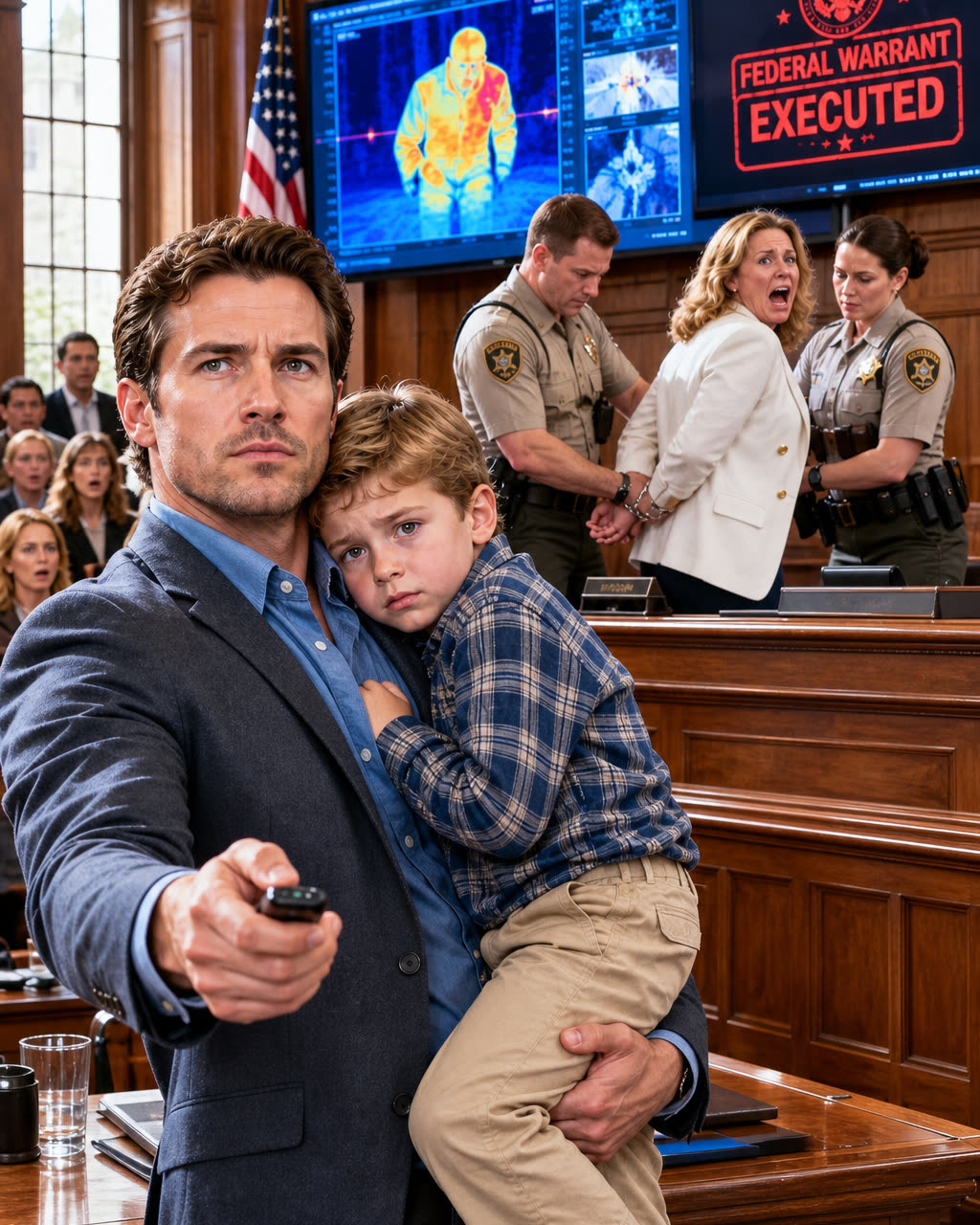
“Victoria Sterling-Vance,” Agent Jenkins’ voice boomed over the shrieking reporters and the gasping gallery. “Step down from the bench with your hands above your head. You are under arrest pursuant to an emergency warrant issued by the United States District Court.”
“No…” Victoria whispered. The word was small, cracked, and completely stripped of its judicial majesty. She backed away from the walnut railing, retreating toward the private judicial chambers door behind the bench. “No! This is a fabrication! This is digital manipulation! My husband is an unstable psychotic who manufactured this evidence to extort me!”
“Move in,” Jenkins commanded.
Two female United States Marshals vaulted the wooden swinging gate into the well of the court and bounded up the private stairs of the dais. Victoria turned, scrambling frantically for the brass handle of her chambers door, her expensive designer heels slipping on the carpet. Before her fingers could turn the latch, the first marshal seized her by the right shoulder, spun her around, and slammed her back flat against the mahogany paneling beneath the state seal.
“Get your filthy hands off me!” Victoria shrieked.
The sound was horrifying, an undignified, feral screech of pure, wounded vanity that echoed off the vaulted ceiling. She thrashed violently, kicking her legs, her manicured nails clawing at the marshal’s Kevlar vest.
“I am a judge of this state! I am the law! David! You peasant! You ungrateful, miserable little clerk! Tell them! Tell them to let me go!”
RIP. The second marshal caught the shoulder of Victoria’s black silk judicial robe and pulled downward with brutal efficiency. The delicate seam tore open with a sharp, screaming sound, and the heavy black fabric peeled away from her body and fell like a pile of dirty, soiled laundry onto the floorboards of the dais. Stripped of the black robes, she stood exposed in her plain civilian blouse, a desperate, disheveled woman thrashing in the iron grip of two federal officers.
CLACK. The heavy steel ratchets of the handcuffs snapped around her manicured wrists, jerking her arms behind her back with mechanical finality. CLINK-CLANK. The marshals forced her down onto her knees and ratcheted heavy, chain-linked steel leg irons around her ankles, locking them tight above her designer leather pumps.
“Defendant is secured,” the marshal called out.
They lifted her by her elbows and dragged her down the three steps of the dais into the well of the court. Her hair had tumbled completely out of its severe chignon, loose black strands sticking to the sweat and smeared mascara on her face. Tears of pure, undiluted rage and terror carved deep grooves through her expensive foundation.
Flashbulbs exploded in continuous, strobe-like waves. Three local news camera crews had breached the courtroom doors, their heavy lenses locked on the falling magistrate. The marshals pinned her against the edge of the court clerk’s desk, right beneath the four eighty-inch monitors that were still broadcasting the horrifying images of Leo’s branded flesh.
I walked down the center aisle and passed through the swinging gate until I stood two feet in front of her. Victoria looked up at me, her chest heaving in ragged, shallow gasps. Even now, bound in federal steel and pinned against the desk where she had ruined hundreds of lives, the venom in her soul refused to die.
“You think you’ve won, David?” she spat, a fleck of blood from her bitten lip landing on her collar. “You think you can destroy me? I have friends in the appellate division who will dismantle this entire indictment before the sun sets! I gave your miserable family status! I gave your little bastard a future! I gave him discipline!”
“You gave him scars,” I whispered.
I leaned down until my face was six inches from hers, my eyes boring into the dead, cold center of her soul.
“You told me at the dinner table that no jury in this state would ever believe a child over a sitting judge,” I said, my voice an arctic, lethal whisper that carried across the hushed gallery. “You were right about one thing, Victoria. They won’t need to believe his word. They have my macro photographs. They have the tissue recovered from the iron. They have the video you thought you erased. And they have your fingerprints burned into the rubber handle.”
Her eyes widened in horror as the finality of the trap settled into her brain.
“You’re not going to a state facility where your judicial friends can protect you,” I continued, each word landing like an anvil. “You are going to a federal maximum-security medical penitentiary for the next forty years of your life. You will eat from a plastic tray. You will sleep on a steel slab. And you will wear orange cotton until the day they carry you out in a cardboard box.”
I straightened, smoothed the lapels of my State Police uniform, and looked up at the federal marshals. “Get her off my bench.”
“David! David, please!” she wailed, her voice breaking into a pathetic, desperate sob as the marshals hauled her backward toward the prisoner holding cells. “David! Don’t do this to me! Think of our family! David!”
Her designer shoes dragged across the linoleum, leaving dark scuff marks on the floor, her hysterical screams fading down the concrete holding corridor until the heavy steel security door slammed shut with a deafening, hydraulic thud. The courtroom fell into an eerie, heavy silence.
Agent Jenkins walked over to where I stood, holding out a thick, red-jacketed file stamped with the seal of the State Department of Social Services.
“David,” Jenkins said quietly, his voice heavy with grim sobriety. “Our tactical team swept her personal office in the basement an hour ago. We cracked her private floor safe.”
I looked at him. “What did you find?”
Jenkins handed me the file. “Six years ago, before she married you, Victoria was the temporary foster guardian for an eight-year-old boy named Julian Cole. The boy died of ‘accidental hypothermia’ following a fall into an abandoned quarry on her family estate. The local county coroner ruled it accidental within twenty-four hours and closed the file.”
Jenkins tapped the edge of the folder. “We found the original autopsy photographs in her safe. Julian had two-inch square burn marks along his lower lumbar spine. The state attorney general is reopening the homicide indictment this afternoon.”
I closed my eyes for a long, shuddering second, the weight of the universe pressing down on my shoulders. Then I took the file, tucked it under my arm, and turned my back on Courtroom 301.
“Process the paperwork, Marcus,” I said, walking toward the exit. “My son is waiting for me.”
A year had passed.
The early sunlight rose above the rugged summits of the Sangre de Cristo Mountains, streaming through the tall, cedar-framed windows of our cabin in southern Colorado. Brilliant bands of golden and amber light spread across the interior, gradually chasing away the coolness of the mountain morning.
The comforting scents of fresh white pine, strong dark-roast coffee, and warm, sweet buttermilk pancakes cooking on a cast-iron griddle filled our home.
In the middle of a handwoven wool carpet covering the wooden floor sat Leo, now seven years old.
He wore worn denim overalls over a vivid yellow T-shirt. Gripping two oversized wooden building blocks, he knocked them together in an enthusiastic, disorderly rhythm while constructing an enormous, unstable tower that rose almost as high as his chin.
CLACK. CLACK. BOOM!
The wooden structure rocked from side to side, gave way, and tumbled across the carpet with a thunderous clatter that reverberated throughout the room beneath its lofty ceiling.
Leo showed no sign of fear. He didn’t lower his head. He didn’t collapse to his knees in frightened submission.
Instead, he tipped his head backward and erupted into a tremendous burst of spontaneous, uninhibited laughter that echoed through every room of the cabin. Next to him, Barnaby, our eight-month-old Golden Retriever puppy, began barking excitedly, leaping among the fallen blocks and enthusiastically licking Leo’s ears until my son rolled across the carpet, laughing so hard he could barely breathe.
“Daddy! Look!” Leo shouted with all his strength, his voice overflowing with the fearless confidence of a child who finally belonged to himself. “The earthquake got the tower! It went BOOM!”
“I heard it all the way from the kitchen, buddy!” I answered cheerfully, smiling as I turned another pancake on the hot griddle.
He made noise. He created delightful disorder. He was gloriously alive.
Twelve months of demanding pediatric trauma counseling, hyperbaric oxygen therapy, and reconstructive scar treatments performed by Denver’s most accomplished plastic surgeons had finally pushed the darkness into the past. Five square-shaped burn marks remained along the lower portion of his spine, now reduced to delicate, silvery geometric patterns that would accompany him as permanent reminders of his survival. Yet the damaged nerves had recovered, the relentless physical suffering had ended, and the horrifying dreams that once dragged him awake screaming and soaked in sweat had gradually disappeared beneath the steadfast comfort of his father’s unconditional love.
Victoria Sterling had been permanently erased from our existence.
Her courtroom proceedings had concluded in fewer than four days. Confronted with thirty-four gigabytes of original, uncompressed forensic footage, statements from three federal specialists in digital evidence, and a recently unsealed second-degree murder charge connected to Julian Cole’s death, she had accepted a blind plea rather than face the possibility of federal capital punishment.
The Chief Federal District Judge imposed a forty-five-year sentence at the Federal Medical Center, Carswell, in Fort Worth, Texas, a high-security administrative correctional institution where federal parole would never be available to her. Her identity had been officially removed from the state’s judicial registry, her authorization to practice law had been revoked for life, and the polished marble nameplate displayed in the courthouse rotunda had been pried from its position and destroyed inside an industrial crushing machine.
The woman once feared as the Iron Maiden of the Third District no longer existed. In her place was Federal Inmate #49281-013, confined for twenty-three hours each day within an eight-by-ten-foot concrete cell, receiving her meals through an opening in a heavy steel door, abandoned and forgotten by the very community she had once ruled through intimidation.
I switched off the griddle, arranged three soft, golden pancakes on a ceramic dish, poured rich mountain maple syrup over them, and brought the plate into the living room.
Then I settled onto the carpet beside my son, sitting with my legs crossed.
Barnaby promptly placed his large, furry head against my knee, his tail thumping happily on the wooden floor, while Leo pressed his small, sturdy body against my side. He stretched out his hand, grabbed a bite of pancake between his fingers, slipped it into his mouth, and smiled up at me with eyes that were entirely bright, peaceful, and free of fear.
“Daddy?” he asked between cheerful mouthfuls.
“Yeah, Leo?”
“Do you remember when we lived in the big dark house?”
A quiet ache tightened around my heart, but I remained composed. In our family, we never pretended that painful memories didn’t exist. We acknowledged what had happened, because accepting the truth meant refusing to let it control us any longer.
“I do, buddy,” I replied gently, placing my palm against his head and tousling his thick brown hair.
Leo glanced at the scattered wooden blocks before reaching behind himself and softly touching the pale silver marks hidden beneath his shirt with his thumb.
“She told me I was bad,” he explained in a low voice, speaking calmly without any trace of the terror that had once consumed him. “She said the stamps were because I was broken.”
I set the dish aside, reached for him, and lifted him straight onto my lap, enclosing his chest securely within my arms until he rested safely against the steady rhythm of my heart.
“You were never bad, Leo,” I murmured against his hair, the profound, undeniable certainty of those words settling into the deepest part of me. “And you were never broken. A monster tried to put chains on you because she was terrified of how bright your light was. But the chains broke. And the monster lost.”
Leo relaxed against my shoulder, his expression opening into a magnificent, radiant smile.
“Because you’re the Chief,” he declared with obvious pride.
“Because I’m your father,” I gently reminded him, pressing a kiss against his temple. “And my only job in this whole wide world is to make sure you are safe, you are loved, and you are free.”
His face shone with happiness as he flung his arms around my neck and hugged me with every ounce of strength his little body possessed. “Daddy! After breakfast, can we build a tower that reaches all the way to the ceiling? And then can we knock it down as loud as we want?”
My eyes traveled toward the towering cedar windows, beyond which the Rocky Mountains stretched endlessly beneath a dusting of snow, their rugged peaks framed by an enormous, breathtaking expanse of brilliant azure sky.
“Leo,” I answered, my voice heavy with the extraordinary, lasting peace of a father who had endured unimaginable suffering to bring his little boy safely home. “You make all the noise you want. You yell, you laugh, and you dance. Because nobody is ever going to tell you to be a statue again.”
Leo sprang from my lap, seized two wooden blocks, and dashed toward the window glowing with morning sunshine, his delighted laughter rising into the rafters like the joyful ringing of church bells on a Sunday morning.
“Daddy! What game are we playing today?”
I rose and joined my son beside the window, watching the mountain wind stir the surrounding pine trees.
“Whatever game you want, Leo,” I replied with a warm smile, slipping my arm affectionately around his shoulders. “The whole world is ours.”
Disclaimer: This story is a work of fiction inspired by real-life themes. Names, characters, places and events are fictionalized, and any resemblance to real persons is purely coincidental. Images are for illustration purposes only.
