

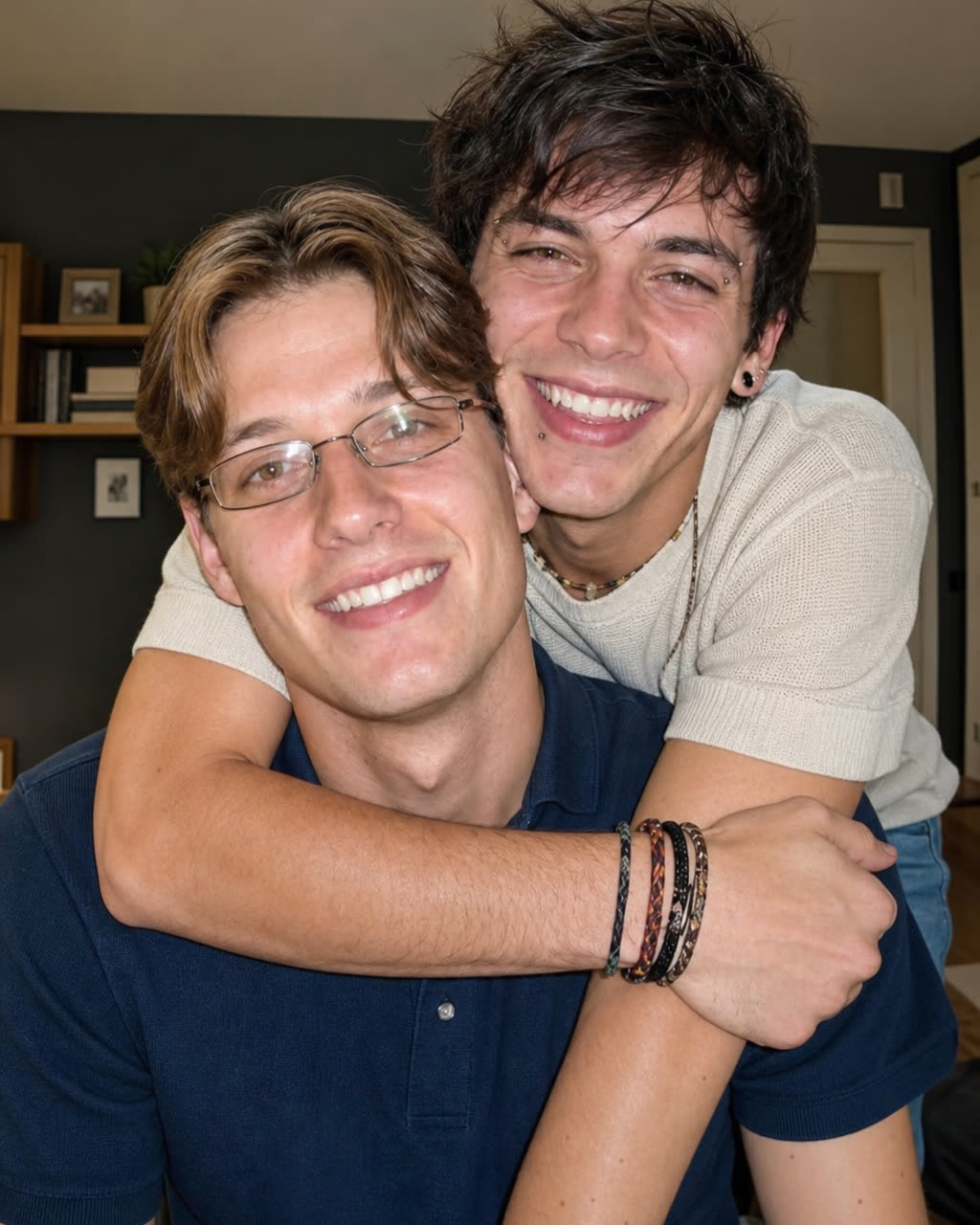
Part One: The Locked Door
Just two days after he moved out, my son came back home in tears.
It was a late-August Thursday evening. I stood at the stove making our usual Thursday spaghetti sauce, the dinner my husband Mike never got tired of. The kitchen window was open. Cicadas screamed in the oaks, and somewhere down the street a neighbor was mowing his lawn.
The front door swung open.
I knew it was Luke without turning around. After eighteen years, I could pick out his footsteps anywhere. But tonight they sounded wrong.
They were slow, heavy with something he could not yet say, and painfully hesitant.
Still gripping my wooden spoon, I turned. Luke stood in the kitchen doorway in his gray Kansas City Royals hoodie, even though it was eighty-five degrees out. His face was blotchy and his eyes were swollen and red.
He had plainly been crying for a long time. This was not the look of a boy who had simply wiped away a few tears after a bad day.
“Mom,” he said. His voice faltered. “I need to confess something.”
I turned off the burner, set the spoon down, and pulled out a kitchen chair. “Come here, honey,” I said. “Sit down. Tell me what’s wrong.”
Luke did not move. He dragged his sleeve across his wet cheeks and glanced nervously toward the hall. Then he went back and quietly locked the front door. He turned the deadbolt and checked it twice.
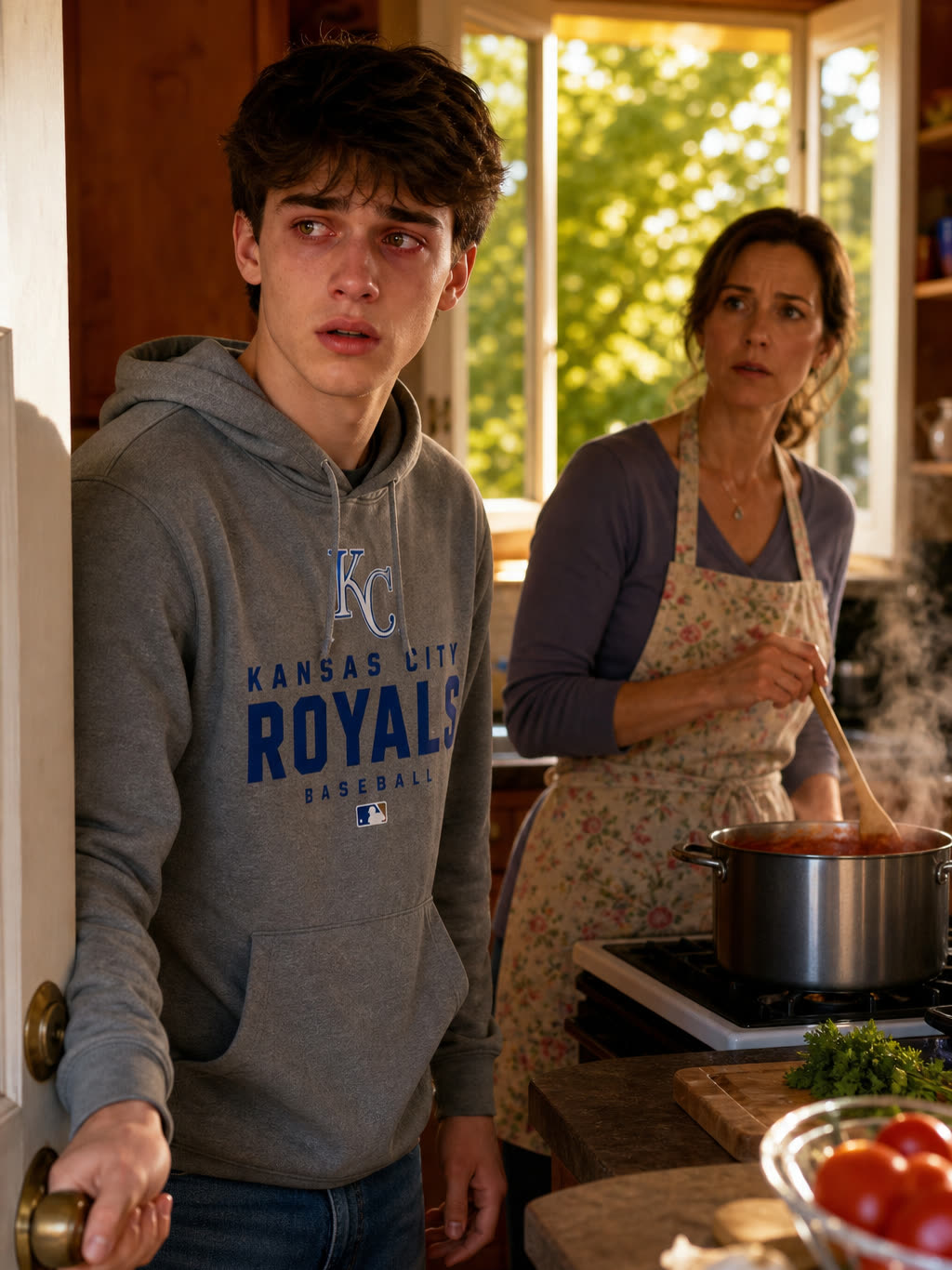
“Is anybody else here?” he asked.
“No, sweetheart,” I said. “Dad’s at the job site in Overland Park until seven. It’s just us.”
He gave a slow nod.
My heart began to race.
“Luke,” I said carefully. “Did something happen between you and Ben?”
“No!” he said. Too loud. Too fast.
Then, quieter: “And whatever you do, don’t call him.”
My stomach clenched.
To understand any of this, you have to know Ben.
My son and Ben Callahan had been inseparable since they were two. They met in the sandbox at a toddler group at the Plaza library branch in Kansas City. Ben threw sand at Luke, and Luke promptly threw it back. Then the two of them built a crooked sandcastle together and became friends for life.
They went to the same preschool, elementary school, middle school and high school. They played on the same Little League, soccer and high-school basketball teams. They spent weekends at each other’s houses and took vacations together. Their private handshake took forty-five seconds to finish.
They also looked startlingly alike.
Both were tall and slender, with dark-brown hair that curled at the ends when it grew out. They shared pale gray-green eyes, a dimple in the left cheek, and a crooked lower tooth.
Strangers took them for brothers all the time. Restaurant servers, teachers meeting them for the first time, and coaches at basketball tournaments kept making the same guess.
“Are you twins?” people would ask.
The boys would laugh. “Nope. Just best friends.”
I always laughed along. Every single time. I knew no other way to respond.
After graduating in May, the boys announced they would share an apartment. It was a second-floor two-bedroom in an aging brick building in Westport, close to the community college where they would start that fall.
I was mostly pleased. Two lifelong friends starting adult life together, splitting rent and groceries and arguing over who took out the trash. What could go wrong?
Mike moved them in on Tuesday. He borrowed a friend’s trailer to haul Luke’s bed, desk and our old basement couch. I packed Luke some kitchen supplies: plates, cups, a skillet, and a month’s worth of canned soup.
I held him for ages in the apartment doorway.
“Call me,” I’d said. “Every day.”
“Mom,” he’d said, rolling his eyes. “I’m fifteen minutes away.”
That was Tuesday.
Now it was Thursday, and my son stood shaking in my kitchen with the door locked behind him, unable to look me in the eye.
“Whatever happened, honey,” I said, “you can tell me. We’ll figure it out together.”
“You can’t promise that!” he burst out.
I stared at him. I had never heard that tone from him, not even in his teenage years. Luke was always the relaxed, steady one. He was the child who comforted other kids when they were upset.
What could Ben possibly have done to frighten him like this?
Possibilities raced through my mind. Drugs, money, trouble with the police, some terrible accident?
Then another possibility occurred to me.
After a moment’s hesitation, I made myself ask.
“Luke,” I said gently. “Is there something going on between you and Ben?”
He looked at me as though I had lost my mind.
“What are you talking about?”
“If the two of you are more than friends,” I said, “that’s okay. That’s completely okay. Nothing could ever change how much I love you. Or your father.”
“Mom, no!”
He pressed both hands hard against his forehead.
“It’s not that,” he said. “God, I wish it were that simple.”
At last he sat down. He kept his hoodie on. He leaned on his elbows and studied the grain of the tabletop.
“I didn’t move out because I was ready to live on my own,” he said quietly.
“Then why did you leave?”
Silence stretched between us.
“Because Ben told me something about our family,” he said. “About my family. Three weeks ago. At graduation.”
He swallowed hard.
“I thought he was making it up,” he said. “I thought it was some kind of sick joke. So I moved in with him because I needed proof.”
My mouth went dry.
“Proof of what?” I asked.
But I already sensed the answer. Somewhere deep inside, I had been waiting for this moment for eighteen years.
Luke reached into his hoodie pocket and pulled out a folded sheet of paper. Its creases had gone soft from being handled again and again. The page shook in his fingers.
“Before I show you this,” he said, “I need you to promise me one thing.”
“What is it?”
For the first time since he had walked in, he looked straight at me. His gray-green eyes. His father’s—no. Not his father’s.
“Don’t lie to me, Mom,” he said. “Not this time.”
His tone scared me more than his tears had.
Not this time.
He knew, or believed he knew. He wanted the pretending to end.
“Luke,” I said. “Where did you find that?”
“At Ben’s house,” he said. “His mom’s house. In her desk. Ben showed me where she keeps it.”
He held it out, and I took it. I was still desperately hoping for a misunderstanding, a trick, a mistake. Unfolding the page took my breath away.
It was a printout from a DNA-testing website, the kind sold in pharmacies and online, where you mail in a saliva sample and later receive your ancestry and a list of relatives. At the top, in large letters, it read: DNA Relatives — Ben Callahan.
Names followed. Mostly distant cousins in Ireland, Michigan and Texas.
One name, though, was highlighted in yellow. It sat at the very top.
Luke Whitman.
Predicted relationship: Half-sibling.
Shared DNA: 24.7%.
A second sheet was clipped behind it. It was older and yellowed, and its letterhead was instantly familiar. The Midwest Reproductive Center in Overland Park, Kansas.
I was looking at a donor profile.
Donor #4127.
Height: 6’2″. Hair: Dark brown. Eyes: Gray-green. Ethnicity: Irish, German. Education: Master’s degree, chemistry.
I read the opening lines, and my legs nearly gave out. I sank into the chair across from Luke.
Neither of us spoke for a long time. The kitchen clock kept ticking. Cicadas shrieked beyond the open window. A skin formed over the cooling spaghetti sauce.
Luke watched me without blinking.
“It’s true,” he said. It wasn’t a question.
I lowered my eyes to the page. To his name in yellow. To the donor number I had memorized nineteen years earlier.
4127.
“Mom,” Luke said. “You promised. Don’t lie to me.”
“It’s true,” I whispered.
Luke closed his eyes. He didn’t cry. Maybe he had used up his tears somewhere between Ben’s apartment and our house. He sat perfectly still, eyes shut, palms flat on the table.
“Ben’s my brother,” he said.
“Half-brother,” I said. “Yes.”
“And Dad,” Luke said. His voice cracked on the word. “Dad’s not my dad.”
“No,” I said quickly. “No, honey, that’s not true. Dad is your dad. He is. In every way that matters.”
Luke opened his eyes, and his face had hardened.
“Except the one way,” he said.
I had no answer.
“Tell me,” Luke said. “All of it. From the beginning.”
And I told him.
I’m Sarah Whitman, forty-seven. I teach fourth graders at Border Star Montessori in Kansas City.
Mike Whitman and I married when I was twenty-five and he was twenty-seven. He was a big, quiet carpenter, often dusted with sawdust, with enormous hands. He built custom cabinets and bookshelves for homes in Mission Hills.
We wanted to start a family right away. Maybe three or four children. We had talked about it on our second date.
We tried for two years without success. There was no pregnancy.
We went to a fertility doctor, and both of us were tested. My results were normal.
Mike’s were not.
I still remember the day we found out why. We sat in a small office in Overland Park surrounded by framed photographs of babies. Kind Dr. Patel held a folder in her lap.
“Mr. Whitman,” she said gently. “I’m afraid the results show that you’re not able to father children naturally. It’s a condition called azoospermia.”
She quietly walked us through the medical findings and our alternatives. Mike sat speechless for a long time.
On the drive home, he pulled onto the shoulder of Interstate 435 and bent over the steering wheel, sobbing.
I had never seen him cry. Not in three years together, not even at his father’s funeral.
“I’m sorry, Sarah,” he said. “I’m so sorry. You married a man who can’t give you a baby.”
I held him while passing semis shook our car on the shoulder.
“I married a man I love,” I said. “We’ll figure out the rest.”
For months we went back and forth over adoption, and we seriously considered building our life together without children at all.
Eventually Dr. Patel brought up donor insemination: an anonymous, medically screened donor from a sperm bank. I would carry and deliver our baby, with Mike beside me the entire way. The child would be ours.
Mike agreed before I did.
“I don’t need it to be my blood,” he said. We were sitting on our back porch on a summer night. “I need it to be my kid. Those aren’t the same thing.”
We chose our donor together. At this very kitchen table, we paged through a thick Midwest Reproductive Center binder of donor profiles. There were no names or photos, only identification numbers and facts: height, hair, eyes, schooling and family medical history. Each donor had written a short personal description.
Mike picked #4127.
“He’s six-two,” Mike said. “Like me. Dark hair. Like me. He likes woodworking. It says right here. He likes to build things.”
He lifted his eyes to mine.
“Our kid could look like me,” he said quietly. “Nobody would ever have to know.”
We had never said that thought out loud before.
Nobody needed to find out.
That was how the secret began.
Part Two: The Promise We Made
I conceived after our second attempt. We had never been happier. Mike cried in the clinic parking lot, and on the drive home he bought a tiny Kansas City Chiefs onesie. That same evening he started building a crib in our garage.
Four months into my pregnancy, the clinic invited me to a support group. We met monthly in a hospital conference room, all of us women who had conceived with donors. We sat in a circle with decaf coffee, sharing our worries. We talked about telling relatives and, eventually, telling our children.
That was where I met Dana Callahan.
Dana was thirty-one, three years younger than me. She worked as an emergency nurse at Saint Luke’s Hospital. Red curls, freckles and a bursting laugh made her unforgettable.
She was single and had always wanted to be a mother. She was tired of waiting for the right partner.
“So I went shopping,” she said at our first meeting. “Picked a donor out of a catalog. Like ordering a sweater.”
Everyone laughed.
Dana and I clicked at once. We had lunch after meetings and shopped for maternity clothes together. On nights when sleep wouldn’t come, she often called me at eleven, and we talked through swollen ankles, stretch marks, and the fear that neither of us would know how to be a good mother.
Our due dates were two weeks apart.
At the fifth meeting, our counselor asked us to describe our donors. Dana volunteered first.
“Mine’s six-foot-two,” she said. “Dark brown hair. Gray-green eyes. Master’s in chemistry. Says he likes woodworking.”
She chuckled.
“I figured if I couldn’t find a guy who could build me a bookshelf,” she said, “at least my kid might be able to.”
I sat frozen in my folding chair. My heart seemed to stop.
Afterward, I cornered her in the parking lot.
“Dana,” I said. “What’s your donor number?”
She gave me a strange look.
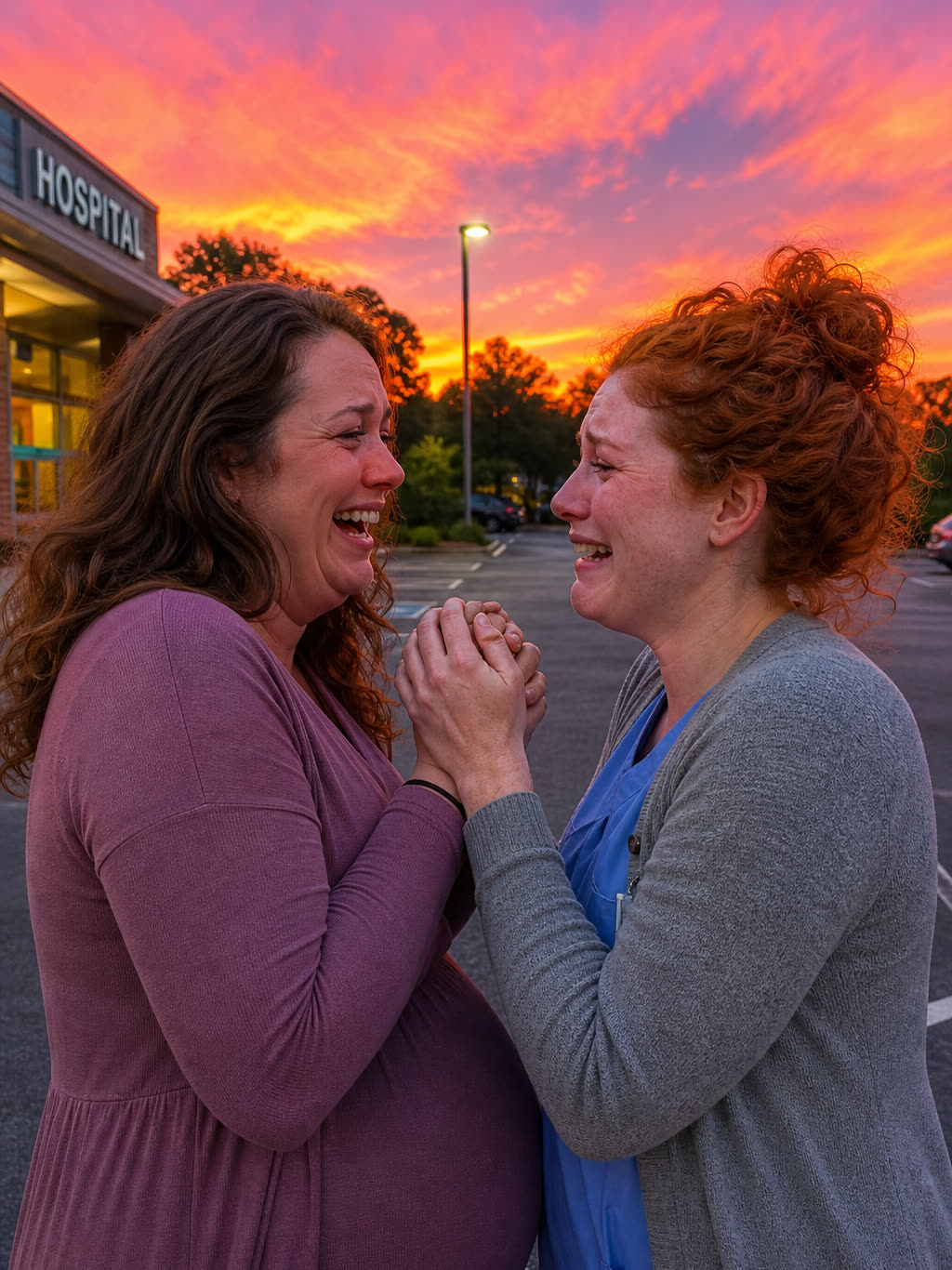
“4127,” she said. “Why?”
We stood in that parking lot for ages. Two expectant mothers, hands clasped, laughing and crying together.
“Our babies are going to be brothers,” Dana said. “Or sisters. Or one of each.”
“Half-siblings,” I said.
“Same thing,” Dana said.
Luke was born on March 11. Eight pounds, two ounces. Dark hair. Gray-green eyes.
Mike held him first. In the corner of the delivery room, still in a paper gown and hairnet, Mike pressed our newborn to his chest and sobbed.
“Hi, buddy,” he whispered. “I’m your dad.”
Ben was born on March 24, two weeks later. Eight pounds, five ounces. Dark hair. Gray-green eyes.
Dana called me from the hospital. “He has your kid’s dimple,” she said. “Left cheek. I swear to God.”
For months after the births, Dana and I argued over the future. Whether to tell the boys, when, and how.
The counselors from the support group urged honesty. Children, they said, should learn where they came from early. Secrets surface eventually, and they hurt more the longer they are delayed.
Mike, though, was afraid.
“If we tell him,” Mike said one night, holding Luke in the rocking chair, “he’ll always know I’m not really his dad. He’ll look at me different. He’ll wonder about this other guy. This donor.”
He looked down at our sleeping baby.
“I want to be his dad, Sarah,” he said. “Just his dad. Not his social father or his legal father or whatever the books call it. Just Dad.”
Dana had worries of her own.
“My mom’s Catholic,” she said. “Old-school Irish Catholic. She thinks Ben’s father was a guy I dated in nursing school who left me when I got pregnant. If she finds out I went to a sperm bank, she’ll never speak to me again.”
So we made a decision. The three of us agreed at Dana’s kitchen table while both babies slept in their car seats.
We promised that the two boys would grow up side by side as best friends. They would know each other all through childhood and beyond. They would be brothers in everything but name.
Someday, when they were older, we would explain.
“When?” Dana asked.
“When they’re eighteen,” Mike said. “When they’re adults. When they can handle it.”
All three of us agreed.
The boys turned eighteen that March.
And still, we said nothing.
“Ben’s mom gave him a DNA test for his birthday,” Luke said quietly. “In March. One of those ancestry kits. He’s always been curious about where his dad’s side came from. Because he never knew his dad.”
I closed my eyes. Dana must have thought it would only show ancestry. Ireland. Germany. She must not have noticed the box that hid the relatives list.
“The results came back in May,” Luke said. “Right before graduation. Ben opened them on his phone in the parking lot after a basketball banquet.”
He looked down at the paper in front of him.
“My name was at the top of the list,” he said. “Half-sibling.”
“Ben didn’t know I’d taken a test,” Luke said. “I hadn’t. But Grandma Whitman gave everybody in the family one for Christmas two years ago. Remember? She wanted to make a family tree.”
The memory came back to me. Mike’s mother, Eileen, handing out kits like party favors. I had tossed mine in a drawer. I never knew Luke had done his.
“I sent mine in,” Luke said. “I never even looked at the results. I forgot about it.”
“Ben told me at graduation,” Luke said. “After the ceremony. Out by the football field, while everybody was taking pictures.”
He swallowed hard.
“He showed me on his phone,” he said. “And I laughed. I thought it was a mistake. Or a joke. I thought maybe the website mixed up the results because we’re always together.”
“But Ben wasn’t laughing,” Luke said.
He faced me.
“He said, Luke, I asked my mom. She cried. She wouldn’t tell me anything. She just kept saying it wasn’t her secret to tell.”
“That’s when I knew,” Luke said. “Because Ben’s mom never cries. She works in the ER. She’s seen everything. She doesn’t cry.”
“So I came home,” Luke said. “And I looked at you and Dad at dinner that night. And you were laughing about something. Dad was telling that story about the client in Mission Hills with the six-foot dog.”
He shook his head slowly.
“And I couldn’t say anything,” he said. “Because what if it was true? What if I asked, and it was true, and I ruined everything?”
“So I decided to find out for myself,” he said. “Without asking you. Without hurting Dad.”
He glanced at the paper.
“Ben said his mom kept all her papers in her desk,” he said. “Locked. But Ben knew where the key was. In a coffee mug on the bookshelf.”
“Ben and I already had the apartment lined up,” Luke said. “For the fall. I told you I wanted to move in early. You thought I was just excited.”
He laughed a little. It was not a happy sound.
“I was excited,” he said. “Just not about the apartment.”
“Tuesday night, after Dad left,” Luke said, “Ben and I drove to his mom’s house. She was working a night shift. We let ourselves in. We opened the desk.”
He pointed to the aged donor profile.
“That was in a folder,” he said. “With her name on it. And there was a sticky note on the folder. In her handwriting.”
He swallowed hard.
“It said, Same as Sarah’s. Tell the boys at 18.”
I covered my face.
Tell the boys at 18.
Dana had written that reminder eighteen years earlier so she would remember. And yet we had forgotten, or chosen to pretend.
“I’m sorry,” I said. “Luke, I’m so sorry. We should have told you. We were going to. We kept saying next year. Next birthday. After graduation.”
“Why didn’t you?” he asked.
I looked up at him.
“Because I was scared,” I said.
“Of what?”
“Of this,” I said. “Of you looking at me like you’re looking at me right now. Of you looking at your dad differently.”
I wiped away tears.
“Of you finding out that your whole life,” I said, “your best friend was your brother, and we let you think he was just a friend.”
Luke said nothing for a long while.
“Is that why you always laughed?” he asked. “When people asked if we were twins?”
“Yes,” I whispered.
“Why did you lock the door?” I asked him.
His eyes drifted toward the hallway.
“Because I didn’t want Dad to walk in,” he said quietly. “Not until I knew for sure.”
His voice splintered.
“Mom, I didn’t want him to see my face when I found out,” he said. “I didn’t want him to see me finding out he’s not my real dad.”
“And why did you say not to call Ben?”
Luke drew a shaky breath.
“Because Ben’s been a mess for three months,” he said. “Ever since graduation. He keeps saying it’s his fault. That he shouldn’t have taken the test. That he ruined my family.”
He rubbed his nose with his sleeve.
“He’s been sleeping on the couch in our apartment,” Luke said. “Even though he has a bedroom. He says he doesn’t want to be alone. He keeps asking if I hate him.”
“Do you?” I asked.
Luke looked at me as if I had asked the stupidest question in the world.
“He’s my best friend,” he said. “He’s been my best friend since we were two. He’s the only person in the world who’s always been there.”
He laughed. Tears were running down his face.
“And now I find out he’s my brother,” he said. “And I’m supposed to be upset about that? Mom, I always wanted a brother. Every single Christmas. You remember. I asked Santa for a brother every year until I was nine.”
The memory came flooding back. Every crayon-scrawled Christmas list. A brother, a bicycle, and Legos. Always in that order.
“I’m not upset about Ben,” Luke said. “I’m upset about Dad.”
At 6:52, a truck pulled into the driveway.
Luke froze.
A truck door slammed. Boots thudded up the walk. Then a key turned in the front lock.
The deadbolt was still engaged, and it held the key out.
Mike knocked.
“Sarah?” he called. “Door’s locked. You okay?”
Luke turned to me, his face pale.
“Mom,” he whispered. “What do I do?”
I looked at my son. Eighteen years old. Six-foot-two. Dark hair, gray-green eyes, a dimple in his left cheek.
Looking closely, I could not find a single feature on his face that belonged to the man knocking at our door.
Yet he had inherited every familiar habit. The way he rubs his forehead when he’s stressed. The way he hums when he cooks. The way he says buddy to every dog he meets. The way he laughs with his whole body, throwing his head back.
Every bit of it was Mike.
“You tell him the truth,” I said quietly. “Like you asked me to.”
I stood, walked to the door, and slid back the deadbolt.
Mike came in carrying his lunchbox, sawdust in his hair, wearing work boots and a faded Chiefs shirt. One look at my face stopped him in his tracks.
He looked past me into the kitchen. Luke sat there in his hoodie, red-eyed, with the document on the table.
Mike lowered his lunchbox. For a moment he couldn’t speak.
Then he walked into the kitchen and looked down at the paper in front of him. At the Midwest Reproductive Center donor profile. At the number he had picked at this very table nineteen years earlier.
#4127.
His face stayed fixed. But his hands began to tremble.
“Dad,” Luke said. His voice was very small. “Is it true?”
Mike paused before answering. He took the chair across from his son and folded his large, work-scarred hands on the tabletop.
“Yes,” he said. “It’s true.”
Luke’s face crumpled.
“Why didn’t you tell me?” he said.
Part Three: Family Is Who Stays
Mike stared at his hands. “Because I was ashamed,” he said. Luke lifted his head.
“Not of you,” Mike said quickly. “Never of you. Not for one second of your whole life.” He swallowed hard.
“Of me,” he said. “Of what I couldn’t do.”
“When the doctor told me I couldn’t have kids,” Mike said, “I felt like less of a man. Like I’d failed your mom. Like I’d failed my own father, who had five boys and always said a Whitman man’s job is to carry on the name.”
He shook his head slowly. “And when your mom got pregnant,” he said, “I made her promise. I made her promise nobody would ever know. Not my mother. Not my brothers. Not you.”
“I thought if nobody knew,” he said, “then I could just be your dad. Nobody would ever look at me and think, That’s not really his kid. Nobody would ever look at you and think, That’s not really his father.”
He met Luke’s gaze. “I was wrong,” he said. “I know that now. I knew it a long time ago. I just didn’t know how to fix it.”
Luke began crying again. “Dad,” he said. “You don’t—you’re not—” The words failed him. Mike reached across the table and covered his son’s hand with his own. “Can I tell you something?” Mike said. Luke nodded once.
“The day you were born,” Mike said, “the nurse handed you to me first. Before your mom. Because she was still getting stitched up.” A faint smile appeared. “You were screaming,” he said. “Bright red. Mad at the whole world. Eight pounds two ounces of fury.”
“And I held you against my chest,” Mike said. “And I started humming. I don’t even know why. It was a song my mom used to sing to me. You Are My Sunshine.” His voice faltered. “And you stopped crying,” he said. “Just like that. You looked up at me with those gray-green eyes. And you grabbed my thumb. I didn’t care whose blood you had,” Mike said. “Not for one second. You grabbed my thumb, and you were mine.”
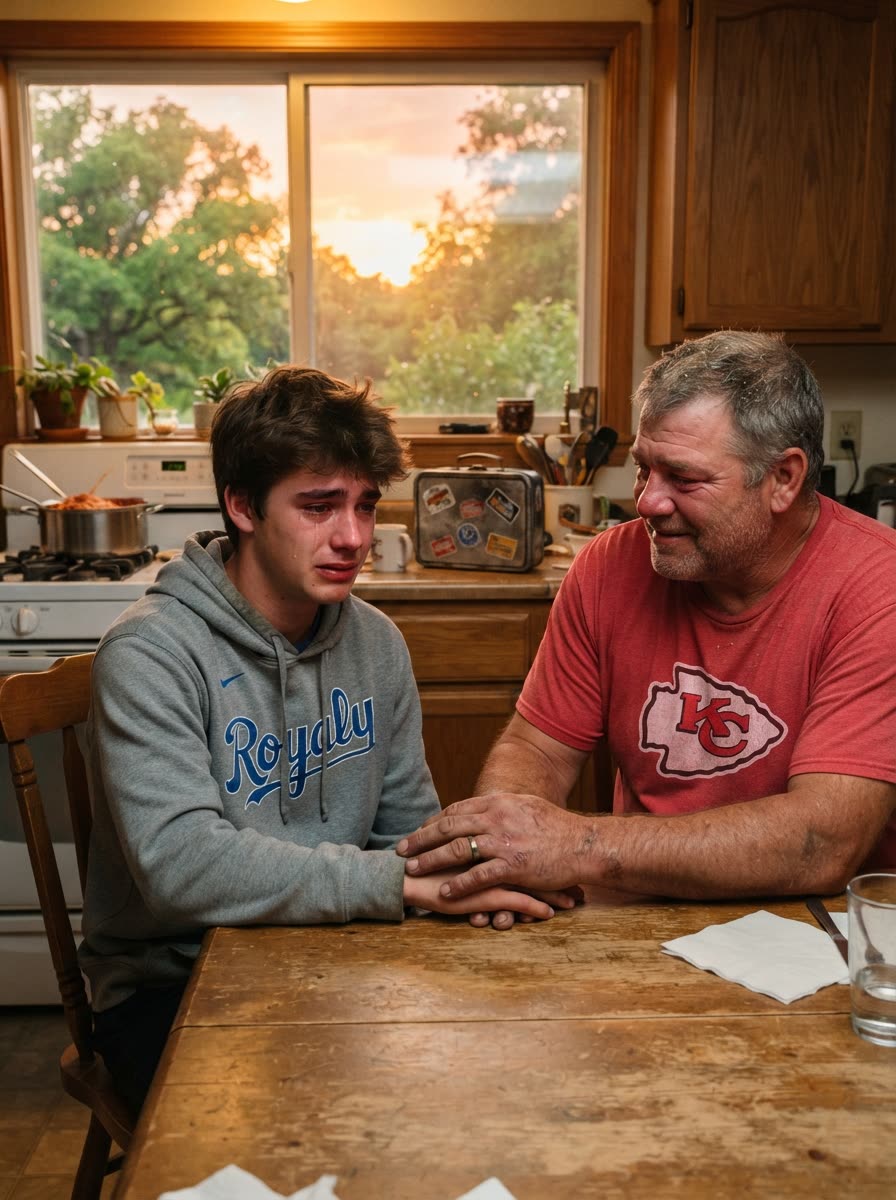
He gently squeezed Luke’s hand.
“I taught you to ride a bike in the church parking lot,” he said. “I taught you to use a hammer when you were six. I taught you how to throw a curveball. I sat up with you every night for a week when you had pneumonia in third grade.”
He looked at his son.
“Some guy in a lab gave you your eyes,” he said. “I gave you everything else.”
Luke stood up. He came around the table and wrapped his arms around his father. He had grown taller than Mike, passing his height two years earlier. Still, he bent down and clung to him like a five-year-old.
Mike held him in return. They stayed that way for a long time, father and son in our kitchen beside the cold spaghetti sauce.
“I’m sorry, Dad,” Luke said into his shoulder. “I’m sorry I went behind your back. I’m sorry I broke into Ben’s mom’s desk.”
“I’m sorry I made you have to,” Mike said.
That night we drove to Dana’s. The three of us rode in Mike’s truck, with Luke between us on the bench seat, just as he had sat as a child.
He had called Ben from the kitchen. He’d said, Get your mom. We’re coming over. All of us.
Dana lived in a small bungalow in Brookside with a porch and a potted lemon tree. She was waiting on the porch when we pulled up, still in her work scrubs. Gray had begun to thread through her red hair at the temples.
Ben stood beside her. He looked gaunt and pale, with shadows under his eyes. His face crumpled when Luke stepped out of the truck.
Luke climbed the porch steps and stopped in front of Ben.
Neither of them spoke at first. They just looked at each other. Two lanky eighteen-year-olds, both dark-haired and gray-green-eyed, with matching dimples in their cheeks.
Luke held out his hand. But not to shake. He wanted their private handshake, the full forty-five-second version.
Ben stared at the offered hand. Then laughter and tears came all at once.
He took Luke’s hand, and they went through every move. Every slap, snap and elbow bump. For forty-five seconds they stood under Dana’s porch light while three parents watched.
Instead of ending with their usual fist bump, they hugged.
“I’m sorry,” Ben said into Luke’s shoulder. “I’m so sorry. I shouldn’t have taken that stupid test. I ruined everything.”
“You didn’t ruin anything,” Luke said.
“I did,” Ben said. “I made you lie to your parents. I made you break into my mom’s desk. I made your whole family fall apart.”
Luke stepped back and looked at his best friend. His newfound brother.
“Ben,” he said. “Remember what I asked Santa for every Christmas?”
Ben wiped his tears away.
“A brother,” he said. “A bike. And Legos.”
“In that order,” Luke said.
Ben let out a tearful, relieved laugh.
“I always wanted one too,” Ben said. “I never had a dad. I never had anybody. Just my mom and you.”
He shook his head slowly.
“I used to pretend you were my brother,” he said. “When we were little. I’d tell kids at school you were my brother.”
Luke grinned.
“So did I,” he said.
After the boys went inside, Dana and I sat down on her porch swing. Mike stayed with them in the kitchen, and their voices carried through the screen. Mike was making grilled cheese. The boys were arguing over whether the bread needed mayonnaise or butter on the outside.
Mike and Ben were for mayonnaise; Luke insisted on butter.
“Traitor,” Mike said to Ben.
Both boys laughed.
“I’m sorry, Sarah,” Dana said quietly. “I should have checked that test before I gave it to him. I didn’t think about the relatives list. I didn’t even know it existed.”
“It’s not your fault,” I said. “We all decided not to tell them.”
“We all decided to tell them at eighteen,” Dana said. “And then we didn’t.”
She looked at me.
“I wrote it on a sticky note so I wouldn’t forget,” she said. “And then I just stopped looking at the folder.”
“Why didn’t you tell Ben?” I asked. “When he asked you?”
Dana was quiet for a long time.
“Because it wasn’t just my secret,” she said. “It was yours too. And Mike’s. I couldn’t tell Ben he had a half-brother without telling him who. And I couldn’t tell him it was Luke without breaking Mike’s heart.”
She shook her head slowly.
“So I cried,” she said. “I told him it wasn’t my secret to tell. I thought maybe he’d let it go.”
“He didn’t,” I said.
“He’s a Callahan,” Dana said. “And a 4127. Neither of those let things go.”
I laughed. I couldn’t help it.
“Did you ever tell your mother?” I asked.
Dana shook her head.
“She died in 2019,” she said. “She still thought Ben’s father was a guy named Kevin who dumped me in nursing school.”
She almost smiled.
“There was no Kevin,” she said. “I made him up. He was a very convincing jerk.”
We stayed on that porch swing in silence, letting the laughter from inside fill the space between us. Mike was telling the story about the Mission Hills client with the six-foot dog.
“Do you think they’ll be okay?” Dana asked.
I listened to Luke laugh, and then Ben. Their laughter was almost identical.
“I think they’ve always been okay,” I said. “I think we were the ones who weren’t.”
The next day, we held a family meeting. All five of us sat around our kitchen table. Mike made bacon and pancakes. His pancakes are better than mine.
After talking late into the previous night, the adults and the boys had agreed on a few things.
First, we would keep no more secrets. Not about the donor, the clinic, or anything else.
“If you want to know something,” Mike told the boys, “you ask. And we answer. The truth. Even if it’s hard.”
Both boys agreed.
The next decision was harder.
“We need to tell the rest of the family,” I said.
Mike went pale.
“My mother,” he said.
“Your mother,” I said.
Eileen, Mike’s mother, was seventy-six and lived in a small house in Raytown. After Mike’s father died, she raised five boys on her own. Stubborn and tough, she went to seven-o’clock Mass every day.
She was also the one who had given Luke his DNA kit.
“She’s going to find out anyway,” Luke said. “She did one too. She’s probably already seen that I don’t match her.”
Mike shut his eyes.
“She’s going to think I lied to her for eighteen years,” he said.
“You did,” I said gently.
That Sunday afternoon, we went to see Eileen. Mike, Luke and I went together. She served iced tea and shortbread. Her little living room held a crucifix and photographs of five sons and eleven grandchildren on every available surface.
Mike explained everything. It took him a long time. He stumbled over his words, his hands shaking.
When he stopped, Eileen was silent. She set down her iced tea and looked at her son. Then her eyes moved to her grandson.
“Michael,” she said. “Do you think I’m stupid?”
Mike blinked in surprise.
“What?”
“I’m seventy-six years old,” Eileen said. “I raised five boys. I know what my grandchildren look like.”
She gestured toward Luke.
“That boy doesn’t have a single Whitman feature on his face,” she said. “Not the nose. Not the ears. Not those eyes. I’ve known since the day he was born.”
Mike stared at his mother.
“You knew?” he said. “For eighteen years?”
“I suspected,” Eileen said. “And then I did that DNA test two years ago. And I looked at the results. And Luke wasn’t on my list.”
She gave a small shrug.
“So I knew,” she said.
“Why didn’t you say anything?” Mike asked.
Eileen studied him for a while.
“Because I watched you hold him,” she said. “At the hospital. That first day. You were humming my song. You Are My Sunshine.”
Tears filled her eyes.
“Your father used to hum that song,” she said. “To all five of you boys. When you couldn’t sleep.”
She reached for Mike’s hand.
“You’re a Whitman, Michael,” she said. “And that boy is a Whitman. Because you made him one. Every single day.”
Mike broke down in his mother’s living room. Luke got up and perched on the arm of his father’s chair, resting a hand on his shoulder.
Eileen looked at her grandson.
“Come here,” she said. “Give your grandmother a hug.”
Luke hugged her.
“I don’t care whose eyes you have,” she whispered in his ear. “You’re my grandson. You’ll always be my grandson.”
In October, the boys brought up the donor. We were having Sunday dinner at Dana’s, which had become a weekly ritual. One week pot roast at Dana’s, the next spaghetti at ours.
“Can we find him?” Ben asked. “Donor 4127. Is that allowed?”
Dana and I traded a look. The clinic had been anonymous when we used it. Things had changed since then. Online DNA databases had transformed everything.
“I don’t know,” Dana said. “We’d have to ask the clinic. And he’d have to agree.”
Luke turned to Mike.
“Dad,” he said. “Would that bother you?”
Mike paused and put down his fork.
“It’s your choice, buddy,” he said. “Not mine. I’m not going anywhere. Whatever you find out.”
He smiled reassuringly.
“But if he shows up and tries to teach you to throw a curveball,” he said, “I’m going to have words with him.”
The boys wrote a joint letter and sent it through the Midwest Reproductive Center. The clinic now ran a contact program for donor-conceived people. Donors were free to decline to respond, but the letter would still reach him. They kept it short.
Dear Donor 4127,
We’re Luke and Ben. We were born two weeks apart in March. We grew up together as best friends. We just found out we’re half-brothers. Because of you.
We don’t want anything. We have families. Luke has a dad and Ben has a mom, and they’re great.
We just wanted to say thank you. And to tell you we turned out okay.
We both like woodworking. Luke’s dad taught us.
— Luke and Ben
A reply came in December. It arrived through the clinic in a plain white envelope. Inside was a handwritten note on ruled paper. The boys opened it together at our table.
Dear Luke and Ben,
I’ve read your letter about thirty times. My wife says I need to stop carrying it around in my pocket.
My name is Tom. I’m sixty-one. I teach high school chemistry in Oregon. I donated in 2005, when I was a graduate student at the University of Kansas and needed money for rent.
I never thought I’d hear from anyone. I’m so glad I did.
I want you to know something. I don’t want to replace anyone in your lives. Luke, you have a dad who taught you woodworking. Ben, you have a mom who raised you on her own. Those are your parents. Not me.
I’m just the guy who gave you your eyes.
But if you ever want to know about my family’s medical history, or where the Irish side came from, or why you both have that dimple, I’m here. Just write.
One more thing.
I have two daughters. They’re twenty-three and twenty-six. They know about you now. They’ve always wanted brothers.
They asked me to tell you that they’re very good at video games and they’ll destroy you both at Mario Kart.
Take care of each other.
— Tom
The boys read it four times. Then Luke looked up at Mike.
“Dad,” he said. “Read the part about woodworking again.”
Mike took the letter and read aloud.
“Luke, you have a dad who taught you woodworking.”
He set it down and simply looked at his son, speechless.
Luke grinned.
“See?” he said. “Even the donor knows.”
We hosted Christmas dinner that year. All five of us—Mike, Luke, Dana, Ben, and me. Eileen came too, with shortbread, and sat next to Dana talking endlessly about nursing.
It was our first gathering as one family. No longer two friendly households, but one family.
Afterward, the boys gave Mike a present. It came in a large, flat package wrapped in brown paper. They had made it themselves, working three weekends in his garage workshop while he was away on jobs.
Mike opened it. Inside was a sign, carved from a single walnut board, sanded and oiled until it gleamed. They had chiseled the lettering by hand with tools Mike gave Luke for his twelfth birthday:
WHITMAN & CALLAHAN
Family is who stays.
Mike rested the sign on his knees for a long time. He traced the carving with his thumb. He could tell each boy’s work apart. Luke’s cuts ran deeper; Ben’s were slightly uneven.
“We made it in your workshop,” Luke said. “With your tools. The way you taught us.”
“You taught Ben too,” Dana said quietly. “Every summer. Every time he came over. He came home talking about dovetail joints.”
Mike glanced at Ben.
“I never knew he was listening,” Mike said.
“I was always listening,” Ben said. “You were the only dad I had.”
Mike said nothing. He laid the sign carefully on the coffee table, stood, and crossed the living room. He wrapped one arm around each boy and pulled them both close.
“Some guy in Oregon gave you your eyes,” Mike said quietly. “Both of you.”
His voice broke.
“But I’ll be damned if I’m not your dad,” he said.
The sign hangs above our front entrance now. I see it every time I come home. WHITMAN & CALLAHAN. Family is who stays.
The boys still share their Westport apartment. Ben is studying nursing, like Dana. Luke works as Mike’s apprentice, learning to build custom cabinets for homes in Mission Hills.
They still perform the whole forty-five-second secret handshake.
Strangers still ask whether they’re twins. Every time. At restaurants, hardware stores, and Royals games at Kauffman Stadium.
These days, the boys answer differently.
“Nope,” Luke says. “Brothers. Born two weeks apart. Different moms.”
The listeners usually look baffled. Ben breaks into a grin.
“It’s a long story,” he says. “Want to hear it?”
People sometimes ask what I would change, if I could go back nineteen years. I tell them I would repeat almost every choice. The clinic, the donor, the binder on our kitchen table, donor #4127—all of it.
Except for one thing. I would tell the boys.
Not at eighteen, not at graduation, and not after a DNA result popped up in a parking lot. I would begin when they were small. At bedtime, maybe with a picture book. Families can come together in different ways.
I would explain a little more each year, until it stopped being a secret and became simply their story.
That was my lesson. The truth never destroyed our family. Secrecy nearly did.
Last week, Luke came for dinner. It was Thursday, spaghetti night. He walked through the front door, and this time he left it unlocked.
He came into the kitchen, kissed my cheek, and snatched a piece of garlic bread off the counter before I could protest. Then he looked out the kitchen window. Mike was working on a birdhouse at his bench in the backyard.
“Mom,” Luke said. “Can I tell you something?”
“Of course.”
“When I came home that day,” he said. “In August. And I locked the door.”
“I remember.”
He gazed outside at his dad.
“I was so scared I was going to lose him,” Luke said. “I thought if it was true, I’d never be able to call him Dad again. Not without thinking about the other guy.”
He bit into his garlic bread.
“But you know what?” he said. “I don’t think about the other guy at all. Tom’s nice. His letters are nice. His daughters destroyed us at Mario Kart.”
He grinned.
“But when I think Dad,” he said, “I just see him.”
He pointed out the window.
“Building a birdhouse,” he said. “Humming.”
I followed his gaze. Mike stood at his workbench with sawdust in his hair and a hammer in his hand. He hummed You Are My Sunshine off-key, the way his father once had, the same way he had soothed a screaming newborn eighteen years before.
Luke pushed open the back door.
“Dad!” he called. “Dinner’s ready!”
Mike looked up and smiled reassuringly. The whole-face smile.
“Coming, buddy,” he said.
He put down the hammer and brushed off his jeans. He crossed the yard toward his home and his son.
The boy who once gripped his thumb.
And never let go.
Disclaimer: This story is a work of fiction inspired by real-life themes. Names, characters, places and events are fictionalized, and any resemblance to real persons is purely coincidental. Images are for illustration purposes only.
