

Part 1: A Driveway Full of Copper
After six years at the same auto repair shop, I turned in my resignation for a better job, one that offered health insurance for my children. My boss was furious, though he barely said a word about it. On my final payday, instead of letting my $915 paycheck land in my bank account, he drove to my house and dumped 91,500 pennies across my driveway. Every last coin had been smeared with dirty motor oil, and the smell of it hung over our yard like a threat.
Then he taped my pay stub to an empty bucket and sneered, “Paid in full. Count it yourself.” My two children watched from the porch as his truck pulled away. I didn’t scream. I didn’t threaten him. I stood there with my heart hammering, and then, over the following days, I quietly set about cleaning and rolling every single penny.
What I didn’t expect was that the local elementary school would find out what I’d done with that money. Once it did, the story raced through town faster than I could have imagined. And the very next morning, my phone rang.
“Becky,” the school cafeteria manager whispered, “your former boss is standing in my office. He’s asking for you.” I asked her what he wanted. Her next words stunned me. “I don’t know. But he’s crying.”
My name is Becky Lindahl. I’m thirty-four years old, married, and raising two children in a small Wisconsin town. For six years I worked at Heckert Auto & Diesel, a repair shop owned by a man named Dale Heckert. I ran the parts counter, ordered supplies, answered the phones when customers called with trouble, and kept the inventory in order. It wasn’t glamorous work, but I was good at it, and I took quiet pride in that.
Dale was a demanding boss who almost never gave a compliment. He expected everybody to work hard, and he didn’t believe in handing out many benefits. I had long since learned not to wait for praise from him. So when a position opened up at the local farmers’ cooperative, I applied without expecting much. The salary was about the same as what I was making. But the job came with health insurance for my entire family, and that made all the difference.
It mattered enormously. Our household had been squeezed by rising medical and insurance costs, and my husband Jake’s employer had recently changed its coverage. Every month the numbers seemed to get a little harder to face. I lay awake more nights than I care to admit, thinking about what would happen if one of the kids got sick. I simply couldn’t pass up the chance to fix that.
When I gave Dale my two weeks’ notice, he barely looked up at me. “You’re leaving for the co-op?” he asked. “Yes. The insurance will really help my children,” I told him. He set my resignation letter aside as though it were a piece of junk mail. Then he stopped speaking to me altogether.
For the next two weeks, he walked past me without so much as a nod, as if I had already vanished from the building. I kept doing my job anyway. On my last day, I left behind a detailed binder filled with supplier contacts, inventory information, and everything my replacement would need to get started. I said goodbye to my coworkers, who hugged me and wished me luck. Dale stayed shut in his office and never came out.
My final paycheck was supposed to be $915 after deductions. But when I checked my bank account that afternoon, nothing had arrived. I assumed it was a delay and tried not to worry. Then, at four o’clock, I heard a pickup truck turn into my driveway. It was Dale. I stepped outside just as he lifted a heavy bucket out of the truck bed. Before I could ask him anything, he tipped it over, and thousands of pennies came pouring across the gravel.
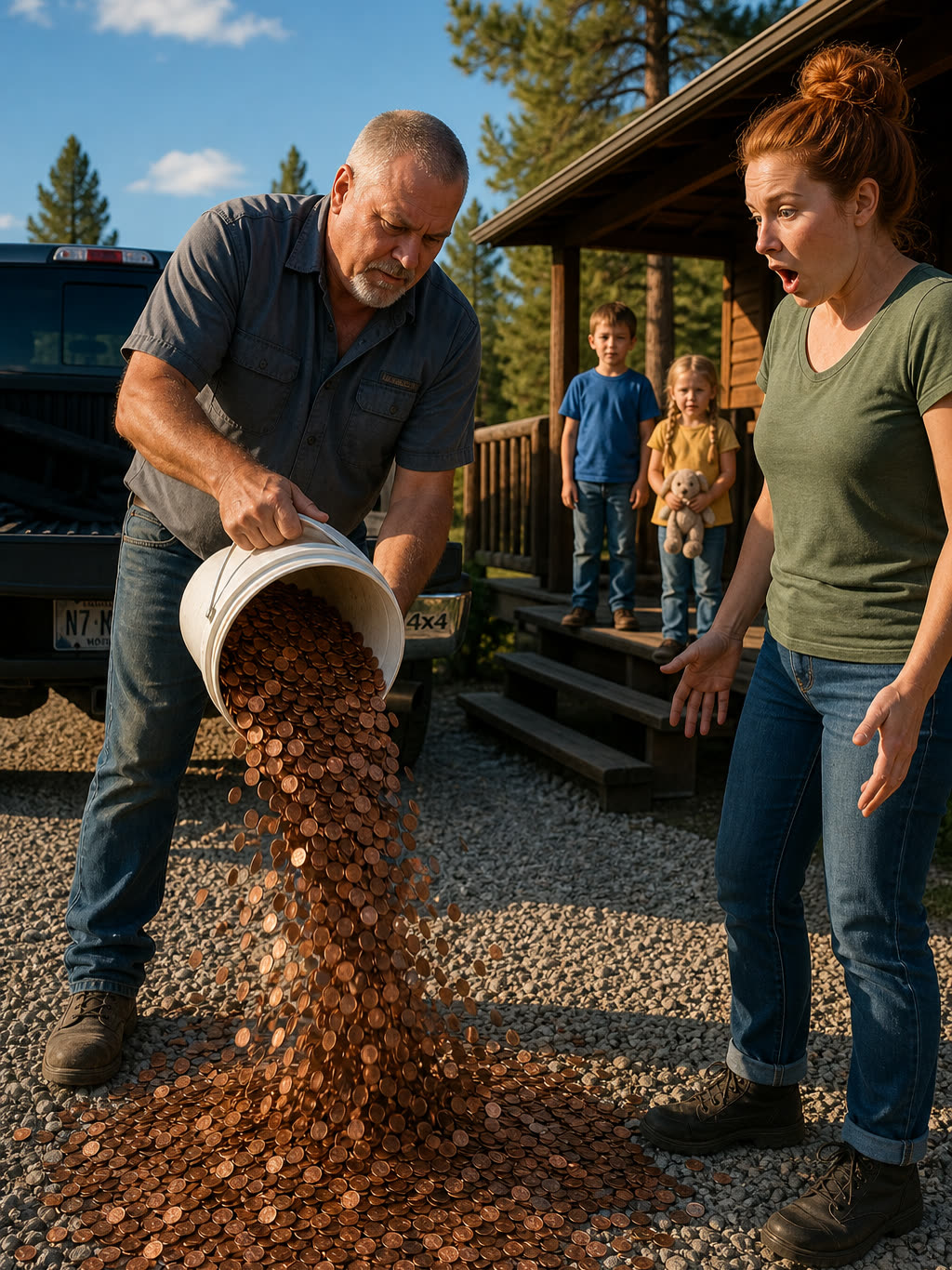
He emptied another bucket. And another. The metallic clatter went on and on, a hard, ugly rain of copper. By the time he finished, a mountain of coins covered my driveway, glinting dully in the afternoon light. The smell of motor oil rose up and filled the air. Dale had deliberately coated those pennies in dirty oil, and I understood that he’d planned every bit of it.
My eight-year-old son, Noah, appeared in the doorway behind me. His five-year-old sister, Lily, stood at his shoulder clutching her stuffed rabbit against her chest. Neither of them said a word. I could feel their eyes on my back, and I wanted more than anything to shield them from what they were watching.
Dale pulled my final pay stub from his pocket and taped it to one of the empty buckets, smoothing the tape down as though he were hanging a notice. “There’s your money,” he said coldly. “Every cent.” Then he climbed back into his truck, started the engine, and drove away without looking back.
I stood there staring at the mess. Six years of loyalty. Six years of hard work. Six years of covering for him on bad days and staying late when the shop was behind. And this was how he had chosen to say goodbye. My throat burned, and I swallowed hard, because I knew my children were still watching me to see what I would do.
That evening, I called my husband. Jake was working away from home, hauling logs for a trucking company, and the line crackled before his voice came through. I described what Dale had done, slowly, because I could barely get the words out. When I finished, there was a long silence on the other end, and then he exploded with anger.
“I’ll borrow a trailer, collect every coin, and dump them right back at his shop!” he said. “No,” I replied. “Becky, he humiliated you!” His voice shook with rage on my behalf, and I loved him for it. “I know,” I said. “But I don’t want to respond by doing exactly what he expects.”
I thought about taking the money to a bank or a coin-counting machine. But the pennies were filthy, and I knew that processing them would be difficult, messy, and possibly expensive. Nobody was going to take that much oily change without a fight. So I made up my mind. I would clean them myself, one handful at a time, if that was what it took.
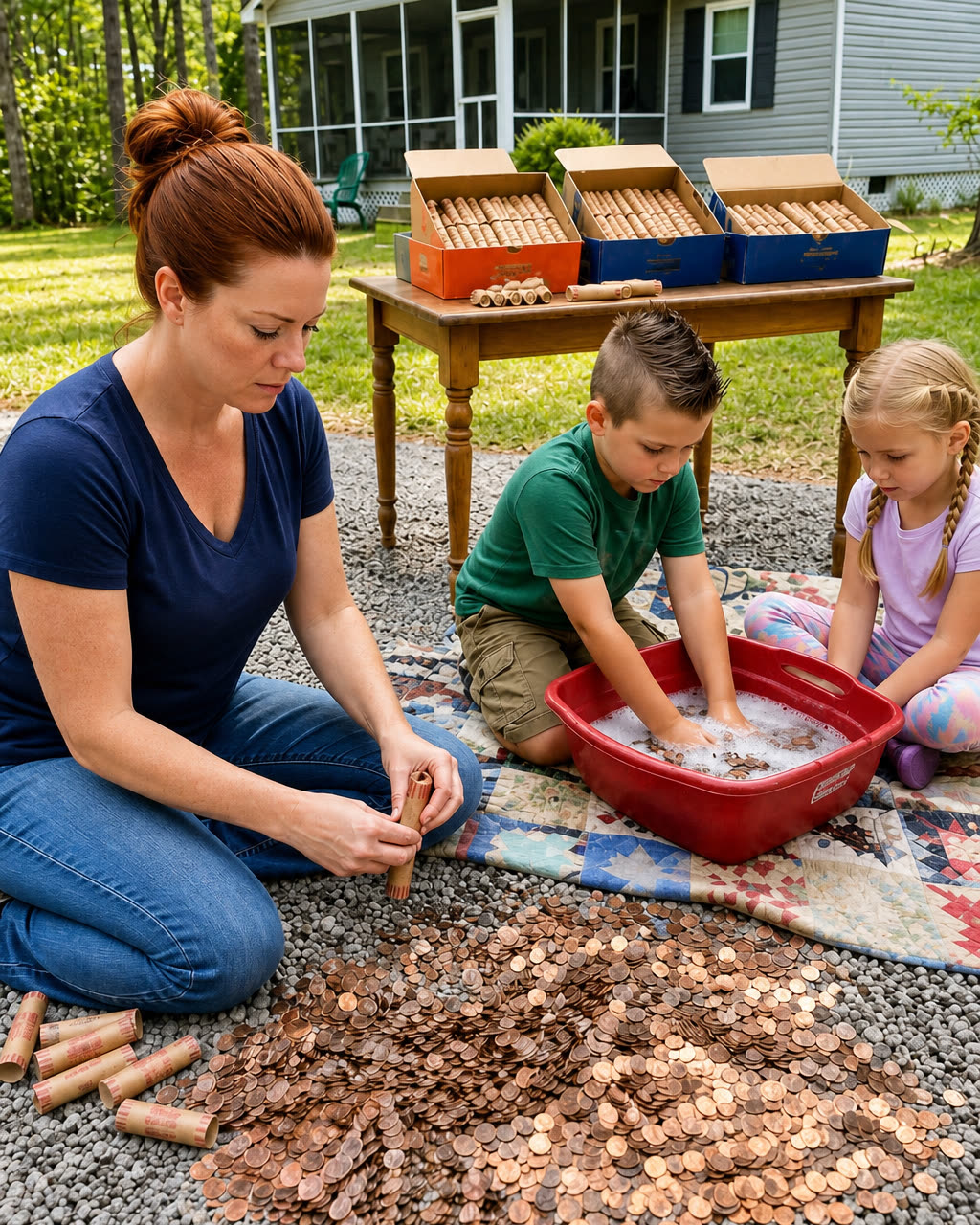
The next morning, I filled a large plastic tub with warm water and dish soap. I carried it outside, set it on the gravel beside the heap of coins, and began washing small batches. The water turned gray almost immediately, and the pennies came out dull but a little less slick. It was slow, tiring work, and I had barely made a dent in the pile when I heard the screen door creak behind me.
Noah stepped onto the porch in his pajamas, his hair sticking up in every direction. “Mom, what are you doing?” he asked. “Cleaning our pennies, sweetheart,” I answered. He studied the enormous pile for a long moment, taking in the size of it. Then he looked back at me. “Can I help?”
I hesitated. I didn’t want my children anywhere near dirty motor oil, and every instinct told me to send him back inside. But he looked so earnest, and I could see how badly he wanted to do something useful. So after I had arranged gloves and found a safe way for the kids to work only with the cleaner coins, I finally agreed.
Lily appeared soon afterward, her rabbit tucked under one arm. “I want to help too!” she announced, in a voice that left no room for argument. I laughed in spite of everything and found her a pair of gloves that swallowed her small hands.
We spread an old picnic blanket on the grass and set up a little cleaning station in the sun. I handled the dirtiest coins at the tub. The children helped dry them, sort them, and count the clean pennies into neat little stacks. Together we figured out that fifty pennies made one roll. And that meant ninety-one thousand five hundred pennies would come to 1,830 rolls.
The task felt impossible. I won’t pretend otherwise. When I did the math, my stomach dropped, and for a moment I wondered if I had lost my mind. But the children didn’t seem discouraged at all, and their patience gave me patience. We worked steadily, and we kept at it.
By evening, several shoeboxes were filled with rolled coins, lined up on the porch like small treasures. My hands were raw and my back ached, but I felt better than I had in days. Doing something, anything, had loosened the knot that Dale had tied inside me.
That night, after Lily had fallen asleep, Noah came and sat beside me on the porch steps. The air had turned cool, and the crickets were loud in the dark. He looked out at the remaining pile of pennies, silver and copper under the porch light, and he didn’t say anything for a long time.
Then, in a small voice, he asked me an unexpected question. “Mom, what happens when kids don’t have enough money for school lunch?”
I turned and looked at him. He had that serious expression he gets when something has been weighing on him. “Why do you ask?” I said gently. He took a breath, picked at the edge of his sleeve, and began to tell me about someone at school. And what he said next would change everything.
Part 2: The Boy Called Cheese
He told me about a boy in his second-grade class named Mason. When Mason’s lunch account didn’t have enough money in it, he sometimes got a plain cheese sandwich instead of the regular meal. It was a small thing, Noah explained, the kind of thing a grown-up might not notice. But the other children noticed. They noticed every time.
One boy had even started calling him “Cheese Boy.” Noah’s face crumpled as he said it, and I could see how much it bothered him. “Mom, everybody knows when he gets that different lunch,” he said quietly. I felt my heart tighten in my chest, because I could picture it so clearly: a small boy at a crowded lunch table, staring down at his tray while the room went on without him.
Then Noah turned his head toward the pile of pennies glittering under the porch light. “Could we use some of this money to help kids like Mason?”
For a moment, I couldn’t answer. That $915 mattered to our family. My new paycheck wouldn’t arrive right away, and we had bills waiting to be paid. I knew exactly how tight the next few weeks were going to be. But my son’s question wouldn’t let go of me, and I knew I would hear it in my head long after he went to bed. Finally, I nodded. “Let’s ask the school how we can help.”
On Monday morning, I called Washington Elementary School. The cafeteria manager, Mrs. Fogle, had worked there for more than thirty years, and her voice was warm and a little tired when she answered. I explained that I wanted to contribute toward outstanding lunch balances. She thanked me kindly and said she would check the records.
I heard her moving through papers, and then she came back on the line and gave me a number. “Twenty-three second-grade students currently have unpaid lunch balances.” I was surprised by how large it sounded. Twenty-three children. Twenty-three little faces like Mason’s. “How much do they owe altogether?” I asked. I heard her typing for a few seconds. “Nine hundred eight dollars and forty cents.”
I sat down hard in the nearest chair. $908.40. My final paycheck had been $915, so the difference was only $6.60. I stared out the window toward the enormous pile of pennies on the driveway, and I understood that the numbers had lined up almost exactly. It felt like more than a coincidence.
Then I made my decision. “Mrs. Fogle, I’d like to cover the entire amount.” She was quiet for a moment, as if she wasn’t sure she had heard me right. “All of it?” she asked. “Yes.”
Then I explained how I’d come to have the money. The buckets. The motor oil. The driveway. And the days we were spending cleaning every coin. I told her about the children at the tub and the shoeboxes on the porch. When I finished, there was a long pause, and then she whispered, “Oh, honey.”
Over the following days, we kept working, and the pile slowly began to shrink. My husband joined us when he returned home from the road, and he rolled up his sleeves without a word about what he had wanted to do to Dale. The children pitched in whenever they could, while Jake and I handled the heavier work. Eventually, every penny had been cleaned and rolled. We packed the coins into seventy-four shoeboxes and stacked them in the back of Jake’s truck.

The next morning, Jake helped carry them to school. Mrs. Fogle and the principal were waiting for us at the entrance, and when they saw all those boxes, they stared in disbelief. Noah stood beside me, holding one final roll in his hand. Lily had wrapped it herself. It was a little crooked, with the paper bunched unevenly around the edges, and he held it as carefully as if it were made of glass.
Noah walked toward Mrs. Fogle and held it out to her. “My sister made this one,” he explained. “It’s for the kids who don’t have enough lunch money.”
Mrs. Fogle took it carefully, the way you take something fragile. Then she sat down on the nearest bench, as though her legs had given out. Her eyes filled with tears. For thirty-one years, she had watched children struggle with unpaid lunch accounts. Sometimes she had even slipped money from her own pocket to cover them. But she could never help everyone, and she had carried that weight quietly for a very long time.
Now, because of a family she barely knew, every negative second-grade balance would be cleared. She looked up at Noah, blinking hard. “Sweetheart, because of your family, those twenty-three children won’t have to worry about their lunch balances today.” Noah smiled shyly and glanced at me, and I squeezed his shoulder, so proud of him I could hardly breathe.
Later that morning, the school published a thank-you message on Facebook. It described how a local mother and her children had cleaned and rolled 91,500 pennies to pay off school lunch debt. The message didn’t mention my former employer. It didn’t need to. But Merrill was a small town, where people knew one another’s business, and the story of Dale dumping oily pennies in my driveway had already made the rounds among his former coworkers.
Within hours, the post had hundreds of shares. Then thousands. My phone buzzed so often that I turned it face down on the kitchen counter. People wrote messages about how angry they were over the way I had been treated. Others wrote that they admired what the money had become. Strangers I would never meet were sharing a picture of the shoeboxes and a photo of my children’s hands covered in soap.
I didn’t join the discussion. I didn’t want revenge. I wanted to settle into my new job at the co-op and enjoy a normal life with my family, one where nobody had to know who Dale Heckert was. I truly believed that the story had run its course and that the quiet days I longed for were just around the corner.
But the following morning, the phone rang again, and this time I picked it up. It was the school. It was Mrs. Fogle. “Becky, could you come here?” Something about her tone made my pulse jump. “Is something wrong with the pennies?” I asked. “No. Everything is fine.”
She hesitated, and I heard her take a breath. “Dale Heckert is in my office.” I froze with the phone pressed to my ear. For a moment, the kitchen seemed to tilt. I thought of the buckets, the oil, the cold voice telling me to count it myself. “What does he want?” I asked. “He says he needs to speak with you.” “Why?” Her voice softened. “Becky, he’s crying.”
I drove to the school with my hands gripping the steering wheel, my mind racing through every cruel thing he might have come to say. When I arrived, Dale was sitting in a small plastic chair far too small for him. He wore his usual gray work shirt and heavy boots. But he looked completely different from the man who had dumped those pennies outside my home. His shoulders were hunched. His eyes were red.
On his lap sat an old coffee can. He stood when he saw me, and the chair scraped against the floor. “Becky.” His voice was rough, as if he hadn’t slept. I stayed near the doorway, keeping my distance. “What do you want, Dale?” I asked. He set the can down on the counter between us. “I need to give you something.”
He pried off the lid with trembling fingers. Inside were bundles of cash, rubber-banded and packed tightly together. “Four thousand three hundred dollars,” he said. I stared at him, then at the money, then back at him. “What’s that for?” I asked. “The rest of the school. Every grade. I asked Mrs. Fogle how much lunch debt was outstanding.”
I looked toward Mrs. Fogle. She nodded slowly, confirming it. Then I turned back to Dale and tried to read his face. I didn’t trust him. I couldn’t. Not after what he had done. “Why are you doing this?” I asked.
He lowered his head. For several long moments, nobody in the room spoke. I could hear the faint noise of children in the hallway, a locker door slamming, someone laughing far away. Dale gripped the edge of the counter as though it was holding him up. Finally, he whispered, “Because I know what it’s like to be the kid who gets the cheese sandwich.”
Part 3: What a Penny Can Be Worth
His words hung in the air, and I didn’t know what to say. Mrs. Fogle stepped forward and gently explained what Dale couldn’t seem to say for himself. When Dale was young, his family had struggled financially. His father ran the repair shop, but money at home was unpredictable, and some weeks there was none to spare for much of anything.
For years, Dale had arrived at school without enough money for lunch. He received the same basic sandwich that Noah had described to me. Other children had mocked him for it. They called him “Cheese.” The nickname followed him through the halls, onto the playground, and into his teenage years, and it never entirely left him, even decades later.
“I hated that name,” Dale admitted. His voice cracked on the last word. “But I never told anyone.” He paused and rubbed a rough hand across his jaw. “In fifth grade, my lunch debt became so large the school was going to contact my father.”
Mrs. Fogle looked at him with something like tenderness. “My mother worked in the cafeteria back then,” she explained. “Her name was Irene Bauer.” She smiled sadly. “She paid Dale’s lunch balance herself. Then she kept helping him quietly.”
Dale wiped his eyes with the back of his wrist. “I didn’t find out until years later, after she died.” His voice broke completely. “She helped me when nobody else would.” For a moment, he couldn’t go on, and the little office was silent except for the sound of him breathing.
I looked at the old coffee can sitting on the counter. For the first time, I understood why the school’s Facebook post had hit him so hard. It wasn’t only a story about me and my children. It was a story about a small boy with a cheese sandwich who had once been rescued by a stranger, and who had never been able to thank her. Dale kept talking, his gaze fixed on the can. “When I saw what you did with those pennies, I remembered being that little boy.”
He looked directly at me then, his eyes wet and unguarded. “I wanted to humiliate you, Becky. I was angry because you were leaving.” His eyes filled again, and he didn’t try to hide it. “You were the best employee I ever had, and I treated you terribly.” He swallowed hard. “I’m sorry. For the pennies. For the oil. For the way I behaved during your final two weeks.”
I stood quietly and let him finish, though my own eyes had begun to sting. I didn’t forgive him in that moment, and I didn’t push him away either. I simply listened. Then he added, in a voice so low I almost missed it, “And I’m sorry I never thanked you for six years of hard work.”
While we were talking, Noah appeared at the office doorway. He must have slipped away from his class, because he stood there with his backpack straps held tight in both hands. He looked at Dale. “Mr. Heckert?” Dale turned, startled. “Hello, Noah.” Noah noticed the can of money on the counter. “Is that for the kids who need lunch?” Dale nodded. “Yes. For the whole school.”
My son considered that for a moment, his forehead creased. Then he asked, “Did you ever get the cheese sandwich when you were little?” Dale looked startled, as though a child had reached straight through all of his defenses. Finally, he nodded. “Yes. For three years.” Noah was quiet. “Did kids make fun of you?” “Yes.” “Did anybody tell them to stop?” Dale shook his head. “No.”
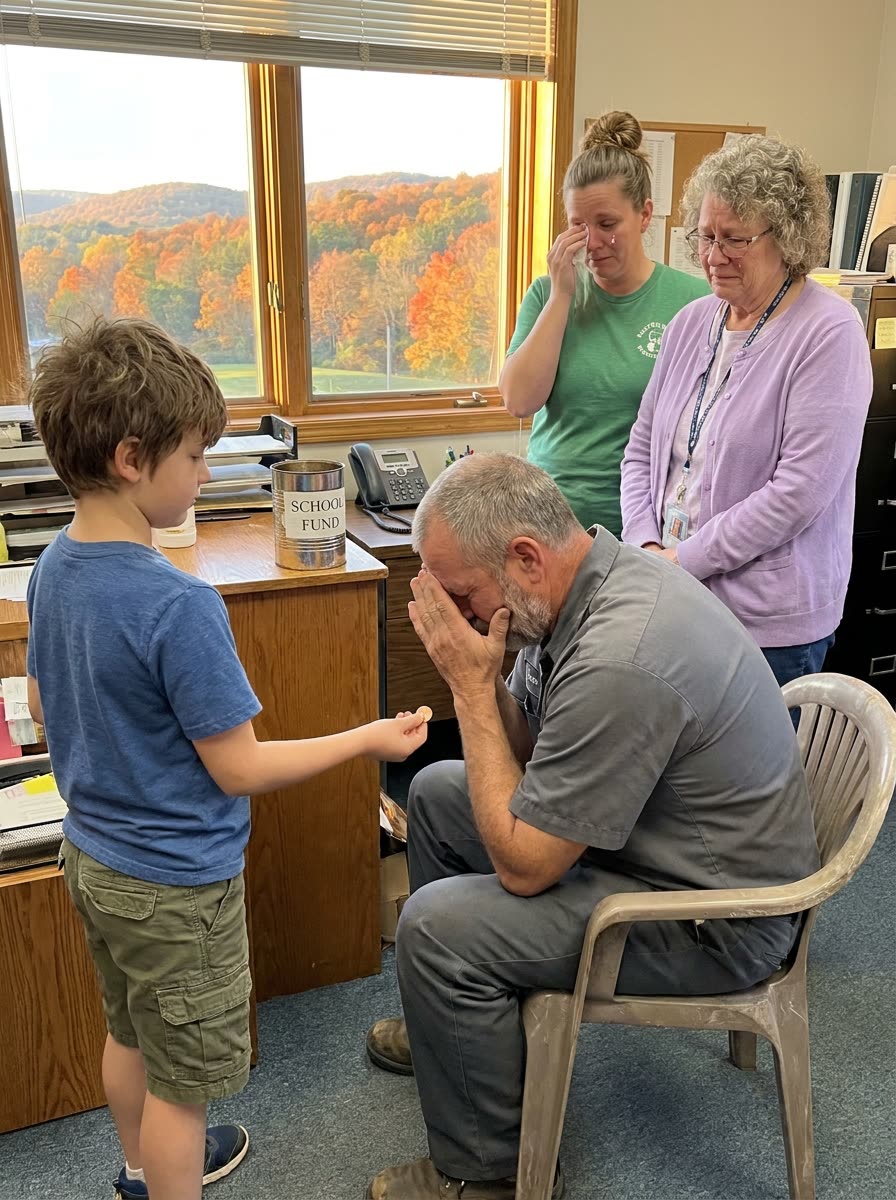
My son reached into his pocket and pulled out a single shiny penny. He had secretly kept it after we finished rolling the others. He held it out toward Dale on his open palm. “This was one of your pennies,” Noah said. “We cleaned it.” Dale looked confused. “Why are you giving it back to me?” “Because you apologized to my mom.” Noah paused. “And because nobody helped you when those kids were mean.” He extended his hand a little farther. “So I want to say I’m sorry they treated you that way.” Dale slowly accepted the penny. He stared at it as if it were something precious. Then he sat down and covered his face with his hands.
I had to look away. My own tears slid down my face, and I didn’t bother to wipe them. Across the room, Mrs. Fogle pressed her fingers to her lips. In all my life, I had never seen a grown man cry the way Dale did then, and I had never been prouder of my eight-year-old son.
Afterward, the school used our $915 to clear the second-grade lunch debt, and the remaining $6.60 was set aside to help another student. Dale’s $4,300 paid off outstanding balances throughout the other grades. For the first time in years, Washington Elementary had no negative lunch balances at all. The lunch line that week felt different, Mrs. Fogle told me later. Nobody was singled out, and no child received a different tray.
But Dale wasn’t finished. A week later, he called me. “Becky, I’ve got an idea.” He explained that an old jar at his repair shop held thousands of pennies collected over decades. He wanted to donate them too. Then he asked a question I never expected. “Would you and the kids teach me how to roll them?”
I laughed out loud. I couldn’t help it. “Seriously?” “Seriously.” He went on to explain that the middle school and high school also had students with unpaid lunch accounts, and that he couldn’t stop thinking about them. “What if we got the whole town involved?” he suggested. I was silent for a moment. Then I said yes.
Two weeks later, we organized an event at the Merrill Fire Hall. We called it Penny Saturday. People came through the doors carrying jars, boxes, and bags filled with spare change, some of it tarnished with age. Families sat together at long folding tables, counting and rolling coins, the sound of clinking copper filling the room. It felt nothing like the afternoon when pennies had been thrown at my feet.
Dale sat beside Noah and Lily. His large hands were terrible at folding the paper wrappers, and he fumbled with them, scowling at his own clumsiness. Lily patiently showed him how, her tongue poking from the corner of her mouth. “No, Mr. Dale. You fold this part first!” He tried again. “Like that?” “Almost!” Noah burst out laughing, and then Dale laughed too, a real laugh that surprised everyone at the table.
By the end of the event, hundreds of volunteers had helped collect and roll enough change to make a meaningful contribution toward lunch debt at other schools. What had begun as an act of humiliation had become a community project, with neighbors who barely knew each other working shoulder to shoulder. And Dale was one of its strongest supporters, arriving early to set up tables and staying late to carry boxes to the truck.
A few days later, I came home from work and found a truck spreading fresh gravel across my driveway. Dale stood nearby with his hands in his pockets. I stepped out of my car, confused. “What’s going on?” He pointed toward the ground. “That motor oil stained your gravel. I’m having it replaced.” I stared at him. “Dale, you don’t have to do that.” He shook his head. “Yes, Becky. I do.”
Then he reached into his pocket and pulled out a key ring. Attached to it was the shiny penny Noah had given him. Dale had drilled a small hole through the coin so he could carry it everywhere. “I look at this every morning,” he said. I smiled. “What does it remind you of?” He studied the penny for a long moment. “That somebody finally stood up for the little boy I used to be.”
A year has passed since the day Dale dumped those pennies in my driveway. I still work at the farmers’ cooperative. My family has better insurance, and we’re doing well. Dale continues to operate his repair shop, but he has made some important changes. He now offers health insurance to his employees. And every September, he helps organize another Penny Saturday.
The event has become a community tradition, raising money to support students with unpaid meal balances. The town even established a fund named after Irene Bauer, the cafeteria worker who quietly helped Dale when he was a child. Mrs. Fogle cried when they announced it, and Dale stood beside her with his hand on her shoulder, nodding as though he were making a promise.
One afternoon, I stopped by the repair shop to pick up a part for my husband’s truck. Everything looked familiar. The gray building. The mechanics working in the service bays. The strong coffee sitting near the counter. But one thing was different. Beside the register stood a large glass jar filled with shiny pennies, and a handwritten sign was attached to the front. FOR THE LUNCH KIDS. EVERY PENNY COUNTS.
I smiled. For a long time, I had believed that the only thing that mattered about my final paycheck was how badly Dale had treated me. But looking at that jar, I understood something else. Those pennies had helped feed children. They had brought strangers together. They had inspired a difficult man to face his mistakes. And they had taught my own children that kindness can accomplish more than anger ever will.
I didn’t forget what Dale did, and his apology didn’t erase the humiliation. Some memories stay with you no matter how many times you scrub them. But he took responsibility, made amends, and chose to become better. Sometimes, that’s where real change begins.
He tried to make me feel worthless with 91,500 dirty pennies. Instead, those pennies helped an entire town discover how much one small act of compassion can be worth.
Disclaimer: This story is a work of fiction inspired by real-life themes. Names, characters, places and events are fictionalized, and any resemblance to real persons is purely coincidental. Images are for illustration purposes only.
